Court etiketine sahip kayıtlar gösteriliyor. Tüm kayıtları göster

25 Nisan 2017 Salı

High court orders UK government to explain clean air plan delay

The government has been ordered back to the high court to explain its last-minute bid to delay publication of the UK’s clean air plan.


Politicians and environmental groups had complained that ministers were “hiding behind the election” after they said they could not publish the proposals because of election purdah.


The high court said on Tuesday that there would be a new hearing on Thursday where ministers will have to defend their application.


James Thornton, CEO of the environmental lawyers ClientEarth, who brought the original case against the government, said they would present their response at the hearing on Thursday.


“This is a public health issue and not a political issue. Urgent action is required to protect people’s health from the illegal and poisonous air that we are forced to breathe in the UK.


“This is a matter for the court to decide once the government has made its arguments because it is the government which has not met, and instead seeks to extend, the court’s deadline for the clean air plan, to clean up our air.”


Ministers had been under a court direction to produce tougher draft measures to tackle illegal levels of nitrogen dioxide pollution, which is largely caused by diesel traffic, by 4pm on Monday. The original plans had been dismissed by judges as so poor as to be unlawful.


But after the announcement by Theresa May of a general election on 8 June, ministers lodged a lengthy application to the court late on Friday. It asked judges to allow them to breach the Monday deadline to “comply with pre-election propriety rules”.


Politicians and environmental groups reacted with anger, claiming ministers were “hiding behind the election” to justify delaying publication of the government’s long awaited proposals instead of tackling the UK’s air pollution crisis. Health experts warned the lack of government action had potentially put thousands of lives at risk.


The mayor of London, Sadiq Khan, said: “It is frankly outrageous that the government thinks it can continue to bury its head in the sand about the serious health impacts of air quality in London and across the country. The prime minister has once again missed this golden opportunity to show real leadership in tackling and improving the air we breathe, which should have been done well before the pre-election period.”


Andrea Leadsom, the environment secretary, was summoned to parliament on Monday to answer urgent questions. During the debate she said she was “personally deeply committed to the importance of ensuring clean air” but had been told by officials in the Cabinet Office that it would breach purdah rules to publish the plans in the run-up to the election.


The government has applied to publish draft plans on 30 June followed by the full policy in September, she said.


Leadsom, who also revealed that it was the second application to delay publication that her department had submitted to the courts, insisted the move would not postpone the rollout of the proposals.


The scale of the air pollution crisis was revealed in a joint Guardian-Greenpeace investigation this month showing hundreds of thousands of children were being educated within 150 metres of a road where levels of nitrogen dioxide from diesel traffic breached legal limits.


Last week figures obtained by Labour showed that more than 38 million people, representing 59.3% of the UK population, were living in areas where levels of nitrogen dioxide pollution were above legal limits.


Research consistently shows that exposure to traffic fumes is harmful to children and adults. Children are more vulnerable because their lungs are still developing and exposure to nitrogen dioxide reduces lung growth, causes long-term ill health and can result in premature death.


ClientEarth’s lawyers will attend the hearing, which has been listed by the court for Thursday at 10.30am. The court has set aside two and a half hours.


High court orders UK government to explain clean air plan delay

12 Nisan 2017 Çarşamba

UK supreme court denies tobacco firms permission for plain packaging appeal

All cigarettes sold in the UK must have standardised packaging from next month after the supreme court refused permission to the tobacco industry to appeal against the new laws.


This is the final domestic legal decision, meaning that plain packaging of cigarettes will come into force on 20 May, the Department of Health said.


Rules requiring tobacco to be packaged in drab, dark brown packs with no graphic branding came into effect in May 2016, with branded packs subsequently being phased out.


Tobacco companies went to the supreme court after the court of appeal last November rejected their attempt to prevent the introduction of mandatory plain packaging of cigarettes in the UK.


British American Tobacco, Imperial Brands, Japan Tobacco International (JTI) and Philip Morris International claimed that the law would infringe their human and intellectual property rights.


The new packs are the same shape, size and colour, with two thirds of the front and back surfaces covered by pictorial health warnings, and written warnings on the sides.


The health secretary, Jeremy Hunt, welcomed the supreme court’s decision, saying: “Standardised packaging will cut smoking rates and reduce suffering, disease and avoidable deaths.”


Smoking remains the biggest cause of premature mortality in the UK, killing more than 100,000 Britons annually, despite Public Health England figures showing a decline in the number of smokers to fewer than one in six adults.


Widespread use of e-cigarettes, nicotine patches and gum helped a record 500,000 smokers kick the habit in 2015, the agency said, bringing the number of ex-smokers in England to 14.6 million.


In 1974, more than half of men in Britain smoked, but that fell in England to just 19.1% by 2015. The rate for women declined from just over 40% in 1974 to only 14.9% in 2015.


The chief medical officer, Dame Sally Davies, said: “Smoking is the biggest preventable killer in this country and this legislation will save lives, so I am thrilled that the tobacco industry will not be allowed to appeal. After years of hard work, I look forward to seeing this policy now brought in, and smoking numbers fall even further.”


Deborah Arnott, chief executive of the health charity Ash (Action on Smoking and Health UK), said the ruling finally ended attempts by “big tobacco” to overturn the UK legislation on standardised packaging.


“This is the latest in a long line of crushing legal defeats for the tobacco industry. Over the years the industry has squandered many millions of pounds of its own money in futile legal challenges, but worse still it has wasted public time and money, which could have been much better spent improving public health.”


In a sign that tobacco companies acknowledge that the tide of public opinion is turning against them, the boss of Marlboro maker Philip Morris has predicted a “phase-out period” for cigarettes.


André Calantzopoulos made the comments in November as the company launched a new product it claimed was less harmful than traditional smoking. The iQos heats tobacco but does not burn it, releases fewer toxins and is capable of replacing cigarettes in the long term, according to Philip Morris.


However, campaigners and analysts questioned whether e-cigarettes or other products such as the iQos would ever replace cigarettes.


Arnott said at the time: “Philip Morris claims to be moving towards a post-smoking future but, like other tobacco companies, it is still actively promoting smoking around the world, using methods that would be illegal in the UK.”


UK supreme court denies tobacco firms permission for plain packaging appeal

7 Nisan 2017 Cuma

Belle Gibson hit with $30,000 in court costs over false cancer claims

Disgraced health blogger Belle Gibson has to pay $ 30,000 towards the legal costs of Consumer Affairs Victoria and has been banned from making deceptive claims about her health in connection with wellbeing advice.


Federal court justice Debra Mortimer made the orders on Friday against Annabelle Natalie Gibson, who claimed she had brain cancer and healed herself with natural remedies.


The judge said Gibson was prohibited from claiming, in connection with the development and promotion and sale of her wellness advice:


  • that she had been diagnosed with brain cancer at any time before 24 May 2016

  • that she was given four months to live

  • that she had taken and then rejected conventional cancer treatments in favour of embarking on a quest to heal herself naturally

Consumer Affairs Victoria took Gibson to court last year alleging she had lied about a 2009 brain cancer diagnosis and subsequent recovery.


It was also alleged that she had lied to consumers about donating to charities from the sales of her Whole Pantry app.


Last month Mortimer found the allegations against Gibson to be mostly true, saying she had “played on the genuine desire of members of the Australian community to help those less fortunate”.


An excerpt from Gibson’s Whole Pantry Book describes her journey from being told she had four months to live, to finding out she was pregnant, to rejecting medical intervention and travelling the country in search of non-medical advice.


If Gibson refused to obey Friday’s court order, she would be liable for imprisonment, sequestration of property or other punishment, the court documents said.


She has been absent from court since the case began and has not defended herself through lawyers.


Belle Gibson hit with $30,000 in court costs over false cancer claims

24 Ocak 2017 Salı

Patient who spent two years in hospital evicted under court order

A patient who was evicted from a hospital under a court order after spending more than two years in a bed has insisted that he did not want to stay there.


Adriano Guedes was removed from the James Paget hospital in Gorleston, Norfolk, which said the 63-year-old was occupying the bed “unnecessarily” and was fit to be discharged.


Guedes, who came to the UK from Portugal 15 years ago seeking work and suffers paralysis following a stroke in 2008, said he “didn’t want to stay” but “they forced me to stay”.


He told the BBC: “It’s very bad to occupy a place which should be used by someone in need, but I didn’t cause the situation; on the contrary, I tried to get out of there.”


The hospital obtained a possession order from the court to remove Guedes and it was granted on 1 December and enforced on 10 January.


Guedes said he had asked to be moved from the hospital to a “wheelchair-friendly place” and said he had been on hunger strike since his removal, with his last meal on 10 January.


He said he was initially admitted to hospital in 2014 on mental health grounds and not because of his physical condition.


His request to see a spinal specialist in London for his injuries was ignored, he said, adding: “I wanted to leave, but they always offered what they knew I would refuse.”


Guedes, whose hospital stay is estimated to have cost around £340,000, is now living in a council flat in Suffolk.


The Department of Health says the average daily cost of a hospital bed is about £400.


Director of governance at the hospital, Anna Hills, said Guedes had “repeatedly refused all offers of appropriate accommodation organised by our local authority and social care partners, despite being fit for discharge”.


The hospital said it had worked “in partnership with a range of agencies to achieve a safe discharge from the hospital” for Guedes.


It said “detailed planning” had taken place which “led to a successful discharge in this complex case”.


Guedes has been described as a so-called “bed blocker”, but the NHS Confederation’s director of police, Johnny Marshall, told the Guardian last year that the term was an inappropriate description of people staying in hospital when they did not need to be there.


He said: “These ‘blockers’ are often older people who are frail and vulnerable and who would like nothing more than to return home to their families. The phrase ‘bed blocker’ puts all the emphasis, and blame, on the individual.


“The reality is that it is the system that has failed to move quickly enough to put together the right package of care to enable the person in the bed to return home.”


Patient who spent two years in hospital evicted under court order

22 Kasım 2016 Salı

Court cryonics ruling is just common sense | Letters

Honestly, these cryonics stories are driving me mad (Report, 18 November). As someone with terminal cancer (and ignoring the fact that I find the description in your articles of people like myself as “cancer victims” to be teeth-grindingly irritating) I feel everyone is ignoring the fact that a young woman looked into her future and saw the denial of everything she was promised. She was denied boyfriends, university, a job, marriage, children, life… and she was not ready to give up on those promises. She didn’t want to die. None of us does. I’m grateful that the judge had the good sense to realise this was not about whether cryonics worked, but her own hopes for the future. Reading some pieces lately it seems that while we’ll arrange bungee-jumping days out for the terminally ill, how one disposes of one’s own corpse is a step too far in giving the dying what they’re asking for.
Julia Frith
Lincoln


Join the debate – email guardian.letters@theguardian.com


Read more Guardian letters – click here to visit gu.com/letters


Court cryonics ruling is just common sense | Letters

2 Kasım 2016 Çarşamba

High court rules UK government plans to tackle air pollution are illegal

The government’s plan for tackling the UK’s air pollution crisis has been judged illegally poor at the high court, marking the second time in 18 months that ministers have lost in court on the issue.


The defeat is a humiliation for ministers who by law must cut the illegal levels of nitrogen dioxide suffered by dozens of towns and cities in the “shortest possible time”.


Legal NGO ClientEarth, which brought the case, argued that current plans ignore many measures that could help achieve this, placing too much weight on costs. On Wednesday Mr Justice Garnham agreed. He also said ministers knew that over-optimistic pollution modelling was being used, based on flawed lab tests of diesel vehicles rather than actual emissions on the road.


The government said it would not appeal against the decision and agreed in court to discuss with ClientEarth a new timetable for more realistic pollution modelling and the steps needed to bring pollution levels down to legal levels. The parties will return to court in a week but if agreement cannot be reached, the judge could impose a timetable upon the government.


Air pollution causes 50,000 early deaths and £27.5bn in costs every year, according to the government’s own estimates, and was called a “public health emergency” by MPs in April.


James Thornton, CEO of ClientEarth, said: “The time for legal action is over. I challenge Theresa May to take immediate action now to deal with illegal levels of pollution and prevent tens of thousands of additional early deaths in the UK. The high court has ruled that more urgent action must be taken. Britain is watching and waiting, prime minister.”


He said the increased action required would very likely include bigger and tougher clean air zones in more cities and other measure such as scrappage schemes for the dirtiest vehicles: “The government will have to be tougher on diesel.”


The mayor of London, Sadiq Khan, who took part in the case against the government, said: “Today’s ruling lays the blame at the door of the government for its complacency in failing to tackle the problem quickly and credibly. In so doing they have let down millions of people the length and breadth of the country.”


A spokeswoman for the Department of Environment, Food and Rural Affairs said: “Improving air quality is a priority for this government and we are determined to cut harmful emissions. Our plans have always followed the best available evidence – we have always been clear that we are ready to update them if necessary. Whilst our huge investment in green transport initiatives and plans to introduce clean air zones [in six cities] around the country will help tackle this problem, we accept the court’s judgment. We will now carefully consider this ruling, and our next steps, in detail.”


ClientEarth defeated the government on the same issue at the supreme court in April 2015. Ministers were then ordered to draw up a new action plan, but now that new plan has also been found to be illegal.


Documents revealed during the latest case showed the Treasury had blocked plans to charge diesel cars to enter towns and cities blighted by air pollution, concerned about the political impact of angering motorists. Both the environment and transport departments recommended changes to vehicle excise duty rates to encourage the purchase of low-pollution vehicles, but the Treasury also rejected that idea.


Documents further showed that the government’s plan to bring air pollution down to legal levels by 2020 for some cities and 2025 for London had been chosen because that was the date ministers thought they would face European commission fines, not which they considered “as soon as possible”.


There had been a draft government plan for 16 low emission zones, which polluting vehicles are charged to enter, in cities outside London but the number was cut to just five on cost grounds.


All these proposals will now be revisited. Thornton said a national network of clean air zones needed to be in place by 2018. “If you put in clean air zones, it works overnight.”


Dr Penny Woods, chief executive of the British Lung Foundation, said: “We urgently need a new clean air act that restricts the most polluting vehicles from our urban areas and protects everyone’s lung health – air pollution affects all of us.”


Sam Hall, at conservative thinktank Bright Blue, said there should be more power and funding devolved to local authorities to enable all English cities to set up clean air zones and more support for electric cars.


Keith Taylor, Green party MEP, said: “The failure highlighted by the judge today is as much moral as it is legal: ministers have displayed an extremely concerning attitude of indifference towards their duty to safeguard the health of British citizens.”


Air pollution table

High court rules UK government plans to tackle air pollution are illegal

Northern Ireland woman takes NHS to court over abortion law

A Northern Irish teenager who as a fifteen year old had to go to England to terminate a pregnancy, is challenging the NHS’s refusal to fund abortions for women from the region in the supreme court on Wednesday.


The health service has so far refused to pay for abortions for women from Northern Ireland who travel to England for terminations.


The girl, identified as “A”, and her mother are appealing to the supreme court to force the NHS to fund abortions. Their lawyers have described the refusal to financially help women from Northern Ireland who are in crisis pregnancies as “perverse and unlawful”.


Abortion is only available in Northern Ireland’s hospitals when there is a direct threat to the mother’s life if the pregnancy continues. In all other cases abortion is illegal.


Last November, a high court judge ruled that, as it stands, Northern Ireland’s abortion laws violate the rights of women and girls in cases of fatal foetal abnormalities or where a pregnancy is the result of a sexual crime.


An estimated 2,000 women travel to English hospitals and clinics from Northern Ireland every year to have terminations. All of these women have to raise money to go to private clinics in England for abortions.


There is strong opposition to liberalising the province’s strict anti-abortion laws across the floor of the Northern Ireland assembly. The 1967 Abortion Act was never extended to Northern Ireland, and a bid to ease the country’s termination laws to include cases of fatal foetal abnormalities and pregnancy via sexual crime was rejected earlier this year.


In the supreme court on Wednesday judges will be told that in 2012, then 15-year old “A travelled to Manchester from Northern Ireland with her mother (B), where she paid £600 for an abortion, on top of £300 in travel costs.


They received charitable assistance from the Abortion Support Network in the sum of £400 without which they could not have afforded the treatment. A and B have since argued in the high court and court of appeal that the cost of the treatment should have been free for them as UK citizens, and that by not enacting this change, Jeremy Hunt, the secretary of state for health, has failed in his duty to make NHS procedures reasonably available.


Abortion in Northern Ireland: ‘Why don’t we trust women to make the right choice?’

Angela Jackman, a partner at law firm Simpson Millar, has been representing A & B throughout the legal process.


Jackman said: “For women in Northern Ireland who are pregnant and seek a termination, the status quo is almost unbearable. I believe the legal arguments of the secretary of State are perverse and contrary to its international obligations. Many women face the choice between an unlawful termination using dangerous and illegal pills, with the prospect of prosecution to follow, or a costly journey to England where they must pay privately for an abortion. For many women, those costs are prohibitive.”


She continued: “This is the end of a long and significant domestic journey. I am pleased that the issue is finally being given due consideration by the supreme court, the importance of which cannot be underestimated.”


The supreme court has recently granted six national charities the right to intervene in the A and B case.


The British Pregnancy Advisory Service, the Family Planning Association, Alliance for Choice, Abortion Support Network, Birthright and the British Humanist Association have been granted permission to provide their perspectives on the issue in the supreme cCourt hearing.


Jackman added: “I am pleased that the court has permitted these six charities to provide submissions in this case. Through their efforts in providing advice and assistance to women like ‘A’, and campaigning for the reproductive choices of women, these charities can offer invaluable insight into the reality of the situation for the court’s consideration.”


The British Humanist Association’s director of public affairs and policy, Pavan Dhaliwal, said denying women from Northern Ireland in crisis pregnancies support was putting their lives at risk.


“Our government’s stance in refusing women from Northern Ireland safe and legal abortion on the NHS is shameful and we believe it is a breach of human rights laws. The supreme court judges have an opportunity to rectify a situation which currently causes undue distress to hundreds of women and leaves many more with no choice but to buy illegal abortion pills online,” he said.


The case will concern A and B versus the secretary of state for health. The arguments will be heard in front of five judges at the one-day hearing.


Northern Ireland woman takes NHS to court over abortion law

21 Ekim 2016 Cuma

Scottish court rejects appeal against minimum alcohol pricing

Scottish judges have rejected an appeal against the Holyrood government’s plans to introduce minimum pricing for alcohol.


The ruling by the court of session in Edinburgh is the latest in a long-running legal battle led by the Scotch Whisky Association after the Scottish parliament voted in favour of minimum pricing in 2012.


Ministers set the minimum price at 50p per unit of alcohol, a measure that would mean whisky could be no cheaper than £14 a bottle.


Last year the European court of justice ruled that the policy was in breach of EU free-trade laws. The European court of justice said the policy could be justified on health grounds under EU law only if it was more proportionate and effective than using general taxation.


However, in a written judgement issued at the court of session on Friday, the three judges ruled that the government’s policy was not illegal. In the judgement, Scotland’s most senior judge, the Lord President Lord Carloway, wrote that the policies didn’t contravene laws set by the ECJ.


Quoting from the judgement issued by the judge who earlier considered the matter, Lord Doherty, Carloway wrote that drinking was important to Scots.


“For many, the consumption of alcohol is a great social lubricant. It’s use in a responsible manner is an important and positive feature in Scottish culture. The general intent, as the Lord Ordinary noted (Opinion para 54) is to ‘get people to build a healthy and sensible relationship with alcohol’; not to stop them drinking altogether or even to drink moderately at all times.”


More details soon …


Scottish court rejects appeal against minimum alcohol pricing

28 Eylül 2016 Çarşamba

Junior doctors fail in high court challenge of new contract"s legality

Junior doctors have lost a judicial review challenging the legality of a controversial new contract, which is now set to be introduced by Jeremy Hunt next week.


In a judgment published on Wednesday, Mr Justice Green rejected arguments presented at the high court by five junior doctors that the health secretary had exceeded his powers.


A Department of Health spokeswoman said: “We welcome this clear decision by the judge that the secretary of state acted entirely lawfully. We must now move on from this dispute to the crucial job of making sure patients get the same high standards of urgent and emergency care every day of the week, which involves more than the junior doctors’ contract.


“We urge the BMA to remove all threat of further industrial action so we can work constructively with junior doctors to address their wider concerns and better recognise their vital importance to the NHS.”


The junior doctors nevertheless claimed the judgment as a victory. They said it showed the contract was not being imposed, which they argued meant junior doctors were not legally compelled to sign the new agreement and could continue to negotiate the terms and conditions.


The Department of Health said it would be seeking repayment of taxpayers’ money spent defending the case up to the previously agreed cap of £70,000 and would use the funds to make a charitable grant to NHS charities.


The doctors had argued that the health secretary had no power, whether solely or with others, to take a decision as to the terms on which junior doctors were employed, only to make recommendations, that Hunt had acted in breach of the requirements of transparency, certainty and clarity and that he had acted irrationally.


But Green rejected all three grounds. He further said he did “not accept the claimants’ argument that the evidence base upon which the minister acted was inadequate”, and he rejected the suggestion that Hunt had misled parliament.


In a two-day hearing last week at the Royal Courts of Justice in London, Jenni Richards QC, for Justice for Health, asked the court to quash Hunt’s decision to bring in the new contract, which she maintained he had no power to do, especially since the Health and Social Care Act 2012 reduced the scope of the health secretary’s powers.


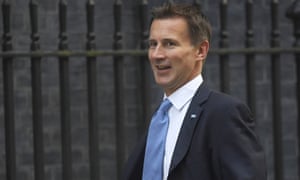
The health secretary, Jeremy Hunt


The health secretary, Jeremy Hunt, is now set to impose the new contract next week. Photograph: Toby Melville/Reuters

But Gavin Sheldon QC, appearing for Hunt, rejected the doctors’ arguments and said that their case was without substance. The health secretary had not decided to “compel” NHS trusts to use the new contract, he had merely approved it, Sheldon said.


“The secretary of state has not gone outside the scope of his powers,” he told the court. “The secretary of state has been clear about what his powers are.”


The five doctors’ high court legal challenge was crowdfunded by £300,000 from about 10,000 donors, most of them fellow junior doctors. They hoped that the court’s ruling would embarrass Hunt, and make it difficult for him to execute his threat to impose the contract, by finding that he had acted outside his powers or the law.


Many junior doctors, frustrated that eight days of strike action between January and May had failed to force Hunt to lift his threat of imposition, hoped that the lawsuit might delay or even scupper altogether Hunt’s plans.


The British Medical Association is facing a backlash from its members after first announcing, and then last Saturday calling off, plans for a series of four all-out strikes by junior doctors as a way of increasing the pressure on Hunt.


As things stand, NHS trusts across England will start phasing in the contract from next week in a process that will take about 18 months to put all 54,000 doctors below the level of consultant on to the altered terms and conditions.


This week Sir David Nicholson, who was the chief executive of the NHS in England until 2014, criticised ministers’ handling of the year-long junior doctors’ dispute.


“Clearly the government overall got it wrong,” Nicholson said. He said given that today’s generation of junior doctors wanted to work more flexibly and have more control over their lives, “it seemed to me that the way the conversation was going … I was really worried that it was less to do with the issues around that particular problem and more to do with a general idea that somehow we needed to put the junior doctors in their place.”


Junior doctors fail in high court challenge of new contract"s legality

20 Eylül 2016 Salı

Jeremy Hunt acted illegally over junior doctors, court hears


Jeremy Hunt acted illegally and beyond his powers by deciding to impose a new contract on NHS junior doctors, the high court has been told in a legal challenge to the health secretary’s handling of the year-long dispute.


The court on Monday began a two-day judicial review of the legal challenge to Hunt brought by five junior doctors.


Their group, Justice for Health, claims that the health secretary has acted ultra vires (beyond his powers)by choosing to force new terms and conditions on 54,000 trainee medics in England despite their overwhelming opposition.


A barrister leading Hunt’s legal team told the judge, Mr Justice Green, that there was no evidence that NHS employers did not want the contract and that the claim was “wholly without substance”.


Hunt suffered an early setback when the judge rejected a claim by his counsel, Clive Sheldon QC, in pre-hearing legal argument that Justice for Health’s claims should be thrown out. Refusing Sheldon’s plea, Green said at the outset of the first session of legal argument that “this is plainly a serious case” which, in his view, “requires full judicial review”.


Green planned to issue his judgment on 28 September, he said, days before junior doctors across England are due to take part in the first five-day strike in the long-running dispute. The strike is planned to start on 5 October, the day the contract is due to be imposed on all trainee doctors below consultant level. The six previous walkouts held since January have lasted one or two days.


Justice for Health, whose action has received £300,000 in crowdfunding from 10,000 supporters, wants the court to overturn Hunt’s decision to use what he called his “nuclear option” of imposition, and rule that he broke the law in choosing to push it through.


Its legal argument states that the campaign group, consisting of Dr Nadia Masood, Dr Ben White, Dr Francesca Silman, Dr Amar Mashru and Dr Marie-Estella McVeigh, “seeks an order quashing the decision of the secretary of state; [and] declarations that the secretary of state had no power to make the decision which he purported to make on 6th July 2016, that the purported imposition was unlawful and that the secretary of state has acted unlawfully”.


Jenni Richards QC, for Justice for Health, said that while Hunt was entitled to recommend a contract, he did not have the power to impose one. The health secretary had “acted in breach” of his “requirements of transparency, certainty and clarity” and behaved “irrationally”, she told the court.


The junior doctors claim that, despite stating publicly when the dispute began last year that he was imposing the contract, Hunt had then switched tack and insisted he had merely made a non-binding recommendation that revised conditions of employment.


Richards also claimed that Hunt had ignored a series of studies of mortality rates among patients admitted to hospital when he began claiming in July 2015 that as many as 11,000 patients a year admitted on a Saturday or Sunday die unnecessarily because too few doctors are on duty – the “weekend effect”.


Giving evidence for Hunt, Sheldon said the secretary of state had decided not to “compel” NHS employers to use the new contract, but to “approve” it. “This case is redundant,” Sheldon told the judge. “There is no evidence at all that there is any NHS employer who doesn’t wish to introduce these new contracts.”


Jeremy Hunt acted illegally over junior doctors, court hears

15 Eylül 2016 Perşembe

PrEP HIV drugs: court hears NHS England appeal

A legal battle is being fought out in the court of appeal over who pays the bill for a service to block HIV infection.


The high court ruled that NHS England has the power to commission PrEP, which has been described as a “game-changer” in the fight against HIV/Aids.


NHS England is appealing on the grounds that local authorities have the legal responsibility to arrange services to “prevent” the spread of HIV, while its own responsibilities are limited to treating those already assumed to be infected.


PrEP, short for “pre-exposure prophylaxis”, is a prevention strategy that involves people who are HIV-negative but at high risk of infection taking the anti-retroviral drug Truvada to reach optimal levels of protection.


The anticipated cost of providing PrEP services is £10m-£20m a year.


When taken consistently, it has been shown to reduce the risk of HIV infection in people who are at high risk by more than 90%.


The legal battle is important and urgent because of its potential impact on the provision of other services, including hearing implants for children with deficient or missing auditory nerves, prosthetics for lower limb loss, and a drug for treating certain mutations in children aged two to five with cystic fibrosis.


Nine new treatments and services NHS England had planned to make available to patients have been put on hold pending the outcome of the appeal.


In May this year NHS England’s specialist services commissioning committee decided not to commission PrEP, saying it lacked power to do so under NHS legislation and regulations.


But Mr Justice Green, sitting in London’s high court, ruled on 2 August that it did have the power under the NHS Act 2006 and under regulations made in 2012 which came into effect in April 2013. The ruling was a victory for the National Aids Trust (NAT), a charity, with backing from the Local Government Association (LGA).


Jonathan Swift QC, appearing for NHS England, is asking the appeal judges – Lord Justice Longmore, Lord Justice Underhill and Lady Justice King – to rule the high court decision wrong in law and to conclude that provision of PrEP services does indeed fall outside NHS England’s legal powers.


Swift said the case was a matter of general public importance because it involved the balancing of the division of health responsibilities between NHS England, the health secretary and local authorities. The QC drew a distinction between “PrEP” and “PEP”. He said NHS England has provided PEP – the post-exposure prophylactic service – since 2013.


He described PEP as an emergency service provided in cases where there was “an assumption” that the person being treated was HIV-infected at the time of treatment – in contrast to PrEP, which was for people not infected.


Mr Swift argued the 2012 regulations only required NHS England to provide services, for patients already believed to be infected. Responsibility for funding PrEP fell to local authorities since they were under an express obligation to make arrangements for services to prevent the spread of sexually transmitted infections, including HIV.


The high court judgment which is being challenged said the case was about “the allocation of budgetary responsibility in the health field”.


Mr Justice Green said: “No one doubts that preventative medicine makes powerful sense. But one governmental body says it has no power to provide the service and local authorities say they have no money.


“The claimant is caught between the two and the potential victims of this disagreement are those who will contract HIV/Aids but who would not were the preventative policy to be fully implemented.


“In my judgment the answer to this conundrum is that NHS England has erred in deciding that it has no power to commission the preventative drugs in issue.”


Alternatively, said the judge, NHS England has “mischaracterised the PrEP treatment as preventative when in law it is capable of amounting to treatment for a person with infection”. In any event NHS England had the power to commission preventative treatments because that facilitated, or was incidental to, “the discharge of its broader statutory functions”.


NHS England is asking the appeal court to rule the high court wrong on all counts. Campaigners have said that while the majority of gay men use condoms to prevent being infected with HIV, there is also an “ethical duty” to provide PrEP to those who do not. And they say the drug would provide an additional defence against HIV, and would not be used simply as an alternative to safe sex.


PrEP HIV drugs: court hears NHS England appeal

28 Ağustos 2016 Pazar

Canines in court: therapy dogs making the wait for a verdict "more human"

David is waiting to find out if his children are going to be taken away from him. He paces the court waiting room and appears to be nearing the end of his tether. Other people instinctively give him a wide berth.


But Tina Jullings from Canine Concern approaches David with a small dog. “Would you like to stroke Bushy?” she asks brightly, offering up the chaotically hairy yorkshire terrier-chihuahua mix. He pauses, smiles, then laughs. “What’s a dog doing in a court?” he asks, touching Bushy gently on his head. “That’s crazy.”


It was January when Judge Lynn Roberts, the designated family judge for Essex and Suffolk, decided to brings dogs into Chelmsford county court. Volunteers from Pets as Therapy and Canine Concern, who usually take their therapy dogs into care homes and special schools, agreed to bring their pets into the court building to visit everyone from the judges and staff to the court users and their families. Roberts also arranges bespoke visits by the dogs if a child will be at court on a day when the animals are not due to visit.


Dogs bring calm to family court.

Chelmsford is the only court in the country to welcome therapy dogs, but six months into the scheme, Roberts regards it as such a success that she is planning to introduce it to Ipswich county and family court.


“For many people, coming to court is the most stressful experience in their lives,” says Roberts, stroking the sleek head of Ella, a black, flat-haired retriever, who is visiting the judge in her retiring room before the official day begins. “It’s easy for us who work in the system to lose touch with how stressful it is but litigants are here because the future of their children is being determined, or their marriage, or where they’re going to live.


“In the US, they bring llamas and alpacas into care homes but I’m not going to attempt to bring in anything larger than a dog.” She pauses and gazes at Ella, who stares back with total canine devotion: “Having said that, I would love to bring in a donkey. I love donkeys too. But no, I think I will stop at dogs.”


So-called “courthouse facility dogs” are common in America, Canada and Chile, where they help children in all legal settings, as well as crime victims and witnesses, and those appearing in front of the drug and mental health courts.


But Roberts admits there is no tangible evidence as to the scheme’s impact. “I don’t think anybody could say if there’s any concrete result,” she said. “There was a suggestion from Cafcass [the body which represents children in family court cases] that we should assess the scheme but I don’t want to do that: I don’t want to make it all scientific. It’s working for us and it doesn’t cost the courts a penny.


“No one’s pretending it’s a cure-all,” she adds, reluctantly waving Ella goodbye and turning back to her case preparations. “It just releases a bit of stress and tension.”


The dogs have a schedule to keep to at Chelmsford: first they visit the judges, then the court staff and then the court users in the waiting rooms.


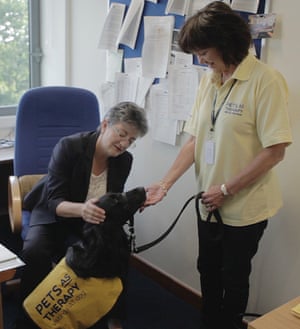
Judge Lynn Roberts stroking a black retriever dog in her office with a Pets as Therapy volunteer


Judge Lynn Roberts with Ella. Photograph: Guardian video

The circuit judge David Vavrecka is a fan of the scheme: “My initial, immediate reaction was that it was a fantastic idea,” he said. “A dog will not change the outcome of a court case but in a very bleak and conflicted situation, it can make the experience less intimidating and more human. And if, only in a very small way, we can improve the experience for our litigants, that seems to be very important.”


The circuit judge Catriona Murfitt agreed: “All the 101 things whirling around in my brain, about the cases I’m going to hear that day, stop whirring for those five minutes when the dogs come round,” she said. “But it’s probably most helpful for litigants in person, who come to court with no lawyers and are often entirely alone, knowing very little about what’s going to happen in the courtroom.”


Stephen Hodges, another district judge, is, however, less enthusiastic. “I just about tolerate the interruption to my morning when the dogs come round,” he said. “But I have two concerns. One is that certain cultures don’t traditionally feel the same way about dogs as British people tend to feel, and it could be quite off-putting for them to be approached by a dog at a moment of great stress.


“The other is that serious business happens in court. When the dogs visit the judges – between 9am and 10am – we’re doing very serious preparation for the cases we’re hearing that day. I personally find it an unwelcome distraction and I suspect the litigants feel the same if they’re talking to their representatives.”


An hour later, however, when Ella trots into his courtroom as he sits surrounded by paperwork, even Hodges appears won over by her canine charm. “Hello,” he croons quietly, tickling her under the ear. “You go all dreamy when I do this, don’t you?”


His concern that some litigants will find the dogs offensive or intrusive is countered by Kate Miller, a family law barrister at Chelmsford: “I have heard judges and lawyers voice concern that litigants who are facing the potential for losing their children don’t want to pat a dog or that certain cultures won’t appreciate it,” she said. “But I have myself observed the contrary: lots of people do want to pat a dog, and often exactly at moments of their greatest stress.”


In the court waiting room, the dogs are welcomed by some but waved away by others.


Angela has been waiting for two and a half hours to hear whether she will be able to keep her children. Visibly shaking and teary, she bends over Bushy and hugs him tightly.


“My little boy loves dogs,” she murmurs. “Bringing dogs in is such a good idea. It distracts me: I can push what’s happening to me to the back of my mind, just for a second.”


A woman standing at the edge of the waiting room is taking a break from giving evidence. When she spots Ella emerging from the lift, her distraught expression changes. She gives a brief laugh of surprise and smiles. Then the moment passes and she turns away.


The names of people in court have been changed.


Canines in court: therapy dogs making the wait for a verdict "more human"

2 Ağustos 2016 Salı

NHS can fund "game-changing" PrEP HIV drug, court says

A leading Aids charity has won a high court battle over whether a preventative treatment for HIV that charities say is a “game-changer” can legally be funded by the NHS.


NHS England said it had received advice that it did not have the legal power to fund pre-exposure prophylaxis (PrEP), a “highly effective” anti-retroviral treatment used to stop HIV from becoming established in the event of transmission.


But Mr Justice Green, sitting in London, ruled that NHS England “has erred in deciding that it has no power or duty to commission the preventative drugs in issue”.


The ruling was a victory for the National Aids Trust (NAT), which brought the case to court.


Deborah Gold, the NAT chief executive, said: “This is fantastic news. It is vindication for the many people who were let down when NHS England absolved itself of responsibility for PrEP. The judgment has confirmed our view that it is perfectly lawful for NHS England to commission PrEP. Now NHS England must do just that.


“Over 4,000 people are getting HIV every year in the UK – we desperately need further prevention options to add to condom use. PrEP works. It saves money and it will make an enormous difference to the lives of men and women across the country who are at risk of acquiring HIV. The delay to commissioning PrEP is both unethical and expensive.”


When taken consistently, PrEP has been shown to reduce the risk of HIV infection in people who are at high risk by more than 90%.


Related: Hope for ‘end of Aids’ is disappearing, experts warn


A row erupted earlier this year after NHS England said it would not routinely fund the drug. In March, the body decided the treatment was a preventative service and was therefore not its responsibility. It has said local councils are in charge of funding preventative health services.


However, NHS England agreed to a re-evaluation after the NAT launched a legal challenge. Then in May it said it had “considered and accepted NHS England’s external legal advice that it does not have the legal power to commission PrEP”, and that under 2013 regulations “local authorities are the responsible commissioner for HIV prevention services”.


Allowing NAT’s application for judicial review, Green said on Tuesday the core of the legal challenge was about “the allocation of budgetary responsibility in the health field”.


He said: “No one doubts that preventative medicine makes powerful sense. But one governmental body says it has no power to provide the service and local authorities say they have no money.


“The claimant is caught between the two and the potential victims of this disagreement are those who will contract HIV/Aids but who would not were the preventative policy to be fully implemented.


“In my judgment the answer to this conundrum is that NHS England has erred in deciding that it has no power to commission the preventative drugs in issue.”


Alternatively, said the judge, NHS England has “mischaracterised the PrEP treatment as preventative when in law it is capable of amounting to treatment for a person with infection”.


In any event NHS England had power to commission preventative treatments because that facilitated, or was incidental to, “the discharge of its broader statutory functions”.


Campaigners have said that while the majority of gay men use condoms to prevent being infected with HIV, there is also an “ethical duty” to provide PrEP to those who do not.


And they said the drug would provide an additional defence against HIV – and would not be used simply as an alternative to safe sex.


It comes after the results of a trial, published in February 2015, suggested that rates of HIV infection could be slashed by treating actively gay men with the anti-viral drug when they are healthy.


Dr Michael Brady, medical director at the HIV/Aids charity Terrence Higgins Trust, welcomed the findings and described the drug as “a game-changer”.


He said PrEP offered “another line of defence” against HIV, alongside condoms and regular testing. Brady said: “It is not a vaccine and it won’t be for everyone, but, once approved, we expect it to significantly increase the momentum in our fight against the virus.


“We urge the government, NHS England and local authorities to make PrEP a key priority in the fight against HIV.”


NHS can fund "game-changing" PrEP HIV drug, court says

3 Temmuz 2014 Perşembe

Celebrities At Wimbledon: Prince William, David Beckham, Pippa Middleton, And Other Stars Hold Court On Centre Court

The Wimbledon Championships have always brought celebrities, moguls and specifically royals to centre court to witness the splendor on the grass. But this year a galaxy of British stars came out to see if Andy Murray could repeat as men’s champion. (Alas, he misplaced in the quarterfinals.) But that did not end David Beckham, Richard Branson, Colin Firth, and the Duke and Duchess of Cambridge from showing their really like of the sport. Although you have to feel undesirable for the fans who have been seated behind Shaquille O’Neal on opening day—and presumably had an obstructed see.


Celebrities At Wimbledon: Prince William, David Beckham, Pippa Middleton, And Other Stars Hold Court On Centre Court

17 Haziran 2014 Salı

Medical doctors ought to seek advice from dying patients in "Do Not Resuscitate" choices, court guidelines

As a lot of as 80 per cent of individuals who die in hospital do so with instructions to medical professionals in area not to try resuscitation, he stated.


Mrs Tracey, who had been diagnosed with terminal cancer, died on March seven, 2011 two weeks soon after breaking her neck in a auto crash.


A former care home manager, she was described as “medically minded” and had expressed a “clear wish” to be involved in choices about her care, the court heard.


Despite the fact that barely in a position to communicate and unable to move, she routinely questioned medical doctors and nurses about medicine and products by creating on a notepad or whispering.


When a single doctor mentioned the probability of “tough decisions”, she replied “I will do my damdest” incorporating: “Please do not exclude me.”


A so-called DNACPR (Do Not Try Cardio-Pulmonary Resuscitation) order – at times identified as a DNR – was positioned in Mrs Tracey’s notes at the finish of February but removed a couple of days later right after her “horrified” daughter, Alison, objected, the judgment explains.


A couple of days later, when Mrs Tracey’s well being deteriorated once more, a fresh buy was place in spot, this time with the agreement of the family.


But following her death, Mrs Tracey’s husband, David, was given permission to deliver judicial assessment proceedings challenging the legality of the original DNR notice on her behalf, because of the relevance of the issue.


Lord Dyson, sitting with Lord Justice Longmore and Lord Justice Ryder ruled the hospital had violated Mrs Ryder’s right to “private and household life”.


But they rejected a separate attempt to force the Overall health Secretary, Jeremy Hunt to situation national suggestions to hospitals to clarify the principles.


Lord Dyson said the court must be “slow to give common guidance” about the exact situations essential to situation this kind of notices simply because of the complexity of person situations.


“But I feel it is appropriate to say that, considering that a DNACPR selection is one which will probably deprive the patient of daily life-saving therapy, there ought to be a presumption in favour of patient involvement,” he additional.


“There want to be convincing factors not to involve the patient.”


He mentioned even though there was small doubt it would be inappropriate to involve patients if performing so would clearly cause them physical or psychological harm, just wishing to keep away from distress did not come below this category.


“In my see, medical doctors ought to be wary of being too prepared to exclude sufferers from the process on the grounds that their involvement is probably to distress them,” he explained.


He also rejected the argument that it was inappropriate to involve a patient if the doctor was sure CPR would be futile.


But he additional that the courts should also be “slow” to rule that decisions not to seek the advice of sufferers violated their rights,”if conscientiously taken.”


In Mrs Tracey’s situation, he mentioned the reality that a later observe was agreed with the household did not justify the earlier decision.


Mr Tracey mentioned afterwards: “Patient care has acquired to come initial, and this will deliver more care to people.”


Dr Keith McNeil, chief executive of Cambridge University Hospitals trust, said: “Today’s ruling hinges on a distinct stage of law. There was no criticism of our clinical care.


“It is a truth of life that each day men and women die in hospitals. From my own expertise as a professional hospital medical doctor, the most essential thing is that these individuals are treated with the utmost respect and dignity.


“End of life scenarios involve physicians and nurses obtaining emotionally demanding but needed conversations, with patients and their families about what happens in the ultimate phases of their care. Medical staff use a blend of their compassion, experience and judgment at these hard times, to try out and discover the right pathway for each person patient, and supply the assistance necessary for everyone involved.”


A spokeswoman for the Division of Overall health stated: “Selections on whether an individual should be subject to Do Not Try Cardio Pulmonary Resuscitation (DNACPR) Notices are extremely delicate and tough, as the court recognised.
“It is important that medical professionals stick to the extremely greatest practice so requirements of care in this in area can be improved. We will carry on to operate with professional bodies to make confident advice is understood by health specialists.”


Medical doctors ought to seek advice from dying patients in "Do Not Resuscitate" choices, court guidelines

Hospital violated patient"s rights with "do not resuscitate" buy, court guidelines

Janet Tracey

Janet Tracey died in 2011 after breaking her neck in a automobile accident soon soon after she had been diagnosed with terminal cancer. Photograph: Family members Handout/PA


The household of a lady who died in a single of Britain’s best-known hospitals have won their claim that her rights have been violated when an buy not to attempt resuscitation was place on her healthcare data with out her currently being consulted.


The case of Janet Tracey, a care property manager who died at Addenbrooke’s hospital, Cambridge, underlines a legal duty of NHS bodies to consult patients prior to producing this kind of “do not resuscitate” (DNR) selections.


Merry Varney of the legal company Leigh Day, representing Tracey’s husband David, explained: “The judgment sends a clear message to all NHS Trusts, regulatory bodies and healthcare experts that individuals have a legal appropriate to be informed and consulted in relation to decisions to withhold resuscitation.”


Physicians and nurses have skilled advice on the concern but health trusts in England also choose their personal policies on how the decisions are manufactured. The family has argued that several are complicated and do not consist of any data for sufferers and their households.


David Tracey mentioned following the court of appeal judgment: “We’re all so pleased that the court has agreed that imposing a ‘do not resuscitate’ buy on Janet without consulting with her was unlawful.


“It feels as however the wrong carried out to Janet has been recognised by the court and the truth that her death has led to greater clarity in the law offers us all some tiny comfort.


“We hope that the robust message to all doctors, that there is a legal duty to consult with patients ahead of imposing a DNR, will stop any other patient and their loved ones going by means of our encounter.”


Varney mentioned: “The belief this kind of information would trigger distress is no longer a enough reason not to inform and seek advice from with a patient. There need to now be convincing factors to displace this right.


“The court’s ruling must now deliver an finish to the unwelcome surprises that not only Janet and her household endured, but also other folks across the country have suffered, when they discover a selection has been made to withhold resuscitation without having any details or consultation.”


Tracey, who was 63, broke her neck in a automobile accident quickly after she had been diagnosed with terminal cancer. She died in March 2011.


Cambridge University Hospitals NHS basis believe in (CUH), of which Addenbrooke’s is element, mentioned it was “taking into consideration the implications of this judgment and the up coming steps extremely cautiously”.


Its chief executive, Dr Keith McNeil, explained: “Today’s ruling hinges on a distinct level of law. There was no criticism of our clinical care.


“It is a truth of life that each and every day men and women die in hospitals. From my very own experience as a specialist hospital physician, the most critical point is that these individuals are treated with the utmost respect and dignity.


“End-of-daily life conditions involve doctors and nurses getting emotionally tough but necessary conversations with patients and their households about what transpires in the ultimate stages of their care.


“Health care staff use a combination of their compassion, experience and judgment at these challenging times to try out and find the proper pathway for every single person patient, and provide the support required for everyone concerned.”


Hospital violated patient"s rights with "do not resuscitate" buy, court guidelines

16 Haziran 2014 Pazartesi

Supreme court situations ahead: cellphones, contraception and world wide web Television

It really is crunch time at the US supreme court, exactly where the justices are racing to situation opinions in far more than a dozen instances above the following two weeks.


On Monday, the court threw out out Argentina’s appeal above 2001 debt default, and revived a challenge by two conservative groups who oppose an Ohio law that punishes knowingly false political statements.


But still to come: the religious rights of firms, the speech rights of abortion protesters and the privacy rights of folks underneath arrest are among the significant problems that are so far unresolved.


Summer season travel, European teaching gigs and relaxation beckon the justices, but only soon after the court hands down selections in all the circumstances it has heard because October.


In unusual instances, the justices will place off decisions and purchase a case to be argued yet again in the next term.


This is also the time of the 12 months when a justice could announce a retirement. But the oldest of the justices, 81-year-outdated Ruth Bader Ginsburg, has signaled she will serve at least one particular much more 12 months, and maybe longer.


The justices will meet again Thursday to situation opinions, and could wind up their perform by the end of the month. Main instances remain that will have key repercussions:


Cellphone searches and arrest privacy


Two instances weigh the power of police to search the cellphones of people they location under arrest without having very first getting a warrant from a judge. The Guardian’s Dan Roberts recorded how justices at occasions struggled to comprehend technological advances. “What is the variation amongst [pictures stored on a smartphone and] hard copy pictures in a billfold?” asked justice Samuel Alito. “I will not see there is much of a difference,” he extra.


Justice Stephen Breyer appeared to bemuse lawyers by referring to the “brzzing” sound of phones and “buzzers” you can push. “[What if] they can just cough and encrypt it?” asked Breyer when discussing why seizing a mobile phone may possibly not be sufficient to prevent evidence tampering.


When one particular lawyer commenced a response by saying “I don’t know what type of smartphone you have, maybe an iPhone,” Breyer responded: “I do not know either due to the fact I can in no way get into it due to the fact of the password.”


Harvard law professor Yochai Benkler argues that justices’ “narrow analogies will systematically fail to protect the values they did 5 or 10 years ago, specifically when we’re walking all around with all the metadata coming out … our pockets.” Privacy advocate Trevor Timm argues the case is “the tip of the iceberg”.


Tv on the Web


Broadcasters are fighting Net startup Aereo’s practice of taking television programming for totally free and providing it to subscribers who can then view on smartphones and other transportable units. Backed by the US government and organizations like the NFL, ABC, CBS, Fox and PBS accuse Aereo of blatant theft. Referring to the company’s organization description, Justice Sonia Sotomayor explained: “I go through it and say: ‘Why are not they a cable company?’” The case has main implications for streaming, cloud-based data storage and on-line programming.


Corporations’ religious rights and contraceptives


Companies are claiming the right to workout religious objections to covering women’s contraceptives beneath their employee well being insurance strategies, regardless of the new well being law’s necessity that birth handle be between a range of no-price preventive companies integrated in wellness plans. Reduce courts have been split on an issue “central to the situation, [of] regardless of whether for-revenue companies have a right to exercising religious freedoms beneath both the first amendment’s totally free physical exercise clause, or under a federal law, the Religious Freedom Restoration Act, the Guardian’s Karen McVeigh notes.


Abortion clinic buffer zones


Abortion opponents are challenging as a violation of their speech rights a Massachusetts law mandating a 35-foot protest-free of charge zone on public sidewalks outdoors abortion clinics. In 2000, court upheld a buffer zone decision in Colorado, but this case hinges on the justices’ balance of “free of charge speech rights versus the state’s duty to protest public safety against many years of intimidation and harassment from protesters”.


Recess presidential appointments


A federal appeals court explained President Barack Obama misused the Constitution’s recess power when he temporarily filled positions on the Nationwide Labor Relations Board in 2012. The Guardian mentioned that “most of the 9 supreme court justices who heard argument in a test situation on Monday appeared to take a dim view of the government’s position.” Justice Elena Kagan said: “This is not the horse and buggy era. There is no this kind of factor as congressional absence right here. What we are dealing with [the recess electrical power] is a historical relic.”


Greenhouse gases


Industry groups and 13 states, like Texas, assert that environmental regulators overstepped their bounds by striving to apply a provision of the Clean Air Act to control emissions of greenhouse gases from electrical power plants and factories. This case is unlikely to impact the current proposal from the Environmental Protection Agency to slash carbon dioxide emissions from energy plants by practically one-third by 2030 that program involves a distinct component of the identical law. Key justice Anthony Kennedy appeared to lean toward government’s situation, and the justices as a group did not appear inclined to hear disputes of climate science.


Union fees


Property healthcare workers in Illinois want the court to rule that public sector unions can’t acquire charges from workers who object to currently being affiliated with a union.


Securities fraud


Investors could find it harder to carry class-action lawsuits more than securities fraud at publicly traded companies in a case involving Halliburton Co, a provider of power, oil and infrastructure companies.


Supreme court situations ahead: cellphones, contraception and world wide web Television

5 Haziran 2014 Perşembe

Thalidomide victims launch substantial court battle for compensation

Thalidomide tablets

Thalidomide tablets. The drug was utilised by pregnant females to ward off morning sickness in between 1958 and 1961. Photograph: Reuters


Thalidomide victims have mounted a new bid for compensation from the drug’s producer and distributor a lot more than 50 many years right after they were born.


Papers have been filed at the high court on behalf of eight people whose mothers took the anti-morning sickness drug when pregnant in the late 1950s and early 1960s, law firm Slater and Gordon said.


They are in search of compensation from the drug’s German maker Grünenthal, and Diageo, which now owns the drug’s United kingdom distributor, Distillers Co (Biochemicals).


Lorry driver Brian Davies, 53, from Gwynedd, Wales, who was left with deformed feet, is a single of these in search of compensation, having been refused underneath a 1970s strategy since his arms had been not affected.


The father of two said: “It really is a disgrace that so numerous people have been denied justice in this way.


“In my eyes it was basically the drug businesses hunting to conserve funds and ignoring the duty of care they have to individuals whose lives they have ruined.


“Ever considering that I was a child I have missed out on each day pleasures, like enjoying football with friends or swimming, factors other folks consider for granted.


“Every day I am in soreness and each day is a struggle. I hope that now we finally get the justice that we have been demanding for so numerous many years.”


Amongst 1958 and 1961 thalidomide was utilised by expectant mothers to handle symptoms of morning sickness.


It was originally prescribed as a “wonder drug” for morning sickness, headaches, coughs, insomnia and colds.


Thalidomide infants usually suffered missing or deformed limbs and intense shortening of arms and legs, but the drug also triggered malformations of the eyes and ears, genitals, heart, kidneys and digestive tract.


By the time safety fears led to it currently being pulled from sale thousands of babies worldwide had been impacted.


According to survivors’ charity Thalidomide Uk, there are 455 victims in the United kingdom but it is estimated about forty% of victims died before their very first birthday.


In 2012 Grünenthal apologised for the drug for the very first time, with chief executive Harald Stock saying: “We have been silent and we are really sorry for that.”


Final year Diageo paid A$ 89m (£49m) to just in excess of 100 further Australians broken by the drug, in a deal that led to a claim towards Grünenthal being discontinued.


Fraser Whitehead, a attorney at Slater and Gordon, explained: “Grünenthal and Distillers have constantly claimed that the thalidomide disaster was an unavoidable tragedy and that they did every little thing expected of drug firms at the time. Our investigation has demonstrated that is nonsense.


“The two organizations knew their drug was leading to severe nerve harm and both have been explicitly warned of the likelihood thalidomide might result in significant malformations. Nevertheless the drug was left on the market for several months afterwards.


“It is time individuals accountable are last but not least held to account for the blunders of the past. Grünenthal, in specific, has accomplished minor to make good the immense damage that it has accomplished and it has to accept accountability for people affected in the United kingdom.”


Thalidomide victims launch substantial court battle for compensation

28 Mayıs 2014 Çarşamba

"No Such Thing As GMO Contamination" Principles Australian Court in Landmark Selection, Rebuffing Organic Activists

As the Genetic Literacy Project reports, in an endorsement of the co-existence of genetically modified and natural farming, the Western Australian Supreme Court today rejected claims by a farmer who contended that his natural licensed farm was “contaminated” by a neighboring farmer growing GM canola.


“I am not pleased that in 2010 Mr. Baxter breached any (lesser) duty of reasonable care,” Justice Kenneth Martin wrote in his judgment.


Natural farmer Steve Marsh had sued his neighbor and former buddy, Michael Baxter, claiming that GM canola from Baxter’s land had drifted onto his organic oats, rye and sheep farm in Kojonup, Western Australia. The Nationwide Association of Sustainable Agriculture Australia (NASAA) temporarily suspended Marsh’s natural certification on about 70 % of his house in late 2010. Marsh sought monetary compensation of $ 85,000 (AU) from Baxter, as effectively as a long lasting court injunction banning Baxter from planting GM crops.


canola12807_wideweb__470x311,0


In contrast to the United States, the European Union and Japan, which let trace amounts of GMO crops in natural meals in acknowledgement of cross pollination by wind or pollen transfer, Australia maintains a zero threshold.


Anti-GMO groups have gotten a great deal of traction by branding cross pollination as “contamination.”  Cross pollination occurs naturally but is regarded unacceptable to organic purists, who want natural crops to be entirely cost-free of pollen from GM crops and want individuals demands incorporated into legislation.


Just lately, voters in two southern Oregon counties accepted measures to ban the cultivation of GM crops based on “contamination” issues. The Marsh versus Baxter case has attracted global consideration as it sheds light on how “contamination” claims by organic farmers may be received in other courts.


In the 150-webpage judgment summary, Justice Martin wrote there had been no unreasonable interference with Marsh’s crops. He found that the determination to withdraw natural certification was produced by the Australian organic certifying bodies NASAA/NCO and it was that decision and not natural cross pollination that price Marsh about $ 85,000 (AU) in decreased cash flow.


“Mr. Baxter was not to be held accountable as a broadacre farmer merely for expanding a lawful GM crop and deciding on to adopt a harvest methodology (swathing), which was completely orthodox in its implementation,” he wrote. “Nor could Mr. Baxter be held responsible, in law, for the reactions to the incursion of the Marshes’ organic certification entire body, NCO, which in the conditions presented to be an unjustifiable response to what occurred.” Martin added there was “a really strong physique of proof in this trial to suggest that there was no reputable contractual basis for NCO to decertify” Marsh’s farm.


Natural tolerance requirements challenged


In the course of the eleven-day hearing in February, scientists also testified that Roundup Ready canola swathes have been harmless to animals, people and land even if consumed.


The court case has highlighted contradictions in recent Australian farming and natural certifying regulations. Professor Rick Roush from Melbourne University’s College of Land and Atmosphere stated he believes the situation is exclusive to Australia, simply because the Australian organics industry has a zero tolerance to the presence of any GM materials in certified organic merchandise.


“In other nations, there is a tolerance for quite little levels of legally accepted seeds, or pollen, or no matter what, to be found in a crop, even in organics,” he mentioned. “In the United States, for instance, there are broad-scale examples of GM and natural crops being grown in near proximity. In fact, in some farming operations in the United States the very same farmer will be using both GM and organic production.”


The Australian court ruling has no direct impact upon U.S. law. While related issues and fears of “GMO contamination” are also widespread amid organic farmers in the US, there has been no case in which an organic farmer has misplaced natural certification because of cross pollination. Even so, typical growers have had grain rejected for shipment simply because of the presence of GMO seeds.


The US Department of Agriculture says there is no threshold for the sum of acceptable cross pollination, and handles the concern as such:


As opposed to several pesticides, there aren’t distinct tolerance levels in the USDA organic regulations for GMOs. As this kind of, National Organic Program policy states that trace amounts of GMOs don’t immediately indicate the farm is in violation of the USDA natural regulations. In these instances, the certifying agent will investigate how the inadvertent presence occurred and advocate how it can be much better prevented in the long term.


Decision fallout


Throughout a major overview in 2011-twelve, the USDA Advisory Committee on Biotechnology and 21st Century Agriculture (AC21) endorsed coexistence in between farmers expanding typical, natural and genetically modified crops and rejected calls by natural activists for “zero tolerance”:


Numerous commenters recommended that we set up a “threshold” for the unintended or adventitious presence of items of excluded strategies in natural products. Some commenters argued that a threshold is required because, with no the necessary labeling of biotechnology-derived items, organic operations and certifying agents could not be assured that items of excluded approaches had been not getting utilised. Other folks argued that, without having an established threshold, the laws would constitute a “zero tolerance” for items of excluded techniques, which would be extremely hard to attain.


"No Such Thing As GMO Contamination" Principles Australian Court in Landmark Selection, Rebuffing Organic Activists

22 Mayıs 2014 Perşembe

Sons of British man killed by German locum GP shed case at European court

Daniel Ubani

Daniel Ubani was on his very first Uk shift when he accidentally gave David Gray an overdose of diamorphine. Photograph: Anthony Collins Solicitors/PA


The sons of a man accidentally killed by a German out-of-hrs physician on his 1st United kingdom shift have misplaced a claim at the European court of human rights that German authorities did not offer an effective investigation into their father’s death.


Rory and Stuart Gray had said their rights had been denied when the German justice system refused to enable the doctor’s extradition to face trial in open court in the United Kingdom. But seven judges at the Strasbourg court rejected their case, saying German authorities had acted in accordance to domestic law.


The court also dismissed the brothers’ assertion that their legitimate interests had been not respected. A single of the judges, Ann Electrical power-Forde, from Ireland, did however raise the query of regardless of whether the authorities ought to have informed Gray’s household that Daniel Ubani, the GP involved, had been convicted in his personal nation in March 2009 of having triggered David Gray’s death by negligence, sentenced to a nine-month suspended prison sentence and give a fine of €5,000, virtually £4,050.


She explained that although there had been no breach of the European convention on human rights, there may in potential need to have to be clarification as to whether subsequent-of-kin had a appropriate to know when criminal proceedings had been ended by a state’s authorities.


Criminal proceedings were opened against the doctor in the United Kingdom and the German choice to prosecute, primarily based on evidence from British police who investigated the death, shocked and angered Uk investigators as effectively as Gray’s loved ones. Ministers have been also concerned that Ubani’s conviction took place without having him appearing in an open court.


Ubani killed David Gray on sixteen February 2008 in his house in Cambridgeshire right after getting recruited by a private agency to operate as a locum medical doctor.


Treating Gray for acute soreness, the physician puzzled two medication and mistakenly injected a tenfold overdose of the painkiller diamorphine.


The brothers had complained that German authorities denied their father’s human rights by not conducting a correct investigation into his death and refusing to allow Ubani’s extradition to Britain.


They also stay furious at what they see as a cover-up by Eurojust, the EU’s judicial co-operation unit, and the United kingdom, as nicely as Germany, in excess of precisely what went on in the months foremost up to the German prosecution.


Sons of British man killed by German locum GP shed case at European court