alcohol etiketine sahip kayıtlar gösteriliyor. Tüm kayıtları göster

12 Mayıs 2017 Cuma

A moment that changed me: realising, aged 16, that I couldn’t handle alcohol | Lou Sanders

I was 16, on holiday in Alicante on my own – my Aunty Sue was due to join me the next day. So in preparation for her arrival, I drank almost a litre of vodka, hit the town and passed out. A Spanish stranger called an ambulance and the local hospital kindly pumped my stomach. “Olé! Olé!” as they say (translation: Oi! Oi!).


I was in a foreign place, didn’t speak the language, and had no idea where my hostel was. I thought I was streetwise but I was a street idiot. Like many people my age, I was a turbulent sea of emotions: a mix of hormones, some unprocessed family happenings, and a classic case of a broken heart. Because of this emotional maelstrom, the male nurse thought he could drop me back to my hostel via his place and have sex with me, since I was too low on self-esteem, and way too out of it, to put up any sort of counter-argument. Turns out he was right. Muchas gracias, maaate!


I’d like to say that this was the moment that changed me, but I still needed another 117 occasions just as murky to decide that maybe drinking wasn’t for me and that, rather than saving me from my problems, it might have actually been causing quite a few of them, or certainly giving them some fertile ground in which to blossom.


A year later, when I was 17, I was working as a bartender in one of the roughest pubs in Margate. To give you some idea, a lot of the clientele had the latest jewellery in electronic tags, and some of the customers were working as local concubines. It was run by a couple called Pam and Bob and they, as you can imagine, had seen all sorts.


The establishment let you accept drinks as tips while you worked. Big mistake, Pam and Bob, big mistake. I’d had some super-strength lager on the bus over, so the double whiskies really topped off the trouble. By 10pm, I had burnt the arm of my jumper, I had one foot stuck in the bounteous fag bin, and I had smashed a whole dishwasher tray full of drinks into a wall. I was not winning any bar-staff awards that night and, of course, got asked to leave. Later on I found out that I was so drunk my bosses thought that I couldn’t have just been intoxicated – I must have been on drugs. I was not on drugs – well, not that night anyhow.


Around this time, I was also arrested for drink-driving. I was driving at 5mph, so as not to arouse suspicion. Then when I realised the police were tailing me, I thought I could trick them by indicating left, and, you guessed it, turned right. They saw through my plan and pulled me over, but drunk me had another scheme; I downed a bottle of lemon grass aromatherapy oil and told them I was “in a rush, so must be getting on”. Needless to say I was prosecuted, and quite right too.


I have lost count of the incidents through the years and the number of times I gave up drinking. But I did get better at controlling it. When I was younger I used to wet myself and pass out, and I’d often come to with a “friend” who had decided that he would try to remove my clothes and insert his penis in me. It’s a shame judges sometimes blame the women in these scenarios, because if a woman was passed out drunk and someone started punching her in the head (another physical violation) would they say – “to be fair she was drunk, so she was asking for it”? She was only asking for “it”, if “it” is a fully clothed snooze, thank you. Or indeed a nudey-snooze if she so fancies.


Anyway, I cleaned up my side of the street and bit by bit became stronger and started working on the trauma and shame. I do believe that if you are lucky and meet the right people, some horrific situations can be an opportunity to grow stronger, and every single person has a spectrum of events happen to them, which don’t have to define them. I’ve forgiven all the people who used me and abused me when I was drunk because, really, they were just as unconscious as me – just in a different way.


There was no knowing when the beast would be unleashed. But, at some point, the beast was always unleashed


I thank them for all the lessons they brought with them – through their “teachings”, as they all helped me to reach that well-documented rock-bottom, so that all I could do was build upwards. And year on year, slowly but surely, I built a rock-solid foundation. I’ve also forgiven myself for everything in the past (I think), and I hope that all the people who I’ve inflicted my pain on have forgiven me too.


Giving up drinking was a slow and gradual thing. In my late 20s, I drank a fair bit, and was for the most part a big, fun drunk without incident. But there was no knowing when the beast would be unleashed. And, at some point, the beast was always unleashed. I had so much shame and guilt that I drank to forget it. Which is a bit like saying you crave exercise so much that you cut off your legs.


Now, finally, I love not drinking. I love the clarity and simplicity of it, but it’s taken a long time to get here, via many, many mistakes. I used to think I was missing out, so inevitably I would always, slowly, creep back to the wine. Then, through a combination of being in the right place at the right time, meeting the right people and finally being ready – I gave up for good. I also read a great book called The Easy Way to Stop Drinking, by Allen Carr (not that one). It somehow made me realise that I wasn’t missing out; in fact, I would only be missing out if I started drinking again.


The word sober sounds so serious. I still love dancing till 2am and talking shit. I still love all the enjoyable things I did drunk, but there’s choice and power in my decisions now. And I’ve also given up drinking lemongrass aromatherapy oil; that was the big one for me.


For information on all of Lou’s upcoming projects please visit lousanders.com


A moment that changed me: realising, aged 16, that I couldn’t handle alcohol | Lou Sanders

11 Mayıs 2017 Perşembe

I know how alcohol can ruin our mental health. So why is it so rarely discussed? | Matthew Todd

It’s amazing to see the British finally begin to talk about our feelings. But even as we mark this year’s Mental Health Awareness week, there’s still an elephant in the therapist’s waiting room: alcohol.


The physical health risks of drinking are well known. Less discussed are the mental health consequences. These are real and significant, and seem to be getting worse. For instance, the number of people admitted to hospital with alcohol-related behavioural disorders has risen in the last 10 years by 94% for people aged between 15 and 59, and by 150% for people over 60.


Alcohol played a key part in my own problems but it took me years to come out of denial about it.


I never drank in the morning or in parks, just in a British way, bingeing along with, well, everybody else. I didn’t question it because no one else seemed concerned.


Presenting to therapists over the years with anxiety, patterns of self-destructive compulsive behaviour, swinging between thinking I was the most important and the most worthless person on the planet, they barely asked how much I was tipping down my neck. And it was a lot.


The more I drank to medicate my low self-esteem, the worse my anxiety got and the more I drank to dull it. Years passed and I couldn’t see I was stuck right in the classic “cycle of addiction”.


Eventually a friend of mine who had gone into Overeaters Anonymous sheepishly suggested I might have a problem. I resented it hugely. I was successful with a good job. There was no problem.


Eventually, it was a work incident that woke me up. As editor of Attitude magazine, I believed it would be culturally significant to have Harry Potter on the cover of a gay magazine. When Daniel Radcliffe, who played Harry in the film franchise, agreed, the only gap in his schedule for a shoot was early on a Sunday morning, which was annoying. Saturday night was my favourite time to go out. But fine. I could do this.


‘The next thing I remember was waking up, empty cans everywhere, with a bunch of messages on my phone asking where I was.’ Photograph: David Jones/PA

I decided not to drink the day before. No wine at lunch, nor during the play I went to see, and then straight home. All went well. Just as I was about to go to bed, ready for the shoot the next day, curiosity got the better of me and I logged on to a dating site, just to check my messages.


The next thing I remember was waking up, empty cans everywhere, with a bunch of messages on my phone asking where I was. Daniel and his publicist couldn’t have been nicer when I arrived with my lame excuse, insisting I go home to bed and that the shoot would be OK, and he found time later in the week to do our interview. Disaster was averted but it was the wake-up call I needed.


Since finally giving up alcohol, I’ve learned many things. First, that addiction is everywhere. That it is not about the drinking (or whatever the substance is), but the feelings underneath. Usually there is some kind of childhood trauma that needs to be addressed. I’ve learned that it isn’t about when or where you drink but about whether you can easily stop once you’ve started. I’ve also learned that there is an astonishing lack of understanding about addiction in general, not just from the public but sometimes by professionals who, being human too, often have their own issues to deal with.


The positive news is that despite alcohol being a socially acceptable carnage-causing drug that is pushed on us from an early age, it too is beginning to be talked about less furtively. Brad Pitt spoke in an interview last week about his struggles, Colin Farrell recently spoke on Ellen about being 10 years sober. Daniel Radcliffe himself has spoken about his problem drinking.


Last year I did another interview, with Robbie Williams and singer John Grant talking about their life-saving experiences of recovery from alcohol, drugs and sex addiction – and this time, I wasn’t late for it. Studies continually show a link between alcohol abuse and violence, domestic abuse and suicide, so talking about it is not a luxury, it is a necessity.


The British drink too much. Alcohol must be next on the mental health agenda.


I know how alcohol can ruin our mental health. So why is it so rarely discussed? | Matthew Todd

6 Mayıs 2017 Cumartesi

More than a quarter of young adults in the UK do not drink alcohol – in data

Young adults in the UK are more likely to be teetotallers than their older counterparts, according to figures released this week. More than a quarter of 16- to 24-year-olds do not drink, compared with just over a fifth of the broader adult population.


Last year, just under 21% of people surveyed in England, Scotland and Wales said they did not drink alcohol, equivalent to around 10.6 million adults aged 16 or over. That’s two percentage points higher than in 2005, when the ONS first collected data on alcohol consumption.


But the proportion of 16- to 24-year-olds who say they do not drink has accelerated at almost four times that pace. Ten years ago, 19% of young adults said they did not drink alcohol, compared with 27% last year.


Conversely, teetotalism among those aged 65 and over is falling: in 2005, almost 30% of people in that age category said they did not drink; last year, it was 25%.


But while people in the youngest age group (16-24) are increasingly likely to be teetotal, drinkers in this age category were also more likely to binge drink – defined as men who exceed eight units of alcohol on their heaviest drinking day, and women who exceed six units.


When teetotallers are excluded, women aged between 16 and 24 were more likely than any other group to have binged in the week prior to the survey: 41% admitting to doing so, compared with 34% of men of the same age.


More generally, the proportion of adults who say they drink alcohol is at its lowest level since 2005. In 2016, just under 57% of Britons surveyed said they had drunk alcohol in the previous week, compared to almost two thirds (64.2%) in 2005.


In its commentary, the ONS noted that drinking behaviour is likely to be impacted by characteristics such as culture and ethnicity: the wider survey found that teetotalism is lower among white respondents (15.7%) than all other ethnic groups (56%).


alcohol use in the UK – in data

More than a quarter of young adults in the UK do not drink alcohol – in data

20 Nisan 2017 Perşembe

Graphic anti-drinking ad shows how alcohol causes cancer – video

An Australian ad showing alcohol being absorbed into the bloodstream, spreading and causing cancerous cell mutations in the liver, bowel and throat, has been named the world’s most effective at making people reconsider their alcohol intake. Researchers tested 83 English-language alcohol advertisements on 2,174 adults who regularly consume alcohol. According to the Cancer Council of Australia, more than 3,200 cases of cancer could be prevented each year nationally if people limited their alcohol consumption


Graphic anti-drinking ad shows how alcohol causes cancer – video

Ad linking alcohol to cancer most effective at curbing drinking, study finds

A graphic Australian advertisement that highlights the link between alcohol and cancer has been nominated by drinkers as the most effective in leading them to reconsider their alcohol intake.


The video advertisement, titled Spread, was developed and funded by the Western Australia government. It shows alcohol being absorbed into the bloodstream, spreading and causing cancerous cell mutations in the liver, bowel and throat.


Researchers led by renowned international behavioural scientist Professor Melanie Wakefield tested 83 English-language alcohol advertisements from around the world on 2,174 Australian adults who regularly consume alcohol.


Study participants ranked each advertisement on a five-point scale, with a score of “one” representing a low motivation to reduce drinking after viewing and “five” representing high motivation to reduce drinking after viewing.


Spread ranked the highest with an average score of 3.77 and was favoured across a range of groups including men, women, young and older adults, and low and high-risk drinkers.


Four out of the top 10 most effective advertisements were from Australia and of those, all were from Western Australia. The least motivating ad, from New Zealand, was titled Add Nothing, and encouraged drinking water instead of beer. The results were published on Thursday in the medical journal BMJ Open.


The McCusker Centre for Action on Alcohol and Youth gave input into the development of the highest-ranked ad. The centre’s executive officer, Julia Stafford, said Spread was successful because experts in the field had been approached for input.


“We are really pleased that the evidence base for these harm-reduction ads is building and that we are learning more about what works in designing and running them,” Stafford said.


“It is important that very careful, research-based approaches are being taken.”


According to the Cancer Council of Australia, more than 3,200 cases of cancer each year could be prevented nationally if people limited their alcohol consumption.


But the CEO of Cancel Council Victoria, Todd Harper, said the carcinogenic properties of alcohol were still widely unknown in the community.


“Our 2015 survey of Victorian men and women found that nearly half of the respondents either believed that alcohol made no difference or were not sure if it had any effect on a person’s risk of cancer,” Harper said.


“It’s worrying because alcohol is a group one carcinogen – the highest classification available. It means that there is strong evidence that alcohol causes cancer at some body sites in humans.”


He said that “every drink” increased the risk of mouth, throat, bowel, liver and female breast cancers.


This risk as well as other alcohol-related harms has prompted some public health experts and health professionals to call for plain packaging on alcohol products that warn people of their risk, similar to that used on tobacco products.


But Alcohol Beverages Australia executive director Fergus Taylor dismissed the Spread adas “off the mark” and “scaremongering”.


“The industry has long advocated for targeted measures to deal with specific areas of problem consumption and misuse, as opposed to broad-based, population-wide measures like ads that use cynical scare tactics to frighten responsible drinkers,” he said.


“These ads will just be dismissed as scaremongering by the vast majority of Australians who drink responsibly and are well aware that alcohol should be consumed in moderation.”


Taylor accused researchers of “simply demonising a product that has well-established health benefits when consumed at moderate and responsible levels”.


Evidence from the World Cancer Research Fund and American Institute for Cancer Research identifies a causal relationship between alcohol and cancer. While any level of drinking increases cancer risk, this risk increases in line with the level of consumption.


Ad linking alcohol to cancer most effective at curbing drinking, study finds

3 Mart 2017 Cuma

Life-saving alcohol services face devastating cuts

When a man in his early 20s, who was an alcohol-dependent heroin user, turned up at hospital with a gastrointestinal bleed, Helene Leslie didn’t think he had long left to live.


Yet three weeks later, Leslie, an alcohol liaison nurse at the Royal Infirmary of Edinburgh, saw him in intensive care and was tasked with trying to get him to give up drinking: “I was surprised that he was alive given how sick he’d been,” she remembers. “I thought I wouldn’t get anywhere, but amazingly, with support, the guy’s really turned his life around and hasn’t drunk for 10 years. People like that keep me going.”


Leslie, 53, who has been an alcohol liaison nurse for 24 years, was one of the very first. But in 2001, the Royal College of Physicians called for there to be an alcohol specialist nurse in every hospital in the UK. What has happened since then, and have they had an impact?


“On the whole, it’s been a success,” says Prof Sir Ian Gilmore, ex- president of the Royal College of Physicians and chair of the Alcohol Health Alliance. “They keep patients out of hospital. There’s good evidence that the nurses are able to send patients home. They can deliver interventions that have been shown to be highly cost-effective.”


Dr Kieran Moriarty, consultant gastroenterologist at Bolton NHS foundation trust and alcohol lead for the British Society of Gastroenterology, did an evidence-based review looking at the impact of specialist alcohol workers. It cited a study at St Mary’s hospital in Paddington, London, which showed that for every two referrals to an alcohol health worker, there was one fewer reattendance to A&E the following year.


Gilmore says that in 2000 there were fewer than 10 alcohol care teams, whereas now the majority of acute hospitals have some sort of service.


Alcohol-related admissions are still rising – more than 1 million were related to alcohol consumption in 2013-14 – despite a fall in per capita consumption in the UK in the past few years. And it’s not just people getting drunk and fighting, says Gilmore. The NHS estimates that about 9% of adult men and 4% of adult women in the UK show signs of alcohol dependence. Alcohol is also a contributing factor in many diseases, including cancers – and the number of people with alcohol-related brain damage is rising.


Amid this pressure, however, cuts are being made to public health budgets responsible for alcohol services. In 2015-16, 46% of local authorities implemented cuts in alcohol services, and this has risen to 72% for 2016-17.


Moriarty is concerned: “A lot of the good is going to be lost. Alcohol nurses can play a major role in prevention and identification of alcohol problems at an early stage.”


Gilmore is keen to emphasise their impact: “A brief intervention – a semi-structured interview of up to 20 minutes by a health worker – is highly effective in changing behaviour even six months down the line.”


Join the Healthcare Professionals Network to read more pieces like this. And follow us on Twitter (@GdnHealthcare) to keep up with the latest healthcare news and views.


Life-saving alcohol services face devastating cuts

24 Ocak 2017 Salı

Radical ketamine therapy could treat alcohol addiction

Scientists believe that a radical treatment involving the horse tranquilliser, ketamine, could help overcome alcohol addiction by “erasing” drink-related memories.


Psychologists based at University College London are testing whether a one-off dose of the drug could help hazardous drinkers who are trying to reduce their alcohol intake. Alcohol addiction is notoriously difficult to treat, and there are few effective therapies available.


Using a recreational drug to treat addiction may sound counterintuitive, but the researchers say there is a growing body of research suggesting that ketamine can be used to disrupt harmful patterns of behaviour.


Ravi Das, one of the lead researchers, said: “There is evidence that it could be useful as a treatment for alcoholism.”


Crucially, ketamine can block the formation of memories, and scientists believe that this property could be harnessed to help over-write the memories that drive addiction and harmful patterns of behaviour.


“Memories that you form can be hijacked by drugs in some people,” said Das. “If you were an alcoholic you might have a strong memory of being in a certain place and wanting to drink. Those memories get continuously triggered by things in the environment that you can’t avoid.”


Scientists believe that psychological cravings, as opposed to short-term physical withdrawal, are underpinned by alcohol-related memories. For instance, seeing a glass of beer, hearing the clinking of glasses or even arriving home from work may trigger memories of the rewarding sensation of taking a drink – and might prompt a person to follow this urge.


“The main problem is the really high relapse rate after treatment,” said Das. “People can successfully quit using over the short term while they’re being monitored in the hospital … but when they return home they’re exposed to those environmental triggers again.”


There is increasing evidence, however, that memories are less stable than once assumed and may be open to manipulation.


Each time our brain accesses a memory, the neural connections that encode it are temporarily destabilised, meaning that our recollection can be slightly altered before it goes back into storage. This is one reason why, in everyday life, people can recall wildly different versions of the same events.


In the clinic, scientists believe this short period of instability in the memories, represents a window of opportunity. Ketamine blocks a brain receptor called NMDA, which is required for the formation of memories. So the logic is that giving someone the drug just as a memory has been destabilised could help weaken the memory, or even erase it.


A similar approach with a different drug was shown to eradicate people’s phobia of spiders. And research in rats that were made to be addicted to cocaine showed that the memories underpinning their addiction could be completely wiped out using a similar strategy (although this involved injecting a chemical into the brain).


In the UCL trial, the scientists will intentionally trigger alcohol-related memories by placing a glass of beer in front of the participants, who are all heavy drinkers. They will then disrupt the memory, by surprising the participant (the team is not disclosing the exact details as this could bias the results).


Participants will then be given either a ketamine infusion, with a concentration equivalent to a high recreational dose, or a placebo. The team will follow up the people for a year and monitor whether their drinking has changed and by how much.


In total the scientists are aiming to include 90 people in the trial and more than 50 have already taken part. It involves people who drink harmful quantities of alcohol, but excludes anyone who meets the clinical criteria for alcoholism. The participants were drinking at least 40 units for men (equivalent to four bottles of strong wine) and 28 units for women, and drinking on at least four days.


Nikki, 31, who works as a consultant in London said she decided to take part in the study when she had some time off between jobs and realised she was drinking more than she wanted to. “It’s just in the culture, that’s what all my friends are like. Everyone drinks to excess,” she said.


She described the experience of being given the ketamine as “overwhelming and intense”, but not unpleasant. “My body felt like it was melting away,” she said. “It was quite psychedelic, I felt untethered from my body.”


In the week after the session, she said, she felt in an “incredibly positive mood” and that since taking part she has been more conscious about deciding whether to have a drink, although said this could also be linked to starting a new job and taking up meditation. “In the past, there were occasions where I would be drinking and I’d be on autopilot ‘Let’s get another drink’,” she said.


If the trial yields promising results, the team hope that the approach could form the basis for therapy sessions targeted at alcoholics and people who are drinking unhealthily. However, they acknowledge that there may be resistance to the use of a recreational drug to treat people with addiction.


“There’s just the general social attitude that everything that’s illegal is terrible. There will obviously be that kind of narrow-sighted pushback,” said Das. “But if it’s safe and effective enough it should be recommended.”


Andrew Misell, a spokesman for Alcohol Concern, said: “The researchers have quite rightly highlighted what a lot of people in recovery from alcohol problems know from experience, namely that cues or triggers like the smell of beer can cause a relapse even after long periods of abstinence. Any work looking at how people can overcome these pitfalls is going to be useful.”


However, he added, no drug-based therapy is risk-free “and that certainly includes ketamine”.


Radical ketamine therapy could treat alcohol addiction

3 Ocak 2017 Salı

Keep lit: how to lose weight without giving up alcohol | Dean Burnett

Alcohol. Fun, isn’t it, for various reasons. The Christmas holidays are a period of particularly heavy drinking for many of the UK population, so much so that January often feels like one long national hangover. This often combines with the sense of “starting afresh” and the ritual of New Year’s Resolutions and results in a period of abstention. In recent years, it’s become fashionable to swear off alcohol for the whole of January, often (but not always) as part of an overall effort to improve general fitness and lose weight.


But, is this necessary? Or is it possible to have your pint and down it, and lose weight while carrying on indulging in the booze?


On paper, it looks like a big ask. It’s easy to see why people find giving up drinking a bit of a challenge. It has pleasurable effects, it aids social interaction, in the UK at least it’s often expected that you’ll drink at social occasions, and if you’re a regular drinker then you’re brain and body will likely have adapted to expect a regular intake.


But all this comes at a cost to the body. Alcohol is second only to fats in terms of the amount of energy per mass it contains. In plain English, alcohol delivers about 7 calories per gram consumed (fat delivers closer to 9 calories per gram). And that’s just the pure alcohol, the ethanol, in your drink. The stuff around it (the beer, the stout, the cocktail ingredients, the mixers) add substantially more. What’s more, these are “empty” calories. The point of drinking is to get the intoxicating effect, not to nourish the body in some way, so physiologically we’re just pouring pointless calories down our throat.


However, scientific analysis offers some way to potentially “game the system”, and not just lose weight while continuing to drink, but use the effects of alcohol to increase your chances of getting in shape! Here are a few suggestions.


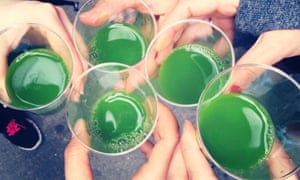
Juice Crawl through New York - like a pub crawl but with juice Green shots


If you stir kale into your shots, it counts as a superfood. Probably. Photograph: Courtesy of Juice Crawl

Pub runs


One of the problems with drinking from a weight-gain perspective is that, as well as pointless calories, it also involves very little physical movement. Sitting down and talking for hours isn’t exactly good cardio. You need to engage in a lot more physical movement if you want to burn off those calories.


So, if you really do fancy a drink, don’t stroll to the local, jog there. In fact, don’t go to your local, pick a pub on the other side of town and jog there instead. Or pick several pubs and sprint from one to the next each time you finish a drink, more of a pub sprint than a pub crawl. This has the added bonus of, at the end of the night, if you arrive at the last pub red-faced, struggling to speak or walk, you’ll fit right in.


You might look at this and decide it’s not worth it just for a drink so opt to stay in. If so, fine. That’s good for your health too. So really, you can’t lose here.


Indulge in impulsivity


One thing alcohol is known to do is make people more impulsive. The complex interaction between alcohol and our brains and genes means our higher-reasoning areas and those that supress impulsivity are often hampered by drink, resulting in us doing and saying things we’d normally shy away from.


You can exploit this effect to improve your health by signing up for fitness classes, marathons, Tough Mudder runs, and things like that. You may have consumed a lot of empty calories but thanks to drink you’re now going to burn those off, and then some.


Obviously, once you sober up, you could just change your mind. It’s harder than you think though, as our brains are reluctant to go back on a decision once it’s made. This is especially true if you made the decision in front of people, who will now think worse of you if you go back on it.


When you wake with a pounding head saying “What the hell did I agree to last night?”, it may well have been good for you in the long run.


alcohol addiction - drunk businessman holding a glass of whiskey on the table


Interesting fact – people often look the same after a heavy workout session as they do after a heavy drinking session Photograph: ronstik/Getty Images/iStockphoto

Embrace the anger


One other unpleasant effect of alcohol, which ties in with greater impulsivity, is an increase in irritability and anger. There are many neuropsychological explanations for this; an inability to correctly work out people’s intentions from their behaviour, a drop in ability to plan actions and predict consequences, releasing pre-existing stresses and issues that you usually supress, and so on.


One consequence of increased anger is an increase in “approach” motivation. The brain seems to have two separate motivations systems, approach and avoidance. Things we want to deal with, we’re motivated to approach. Things we are wary or scared of, we’re motivated to avoid. Anger increases the power of the approach system, meaning we “get stuck in” where we otherwise wouldn’t.


So, if you’re drunkenly tempted to pick a fight with the biggest bruiser in the room, go ahead. The realisation of what you’ve done will soon get through your alcohol-infused brain, triggering an adrenaline-rush fight-or-flight response. You’ll have no choice but to get moving to stay ahead of the enraged beast, burning many calories as he chases you with a pool cue.


Blank the workout


Alcohol, at the right doses, can and does disrupt the ability to form new memories. So, if you have a gym session or exercise routine planned, you could dry quickly getting so drunk beforehand your brain can’t form new memories, but you can still complete your workout before passing out from intoxication. When you eventually wake up, you should have no memory of exercising, so will think you still need to do it. Voila; you get to drink and actually double the exercise you partake in.


It’s a delicate balancing act though, to get the timing and intake just right to hit that narrow window of usefulness. So practice is needed, which may well render the whole thing pointless.


Glasses of red and white wine on a dinner table.


Wine is made from grapes. Grapes are a fruit. Fruit is good for you. So, therefore…

I’ll be honest, I’m really reaching here. Photograph: Thorben Maier / Alamy Stock Phot/Alamy Stock Photo


Try moderation


You may think all these suggestions fall into the category of “terrible” or maybe even “downright hazardous to health, life and liberty”. And you’d be right.


Truth is, alcohol isn’t ever really going to be helpful if you’re trying to lose weight and get in shape. That’s just not how our bodies work. But that doesn’t mean you have to cut it out entirely. Each to their own, and many people just cut down and/or increase their physical activity, or some combination of the two. You need to find what works for you.


Of course, this involves navigating the onslaught of “expert” advice and trendy “diets” we are bombarded with at this time of year. It’s enough to drive you to drink.


Dean Burnett ‘s book The Idiot Brain isavailable now in the UK,USA,Canadaand many other countries.


He is appearing at Dry Humour, an alcohol-free comedy night on Friday the 13th in Cardiff, in aide of Alcohol Concern.


Keep lit: how to lose weight without giving up alcohol | Dean Burnett

22 Aralık 2016 Perşembe

Vladimir Putin orders clampdown on "surrogate" alcohol as deaths rise

Russia’s president Vladimir Putin has ordered the government to crack down on so-called surrogate alcohol, as the death toll from consumption of a fake batch of bath tincture exceeded 60.


Putin on Wednesday demanded new regulations be put in place to tighten controls over the production and sale of liquids including perfume, cleaning fluids, medicines and cosmetics that contain more than 25% alcohol. He also told the government to look at increasing the legal consequences for violations in the production and sale of these items.


The death toll in the Siberian city of Irkutsk over recent days has now reached 62. Investigators on Monday said they had discovered an underground laboratory in the city making fake boyaryshnik, a tincture supposedly meant to be added to baths for relaxation. The fluid, which normally contains 93% ethanol, as well as hawthorn extract and lemon oil, is widely drunk in Russia as a cheap substitute for alcohol.


However, police found that the batch in Irkutsk contained methanol, a poisonous substance found in antifreeze, instead of ethanol. Local authorities declared a state of emergency in Irkutsk on Monday, and across the wider region on Tuesday. Police seized thousands of bottles of the liquid from shops and kiosks across the region, and authorities ordered a temporary ban on the sale of all fluids containing alcohol.


Twelve people have been arrested for distributing the fake batch, and courts in Irkutsk remanded them in custody on Wednesday.


According to Irkutsk region’s ministry of health, 107 people have been poisoned by the batch of fake boyaryshnik, with 62 dead so far. Around half of them died in hospital, while others were already dead on arrival. There are still 36 people in hospital. Four people have been released having made what local doctors called a “miracle recovery”.


There are two main problems in Russia’s surrogate alcohol market: first is the widespread consumption of items marked as perfumes or bath tinctures. They are exempt from sales restrictions and taxes that normal alcoholic drinks would carry but are often sold at drinks kiosks where it is obvious people would purchase them for consumption. In one Russian region, automated street machines selling Boyaryshnik were installed earlier this year.


The second problem is fake alcohol: there have been numerous cases of underground factories making cheap vodka or whisky and attaching fake labels to the bottles.


In Irkutsk, both problems combined to lethal effect, as dozens died from ingesting a tainted version of something that was in any case not designed as a drink.


The Irkutsk tragedy is an extreme example, but deaths from drinking low-quality alcohol are common. Russia’s consumer watchdog said that during the first nine months of 2016, 9,300 Russians died from alcohol poisoning. Of these, 1,200 had died from methanol poisoning, the watchdog said.


Vladimir Putin orders clampdown on "surrogate" alcohol as deaths rise

25 Ekim 2016 Salı

Women now drink as much alcohol as men, global study finds

Women have caught up with men in the amount of alcohol they drink and are doing increasing amounts of damage to their health as a result, according to a global study that looked at the consumption habits of four million people over a period of over a century.


The change is partly the result of successful marketing campaigns and the creation of sweeter products aimed at young women or girls, as well as cuts in price, say health campaigners. Some studies have even suggested that younger women may be out-drinking men, according to the study’s authors.


The researchers from the National Drug and Alcohol Research Centre of the University of New South Wales, Australia, say the conclusion is that public health efforts need to focus more on women.


“These results have implications for the framing and targeting of alcohol use prevention and intervention programmes. Alcohol use and alcohol-use disorders have historically been viewed as a male phenomenon. The present study calls this assumption into question and suggests that young women in particular should be the target of concerted efforts to reduce the impact of substance use and related harms,” they say.


Their analysis, published in the journal BMJ Open, looks at the convergence of drinking habits between men and women over time, from 1891 to 2014. It pools the results of 68 international studies, published since 1980, to look at the changing ratio of male to female drinking over the years.


Historically, far more men drank alcohol than women. Men born between 1891 and 1910 were twice as likely as their female peers to drink alcohol and more than three times as likely to be involved in problematic use or use leading to harms. But in all three respects, this had almost reached parity among those born between 1991 and 2000.


Women’s drinking has increased for a number of reasons. Those who have succeeded in obtaining jobs that were once the preserve of men have joined – or found it necessary to become part of – the after-work drinking culture. Office for National Statistics figures from 2011 show that women in management and professional jobs drink more than the average woman and drink more on weekdays.


But drops in the price, which have led to wine and beer becoming regular items in the supermarket shopping trolley and part of everyday life at home, have also been a factor, alongside deliberate marketing targeted at women.


“Since the 1950s we’ve seen women’s drinking continue to rise,” said Emily Robinson, director of campaigns at Alcohol Concern. “Drinking at home has continued to increase and because alcohol is so cheap and easily available it’s become an everyday grocery item. We’ve also seen a concerted effort from the alcohol industry to market products and brands specifically to women.


Some women drink some shots in a bar


Some studies have even suggested that younger women may be out-drinking men, according to the study’s authors. Photograph: OJO Images / Rex Features

“We know from our annual Dry January campaign that people often don’t realise that alcohol has become a habit rather than a pleasure, with women having ‘wine o’clock’ most nights of the week.


“Drinking too much, too often, can store up future health problems, both mental and physical, with people not realising just how easy it is to go over recommended limits,” Robinson added.


“This is why we need mandatory health warnings on alcohol products and a mass media campaign to make sure the chief medical officer’s guidelines are widely known and understood.”


Sally Davies, the chief medical officer (CMO), changed the alcohol guidance earlier this year, advising both men and women they risked harm if they drank more than 14 units a week – previously the upper limit for men was 21 units. But she warned that there was no safe limit for anybody.


Katherine Brown, director of the Institute of Alcohol Studies, said: “Historically women did not drink that much. There has definitely been a proactive effort to entice women to drink more.”


Some of the drinks now available have been targeted at young women who “pre-load” while getting together to dress and do their make-up before a night out. Three large glasses of wine can be the equivalent of nine units, she added.


Babycham was the first drink specifically designed with women in mind in post-war Britain. Today there are many others including Lambrini, which is aimed entirely at young women. “Sweet or fruity? Lively, smooth – or are you a classic kind of girl? With a Lambrini tailored to complement your own personal style and taste, you’re going to love our new collection!” says the advertising on its website.


Alcohol advertising and sponsorship is also noticeable in TV programmes aimed at women. For example, Baileys backed Desperate Housewives.


Women’s bodies do not tolerate alcohol as well as men’s, however, because they have a higher fat to water ratio. Because they have less water, the alcohol in their system remains more concentrated. They also have smaller livers than men, which makes it harder to process alcohol safely.


Women now drink as much alcohol as men, global study finds

21 Ekim 2016 Cuma

Scottish court rejects appeal against minimum alcohol pricing

Scottish judges have rejected an appeal against the Holyrood government’s plans to introduce minimum pricing for alcohol.


The ruling by the court of session in Edinburgh is the latest in a long-running legal battle led by the Scotch Whisky Association after the Scottish parliament voted in favour of minimum pricing in 2012.


Ministers set the minimum price at 50p per unit of alcohol, a measure that would mean whisky could be no cheaper than £14 a bottle.


Last year the European court of justice ruled that the policy was in breach of EU free-trade laws. The European court of justice said the policy could be justified on health grounds under EU law only if it was more proportionate and effective than using general taxation.


However, in a written judgement issued at the court of session on Friday, the three judges ruled that the government’s policy was not illegal. In the judgement, Scotland’s most senior judge, the Lord President Lord Carloway, wrote that the policies didn’t contravene laws set by the ECJ.


Quoting from the judgement issued by the judge who earlier considered the matter, Lord Doherty, Carloway wrote that drinking was important to Scots.


“For many, the consumption of alcohol is a great social lubricant. It’s use in a responsible manner is an important and positive feature in Scottish culture. The general intent, as the Lord Ordinary noted (Opinion para 54) is to ‘get people to build a healthy and sensible relationship with alcohol’; not to stop them drinking altogether or even to drink moderately at all times.”


More details soon …


Scottish court rejects appeal against minimum alcohol pricing

16 Ekim 2016 Pazar

Most countries get more calories from alcohol than soft drinks – study

People in the UK and many other countries get more of their calories from alcohol than from sugary drinks like cola and lemonade, according to new data which suggests that tackling Britain’s drink problem may be more important for health than cracking down on sugar consumption.


Of 24 countries tracked by the data analysts Euromonitor International, all but one have higher daily calorie consumption from alcoholic drinks than sugary beverages. In the UK, adults are consuming more than 106 calories per head every day from alcoholic drinks, compared with 98 from sugar-sweetened drinks.


The highest calorie intake from alcohol is in South Korea, with nearly 168 calories a person each day and only 44 calories from sugary drinks. Also high are Poland, the Czech Republic, Finland and Germany while – of the countries examined – only the people of Taiwan get more calories from sweet drinks than alcohol. The US was not included.


Calories from sugar and alcohol

Sugar has been targeted by health experts and obesity campaigners. A number of governments are introducing taxes on sugar-sweetened drinks which are recognised as a major cause of childhood obesity.


But little has been said or done about alcohol, which the new data suggests is more significant even than sugary drinks in obesity in adults. Most people are unaware that alcohol can make you gain weight, because – unlike food – the number of calories are not routinely marked on beer cans and bottles of wines and spirits. Yet a large glass of 13% wine contains 228 calories and a standard glass 160 calories. A pint of 4% beer is also around 160 calories.


“In the UK, alcoholic drinks above 1.2% ABV are currently exempt from having to provide calorie information. This research demonstrates clearly that this exemption should now end,” said Prof Sir Ian Gilmore, chair of the alcohol health alliance.


“The public have the right to know what is in their drinks, so they can make informed choices about their consumption. These labels should make the public aware, for example, that a pint of standard-strength beer contains around 180 calories, about the same as a packet of crisps, and that a large glass of red wine contains around 200 calories, roughly equivalent to the calories found in a doughnut.”


Euromonitor’s nutrition analyst, Sara Petersson, said this did not let sugar off the hook. “It is very interesting because the whole reason why soft drinks are under attack is because they are liquid calories. We don’t have a compensatory mechanism that says we should eat less after drinking them,” she said. “It works the same way with alcohol and if anything, not only does it have a worse health effect but it is an appetite stimulant which makes you eat more. That is not to take anything away from the need to reduce sugar. That is crucial because it is a very important source of weight gain.”


But, she said, tackling alcohol consumption was also crucial to combatting obesity, which can lead to heart disease, type 2 diabetes and cancer, and was in danger of crippling health systems around the world.


Euromonitor’s nutrition data also shows that the average daily consumption of calories in the world is 1,398 calories, with the lowest amount in India at 761 calories per capita per day and the highest in Belgium at 2,559 calories per capita per day. It also shows that most of the developing countries it tracked (78%) get more calories from packaged food than fresh food.


Most countries get more calories from alcohol than soft drinks – study

6 Ekim 2016 Perşembe

Alcohol continues to be sold at "pocket money prices", report finds

Alcohol continues to be sold at “pocket money” prices across the UK, with white cider on offer for pennies, according to a report.


The study from the Alcohol Health Alliance (AHA) concluded that little has changed in recent years when it comes to people being able to buy cheap booze from supermarkets and off-licences.


Meanwhile another study has found that British teenage girls are more likely to get drunk than their male counterparts. The Organisation for Economic Co-operation and Development (OECD) study found 31% of 15-year-old girls reported having been drunk at least twice compared with 26% of boys of the same age.


Researchers from the AHA analysed 480 products to find the cheapest drink on sale across the UK. The team found that high-strength white cider, which they say is mostly drunk by dependent and underage drinkers, is being sold for as little as 16p per unit of alcohol.


They said: “The conclusion is clear – alcohol continues to be sold at pocket money prices in supermarkets and off-licences across the UK.”


They found a wide range of cheap alcohol being sold by major supermarkets – including Asda, Tesco and Sainsbury’s.


Their report said: “Both Asda and Tesco were found to be selling perry at 19p per unit, while Morrisons were selling cider at 20p per unit and Sainsbury’s stocked perry at 22p per unit.


“In our research, we also found an abundance of summer-focused promotions. The promotions included deals on multi-packs and free giveaways with alcohol purchases, enticing people to buy.”


The report said that for the cost of a standard off-peak cinema ticket (£8.24), people could buy 7.5 litres of the cheapest white cider – the equivalent of 53 shots of vodka.


“The minimum hourly wage for those aged under 18 is £3.87,” the study went on. “After just an hour’s work, you would still have 38p change after buying a three-litre bottle of Frosty Jack’s containing 22.5 units of alcohol.


“For the cost of a monthly Netflix subscription at £7.49, you would have change from buying two three-litre bottles of Frosty Jack’s.


“Today, £10 will not buy you a large Domino’s pizza, but you would have a penny left over from a 700ml bottle of 40% Putinoff vodka at £9.99.”


The report concluded: “Cheap booze can be found on every street corner. Fundamentally, very little has changed since the last report was carried out five years ago.


“While the lowest price we report is 16p per unit, we found a broad range of products on sale for 25p or less, which is half the 50p minimum unit price recommended by health bodies and alcohol charities.


“At the cheapest price per unit for white cider (16p), the low-risk drinking limit of 14 units per week for both men and women could be purchased for just £2.24.”


Chairman of the AHA and former president of the Royal College of Physicians, Professor Sir Ian Gilmore, said: “In spite of a government commitment to tackle cheap, high-strength alcohol, these products are still available at pocket money prices. Harmful drinkers and children are still choosing the cheapest products – predominantly white cider and cheap vodka.


“We need to make excessively cheap alcohol less affordable through the tax system, including an increase in cider duty. It’s not right that high strength white cider is taxed at a third of the rate for strong beer.


“In addition, we need minimum unit pricing. This would target the cheap, high strength products drunk by harmful drinkers whilst barely affecting moderate drinkers, and it would leave pub prices untouched.”


Each year, there are almost 23,000 deaths and more than 1 million hospital admissions related to alcohol in England.


More than two-thirds of alcohol sold in the UK is purchased in supermarkets and off-licences.


Another report has found that British teenage girls are more likely to get drunk than their male counterparts. The Organisation for Economic Co-operation and Development (OECD) study found 31% of 15-year-old girls reported having been drunk at least twice compared with 26% of boys of the same age.


Alcohol continues to be sold at "pocket money prices", report finds

19 Ağustos 2016 Cuma

Half of UK parents allow children to drink alcohol at home, says survey

Half of parents with children under the age of 14 allow them to drink alcohol at home, research by Churchill home insurance has found.


It also found that 34% of parents with children under 14 used alcohol as a bribe to encourage good behaviour, while 11% of parents with children aged five to seven allowed them to drink at home. A quarter of those surveyed who let their children drink said they saw nothing wrong with it.


Related: Should you be worried about your student son or daughter’s drinking?


While it is not illegal for children aged five to 16 to have alcohol at home, the Chief Medical Officer’s report states that children under 14 who drink have increased health risks – including suicide attempts, involvement in violence and alcohol-related injuries.


Almost a third of parents said that allowing their children to drink at home let them monitor their child’s alcohol consumption. The research also suggested that one in five parents would allow minors who are not family members to have alcohol in their house.


Martin Scott, head of Churchill home insurance said: “The relationship between children and alcohol in Britain always seems more fraught than for our continental cousins. Many parents want their children to have a responsible attitude to drinking and introduce alcohol in a safe, controlled environment.


“The challenge any parent will recognise is how to prevent excessive drinking, especially amongst teenagers … Whenever people are drinking in the home, there is a greater risk of injury or property damage as alcohol has a significant impact on co-ordination.”


Joanna Simons, chief executive at Alcohol Concern, said: “We know that many parents start from the best intentions when they introduce children to alcohol at home, but all the research indicates that the younger that children start drinking, the more likely they are to have problems with alcohol in later life.


Related: Alcohol-related deaths in England up 4% in one year


“Parents are really important role models for their children and the more that they can keep an eye on the number of units they’re drinking, and have a few days off drinking each week, the more that their children’s attitude to alcohol will be shaped in a safer way.


“The Chief Medical Officer advises that an alcohol-free childhood is the safest option and that those under 15-years-old, ideally, should not drink at all.”


Rosanna O’Connor, director of alcohol, drugs and tobacco at Public Health England, said: “Advice from the Chief Medical Officer for England is that an alcohol-free childhood is the healthiest option.


“Most parents are aware of the dangers of children and young people consuming alcohol from an early age and evidence points to the fact that starting to drink alcohol before the age of 15 can affect their health and wellbeing in the future.”


Half of UK parents allow children to drink alcohol at home, says survey

7 Ağustos 2016 Pazar

Olympic sponsorship and alcohol don’t mix | Letters

As medical bodies and charities who support children and young people through sport, we are writing to express our concern that Strongbow is an official partner of Team GB at the 2016 Olympic Games.


Our children and young people look to our Team GB athletes as role models and heroes. They are right to do this – we should be proud as a nation of our athletes, who represent a fine example of what one can achieve through hard work and dedication. Yet this also means that Team GB, as an organisation, has a responsibility to consider what messages it is sending to our children and young people.


By partnering with an alcoholic drinks company, the message received by our children and young people will be that sport and alcohol go hand in hand. We are concerned that children will be encouraged to drink as a result.


There is strong evidence that exposure to alcohol marketing leads young people to drink at an earlier age. A study of school children aged 13-14 from four EU countries found exposure to alcohol sports sponsorship through viewing a major football tournament was linked to a 70% increased chance of underage drinking. We know from the research that exposure to alcohol messages increases the likelihood that non-drinking young people will start to drink, and increases the likelihood that existing young drinkers will drink more alcohol, and in a more risky fashion. This exposure also leads to more positive beliefs among young people about alcohol.


The later we can delay the uptake of drinking among young people, the better. We know that the younger people start to drink, the more chance there is that they will become dependent drinkers, with all the harm that causes to individuals, their families and society.


This is why it is crucial that Team GB does not do anything that may promote the idea of drinking to young people. We urge Team GB to make a commitment that, for future events, it will not partner with the alcohol industry.
Sir Ian Gilmore Chair, Alcohol Health Alliance
Matt Stevenson-Dodd Chief executive, Street League
Katherine Brown Director, Institute of Alcohol Studies
Joanna Simons CBE Chief executive, Alcohol Concern
Colin Shevills Director, Balance
Shirley Cramer CBE Chief executive, Royal Society for Public Health
Alison Douglas Chief executive, Alcohol Focus Scotland
Sarah Toule Head of health information, World Cancer Research Fund
Eric Carlin Director, Scottish Health Action on Alcohol Problems
Modi Mwatsama Director of policy and public health, UK Health Forum
Linda Harris CEO, Spectrum Community Health CIC, medical director substance misuse and associated health, RCGP
Dr Clifford Mann President, Royal College of Emergency Medicine
Prof Frank Murray President, Royal College of Physicians of Ireland
Andrea Crossfield Chief executive, Healthier Futures
Andrew Langford Chief executive, British Liver Trust
Professor Jonathan Shepherd CBE Director, Violence Research Group
Kate Knight Public Health Action
Professor Graeme Alexander British Association for the Study of the Liver
Kieran Moriarty British Society of Gastroenterology
Linda Bauld UK Centre for Tobacco and Alcohol Studies


Join the debate – email guardian.letters@theguardian.com


Olympic sponsorship and alcohol don’t mix | Letters

3 Ocak 2016 Pazar

Can You Detox from Alcohol at House?

Alcoholism is a condition whereby a person gets dependent on alcohol. A particular person may be considered an alcoholic when some of the following qualities occur:


  • Extreme drinking

  • Unable to stop drinking

  • Turning into reliant on alcohol

  • Can’t fulfill every day duties simply because of dependence on alcohol

Well being problems could to the excessive use of alcohol, and withdrawal symptoms happen. The use of such big quantities of alcohol can have an effect on an individual’s heart, brain, liver, pancreas, and even their immune method.


It is advised that an alcoholic look for quick assist. There are several alternatives offered, but the initial phase is to realise and accept that you have a critical addiction. Up coming, you require to look at your drinking routines to decide what you need to have to do to remedy this unhealthy addiction. Usually times, it can be helpful to talk to pals and family members, eliminate all alcohol from your home, and do not attend any functions exactly where alcohol is offered until you have detoxed. Detox is usually the hardest step in alcohol withdrawal because of the bodily signs that might happen. You might knowledge extreme headaches, evening sweats, elevated heart charge, nausea and vomiting, shaking, confusion, irritability, and depression.


Detox can be carried out at residence or in treatment services. Ibogaine Treatment Centres are available around the globe. They utilise Ibogaine because of its potential to treat several additions at after. It assists with withdrawal signs and also beats the cravings of addiction. Nevertheless, detox from alcohol can be finished at residence too. Outlined under are some important factors you will want to do to make sure you encounter accomplishment at residence.


  1. Assistance System


Throughout the detox method you will need to have at least a single man or woman by your side. Talk to your ideal buddy, your brother or sister, or somebody you are near to who will help you during the detox procedure. It is critical to have a person close by to support you via the withdrawals. If they are not able to remain with you, do make certain that they can check on you in the course of the initial three to seven days. These will be the toughest days throughout the method of turning into alcohol totally free.


  1. Time


Make confident you have scheduled time off function, and clear your routine of any events. You may possibly not truly feel like going out and entertaining anyone for the duration of this time. It is critical to target on yourself and your self only.


  1. Diet program and Water


Your dietary adjustments are considerable in the success of your transition. Make certain you stock your fridge full of fruits and vegetables. You will be changing the unsafe toxins you have place into your physique with healthier foods that will recharge your physique. Suggested foods to snack on are berries, oats, grains, and bananas. It is encouraged that you eat food items rich in protein this kind of as fish, chicken, and turkey for more substantial meals. You might not have a huge appetite during this time, so make small meals and consume several occasions during the day. Do not replace your addition of alcohol with junk meals and/or caffeine. Stick to healthful food items due to the fact this will help to shorten the detox method.


It is also really essential that you stay hydrated. Make confident to drink loads of water. You need to drink half of your physique bodyweight in ounces each and every day to stay totally hydrated. Buy a massive sixty ounce plastic bottle at the store and fill that with water every single day. Consider your very best to drink as significantly as you can to ensure you continue to be hydrated.


  1. Nutritional vitamins


It is also essential to get a day-to-day vitamin, particularly a single that is made up of Vitamin B since it will alleviate the signs and symptoms of withdrawal. However, a supplement that also contains Vitamin C, magnesium, and zinc is also encouraged.


  1. Workout


Lastly, some form of physical exercise is essential. Exercise and fresh air will give you a sense of function, as opposed to isolation during the detox. Exercise will boost your sleep, give you a lot more energy, and inspire heart strength. Most importantly, it will alleviate depression, increase psychological clarity, increase your mood, and give you added self-self confidence, which is needed to overcome alcohol addiction.


Each and every of these 5 procedures will aid you detox at property, in reality, they are essential to your success of effectively detoxing. It is achievable to detox from home as long as you keep assured and convicted in your selection.


Sources


http://interventiontreatmentrecovery.org/alcohol-abuse/indicators-of-alcoholism/


http://wellness.usnews.com/wellness-information/blogs/eat-run/2013/09/13/the-truth-about-how-a lot-water-you-should-truly-drink


https://www.theholisticsanctuary.com/ibogaine-treatment/


http://www.livestrong.com/post/316546-vitamins-that-aid-with-alcohol-withdrawals/


Can You Detox from Alcohol at House?

18 Temmuz 2014 Cuma

Dwell Nicely: Stressed females burn calories gradually, alcohol can increase dementia chance but consume unripe bananas

The capsules could go on sale as early 2019, the scientists from Barts and the London School of Medicine and Dentistry, Queen Mary University of London explained.


The examine was published in GUT, the global journal of gastroenterology and hepatology.


two. An hour of physical exercise can assist stave off dementia


We’re often advised it is crucial to workout but now a landmark examine says just one hour’s physical exercise a week can minimize the opportunity of Alzheimer’s condition by almost half.


The review, which ranked the lifestyle factors that enhance the chance of dementia, also located a reduction in smoking and tackling well being difficulties this kind of as weight problems and diabetes could assist.


The analysis led by Cambridge University, published in the Lancet Neurology, identifies physical exercise as the most substantial protection against the problem.


three. Anxiety causes calories to burn slowly


Females who really feel stressed locate it more difficult to get rid of fat because they burn calories a lot more slowly, a study published in journal Biological Psychiatry suggests.


Researchers found that girls who had knowledgeable a single or much more stressful events the earlier day burned far fewer calories from a meal than individuals who did not – a big difference amounting to eleven further lbs in excess of the course of a year.


Professor Jan Kiecolt-Glaser, lead author from Ohio State University, said one achievable cause was that folks were “much more probably to eat the wrong foods when we’re stressed, and our data say that when we eat the wrong foods, excess weight achieve gets more most likely simply because we are burning fewer calories”.


4. Consume unripe bananas, drink water for a healthier back but do not eat mash


The ways to consuming healthily are quite easy in accordance to one particular professor: consume unripe bananas, do not mash potatoes and don’t cook with olive oil.


Rodney Bilton spent 15 years researching what a healthier diet plan based mostly on scientific evidence is and provided a number of guidelines to readers.


These consist of eating green bananas due to the fact they incorporate much more resistant starch than their ripe counterparts which gives extended-phrase power as it is absorbed slowly by the entire body.


He also suggested consuming water to reduce back pain and warned towards mash since heating and grinding the starch granules in potatoes triggers the volume of sugar to enhance “by breaking open the membrane that surrounds them, releasing starches that turn into sugar”.


five. Arthritis drug could halt progression of Alzheimer’s


A drug which is frequently utilized to deal with arthritis may possibly be the 1st medicine discovered which can halt the progression of Alzheimer’s ailment.


Scientists at the University of Southampton discovered Etranercept, which is typically provided as a weekly injection to relieve arthritis signs, stopped dementia obtaining worse.


Professor Clive Holmes led the research, and presented his results at the Alzheimer’s Association Global Conference in Copenhagan, identified the drug soaked up and disposed of a protein in the blood called TNF-alpha.


Professor Holmes’ group has already proven folks with Alzheimer’s that have large levels of energetic protein in their blood decline faster than people who have extremely reduced amounts.


Dwell Nicely: Stressed females burn calories gradually, alcohol can increase dementia chance but consume unripe bananas

12 Temmuz 2014 Cumartesi

How do I speak to my kids about alcohol?

rehab column family

‘What I truly want to say is ­“Drinking can be enjoyable, little ones. Do it proper and it can be a riot and a complete pleasure, and totally fine. Do it incorrect and you could finish up in the gutter.”’


“I like beer,” our youngest declares at the dinner table. Everyone laughs, and his older siblings urge him to say it once more, louder. I shoot them a serious search, because their favourite thing at the moment is to get their brother to say controversial issues in public. I don’t want him to wreck his nursery induction morning in a couple of days, by answering the teacher’s query of, “What do you like?” with a well–rehearsed: “Willies and beer.”


As an alternative of admonishing him for saying he likes alcohol (simply because let’s face it, until he is experimented with it he can’t say if he does or not), I appear at my son and say, “This is not actual beer.”


I should have just stated, “Yes, beer is lovely,” and moved the conversation on simply because my son seems cheated and crestfallen, like he is received his references all wrong. I’m shocked that he understands what beer even seems like, but then I realise there is a line in The Tiger Who Came to Tea, in which the mother in the story is quite concerned simply because a going to tiger has eaten all of the meals in the cupboard, and alas, drunk all of Daddy’s beer.


If a tiger came for tea at ours and was looking for booze, he’d be disappointed. We do not have any, save the odd bottle of beer that I hide under the stairs for when R’s out and I fancy an evening swig. I pop the bottle into the freezer 5 minutes before I want a drink. I have not advised him I do this due to the fact he’ll probably laugh and say, “You believe finding one beer in the residence will make me want to drink again? I can go to the shop at the end of our street if I truly want to get pissed.” But not obtaining alcohol in the house – as a loose rule that I set when R moved back in – feels right at current. The stuff that R is drinking now is alcohol-cost-free and quite why I feel the require to level this out to our 3-year-outdated son – who is confused to say the least – is questionable.


I do not feel I have a issue with R consuming pseudo-beer (regardless of some folks pondering it really is a phase towards relapse), but I feel I’d fret if our neighbour popped by, saw the bottle and did not spot the % on the label, and believed he’d fallen off the wagon, and we were carrying on as if everything had been regular. It tends to make me query how I would react if R did sit down a single evening and pour himself a actual drink. I believe I am Okay with him carrying out specifically as he pleases now, but that’s only since he is nevertheless sober.


When I have answered friends’ queries about R’s on/off romantic relationship with drink, I feel like it may possibly be much more helpful to just remain quiet and allow his sobriety and progress do the speaking. But I can’t remain silent about every thing simply because our children inquire inquiries all the time.


How do I speak to them about alcohol? Or rather, how do I speak to my young children about the problem with alcohol? Due to the fact if there hadn’t been a problem in the first location, then R wouldn’t be sitting right here with half a litre of impotent brown beer in front of him. He’d be drinking the actual things.


Like all talk surrounding things that can sometimes be fantastic but also be terrible (sex, present day art, solitude), the joy and the ache that alcohol can elicit is challenging to describe. Our older two children may possibly realise that in our family members life it has been the crux of numerous a dilemma in the previous few many years and we have talked about how nicely R is undertaking. But it is difficult to talk about his real dilemma and how alcohol grew to become a difficulty in the first area.


What I genuinely want to say is “Drinking can be fun, little ones. Do it correct and it can be a riot and a total pleasure, and entirely fine. Do it wrong and you could finish up in the gutter.”


I never want to put alcohol in the identical bracket as heroin since any way you look at heroin – even if the consumer is fortunate enough to be undertaking the pure stuff – they are dropping. But alcohol? I have often been capable to drink in moderation and R has not. A single of us can manage alcohol, and the other are not able to. How do you clarify that to individuals who still have pretty idealistic views about life?


I try to reply the concerns as they come, such as the tricky “sex, really like and which-comes-very first?” ones, or the even tougher ones with regards to excellent, needed fibs and poor, nefarious lies. Nonetheless, as difficult as answering my children’s concerns may be at times, I realise that they are an incredibly valuable way of exploring locations that I uncover uncomfortable or I am unsure about. And I never always have to pretend that I know all the solutions.


How do I speak to my kids about alcohol?