dogs etiketine sahip kayıtlar gösteriliyor. Tüm kayıtları göster

19 Ocak 2017 Perşembe

"I want to kill these dogs": question of whether to cull strays divides Yangon

Zu May Naing was playing with her brother outside their house in Bago Region, close to Myanmar’s commercial capital of Yangon, last month when a pack of stray dogs rounded on the 18-month-old.


Her mother, San Thar Myint, found her lying prone on the ground, bleeding and in shock. “Her temperature was over 100 [degrees fahrenheit] before they got to the operation room,” she says.


At the nearest children’s hospital in Yangon, doctors performed surgery and injected the baby with the anti-rabies vaccine. It was the second time that week a child had come in with dog bites. A doctor who declines to be named (he is not authorised to speak to the press) says they see between two and five cases per week.


A few days later, Zu May Naing’s arm is swaddled in bandages at the wrist where the dog seized her in its jaws. A red-brown gash sweeps from her left eye across her cheek. Another droops from the corner of her bottom lip where it was torn off. She glances fitfully around the hospital ward.


“She can’t sleep well at night,” her mother says. “She wakes up suddenly. She’s still afraid.”


Like many parts of the developing world, Myanmar has lived with stray dogs for generations. More than six decades ago, travel writer Norman Lewis described the mutts of Mergui, a coastal city in the south, with unsparing vividness: “There are more dogs than humans; they are a slinking, evil breed, cursed with every conceivable affliction … Many were earless, partially blind and had paralysed or dislocated limbs.”


For now, there is no killing – just breeding


Ye Naung Thein


The situation has not improved – and is arguably most acute in Yangon, the country’s rapidly developing commercial capital with a population of some five million. It is overrun with strays; government estimates seen by the Guardian put the number at more than 120,000. Some are scrawny creatures, rib cages pressing against flea-bitten skin, tumours flapping as they nose through rubbish carts. Others are visibly well fed, their muscular tawny torsos straddling spindly legs.


After dark, when the traffic clears and the air cools, some neighbourhoods descend into a chorus of howling. Others face more niggling problems: in a recent post on the local Facebook group “Eliminate All Stray Dogs”, one resident claimed an unruly pack kept jumping on his car, destroying its windscreen wipers.


“They occupy the streets – especially at night,” Ye Naung Thein, a local administrator, says at his office in Mingalar Taung Nyunt township.



A child bitten on the face by a stray dog in Yangon, Myanmar


Zu May Naing was bitten on the face by a stray dog in Yangon. Photograph: Aung Naing Soe

For decades the government has sought to curb the ever-spiralling canine population with regular mass culls. But increased resistance from animal lovers has led authorities to take a different tack – much to the ire of people such as Ye Naung Thein.


Last July, he says, the Yangon City Development Committee (YCDC) – the city’s chief administrative body – banned the killing of all dogs in two areas: Sanchaung, and his neighbourhood, Mingalar Taung Nyunt.


It was a condition of an agreement signed last year with the global nonprofit Humane Society International (HSI) and the Bangkok-based Soi Dog Foundation, which are set to help Yangon authorities implement a project that would replace culling with a spay-and-neuter programme while also vaccinating dogs against rabies. Six months on, however, Ye Naung Thein has heard nothing about the plan; HSI says it is finalising a proposal.


“For now, there is no killing – just breeding,” he complains.


In the past month, two children have been bitten in his quarter alone – including four-year-old Thurein Lin. He and his mother, Zin Mar Min, were sitting at a teashop when one of the dogs milling around lunged for the boy, sinking its teeth into his skin. The same dog had bitten a different child earlier that day; the girl was in hospital for a week. The dog was later beaten to death.


“The residents are scared,” says Ye Naung Thein. “They are scared of sending their children on to the streets.”


The threat of rabies


As well as attacks, the dogs bring with them a graver threat: rabies. Invariably fatal once symptoms appear, the virus is now largely forgotten in the UK, though it was a real fear in the 19th century.


Today, it is Asia and Africa that bear the largest burden. The virus claims an estimated 50,000 lives a year, and Myanmar has the second-highest incidence of any country in south-east Asia with about 1,000 deaths per year, according to the World Health Organisation.


Last year, 41 patients with rabies were sent to Yangon General Hospital, the biggest in the city, according to its deputy medical superintendent Daw Khin Than Mon. But the overall number of victims is likely higher: “It’s hard to know the number of people bitten because people can go to the clinic or regional hospital,” she says.


In Yangon, once rabies patients are confined to the isolation ward in the hospital – a vast, colonial-era building with no air-con and sporadic fans – there’s not much else to be done. Most people die within a few days.


“It’s very depressing,” says one of the nurses, who asked not be named.



Dogs on Yangon streets


After dark some neighbourhoods descend into a chorus of howling. Photograph: Romeo Gacad/AFP/Getty Images

Yangon’s regular mass dog culls have involved municipal workers laying out poisoned meat; scooping up the corpses later. But this method is deeply divisive in the Buddhist-majority nation, where religious conviction strengthens a deep love for animals.


“I have a YCDC official friend who worked for the animal department,” says Ye Naung Thein. “I met with him a couple of months ago and he said he is happy now because he moved to another department and doesn’t need to do killing any more.


“I told him: ‘You are government staff and you’re doing the government’s work. Who said this is a sin?’ But he replied: ‘Buddha said he doesn’t like killing and this is the sin’.”


While allowing authorities to remove obviously rabid or sick animals, the culls did little to bring the population down or eliminate the virus. Animal experts and humane organisations say culling alone has never helped a city control its dog population.


“I mean, it’s just common sense,” says Rahul Sehgal, Asia director at HSI. “If you compare the statistics of rabies in a country that is undertaking culling over the years, you will hardly see any hint of reduction in the number of rabies cases.”


Indeed, studies show culls can actually worsen the problem by killing vaccinated animals, unsettling the population – leading to fights over territory – and keeping it young and more aggressive.


“What is happening is a kneejerk reaction,” says Sehgal. “It’s a symptom but we are not finding a cure.”


He advocates the “spay-neuter-release” strategy, which involves capturing animals, neutering and vaccinating them and letting them go in the exact place they were caught.


The method – which studies say have produced results in some cities, including Jaipur – is now enshrined in law in India and elsewhere. But it takes time to work.


“The dog population has existed for several decades,” says Sehgal. “You can’t bring it down in a couple of years – it’s not magic.”



Stray dogs on the streets of Yangon, Myanmar, December 2016


Residents are still waiting for the launch of a ‘spay-and-neuter’ programme to control the stray dogs. Photograph: Aung Naing Soe

‘We just want killing’


In her spacious office in the downtown YCDC building, Dr Hla May Oo, assistant head of the veterinary and slaughterhouse department, pulls a black plastic blowpipe out of a cardboard box and puffs into the tube.


“Stray dogs are very difficult to catch so we use a traditional method,” she says, laughing.


The city authorities carried out their own spay-and-neuter plan in one township late last year, sending municipal workers out with blowpipes loaded with anaesthetic.


Hla May Oo claims workers vaccinated and sterilised more than 70% of strays – the minimum threshold animal experts say must be met for population control to be sustained. Plans are under way to extend the campaign, funded by donations, to another township this month.


In the meantime, the department has stopped culling except on special request, aside from the two townships involved in the HSI project where it is banned outright.


Hla May Oo, who has led the department since 1988, says she is caught in the middle of what some are calling a war between dog lovers and dog haters. “We are receiving a lot of complaint letters every day,” she admits.


Ye Naung Thein is skeptical about the plan, having seen similar projects fall by the wayside in recent years.


“In our situation, a lot of corruption is happening everywhere,” he says. “We don’t how the money comes and what it goes on … We objected to the [spay-and-neuter] plan because we knew they would not do any follow-up after the project. We just want killing.”


Even in places where anti-rabies spay-and-neuter plans have showed signs of success, including Bali and some Indian cities, the expense of the programmes and the sheer terror of rabies has led governments back to culling.


“I live in India, which has 35 million stray dogs,” says Sehgal of HSI. “A massive amount of money is needed to do this, and [implementation of spay-and-neuter] has been sporadic there … You work for a year, you stop for a year. By the time you are coming back to it, the dog population has multiplied again.”


But if the efforts are sustained, Sehgal says, “it just cannot fail.”


The thing about culling, by contrast, is that the results can be seen straight away. As San Thar Myint cradles her baby in the hospital ward, she is in no doubt about what she wants.


“I want to kill these dogs – I don’t want to look at them,” she says. “I want to say that villages and residential areas should not have dogs.”


Additional reporting by Cape Win Diamond and Aung Naing Soe


Follow Guardian Cities on Twitter and Facebook to join the discussion, and explore our archive here


"I want to kill these dogs": question of whether to cull strays divides Yangon

30 Eylül 2016 Cuma

15 Hypoallergenic Dogs and Cats

Hypoallergenic or Hype?


If you love animals but hate allergies, you may be tempted to spring for a pricey hypoallergenic pet.


Not so fast. Studies suggest hypoallergenic cats and dogs can cause just as many symptoms as the regular kind, says James Seltzer, MD, a spokesperson for the American College of Allergy, Asthma & Immunology. That’s because skin and saliva proteins, not just hair, trigger allergy symptoms.


The only pets proven to be hypoallergenic have scaly skin—like iguanas and snakes, he says. That said, if you’re dead set on a furry pet, here are a few that are touted—but not proven—to be better for people with allergies.


15 Hypoallergenic Dogs and Cats

29 Eylül 2016 Perşembe

9 Dogs Less Likely to Aggravate Allergies

If you suffer from allergies, being around dogs can be a torturous experience. On the one hand, you might want to give them some loving pats on the head, but on the other, you know you’ll be sorry when your sneezing just. won’t. stop. 


It might be tempting to shell out some cash for a hypoallergenic dog, but studies suggest that these pets can cause just as many symptoms as the regular kind because skin and saliva, in addition to hair, can cause symptoms. The only pets that truly won’t have you reaching for the tissue box have scaly skin.


RELATED: 20 Ways to Stop Allergies


But, if you do want to have a furry friend around, the following 9 dogs might be better for people with allergies. 


Don’t have time to watch? Read the full transcript:


The only truly hypoallergenic pets have scaly skin. If you must have a furry pet, here are some that are said to be better for people with allergies. 


Bedlington Terrier: They have curly, wooly coats and they weigh 17-23 pounds. 


Bichon Frise: “Powder puff” dogs have a soft, silky undercoat and a coarse, curly outer coat. They weigh about 10-18 pounds. 


Chinese Crested: They hardly shed and weigh 10-13 pounds. 


RELATED: What to Do If You’re Allergic to Your Pet


Irish Spaniel: They have a curly coat and can weigh 45-65 pounds.


Kerry Blue Terrier: These dogs have a soft, dense coat and weigh 33-40 pounds. 


Labradoodle: Labradoodles are created by crossing a poodle and a Labrador retriever. They can be Standard or Medium size and range from 30-65 pounds. 


Maltese: They have long silky fur that should be brushed daily. They weigh 4-6 pounds. 


Poodle: Poodles grow soft, curly fur and come in 3 sizes—Toy, Miniature, and Standard. Their weight ranges from 6-60 pounds. 


Soft-Coated Wheaten Terrier: This dog has a long silky coat and weighs about 30-40 pounds. 


9 Dogs Less Likely to Aggravate Allergies

28 Ağustos 2016 Pazar

Canines in court: therapy dogs making the wait for a verdict "more human"

David is waiting to find out if his children are going to be taken away from him. He paces the court waiting room and appears to be nearing the end of his tether. Other people instinctively give him a wide berth.


But Tina Jullings from Canine Concern approaches David with a small dog. “Would you like to stroke Bushy?” she asks brightly, offering up the chaotically hairy yorkshire terrier-chihuahua mix. He pauses, smiles, then laughs. “What’s a dog doing in a court?” he asks, touching Bushy gently on his head. “That’s crazy.”


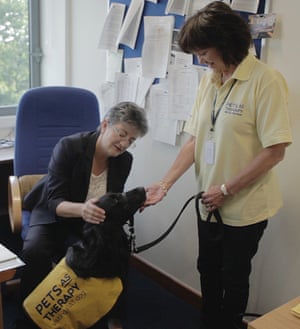
It was January when Judge Lynn Roberts, the designated family judge for Essex and Suffolk, decided to brings dogs into Chelmsford county court. Volunteers from Pets as Therapy and Canine Concern, who usually take their therapy dogs into care homes and special schools, agreed to bring their pets into the court building to visit everyone from the judges and staff to the court users and their families. Roberts also arranges bespoke visits by the dogs if a child will be at court on a day when the animals are not due to visit.


Dogs bring calm to family court.

Chelmsford is the only court in the country to welcome therapy dogs, but six months into the scheme, Roberts regards it as such a success that she is planning to introduce it to Ipswich county and family court.


“For many people, coming to court is the most stressful experience in their lives,” says Roberts, stroking the sleek head of Ella, a black, flat-haired retriever, who is visiting the judge in her retiring room before the official day begins. “It’s easy for us who work in the system to lose touch with how stressful it is but litigants are here because the future of their children is being determined, or their marriage, or where they’re going to live.


“In the US, they bring llamas and alpacas into care homes but I’m not going to attempt to bring in anything larger than a dog.” She pauses and gazes at Ella, who stares back with total canine devotion: “Having said that, I would love to bring in a donkey. I love donkeys too. But no, I think I will stop at dogs.”


So-called “courthouse facility dogs” are common in America, Canada and Chile, where they help children in all legal settings, as well as crime victims and witnesses, and those appearing in front of the drug and mental health courts.


But Roberts admits there is no tangible evidence as to the scheme’s impact. “I don’t think anybody could say if there’s any concrete result,” she said. “There was a suggestion from Cafcass [the body which represents children in family court cases] that we should assess the scheme but I don’t want to do that: I don’t want to make it all scientific. It’s working for us and it doesn’t cost the courts a penny.


“No one’s pretending it’s a cure-all,” she adds, reluctantly waving Ella goodbye and turning back to her case preparations. “It just releases a bit of stress and tension.”


The dogs have a schedule to keep to at Chelmsford: first they visit the judges, then the court staff and then the court users in the waiting rooms.


Judge Lynn Roberts stroking a black retriever dog in her office with a Pets as Therapy volunteer


Judge Lynn Roberts with Ella. Photograph: Guardian video

The circuit judge David Vavrecka is a fan of the scheme: “My initial, immediate reaction was that it was a fantastic idea,” he said. “A dog will not change the outcome of a court case but in a very bleak and conflicted situation, it can make the experience less intimidating and more human. And if, only in a very small way, we can improve the experience for our litigants, that seems to be very important.”


The circuit judge Catriona Murfitt agreed: “All the 101 things whirling around in my brain, about the cases I’m going to hear that day, stop whirring for those five minutes when the dogs come round,” she said. “But it’s probably most helpful for litigants in person, who come to court with no lawyers and are often entirely alone, knowing very little about what’s going to happen in the courtroom.”


Stephen Hodges, another district judge, is, however, less enthusiastic. “I just about tolerate the interruption to my morning when the dogs come round,” he said. “But I have two concerns. One is that certain cultures don’t traditionally feel the same way about dogs as British people tend to feel, and it could be quite off-putting for them to be approached by a dog at a moment of great stress.


“The other is that serious business happens in court. When the dogs visit the judges – between 9am and 10am – we’re doing very serious preparation for the cases we’re hearing that day. I personally find it an unwelcome distraction and I suspect the litigants feel the same if they’re talking to their representatives.”


An hour later, however, when Ella trots into his courtroom as he sits surrounded by paperwork, even Hodges appears won over by her canine charm. “Hello,” he croons quietly, tickling her under the ear. “You go all dreamy when I do this, don’t you?”


His concern that some litigants will find the dogs offensive or intrusive is countered by Kate Miller, a family law barrister at Chelmsford: “I have heard judges and lawyers voice concern that litigants who are facing the potential for losing their children don’t want to pat a dog or that certain cultures won’t appreciate it,” she said. “But I have myself observed the contrary: lots of people do want to pat a dog, and often exactly at moments of their greatest stress.”


In the court waiting room, the dogs are welcomed by some but waved away by others.


Angela has been waiting for two and a half hours to hear whether she will be able to keep her children. Visibly shaking and teary, she bends over Bushy and hugs him tightly.


“My little boy loves dogs,” she murmurs. “Bringing dogs in is such a good idea. It distracts me: I can push what’s happening to me to the back of my mind, just for a second.”


A woman standing at the edge of the waiting room is taking a break from giving evidence. When she spots Ella emerging from the lift, her distraught expression changes. She gives a brief laugh of surprise and smiles. Then the moment passes and she turns away.


The names of people in court have been changed.


Canines in court: therapy dogs making the wait for a verdict "more human"

26 Temmuz 2016 Salı

A Few Natural Remedies For Your Dog’s Well-being

A pet dog’s wellbeing is one of the main areas of concern for its master. Here are a few tips so that you can ensure the well-being of your dog:


  • Vitamin E: Many dogs suffer from a problem of dry skin and Vitamin E is the ideal thing to nourish such skin. There are many methods of supplying it to your pup such as giving it a message, bathing it in water mixed with vitamin E or making it take Vitamin E pills.

  • Colostrum Supplements: Colostrum is the first secretion from a mother’s mammary gland which is essential for all mammals in their early days. Your pet dog also needs the same. Assuming that you have got hold of your pet from a place such as puppyfind and it does not have any exposure to its mother, a good way of providing your dog with it would be the colostrums supplements. They are whole-food supplements and have the ability to protect your dog from several diseases.

  • Herbal or Homeopathic Detox: You need to supply your pet dog with the proper detoxifiers to prevent detoxification in its body. These detoxifiers can be herbal or homeopathic. They help in liver and kidney functions, thus stimulating metabolism. You should use them not only during the times of acute detoxification but also once or twice every year on a regular basis.

  • Chamomile Tea: This is a powerful disinfectant which proves helpful for upset doggy tummies. You need to store it in the refrigerator and apply it to the wounds of your dog. It will help in healing the wounds. Also, warm chamomile tea bags which help in curing eye infections of your dog.

  • Enzymes and Pro-biotics: These are absolutely essential for your dog. Enzymes will help it in proper digestion since they contain amino acids. On the other hand, the probitoics adjust the levels of microorganisms in the body and thus helps in bowel movement. They thus save your dog from colitis, irritable bowel syndrome and other health disorders.

  • Essential Fatty Acids: These will have auxiliary benefits in your dog. And the right way to promote the concentration of these acids in your pet’s body would be to serve fatty diets to it. We understand that it may not be possible to provide butter or soya milk to it. So a great alternative would be to cook food using coconut oil. Apart from restoring the fat balance in the pet’s body, coconut oil also saves the GI tracts from the attacks of parasites.

  • Maintaining a Hormonal Balance: To maintain the hormonal balance of your dog, you must replace the Omega-6 fats in your diet by Omega-3 foods. This can be done by incorporating wild fish, walnuts and chia seeds in the diet. Remember, maintaining hormonal balance is important to ensure that your dog behaves in the right way.

  • Rescue Remedy: It involves the use of Bach Flower Essence which its versatile applications in Trauma, injury and stress. Just like it helps in providing relief to the humans in these situations, it can also be used for dogs in the same way. Before applying it, you must know how to provide it in the right dosage. You can either administer it orally or rub it around the ears of your dog.

  • Youghurt and Acidophilus: These are the best natural home remedies for dogs. While acidophilus helps in restoring intestinal balance, yoghurt helps in keeping yeast infections away. So, you can feed your dog with yoghurt, either in lunch or as a sweet-dish at the end of it.

  • Oatmeal: It can prevent itching in the dog’s body. It cures irritations in the skin and keeps infection at bay. Just grind some oatmeal and mix it with warm water. Bathe your dog in this solution to see the miraculous results!

  • Epsom Salt: Epsom salt baths help in healing wounds. You may prepare a home-made heal pack and apply it to wounds using a clean towel.

All these natural remedies will protect your dog from various diseases and help in its well-being. So, instead of depending on anti-biotic and other such things, you can use them for your dog’s well-being.


Author byline:


Rehan is an author, SEO Specialist, Freelancer, speaker, health, and wellness coach. He provides concise, powerful information on how you can get control of your health quickly and easily. He loves exercise, yoga, sleeping in colder rooms and discuss puppyfind, cooking, internet, web hosting and traveling to new places.


References:


  1. http://everydayroots.com/flea-remedies

  2. https://pethelpful.com/dogs/How-to-Treat-Your-Dogs-Upset-Stomach-Naturally

  3. http://holistichound.com/resources/natural-remedies-for-your-dogs-wellbeing/


A Few Natural Remedies For Your Dog’s Well-being

29 Nisan 2014 Salı

Why we need to know that bad people are more probably to be bitten by dogs | Jane Dudman

You are three times more likely to be bitten by a dog if you live in most deprived areas of England.

You are 3 times a lot more probably to be bitten by a canine if you reside in the most deprived locations of England. Photograph: Xavi Gomez/Getty


Canine bites man has by no means been a headline, but the reality that 3 times as several folks residing in the most deprived regions of England are bitten by canines as in the least deprived regions is an eye-catching statistic.


That fact, from the Overall health and Social Care Data Centre, is one particular of the pieces in an more and more complicated, but potentially hugely strong mosaic of information about our well being and wellbeing. Public managers and government bodies, as well as academics, are commencing to realise the value of placing together various bits of the jigsaw to attain far more joined-up pondering about public wellness policies in neighborhood areas.


A single conclusion that is already inescapable is the part of alcohol in endangering public well being. Even though the leads to of the big fall in crime in England and Wales, reported last week, are complicated, researchers at Cardiff University highlighted the decline in binge drinking and growing alcohol charges as a single element: proba tion solutions were urged to pay out far more focus to alcohol misuse to aid lessen reoffending. Paul McDowell, chief probation inspector, stated progress on cutting down offending had been “let down” by lack of focus to tackling alcohol misuse.


Men and women living in poorer neighbourhoods are still considerably a lot more very likely to suffer an assault – by puppy or human – than these who dwell in more affluent regions, but Manchester University academic Ian Warren, has discovered that living in an ethnically diverse location lowers the affect of poverty on levels of violence. This suggests that there is far more violence in bad white neighbourhoods.


Warren unearthed this obtaining by pulling with each other statistics from the North West Ambulance Support and from hospital admissions information in Better Manchester. His analysis also reveals that residents in quick-changing neighbourhoods are more most likely to be assulted, specifically in areas with huge numbers of college students.


Details like these are gold nuggets of data for councils and public managers trying to assistance healthier and safer communities. They supply a worthwhile counterbalance to distrust of some official figures, most notably crime data.


Creating for the Whitehall Watch website, Warren says public overall health information offers a far more extensive and reliable image of the impact of violence on local communities than official crime statistics.


“These of us who research interpersonal violence have recognized for numerous many years that police-recorded crime statistics are a poor signifies to measure the scale of violence,” says Warren. Rather, researchers, which includes the violence and society research group at Cardiff and the trauma and damage intelligence group at John Moores University, in Liverpoool, are making use of public well being data to provide new and dependable details.


A violent incident, for instance, could result in a single man or woman becoming charged with a crime and yet another person going to hospital. There’s no way, at the minute, to website link individuals two pieces of information. Warren and other researchers want that to modify. By linking public health data with police information, there could be a richer comprehending for policy managers about what is really going on – and the complex connection amongst crime and overall health.


But whose task is it to delve into and place collectively these types of statistics? A survey by Colin Talbot, professor of government at Manchester University, about how senior civil servants are making use of academic analysis highlights the reality that extremely small is recognized about just how academics and policymakers interact. Time to place that right.


Why we need to know that bad people are more probably to be bitten by dogs | Jane Dudman