rules etiketine sahip kayıtlar gösteriliyor. Tüm kayıtları göster

31 Mart 2017 Cuma

New rules for Indian mothers – so long as the government accepts they exist

The Indian government’s new maternity bill, which comes into force this week, has been branded an elitist policy that will do little or nothing to help the vast majority of the country’s mothers.


According to women’s groups, the new rules – which raise maternity leave from 12 to 26 weeks, putting India ahead of France and the US – will apply only to a small fraction of the female workforce.


“It’s as if, for the government, 95% of India’s women don’t even exist,” said Juin Dutta, from Paatshala, a group helping impoverished female handicraft workers. She pointed out that the extension will only apply to women in the formal sector, which amounts to just 5% of India’s working women.


India’s prime minister, Narendra Modi, hailed the bill as “a step forward for Indian women” when he introduced details of the legislation on his monthly radio address this week.


“The basic aim is to ensure proper care of the newborn, the future citizen of India, from the time of birth,” he said. “The newborn should get the complete love and attention of the mother. That is how these children will become true assets of the country when they grow up. Mothers too will remain healthy.”


Internationally, the bill has been touted as a success for India, which has one of the world’s lowest female employment rates – 25% – and where mothers often feel under pressure to leave their jobs after having children. A headline in Fortune magazine said India’s move “puts the US to absolute shame”.


But most Indian women will never reap the benefits, according to the International Labour Organisation. “India’s informal economy is huge, it employs over 435 million men and women who never see the benefits of government laws,” said Aya Matsuura of the ILO.


“In the informal sector, you never have to sign a formal employment contract and your relationship with the employer is unclear. For example if women work as maids – and up to 10 million Indian women work as domestic cleaners or cooks – they will not have signed a contract. They have a verbal agreement, so in reality they are not really covered by formal rules and are not recognised by law.”


Those working in the informal industries are among the most vulnerable, Matsuura said: “They have problems. If a woman gets pregnant, she has to find a temporary replacement for herself, like a sister or a sister-in-law. Otherwise, she loses the job.”


Pratibha R, of the Garment and Textile Workers Union in Bangalore, said the bill did little to resolve the problems of working mothers. “Our members are entitled to the 26 weeks, but what happens after? According to the new law, workplaces are supposed to provide creches on site, and women are supposed to be able to go see their babies four times a day, but in practice that doesn’t happen.


“The facilities provided are unclean and low quality, women don’t feel comfortable leaving their babies there. Women are very afraid to leave small babies there, and so they just leave after pregnancy.”



A pregnant female worker at a construction site in Ahmedabad, in India’s Gujarat state


A pregnant female worker at a construction site in Ahmedabad, in India’s Gujarat state. Photograph: Dinodia Photos/Alamy Stock Photo

A survey by the Associated Chambers of Commerce and Industry suggests that a quarter of women in India don’t return to work after having their babies.


Reducing that number could increase India’s national income by 27%, according to the International Monetary Fund.


But increasing female participation in India is complex, said economist Rupa Subramanya. Maternity benefits may make women more willing to work, but they also make employers less willing to hire them.


“India is still a developing country. Countries like Norway can afford to give mothers a year’s maternity leave now but they didn’t have that while they were still developing,” Subramanya said.


LocalCircles, a citizen engagement organisation that surveyed more than 4,000 small businesses about the new maternity rules, found that 26% of firms said they would favour men over women because of the new rules.


Yatish Rajawat, chief strategy officer for LocalCircles, said: “There is a lot of political correctness on hiring for diversity. Many people say something and do the opposite. The fact is that business dynamics will take over politically ‘right’ things. Now businesses are looking at women and thinking I’ll have to pay two persons’ salary for one person’s work. Now employers will not just look at women’s qualifications and capability but also the fact that they come with an additional cost.”


One solution, according to Naiyya Saggi, founder of BabyChakra, India’s largest online community of mothers, would be to introduce paid paternity leave. “When an employer is deciding between a man and a woman, the burden of parental leave should be equally shared,” said Saggi. “The government hasn’t put in place proper childcare infrastructure for women, and instead has passed that burden on to employers.”


She said women still feel taking any time off would have a negative impact on their careers. “Six months is a long time in today’s world, with automation and artificial intelligence. Mothers already feel they need to be reskilled after taking that much time off.”


But Nidhi Gupta from the Takshashila Institute, a thinktank, said the law was a step in the right direction despite its limitations.


She said: “Women bring as much skill and talent to the table as men do. We go to the best schools, best colleges, as we are as talented and skilled as men are. So why should we be excluded?”


The argument that employers will be reluctant to hire women over maternity leave is unproven. “In the UK, when they introduced the Equal Pay Act, the same argument was made,” said Gupta. “But actually studies have shown that it has not made employers less willing to hire women.”


New rules for Indian mothers – so long as the government accepts they exist

20 Mart 2017 Pazartesi

NHS trust triples injury payout to £9.3m under controversial new rules

The first case settled under controversial new compensation rules for serious injuries has seen an NHS trust forced to nearly triple its payout to a 10-year-old girl left with cerebral palsy from £3.8m to £9.3m.


The case, involving East Lancashire Hospitals NHS trust, will send fresh shockwaves through the NHS and insurance companies, which have been braced for big increases in claims since the new “Ogden” formula was announced last month.


Despite intensive lobbying, the new rules came into force this week, and immediately resulted in a dramatic escalation in one payout. As recently as January, it was agreed that the 10-year-old would receive a lump sum capitalised at £3.77m, but this will now be increased to £9.29m.


Her solicitor, Leonie Millard of Forbes Solicitors in Accrington, said: “The benefit for the claimant from the new -0.75% discount rate, is immense. It vastly improves the long-term future financial ability to meet her needs for the rest of her life, which is expected to be long. Her parents are comforted to know that there is funding to ensure that her needs are properly met when they are no longer around.”


Until now the Ogden formula for paying out compensation assumed that the claimant could earn 2.5% interest a year on a lump-sum payment. But under the new rules, the rate is assumed to be -0.75%.


In documents published after the budget, it emerged the government’s finances will take a near-£6bn hit as a result of the increased bill faced by the NHS and other parts of the public sector as a result of the changes made to the way compensation awards will now be calculated.


The Office for Budget Responsibility said the government would be setting aside an extra £1.2bn a year to meet the expected costs to the public sector – and it would push up car insurance premiums by about 10%.


The Association of British Insurers said it was “crazy” that up to 36m insurance policies could be affected in what it alleged would be “over-compensating” a few thousand claimants a year.


It is estimated that the cost of the average car insurance policy could increase by £60 a year, but for younger and older drivers, the increase will be higher. Comparison site comparethemarket.com said the average price for drivers aged 17 to 20 will rise by £115 to £1,650. The total increase in premiums paid by all motorists is expected to reach £2bn.


Direct Line, one of Britain’s biggest insurers, has already blamed a £217m slump in profits on the new Ogden rate, as it pencilled in bills for some individual cases doubling from £10m to £20m.


The lord chancellor, Liz Truss, has said there will be consultation on the new rules, but the insurance industry says it has yet to be told the shape of any reforms that might be forthcoming.


The ABI said: “The first wave of impacts on insurance costs are already being felt. A number of insurers have already publicly confirmed that premiums are going up as a result of the decision in February to cut the discount rate.”


Huw Evans, director general of the ABI, said: “The massive rise in insurers’ claims costs, which makes premium rises for millions of customers inevitable, results from a wholly avoidable decision by the lord chancellor. It was based on pressure from claimant lawyers, poor legal advice and an outdated formula that does not reflect the choices available today for a prudent claimant. With the public purse hit by £6bn, the government consultation cannot come soon enough.”


But Michael Redfern, the QC who was counsel for the 10-year-old girl, known only as “LMS”, said: “The large increase in lump-sum awards is offset by lack of return on lump-sum low-risk investment and the ability to keep pace with inflation.


“We welcome the new discount rate, the first change in 17 years, which addresses the actual lack of meaningful return on safe lump-sum investment opportunities. The only person to benefit from the new discount rate is the claimant. It has no impact on legal costs.”


NHS trust triples injury payout to £9.3m under controversial new rules

3 Mart 2017 Cuma

NHS England chief brings in new rules on ward bed closures

Simon Stevens, the chief executive of NHS England, has acted to make it much more difficult for hospitals to slash their supply of beds, after the dramatic loss of the facilities in recent years was widely blamed for exacerbating the winter crisis.


Stevens is introducing tough rules for hospitals concerning bed closures from April to ensure that patient care does not suffer.


His move comes after heavy criticism of the NHS for allowing the number of hospital beds in England to fall by 20% over the past 10 years at a time of growing demand. About 15,000 beds disappeared between 2010-11 and 2016-17, official NHS figures show.


Stevens stressed that his edict would not mean a complete moratorium on hospitals shrinking their tally of beds, but there was a need for tough criteria given the increasingly large number of beds being used by patients who could not be discharged yet were medically fit to leave.


In A Friday speech at the Nuffield Trust’s health policy summit, Stevens will say: “More older patients inevitably means more emergency admissions, and the pressures on A&E are being compounded by the sharp rise in patients stuck in beds awaiting home care and care home places, so there can no longer be an automatic assumption that it’s OK to slash many thousands of extra hospital beds, unless and until there really are better alternatives in place for patients.”


NHS trusts in England planning to cease provision of a particular service already have to pass four tests before doing so, including showing that GPs back their move and that the public has had a say.


Stevens’ intervention, in effect, creates a new fifth test that will have to be passed by NHS managers planning bed closures. They will get the go-ahead only if they can prove that NHS care in the local area outside the hospital can ensure patients will receive good care; permission could also be given if it can be shown that a new medical treatment for patients with a particular condition means beds can be safely deleted. Hospitals which are inefficient in their use of hospital beds will get the green light if they improve their performance to show that losing beds will not affect patients.


It is unclear what the impact of the new rules will have on the sustainability and transformation plans (STPs) developed recently by NHS chiefs in 44 areas of England. Many of the plans envisage a further loss of hospital beds by 2020-21 in efforts to help the NHS save £22bn. Also, the conditions will only apply to “significant bed closures”, which may not stop hospitals reducing their numbers gradually, a few at a time.


Prof Jane Dacre, president of the Royal College of Physicians, said Stevens’ plan was a step in the right direction. “However, the RCP would urge STPs to reduce the potential impact on patient care and have extra capacity in place before any bed closures occur,” she said.


Jonathan Ashworth, the shadow health secretary, said: “The number of hospital beds across the country is actually now forecast to drop again under the government’s STP proposals, with no convincing evidence that the necessary community care will be put in place to replace them. It’s not obvious therefore how health ministers will meet these new tests on bed closures Mr Stevens is setting.”


NHS England chief brings in new rules on ward bed closures

1 Mart 2017 Çarşamba

All-powerful Theresa dispenses with normal rules of human interaction

There was a time when Theresa May cared that the public considered the Conservatives to be the “nasty party”. That time has long past. Now Theresa is ruler of all she surveys. She has created the world in her own image and it is good. With Labour posing little threat and surrounded only by flatterers, the prime minister has absolute power.


And with that absolute power has come an absolute lack of self-criticism. She no longer notices nor cares what people think. She even imagines that saying the word “Inc-red-i-ble” in the manner of a 1970s comedian on the sex offender register is funny. Prime minister’s questions has come to this.


Jeremy Corbyn had chosen to use all six of his questions on the prime minister’s decision to override a court judgment to extend personal independence payments to people with mental as well as physical disabilities. It should have been a good call on the Labour leader’s part, as picking on people with dementia and mental illness is not generally a good look for a government. Theresa, though, was outraged that anyone should dare question her judgment.


“No one is going to see a cut in their payments,” she said, wilfully missing the point that the real issue was the 120,000 people who wouldn’t now be getting the money that the judiciary had said they should have.


Corbyn then accused her of trying to sneak the changes in legislation through parliament without consultation. The prime minister narrowed her eyes. How dare he talk to her like that? How very dare he? Any member of her cabinet who took that tone would be out of a job.


“We made a written ministerial statement to the house last Thursday,” she replied, her voice pure ice. “And the work and pensions secretary left a message on a voicemail.” She didn’t sound entirely sure whose. Or when.


By any normal standards a written statement and a dodgy voicemail could count as sneaking, so Corbyn had another go. “The government has over-ridden an independent court decision,” he repeated. Theresa shrugged. So what? What was he going to do about it? She wasn’t that bothered what the Labour leader did or didn’t think.


Yes, it had been a bit unfortunate that her policy chief had appeared to rubbish people with mental health issues as pill-popping timewasters who sit around at home all day, but he probably had a point. There were too many people moaning and droning about feeling depressed and anxious who just needed to do a decent day’s work. Far better to cut inheritance tax rather than add to disability handouts. Anyone could see that.


As it dawned on him that the prime minister wasn’t in the slightest bit interested in people with mental health issues, Corbyn began to lose some of his focus; the normal rules of human interaction clearly no longer applied and he had no frame of reference. Most people would at least be a little embarrassed at having their indifference shown up, but Theresa was now borderline sociopathic.


Theresa drummed her fingers on the dispatch box. She was tired of talking about people with disabilities. What she wanted to talk about was her fantastic byelection victory in Copeland. Could someone ask her why she was so marvellous? There were any number of Tory sycophants only too willing to oblige.


Andrew Bridgen got in first. Did she agree with him that the Tory success in Copeland was entirely down to the prime minister’s own brilliance? This was much more like it. “Yes,” she replied. It was entirely down to her own magnificence. The idea that winning the byelection might have more to do with Labour being completely useless was just absurd.


But even talking about herself wasn’t enough to conceal her sense of boredom. She wasn’t the only one. As she went on to yawn her way through a tough question from the SNP’s Angus Robertson on devolved agriculture and fisheries powers, large gaps began to open up on both benches. PMQs used to play to a packed house, but May and Corbyn have turned it into something entirely missable.


All-powerful Theresa dispenses with normal rules of human interaction

10 Ocak 2017 Salı

“Who Rules Over You?—Just Ask Who You Can’t Sue!”

When American soldiers sustain battlefield injuries from faulty military hardware, should they be allowed to sue the hardware manufacturers?  According to one Congressman, “No,” and this has civil rights groups openly accusing Congress and the defense industry of being in cahoots.  


Congressman Mike Acheron, (D) Sacramento, Calif., recently introduced a bill that would eliminate a soldier’s ability to sue companies that manufacturer defective battlefield munitions.  Entitled, “The Safe Battlefield Act of 2017,” the bill would forbid personal injury lawsuits against private companies that manufacture defective military hardware.  


Instead of suing companies like General Dynamics, Lockheed, or Haliburton in a regular courthouse, servicemen and women alleging injuries from defective munitions would be required to sue in a special courthouse – with no judges or juries.  Said Congressman Acheron, “Instead of soldiers being sue-happy, the Act creates a more streamlined process to facilitate the needs of our young men and women who may sustain injuries on those rare occasions when they may have encountered allegedly defective battlefield munitions.”


But some veterans groups say that battlefield injuries from negligently designed explosives are far more common than we are led to believe.  One group, Veterans Injured by Negligent Explosives, (“VINE”), says that battlefield injuries too often go unreported. 


VINE claims that the defense industry intentionally minimizes the nature and extent of battlefield injuries caused by defective explosives.  VINE Founder, Rebecca D. Aubrey, says, “The Army has a reporting system for injuries caused by defective munitions, but the truth is, there’s no consequence for not reporting, which basically means that nobody’s reporting these injuries.”  Aubrey adds, “And the reality is – they just wanna keep it all hush-hush.”    


PFC Audie Murphy, U.S. Army, argues: “There’s no such thing as a safe explosive.”  While serving in Kandahar, Pvt. Murphy lost his right leg in an incident involving an allegedly defective landmine.  Pvt. Murphy says: “If we can’t sue these corporations for their unsafe products, then there’s no incentive for them to make their products any safer.”


The Obama Administration and the War Department show vigorous support for the proposed restrictions on suing the defense industry.  An unidentified State Dept. spokesperson was quoted as saying: “The Earth is round, the sky is blue, and America’s battlefield munitions are both safe and effective.”   


But according to civil rights firebrand, attorney T. Matthew Phillips, the proposed law is unconstitutional.  “The Seventh Amendment guarantees the people’s fundamental right to file lawsuits,” says Phillips, adding, “C’mon!—if our battlefield explosives were truly safe, like the industry claims, then there’d be no need for Congress to immunize the industry from lawsuits in the first place!”


Phillips compares the proposed law to the Vaccine Injury Act of 1986, which forbids personal injury lawsuits against vaccine makers.  “All battlefield explosives – just like all vaccines – are unavoidably unsafe,” claims Phillips, “These companies should be required to face jury trials and class action lawsuits – to keep ‘em honest — because the government won’t!”


The proposed bill is now in the Armed Services Committee…


[Yes, this piece is satire!!  Attorney, T. Matthew Phillips, writes to expose the hypocrisy, fraud, and oppression of the Vaccine Injury Act of 1986 – which forbids lawsuits against vaccine makers!!  If you’re furious about this, then sue to overturn the law! <<<< And THAT is not sarcasm.  We urge others – fight to retain your freedom!!  Sue vaccine makers for vaccine injuries!  Don’t wait for someone else!!  Be the brave plaintiff who changes the course of history!  ::::::: Attorney, T. Matthew Phillips and RevoltRevokeRestore.com are now suing the State of California to stop mandatory vaccination!  The Calif. Court of Appeals will soon determine whether it’s legal for the State to mandate products known to come with appreciable risk of great bodily harm!  Folks – things will never change merely by “liking” and “sharing” on Facebook.  We all should be in court fighting to protect our custodial rights as parents!  Join us in this fight!!  Hire a lawyer and sue Jerry Brown today!]


“Who Rules Over You?—Just Ask Who You Can’t Sue!”

8 Ocak 2017 Pazar

Will new FDA rules curb antibiotic use in farm animals?

New federal rules went into effect last week that ban the use of antibiotics to help livestock gain weight, a practice that leads to antibiotic-resistant bacteria that pose health threats to humans. Meat producers will also need a veterinary prescription to use these drugs for other purposes such as treating or preventing disease.


The new rules by the Food and Drug Administration (FDA) represent a broad attempt to limit antibiotic use in farm animals, not just banning a class of antibiotic for a type of livestock. Historically, antibiotics are given regularly to chicken, cattle, pigs and other animals not only to treat diseases but also to prevent them and to make the animals grow faster and bigger. But most of the antibiotics given to them are also used to treat humans and referred to as “medically important”.


The widespread use of antibiotics in both animals (and humans) has contributed to the rise of so-called superbugs, bacteria that have grown resistant to antibiotics. Drug-resistant infections currently kill an estimated 700,000 people worldwide each year, a number that could increase to 10 million by 2050 if the drug resistance trend continues, according to a report commissioned by the UK government. In the US, at least 2 million people get sick from drug-resistant bacteria each year, and roughly 23,000 die annually, said the Centers for Disease Control and Prevention (CDC).


Critics contend the FDA’s new rules are weak. The National Resources Defense council, for example, says the rules would still let farmers use antibiotics for disease prevention, an allowance that continues to sanction the prolonged use of the drugs.


Below are some charts that show why the widespread use of antibiotics threatens public health.


More meat in the future


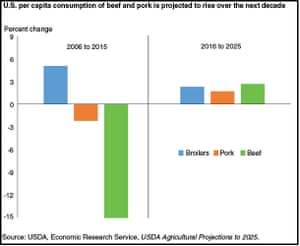
US per capita meat consumption projection

Illustration: USDA

Americans’ meat diet has changed. In the past decade, we’ve eaten less beef and pork, but more chicken. But the government is projecting an increase for all three types of meat as their prices fall, a result of a growing demand for them domestically and overseas and falling cost to feed the animals. Beef consumption is forecast to grow 11.7% and pork 10.3% from 2016 to 2025.


The term “broilers” in the chart refers to young chickens (as opposed to, say, hens raised primarily for eggs), which make up the bulk of chickens eaten.


Tracing antibiotic-resistant bacteria


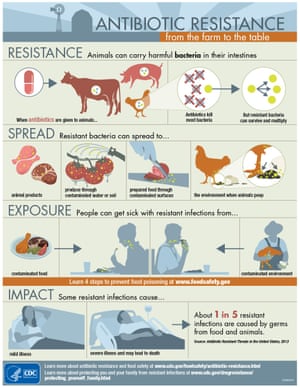
Antibiotic resistance from farm to table CDC


Illustration: CDC

When bacteria that dwell in farm animals develop resistance to drugs, they are more likely to reach humans. Some of the paths for the bugs take to get to their human hosts include handling and eating raw or undercooked and contaminated meat, drinking or swimming in water contaminated with animal feces and taking care of animals.


The sales boost


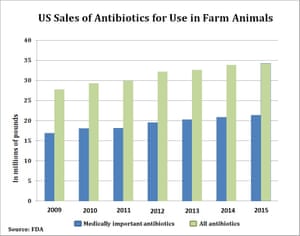
Antibiotic sales for farm animals


Illustration: Ucilia Wang/The Guardian

For more than a decade, the meat industry has faced mounting pressure from consumers and health groups to phase out the routine use of antibiotics in raising animals. The industry had to stop using certain antibiotics because the practice contributed to drug-resistant bacteria and caused a rise in food-born illnesses. Yet sales of medically important antibiotics to raise livestock, such as penicillins, tetracyclines and macrolides, have grown 26% from 2009 to 2015, according to the FDA.


As much as 70% of antibiotics developed to treat humans are sold for use in feed and water for farm animals.


Detoxing Chicken


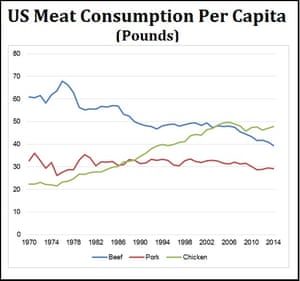
Meat consumption per capita

Illustration: USDA

Americans are eating more chicken than before, partly because it’s cheaper than beef or pork, as well as the belief that white meat is healthier than red meat. Chicken farmers have been ahead of other meat producers in reducing the use of antibiotics.


The FDA also has banned the use of certain antibiotics – sarafloxacin and enrofloxacin – in chicken because their use led to a type of drug-resistant bacteria called Campylobacter, which shows up in food poisoning cases in humans and causes diarrhea, stomach pain and fever. The bacteria developed resistance to ciprofloxacin, which belongs to the same class of antibiotics as the banned versions for chicken. Bacterial resistance to ciprofloxacin has persisted, however, mainly because many people contract the infection while traveling overseas, said the CDC.


How fast food chains respond


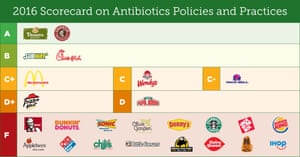
Restaurant antibiotic policy scorecard


Illustration: Natural Resources Defense Council

In response to the changing FDA rules and pressure from consumer advocates, fast food restaurants such as McDonald’s, Subway and Chick-fil-A in recent years have pledged to use meat raised with minimal or no antibiotics. Several consumer groups, including Center for Food Safety and Consumer Union, issued a report in September that graded big chain restaurants on their antibiotics policies. The scorecard, shown above, gave a failing grade to well-known brands such as KFC and Dunkin’ Donuts.


Consumer food and safety groups sent a petition earlier this month to 16 fast food restaurants, including KFC, Burger King and Jack in the Box, demanding that they stop using these drugs in their meat products.


Will new FDA rules curb antibiotic use in farm animals?

2 Kasım 2016 Çarşamba

High court rules UK government plans to tackle air pollution are illegal

The government’s plan for tackling the UK’s air pollution crisis has been judged illegally poor at the high court, marking the second time in 18 months that ministers have lost in court on the issue.


The defeat is a humiliation for ministers who by law must cut the illegal levels of nitrogen dioxide suffered by dozens of towns and cities in the “shortest possible time”.


Legal NGO ClientEarth, which brought the case, argued that current plans ignore many measures that could help achieve this, placing too much weight on costs. On Wednesday Mr Justice Garnham agreed. He also said ministers knew that over-optimistic pollution modelling was being used, based on flawed lab tests of diesel vehicles rather than actual emissions on the road.


The government said it would not appeal against the decision and agreed in court to discuss with ClientEarth a new timetable for more realistic pollution modelling and the steps needed to bring pollution levels down to legal levels. The parties will return to court in a week but if agreement cannot be reached, the judge could impose a timetable upon the government.


Air pollution causes 50,000 early deaths and £27.5bn in costs every year, according to the government’s own estimates, and was called a “public health emergency” by MPs in April.


James Thornton, CEO of ClientEarth, said: “The time for legal action is over. I challenge Theresa May to take immediate action now to deal with illegal levels of pollution and prevent tens of thousands of additional early deaths in the UK. The high court has ruled that more urgent action must be taken. Britain is watching and waiting, prime minister.”


He said the increased action required would very likely include bigger and tougher clean air zones in more cities and other measure such as scrappage schemes for the dirtiest vehicles: “The government will have to be tougher on diesel.”


The mayor of London, Sadiq Khan, who took part in the case against the government, said: “Today’s ruling lays the blame at the door of the government for its complacency in failing to tackle the problem quickly and credibly. In so doing they have let down millions of people the length and breadth of the country.”


A spokeswoman for the Department of Environment, Food and Rural Affairs said: “Improving air quality is a priority for this government and we are determined to cut harmful emissions. Our plans have always followed the best available evidence – we have always been clear that we are ready to update them if necessary. Whilst our huge investment in green transport initiatives and plans to introduce clean air zones [in six cities] around the country will help tackle this problem, we accept the court’s judgment. We will now carefully consider this ruling, and our next steps, in detail.”


ClientEarth defeated the government on the same issue at the supreme court in April 2015. Ministers were then ordered to draw up a new action plan, but now that new plan has also been found to be illegal.


Documents revealed during the latest case showed the Treasury had blocked plans to charge diesel cars to enter towns and cities blighted by air pollution, concerned about the political impact of angering motorists. Both the environment and transport departments recommended changes to vehicle excise duty rates to encourage the purchase of low-pollution vehicles, but the Treasury also rejected that idea.


Documents further showed that the government’s plan to bring air pollution down to legal levels by 2020 for some cities and 2025 for London had been chosen because that was the date ministers thought they would face European commission fines, not which they considered “as soon as possible”.


There had been a draft government plan for 16 low emission zones, which polluting vehicles are charged to enter, in cities outside London but the number was cut to just five on cost grounds.


All these proposals will now be revisited. Thornton said a national network of clean air zones needed to be in place by 2018. “If you put in clean air zones, it works overnight.”


Dr Penny Woods, chief executive of the British Lung Foundation, said: “We urgently need a new clean air act that restricts the most polluting vehicles from our urban areas and protects everyone’s lung health – air pollution affects all of us.”


Sam Hall, at conservative thinktank Bright Blue, said there should be more power and funding devolved to local authorities to enable all English cities to set up clean air zones and more support for electric cars.


Keith Taylor, Green party MEP, said: “The failure highlighted by the judge today is as much moral as it is legal: ministers have displayed an extremely concerning attitude of indifference towards their duty to safeguard the health of British citizens.”


Air pollution table

High court rules UK government plans to tackle air pollution are illegal

21 Eylül 2016 Çarşamba

Neglect contributed to teenager"s death in psychiatric hospital, coroner rules

The lack of resources for children’s mental health services in the UK has been described as a “national scandal” after a coroner ruled that neglect and “continuing failures” at one of the largest mental health trusts in England contributed to the death of a teenage boy.


Christopher Brennan, 15, died after being found unconscious at Bethlem Royal hospital in south London in August 2014. He had been admitted to the psychiatric hospital’s adolescent unit six weeks earlier as his family and local mental health services felt unable to keep him safe at home.


Christopher had a history of harming himself, and a deterioration in his mental health over the two years before his death led to repeated hospital admissions.


The coroner found that no formal risk assessment was carried out during his stay at Bethlem hospital, which is run by South London and Maudsley NHS foundation trust, and there was no care plan in place, according to the charity Inquest, which is supporting his family.


South London coroner’s court heard he was also allowed access to a number of items in hospital which he used to self-harm.


On 31 August 2014 Christopher was found unconscious in a communal toilet and later died after suffering a cardiac arrest.


Handing down her ruling on Wednesday, the coroner, Selena Lynch, said: “Christopher’s actions were in part because of cumulative and continuing failures in risk assessment and management. His death was contributed to by neglect.”


The hospital trust offered its “sincere apologies” to his family and said it had reviewed its practices. A spokesman said: “Areas of learning for the trust were identified through a serious incident investigation and we have carefully reviewed our procedures accordingly.


“More recently, the service has been inspected by the Care Quality Commission and care was found to be of a ‘good’ standard. We hope this offers some reassurance to the family that lessons have been learnt from this very tragic event.”


Following the inquest Christopher’s family said: “Losing our beloved son and brother when he was just 15 years old was so painful. Losing him as a result of the hospital’s failure to protect his life is unbearable.


“Chris will never be forgotten and no other child should be allowed to die in this way.”


Christopher was one of at least 11 young people to die in psychiatric units in England between 2010 and 2014, according to Inquest.


Deborah Coles, the charity’s director, said: “Sadly, Chris’s death is not an isolated one. Incredibly, we find that no single body is responsible for collating, analysing or publicising these deaths and that these deaths are not being independently investigated.


“The lack of resourcing of child and adolescent mental health services across the country is a national scandal. The only possible response to this case and the growing public outcry and disquiet around mental health services for children and young people is for an urgent independent review. We call upon the government to now take this necessary step.”


Neglect contributed to teenager"s death in psychiatric hospital, coroner rules

16 Eylül 2016 Cuma

Obama administration updates rules on publishing results of clinical trials

The Obama administration is publishing new rules that promise to help doctors and patients learn if clinical trials of treatments worked or not.


At issue is how to help people find medical studies that may be appropriate for them – and then to make the results public so that successes can reach patients more quickly and what fails isn’t duplicated.


Many clinical trials make news as they are published in scientific journals, and federal law requires reporting the results of certain studies on a government website, www.clinicaltrials.gov. But too often, that reporting doesn’t happen, especially the failures. In June, Vice-President Joe Biden cited concern that such secrecy was stifling cancer progress.


One analysis of 400 studies involving a variety of diseases found 30% had not disclosed results within four years of completion.


“That’s clearly unacceptable,” said Dr Francis Collins, director of the National Institutes of Health.


On Friday, federal health officials released updated rules making clear exactly what kinds of studies must be listed on the website so potential participants can consider enrolling, and which ones must post the results by certain deadlines.


“It does in fact have some teeth,” Collins added. Researchers that don’t meet the requirements for reporting results may face fines or lose taxpayer grants.


The long-awaited rules change takes effect on 18 January.


Obama administration updates rules on publishing results of clinical trials

11 Ağustos 2016 Perşembe

Tribunal rules Yorkshire Ripper can be sent to mainstream prison

[unable to retrieve full-text content]


Peter Sutcliffe, now known as Peter Coonan, may be released from Broadmoor after mental illness judged to be under control


The Yorkshire Ripper, Peter Sutcliffe, who murdered 13 women during the 1970s, may be released from Broadmoor, the secure psychiatric hospital, and sent to a mainstream prison after a tribunal concluded his mental illness was under control.


Sutcliffe was given 20 life sentences when he was convicted in 1981 but in 1984 was diagnosed with paranoid schizophrenia and transferred to Broadmoor.


Related: Police review claims of unsolved Yorkshire Ripper attacks


Continue reading…


Tribunal rules Yorkshire Ripper can be sent to mainstream prison

13 Ağustos 2014 Çarşamba

In spite of Obamacare Rules, Employer Expense Trend Slows In 2015

Health benefit costs for large employers are expected to rise 6.5 percent next year, a slower rate of increase than this year as companies implement myriad new ways to mitigate medical inflation, according to a new analysis.


The National Business Group on Health, an association of about 400 large employers, said companies are dangling more incentives in front of their workers to stay healthy, using “narrow networks” known to limit doctor choices and increasing cost-sharing via higher co-payments and deductibles for worthers. The national business group said the rate of increase was 7 percent this year and could even be lower next year, falling to 5 percent if employers implement various cost-containment strategies.


Many of these changes are being implemented to comply with the Affordable Care Act, particularly an excise tax that will be implemented in 2018. The tax, also known as a fee on “Cadillac” health plans is levied when benefits exceed a predetermined threshold. Here’s one insurer’s more detailed explanation of such plans linked here.


“Despite the many distractions that the Affordable Care Act (ACA) has created, large employers haven’t lost sight of the fact that rising health care costs remain a significant issue that needs to be constantly addressed,” said Brian Marcotte, president and chief executive officer of the National Business Group on Health in a statement accompanying the new analysis.


NBGH’s membership is diverse, including employers like Boeing Boeing (BA), Pfizer Pfizer (PFE) and Coca-Cola Coca-Cola (KO) along with health insurers Aetna (AET), Humana (HUM), UnitedHealth Group (UNH) and most Blue Cross and Blue Shield plans. Most of the members surveyed, or about 83 percent, are companies with more than 10,000 employees.


English: Barack Obama signing the Patient Prot...

English: Barack Obama signing the Patient Protection and Affordable Care Act at the White House (Photo credit: Wikipedia)


“Many employers are, in fact, taking necessary steps to rein in costs,” Marcotte said. “This includes partnering with workers to engage in health care decisions and educating them to be better health care consumers, as well as sharing more costs with workers and narrowing their benefit options.”


For example, more than half, or 57 percent of employers are expanding consumer-directed health plans. These plans often come with a high deductible and a contribution from the employer for employees to put toward their costs. But they generally lead to lower costs when employees, faced with the financial implications of their health benefit choices, tend to shop for better deals.


National Business Group on Health said the survey showed a “nearly 50 percent increase in the number of employers that plan to offer a (consumer-directed health plan as their only benefit plan option next year.” All told, 32 percent plan to offer a consumer-directed plan in 2015 compared to 22 percent this year, the business group said.


Wondering how Obamacare will affect your the cost of your health care? The Forbes eBook Inside Obamacare: The Fix For America’s Ailing Health Care System answers that question and more. Available now at Amazon and Apple.


In spite of Obamacare Rules, Employer Expense Trend Slows In 2015

6 Temmuz 2014 Pazar

EU working time rules a "mistake" that prevents junior medics obtaining adequate experience, says top surgeon

He has now written a guide about his career as a neurosurgeon, entitled Do No Harm, and earlier this yr disclosed he had made the decision to retire from the NHS soon after management banned him from sporting his wristwatch.


When asked no matter whether younger doctors had been offered sufficient expertise in coaching right now, Mr Marsh informed an audience said: “No, they’re not.


“It is a fear. What is indicates is the new generation of young consultants are a lot less skilled.


“At the minute I’m fairly positive junior medical professionals are not working enough. The European operating time directive is a blunder.”


He additional: “The difficulty is now my students face is that they operate 48 hours a week and are significantly, significantly much less experienced than I was at their stage.


“They don’t have continuity of care, they don’t comply with individuals via in the way we used to. I believe that’s all very undesirable.


“But they invest the entire night on the phone. My juniors are used as a brain scan reporting services for the whole location, so they get no sleep at all.


“Most of their time is spent handing out very simple health-related advice to quite inexperienced casualty physicians.”


Mr Marsh, who plans to continue educating around the globe when he retires, stated he also believed physicians improved in their later career, gaining empathy and insight into the patients’ own maladies as they aged.


“I like to think they’re like a good red wine,” he added. “They get far better with age.”


His memoir, Do No Harm: Tales of Daily life, Death and Brain Surgery, is out now.


EU working time rules a "mistake" that prevents junior medics obtaining adequate experience, says top surgeon

30 Mayıs 2014 Cuma

Throw The Old Rules Out The Window

Changes in China’s environmental rules, the initial revision in 25 years, take effect January 1 next 12 months with stiffer penalties for companies that flout the law. In latest years, as properly, there have been a amount of cases across the nation in which residents’ objections, simply because of environmental issues, have led to key tasks getting scrapped. .


The  water, or undermining their neighborhood economic system.  Buyers are being catalyzed to consider action towards businesses whose products are unsafe or practices are unfair.  Governments are currently being catalyzed to increase requirements, largely in response to the actions of citizens and customers, and this increases the cost of doing business. This is why, for .


Environmentally Aware


For years, investments in CSR and sustainability plans were touted as the very best way to generate engagement and insulate a brand. But people investments are frequently separate from the core enterprise so when failures snowballed into a phone to action, the brief-term nature of these plans speedily showed by way of. Going forward, firms will have to break via this cycle if they are going to maintain up with, and stay ahead of, the adjustments in regulation and consumers’ expectations.


To do this, company leaders must understand the need to have for recalibration at the extremely core of their organizations. This would be a major shift that moves a company from the mindset that ‘compliance and excellent CSR is merely strategy’, to one the place a new vision for the firm is born, dangers are removed completely, and new market possibilities are recognized, innovation created, and stakeholders are engaged.


In this situation, no templates exist. The issues are intangible and, depending on every firm’s construction, sector position, and capability, it will need to have to produce anything very customized. But, in common, there are 6 measures to producing this change:


1. Rethink: Discover and analyze your value chain to determine areas of danger, possibility, and action. For many firms, this is a vital very first stage. It provides the information necessary to recognize and comprehend the problems of atmosphere, society, and economy that will challenge the value chain. These are difficulties that will force leadership to scrap boiler plate definitions of sustainability, and generate customized, tangible, definitions.


two. Re-Vision: Be committed to a crystal-clear vision and purpose. In the instances of Unilever, Interface Interface, Complete Foods Markets, and numerous other individuals, this vision came from the CEO and/or founder, who had to personally drive the move forward. For Ray Anderson, founder of Interface, the process has been ongoing for 20 many years. Prior to his passing, Anderson had developed the capability inside of Interface’s ranks to maintain their path towards summiting “Mount Sustainability” and attaining their 2020 objectives of zero waste and zero virgin materials utilization.


Watch the Video: Brubaker on China’s Climate Adjust Debate


3. Restructure: Develop a blueprint for implementing your ‘re-vision’. Redesign products so that needless processes can be eliminated, so that usage and waste of materials can be reduced. This, in turn, leads to a restructuring of tools specification and purchasing practices. It also means positively engaging employees, suppliers, and buyers in the journey towards ‘good’.


4. Realign: Strategy needs to be closely aligned to stakeholder wants, interests, and capacity. Assessment where you make your investments for long-term engagement. Quick-term CSR exercises are a good start off. But for the recalibration to have greatest influence, these engagements require to concentrate on how stakeholders up and down the value chain see exactly where the company is exposed, the place possibilities for collaboration exist, and the place there are new business opportunities.


5. Recalibrate: Perform a series of pilot tasks that are meant to test, tweak, and prepare for a systemic recalibration of the company more than time. Interface is twenty many years into their method Wal-Mart and Unilever are both five years into theirs.  It will consider time, and experimentation, to get the mix proper. For people firms that have completed the initial four measures, this is when innovation and an revolutionary culture will begin to bear fruit.


6. Stay Committed: Developing a ‘good’ business demands the wholehearted adoption of the procedure, and a dedication to taking methods forward in realigning the firm’s vision, value chain, and merchandise offerings.


Eventually, leaders want to realize that, going forward, the problems of sustainability and CSR will turn into far more essential to their organization as the unfavorable effects of “business as usual” more and more disrupt the lives of their stakeholders.


This knowing will push them to consider up the challenge to recalibrate their firms in direction of a new model, a model that is not a full tear down of their old method – or predicated on worst-case predictions of environmental collapse. It is a single that is created on strong foundations of understanding how problems of environmental, social, and economic exposures map into their worth chains. It’s about re-visioning their business to remove people areas of vulnerability, and then taking the actions needed to move from inspiration to action.


Richard Brubaker is Adjunct Professor of Management at China Europe International Organization School (CEIBS) and Founder of Collective Duty. He has spent the final 15 many years in Asia working to engage, inspire, and equip those all around him to consider their very first phase in direction of modify.


Throw The Old Rules Out The Window

23 Nisan 2014 Çarşamba

Obama administration tightens coal dust rules to lessen black lung situations

The Obama administration stated Wednesday it is cutting the amount of coal dust permitted in coal mines in an energy to help lessen black lung condition.


“Nowadays we advance a really simple principle: you shouldn’t have to sacrifice your lifestyle for your livelihood,” Labor Secretary Thomas E Perez said. “But which is been the fate of a lot more than 76,000 miners who have died at least in part because of black lung since 1968.”


Perez was one particular of many best government officials to announce the lengthy-awaited final rule Wednesday at an event in Morgantown, West Virginia.


Black lung is an irreversible and potentially deadly ailment caused by publicity to coal dust, the place the dust particles accumulate in the lungs.


The rule by the Labor Department’s Mine Security and Overall health Administration lowers the overall dust regular from 2. to 1.5 milligrams per cubic meter of air. For certain mine entries and miners with black lung condition, the normal is cut in half, from 1. to .5. The rule also increases the frequency of dust sampling, and calls for coal operators to take instant action when dust levels are higher. In addition, coal mine operators will be required to use new technology to supply true-time dust levels. The needs will be phased in in excess of two years.


“It is a significant occurring in the coal fields,” Joseph A Major, assistant secretary of labor for mine security and health, explained in an interview just before Wednesday’s event. “And it truly is 1 whose time has genuinely come.”


Principal, who worked as a coal miner in Pennsylvania and West Virginia for about eight many years beginning when he was 18, mentioned he manufactured a “personalized commitment” to assisting to eradicate black lung illness.


“I personally know miners who have had the ailment and died from the disease – the very same as other folks who grew up in coal mining communities,” Major mentioned.


The administration 1st proposed the rule back in 2010, when it said it would fight a resurgence of black lung ailment. The Mine Security and Wellness Administration held 7 public hearings, extended the comment time period three times, and received all around two,000 pages of feedback. It took 3 ½ years for the rule to be finalized.


“We possibly all would have liked to move faster, but you’ve received to be cautious when you are getting to regulatory processes like this,” Primary explained. “Acquiring it appropriate was extremely crucial.”


Major and John Howard, the director of the Nationwide Institute for Occupational Safety and Overall health, joined Perez at the event in West Virginia.


Hal Quinn, president and CEO of the National Mining Association, a trade association, known as the rule “a lost possibility to supply much better protection for these who need it and more job protection for all our coal miners.”


The Mine Safety and Health Administration, Quinn stated in a statement, “declined to embrace constructive suggestions and confirmed remedies to reduce miner’s publicity to respirable coal dust.” Those incorporate the use of proven private protection technologies rotating miners to decrease their publicity to coal dust and requiring miners to participate in X-ray surveillance plans to encourage timely medical intervention, Quinn said.


But Senator Jay Rockefeller, a West Virginia Democrat, stated Wednesday marked a “really historic day” for coalminers.


“While this is a large stage forward, it is by no implies the finish of our fight to eradicate this scourge of coalminers,” he mentioned, referring to black lung condition.


The United Mine Workers of America had no quick comment on the rule.


Obama administration tightens coal dust rules to lessen black lung situations

26 Şubat 2014 Çarşamba

Packets of 10 cigarettes and menthol flavours banned under new EU rules

The legislation will consider effect in 2016 following what is anticipated to be a rubber stamp approval method by EU governments next month.


Professional-smoking groups have criticised a “nanny state mentality”, but cancer charities have backed the measures.


The new guidelines to be introduced across the European Union include:


• picture warnings should cover 65% of the front and back of every single packet of cigarettes, with added warnings on the best of the pack


• a ban on “lipstick-design” packs aimed at ladies – all packs have to have at least twenty cigarettes to leave space for overall health warnings


• roll-your-own tobacco packs to have comparable picture warnings


• a ban on promotional elements, this kind of saying “this solution is free of charge of additives” or is less dangerous than other brands


• a ban on flavoured cigarettes, such as menthol, fruit and vanilla


• a greatest nicotine-concentration degree for e-cigarettes.


• EU-broad monitoring of cigarettes to fight illegal trade


Ministers are expected to endorse the guidelines in March, to come into force in May possibly 2014. Member states will have two many years to introduce the legislation.


The European Commission says the new rules will “deter younger men and women from experimenting with, and turning into addicted to, tobacco” and must lead to a 2% drop in the sum smoked in excess of the up coming five years.


EU Wellness Commissioner Tonio Borg stated: “Nowadays is a wonderful day for EU health policy.


Today marks a genuine turning level for European tobacco handle ”


“The new rules will support to minimize the number of men and women who commence smoking in the EU.


“These measures place an finish to products which entice children and teens into commencing to smoke in the European Union.”


Nevertheless, the director of the pro-smoking campaign group Forest, Simon Clark said banning menthol cigarettes was a ban on client option that “will do little” to deter kids from smoking.


He also questioned the need to have for plain packaging legislation to take away any branding from packs, which is being deemed in some EU countries, including the United kingdom.


Packets of 10 cigarettes and menthol flavours banned under new EU rules

19 Şubat 2014 Çarşamba

Most Large Employers Maintaining Coverage Regardless of ObamaCare Mandates, Rules

Just one particular percent of big employers plan to quit providing their wellness advantages to their staff this yr and just 5 % will “exit wellness care completely” in 3 to 5 years as organizations deal with new principles underneath the Cost-effective Care Act, according to a new nationwide survey of employer overall health care techniques.


However these generally big employers with 500 or more employees strategy on maintaining rewards for their employees, they are modifying the way individuals benefits are delivered to employees in the potential, in accordance to Aon Aon Hewitt (AON), the huge employee rewards consultancy.  Though size of employers in the survey varies, Aon Hewitt explained those surveyed are overwhelmingly firms with 10,000 or a lot more employees.


“Employers continue to be committed to offering well being advantages, but acknowledge the require for new approaches that fix individuals problems,” says Jim Winkler, Aon Hewitt’s chief innovation officer for health and benefits.


The Aon Hewitt survey of more than one,230 employers who give coverage for much more than ten million employees displays firms are looking to shift much more charges to staff through a so-named “house cash/home rules” approach. This indicates virtually 40 percent of employers in the survey are requiring workers to consider a more active role in their well being through various initiatives to decrease expenses and improve employee health such as participating in a biometric screening to get a lower premium or accessibility to richer coverage.


Another 1-third of employers plan to move their staff to a private exchange within 3 to 5 many years.


Below the private exchange technique, employers decide on a subsidy or credit that every single worker will get to purchase coverage. Then, the employees take to the exchange to pick their coverage. The subsidy will vary from employer to employer.


Aon Hewitt has described its exchange will flip “selecting overall health rewards into a retail buying experience” akin to Amazon.com Amazon.com (AMZN), or Orbitz (OWW).


For illustration, far more than 600,000 workers from 18 employers this kind of as Walgreen Walgreen (WAG), Sears Holdings Sears Holdings (SHLD) and Darden Restaurants Darden Dining establishments are presently using the Aon Hewitt exchange. Insurers, too, such as Cigna (CI), UnitedHealth Group (UNH), Aetna (AET) and Blue Cross and Blue Shield strategies are also launching private exchanges for their employer customers.


“Traditional cost management techniques do not address foundational issues in health care, such as worsening population overall health and misaligned provider payment methodologies,” Winkler explained.


A lot more on Forbes:


Most Large Employers Maintaining Coverage Regardless of ObamaCare Mandates, Rules

27 Ocak 2014 Pazartesi

NHS hospitals are above-run with rules and regulations

NHS nurses

Rosemary was worn out by the normal inquisitions. Photograph: Christopher Furlong/Getty


Rosemary has just invested two days in hospital, where, regardless of becoming above 70, an ex-smoker with a heart situation and a even now-rotting leg from MRSA contracted in 1997, her remedy was tip-top. What a shock! Getting old and female, she is a dead loss in terms of “monetary value”, AKA “wider societal advantage”. And she is not even “pushy” – an attitude David Haslam, Nice’s chairman, thinks we must all adopt if we’re to get the greatest treatment method.


Does Mr Chairman truly know what he is talking about? Rosemary was taken care of almost as well perfectly. The nurses were so attentive, she had to beg them to depart her alone. But it was not allowed. They had rigid guidelines, on a plastic card hanging from their waists, which must be obeyed. The card ordered them to ask Rosemary the very same record of questions every single half-hour: What was her name (previously up on the wall)? Date of birth? Any discomfort? Need to have the lavatory? Was she cozy? Want her place modified? Had she every little thing she essential close at hand? Nurse need to also inform her the program for her day. Anything at all else? Written in daring on the card, so Nurse did not overlook to inform the patient: “I have the time.” Plus a reminder to reset the cardboard clock beside Rosemary’s bed each and every 30 minutes, the only point Nurse failed to do. Naughty. It was in capitals on the two sides of the cards.


Bad nurses. Does management consider them all dim and incompetent? Rosemary was worn out by her regular inquisitions, and not even thrilled by her “welcome pack” with its eye-mask, ear plugs, pencil, paper, non-slip socks and shiny information booklet, which all looked rather pricey. She wondered who was shelling out for all this. Would not a handful of a lot more medical professionals and nurses have been better value?


“Sounds like educating to me,” says Fielding, who was bossed all around and mistrusted by management for many years, even though he slaved away at the chalkface – although some other creatures make a fortune out of shiny booklets. Probably management wants a list of guidelines. On a sheet of low-cost A4. I have some recommendations …


NHS hospitals are above-run with rules and regulations