Year's etiketine sahip kayıtlar gösteriliyor. Tüm kayıtları göster

11 Mayıs 2017 Perşembe

Number of strokes in UK predicted to rise by 44% in next 20 years

The number of strokes in the UK is expected to increase by almost half over the next 20 years owing to the ageing population, according to a study.


Over the same period, the number of stroke survivors is predicted to rise by a third, raising questions about how the already stretched NHS and social care services will cope.


King’s College London analysed data from 35 European countries, finding that the number of strokes across the continent is likely to rise by a third (34%) by 2035. But the increase in the UK is expected to be more pronounced at 44%, owing to the rate at which the country’s population is ageing relative to many other European countries.


By 2035 the number of UK stroke cases is expected to increase by 44% to about 62,000 a year

Alexis Wieroniey, deputy director of policy and influencing at the Stroke Association, said: “The predicted rise in the burden of stroke is largely due to our ageing population, as the risk of having a stroke increases as you get older. It is a worrying forecast, but it is not inevitable.


“Most strokes are preventable and everyone can take steps to lower their risk of stroke as they get older. Obesity can increase your risk of stroke by at least 64%. However, simple lifestyle changes like eating healthier meals, taking regular exercise and stopping smoking, along with checking your blood pressure regularly, can greatly reduce your risk.”


According to the Stroke Association, an estimated 1.2 million people are currently living with the effects of stroke. It says there are more than 100,000 strokes each year.


Spending on stroke patients

The King’s College London analysis is published on the same day as the British Medical Association warns that the UK is facing a health time bomb owing to a failure in addressing the burden placed on the NHS by obesity, smoking and alcohol consumption.


The BMA points to figures showing that nearly one in six adults still smoke, 7.8 million adults binge drink and obesity rates remain stubbornly high. It says there has been a failure to publish a new tobacco control plan and a lack of recognition of the need for a new alcohol strategy. It also describes the childhood obesity strategy as “watered-down”.


In its manifesto, A Vote for Health, the BMA says whichever party wins the general election should reverse the £400m of public health cuts taking place between 2015-16 and 2020-21.


Dr Mark Porter, chair of the BMA council, said: “In England, successive governments have failed to deliver a long-term plan to improve public health, and too often evidence-based public health measures have been kicked into the long grass. We need tighter regulation of the food and soft drinks industry, a minimum unit price on alcohol and support for people to quit smoking.”


The Stroke Association says a plan to tackle strokes is also essential given the projected rise in the number of cases. The current stroke strategy for England is scheduled to end this year, leaving it as the only UK nation without such a plan.


A Conservative party spokeswoman said: “We are committed to improving the health of the nation. Smoking rates are now the lowest in our history, with cancer survival the highest, and we’ve put in place a childhood obesity plan Public Health England calls the most ambitious in the world.


“But the truth is that this all depends on a strong economy – we spent £3.4bn on public health programmes last year – which Jeremy Corbyn would risk with his nonsensical economic ideas.”


Number of strokes in UK predicted to rise by 44% in next 20 years

5 Mayıs 2017 Cuma

Inspiral Carpets drummer killed himself after 20 years of "unbearable" tinnitus

The wife of the Inspiral Carpets drummer Craig Gill has said there needs to be a greater awareness of the devastating effects of tinnitus after an inquest into his death returned an open verdict.


Rose Marie Gill issued a statement about the condition after an inquest into her husband’s death heard how the only concern he had in his life was the tinnitus he had had for more than 20 years.


Gill told a coroner how she discovered her 44-year-old husband dead at their home in Greenfield, Greater Manchester, after returning with their children from a day out.


She told the inquest in Heywood, Greater Manchester, that her husband’s death had baffled everyone who knew him and that her husband had no history of depression or suicidal thoughts. “That’s what’s shocking about it. I have no idea where this has come from,” she told the senior coroner for north Manchester, Joanne Kearsley.


In a statement issued after the hearing, she said her husband’s tinnitus became “so unbearable he felt there was no cure” and urged more awareness of the problem and men’s mental health.


She said in the statement: “Instead of reaching out, on that day in November, Craig made the saddest and most tragic of decisions.”


Gill said: “For the past 20 years, Craig suffered from debilitating tinnitus, a condition caused by not protecting his hearing when enjoying the careers he loved the most – a successful musician, DJ and love of listening to music.


“His condition affected his day-to-day wellbeing and he suffered in silence with both sleep deprivation and anxiety.”


She said: “Although we struggle with the day-to-day existence of life without Craig, we are now able to discuss and promote awareness of tinnitus and men’s mental health. It takes courage for men to speak out, to talk to one another, to share their thoughts and their fears.


“If you are one of those men, like Craig, we urge you to reach out to those you love and find comfort in sharing your pain.”


Inspiral Carpets members Graham Lambert, Stephen Holt and Clint Boon attended the inquest. Boon read a statement from the band that said: “We will always remember Craig for his great sense of humour, his passion for music, his incredible skills as a musician and his devotion to his family.


“Craig was a friend, a loyal son and brother, philosophical father and important member of our gang. We feel extremely privileged to have spent the last 30 years making music with him.”


Earlier, Gill had told the inquest how the whole family had set off early in the morning on Sunday 18 November last year and travelled to Media City, in Salford, to watch the recording of a children’s TV Christmas special.


She said that after they arrived at the studios, her husband said it was not something he really wanted to do and they decided he would go home. She said she thought this was perfectly normal behaviour as most men would not want to spend a day watching a children’s show in Christmas jumpers.


Gill described how she spoke to her husband on the phone during the day but he was not at the station to meet them. She said she and the children walked the short distance home, where she discovered his dead body.


DI Ian Harratt said a police investigation had shown no sign of any disturbance at the house but also found no suicide note.


Harratt told the coroner: “There was nothing in the information we have received that this was premeditated or preplanned. It appears to me that this is something that was completely out of the blue. It was something that took everybody who knew Mr Gill completely by surprise.”


The coroner told Gill it was clear her husband was responsible for taking his own life but she could not record a conclusion of suicide because she could not be sure, to the criminal standard of proof, that he had intended to kill himself.


Recording an open conclusion, Kearsley said she was sorry she could not offer the family an explanation for what happened.


She said he was also described as a “pillar of the community” who was “thought of so highly by everybody”.


Gill was a founding member of the Inspiral Carpets and played with the band throughout their heyday in the 1990s, returning when the band reformed 20 years later to tour and record their self-titled album in 2014.


In the UK, the Samaritans can be contacted on 116 123. In the US, the National Suicide Prevention Hotline is 1-800-273-8255. In Australia, the crisis support service Lifeline is on 13 11 14.


Inspiral Carpets drummer killed himself after 20 years of "unbearable" tinnitus

29 Nisan 2017 Cumartesi

How bad parenting can knock 20 years off your life

There is a scene in James Redford’s new film, Resilience, in which a paediatrician cites a parental misdeed so outmoded as to seem bizarre. “Parents used to smoke in the car with kids in the back and the windows rolled up,” she says, incredulous. How long ago those days now seem; how wise today’s parents are to the dangers of those toxins. Yet every week in her clinic in the Bayview-Hunters Point area of San Francisco, children present with symptoms of a new pollutant – one that is just as damaging. But unlike the smoke-filled car, this new pollutant is invisible, curling undetected around children’s lives and causing lasting damage to their lungs, their hearts, their immune systems.


“Stress,” Redford says. “It is a neurotoxin like lead or mercury poisoning.” He mentions the city of Flint in Michigan, where residents were exposed to lead in drinking water. “And that’s literally what’s going on” with children who are “coming from really stressful environments. We know what environmental toxins are. Well, this is an environmental toxin.” The proliferation of so-called “toxic stress” among children, Redford says, “is a public health crisis”.


He had just finished working on a film about dyslexia when he and his film partner, Karen Pritzker, were casting around for their next story. Pritzker came upon the 1998 research by Vincent Felitti and Robert Anda into adverse childhood experiences (ACEs). “She said, ‘Read this.’”


James with his father, the actor Robert Redford, in 1999.


James with his father, the actor Robert Redford, in 1999. Photograph: Evan Agostini / Getty

The ACE survey asks people to respond to questions about childhood: did they witness substance abuse? Did their parents divorce or separate? Did anyone in the home have a mental illness? Was a family member imprisoned? Those completing the questionnaire who rack up three or more (out of a possible 10) risk serious ill health. According to Redford’s film, three ACEs means you are twice as likely to develop heart disease as those who score zero. Four means you are three times as likely to have depression. Six reduces your life expectancy by 20 years. “I thought this is completely unknown,” Redford says. “This has to be told.”


This continual exposure to stress wears the body down, and makes you more prone to cardiovascular disease


The idea that exposure to difficult experiences in childhood might lead to health problems is a familiar idea. A child might self-soothe with drugs or food, become dependent or obese, and in turn have ill health. But the ACE research uncovers a different kind of connection – a response to stress that is biological rather than purely behavioural, which can cause serious illness, and is a stronger predictor of coronary heart disease than high blood pressure, high cholesterol, and even smoking.


The film is a little light on the science, so I’m hoping that Redford can explain.


“Think about a child who comes home and opens their front door and there’s a bear in the room,” he says. “And the bear roars.” The child’s adrenal glands begin to secrete cortisol. Blood pressure rises. Pupils dilate. Blood shoots from the stomach to the bigger muscles. “This is a biological response to fear. Now imagine that kid comes home every day.” But when she opens the door, what she finds in the living room is not a bear.


“It’s a mentally ill relative or a verbally abusive father or emotionally abusive parents or an unstable situation or no food or you don’t know where your parents are. Your body will continue to have that biological response if you are in stress. But day after day, those chemicals – the adrenaline, cortisol, the process of high sugar, that whole response, changes the way your brain processes information. It affects the development of the organs on a cellular level. This continual exposure to stress wears the body down, makes the immune system not work as well, makes you more prone to cardiovascular disease, cancers and other immune disorders later in life.”


This is not what childhood is meant to be like. “You are really not meant to be exposed to those hormones [at that level] on a daily basis,” he says.


Did Redford check his own ACE score when he began looking into the subject? There is a nervous laugh; he is talking on the phone from New York, though he lives in Fairfax, Marin County, with his wife, Kyle, an educator and writer. They have a son, 25, and a daughter who is in college. “Depending on how I analysed it, my score was between a two and a three.”


[embedded content]

Some of the ACE questions are surprisingly broad. One asks, “Did your parents ever swear at you, insult you or put you down?” Another asks if “Your family didn’t look out for each other, feel close to each other or support each other?” The questionnaire makes the respondent interrogate their own experience, not only as a child but as a parent too.


“It does, doesn’t it? Because it’s more subtle than we’re used to. If you have zero ACEs in your life, you’re very … fortunate. You’re in the minority.”


ACEs are experienced across the social and economic spectrum. For one segment of Resilience, Redford filmed at a conference of social workers, researchers and educators, and 34% of the audience, which was mostly middle class and educated, reported four or more ACEs.


Of course, we do not yet know what activities in the home may constitute future ACEs. Maybe one day questionnaires will ask, “Did your caregivers work more than 50 hours a week? Did they repeatedly look at their smartphones while you were trying to talk to them?”


“That could easily be an ACE right there,” Redford shoots back. “Definitely. It changes the way we relate to others.”


In Resilience, words evoking adverse childhood experiences are summoned graphically on screen. “Substance abuse … Physical abuse … Divorce.” It is surprising to see divorce grouped into that same category of experience. So even well-handled, peaceful divorce is an adverse experience? “It is,” says Redford, whose parents – the actor Robert Redford and Lola Van Wagenen – divorced when he was 23.


It was Redford’s experiences as an adult, rather than as a child, he says, that made him connect with the research when Pritzker showed it to him. He had been born seven weeks prematurely, had ill health as a child, and was eventually diagnosed with ulcerative colitis. At the age of 30, he required a liver transplant; the first failed, and there was an anxious three-month wait for a second. His “brush with death”, he says.


“You have to be tested to make sure you can withstand the procedure, that you don’t have other problems that might get in the way. They [the doctors] spend a lot of time asking about your family, your relationships … I was newly married and very close and already had a son at the time.” He asked the surgeon, why all the questions? “And the surgeon said, ‘Well, we just find that transplant is such a difficult ordeal, if we transplant patients that don’t have any family support, they don’t survive nearly as well.’ That really stuck with me – that the psychological and emotional framework in your life can make you more likely or less likely to do well in surgery?” He frames his conclusion as a question and the way he lifts his voice makes me think he has been asking it for a very long time.


Somehow that conversation slipped from his memory – but when he began to read about ACE, there it was again. “Immediately it clicked with me.”


Maybe survival was Redford’s own proof of resilience. Certainly the word is important to him. And while it recalls the much-vaunted work on “grit” of the psychologist and author Angela Duckworth, the approaches couldn’t be more different.


“The message culturally is ‘get over it’,” Redford says. “If you have it rough, so did everyone else. There’s nothing special about you. Buck up and get on with it. If you’re struggling and you have problems with addiction, or you’re having depression or anxiety, you must be weak. That’s a very damaging message. The reason we called this film Resilience is to focus on what true resilience is. Which for most of us is something we need to develop.”


It sounds as if he is reclaiming the quality. “That’s what I’m hoping.”


So how can the ACE questionnaire be used as a tool to improve the life experiences of those people who experience sustained trauma in childhood? At one point in Resilience, Laura Porter, former director of the Washington State family policy council, suggests that the “general population will invent very wise actions” to confront the damage.


This sounds a rather noncommittal kind of optimism, but Redford says there are already signs of improvement. When he first read the ACE study, the phrase “toxic stress” had yet to be invented. (It was coined by Jack Shonkoff of Harvard University’s Center on the Developing Child, who also appears in the film.) “Now you have entire school districts focusing on being trauma-informed,” Redford says. The city of Tarpon Springs in Florida has declared itself a “trauma-informed” city. “So it’s starting to get out there.”


In the UK, “there is a growing momentum” to the exploration of the possible uses of ACEs, says Warren Larkin, clinical lead at the Department of Health’s adverse childhood experiences programme. He has recently worked with a school in Blackburn and Lancashire police and is starting to see attitudes change. Public Health Wales has published its own report. Others, such as a spokesperson for Early Intervention Foundation, point out that the evidence “is still at an early stage … We look forward to seeing the results from pilots that are running at the moment.”


What makes a difference, Redford says, is often something quite small. He recounts an anecdote about one school that was initially disinclined to pay much heed to the trauma its pupils encountered at home. It was focused on behaviour in school and there were behavioural lines that must not be crossed. However, the teachers were persuaded to try one minor innovation: to greet each pupil at the classroom door in the morning, look them in the eye, and say hello.


“Just that,” Redford says. “Just that level of engagement had a positive effect on classroom performance. Paying attention. Showing a little curiosity about who they are.” In that moment, and then perhaps in life, “every one of those kids has the possibility of being really special.”


Resilience is now in selected cinemas, see dartmouthfilms.com/resilience


Fill in the ACE questionnaire: npr.org/sections/health-shots/2015/03/02/387007941/take-the-ace-quiz-and-learn-what-it-does-and-doesnt-mean


How bad parenting can knock 20 years off your life

6 Nisan 2017 Perşembe

Rich Americans live up to 15 years longer than poor peers, studies find

You can’t buy time – except, it seems, in America.


Increasing inequality means wealthy Americans can now expect to live up to 15 years longer than their poor counterparts, reports in the British medical journal the Lancet have found.


Researchers said these disparities appear to be worsened by the American health system itself, which relies on for-profit insurance companies, and is the most expensive in the world.


Their conclusion? Treat healthcare as a human right.


“Healthcare is not a commodity,” wrote US Senator Bernie Sanders in an opinion article introducing the issue of the journal, whichis devoted to inequality in American healthcare.“The goal of a healthcare system should be to keep people well, not to make stockholders rich. The USA has the most expensive, bureaucratic, wasteful, and ineffective healthcare system in the world.”


Sanders, like authors of the lead report, called for single-payer health insurance or what Americans might know as “Medicare for all”, a reference to an existing public health program for older Americans.


“Making sure that every citizen has the right to childcare, healthcare, a college education, and secure retirement is not a radical idea. It is as American as apple pie,” he said.


The Lancet studies looked at how the American health system affects inequality and structural racism, and how mass incarceration and the Affordable Care Act (ACA), also known as Obamacare, have changed public health.


Among the studies’ key findings: the richest 1% live up to 15 years longer than the poorest 1%; the same gap in life expectancy widened in recent decades, making poverty a powerful indicator for death; more than one-third of low-income Americans avoid medical care because of costs (compared to 7% in Canada and 1% in the UK); the poorest fifth of Americans pay twice as much for healthcare as a share of income (6% for the poor, versus 3.2% for the rich); and life expectancy would have grown 51.1% more from 1983 to 2005had mass incarceration not accelerated in the mid-1980s.


The poorest Americans have suffered in particular, with life expectancies falling in some groups even while medicine has advanced. For example, researchers reported that the poorest fifth of women born between 1930 and 1960 statistically lived four years less than Americans in the top fifth of the socioeconomic spectrum.


All of these health outcomes arrive in the context of widening general inequality. The share of total income going to the top 1% of earners has more than doubled since 1970,making the US more unequal than all but three developed countries: Chile, Mexico and Turkey.


At the same time, the ACA brought relief to many. The number of Americans without insurance dropped from 48.6 million in 2010 to 28.6 million in 2015. The number of Americans who struggle with medical bills dropped from 41% to 35% in 2014.


Further, accounting for current public health insurance programs, military healthcare, the portion of local and state budgets used to purchase private health insurance for workers, and subsidies to employers to buy workers health insurance, researchers believe as much as 65% of health insurance nationally is already paid for by taxpayers.


The conclusions come at a tumultuous time for American healthcare.


Donald Trump’s election threw his predecessor’s market-based health laws into question. Trump promised multiple times on the campaign trail to repeal the ACA and replace it with “something terrific”.


Though Barack Obama’s signature health law insured more Americans than ever before, problems remain.


Insurance companies have increasingly passed costs on to consumers through “cost-sharing”, or asking Americans to pay more for doctor’s visits, prescription drugs and procedures before insurance kicks in. Sky-high prescription drug prices have prompted public outrage. And a requirement that Americans purchase insurance, even with government subsidies, was politically toxic.


Though Republicans promised for more than seven years to repeal the ACA – if they could only gain control of the federal government – once Trump took office, they offered a plan not conservative enough for conservatives, and not moderate enough for moderates. With an abysmal public approval rating of just 17%, the plan combusted weeks after it was introduced. Failure to pass the bill became a major loss for the Trump administration.


That has left a vacuum of ideas. Republicans tried and failed to resurrect a version of the hated plan this week. Progressives have expressed hope that single-payer reform could move into the forefront.


“I, like many others, was deeply concerned with Republican proposals that went down in flames,” said Dr David Himmelstein, a New York City doctor and co-founder of Physicians for a National Health Program, a group that lobbies for single-payer health reform. Himmelstein was also the author of one Lancet report, America: Equity and Equality in Health.


“It would have been tremendously damaging to large numbers of people in our country. So the defeat of that proposal was encouraging,” he said.


“It’s opened up much more room for debate about what there should be, so in that way, I think it’s an encouraging time that has perils but also opportunities.”


However, single-payer healthcare remains unpopular with American conservatives, who still control the government.


Robert Moffit, a researcher at the conservative thinktank the Heritage Foundation, argued that Americans would use healthcare willy-nilly if it were provided by the government.


“I mean look – you can save money with a single-payer system, don’t misunderstand me, but the quality and supply of medical services is going to be determined by government officials,” he said.


“You’re going to have inequalities in any state,” he said, calling it it “naive” to believe a “government-run system that is going to ultimately be highly politicized” would be better than a private one.


Rich Americans live up to 15 years longer than poor peers, studies find

Immigration skills charge could hit health funding for years

A new immigration skills charge which comes into force on Thursday could take “desperately needed money” from the health service for years to come due to the service’s continuing reliance on foreign staff.


Employers will have to pay a £1,000 annual charge for skilled workers from outside the European Economic Area newly applying for the two main categories of Tier 2 visas. There were more than 6,000 such applications for non-EEA doctors and nurses in 2015 alone.


Smaller businesses and charities will pay a reduced charge of £364 per employee per year. The charge is on top of the fees already in place.


The employers of Tier 2 skilled visa holders who are already in the UK and those currently outside the UK who were assigned a certificate of sponsorship before today will not have to pay the charge.


The British Medical Association and Royal College of Nursing have raised concerns that the £1,000 annual charge could have a “damaging impact” on health and social care funding.


They jointly wrote to the home secretary in March expressing concern that the charges would take millions out of the NHS budget each year. However, their call that the NHS and the wider health and social care system be exempted from the charge has not led to a reversal in the government’s position.


BMA council chair Dr Mark Porter said it was “unthinkable” that trusts should be penalised for trying to fill staff shortages from overseas who it requires to maintain safe staffing levels and safe patient care.


“The government’s poor workforce planning has left it struggling to cope with huge and predictable staff shortages,” he said. “The introduction of this charge could take desperately needed money from an already under-funded health service, worsen the current staffing issues, and impact the level of care that hospitals are able to provide to patients.”


The chief executive of NHS Employers, Danny Mortimer said the immigration skills charge meant recruiting new non-EEA staff in future will become more expensive.


“Because of the workforce shortfalls faced by the NHS, and the time it takes to train new clinical staff, we anticipate employers will still need to recruit more non-EEA staff in the short to medium term,” he said.


Current exemptions only apply to PhD-level occupations and specific categories of trainee graduates and those switching from student visas to skilled work visas.


Detailed figures provided by the Home Office under the Freedom of Information Act show there were 87,280 applications for Tier 2 visas for non-EEA workers in the UK in 2015, an increase of 52% compared to 2011.


Among that figure there were 3,702 applications made on behalf of doctors, including consultants, specialists, GPs and surgeons. The highest number of these were Indian (820) and Pakistani (795) nationals.


3,702 doctors, including consultants, specialists, GPs and surgeons, applied for skilled visas in 2015

There were 2,535 applications for skilled visas for nurses in the same year, the majority of them from either the Philippines or India. A further 130 Croatian nationals also appear on the list of nationalities recruited as nurses due to restrictions on Croatian nationals’ access to the UK labour market.


There were 2,535 applications for skilled visas for nurses in the same year, the majority of them from either the Philippines or India.

Health is not the only industry that will be affected by the charge. The IT industry uses skilled visas more than any other: almost 35,000 tech professionals applied for Tier 2 visas in 2015, 40% of applications.


The vast majority of those who applied for positions in IT in 2015 were Indian citizens, almost 30,000 in total, followed by US citizens.


34,835 IT workers applied for skilled visas in the UK in 2015, up 71% on 2011

Programmers and developers are in highest demand with more than 12,300 applications for skilled visas while business analysts, architects and systems designers accounted for almost 10,500 applications within the sector.


Charlotte Holloway, policy director with techUK says that, while larger companies will be able to absorb the cost and additional bureaucracy the charge will bring, that the new charge was an extra burden on business which would disproportionately affect SMEs.


The business, research and administration sector also relies heavily on the visa scheme, making up 11% of skilled visa applications in 2015, most commonly for management consultants and business analysts and accountants.


In the same year almost 5,000 engineers applied for the skilled visa programme making it the third most reliant industry on non-EEA labour.


Other smaller industries such as speciality restaurants may also see an impact. There have been repeated warnings in recent years of a curry house crisis with the industry warning that a third of curry houses are at risk due to rising costs many of them connected to changes to immigration rules.


This is borne out in the figures provided by the Home Office. The number of non-EEA chefs and cooks applying for visas fell from 1,860 in 2013 to 745 in 2015.


Chart showing that the number of applications for non-EEA chefs and cooks fell from 1,860 in 2013 to 745 in 2015

A government spokesperson said income raised from the new immigration skills charge will be used to address skills gaps in the UK workforce.


“For too long there has been an under-investment in training for UK workers but this government is committed to building homegrown skills and wants to encourage employers to do the same.


“The introduction of the immigration skills charge will help encourage employers to invest in training so that UK workers have the right skills to fill jobs.”


Immigration skills charge could hit health funding for years

5 Nisan 2017 Çarşamba

Muslim population set to overtake Christian birthrate in 20 years

The number of babies born to Muslims is expected to overtake those born to Christians within two decades, making Islam the world’s largest religion by 2075, according to new analysis of data by the Pew Research Center.


People with no religious affiliation are set to shrink as a proportion of the world’s population as a result of their declining birthrate and growing numbers of Muslims and Christians.


The analysis points to modest but highly significant demographic shifts in religious affiliation over the coming decades, as populations in the global south continue to grow rapidly and Christian populations in Europe age and die.


Between 2010 and 2015, an estimated 31% of babies born in the world were to Muslim parents, far exceeding the 24% share of the world’s population held by Muslims.


In the same period, 33% of the world’s babies were born to Christians, only slightly higher than their 31% share of the global population.


That is set to change, due to the relatively young age profile of Muslims and their high fertility rates. Between 2030 and 2035, slightly more babies (225 million) will be born to Muslims than to Christians (224 million). Between 2055 and 2060, the gap is expected to widen to six million – 232m births to Muslims, and 226m to Christians.


Meanwhile deaths among Christians in Europe are far outstripping births. In Germany, between 2010 and 2015, there were an estimated 1.4m more deaths than births among Christians. Pew said the “pattern is expected to continue across much of Europe in the decades ahead”.


Despite a relatively young and fertile Christian population in sub-Saharan Africa, Christians have accounted for a disproportionate 37% of the world’s deaths in recent years.


“In contrast with [the] baby boom among Muslims, people who do not identify with any religion are experiencing a much different trend,” said Pew. Religiously unaffiliated people make up 16% of the global population, but only produce 10% of the world’s babies.


“This dearth of newborns among the unaffiliated helps explain why religious ‘nones’ (including people who identify as atheist or agnostic, as well as those who have no particular religion) are projected to decline as a share of the world’s population in the coming decades.”


By 2055 to 2060, 9% of all babies will be born to religiously unaffiliated women, while more than 70% will be born to either Muslims (36%) or Christians (35%), said Pew.


Religiously unaffiliated people are “heavily concentrated in places with ageing populations and low fertility, such as China, Japan, Europe and North America. By contrast, religions with many adherents in developing countries – where birth rates are high and infant mortality rates generally have been falling – are likely to grow quickly. Much of the worldwide growth of Islam and Christianity, for example, is expected to take place in sub-Saharan Africa,” said Pew.


In 2015, of the world’s 7.3bn people, Christians were the largest religious group at 31%. Muslims were second at 24%, followed by religious “nones” (16%), Hindus (15%) and Buddhists (7%). Jews, adherents of folk religions (faiths associated with a particular group of people, ethnicity or tribe), and followers of other religions made up smaller shares of the global population.


The projections did not assume all babies would retain the religion of their parents, but attempted to take religious switching into account although “conversion patterns are complex and varied”, said Pew.


Muslim population set to overtake Christian birthrate in 20 years

31 Mart 2017 Cuma

"It took 20 years for a doctor to mention endometriosis"


This week it was reported that GPs are failing to treat women with common gynaecological complaints such as endometriosis, which affects about 2 million women in the UK.


A report by the all-party parliamentary group on women’s health said these issues were being treated with insufficient dignity and respect. A survey of 2,600 women found 40% of those with endometriosis had had to visit their GP 10 or more times before getting treatment, while many women were left feeling they were “going mad” after being turned away by doctorsdespite painful symptoms, and more than two-thirds of women received so little information from doctors that they resorted to searching for online for it. We asked our readers to share their experiences. Here is a selection of responses, with some names changed to protect people’s identities.


Kelly, 35, from London: Despite repeat visits to my family doctor, no one suggested endometriosis


I find it bizarre that it took 20 years of seeing a doctor about my incredibly painful periods for one of them to mention endometriosis. It’s a common condition, and I had many of the symptoms. Despite repeat visits to the GP throughout my teens and twenties, none of the doctors I spoke to suggested the condition. It wasn’t until I wrote down my symptoms and went to a female doctor that she said “That sounds like endometriosis” and I was referred to a specialist.


With premenstrual syndrome (PMS), doctors haven’t been able to help much. I’ve had judgmental responses to my questions, including one doctor who said: “maybe you’re an up-and-down sort of person”. This made me feel as though the doctor wasn’t taking my concerns seriously. I’ve never been given a solution, and continue to suffer with this problem. I’m trying alternative remedies now, with some success.


The best aspect of the care for my endometriosis came when I was sent to a specialist clinic. There, a nurse listened to me and respected what I was saying. Emotionally, this was hugely significant.


Olivia, 60: Chronic UTIs have plagued me since I was 13, but now I am getting the right help


By the time I was 13 I had had my first urinary tract infection. Over the next 25 years I had frequent attacks and was given varying courses of antibiotics. I saw a urologist in my 30s who said my urethra needed stretching as my urine wasn’t flowing out properly and was probably pooling in my bladder and causing infections. That didn’t work. So I was put on a low dose of trimethoprim, an antibiotic used mainly in the treatment of bladder infections, for about a year. This seemed to stave off attacks. Then the UTIs continued, occurring about every four months.


I was given lots of advice – don’t wear tight jeans, only wear cotton knickers – which was useless. I went to my GP who constantly tested my urine and sometimes found infection, sometimes not. I would have to cry, cajole and persuade them to give me antibiotics. It was very demeaning, as I felt dismissed and not taken seriously. I was made to feel it was my fault and that I imagined my symptoms. I was referred eventually to a urogynecologist who said she would “cure” me. I underwent a massive operation to repair a prolapse with mesh which went horribly wrong. I developed a terrible infection, haemorrhaged many times and had to have three blood transfusions.


Still the UTIs carried on.


At that point my GP said there was nothing the matter with me and I should get on with my life. Eventually I went to see another gynaecologist who repaired the damage the previous surgeon had done, and recommended I go to a specialist clinic in Haringey where they treat chronic UTIs. I was listened to carefully there, and treated so successfully that I have my life back. I am no longer in pain, I am no longer exhausted, and although I am still being treated, I believe I will be cured in the end.


Georgia, 38, from London: I’ve had thrush-like symptoms for eight years. I’ve heard of others experiencing the same


I have had thrush-like symptoms for around eight years now – near-permanent mild itching and discomfort. It’s much worse before my period and can make sex painful or uncomfortable. I’ve been to three different practices and about five doctors. I’ve got thrush creams and pills and bacterial vaginosis cream, none of which has ever helped. Some doctors have been more sympathetic than others, but they have not had very many ideas about what is wrong with me. I’ve tested negative for thrush on occasion.


I was finally referred to a local gynaecologist after about six years. They made a few suggestions but showed very little sympathy and did not identify what my problem was. There seems to be a huge lack of research and GP knowledge in this area. One of my doctors even said that straightforwardly, and others have looked things up online while I’ve been in their surgery room. My husband got tested for male thrush, and when he went to the sexual health clinic they told him it was now thought that men didn’t get thrush. I’ve heard about lots of other women having similar long-term problems. Mine was probably brought about by use of the contraceptive pill, as I didn’t have it before then. I feel that it’s linked to my body as a whole and is probably candida-related. This is a self-diagnosis after lots of research.


I know from talking to friends that I’m not the only one who suffers from whatever it is that I have. Many of them know someone who has something similar. I’ve used given up sugar, caffeine, alcohol and even wheat four years ago. This partly helped with some symptoms. I use natural things like yoghurt and essential oils to alleviate my discomfort, and have read several books about the problem, but nothing has got rid of it. It’s massively affecting my sex life with my husband.


Kacey, 18, from Brighton: I may never be able to have penetrative sex – but doctors don’t seem to know much about my condition


After two years of investigation, I was finally diagnosed with vulvodynia. This is a life-long chronic pain condition which involves the nerves in or around the vagina sending pain signals unnecessarily. I am only 18 and my life will never be normal. I can’t have sex with my partner as it is so painful I have thrown up and passed out. And although I have a diagnosis now, so many medical professionals are ignorant of my condition. I feel distraught when I think about the future. There’s so little research and the only “cure” is to be on constant medication that dulls the nerves. I am all out of hope. I may never be able to have kids naturally, or have penetrative sex with my partner. This leaves me feeling like I am ruining the lives of two people because there is such pressure to have penetrative sex as a young woman, or as a woman at all.


Of the care I’ve received, the best was from a vulva specialist at my local hospital and a psychosexual counsellor. They have helped me on my way to having a different, but equally loving, sexual relationship with my long-term partner. The worst care I received was about a year after my diagnosis, where a gynaecologist coerced me into a speculum examination. This was totally unnecessary and for several months it left me in even worse pain.


"It took 20 years for a doctor to mention endometriosis"

22 Mart 2017 Çarşamba

Using the pill can protect women from certain cancers "for up to 30 years"

Women who have taken the contraceptive pill are protected from some types of cancer for as long as 30 years after they stopped taking it, according to new research.


Those who have used the pill “during their reproductive years” are less likely to have bowel cancer, endometrial cancer or ovarian cancer than women who had never taken it, a study at the University of Aberdeen found.


Researchers also looked at the risk of all types of cancer in women who have taken the pill during their reproductive years and found it does not lead to new cancer risks later in life.


The results are the latest published from the longest-running study in the world into the effects of taking the contraceptive pill.


Established by the Royal College of General Practitioners in 1968, the Oral Contraception Study was set up to look at the long-term health effects of oral contraceptives.


The latest study, led by Dr Lisa Iversen, relates to 46,000 women followed for up to 44 years.


Iversen, research fellow in the Institute of Applied Health Sciences at the university, said: “Because the study has been going for such a long time we are able to look at the very long-term effects, if there are any, associated with the pill.


“What we found from looking at up to 44 years’ worth of data was that having ever used the pill, women are less likely to get colorectal, endometrial and ovarian cancer.


“So, the protective benefits from using the pill during their reproductive years are lasting for at least 30 years after women have stopped using the pill.


“We were also interested in what the overall balance of all types of cancer is amongst women who have used the pill as they enter the later stages of their life. We did not find any evidence of new cancer risks appearing later in life as women get older.


“These results from the longest-running study in the world into oral contraceptive use are reassuring. Specifically, pill users don’t have an overall increased risk of cancer over their lifetime and that the protective effects of some specific cancers last for at least 30 years.”


The study, which has received funding from bodies including the Medical Research Council, Imperial Cancer Research Fund and the British Heart Foundation, published its latest findings in the American Journal of Obstetrics and Gynaecology.


Using the pill can protect women from certain cancers "for up to 30 years"

24 Şubat 2017 Cuma

Don’t dread old age. I’m 94, and I won’t spend my last years in fear of the Tories | Harry Leslie Smith

I have lived a very long time. Tomorrow, it will be exactly 94 years ago that a midwife with a love of harsh gin and rolled cigarettes delivered me into my mother’s tired, working-class arms. Neither the midwife nor my mother would have expected me to live to almost 100 because my ancestors had lived in poverty for as long as there was recorded history in Yorkshire.


Nowadays, when wealth is considered wisdom, too often old age is derided, disrespected or feared, perhaps because it is the last stage in our human journey before death. But in this era of Trump and Brexit, ignoring the assets of knowledge that are acquired over a long life could be as lethal as disregarding a dead canary in a coal mine.


I have been living on borrowed time since my birth in Barnsley all those years ago: I survived both the depression and the second world war. Even in advanced old age, because I walked free of those two events, I feel like a man who beat all the odds in a high-stakes casino. It’s why I’ve embraced each season of my life with both joy and wonderment because I know our time on Earth is a brief interlude between nonexistence.


Still, many people persist in thinking that old age is the end of one’s usefulness or purpose, which could explain why the news that women in South Korea can expect to live into their 90s has been badly received. Some fear the indignity that old age may bring, or the dependence it may cause because of physical or mental impairment. On occasion I too worry that before death sets in on me that it may rob me of the elements that make me who I am. But ultimately, having experienced the profound indignity of extreme poverty during the 1930s and the sheer terror of war in the 1940s, I know that life must be battled until the bitter end.


Eternity is just around the corner for me but I don’t fear my death. I only regret that death will end my dance to the music of time, no matter how slow the waltz has become to allow me keep up. I know that my physical wellbeing and dignity may yet be affected adversely by the government’s self-created social care crisis but I will not spend either my last years or days living in fear of the Tories. I cannot because I have seen their kind before in the 1930s and 1980s and know that the only way we can beat the tyranny of austerity is through our own personal defiance.


People should not look at their approaching golden years with dread or apprehension but as perhaps one of the most significant stages in their development as a human being, even during these turbulent times. For me, old age has been a renaissance despite the tragedies of losing my beloved wife and son. It’s why the greatest error anyone can make is to assume that, because an elderly person is in a wheelchair or speaks with quiet deliberation, they have nothing important to contribute to society. It is equally important to not say to yourself if you are in the bloom of youth: “I’d rather be dead than live like that.” As long as there is sentience and an ability to be loved and show love, there is purpose to existence.


I learned a long ago time ago that there was wisdom and beauty that could be mined from the memories of those in the sunset of life. It is why as a boy I listened in rapt attention to my granddad as he lay dying from cancer and told me about his life both as soldier and miner during the reign of Queen Victoria.


All of you, when young, will make your own history: you will struggle, you will betray some and others will betray you. You will love and lose love. You will feel profound joy and deep sorrow and during all of this you will grow as an individual. That’s why it is your duty when you get old to tell the young about your odyssey across the vast ocean of your life. It is why when death does come for me – even if it mauls me with decrepitude before it takes me – I will not lament either my old age or my faded youth. They were just different times of the day when I stood in the sun and felt the warmth of life.


Don’t dread old age. I’m 94, and I won’t spend my last years in fear of the Tories | Harry Leslie Smith

22 Şubat 2017 Çarşamba

Life expectancy forecast to exceed 90 years in coming decades

Life expectancy will soon exceed 90 years for the first time, scientists have predicted, overturning all the assumptions about human longevity that prevailed at the beginning of the 20th century.


Women born in South Korea in 2030 are forecast to have a life expectancy of 90, a study has found. But other developed countries are not far behind, raising serious questions about the health and social care that will be needed by large numbers of the population living through their 80s.


The findings are from an international team of scientists funded by the UK Medical Research Council and the US Environmental Protection Agency, and come with caveats. It is impossible to accurately forecast the natural disasters, disease outbreaks or climate changes that may take a toll of lives around the world.


But the study in the Lancet medical journal shows a significant rise in life expectancy in most of the 35 developed countries studied. A notable exception is the US, where a combination of obesity, deaths of mothers and babies at birth, homicides and lack of equal access to healthcare is predicted to cause life expectancy to rise more slowly than in most comparable countries.


Life expectancy graphic

Boys born in 2030 in the US may expect to have similar lifespans to those in the Czech Republic, the study suggests, and girls will have life expectancy similar to those in Croatia and Mexico. Life expectancy for babies born in the US in 2030 is predicted to be 83.3 in 2030 for women and 79.5 for men, a small rise from the 2010 figures of 81.2 and 76.5 respectively.


The authors point out that the US is the only country in the Organisation for Economic Cooperation and Development without universal healthcare coverage. “Not only does the US have high and rising health inequalities, but also life expectancy has stagnated or even declined in some population subgroups,” write the authors.


The big winners are South Korea, some western European countries, and some emerging economies. France is second in the league table for women – as it was in 2010 – at 88.6 years, and Japan is third on 88.4 years after decades with the longest life expectancy in the world. Men born in 2030 are predicted to enjoy life expectancy of 84.1 years in South Korea and 84 years in Australia and Switzerland.


The UK is 21st in the league table for women, with a predicted life expectancy at birth in 2030 of 85.2 years, and 14th for men, whose life expectancy is predicted to be 82.5 years.


The study incorporates 21 different models of life expectancy to try to come to a definitive prediction of the future, but the authors say there is still uncertainty. There is a 97% probability that women’s life expectancy at birth in 2030 in South Korea will be higher than 86.7 years and 57% probability that it will exceed 90 years.


South Korea’s league-topping performance is due to improvements in its economy and education, say the authors. Deaths among children and adults from infectious diseases have dropped and nutrition has improved, which has also led to South Koreans growing taller. Obesity, which causes chronic diseases such as diabetes, heart problems and cancer, has not become a huge issue and fewer women smoke than in most western countries.


Other countries with high projected life expectancy such as Australia, Canada and New Zealand have high-quality healthcare to prevent and treat cancer and heart disease, few infant deaths, and low smoking and road traffic injury rates, says the paper. In France and Switzerland, a lower proportion of women are overweight or obese.


Our increasing lifespan will require more attention to the health and social needs of elderly people, say the authors.


“As recently as the turn of the century, many researchers believed that life expectancy would never surpass 90 years,” said the lead author Prof Majid Ezzati, of Imperial College London. “Our predictions of increasing lifespans highlight our public health and healthcare successes.


“However, it is important that policies to support the growing older population are in place. In particular, we will need to both strengthen our health and social care systems and to establish alternative models of care, such as technology assisted home care.”


Life expectancy forecast to exceed 90 years in coming decades

24 Ocak 2017 Salı

Patient who spent two years in hospital evicted under court order

A patient who was evicted from a hospital under a court order after spending more than two years in a bed has insisted that he did not want to stay there.


Adriano Guedes was removed from the James Paget hospital in Gorleston, Norfolk, which said the 63-year-old was occupying the bed “unnecessarily” and was fit to be discharged.


Guedes, who came to the UK from Portugal 15 years ago seeking work and suffers paralysis following a stroke in 2008, said he “didn’t want to stay” but “they forced me to stay”.


He told the BBC: “It’s very bad to occupy a place which should be used by someone in need, but I didn’t cause the situation; on the contrary, I tried to get out of there.”


The hospital obtained a possession order from the court to remove Guedes and it was granted on 1 December and enforced on 10 January.


Guedes said he had asked to be moved from the hospital to a “wheelchair-friendly place” and said he had been on hunger strike since his removal, with his last meal on 10 January.


He said he was initially admitted to hospital in 2014 on mental health grounds and not because of his physical condition.


His request to see a spinal specialist in London for his injuries was ignored, he said, adding: “I wanted to leave, but they always offered what they knew I would refuse.”


Guedes, whose hospital stay is estimated to have cost around £340,000, is now living in a council flat in Suffolk.


The Department of Health says the average daily cost of a hospital bed is about £400.


Director of governance at the hospital, Anna Hills, said Guedes had “repeatedly refused all offers of appropriate accommodation organised by our local authority and social care partners, despite being fit for discharge”.


The hospital said it had worked “in partnership with a range of agencies to achieve a safe discharge from the hospital” for Guedes.


It said “detailed planning” had taken place which “led to a successful discharge in this complex case”.


Guedes has been described as a so-called “bed blocker”, but the NHS Confederation’s director of police, Johnny Marshall, told the Guardian last year that the term was an inappropriate description of people staying in hospital when they did not need to be there.


He said: “These ‘blockers’ are often older people who are frail and vulnerable and who would like nothing more than to return home to their families. The phrase ‘bed blocker’ puts all the emphasis, and blame, on the individual.


“The reality is that it is the system that has failed to move quickly enough to put together the right package of care to enable the person in the bed to return home.”


Patient who spent two years in hospital evicted under court order

12 Ocak 2017 Perşembe

The Five New Years Resolutions I Should Have Made Last Year

Am I the only one who laughs myself to tears when I read the meme: “Either my house is clean and I look like a dirty truck driver, or my house is a mess, and I look like JLo. There is nothing in between?” I’m so tired, and I can’t do it all and myself, or my house is generally always in disarray. I am 38 years old and have three small children, who suck the life from me. I’m trenched in tantrums, diapers, laundry and sleepless nights. For these three reasons – I didn’t get to check off any of my New Years resolutions from last year, so is setting resolutions this year even worth it?


Almost half of the people in the United States make New Years Resolutions, and eight percent actually keep their New Years goals. These numbers are a little discouraging, and I admit I am rarely a part of the coveted eight percent, but honestly my conscience would suffer too much if I didn’t at least try to commit to doing better.


So this year I’m going to lower my expectations, and set goals that make more sense for a young mom raising three children under six. I hope the goals will be as good for my kids as they are for me. The following are my 2017 goals in no particular order:


I’ll cut down on Facebook, Instagram, and Pinterest usage. During my downtime instead of spending time on social media, I’ll take in the sound of silence. When I am with my kids, I’ll watch them play and interact with them, instead of my iPhone.


It’s too hard to pack up the kids and take them to the daycare at the gym or to your friends. It takes twice the time to do. I used to swear off of at home workouts, but now they seem like the only option that actually makes sense. My little ones might get in the way a little, but most of the time they work out right alongside of me.


When you realize a 300-calorie workout is destroyed with a handful of chocolate chips, you are more particular about what you eat. I won’t walk away from sugar completely this year; I’ll just have one less handful of chocolate a day.


I’m going to leave my house without my kids more often. This year I will go on more dates, I will take more ‘me’ time, go to bed an hour earlier, or whatever else it takes to regain some of the sanity my children robbed me of during the day.


It’s a long-standing tradition of moms to pile on the responsibilities, and I am no exception to this rule. I’m going to set more boundaries in 2017. Take unnecessary things off of my plate. Learn to say ‘no’ more often to friends, family, and co-workers.


Young motherhood is one heck of a season. I never thought I would spend so much time crying over sappy commercials. Or laughing at really goofy things my toddlers says. Or wondering how long it will be before my kids are off to college.


Being an older mother of young children is tough and spare daytime hours are not generally on my side. But when I look at the bigger picture it does make sense to make and keep goals. Right now really is the best time to set New Year’s resolutions. My kids are still young, and I am still their world. Wish me luck this time around, because I hope to make 2017 count for my kids and for me.


The Five New Years Resolutions I Should Have Made Last Year

9 Ocak 2017 Pazartesi

A Solution to Failed New Year’s Resolutions

I love New Year’s!  It’s a new beginning; a fresh start filled with optimism and hope. It’s like hitting the reset button on life.


I particularly love New Year’s resolutions.  My whole life, I’ve been a goal setter, which probably harkens back to my days as an athlete where each day was met with new goals.  And, success was clearly measured: If you achieved your goal, you succeeded.  If you didn’t, you failed.  Hence, New Year’s resolutions are like finding a pot of gold for goal-setters like me!  Each New Year’s bring a new opportunity to set new goals. Here are a two of my favorite resolutions from over the years:


  1. “This year I will go to the gym twice a week.”

  2. “I’ll lose 5 pounds by the summer so I feel comfortable wearing my bathing suit.”

The problem is: The New Year comes and goes and my New Year’s resolutions inevitably fall to the wayside. I start the year extremely motivated and then, life gets in the way.  I get busy, and I push the New Year’s goal off to the next month, and then the next month, and the next.  Until, before I know it, it’s time to make New Year’s resolutions all over again:


  1. “This year I will definitely go to the gym twice a week. This year I’ll make it a priority.”

  2. “I’ll lose 5 pounds by the summer so I’ll finally feel comfortable wearing a bathing suit. This time I’m serious.  This time, I’m going to do it. I’m tired of feeling fat.”

Does that sound familiar?


Why do we do that to ourselves?  It’s great to have goals. But, if setting goals isn’t working for you, why not try something different?


I recently read a book by Scott Adams titled How to Fail at Almost Everything and Still Win Big.  Scott Adams is the creator of Dilbert, the comic strip.  His book changed my life.


I no longer set goals.  Instead, I create systems.  


According to Adams, setting goals and assigning deadlines can set you up for failure. For example, if your goal is to lose 5 pounds, you may fixate on that number:


  • Even if you lose 4 pounds, it won’t be “good enough” because you didn’t reach your goal.

  • In addition, until you lose those 5 pounds, you may “exist in a state of continuous presuccess failure,” according to Adams.  In other words, you feeling successful hinges on that specific goal.   Consequently, you may not feel like you are “good enough” until that goal is achieved.

Alternatively, Adams proposes a system-oriented model, with no deadlines and no specific goals. Instead, you implement a system where you do something “on a regular basis with a reasonable expectation that doing so will get you to a better place in your life.” Using this approach, you succeed every time you apply your system because you did what you intended to do. This approach promotes lasting change.


I think of the system-oriented model as focusing on the “how” and not the “what.” For instance, Instead of setting a goal of going to the gym twice a week (the “what”), I choose to create a system of being more active (the “how”). But, there are no specific goals or timelines attached to the “how:”


  • I create a system by making a list of what it looks like to be more active. For instance, I can choose to get up from my chair at work and walk a lap around the office, I can park further away from the grocery store, and if I walk down the stairs I can walk back up and down an extra time.

  • But, I don’t set myself up for failure by attaching a timeline, such as walking up and down the stairs every day.

  • That way, each time I choose to be more active, I have succeeded. And, if I’m not active on any given day, I haven’t failed because my activity level is not attached to a specific goal.

Instead of setting a goal to lose 5 pounds (the “what”), I choose to create a system of eating healthy (the “how”). But, there are no specific goals or timelines attached to the “how:”


  • I don’t set myself up for failure by attaching a timeline, such as promising to eat healthier every morning, or on the weekdays.

  • Instead, I create a system by making a list of what it looks like to eat healthier. For instance, I can choose to eat nuts instead of potato chips or a salad instead of fried chicken.

  • Consequently, each time I choose to eat healthy, I have succeeded. But, if I don’t eat healthy on any given day, I don’t beat myself up about it. I simply keep moving forward.

This year, instead of setting specific goals with specific timelines attached, I am implementing systems (Technically, you could say I just set a goal!). Instead of setting myself up for failure, I am setting myself up for success. By creating systems, I am filling my year with hope:


  • I hope to stop beating myself up for not achieving a “goal” in a specific amount of time that I arbitrarily establish.

  • I hope to encourage myself to implement change when I can, instead of scolding myself for missing a self-imposed deadline.

  • I hope to practice kindness by allowing myself the time it takes to create a new, healthy habit instead of expecting myself to change in an instant.

  • I hope to give myself the gift of grace, instead of harboring the feeling that I’m still not “good enough.”

This year, I hope to end the failure that’s all too often attached to New Year’s resolutions, and goal-setting in general. This year, I hope to find a system that works for me.


I’d love to hear from you!


Have you implemented a system-oriented model? If so, has it worked for you?


A Solution to Failed New Year’s Resolutions

3 Ocak 2017 Salı

How the world got fat: a visualisation of global obesity over 40 years | Max Galka

Last year, a network of health scientists from around the world set out to create the most comprehensive portrait of world obesity ever produced. The researchers compiled results from 1,698 studies on adult obesity, covering 186 countries, 19.2 million participants, and spanning 40 years. And they condensed it all into a single study, published earlier this year in the Lancet medical journal.


And here are the full results, presented in one eye-opening graphic.


The colour of each country represents its adult obesity rate in the year shown. Hover over a country to see what its obesity rate was in 1975 and what it is today.


Since 1975, obesity rates have risen in every country in the world, without exception. That includes countries like the United States and the UK, where food is cheap and abundant, and countries like Somalia and Angola, where malnutrition remains an epidemic.


At the low end, North Korea’s obesity rates are up about 1% (from 1.6% in 1975 to 2.8% today). Japan is also near the bottom with a 2% increase since 1975 (from 1.1% to 3.3%). The largest changes occurred in smaller Pacific island countries. Samoa, Tonga, and Tuvalu all saw their obesity rates increase by more than 20%, a doubling of what they were in 1975.


Perhaps the country that stands out most of all is China. In 1975, only 0.5% of Chinese adults were obese. Today, China’s obesity rate is about 8%, a 16-fold increase in the most populous country in the world.


Globally, the average adult today is three times as likely to be obese compared to the average adult in 1975.


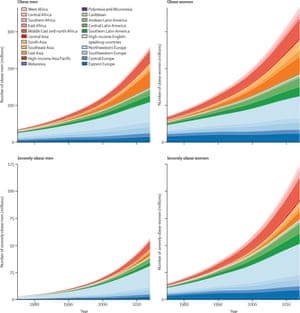
Trends in the number of obese and severely obese people by region. A person is obese if they have a body-mass index (BMI) of 30 kg/m2 or higher, or is severely obese if they have a BMI of 35 kg/m2 or higher. From Lancet report: Trends in adult body-mass index in 200 countries from 1975 to 2014


Trends in the number of obese and severely obese people by region. A person is obese if they have a body mass index (BMI) of 30 kg/m2 or higher, or is severely obese if they have a BMI of 35 kg/m2 or higher. Photograph: The Lancet Publishing Group/Trends in adult body-mass index in 200 countries from 1975 to 2014

Few other problems exhibit such a clear trend, over such a long time frame, across the entire world. In fact, I created this map because I think the magnitude of the global obesity epidemic is difficult to communicate with statistics alone.


However, the map also illustrates another point about a completely different topic, one that is even bigger and further reaching than global obesity – the problem of information overload.


The digital universe is growing exceptionally fast. Half of the information available online today was created in just the last two years. But for that information to be useful to anyone outside of subject matter experts, it must overcome a host of challenges.


First, the information must be practically accessible. This obesity study represents the work of thousands of researchers over perhaps millions of hours. Data visualisation, reduces it all into an intuitive, easily-digestible graphic.


At the same time, data visualisation gives us a frame of reference for understanding what would otherwise be cold, abstract numbers. When you read statistics about obesity, either as written language or as tables of numbers in a spreadsheet, you realise obesity is a problem. But when you watch the story unfold visually, you can feel the depth and magnitude of the problem because you are witnessing it firsthand.


Finally, for the information to be useful, it must be discoverable from among an ever-growing sea of digital noise. Data visualisations are not only informative, they can also be fun and beautiful, something that people will want to share with their friends.


As the digital universe continues to grow, making sense of all that information presents an increasingly difficult challenge. Fortunately, it may have an easy solution: communicate it visually.


How the world got fat: a visualisation of global obesity over 40 years | Max Galka

31 Aralık 2016 Cumartesi

New Year"s Eve partygoers told to beware of fake booze

New Year’s Eve partygoers are being urged to avoid cheap fake booze containing potentially lethal ingredients found in antifreeze.


The warning in the run-up to the UK’s biggest drinking night of the year comes from the Local Government Association (LGA), which represents more than 370 councils in England and Wales. It follows recent council seizures of counterfeit vodka laced with highly dangerous chemicals found in cleaning products and paint solvent.


After a series of raids on suspect premises leading up to New Year’s Eve, council trading standards teams are also warning sellers of illegal alcohol that they face confiscation of their stock, prosecution and being stripped of any relevant licences.


As people stock up on alcohol at home and attend major celebrations in towns and city centres, councils are issuing safety advice to help people avoid harm from dangerous alcohol containing lethal chemicals such as chloroform – which can induce comas – and high levels of methanol which is a key ingredient in antifreeze. Drinking the bogus booze can lead to vomiting, permanent blindness, and kidney or liver problems, and can be fatal in extreme cases.


The LGA is urging shoppers to look out for telltale signs of fake booze. These include unfamiliar names or names mimicking recognised brands, crooked labels, spelling mistakes, and very low prices that seem “too good to be true”. Drinkers being served vodka in pubs and clubs should also smell the drinks as fake vodka will often smell of nail varnish.


“New Year’s Eve is the biggest drinking night of the year but people need to avoid suspiciously cheap, fake alcohol at all costs because it could seriously harm your health, and even kill you,” said Simon Blackburn, a councillor and chair of the LGA’s Safer and Stronger Communities Board.


“Counterfeit alcohol also harms legitimate traders and threatens livelihoods, with the black market trade helping to fund organised criminal gangs. Council trading standards teams have been cracking down on businesses selling fake alcohol and rogue sellers should think twice about stocking these dangerous drinks as we will always seek to prosecute irresponsible traders.”


In a prosecution brought by Halton borough council, a taxi driver had his vehicle seized and was given a suspended sentence after counterfeit vodka was found in his taxi. Twenty-six litres of fake vodka – found to be unfit for human consumption – and 108 bottles of illicit wine were seized following a search of a storage unit.


Separately, Lincolnshire county council’s trading standards officers helped seize 3,570 litres of beers, wines and spirits – most believed to be counterfeit – from 20 premises as part of an operation with police and HMRC.


Drinking industrial-strength isopropanol – which is more commonly found in antifreeze, lotions and cosmetics – can lead to dizziness, vomiting, anaesthesia and even blindness, and can leave someone in a coma. Other substances found in fake bottles of spirits include ethyl acetate, which is normally found in glues, nail polish removers and cigarettes, and can lead to organ damage.


New Year"s Eve partygoers told to beware of fake booze

30 Aralık 2016 Cuma

Norovirus cases in England at highest level in five years

More patients have been struck down with vomiting bug norovirus this year compared with the previous five years, according to official figures.


Data from Public Health England shows reports of the bug had reached 2,435 this winter – 12% more than the average for the same period over the last five years. The figure is also 71% higher than the same period last year, although last winter had unusually low levels of norovirus.


In the week ending on Christmas Day, the outbreaks of vomiting and diarrhoea resulted in more bed closures than during the same period last year – rising from an average of 559 beds closed per day to 699. Hospitals reported 20 outbreaks of norovirus in the first two weeks of December, 17 of which led to bay or ward closures and 13 of which were confirmed as the bug.


In total so far this season, there have been 163 hospital outbreaks reported.


Nick Phin, deputy director of the national infection service at PHE, said: “Norovirus is a common cause of illness during winter. Exactly when the peak in activity occurs will be different each winter but levels seen so far this year are not unexpected compared with the previous five years.”


The number of laboratory reports of the bug rotavirus this season is 1,136, which is also 3% higher than the average for the period from 2003 to 2013.


In early November the Mexican restaurant chain Wahaca closed several branches in London after more than 350 customers and staff fell ill with suspected norovirus. PHE and environmental health officers were called in after the suspected outbreak of the winter vomiting bug struck at nine restaurants.


NHS England also released figures showing there were 291,808 calls to the NHS 111 service in the week ending on Christmas Day as temperatures plummeted and a cold weather alert was issued. This was nearly 9% lower than the number of calls to the helpline in the same week last year. Of calls answered, 93.2% were answered within 60 seconds and 1.5% of patients abandoned their calls after waiting 30 seconds.


Norovirus cases in England at highest level in five years

21 Aralık 2016 Çarşamba

Healthy Eating New Year’s Resolutions for 2017

Congratulations, dear parents! You crossed yet another year of parenting and you, for sure, deserve a pat on your backs. Parenting is a completely different challenge altogether, especially when it comes to keeping your kids’ tummies full. Some don’t like milk; some run away from vegetables like they’re a contagious disease and some just sulk in front of their plates like somebody is making them sit through science lectures post lunch.


The deal is, children are picky eaters, and if you too happen to have strong likes and dislikes as far as eating habits go, then here’s a head’s up: ‘healthy’ eating has perched right next to impossible. There’s always a solution, though. This new year, you could make a list of resolutions that gently nudge you towards embracing eating habits that are healthier.


You might not realize how important this is. But, consider this for a moment: obesity is a reality we are dealing with right now. This stems a lot from unhealthy eating choices. Did you know that in the past 30, the number of obese children has doubled? In fact, by 2012, more than one-third of children and adolescents had obesity. The effects are scary. Studies have shown that 70% of obese youth were at risk of a cardiovascular disease.


Now that we have established the need to have a healthy eating routine let’s understand what will help us get there. Making new year resolutions to eat healthy is a great step. Here are some resolutions you could think of.


1. Pick out the least favorites and glorify them


Every house has a least favorite food. Ok, wait, more than one, to be honest. When I was a kid, my mother would ask me which dish I hated, and she’d go on to glorify it so much, that I’d end up tasting it. Most of the times, I’d like it, and my mom’s mission would be successful. Fruits, veggies or meat, tell your children, or yourself how beautiful it is and look at healthy eating fly back into your house!


2. Educate about the plate


There’s no point chomping the stuff that’s laid out on the plates. If you want to make eating fun, educational, and healthy at the same time, try breaking down the dish into nutritional value, scientific information and all of that. Once you and your children know the benefits of what you’re eating, it makes healthy eating a fun affair, and not a boring one.


3. Involve your children in cooking


When your little elves see how much effort and love goes into the preparation of a dish, they’ll appreciate the food, even if it’s not as appealing as the fries and burgers. Letting them help you with cooking will not just create a beautiful bonding time, but will also help them take to healthy eating habits better.


4. Try using local/organic produce


What’s better than half dead and sad looking veggies from the supermarket? Fresh local produce. Be it veggies, or meat, added preservatives are never a wise choice. It’s slightly more time consuming, but worth all the effort. Fresh and organic ingredients elevate the taste and health quotient of any dish, so this new year, you could give a big thumbs up to this habit.


5. Replace junk with healthier options


Your kids like chips? Go for crispy baked sweet potatoes. Don’t they like fruits? Blend them into oh-so-inviting smoothies. Replace aerated drinks with fresh fruit juices, include salads with interesting dressings as evening snacks and so on. Healthy eating isn’t about starving, you see.


6. Take a trip to the farm


It’s a lot of great things rolled into one. First, this is a perfect getaway during the weekends. Two, your children will see how beautiful food is, be it fruits or vegetables. Third, they get a chance to try a hand a plating a seed and in subsequent visits; they see it grow. This enriching experience is enough for them to fall in love with their plates. If a farm visit is difficult, you could try gardening at home.


7. Eat a rainbow


No, this doesn’t mean you pluck one of the skies. It simply means including seven different coloured food during the seven days of the week. Each color has a nutritional benefit to it, eating different colors will ensure that there is a balance and you will be on track as far as your healthy eating goals are concerned.


8. Blind tasting sessions


This is just like going on a blind date, except for that fact that you and your children will be dating food. Pick out foods that feature on the ‘no way’ list, blindfold members of your family, and make them taste it. Chances are because they don’t know what’s the dish, they’ll end up liking it. That’s how you own the healthy eating habit resolution.


9. Hop, skip and jump


Physical activities are essential. Couch potatoes munch on food not because they’re hungry. Hunger stems from physical activities, so, encourage your entire family to be active. Play, run and ditch the couch for sometime and look at how hungry you feel. And when you’re hungry, healthy food will be gobbled down in seconds.


10. Follow a schedule


Eat in time. This might sound like your grandmother, but eating at regular intervals and on time is important. Binge eating is the unhealthiest form of eating. Breakfast, lunch, dinner and snacks should have a designated time, and make sure your entire family sticks to it. Also, never skip meals. Ever!


11. Wash your hands


Eating healthy is great, but when you touch those fries with germ-infested hands, all your healthy eating goes down the drain. People fall sick despite eating healthy, and dirty hands have been found to be the biggest cause. So, before you eat something, ensure that your hands are clean!


With so many resolutions, your health and eating habits will catapult to a new high. This new year, say hello to good health and smart eating choices. All the best!


Healthy Eating New Year’s Resolutions for 2017

9 Aralık 2016 Cuma

Over 200 years of deadly London air: smogs, fogs, and pea soupers | Vanessa Heggie

On 9 December 1952 the Great Smog officially ended – for five days a thick layer of air pollution, mostly caused by coal fires, had covered London and caused the deaths of thousands of residents. 64 years later the London Mayor has committed £875 million to tackle the problem. This week the Royal Society of Biology hosted an event on air pollution and health (#greyskythinking) and the Royal Society of Chemistry will run their annual Air Pollution conference next week. After two centuries of fatal London fogs, what have we learnt?


Fogs were relatively common in London in the 1700s, but by the early 1800s these had become deadly, as the smoke and fumes from industrialisation and urban growth were trapped by calm, still air. It was not just the pollution that was a threat to life and health, but also the traffic, and newspapers were full of tragic stories of accidents: in the 1837 December fog the Times reported that “an aged female named Jane Wilson” was “knocked down by a cart and severely injured” and Chelsea resident Mr Phillips was thrown out of his chaise into the road where a “cart passed over his right thigh, and fractured it dreadfully”. Animals suffered too – in 1873 the annual cattle show at Smithfield market was ruined by a December fog that left the “fat cattle…panting and coughing”, and many of the animals collapsed and died.


The Victorians are famous for their public health activity – ambitious sewer schemes, the introduction of Medical Officers of Health, and vaccination programmes – so why did they struggle, as we do, to deal with deadly air pollution?


black and white illustration showing foggy street scene; two men with burning torches lead a horse and carriage, while in the foreground a small boy with a torch leads a family group.


The Illustrated London News, Volume 10, 1847. The men and boy carrying lighted torches are acting as guides to the carriage and pedestrians: fogs were often so thick it was impossible to see across a street. Illustration: Wellcome Library, London/Wellcome Library, London. Wellcome Images

If it’s everyone’s fault, it’s no one’s fault


One problem lay in the fact that the smogs had many causes. Heavy industry was one source, but so too were the railways and steamer-boats,and particularly domestic coal-burning fires. Various societies were formed to campaign for what was often called ‘smoke abatement’, but they met with resistance. At a meeting of the ‘Noxious Vapours Abatement Association’ in Manchester, a representative from the Health Committee of the Salford Corporation (like a modern city council) won applause from a working class audience when he objected to smoke abatement because


“he would be sorry to see a persecution commenced against the manufacturers, for if they were driven from the borough, where would the bread of the working man come from?”


If ‘big business’ wasn’t going to reform, why should individuals? Smoke abatement campaigners seem to have thought that education was all that was needed: in 1881 the Smoke Abatement Committee opened a smoke-prevention technology exhibition in London which attracted an extraordinary 116,000 visitors in just a few months; all the installations were independently tested to make sure that the manufacturers’ claims were accurate. Yet this did not lead to a mass take-up of smoke-reducing technology, and an attempt to force changes by passing a law regulating domestic smoke failed in 1884.


Some industries had been regulated by the Smoke Nuisance Abatement (Metropolis) Act of 1853, but only in London, and this excluded some factories such as glass works and potteries. Rather oddly, a lot of the discussion about this Act focused not on the health risks of smoke, but on the expense of laundry caused by the dirty air of London (estimated as high as £2 million) – as one member of the House of Lords suggested: “The smoke so affected the clothing of the working classes that it was computed every mechanic paid at least five times the amount of the original cost of his shirt for the number of washings rendered necessary.”


Sensational cover (orange and blue) of a skull-faced Death in a swirling dark cloud over a city from which terrified inhabitants are fleeing on foot, in cars, bicycles and horse-drawn carriages.


Front cover for booklet advertising Peps cough and cold tablets in 1913. The ‘peril’ refers to deaths from respiratory diseases during heavy fogs in cities. Photograph: Wellcome Library, London/Wellcome Library, London. Wellcome Images

Who pays the price?


Even if it saved on washing bills, there was a genuine fear that over-regulation might lead to job losses. Worse, the Victorians were also concerned that reforming domestic fireplaces would actually make people sicker, rather than healthier. Although open fire places were serious sources of coal smoke pollution, they had one advantage over more efficient systems: they created draughts. Through most of the nineteenth century medical professionals thought that disease was spread by ‘miasmas’, clouds of harmful matter. One way to tackle the danger of miasma was to ensure air did not become ‘stagnant’, and open fireplaces helped to create a ‘healthy’ circulation of air.


While the larger, airier homes of the middle and upper classes could be ventilated in other ways, investigations into the slums and basement dwellings of the poor suggested that open fires were vital. Of course, this could be solved with serious slum clearances and massive investment in homes for the poor, but it proved hard to justify that expense on the grounds that it would prevent air pollution. In any case, reformers worried, people were ‘sentimentally attached’ to their open fires, and resisted technological change.


Suggestions to solve the smoke problem remained small scale: taxes on new stoves or fireplaces, restrictions on certain manufacturing plants, the formation of small local societies to help people buy efficient stoves ‘by instalments’, and so on. But one problem not tackled was the rather obvious one: pollution travels. Responsibility for enforcing anti-pollution and anti-smoke laws rested, by the late 19th century, with local governments and the London County Council, so if pollution was blowing in from a factory in an uncooperative neighbouring jurisdiction, there was nothing councils could do to enforce the limited rules that existed. In 1914 central government was finally persuaded to set up a committee to reconsider the legislation about pollution, but its work was interrupted by the outbreak of war.


It was not until 1956 that a Select Committee’s recommendations, pushed by backbenchers against a sceptical Conservative government, led to the passing of the 1956 Clean Air Act, a direct response to the smog of 1952. For the first time, this Act regulated domestic fireplaces as well as industrial furnaces, and created smoke control areas where only smokeless fuels could be burnt.


Although a milestone in public health, just 60 years later Londoners are dying, again, from polluted air. Although the London Mayor has announced that funding for this problem will be doubled the challenges remain essentially the same faced by the Smoke Abatement Leagues in the 1800s: the causes are complex, some pollution is (thought to be) linked to economic growth and jobs, there are social reasons why people resist changes (especially if they require personal sacrifices, such as giving up car or air travel) and the miasma of pollution still travels across regional and national boundaries. Do we have any new solutions?


Over 200 years of deadly London air: smogs, fogs, and pea soupers | Vanessa Heggie