just etiketine sahip kayıtlar gösteriliyor. Tüm kayıtları göster

12 Mayıs 2017 Cuma

Female mannequins aren"t just skinny, they"re emaciated


There have have been several observations in the press and on social media in the past few years that some of the mannequins used to sell women’s fashion represent unrealistic and unhealthy body sizes. But until we started to look into it, the issue had not been researched properly, and the evidence was mostly anecdotal.


Back in 1992, researchers surveyed a handful of mannequins from the 1930s-1960s housed in museums. They concluded that real women of a similar body size would be so thin that they would be unable to menstruate. More than 80 years on, and with women in a very different societal position than previously, you might expect things to have changed.


Sadly, however, that’s not the case. Our newly published research concludes that the body sizes of mannequins being used to sell female fashion on the British high street today represent those of severely underweight women.


Unhealthily thin


In 2015, we conducted a formal study of mannequins by surveying all national chain fashion stores on the high streets of two cities in England – Liverpool and Coventry – that were using mannequins. In total, we visited 17 stores and got acquainted with 58 mannequins, 32 of which were “female” and 26 “male”.


What we found was that all of the female mannequins in these shops had body sizes that corresponded to that of an underweight human. We didn’t find a single female mannequin that was a normal body size on display.


Samantha Jenkins (@samanthajenkins)

Is it even humanly possible to be as skinny as this Topshop mannequin? pic.twitter.com/fDJSO88v2L


October 30, 2014


The “ultra-thin ideal” is something that I, and many others across the world, loathe. Size zero culture and glamorisation of unrealistic and unobtainable body sizes has meant that the “ideal” body size frequently and implicitly communicated to women is dangerously unhealthy.


Promotion of the ultra-thin ideal has been shown to cause women to be dissatisfied with their body size. And, in turn, this dissatisfaction is thought to be one step along the path of developing an unhealthy desire or “drive” for thinness, and subsequent eating disorders.


Not everyone will develop an eating disorder from having the ultra-thin ideal pushed upon them, and it is difficult to say why some people develop them and others don’t. However, the academic community is pretty convinced that promotion of ultra-thinness is a major player in eating problems, and that it is responsible for the propagation of body image problems in young women.


An ideal model?


Interestingly, we found that most of the male mannequins in our survey didn’t look underweight – only 8% of those surveyed were too thin. This fits well with what we know about ultra-thin body ideals and gender: it is primarily communicated to women, who are a lot more likely than men to develop an eating disorder like anorexia.
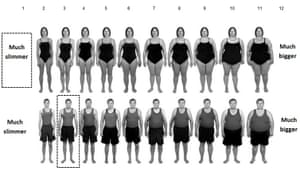


Mean mannequin sizes rated using the BMI-based body size guide rating scale.


Mean mannequin sizes rated using the BMI-based body size guide rating scale. Photograph: Eric Robinson

Our observation of male mannequin shows that there is no legitimate reason why mannequins used to sell female fashion have to be ultra-thin. If their male counterparts can be a “human” shape and size, then why can’t they?


Although some nation fashion stores say they are using larger bodied mannequins, we found no evidence of this in any of the stores that we visited. Of course, we can’t rule out that there may be some larger mannequins knocking about in a small number of stores, but we found that unhealthily thin mannequins are the norm on the high street.


Mannequins aren’t people, nor do they have a sign on them saying “you need to look like this”. But they are representations of the human body that are used to sell fashion and the idea of beauty. There is clear evidence showing that the ultra-thin ideal is contributing to the development of mental health problems and eating disorders.


There is no excuse for the continued use of emaciated mannequins.


Eric Robinson is a senior lecturer in the department of psychological sciences at the University of Liverpool.


This article was originally published on The Conversation. Read the original article.


Female mannequins aren"t just skinny, they"re emaciated

16 Nisan 2017 Pazar

‘I just coped’: Kirsty Wark on breaking the silence about menopause

‘The most disconcerting side-effects were disturbed sleep and night sweats, waking up literally wrung out, with no discernible pattern to either,” says Kirsty Wark. She sounds as measured, informed and professional as is her norm when presenting Newsnight but Wark is talking about something much more personal than current affairs: her menopause.


Wark is fronting a documentary that will air on BBC1 on Thursday: The Menopause and Me. Her involvement in the programme comes from her own sudden and unexpected experience. She had a “medical menopause” at the age of 47, after a hysterectomy and after coming off hormone replacement therapy(HRT) because of fears over its reported link to breast cancer.


“Suddenly, I had no oestrogen and the disturbed sleep and night sweats started. By the time I started making the documentary, nothing much had changed for me in 12 years and I just coped with it, as so many others do.”


But, aside from the obvious physical battle she had to endure, what Wark also struggled with was the apparent silence surrounding the menopause. In many households it is still not discussed and, in those that do broach the subject, it is often talked about in hushed tones as “the change”.


“It’s not so long ago that the hormonal changes that came with menopause were regarded as madness – the madwomen in the attic,” says Wark. “Mythology has a lot to answer for.”


Just 50 years ago, menopausal women tended to suffer alone, mortified by hot flushes and bewildered by hormonal mood swings. There was also a general acceptance that they should retire into the shadows in case it bothered anyone else. The very idea that work colleagues might know or show empathy was anathema.


It has, however, long been the subject of comedy, featuring in episodes of Father Ted and Absolutely Fabulous, as well as in routines by Les Dawson. Jennifer Saunders – who had a cancer-induced menopause – is both funny and uplifting in the Wark documentary. “There’s a moment when you realise everything’s changed,” she says. “Your metabolism, energy levels, skin, hair … so I just had a large glass of champagne and got on with it.”


This 2001 episode of Absolutely Fabulous is called Menopause – the subject crops up frequently on comedy programmes.


This 2001 episode of Absolutely Fabulous is called Menopause – the subject crops up frequently on comedy programmes. Photograph: Brian Ritchie/BBC

Not until relatively recently has it started to be something that is not ignored or giggled at, or both – and this is partly owing to the willingness of celebrities such as Wark and others to speak openly about it.


In a recent interview with People magazine, Gillian Anderson talked about a sense of life falling apart when she experienced perimenopause, the hormonal transition prior to menopause. “All of a sudden, I felt like I could handle nothing. I felt completely overwhelmed,” Anderson said. “When I talked to the specialist, she said she often gets phone calls from female CEOs screaming, ‘I need help now! I’m losing my mind!’ I felt like somebody else had taken over my brain.”


She credits Angelina Jolie with helping change the stigma when she spoke openly about her menopause after having her breast and ovaries removed because of being genetically at risk of breast and ovarian cancer. “Perimenopause and menopause should be treated as the rites of passage that they are,” Anderson told People. “If not celebrated, then at least accepted and acknowledged and honoured.”


Cynthia Nixon, famous for her role in Sex and the City, has also been open, although she had a completely different experience from Anderson, telling the Telegraph that she and her wife are going through the menopause together. Nixon wasn’t upset, revealing: “There has been no sadness for me, because once you hit 50, you’re done.” She cites the advantages of passing childbearing age and experiencing it together. “Although I have a six-year-old, the freedom that comes from no longer being fertile is huge.”


Those differing experiences also highlight a potential problem in being more open about menopause, since symptoms can vary wildly. We have gone from a culture where it was rarely mentioned to, in some cases, one where women suffering badly ask for special consideration in the workplace. This leads to inevitable scepticism not just from men, but from other women who simply don’t suffer to the same extent and feel their colleagues should just put up with it.


Wark’s response to this is to suggest we should all be a bit kinder in the workplace if colleagues aren’t feeling well – which is possibly the best approach.


Wark’s programme is also for partners, husbands, family, friends and employers, to help give them an understanding of what women go through when they enter the menopause. Every angle is explored, with many women and one husband talking about loss of libido, weight gain, hair loss, joint pain and the almost unspeakable vaginal atrophy. 


It’s also useful as a reminder that times change – everyone recognises the classic image of menopausal women as witch-like harridans exhibiting seriously odd behaviour – and that the modern menopausal women is more likely to be leading a busy and satisfying life.


Many confident, articulate women are now talking and writing about the menopause, with India Knight and Christa D’Souza producing highly entertaining books, and Miranda Sawyer writing on the subject with such penetrating honesty and empathy that you wonder if she has been poking about in your own mind.


Gillian Anderson spoke of a sense of her life falling apart following her perimenopause in an interview with People magazine.


Gillian Anderson spoke of a sense of her life falling apart following her perimenopause in an interview with People magazine. Photograph: Anthony Harvey/Getty Images

Many women live a third of their lives post-menopausal, often at the peak of their careers and still with big plans. Medical advances are also making a huge difference to women’s experiences – and how they are seen to be dealing with it by those around them.


Wark admits she was surprised by how much she learned during the making of the programme, particularly from Dr Heather Currie, chair of the British Menopause Society and consultant obstetrician and gynaecologist at Dumfries and Galloway Royal Infirmary in Scotland. Currie also runs the Menopause Matters website.


“Discovering Heather was on HRT was an absolute eye-opener for me,” says Wark. “The US study that prompted me to come off HRT has been considerably revised and HRT only increases the risk of breast cancer if you are already predisposed. I’m back on a small dose of HRT and think I’m starting to see my sleep improve.”


Currie says a new paper by Professor Robert D Langer demonstrates that errors in the study led to 15 years of unnecessary suffering for women who stopped HRT. “There’s a better understanding of risk,” she says. “For most women who commence HRT under the age of 60, or within 10 years of the menopause, it provides more benefits than risks, including symptom control, as well as improved urogenital, bone and cardiovascular health.”


She adds: “The study didn’t show any statistically significant increased risk of breast cancer or heart disease in women using HRT, yet the highly publicised conclusions emphasised these risks. It’s hard to come back from such panic-inducing headlines but I think we are getting there, with more women talking to their GPs about the consequences of menopause and treatment options.”


WHI Study errors led to 15 years of unnecessary suffering for women who stopped HRT.


Dr Heather Currie


Carol Smillie, another famous face who has previously spoken openly about incontinence and periods, thinks women should not be afraid to talk with GPs, friends and family about the menopause. “We live in a far more tolerant society than our parents did,” she says. “Look how far we have come with issues like gender and disability; menopause is more openly discussed and therefore better understood now.”


It is a sentiment echoed in India Knight’s book, where she writes: “There’s a whole third of life to go. That’s not an ending – it’s a thrilling new beginning. And as you approach the years ahead, you do so at the height of your powers. You know more than you’ve ever known. You are the wisest you’ve ever been.”


THE FACTS


The menopause is when a woman stops having periods and cannot get pregnant naturally. It usually occurs between 45 and 55, as oestrogen levels decline. The average age in the UK is 51.


Common symptoms include hot flushes – sudden body temperature changes that produce heat and sweating – night sweats, irregular periods, decreased libido, vaginal dryness and mood swings.


Treatments include HRT and gabapentin, which have received mixed reviews in treating hot flushes and can have significant side-effects.


The most significant recent development is the clinical trial of a new drug carried out by Dr Julia Prague and colleagues at Imperial College London that promises the development of an effective way of reducing hot flushes. The drug is currently undergoing further trials and if these are successful it could make a considerable difference to women’s lives.


Alternative remedies include bio identicals and evening primrose oil.


‘I just coped’: Kirsty Wark on breaking the silence about menopause

29 Mart 2017 Çarşamba

Veganism raises your game. Just ask Jermain Defoe | Jamie Berger

Jermain Defoe knows he’s gained far more than he’s lost by dropping meat, eggs and dairy products from his diet. “I don’t find anything hard to give up … because I know the feeling scoring goals gives me,” the recently recalled England striker said.


He’s not the only one fuelled by plants who experiences that unique, momentous feeling. Countless other athletes of all levels are discovering the same benefits of a vegan diet – and, like Defoe, are seeing their performance soar and recovery time plummet. Many even say that fuelling their body with super-nutritious plant foods is the key to their success.


Take the ultramarathoner and vegan Scott Jurek, who broke the world record for the fastest completion of the 2,189-mile Appalachian Trail. A passionate advocate of vegan eating, Jurek believes the diet is central to the success of his decades-long racing career.


Or consider the NFL defensive lineman David Carter, who is 6ft 5in and “300 pounds of veganism”. “I don’t have the soreness I used to have before. I’m not sluggish. I recover a lot faster,” Carter told the Chicago Sun Times of his transition to a plant-based diet. “I was shocked. When I first started, I was, ‘What the hell? I have more energy. I’m a lot stronger than I was before.’” Carter embodies a definitive riposte to the question many vegans often hear: “But where do you get your protein?”


So does the British professional boxer David “the Hayemaker” Haye, widely recognised as one of the best boxers of his generation. Although he went vegan for ethical reasons, Haye told the Telegraph last year that the diet made him stronger than he’s ever been. Even the superstar tennis sisters Venus and Serena Williams eat a plant-based diet, and Venus credits the diet alone for her ability to get back on the court after she was diagnosed with a debilitating autoimmune condition. “It definitely changed my whole life,” she said in an interview with Health magazine.


So why are so many professional – and amateur – athletes adopting this lifestyle? And why does it seem to supercharge their performance? The body of research on vegan athletes specifically is still small, but studies on those in the general population who have adopted this way of eating offer a great deal of insight.


Venus Williams


Venus Williams got back on the court after a debilitating autoimmune condition. Photograph: Luis M Alvarez/AP

First, overwhelming evidence shows a diet that is full of fruits, vegetables, grains and beans, and devoid of animal products, is perhaps the best diet for cardiovascular health. In fact, some doctors say it’s the only diet proven to actually reverse heart disease, the UK’s number-one killer. In one long-term study, 99% of people with heart disease following a whole-foods, plant-based diet avoided having a major cardiac event such as a heart attack or stroke. Meanwhile, 62% of people who did not adhere to the diet experienced cardiac events.


Given that heart health is a main concern for athletes of all levels, it makes sense that a diet proven to be lower in cholesterol, and to improve cardiovascular function, would be the top choice for top performance. And at least one study on vegetarian athletes backs this up: plant-eating endurance athletes had better cardiorespiratory fitness than their omnivorous counterparts.


Plant-based diets help athletes and nonathletes alike maintain a sleek physique. Studies have found that vegans have lower average body mass indices than even vegetarians, while meat-eaters, on average, have the highest BMIs. In fact, even when calorie intake is the same across all groups studied, the vegans’ high intake of plant-based proteins, fibre, magnesium and other nutrients helps them stay the slimmest.


These healthy nutrients have also been proven to reduce chronic inflammation: the athlete’s worst nightmare. High meat consumption, on the other hand, is associated with inflammation – not to mention greater risk for serious illnesses such as heart disease and type 2 diabetes.


The same is true for meat consumption and cancer. Even when physically fit, athletes aren’t immune from the disease, which accounts for more than a third of all deaths in the UK. Cutting out meat, dairy, and eggs is one of the best ways athletes and others can reduce their cancer risk; studies show that consuming too much animal protein might be just as dangerous as smoking, given that those who eat a lot of meat are four times as likely to die from cancer or diabetes.


Elite athletes make headlines, as Defoe has, when they go vegan, but the science is clear: everyone can benefit from a plant-based lifestyle. We may not all get the thrill of scoring a goal at Wembley, but powered by plants, we’ll all feel better, live healthier and run farther.


Veganism raises your game. Just ask Jermain Defoe | Jamie Berger

16 Mart 2017 Perşembe

“Every year I get a Flu Shot and every year I get the Flu!” Just say NO (thanks)

Every year, thousands of people line up for the flu shot. Very soon after –they get the flu. I’ve heard it so many times in the last month and I know from personal experience working as a nurse years ago, the flu shot can cause the flu. Why keep getting one?


The question then, is how did humanity survive throughout millennia without the flu shot? To answer, we have to study ancient history, or we’re destined to repeat it.


In fact, epidemiologists and viral geneticists studied the worst flu pandemic in the history of the world–the 1918 flu, which infected one-third of the entire world population at the time—over 500 million people. The first wave of this epidemic was typical of the flu—respiratory symptoms, fever, and malaise. As the virus spread beyond the respiratory track, it turned deadly. Instead of being confined to the lungs, the second wave of attack caused massive hemorrhaging from every opening in the body. People bled out from everywhere, not because of the virus—but due to the virus-stimulated cytokine storm, that burst vessels open from inflammation.


A “Cytokine Storm” occurs when the immune system continues to be activated and remains activated against the immune stimulant long after it is necessary. This causes collateral, damaging inflammation.


From scientific research of the viral genome, it appears two events aligned at just the exact time to create the 1918 pandemic:


  • A new influenza strain had “jumped species” aka an “antigenic shift” occurred from avian (birds) just before 1913. Then by 1915 the virus split into two new forms infecting pigs and humans. Analysis of data showed that the severity of this flu was due to the powerful cytokine cascade initiated by the immune system response to infection. Cytokines are immune regulatory proteins that the body sends out to attempt to kill off an invading pathogen. But the response was a thousand times more extreme than the normal. Usually, those with weakened immune systems succumb because they can’t mount an immune response quickly (the elderly and the young)— but this was the opposite—these were mostly young people with healthy, strong immune systems, thrown together in the middle of war, crowded in trenches with no time to rest. This is what spread and what killed so many so quickly.

  • The war itself, which began in 1914. This new strain of influenza spread like wildfire through the ranks on both sides of the conflict. Crowded together in trenches, hospital tents, and extremely unhealthy and contagious conditions, the virus found a perfect breeding ground. Sometime between 1915 and late 1917, the virus mutated again. The first to die, after the infected soldiers, were the first to respond—nurses and doctors; followed by morticians. These people were dealing with massive numbers of casualties, bleeding out from everywhere, completely overwhelming the systems in place—so many in fact, and so much blood—that machines were brought in to scoop up and bury bodies en masse. Day after day for two years, the machines, and the mass burials continued as hospitals, school gymnasiums, and any large building were emptied of bodies. As the war ended, millions of infected soldiers crowded onto ships heading home (no air travel yet). As these ships sailed from port to port, so did the influenza virus—and then further from trains, buses, and cars.

And then, between November and December 1920, simultaneously, around the world, the worst pandemic ended. What did we learn? Would a flu shot have prevented this? These are exactly the kind of questions that keep viral researchers and epidemiologists awake at night.


Fast forward. Could it happen again? Well, we have crowded animal feedlots with little inspection and several different animal species living side by side in virus breeding ground conditions—allowing viruses to jump species and mutate more readily. We have lots of population dense areas like inner city housing, day care centers, schools, hospitals, nursing homes, and even corporate offices. And we have air travel—enabling one human to come in contact with infected animal blood in a remote village and to carry that virus (HIV in the 80’s) across the globe, spreading exponentially, in a matter of hours.


Flu vaccines take time to make—at least 4-6 months from production to distribution. By the time the vaccine is available, the infrastructure of the health care system to quarantine and treat those infected, and effectively administer it would already be decimated. Remember– first to succumb are the first to respond—nurses, doctors, health care workers; followed by morticians. If a vaccine could be distributed quickly—it would only work on the specific virus that emerged in that year, that instance, and was administered within 48 hours from the onset of illness. Any viral mutation would render the entire batch useless. Such exact conditions are essentially impossible to predict. In other words—without an actual human with the flu—it is impossible to make the right vaccine for that particular strain and by the time one case is discovered, it is too late. Drugs like Tamiflu are only active when metabolized in the body, and don’t break down before being excreted in the active form to flow unaffected through wastewater treatment plants. As this active form ends up in streams and waterways—it comes in contact with waterfowl. Thus, the avian strains develop resistance; and as the avian, swine, and human strains get together for dinner and share survival strategies—super resistance is passed on to strains infecting humans.


Tamiflu has some serious, questionable side effects too. Is it worth it?


If an epidemic began in an area where you live, would you know how to protect yourself? Your children?


The best defense is a pro-active offense. Find your truth.
Stephen Harrod Buhner wrote an amazing and informative book to help you called Herbal Antivirals, listed below.


RESOURCES:


CYTOKINE STORM


https://www.quora.com/What-is-a-cytokine-storm-and-what-are-the-diseases-that-cause-that


FLU SHOT


http://www.realfarmacy.com/flu-shot-respiratory/


TAMIFLU


http://www.cchrflorida.org/warning-tamiflu-causes-mental-health-issues/


STEPHEN HARROD BUHNER


http://www.barnesandnoble.com/w/herbal-antivirals-stephen-harrod-buhner/1116395381


Thomasina Copenhaver

Thomasina Copenhaver is a naturopathic doctor and registered nurse with over 30 years experience in the healthcare profession. Her passion is writing, researching, and empowering all humans with knowledge of healing at the cellular level; to enable them to make educated and informed choices regarding their health. For more information visit her website www.notesfromanaturopath.com or to buy her book, “Notes from a Naturopath” visit Amazon or Barnes and Noble.


“Every year I get a Flu Shot and every year I get the Flu!” Just say NO (thanks)

“Every year I get a Flu Shot and every year I get the Flu!” Just say NO (thanks)

Every year, thousands of people line up for the flu shot. Very soon after –they get the flu. I’ve heard it so many times in the last month and I know from personal experience working as a nurse years ago, the flu shot can cause the flu. Why keep getting one?


The question then, is how did humanity survive throughout millennia without the flu shot? To answer, we have to study ancient history, or we’re destined to repeat it.


In fact, epidemiologists and viral geneticists studied the worst flu pandemic in the history of the world–the 1918 flu, which infected one-third of the entire world population at the time—over 500 million people. The first wave of this epidemic was typical of the flu—respiratory symptoms, fever, and malaise. As the virus spread beyond the respiratory track, it turned deadly. Instead of being confined to the lungs, the second wave of attack caused massive hemorrhaging from every opening in the body. People bled out from everywhere, not because of the virus—but due to the virus-stimulated cytokine storm, that burst vessels open from inflammation.


A “Cytokine Storm” occurs when the immune system continues to be activated and remains activated against the immune stimulant long after it is necessary. This causes collateral, damaging inflammation.


From scientific research of the viral genome, it appears two events aligned at just the exact time to create the 1918 pandemic:


  • A new influenza strain had “jumped species” aka an “antigenic shift” occurred from avian (birds) just before 1913. Then by 1915 the virus split into two new forms infecting pigs and humans. Analysis of data showed that the severity of this flu was due to the powerful cytokine cascade initiated by the immune system response to infection. Cytokines are immune regulatory proteins that the body sends out to attempt to kill off an invading pathogen. But the response was a thousand times more extreme than the normal. Usually, those with weakened immune systems succumb because they can’t mount an immune response quickly (the elderly and the young)— but this was the opposite—these were mostly young people with healthy, strong immune systems, thrown together in the middle of war, crowded in trenches with no time to rest. This is what spread and what killed so many so quickly.

  • The war itself, which began in 1914. This new strain of influenza spread like wildfire through the ranks on both sides of the conflict. Crowded together in trenches, hospital tents, and extremely unhealthy and contagious conditions, the virus found a perfect breeding ground. Sometime between 1915 and late 1917, the virus mutated again. The first to die, after the infected soldiers, were the first to respond—nurses and doctors; followed by morticians. These people were dealing with massive numbers of casualties, bleeding out from everywhere, completely overwhelming the systems in place—so many in fact, and so much blood—that machines were brought in to scoop up and bury bodies en masse. Day after day for two years, the machines, and the mass burials continued as hospitals, school gymnasiums, and any large building were emptied of bodies. As the war ended, millions of infected soldiers crowded onto ships heading home (no air travel yet). As these ships sailed from port to port, so did the influenza virus—and then further from trains, buses, and cars.

And then, between November and December 1920, simultaneously, around the world, the worst pandemic ended. What did we learn? Would a flu shot have prevented this? These are exactly the kind of questions that keep viral researchers and epidemiologists awake at night.


Fast forward. Could it happen again? Well, we have crowded animal feedlots with little inspection and several different animal species living side by side in virus breeding ground conditions—allowing viruses to jump species and mutate more readily. We have lots of population dense areas like inner city housing, day care centers, schools, hospitals, nursing homes, and even corporate offices. And we have air travel—enabling one human to come in contact with infected animal blood in a remote village and to carry that virus (HIV in the 80’s) across the globe, spreading exponentially, in a matter of hours.


Flu vaccines take time to make—at least 4-6 months from production to distribution. By the time the vaccine is available, the infrastructure of the health care system to quarantine and treat those infected, and effectively administer it would already be decimated. Remember– first to succumb are the first to respond—nurses, doctors, health care workers; followed by morticians. If a vaccine could be distributed quickly—it would only work on the specific virus that emerged in that year, that instance, and was administered within 48 hours from the onset of illness. Any viral mutation would render the entire batch useless. Such exact conditions are essentially impossible to predict. In other words—without an actual human with the flu—it is impossible to make the right vaccine for that particular strain and by the time one case is discovered, it is too late. Drugs like Tamiflu are only active when metabolized in the body, and don’t break down before being excreted in the active form to flow unaffected through wastewater treatment plants. As this active form ends up in streams and waterways—it comes in contact with waterfowl. Thus, the avian strains develop resistance; and as the avian, swine, and human strains get together for dinner and share survival strategies—super resistance is passed on to strains infecting humans.


Tamiflu has some serious, questionable side effects too. Is it worth it?


If an epidemic began in an area where you live, would you know how to protect yourself? Your children?


The best defense is a pro-active offense. Find your truth.
Stephen Harrod Buhner wrote an amazing and informative book to help you called Herbal Antivirals, listed below.


RESOURCES:


CYTOKINE STORM


https://www.quora.com/What-is-a-cytokine-storm-and-what-are-the-diseases-that-cause-that


FLU SHOT


http://www.realfarmacy.com/flu-shot-respiratory/


TAMIFLU


http://www.cchrflorida.org/warning-tamiflu-causes-mental-health-issues/


STEPHEN HARROD BUHNER


http://www.barnesandnoble.com/w/herbal-antivirals-stephen-harrod-buhner/1116395381


Thomasina Copenhaver

Thomasina Copenhaver is a naturopathic doctor and registered nurse with over 30 years experience in the healthcare profession. Her passion is writing, researching, and empowering all humans with knowledge of healing at the cellular level; to enable them to make educated and informed choices regarding their health. For more information visit her website www.notesfromanaturopath.com or to buy her book, “Notes from a Naturopath” visit Amazon or Barnes and Noble.


“Every year I get a Flu Shot and every year I get the Flu!” Just say NO (thanks)

7 Mart 2017 Salı

“Every year I get a Flu Shot and every year I get the Flu!” Just say NO (thanks)

Every year, thousands of people line up for the flu shot. Very soon after –they get the flu. I’ve heard it so many times in the last month and I know from personal experience working as a nurse years ago, the flu shot can cause the flu. Why keep getting one?


The question then, is how did humanity survive throughout millennia without the flu shot? To answer, we have to study ancient history, or we’re destined to repeat it.


In fact, epidemiologists and viral geneticists studied the worst flu pandemic in the history of the world–the 1918 flu, which infected one-third of the entire world population at the time—over 500 million people. The first wave of this epidemic was typical of the flu—respiratory symptoms, fever, and malaise. As the virus spread beyond the respiratory track, it turned deadly. Instead of being confined to the lungs, the second wave of attack caused massive hemorrhaging from every opening in the body. People bled out from everywhere, not because of the virus—but due to the virus-stimulated cytokine storm, that burst vessels open from inflammation.


A “Cytokine Storm” occurs when the immune system continues to be activated and remains activated against the immune stimulant long after it is necessary. This causes collateral, damaging inflammation.


From scientific research of the viral genome, it appears two events aligned at just the exact time to create the 1918 pandemic:


  • A new influenza strain had “jumped species” aka an “antigenic shift” occurred from avian (birds) just before 1913. Then by 1915 the virus split into two new forms infecting pigs and humans. Analysis of data showed that the severity of this flu was due to the powerful cytokine cascade initiated by the immune system response to infection. Cytokines are immune regulatory proteins that the body sends out to attempt to kill off an invading pathogen. But the response was a thousand times more extreme than the normal. Usually, those with weakened immune systems succumb because they can’t mount an immune response quickly (the elderly and the young)— but this was the opposite—these were mostly young people with healthy, strong immune systems, thrown together in the middle of war, crowded in trenches with no time to rest. This is what spread and what killed so many so quickly.

  • The war itself, which began in 1914. This new strain of influenza spread like wildfire through the ranks on both sides of the conflict. Crowded together in trenches, hospital tents, and extremely unhealthy and contagious conditions, the virus found a perfect breeding ground. Sometime between 1915 and late 1917, the virus mutated again. The first to die, after the infected soldiers, were the first to respond—nurses and doctors; followed by morticians. These people were dealing with massive numbers of casualties, bleeding out from everywhere, completely overwhelming the systems in place—so many in fact, and so much blood—that machines were brought in to scoop up and bury bodies en masse. Day after day for two years, the machines, and the mass burials continued as hospitals, school gymnasiums, and any large building were emptied of bodies. As the war ended, millions of infected soldiers crowded onto ships heading home (no air travel yet). As these ships sailed from port to port, so did the influenza virus—and then further from trains, buses, and cars.

And then, between November and December 1920, simultaneously, around the world, the worst pandemic ended. What did we learn? Would a flu shot have prevented this? These are exactly the kind of questions that keep viral researchers and epidemiologists awake at night.


Fast forward. Could it happen again? Well, we have crowded animal feedlots with little inspection and several different animal species living side by side in virus breeding ground conditions—allowing viruses to jump species and mutate more readily. We have lots of population dense areas like inner city housing, day care centers, schools, hospitals, nursing homes, and even corporate offices. And we have air travel—enabling one human to come in contact with infected animal blood in a remote village and to carry that virus (HIV in the 80’s) across the globe, spreading exponentially, in a matter of hours.


Flu vaccines take time to make—at least 4-6 months from production to distribution. By the time the vaccine is available, the infrastructure of the health care system to quarantine and treat those infected, and effectively administer it would already be decimated. Remember– first to succumb are the first to respond—nurses, doctors, health care workers; followed by morticians. If a vaccine could be distributed quickly—it would only work on the specific virus that emerged in that year, that instance, and was administered within 48 hours from the onset of illness. Any viral mutation would render the entire batch useless. Such exact conditions are essentially impossible to predict. In other words—without an actual human with the flu—it is impossible to make the right vaccine for that particular strain and by the time one case is discovered, it is too late. Drugs like Tamiflu are only active when metabolized in the body, and don’t break down before being excreted in the active form to flow unaffected through wastewater treatment plants. As this active form ends up in streams and waterways—it comes in contact with waterfowl. Thus, the avian strains develop resistance; and as the avian, swine, and human strains get together for dinner and share survival strategies—super resistance is passed on to strains infecting humans.


Tamiflu has some serious, questionable side effects too. Is it worth it?


If an epidemic began in an area where you live, would you know how to protect yourself? Your children?


The best defense is a pro-active offense. Find your truth.
Stephen Harrod Buhner wrote an amazing and informative book to help you called Herbal Antivirals, listed below.


RESOURCES:


CYTOKINE STORM


https://www.quora.com/What-is-a-cytokine-storm-and-what-are-the-diseases-that-cause-that


FLU SHOT


http://www.realfarmacy.com/flu-shot-respiratory/


TAMIFLU


http://www.cchrflorida.org/warning-tamiflu-causes-mental-health-issues/


STEPHEN HARROD BUHNER


http://www.barnesandnoble.com/w/herbal-antivirals-stephen-harrod-buhner/1116395381


“Every year I get a Flu Shot and every year I get the Flu!” Just say NO (thanks)

2 Mart 2017 Perşembe

Just keep swimming – through the pee, plasters and human hair | Sally Goble

Look. If you are of a delicate disposition, best not take up swimming. Don’t venture down to your local pool, strip off your clothes, wade through a slightly wet and dirty changing room and immerse yourself into what is, effectively, a communal bath full of the hoi polloi and all their bodily fluids. Just don’t do it.


If you are of a delicate disposition, you won’t end up feeling relaxed, with a sense of wellbeing and a healthy glow. You’ll be too concerned about verrucas, or cross and suffering from “lane rage”. You’ll complain about everything from people peeing in the water – which scientists have found is a frequent occurrence – to the quantity of the pool chemicals needed to counteract the peeing, to the water being too cold (or too hot).


You’ll be unhappy about the plasters and miscellaneous hairs that have sunk to the bottom of the pool. You’ll be irritated by the kids screaming and about swimmers splashing arrogantly; or women slowly breaststroking in twos and chatting while still in full makeup. You’ll feel as if your swim has been ruined.


I’ve swum in many pools – probably more than 100 – and I can tell you that every one has its fair share of annoyances. And they all, undoubtedly, have users who pee in the water. Every pool in the UK (where, for some reason, we don’t require swimmers to wear bathing caps) has great billowing clouds of hair floating around waiting to get caught repulsively between your fingers.


Many pools aren’t as clean as we’d like, but public pools are often underfunded. The staff who work at these places are often poorly paid and on casual shifts. The lifeguards who keep order, and whom we trust to save our lives, if necessary, are often required to do most of the cleaning, and to regulate the chemicals and temperatures of the water. Cut them some slack.


In most pools, just as there are cleanliness issues, there are people issues too. Every leisure centre has a weirdo who spends too much time in the shower. Every swim features a strange encounter with a near-naked stranger.


If you are of a delicate disposition you won’t end up feeling relaxed. You’ll be too concerned about verrucas


Last weekend, as I was doing lengths at my local pool, I noticed a woman standing at the end of the pool, at the deep end. She stood for about five minutes on the pool deck, with her arms folded, staring at the swimmers already in the water. It was disconcerting. Every time I swam up to the deep end, I wondered if she would jump on top of me as I reached the wall to turn.


Instead, after a while, she got into the lane next to me and swam breaststroke – badly – clad in swimwear that left little to the imagination, splendidly displaying much of her bottom as she glided along.


The weekend before, there was a strange man practising “free diving”. This moustachioed fellow would periodically swoop down to the bottom of the pool where he would stay for minutes at a time, staring in a trance at the tiles, barely moving. If you didn’t know what he was doing, you’d think he had drowned. It slightly unnerved me as I swam over the top of him, metres above.


And every week, no matter where I swim, there is always some beefy guy in beach shorts who gets in the same lane as me. This bloke will assume that he can swim faster than me because he’s a bloke and I am a middle-aged woman. So he will wait until I am about to turn at the end of the lane and push off in front of me and then hold me up by swimming more slowly than me. I take great pleasure in overtaking while simultaneously, very deliberately, eyeballing him.


But I don’t get exercised. I don’t complain to the lifeguards. It’s not my pool, I think. It’s there for us all to share. Live and let live. Your swim is just as valid as my swim. I embrace your chattering, your free-diving, your breaststroke screw-kick and your bikinis. I embrace the floating plasters and the overwhelming smell of chlorine. And if your kid (or you) have peed in the water, I don’t really care about that either.


But if the thought of urine, sweat and snot (and worse) appals you, and if you don’t want to swim too close to someone who is almost naked and cooperate with them, then do yourself – and me – a favour. Walk up a deserted mountain instead.


Just keep swimming – through the pee, plasters and human hair | Sally Goble

20 Şubat 2017 Pazartesi

Vitamin D is not just beneficial, it’s a necessity | Letter

Great to see vitamin D on your front page at last (Vitamin D ‘proved to cut risk of colds and flu’, 16 February). Those of us in the British Society for Ecological Medicine, a group of doctors who take the nutritional aspects of our patients’ treatment very seriously, have been banging on about the benefits, and indeed the necessity, of vitamin D for decades. Indeed, the society’s president, Dr Damien Downing, published a book about it back in 1988 entitled Day Light Robbery – The Importance of Sunlight to Health.


I would just like to add two points: first, vitamin D is vital not only to the health of the immune system, thereby in fact reducing the likelihood of cancer as well as of infections, it is also essential for mental health. In young people with depression and in older people with onset of dementia, we find desperately low levels of vitamin D. Vegans are particularly at risk, because in the British climate they have virtually no source of vitamin D at all.


Second, with regard to the proposal to add vitamin D to our food: it is crucial that this be the real thing, vitamin D3, cholecalciferol. Too often, what is added to foods and cheap multivitamins is vitamin D2, ergocalciferol, which is synthetic and far less useful.


Thank you again for publicising this excellent research.
Dr Jenny Goodman
Barnet, Hertfordshire


Join the debate – email guardian.letters@theguardian.com


Read more Guardian letters – click here to visit gu.com/letters


Vitamin D is not just beneficial, it’s a necessity | Letter

26 Ocak 2017 Perşembe

The war on abortion is just beginning | Jessica Valenti

If you’ve ever wondered what the oft-used and much maligned word “patriarchy” looks like, you need look no further than a picture of Donald Trump, surrounded by white men, reinstating the global gag rule. The policy, which bans funding any international organization that dares to even talk about abortion, has contributed to thousands of women’s deaths across the globe.


The executive order was just the beginning. In the short time Trump has been president, his administration has set a disastrous course for women’s health and rights. On Tuesday, days after historic marches that put millions of women on the street globally, Republican congressmen introduced the first ever federal ‘heartbeat bill’ – a policy that would ban abortions after six weeks, well before most women even know they’re pregnant.


That same day, the House passed a bill that would make the dangerous and discriminatory Hyde Amendment – which prevents federal funds from covering abortion, even in cases of fetal abnormalities and maternal health issues – permanent. The bill, which targets poor women, would also impact abortion coverage for women with private insurance. Congressional republicans have even introduced a federal ‘personhood’ bill that would define life as beginning at conception.


While the bills will not likely get far, the new administration is sending a clear message – they’re keeping Trump’s promise to punish women who have abortions, and rolling back hard-won rights. These are far-reaching and radical policies that quite literally kill women. There is no overstating just how harmful they are.


So you’ll excuse me for laughing off recent suggestions that feminists embrace “pro-life” women in the name of inclusivity. You don’t get to feel bad about being banned from the treehouse when you’re in the middle of setting the trunk on fire.


And let’s be clear: these political positions are not about reducing the number of abortions. The global gag rule, for example, has been shown to increase abortion – especially illegal and unsafe abortions. The same is true for state level abortion bans; hundreds of thousands of women in Texas have tried to induce their own abortions. Anti-choice policies don’t prevent women ending their pregnancies, they just ensure that women do it dangerously.


If anti-abortion legislators or so-called pro-life feminists were interested in decreasing the number of abortions they’d be enthusiastically supporting comprehensive sex education, affordable birth control, and access to over-the-counter emergency contraception. They’d be introducing legislation to mandate paid parental leave and subsidized child care.


But they’re not. And they won’t. So let’s not fool ourselves – these next four years are about fighting for what’s right, not searching for the nonexistent distraction of common ground.


Conservative, and mostly male, legislators will continue to push extreme policies; not necessarily with the hope that they’ll pass, but with the understanding that less radical laws might then seem “reasonable.” Diane Horvath-Cosper from Physicians for Reproductive Health told the Guardian this week, “So when a congressman introduces a 20-week bill, it looks moderate by comparison.”


But there is nothing moderate or reasonable about forced pregnancy, not at any point. There is no common ground with an administration that would put the rights of a fertilized egg above those of a living person. So keep those pink hats handy – we’re going to need them.


The war on abortion is just beginning | Jessica Valenti

24 Ocak 2017 Salı

Tackling mental health stigma will require more than just goodwill

The prime minister, Theresa May, has pledged to tackle mental health stigma as part of her vision for her “shared society”. May announced plans to transform the way mental illness is dealt with not in our hospitals but in classrooms, at work and in our communities. The initiative has been largely welcomed, although there is concern that this is yet another governmental policy that hinges on goodwill rather than identifiable resource.


Given the stakes, we cannot afford to be sceptical or dismissive about any initiative on stigma.


Just as mental illness is a common phenomenon, so is stigma. Mental health problems affect more than 450 million people worldwide, of whom more than three-quarters come from middle- and low-income countries. At least one in four people will experience a mental health problem at some point in their life and one in six adults has a mental health problem at any one time.


An Australian survey (pdf) found that three out of four patients with mental illness reported that they had experienced stigma. The same study also found that one in four members of the public thought depression was a sign of weakness and said they would not employ a person with depression; around a third would not vote for a politician who had depression, and one in five said if they had depression they would keep it to themselves.


Patients suffer a range of adversities as a result of stigma and discrimination, from distress to suicidal acts. A number of patients are put off seeing a mental health professional for fear that they will be looked down on if they venture anywhere near a psychiatric unit.


A substantial number of patients therefore remain untreated, and if they do seek treatment it is often when their illness has become so severe that there is little option for them or their relatives to obtain specialist help. Barriers preventing patients seeking help or adhering to treatment include a lack of positive experiences, poor knowledge of mental disorders and their treatment, reliance on faith based or religious healers, and specific taboos such as marital or child-bearing prospects.


Mental illness, and by implication stigma, has a profound impact on individuals, their families and the community as a whole.


The wider impact of such stigmatisation has not been studied in detail. However, there is good evidence that the carers and families of affected individuals can be similarly affected. Furthermore, it is not unusual for mental health professionals themselves to be looked down on by other health professionals.


The de-stigmatisation of mental illness requires a complete change in attitude by the medical and other professions. It is unethical to discriminate against any patient on any count, and in this regard mental illness is no different. The evidence is compelling that the best outcomes are achieved by ensuring any mental disorder is treated vigorously in patients who present with physical disease. It is entirely unacceptable that patients with severe mental illness should die 10 to 20 years earlier than the general population.


Patients with mental illness and a concomitant physical disease are also reluctant to seek medical advice, and have worse outcomes; the reverse is also true, that patients with a physical illness and concomitant mental illness also have worse outcomes than those without any mental disorder. The role of clinicians is crucial in providing that holistic approach to physical and mental care and treatment to ensure that such anomalies are eliminated.


There is compelling evidence that severe mental illness in most patients shows signs of emergence at an early age, sometimes as early as seven years. In the majority of cases, schools are well equipped to dealing with minor behavioural problems, but as more complex issues arise, expert help needs to be immediately accessible through child and adolescent mental health services. However, there are major issues – including recruitment, costs and availability of beds – that have to addressed urgently because the system is at breaking point in many areas.


In regards to employers, there will have to be a sea change in their attitudes. There is widespread discrimination of patients with mental illness; more often than not patients will make no declaration for fear that they will become unemployable. It remains to be seen how the government will tackle this.


Stigma of mental illness is a serious issue that requires a concerted and collaborative political, social, medical and media will to eradicate. The negative impact it has on patients and their families and carers must not be underestimated.


The prime minister may have bitten off more than she can chew, but there must be no doubt at all that her announcement gives us fresh impetus and thinking on how to tackle an issue that has blighted the lives of millions of people worldwide, and continues to do so. However, if she has the strength of her convictions than she must have no illusions; she can no longer rely on the overstretched goodwill of the staff, be they in education, healthcare or the voluntary sector. Without allocating resources, this is little more than motherhood and apple pie.


Join the Healthcare Professionals Network to read more pieces like this. And follow us on Twitter (@GdnHealthcare) to keep up with the latest healthcare news and views.


Tackling mental health stigma will require more than just goodwill

23 Ocak 2017 Pazartesi

The coil isn’t just a great contraceptive, it’s a form of resistance for US women | Nell Frizzell

As I lie back across the thin blue paper runway, my legs open, an Anglepoise lamp shining into the abyss, my nurse (called, ironically, Comfort) warns: “This may be a little uncomfortable.” Oh how we laughed. But I was determined – I wanted a coil.


According to reports, in the first week after the US election, Planned Parenthood (which Donald Trump, vice president Mike Pence, and House speaker Paul Ryan all want to stop funding, by the way) saw a 900% increase in patients seeking IUDs. As the news that Trump was to nominate “women’s health opponent” Tom Price for secretary of health and human services fell across America like sleet, women, nurses and healthworkers took to social media advising one simple thing: get a coil.


It builds on an existing trend for American women to choose intrauterine devices. Under Barack Obama’s Affordable Care Act, insurance providers are required to cover a woman’s birth-control method of choice for free; usually this costs about $ 1,000 for insertion and follow-up visits. For the first time, the IUD was affordable, as well as reliable. And so, according to US Center for Disease Control and Prevention’s National Center for Health Statistics (NCHS), IUD use increased 83% comparing 2006–2010 with 2011–2013. In an anti-abortion, pussy-grabbing climate, American women have been backed into a corner and the IUD seems, at the moment, like their last form of defence.


Coils give us hormone-free control over our wombs and, therefore, lives


Nearly 10 years ago, I had my very own little hammerhead shark of copper wire inserted into my uterus. It would do nothing to protect against sexually transmitted infections, I knew; it might make my periods heavier, I understood; having it put in might make me wince, I’d been told. But, my god, it was better than the alternatives. Even in this new millennium I couldn’t rely on men to carry, let alone use, condoms. And while on the pill I had cried, almost continuously, for three months. Sex wasn’t just off the menu – my body felt like a bovine mass of lustless, listless despair. In that way, the contraception was working brilliantly – I was about as likely to want sex as I was to take up a laboratory position at Massachusetts Institute of Technology.


That the source of my sadness could be linked to the galloping horse-sized quantity of hormones running through my bloodstream didn’t occur to me for longer than I care to admit. But when it did, the solution seemed as clear as it did to that tweeting nurse in Colorado: get your IUD.


As Vicky Spratt of The Debrief has written for their new Mad About The Pill campaign, the link between the contraceptive pill and mental health problems is still just anecdotal. But by god the anecdotes are there. According to the site’s survey of 1,022 women, 46% reported that the pill had decreased their sex drive, 45% said that they believed they had experienced anxiety, 45% said they had experienced depression and 20% reported experiencing panic attacks which they attributed to their hormonal contraception. If we were in America, we’d have had to pay for the pleasure of this troublesome medicine. So no wonder so many of us are looking into alternatives.


The copper coil didn’t make me weep uncontrollably with the curtains closed, it didn’t turn my tits into bricks and I never had to panic that I’d left it at home. You do not forget about your coil and then have to seek emergency contraception; you can keep the same coil in for up to 10 years, which means you can be miles from a chemist, in another country, or simply at work and never have to worry. It will not tear while fumbling in the gloom of your parents’ spare room; it won’t get punctured by the keys in your pocket; you don’t have to pay £2 in a pub toilet for it and, in my case at least, it didn’t hurt.


Coils give us hormone-free control over our wombs and, therefore, lives. On the downside they do nothing to protect against STIs and there are, of course, women who suffer serious side-effects – heavy or irregular periods, damage to the womb, pelvic infections, ectopic pregnancies. But the coil still deserves to move away from the icky, scary reputation it had when our mothers were sleeping around.


Of course I find it exasperating, frustrating, maddening and saddening that the burden of not getting pregnant still falls almost entirely on women. Many men will still assume that she “has it covered”; many still squirm away from condoms; some seem entirely unaware of what sperm may do. It’s 2017, for Christ’s sake – and yet, I know firsthand that many women are expected to be magically infertile right up until the moment their partner wants a baby. And, should that woman want to get pregnant earlier? Well then, of course, the question of coming off contraception must be a joint one. He must have his say. If he’s not ready then you cannot push it on him. If you do, you are branded selfish and controlling.


When it comes to our bodies, we carry all the responsibility; but not quite all of the power. But, perhaps, the coil can help claim some back.


The coil isn’t just a great contraceptive, it’s a form of resistance for US women | Nell Frizzell

20 Ocak 2017 Cuma

One Home Remedy for Allergies That Just Doesn't Work


Can drinking cayenne tea help with my allergies?


The essential ingredient in cayenne pepper is capsaicin, which is used for many things, from rubs that treat sore muscles to pepper sprays used for self-defense. It is also found in certain nasal sprays to alleviate congestion in people with sinus issues. But, sadly, there is no research to support the claim that drinking it in hot tea will help with your allergies.


At the very least, if the tea is spicy enough, it may trigger a runny nose in the same way that eating spicy foods can, and this might bring some minor relief if your allergies are stuffing you up. People who’ve tried it say that it’s like a “clearing-out.”


But I don’t recommend following their lead. Aside from being only a temporary solution, the spiciness of the tea can upset your stomach. Plus, if it’s making your nose run, there’s the possibility that it will backfire by adding more mucus. What you really want is prevention. If you haven’t already, see an allergist to determine exactly what your triggers are so you can avoid them. And, if needed, take an antihistamine or use a steroid nasal spray daily to get ahead of stuffiness.


Health‘s medical editor, Roshini Rajapaksa, MD, is assistant professor of medicine at the NYU School of Medicine and co-founder of Tula Skincare.RELATED: 24 Ways to Allergy-Proof Your Home

20 Ways to Stop Allergies


11 Unexpected Allergy Triggers


One Home Remedy for Allergies That Just Doesn"t Work

Ebola, war … but just two psychiatrists to deal with a nation"s trauma

The history of Africa’s oldest psychiatric hospital is written on the walls of its isolation units, desperate messages chiselled into the woodwork like scars. “I came here for I don’t have any money,” reads one note in a corner of the room. “People want me to run from my father’s house,” reads another. “You go nowhere,” announces a third. “Stay out.”


Since the hospital opened in the early 19th century, most Sierra Leoneans have aspired to do exactly that, avoiding this imposing building perched high on a hill above the capital, Freetown.


Still the country’s only mental healthcare facility, the Sierra Leone psychiatric hospital is known in the local Krio language as the “crase yard” or “place for crazy people”. During the civil war in the 1990s, rebel fighters got as far as the staff quarters before turning back, too afraid of what they might find inside, witnesses say.


We do counselling, though it’s not the type of counselling they do in America or Europe


Edward Nahim, psychiatrist


When the world’s worst Ebola outbreak began there two years ago, Sierra Leone had just 136 doctors working in the public sector, according to the World Health Organisation, a massive shortfall for a population of 6 million.


There was only one psychiatrist: Edward Nahim, a wry, Soviet-trained 70-year-old who spent his mornings scribbling prescriptions in the foyer of the hospital, where many patients were kept chained and treatment consisted of little more than a daily dose of expired antipsychotic drugs. Electricity flickered and rusting buckets served as makeshift toilets on the days the pipes ran dry, which was most of the time.


The mental health toll that Ebola exacted – depression, anxiety and post-traumatic stress disorder – was massive. But the hospital’s fearsome reputation meant few of those affected considered looking there for support. In the early days of the outbreak, many people considered hospitals to be dumping grounds for the dying or, worse, the places that had made them sick.


Those suffering from the virus’s psychological side-effects viewed the psychiatric facility in a similarly negative light.


“Because we have so few professional resources, people are used to understanding mental illness in their own way and most would never even think of coming to a hospital for psychiatric treatment,” says Stephen Sevalie, who this year became the country’s second psychiatrist, working for the Sierra Leone armed forces.


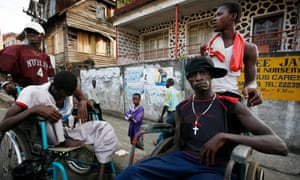
Boys and men in wheelchairs in Freetown


About 25% of disabled people in Sierra Leone are amputees who were wounded in the civil war. Photograph: David Levene for the Guardian

But Nahim says this caution may not be entirely a bad thing. Places such as Sierra Leone needs fewer formal mental health services than western countries, he says, because its people are able to rely so heavily on community structures – families, traditional healers and religious leaders – during times of emotional distress.


“We do counselling, though it’s not the type they do in America or Europe,” Nahim says. “Here, if you have a problem, someone talks to you. Your parents talk to you. Your church talks to you. Your traditional healers treat and counsel you. In America they need professional counsellors because no one talks to anybody – if you try to talk to somebody, they’ll probably call the police.”


But a lack of formal treatment options for those struggling the most has led to desperation, too. Bars selling cheap sachets of gin and whisky are crowded long before noon, and weather-battered men wander the streets of Freetown, mumbling to themselves and begging for change and discarded food. Drug abuse is rampant, particularly among the war veterans, many of whom were children when they fought.


For those working in the mental health sector, this is not the way things were supposed to be. In the years after the decade-long civil war which, according to the UN, led to the deaths of more than 70,000 people and to hundreds of thousands being maimed by amputation, international charities poured into Sierra Leone with promises to heal its emotional wounds.


Healthcare workers carry a man suspected of having Ebola to an ambulance in Kenema, the country’s third largest city.


Healthcare workers carry a man suspected of having Ebola to an ambulance in Kenema, the country’s third largest city. Photograph: Tanya Bindra/AP

“Many of these programmes were excellent,” says Dr Florence Baingana, who works for the World Health Organisation’s Sierra Leone office. But they were also temporary. “You can’t run a mental healthcare system with outsiders – NGOs have a life cycle; they come and they go.”


Mental health in particular proved a hard sell to international donors over the long term – the wounds it healed were largely invisible and the progress drawn out.


Slowly, the international money dwindled, says Edward Bockarie, executive director of the Community Association for Psychosocial Services (Caps), a Sierra Leonean NGO that has provided counselling since the end of the war.


Map

On a recent morning, counsellors at one of his regional offices in the eastern province of Kailahun hunched over a few shared computers, planning projects. None of them had been paid for nearly six months, after their last spurt of funding ran dry.


“This is our initiative. We can’t just leave it,” says Maxwell Makieu, a counsellor who has worked with the association since its launch in a refugee camp in Guinea 20 years ago.


Back then, he and the other Caps counsellors were refugees fleeing conflict in Sierra Leone, hired by an American nonprofit organisation to provide peer counselling to others in the camp. When the centre retreated from Sierra Leone a few years later, its local counsellors started their own group.


For the past decade, they have scraped together grants to keep their shoestring operation running in two districts in the war-ravaged east.


That meant that when Ebola broke out they were among the only counsellors prepared to respond. Their staff were quickly scooped up by Médecins Sans Frontièresand other international charities to work in their treatment centres.


But when the outbreak ended, predictably, so did most international interest in their work.


At the Kailahun district hospital, there are signs that changes to the mental health system are at last being institutionalised.


Martin Senesie is referred to as the ‘crase doctor’ by locals.


Martin Senesie is referred to as the ‘crase doctor’ by locals. Photograph: Ryan Lenora Brown

Martin Senesie, Kailahun’s first trained mental health nurse, arrived last year as part of a programme that placed 21 such nurses at hospitals around the country, and now has a bright office.


However, he admits the work at times feels never-ending. He has grown used to whispers of “crase man doctor” when he walks through town. His pay of approximately 750,000 leones (about £108) a month, feels like a slight, given the many years he spent earning his qualifications.


Each month, dozens of Ebola survivors and their families queue outside his office seeking help for depression and anxiety. Without him, he wonders, where would they go?


In Freetown, Sevalie hopes the enthusiasm around mental health services will continue. “Whether Ebola is here or not, these systems are essential. This is an opportunity for us. It could be the turning point.”


A version of this article first appeared on Bhekisisa, centre for health journalism


Ebola, war … but just two psychiatrists to deal with a nation"s trauma