hears etiketine sahip kayıtlar gösteriliyor. Tüm kayıtları göster

3 Ocak 2017 Salı

"Terrified" mother died after C-section advice dismissed, inquest hears

A mother lost half of her blood and died after midwives disregarded advice that she give birth via a caesarean section, an inquest has heard.


Frances Cappuccini was terrified of giving birth to her second child, according to her husband, and went into hospital in labour apparently certain she wanted the C-section recommended by her consultant obstetrician.


After the procedure was delayed, however, and after a serious error relating to the treatment of her placenta, the 30-year-old bled heavily and died in intensive care.


“Frankie was terrified,” Tom Cappuccini said on Tuesday at the inquest in Gravesend, Kent. “She was very certain she wanted me to make sure she had a C-section on arrival.


“I put my trust and Frankie’s trust in the people that were there. They disregarded previous medical advice and we were made to feel small and insignificant. In hindsight I wish I had never agreed.”


The inquest heard the expectant mother, from Offham in Kent, booked an elected C-section for 10 October 2012 at Tunbridge Wells hospital following an obstetrician’s advice at nearby Maidstone hospital. But she went into labour two days before, arriving at Tunbridge Wells hospital at about 8.30pm, where she explained she did not want a natural birth or epidural.


The primary school teacher had suffered a placental tear while giving birth to her first child, Luca, four years previous. But midwives and doctors allegedly had “almost a smirk across their face, almost laughing”, saying a decision should not be made based on “pain and fear”, and allegedly said there was no reason she could not give birth naturally.


After 12 hours in labour, she was rushed for a C-section at 8.30am, when surgeons made the serious error of leaving a large piece of placenta in the uterine cavity. She was feeding her son for the first time when she felt blood “flowing between her legs”, the inquest heard. She died from a cardiac arrest.


Tom Cappuccini said: “I had the opportunity to kiss her and tell her how much I loved her. She said: ‘I love you and if anything happens make sure you look after the boys.’”


The family’s lawyer, Neil Sheldon, told the coroner, Roger Hatch: “If the C-section had been undertaken in an elected basis promptly on arrival at hospital, possibly by a different surgeon, then that basic error may not have been made.”


He asked the midwife Julie Ann Michaud: “You have a competent, intelligent, articulate adult patient who has come in and expressed a clear wish for a certain type of treatment. Why was that not the end of the matter?”


Michaud, who described Frances Cappuccini as coming in with a feeling of “impending doom”, and denied talking her out of the C-section, said: “She was a lovely lady to look after.”


Mike Atkins, representing Maidstone and Tunbridge Wells NHS trust, said the error that occurred could have been made regardless of when the surgery took place.


The inquest was originally halted in 2014 when the NHS trust made legal history by becoming the first to face corporate manslaughter charges.


A judge dismissed the case at the Inner London crown court in February 2016.


The inquest continues.


"Terrified" mother died after C-section advice dismissed, inquest hears

24 Kasım 2016 Perşembe

Ebola nurse Donna Wood had unblemished record, tribunal hears

The nurse who was found to have concealed her colleague Pauline Cafferkey’s raised temperature before she tested positive for Ebola risked her life for others in Sierra Leone and has an otherwise unblemished record, a tribunal has heard.


Donna Wood’s lawyer told an independent panel at the Nursing and Midwifery Council that he accepted their findings but said her actions amounted to a brief “lapse of judgment” by a professional who had given almost 30 years of “distinguished” service to the NHS.


Ben Rich was speaking the day after Wood had been found guilty of misconduct following allegations that she knew Cafferkey had a high temperature and that she failed to escalate this during the screening process at Heathrow airport when they returned from six weeks volunteering in Sierra Leone in December 2014.


Before the panel retired to consider whether her misconduct amounted to an impairment in the nurse’s current fitness to practice, Rich told them: “On your findings it would be incorrect to find that any of those professionals, Donna Wood included, really thought that Pauline Cafferkey had Ebola.”


He told the panel that several witnesses including the lead clinician on the screening team, Deepti Kumar, had said that Cafferkey did not seem unwell on the day.


“Had there been the slightest suspicion that actually Pauline Cafferekey was ill, you know that witnesses you found to be honest, thought that Pauline Cafferkey seemed completely well,” Rich said.


Cafferkey initially passed the screening process after her temperature was found to be over 38C but was recorded on a form as normal. When she returned to the screening room her temperature was taken three more times and found to be normal.


Cafferkey had told the manager of the screening process, David Carruthers, a former Metropolitan police officer, that she had taken paracetamol about an hour before, which could have masked her real temperature.


But Carruthers, who had no clinical training, did not understand the significance of this and failed to pass the information on to Kumar, who was assessing Cafferkey in the second screening.


Rich pointed out that Kumar was among several witnesses who had nonetheless said that Cafferkey appeared well despite her temperature.


He told the panel on Thursday that the findings amounted to a “momentary lapse of judgment in a nurse who has an otherwise distinguished record of service to the NHS, to the public, a distinguished period of service to Ebola patients before this during which time she risked her own life for the benefit of others”.


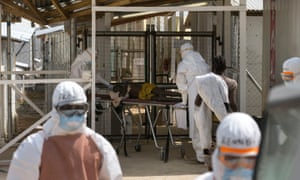
An Ebola treatment centre outside Freetown, Sierra Leone, in December 2014.


An Ebola treatment centre outside Freetown, Sierra Leone, in December 2014. Photograph: Baz Ratner/Reuters

Wood was brought before the NMC on three misconduct charges, including recording Cafferkey’s temperature reading dishonestly in order to hide it from public health officials.


It transpired during the hearing that the group had decided to take their own temperatures because the screening team were not equipped to do so. They had run out of screening forms and only had four screening cubicles for about 50 people.


On Wednesdsay the NMC found that she had not recorded an incorrect temperature as alleged but found that she had suggested that Cafferkey’s temperature be recorded lower so that the volunteer group could leave the “uncomfortable” and “chaotic” area more quickly.


Wood is facing a professional sanction, which could involve being struck off or a suspension.


Aja Hall, the case presenter for the NMC, told the panel the case was “particularly serious” as “Pauline Cafferkey was in the starting stages of Ebola and in an extremely busy and public place”.


She said it was “well established” that a high temperature was the “first sign that there may be infection which is why so much significance was placed on the taking of temperature, both in Sierra Leone but more crucially through the screening process at Heathrow airport”.


The panel is expected to to conclude its deliberations on Friday.


Ebola nurse Donna Wood had unblemished record, tribunal hears

20 Eylül 2016 Salı

Jeremy Hunt acted illegally over junior doctors, court hears


Jeremy Hunt acted illegally and beyond his powers by deciding to impose a new contract on NHS junior doctors, the high court has been told in a legal challenge to the health secretary’s handling of the year-long dispute.


The court on Monday began a two-day judicial review of the legal challenge to Hunt brought by five junior doctors.


Their group, Justice for Health, claims that the health secretary has acted ultra vires (beyond his powers)by choosing to force new terms and conditions on 54,000 trainee medics in England despite their overwhelming opposition.


A barrister leading Hunt’s legal team told the judge, Mr Justice Green, that there was no evidence that NHS employers did not want the contract and that the claim was “wholly without substance”.


Hunt suffered an early setback when the judge rejected a claim by his counsel, Clive Sheldon QC, in pre-hearing legal argument that Justice for Health’s claims should be thrown out. Refusing Sheldon’s plea, Green said at the outset of the first session of legal argument that “this is plainly a serious case” which, in his view, “requires full judicial review”.


Green planned to issue his judgment on 28 September, he said, days before junior doctors across England are due to take part in the first five-day strike in the long-running dispute. The strike is planned to start on 5 October, the day the contract is due to be imposed on all trainee doctors below consultant level. The six previous walkouts held since January have lasted one or two days.


Justice for Health, whose action has received £300,000 in crowdfunding from 10,000 supporters, wants the court to overturn Hunt’s decision to use what he called his “nuclear option” of imposition, and rule that he broke the law in choosing to push it through.


Its legal argument states that the campaign group, consisting of Dr Nadia Masood, Dr Ben White, Dr Francesca Silman, Dr Amar Mashru and Dr Marie-Estella McVeigh, “seeks an order quashing the decision of the secretary of state; [and] declarations that the secretary of state had no power to make the decision which he purported to make on 6th July 2016, that the purported imposition was unlawful and that the secretary of state has acted unlawfully”.


Jenni Richards QC, for Justice for Health, said that while Hunt was entitled to recommend a contract, he did not have the power to impose one. The health secretary had “acted in breach” of his “requirements of transparency, certainty and clarity” and behaved “irrationally”, she told the court.


The junior doctors claim that, despite stating publicly when the dispute began last year that he was imposing the contract, Hunt had then switched tack and insisted he had merely made a non-binding recommendation that revised conditions of employment.


Richards also claimed that Hunt had ignored a series of studies of mortality rates among patients admitted to hospital when he began claiming in July 2015 that as many as 11,000 patients a year admitted on a Saturday or Sunday die unnecessarily because too few doctors are on duty – the “weekend effect”.


Giving evidence for Hunt, Sheldon said the secretary of state had decided not to “compel” NHS employers to use the new contract, but to “approve” it. “This case is redundant,” Sheldon told the judge. “There is no evidence at all that there is any NHS employer who doesn’t wish to introduce these new contracts.”


Jeremy Hunt acted illegally over junior doctors, court hears

15 Eylül 2016 Perşembe

PrEP HIV drugs: court hears NHS England appeal

A legal battle is being fought out in the court of appeal over who pays the bill for a service to block HIV infection.


The high court ruled that NHS England has the power to commission PrEP, which has been described as a “game-changer” in the fight against HIV/Aids.


NHS England is appealing on the grounds that local authorities have the legal responsibility to arrange services to “prevent” the spread of HIV, while its own responsibilities are limited to treating those already assumed to be infected.


PrEP, short for “pre-exposure prophylaxis”, is a prevention strategy that involves people who are HIV-negative but at high risk of infection taking the anti-retroviral drug Truvada to reach optimal levels of protection.


The anticipated cost of providing PrEP services is £10m-£20m a year.


When taken consistently, it has been shown to reduce the risk of HIV infection in people who are at high risk by more than 90%.


The legal battle is important and urgent because of its potential impact on the provision of other services, including hearing implants for children with deficient or missing auditory nerves, prosthetics for lower limb loss, and a drug for treating certain mutations in children aged two to five with cystic fibrosis.


Nine new treatments and services NHS England had planned to make available to patients have been put on hold pending the outcome of the appeal.


In May this year NHS England’s specialist services commissioning committee decided not to commission PrEP, saying it lacked power to do so under NHS legislation and regulations.


But Mr Justice Green, sitting in London’s high court, ruled on 2 August that it did have the power under the NHS Act 2006 and under regulations made in 2012 which came into effect in April 2013. The ruling was a victory for the National Aids Trust (NAT), a charity, with backing from the Local Government Association (LGA).


Jonathan Swift QC, appearing for NHS England, is asking the appeal judges – Lord Justice Longmore, Lord Justice Underhill and Lady Justice King – to rule the high court decision wrong in law and to conclude that provision of PrEP services does indeed fall outside NHS England’s legal powers.


Swift said the case was a matter of general public importance because it involved the balancing of the division of health responsibilities between NHS England, the health secretary and local authorities. The QC drew a distinction between “PrEP” and “PEP”. He said NHS England has provided PEP – the post-exposure prophylactic service – since 2013.


He described PEP as an emergency service provided in cases where there was “an assumption” that the person being treated was HIV-infected at the time of treatment – in contrast to PrEP, which was for people not infected.


Mr Swift argued the 2012 regulations only required NHS England to provide services, for patients already believed to be infected. Responsibility for funding PrEP fell to local authorities since they were under an express obligation to make arrangements for services to prevent the spread of sexually transmitted infections, including HIV.


The high court judgment which is being challenged said the case was about “the allocation of budgetary responsibility in the health field”.


Mr Justice Green said: “No one doubts that preventative medicine makes powerful sense. But one governmental body says it has no power to provide the service and local authorities say they have no money.


“The claimant is caught between the two and the potential victims of this disagreement are those who will contract HIV/Aids but who would not were the preventative policy to be fully implemented.


“In my judgment the answer to this conundrum is that NHS England has erred in deciding that it has no power to commission the preventative drugs in issue.”


Alternatively, said the judge, NHS England has “mischaracterised the PrEP treatment as preventative when in law it is capable of amounting to treatment for a person with infection”. In any event NHS England had the power to commission preventative treatments because that facilitated, or was incidental to, “the discharge of its broader statutory functions”.


NHS England is asking the appeal court to rule the high court wrong on all counts. Campaigners have said that while the majority of gay men use condoms to prevent being infected with HIV, there is also an “ethical duty” to provide PrEP to those who do not. And they say the drug would provide an additional defence against HIV, and would not be used simply as an alternative to safe sex.


PrEP HIV drugs: court hears NHS England appeal

13 Haziran 2014 Cuma

Former croquet champion died after spiralling into drug addiction, inquest hears

The inquest into Mr Burrow’s death at the Royal Court Residence in Jersey heard how his grandmother, Doreen Burrow, 84, discovered him slumped unconscious on the floor of her bathroom in Saint Brélade, on November 26 last 12 months and dialled 999.


He had overdosed on following injecting himself with Fentanyl, a powerful prescription painkiller, and paramedics have been unable to revive him.


Mr Burrow turned to the drug, which is usually administered gradually in a patch in excess of a period of three days, soon after establishing a habit for heroin.


His addiction led to many stints in rehabilitation centres and a spell in jail for trying to smuggle heroin into the Channel Islands.


The day just before he died, Mr Burrow had overdosed on Fentanyl – a prescription opiate 100 instances more powerful than heroin – at a friend’s residence, but he refused to go to hospital for remedy.


The inquest heard he had .01 mg of Fentanyl and .43 mg of diazepam in his system.


Nicholas Hubbard, a medicines professional, informed the inquest that as tiny as .003 mg of Fentanyl can demonstrate fatal, less than a third of what Mr Burrow had injected.


Mr Hubbard explained that the patches had been getting to be a drug of selection for users who can not effortlessly entry heroin in the Channel Islands, in which it can expense 10 instances the street price tag in the Uk.


He explained: “It is a rather unsafe method since it is quite challenging to know how much Fentanyl has been abstracted from the patch and it really is impossible to know how significantly is acquiring injected.”


Emma Pankhurst, Mr Burrow’s cousin, told the inquest they had been close pals when he was in his sporting heyday, representing Britain, winning the European championship in 2002 and rising up the globe rankings as high as amount 13.


But she explained they fell out when he acquired into the “wrong crowd” and started out abusing drugs.


In April 2010 Mr Burrow was jailed for three many years for helping a lady, Helia Filipa Da Silva, to import heroin from the United kingdom to Jersey.


The inquest was informed he underwent treatment with the island’s Alcohol and Drugs Services and remained clean for short periods but frequently relapsed.


A statement read out to the inquest from a pal who experimented with to revive him the night just before his death, mentioned: “I don’t consider Matthew took his very own lifestyle.


“We all know the dangers of taking the gear. It really is like Russian roulette. We all know the consequences.”


The coroner, Deputy Viscount Mark Harris, said in summing up: “It was a unhappy and untimely death caused by Fentanyl poisoning, a powerful pain relief drug which Mr Burrow had unlawfully picked up.”


Mr Burrow’s grandmother explained following the inquest: “He started playing croquet when he was 14 and continued right up until about two years before his death.


“It was a prolonged time ago that he received into medicines. He stopped but then acquired in with the incorrect individuals once more.


“He was down in the dumps and could not find work. His dad dying eight many years in the past did not aid. I consider that he looked for something to help him come to feel far better.


“He did so nicely with his croquet. I was very proud of him – it was a shame it ended like this. I couldn’t have had a nicer grandson. To me he was a lovely lad.”


Michael Gafoor from the Jersey Alcohol and Medicines Support warned that prescription drug abuse is turning into rife in Jersey because typical narcotics are so difficult to acquire.


He said: “One gram of heroin in London is well worth £50, the exact same gram in Jersey is worth £500, so end users in Jersey have a tendency to depend far more on prescribed drugs.


“In the United kingdom people have a tendency to use heroin in excess of Fentanyl simply because it is more offered. Heroin is quite tough to get hold of in Jersey.


“It can be extremely unsafe if it is employed inappropriately.”


Former croquet champion died after spiralling into drug addiction, inquest hears

3 Haziran 2014 Salı

Best surgeon sacked right after allegedly harassing two female trainee medical professionals, tribunal hears

“I feel the claimant had sought to engage in inappropriate conversations of a personalized nature with (the medical doctors) and had tried to persuade them to meet privately with him. In addition, he had, I believed, told them each to maintain these matters amongst them secret,” Dr Thomson said.


She added: “Worst of all, the claimant had sought to influence the junior physicians by implying that their careers may be affected if they did not comply with his requests to meet, or would be enhanced if they complied with the requests to meet outside of function hours and at his residence.


“As junior doctors, they have been in a vulnerable position in relation to the claimant and their careers would have been hard won and very dear to them. To try to exploit this was wholly wrong.”


Dr Thomson stated the ladies, who are not able to be named, “felt intimidated by the advances created by the claimant”, and that his conduct had been “unwanted and had triggered them anxiousness and distress”.


One of the females alleged the unmarried surgeon touched her inappropriately on the leg in a failed sexual advance in his office, whilst the other explained he sent her “persistent” text messages asking her to come over to his house soon after perform.


Dr Thomson said: “The two medical doctors explained how the claimant’s position and influence with the Yearly Assessment of Competence Progression approach had been referred to on numerous occasions and that they had understood that their ARCP would endure if they did not agree to devote social time with the claimant.”


The ARCP is a formal assessment used to determine how well a trainee doctor is progressing in their coaching, the tribunal heard.


Dr Thomson stated the accused advisor had referred to as one particular of the ladies “a liar” and claimed the two had colluded to destroy his profession when he was hauled just before the disciplinary hearing.


“In essence, the claimant denied he had behaved in the way alleged by (the physicians) and he said the incidents they described had basically not happened,” explained Dr Thomson, director of children and women’s services at the hospital Believe in.


She continued: “I in the end concluded that each (doctors) were credible witnesses. I discovered no evidence to substantiate the claimant’s argument that the junior physicians had colluded with every single other.


“I believed (the doctors) and I believed the claimant had behaved in the way they described. I identified the claimant’s perform, aside from getting intimidating and upsetting, amounted to sexual harassment.”


The advisor was located guilty of gross misconduct and sacked with instant impact in December 2012.


Now, he is suing the NHS Believe in for unfair dismissal, breach of contract, racial discrimination, sexual discrimination, and loss of wages at Reading through Tribunal Centre, Studying, Berkshire.


The advisor claims the allegations were fabricated as portion of a cynical move by the Trust managers to force him out of his occupation amid budget cuts.


Nonetheless, Dr Thomson mentioned she was unaware of the planned restructuring of his department at the time she sacked him, and pointed out that his dismissal induced “quick-phrase troubles” at the hospital in which he worked.


The 3-week tribunal continues ahead of Employment Judge Andrew Gumbiti-Zimuto. The tribunal manufactured an buy precluding the naming of the claimant or anything at all which may possibly identify him for the length of the proceedings.


Best surgeon sacked right after allegedly harassing two female trainee medical professionals, tribunal hears

19 Mayıs 2014 Pazartesi

Federal court hears opening arguments in challenge to Alabama abortion law

The owner of an abortion clinic in Alabama’s capital city testified Monday that for the 36 years she’s been in business, she has always used out-of-town doctors who wouldn’t be able to admit patients to local hospitals as required under a new state law.


June Ayers, the owner of Montgomery’s Reproductive Health Services, was the first witness in the trial of a lawsuit that she and others filed over the law that requires clinics to use doctors who have approval to admit patients to nearby hospitals in case of complications. Her clinic and clinics in Mobile and Birmingham would have to close if the law is enforced, officials have said.


Mississippi, Wisconsin and Texas have laws similar to Alabama, but Texas is the only state where the law is being enforced.


Ayers said she has never been approached by any Montgomery physician wanting to perform abortions at the clinic. She said doctors can be harassed for performing the procedure that brings emotional debate from opponents and supporters.


She recounted one physician the clinic used from Baltimore, Maryland, who had his picture taken outside the clinic and then had posters about him being an abortion doctor show up in his neighborhood.


Proponents of the law say problems arise because traveling doctors remain in a city only a few hours and aren’t around to handle complications. Attorney General Luther Strange’s staff said in a court filing that the state will present witnesses, including physicians, who will testify that having a doctor on hand to manage complications and admit a patient to the hospital will improve the quality of care.


Ayers testified complications are rare, but her traveling physicians wouldn’t qualify for the privileges because they don’t live in the Montgomery area and would not have the required number of hospital admissions.


Three of Alabama’s five licensed abortion clinics, including Planned Parenthood Southeast clinics in Mobile and Birmingham, use traveling doctors and say they will have to close if the 2013 law is enforced.


The West Alabama Women’s Center in Tuscaloosa and the Alabama Women’s Center in Huntsville use local doctors who have admitting privileges at hospitals in those cities.


Federal court hears opening arguments in challenge to Alabama abortion law

Federal court hears opening arguments in challenge to Alabama abortion law

The owner of an abortion clinic in Alabama’s capital city testified Monday that for the 36 years she’s been in business, she has always used out-of-town doctors who wouldn’t be able to admit patients to local hospitals as required under a new state law.


June Ayers, the owner of Montgomery’s Reproductive Health Services, was the first witness in the trial of a lawsuit that she and others filed over the law that requires clinics to use doctors who have approval to admit patients to nearby hospitals in case of complications. Her clinic and clinics in Mobile and Birmingham would have to close if the law is enforced, officials have said.


Mississippi, Wisconsin and Texas have laws similar to Alabama, but Texas is the only state where the law is being enforced.


Ayers said she has never been approached by any Montgomery physician wanting to perform abortions at the clinic. She said doctors can be harassed for performing the procedure that brings emotional debate from opponents and supporters.


She recounted one physician the clinic used from Baltimore, Maryland, who had his picture taken outside the clinic and then had posters about him being an abortion doctor show up in his neighborhood.


Proponents of the law say problems arise because traveling doctors remain in a city only a few hours and aren’t around to handle complications. Attorney General Luther Strange’s staff said in a court filing that the state will present witnesses, including physicians, who will testify that having a doctor on hand to manage complications and admit a patient to the hospital will improve the quality of care.


Ayers testified complications are rare, but her traveling physicians wouldn’t qualify for the privileges because they don’t live in the Montgomery area and would not have the required number of hospital admissions.


Three of Alabama’s five licensed abortion clinics, including Planned Parenthood Southeast clinics in Mobile and Birmingham, use traveling doctors and say they will have to close if the 2013 law is enforced.


The West Alabama Women’s Center in Tuscaloosa and the Alabama Women’s Center in Huntsville use local doctors who have admitting privileges at hospitals in those cities.


Federal court hears opening arguments in challenge to Alabama abortion law

7 Mayıs 2014 Çarşamba

"Do not resuscitate" orders not a matter for national policy, appeal court hears

Addenbrooke

Addenbrooke’s hospital: health department attorneys explained the position on DNRs was a decision for nearby health trusts rather than nationwide policy. Photograph: Graham Turner for the Guardian


Forcing medical doctors to adhere to a national policy on choices about whether or not to attempt resuscitation of critically sick individuals would run counter to the political will of ministers on how the NHS is run, judges have been told.


Attorneys for the Division of Well being (DH) and the hospital trust at the heart of a family’s challenge on the concern also informed the appeal court in London that courts need to not rush in to prescribe or override the judgment of physicians.


The husband and daughters of Janet Tracey, who died at Addenbrooke’s hospital in Cambridge, want Jeremy Hunt, the wellness secretary, to institute a national policy requiring medics to seek advice from patients and family members ahead of putting ‘do not resuscitate’ (DNR) orders in the notes of critically sick individuals.


Tracey, who broke her neck in a auto accident quickly right after being diagnosed with terminal lung cancer, died in March 2011, aged 63, possessing had two this kind of notices.


Vikram Sachdeva, representing the DH, stated the place on such troubles was for nearby well being trusts “and a matter of expert obligation rather than binding national policy”. Problems that arose from such an arm’s length technique could be dealt with in a variety of ways, such as audits, patients’ or coroners’ issues, analysis groups and other avenues that could bring accountability.


The Tracey family’s want for Hunt to phase in was, Sachdeva stated, “inconsistent with the clear political will” on how well being companies were presented.


Lord Pannick QC, for Cambridge University Hospitals NHS Foundation trust, of which Addenbrooke’s is portion, earlier said the court need to be “exceptionally slow” to override the judgement of medical professionals acting sensitively and in very good faith.


Tracey’s death had occurred regardless of the medical doctors and health-related personnel delivering “devoted” care, attempting to involve Tracey and her household, and “undertaking their very best in situations that had been difficult for all concerned”.


"Do not resuscitate" orders not a matter for national policy, appeal court hears

23 Nisan 2014 Çarşamba

Pensioner died following two-hour wait for ambulance, inquest hears

Mr Gouldburn had undergone shoulder surgery days before his death in April last yr and had been visited by a medical doctor that day right after he complained of feeling unwell to his wife Pamela, 70.


The medical professional could not discover anything significantly wrong, but provided to send him to hospital – which he refused.


Nonetheless, Mr Gouldburn collapsed at his property in Hartlepool at close to ten.20am, prompting his carer to get in touch with 999, telling get in touch with-handlers about the doctor’s earlier go to.


Despite explaining that Mr Gouldburn could not move, his situation was not deemed to be a “red” emergency and was allocated a 60-minute response time, the inquest heard.


At around 12.20pm an ambulance arrived, but it was a St John automobile manned by less-educated medics.


Realising the seriousness of the predicament, a car with an eight-minute response time was requested and sooner or later an ambulance and quick response car arrived.


Even so, it was also late – despite making an attempt for 10 minutes to conserve his existence, Mr Gouldburn was pronounced dead quickly right after.


Speaking at the two-day inquest, a dispatch manager for the North East Ambulance Services stated on the day Mr Gouldburn fell they had been going through a large degree of urgent calls.


Lynn Corrigan stated ambulance drivers had been hit by delays in admitting individuals to North Durham hospital due to a lack of offered beds.


Mr Donnelly asked her: “Is what I’m hearing you never have sources to meet demand?”


Mrs Corrigan said: “Yes, that’s correct. It is a nationwide dilemma.”


Dr Jan Lowe, a pathologist, informed the inquest Mr Gouldburn had an underlying heart situation, but that it was manufactured worse by the stress of becoming on the bathroom floor for so prolonged.


Mr Donnelly ruled the retired instructor died of organic leads to – his underlying heart illness – but his death was aggravated by a “lack of timely and proper medical intervention”.


Speaking of the ambulance service’s lack of assets, he extra: “The consequence of that would look to be that instances such as Mr Gouldburn are likely to be a unhappy consequence of the lack of sources.


“It would appear to be a consequence of stretched assets, probably performing the greatest they can, but folks are not receiving the support they may feel entitled to sometimes.


“My concern is the time it takes for deployment and when that does attend it is manned by a charity.”


Mr Gouldburn’s family expressed anger at the ambulance service’s “failure” to grasp the seriousness of the scenario right up until it was as well late.


Speaking after the inquest, they said: “This should by no means happen once again to anyone.


“We simply want recognition from the trust that a mistake was produced, and that the believe in failed a amazing guy.”


“He gave his existence to helping others and the trust failed him in his moment of require.


“We hope they will make sure as greatest they can this will never happen once more to an additional household in Hartlepool.”


Tom Howard, head of the North East Ambulance Service’s make contact with centre, admitted Mr Gouldburn did not obtain the degree of care he should have.


For the duration of the inquest he told the pensioner’s stepdaughter, Joanne Dobson, and her husband, Colin Dobson: “Mr Gouldburn did not receive the degree of care that he ought to have done. The 60 minute target was not met.”


He additional: “It is a resource issue which we have already had explained.


“It is very unfortunate, and I’m actually sorry it has took place.”


Mr Gouldburn was a phase-father of four and had nine phase-grandchildren and 3 stage-fantastic-grandchildren.


He served in the merchant Navy as an engineer, but invested most of his existence working as a instructor at a unique demands college.


Pensioner died following two-hour wait for ambulance, inquest hears

27 Mart 2014 Perşembe

Profoundly deaf girl hears for initial time

“Hearing items for the very first time is so, so emotional, from the ping of a light switch to running water. I can’t cease crying.


“I can previously foresee how it really is going to be lifestyle altering and the implants will get better and greater above time, I am so so content.”


Ms Milne, who operates for charity Sense, mentioned she was now a lot a lot more aware of items about her, which was a huge help offered that she is also blind.


“I am also attempting to use the phone at one particular point but it’s 1 stage at a time as it truly is all so daunting. It is the little factors that are large existence shifting experiences to me correct now and this will possibly final a few months,” she mentioned.


“More than the final 48 hrs hearing somebody laughing behind me, the birds twittering and just getting with friends – they did not have to tap my arm or leg to get my consideration, which is a huge leap for a deaf man or woman.”


She thanked the team at the Midlands Implant Centre at the Queen Elizabeth Hospital, Birmingham, for the procedure and explained their support had been fantastic.


Source: Caters News Company / PA


Profoundly deaf girl hears for initial time