Facebook has censored the page of an organization that helps women obtain abortion pills, citing its policy against the “promotion or encouragement of drug use”.
Women on Web, which is based in Amsterdam, helps connect women with doctors who can provide abortion pills if they live in countries where abortion access is restricted. It is a sister organization to Women on Waves, which provides abortions and other reproductive health services on a ship in international waters.
Women on Waves announced that the page had been “unpublished” on its own Facebook account, writing: “Women on Web provides life-saving information to thousands of women worldwide. Its Facebook page publishes news, scientific information and the protocols of the World Health Organization and Women on Web has answered over half a million emails with women who needed scientific, accurate information essential for their health and life.
“We expect Facebook will [undo] this action soon enough, as access to information is a human right.”
This is the second censorship row between Facebook and Women on Web. In January 2012, Facebook deleted the profile photograph of the group’s founder and director, Dr Rebecca Gomperts. The image contained instructions for inducing an abortion using Misoprostol. Gomperts was locked out of her account for two days after re-posting the image, but Facebook subsequently apologized and reinstated both the image and her account.
We expect Facebook will [undo] this action soon enough, as access to information is a human right
Facebook did not immediately respond to a request for comment.
With nearly 2bn users, the social media site plays a crucial role in disseminating news and information around the world. But Facebook has struggled to meet competing demands to allow for the free flow of information while cracking down on graphic material (such as the livestreamed murder of a baby in Thailand in April).
In 2016, the company faced international condemnation over its decision to censor the iconic Vietnam War photograph of a naked girl fleeing a Napalm attack. Facebook subsequently altered its policy to allow for editorial judgments about newsworthiness.
On 3 May, amid criticism over its handling of graphic videos, Facebook announced that it would hire 3,000 more content reviewers. Such content reviewers are tasked with applying the company’s “community standards”, often with uneven results.
Facebook’s has faced particular difficulty enforcing its rules for “regulated goods” – prescription drugs, marijuana, firearms, and ammunition. The company bars “attempts by private individuals to purchase, sell, or trade” such items, but has struggled to halt gun sales.
The company has cracked down aggressively on pages related to legal medical marijuana, however. In 2015, the site temporarily banned business publication Crain’s for promoting a cover story about medical marijuana.
Last year, Donald Trump suggested that current abortion laws allowed doctors to “rip the baby out of the womb of the mother just prior to the birth of the baby”. His statement erroneously described abortion procedures, and also triggered an uproar among the women and men who know firsthand the devastation of ending a late-term pregnancy.
Nearly 99% of abortions occur before 21 weeks, according to the Center for Disease Control and Prevention, but when needed pass that point it is in response to harrowing circumstances.
“Abortions that occur at this stage in pregnancy are often the result of tragic diagnoses and are exactly the scenarios wherein patients need their doctors, and not obstructive politicians,” says Dr Jennifer Conti, clinical assistant professor at Stanford University. “Asking a woman to carry a fatally flawed pregnancy to term is, at the very least, heartbreaking. I’ve often heard women say that they chose to end such pregnancies because of unselfish reasons: they couldn’t bare the thought of putting their fetus through even more pain or suffering.”
Just this year, 400 abortion restrictions were introduced in 41 states, according to the Guttmacher Institute, a research organization that supports abortion rights. Among them, Republicans introduced the first ever federal “heartbeat” bill earlier this year – which would ban abortions after a heartbeat is detected. Meanwhile, Congress is considering a bill that would also ban abortion at 20 weeks nationwide – which is when ultrasounds can offer the first signs of fetus anatomy anomalies.
Here, three different women agreed to share their experiences to end misconceptions about late-term terminations, and to explain to politicians and the general public why they’re necessary in the first place.
Kate Carson, teacher, outside of Boston, Massachusetts
That warm June day, the recovery room was silent. The doctor entered carrying Laurel, a bundle of just five pounds wrapped in a pink-and blue striped cotton blanket. He gently passed her to her mother, Kate. She bent forward to smell her. She touched her skin. Her daughter was warm, but not as warm as she should have been.
“I just needed to know it happened. I needed to know that I had a baby,” Kate Carson says.
At 27, Kate had her life planned out. She and her husband were going to have four kids, and she was going to be an engineering professor. Her first pregnancy went fine, and she had a healthy baby girl. But while pursuing her PhD in engineering, she suffered three miscarriages. “It was a long road,” she says, but at by 29, she was finally expecting another girl, Laurel. She was due in the summer of 2012, and both parents were elated.
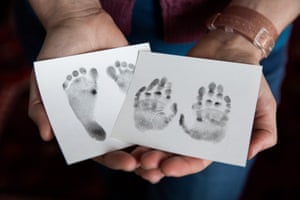
Kate holds her baby Laurel’s foot and hand prints that were made by nurses at the clinic. Photograph: Kayana Szymczak for the Guardian
At 19 weeks, an ultrasound revealed a shadow of concern but the finding was reversed with full confidence at a level two ultrasound. “I’m not seeing any problems. Everything looks fine,” the specialist told the parents.
But Kate had a nagging worry. “My husband and I did not feel like everything was fine,” she says. She asked the nurse how sure the specialist was. “He would have to be so certain. They would never reverse a diagnosis without being super sure about it,” the nurse replied.
Yet her husband encouraged her to book another second level two ultrasound, a “piece of mind ultrasound”.
Expecting only reassurance, Kate knitted a pink sweater for Laurel while chatting freely with the technician who quickly grew silent. There was a big black spot on Laurel’s brain. “This baby is different,” the technician said. She left the room and returned with a maternal fetal specialist and a specialist in training.
“That’s when they started telling me,” Kate says. The fetus had Dandy-Walker malformation, a set of abnormalities of the cerebellum.
“The problems we didn’t see last time, we are seeing today,” said the specialist. She offered Kate adoption and abortion, “if it was still a legal option”. They used to send women to Kansas for abortions, she told her, but that was before Dr Tiller was shot in the face at a Sunday church service.
Kate asked if children with Dandy-Walker malformation are ever normal. “Yes,” said the specialist.
“And that, honestly, is so hard to hear because you just want something definitive”, Kate recalls. “On the one hand, of course you want your child to be normal. On the other hand, you want to know, is your kid going to be okay, is your kid going to receive a devastating diagnosis?” But the specialist had no definitive answers and recommended an MRI to determine whether Laurel would be okay or “incompatible with life”.
Kate couldn’t get the MRI for the next 48 hours. The wait was excruciating. At home, she could find no peace and substituted knitting her baby’s sweater for sleeping. She curled up on her living room sofa and cried until her husband scooped her up each night and took her to bed.
“When you’re imagining futures beyond the miracle happy ending, it’s sinking in,” she says.
The day of the MRI finally arrived. She was 35 weeks, 0 days. By the end of it, Kate and her husband had the hardest answers they’ve ever received.
Their daughter had moderate to severe Dandy-Walker malformation. But that wasn’t the only diagnosis; Laurel also had a brain condition in which fluid builds up in the ventricles, eventually developing into hydrocephalus and possibly crushing her brain. She had a congenital disorder too, in which there was complete or partial absence of the broad band of nerve fibers joining the two hemispheres of the brain.
What this meant was Laurel was expected to never walk, talk, or swallow. That was if she survived birth.
Kate asked her doctor, “What can a baby like mine do? Sleep all the time?”
“Babies like yours are not generally comfortable enough to sleep,” the neurologist said.
“That is when it became very clear what I wanted to do,” she says. “The MRI really ruled out the possibility of good health for my baby.”
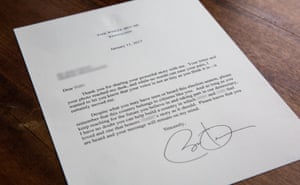
A personal letter of support from Barack Obama. Kate wrote to President Obama after her abortion experience, in an effort to educate politicians about the realities of late-term abortion. Photograph: Kayana Szymczak for the Guardian
For Kate, giving a child life and peace are the two gifts a mother can offer. “Most babies get to have life and get to have peace, but this baby, I had to choose. I could choose life, with the outside chance of peace or occasional peace, or I could choose certain peace without life. And for me, certain peace without life was the choice I wanted to make.”
On their ride home, Kate and her husband were silent as they drove in rush hour traffic across the Zakim Bridge. Unable to say it herself, Kate’s husband uttered the word abortion. “I think we should ask about it,” he said.
“I had been in this dark, awful prison of a place inside myself,” she says. Her husband’s words comforted her.
When they arrived home, Kate immediately called the doctor and left her a message. Her mother arrived to pick up their daughter and before leaving said she would have done the same. An hour later, the phone rang. Kate grabbed it. If they wanted the abortion, they had 30 minutes to call a clinic in Colorado before closing time or wait the weekend. The procedure would last four days. And they would need $ 20,000. Massachusetts doesn’t allow abortion after 24 weeks unless it’s necessary to save the life of the mother.
Kate and her husband live a modest life, certainly not one with $ 20,000 readily available. Kate’s younger brother offered his life savings of $ 5,000, but it was her parents who gave them the money from their retirement fund. “This is exactly why these abortions exists,” said her father.
Three days later, they were driving up to Dr Hern’s Boulder Abortion Clinic, where surveillance cameras and razor wired fences surrounded them. She was 36 weeks.
I felt like the only one in the entire world … but we are not entirely alone. Just hidden
Inside the clinic, Kate took a blood test followed by exhaustive counseling sessions, then the consent form. Dr Hern wanted to make sure she was doing this of her own free will.
By the end of the day, Kate and her husband knew it was time. Dr Hern took Kate to a room for the injection. It would slow her baby’s heart to a stop as soon as it penetrated. Sometimes, it happens quickly. For Kate, it happened over the course of a couple of hours. Just as she and her husband were planning to grab a bite of food, Laurel kicked. “I lost it,” says Kate. She retreated to her hotel room and lay there until the moving stopped. When Laurel went still, Kate’s stomach sagged low and lifeless, she says. “It was really sad and really hard.”
“I did not ever doubt I was doing the right thing for her but that did not make it easier,” she says. Kate says Laurel got the “tightest hug”. Her body was hugging her.
Next, it was time to get dilated, which was painful for Kate because she couldn’t receive an epidural. On the last day in Colorado, on an early June day, Kate, who was in labor for two and a half hours, delivered Laurel.
In the recovery room, Dr Hern brought Laurel to her. She smelled right, she felt warm, but not as warm as a live baby.
“She was beautiful,” Kate says.
When Kate returned home, they scattered Laurel’s ashes in the ocean. It was time for closure, but Kate worried about judgment so she didn’t tell anyone what happened for months. Then the self-doubt came.
“I feel like myself got fragmented into a million different selves. And I had my angry guard dog piece and my jealous piece, had my sad piece, I had the guilt, the religious piece. All of these pieces, and I had to figure out who I was”.
For some time, Kate wondered about the human error piece in the equation and wondered if her first doctor might have mislead her on purpose. A little research later proved it was just an honest mistake. “I can live in a world where people make mistakes,” she says. “I felt like the only one in the entire world who had had such a later abortion and it is true that we are rare, but we are not entirely alone. Just hidden.”
Since Laurel, Kate gave birth to another healthy daughter.
Kate Carson speaks about her experience to doctors, lawyers, and neighbors. You can also read about her experience here
Lindsey Paradiso, wedding photographer, Virginia
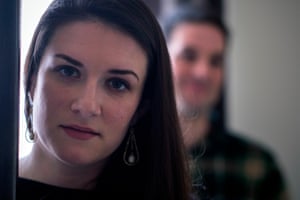
Lindsey and Matt Paradiso, photographed inside their home. Photograph: Justin Ide for the Guardian
The moment Lindsey, 27, found out she was pregnant, she wrapped the positive test strip in a used gold metallic gift bag and surprised her husband, Matt, with it. Two months later, they named her Omara Rose.
This was not the easiest pregnancy for Lindsey. She suffered from sciatica nerve pain and had to undergo daily injections for her blood clotting disorder. But she was over the moon about the pregnancy.
At first, it looked like a bubble floating on the ultrasound. At the routine 18-week visit in February 2016, the doctor speculated the peculiarity could be cystic lymphangioma, a group of cysts found mostly in the neck. Or it could be nothing. They immediately booked an appointment with the University of Virginia (UVA).
After seeing the ultrasound at UVA, Lindsey noticed the growth had enveloped half of Omara’s face and spread around her neck to the back of her head. When the doctor entered, they expected the worst. Again, the term lymphangioma came up. But so did cervical teratoma. Only an MRI could determine decisively, but whether it was malignant or benign, it could be fatal to the baby.
“You could just tell the energy in the room was like you should end it, it’s not going to turn out well,” she says. The doctor told them they could terminate the pregnancy since Omara’s chances of survival were slim. Matt and Lindsey were crushed by the prospect. They wanted to fight.
Twenty days after seeing the first signs of trouble, they learned that Omara had an aggressive form of lymphangioma growing out of her neck. The diagnosis came in the form of a dense two-page MRI report. The fast-growing, inoperable tumor had grown into her brain, heart, and lungs. It had wrapped around her neck, eyes, and deep into her chest. It was so invasive, it was pushing her tongue out of her mouth.
Her chances of living to age of viability or birth were slim. Lindsey and Matt made the heartbreaking decision to follow through with an abortion at around 24 weeks. They were just a few days away from it being an illegal termination.
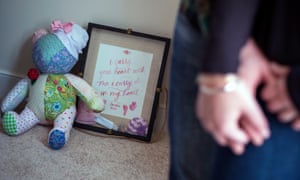
A shadow box of memories of their daughter, including her hand and foot prints, sits with a teddy bear. Photograph: Justin Ide for the Guardian
On 26 February 2016, Omara Rose’s heart stopped beating. Shortly after, Lindsey was admitted into the hospital for labor induction but the epidural stopped working. “I felt like my insides were being ripped apart,” she says. When the doctor administered a second epidural, Lindsey became nauseous. Her ears rang. The room spun. The doctor rushed in to administer a third epidural.
She was conflicted the whole time because while she was in pain, she didn’t want it to stop because she knew by the end of it “your child is going to be dead”, she says. Matt held her hand the whole time.
To hide something because you’re ashamed of it is just going to perpetuate misunderstanding
When she finally delivered Omara Rose 40 hours later, she was so small, “I barely felt her leave me but I knew she had,” she says.
Over the next few hours, Lindsey and Matt got to hold Omara Rose, dressed in a tiny dress with a hat the size of the cup of Lindsey’s hand. Then Lindsey’s and Matt’s family came, each taking turns to say their goodbyes. “I wanted her to be alive so badly but I knew it was for the best. She went without pain,” she says.
The next day, they buried their daughter in a cemetery four hours away from where they live now.
“I don’t think people understand the gravity of how sick she was. How fatal her tumor was,” says Lindsey.
But it took some time for them to be open about it, especially Matt. Lindsey found comfort in blogging while Matt focused on completing his education at Virginia Tech.
“To hide something because you’re ashamed of it is just going to continue to perpetuate misunderstanding,” says Lindsey. People automatically assumed that if she had the abortion, it was out of convenience. On the contrary, she says. “It’s something that will stick with you forever.”
For those who believe these babies are unwanted, Matt says: “You’re not going to wait until halfway through your pregnancy to finally have an abortion.”
Prompted by Donald Trump’s statements on late-term abortions, Lindsey shared more widely her experience in a Facebook post, which was shared over 100,000 times.
“Abortions are hard decisions made by real people,” she says. “Being open is a call for empathy.”
Lindsey Paradiso testifies against bills to limit access to safe and legal abortions. She’s also blogged about her experience here
Darla Barar, Austin, Texas, copyrighter
Darla Barar and her husband Peter. Darla was pregnant with twins – Catherine and Olivia – when they discovered that Catherine had a number of serious health issues. Photograph: Courtesy of the Barar family
On 22 June, at 3.30pm, the doctor let them see Cate one last time. She danced for them and then kicked. Her mom told her it was going to be okay. And then, guided by the ultrasound, the doctor injected a medication into Cate’s heart, stopping it. When they checked for a heartbeat 30 minutes later, the silence was deafening.
Darla, then 29, and her husband Peter had tried for years to get pregnant. When treatments failed, they traveled to the Czech Republic to use donated eggs. A week after the transfer, Peter got a dinner dessert with a message: “Congratulations daddy.” They were expecting twins.
Darla and Peter had named their twins Catherine “Cate” and Olivia, and by their 20-week anatomy scan they already knew their distinct personalities. Olivia was a “diva” and Cate was shy, a “cuddle bug”. “We loved them more fiercely than I ever thought possible,” Darla says.
But during a routine anatomy scan, the technician was abnormally quiet. Cate was measuring a little behind but she was always the smaller of the two, so Darla didn’t worry much. After a long wait, the OBGYN entered the room and asked Darla to sit next to her husband. “I just knew something was wrong,” Darla says.
Finally, we just looked at each other and said it was okay. We had to do what was best for her
Darla recalls hearing the doctor say he had never seen this combination of anomalies before.
Darla and Peter saw additional specialists, and all confirmed a number of issues. Cate had encephalocele, which is a neural defect that causes brain matter to leak out, slow growth, microcephaly, a very large cleft lip and possible fused digits. Her cerebellum was so underdeveloped that one doctor had trouble finding it and her brain’s midline was shifted, indicating “severe disorganization”.
To make matters worse, Olivia’s life was in danger. Cate’s amniotic sac was growing and restricting the growth of Olivia’s sac.
If she carried to full term, the restriction on Olivia’s sac would likely mean an early delivery. Darla says that every specialist they saw disclosed there was a high probability that Cate would not survive the delivery but if she did, there was no guarantee the surgeries – removing the encephalocele and placing her brain tissue back into her skull – would save her.
Darla cried and Peter prayed. “We needed a miracle and we knew as the day went on we weren’t going to get one.”
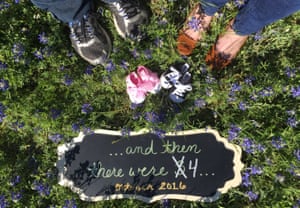
‘And then we had to grasp that we were only a family of three.’ Photograph: Courtesy of the Barar family
Their other option was abortion, one they did not take lightly, but one that felt rushed because of Texas’ restrictive abortion laws, which bans abortions after 22 weeks. Darla and Peter had 12 days to decide. “If laws were different … we would have done more testing – one doctor mentioned an MRI, for example, to try to test the level of her brain function. But we didn’t have that, and knowing what timeline we were on, we spent a lot of sleepless nights researching, making appointments, talking to each other and our therapist, and really just spending time being the four of us,” she says.
“Finally, we just looked at each other and said it was okay. We had to do what was best for her. So we knew what we had to do to bring home one”. Darla says she was prepared to deal with it all, but “if it meant Cate was going to suffer, we just couldn’t do that to her.”
At 21 weeks and 6 days, Darla had an injection, and Cate’s heart stopped. “For us, it was completely humane,” she says.
In the case of an additional fetus that gets aborted in the womb, the tissue is usually reabsorbed back into the body, but that wasn’t the case this time.
“I kept telling Peter, I’m carrying our healthy baby and our dead baby. I can’t reconcile that in my brain. At the same time, it was a comfort to know that I didn’t have to say goodbye right then,” she says.
Thirteen weeks after the diagnosis, Darla delivered Cate and then gave birth to Olivia, a healthy five-pound baby. The family took turns holding Cate and later in the afternoon, the chaplain came to take her away.
“And then we had to grasp that we were only a family of three,” she says.
Darla says she couldn’t face people after the abortion. She called it a stillbirth. “I knew I was dealing with more than just grief and I couldn’t explain that to people,” she says. She was also dealing with guilt. But she never felt regret, she says. She knew she did the right thing.
Spurred on by Donald Trump’s comments about later abortions, Darla took to social media to share her story and the response was overwhelming, both good and bad. The meaner comments focused on abortions as a version of birth control, or a way to rid oneself of an imperfect child.
“I can tell you, knowing how much the procedure cost, nobody is doing that for birth control,” she says. “Ask us why we’re getting it. Don’t assume that you understand our lives.”
Nonetheless, “being open has allowed me to be a better mom. I’m much more free with my emotions,” she says. Knowing that she could become a voice for women and men who needed it empowered her.
“It’s always the health of the mother but the health of the baby is never taken into consideration [into laws] and in situations like ours, it could have meant two dead babies on our hands,” she says.
A quarter of young women in the UK have suffered from anxiety and depression, according to a new survey released by the Office for National Statistics (ONS).
The figures were collected as part of a wide-ranging survey gauging the wellbeing of people aged between 16 and 24. They show that, despite an increase in the number of those who said their quality of life had improved since 2009, one in four young women said they had faced symptoms linked to poor mental wellbeing in 2014-15.
The report said that young women were “significantly more likely” than their male counterparts to recognise and admit being anxious or depressed, with less than one in six young men reporting similar symptoms.
The ONS report used data taken from surveys that focused on a person’s overall happiness – shown by their attitudes to issues such as relationships, work, education and finances – to create a nationwide picture.
The results show that while more than a third of young people aged between 16 and 19 who were questioned said they had a “very high” level of life satisfaction, this dropped to just a quarter among people aged between 20 and 24.
The study also reveals that in the four years from 2009-10 to 2013-14, the number of young people saying their mental health had “deteriorated” rose from 18% to 21%.
Tom Madders, campaign director at the mental health charity YoungMinds, said: “There is still a huge amount of misunderstanding about mental health conditions, making people less likely to open up to others if they are struggling to cope. This is particularly difficult for young people who face pressure, including stress at school, college or university and body image issues.”
He said that an environment of 24-hour access to social media led to some young people feeling they needed to “keep up the pretence of having a perfect life”.
Other figures from the study show that the number of young people who believe they are financially comfortable has increased since 2009-10. Seven years ago, 15% said they were struggling to get by, while by 2014-15 the number reporting financial hardship was 7% – and a significantly higher percentage (45%) said they were satisfied with their household income, up from about 30% in 2009-10.
The report added that levels of “general health satisfaction” had risen, with 56% saying they were “mostly or completely happy” in 2014-15, compared with about 52% the year before.
However, the figures also show a rise in households deemed to be living in poverty, based on families who earn less than 60% of the average UK income. One in four said they lived in a household at such a level, compared with 20% in 2008.
YoungMinds recently called on teachers, parents and carers to sign an open letter to the prime minister, Theresa May, urging her to place an increased emphasis in schools and colleges on improving young people’s mental health, and to recognise the pressures caused by exam stress, cyberbullying and fears over employment when they leave education.
Madders said: “A good quality of life includes having positive mental health and wellbeing, so it’s crucial that the problems which young people report are taken seriously and supported to prevent them escalating and going into crises.”
Who is suggesting that the pill might protect women from cancer as well as from pregnancy?
The University of Aberdeen, which has been analysing results from the Oral Contraception Study set up by the UK Royal College of General Practitioners more than 40 years ago. There have always been concerns about the mass medication of healthy women, and it has more often been the risks and harms of the pill, rather than its benefits, that have been trumpeted.
So which cancers does the pill protect women from?
The pill protects women from endometrial cancer – cancer of the womb – ovarian and bowel cancer. That had been established. But this, the longest-ever study, says that protection lasts up to 35 years after women stop taking it, and that there are no other cancers connected to it in the long-term.
But doesn’t the pill increase the risk of breast cancer?
Yes, while taking it, but women on the pill are generally young and have a low risk of breast cancer, unless they have a family history. A small increase on a small risk is not much to worry about, and the increased risk disappears within five years of coming off the pill. There is also a small increased risk of cervical cancer, but that also disappears within five years of stopping.
Did the study discover anything else?
Yes. It found that women who take the pill are no more likely to get other sorts of cancers in later life than women who don’t. So, in relation to cancer, researchers say the pill is very safe in the long term.
What have other researchers found?
Researchers at Oxford University published a major review in 2008, which showed that the pill reduced the risk of ovarian cancer by 20% for every five years that a woman took it. Those on it for 15 years cut their risk in half. That’s an attractive idea, because ovarian cancer is not easily detected at an early stage, and kills two-thirds of those who get it. The Oxford scientists published in the Lancet, which ran an editorial calling for the pill to be available over the counter, as opposed to prescription-only, thereby “removing a huge and unnecessary barrier to a potentially powerful cancer-preventing agent”.
In 2015, the same team published a further review on the protection the pill provided against endometrial cancer. Protection lasted for at least 30 years, said Prof Valerie Beral. Women in their 70s were still being protected due to taking the pill earlier in life. “It is time to start saying that not only does it prevent pregnancy, which is why people take it, but you should know you are less likely to get cancer than women who don’t take the pill,” Beral said.
Why would the pill protect from cancer?
Female hormones are implicated in a number of cancers. The pill contains a low dose of the hormone oestrogen, which is linked to breast and cervical cancer, so it raises these risks, as does HRT (hormone-replacement therapy), which is given to women dealing with menopausal symptoms. But it also contains progesterone, which is known to be protective against endometrial cancer.
Aren’t there other risks involved in taking the pill?
Yes, although the NHS says they are small and that “for most women, the benefits of the pill outweigh the risks”. There is a slight increased risk of stroke because oestrogen can cause blood to clot more readily. In the leg, that can cause deep-vein thrombosis. Clots can also form in the lung or cause a stroke or heart attack. The NHS has a list of conditions that make taking the pill more risky, and says that if women have more than one of them, they should find another form of contraception. They include being over 35, being a smoker, being very overweight and having high blood pressure.
So does this mean most women should take the pill for a while in their youth?
If women want to use the pill to prevent pregnancy, the anti-cancer effect is an added bonus, and might make it a more attractive form of contraception. But no medicine is without any side effects at all, and for a small number of people, the pill is a more risky option.
Almost three-quarters of women in England start breastfeeding after giving birth but less than half are still doing so two months later, according to NHS and Public Health England data.
PHE recommends exclusive breastfeeding for the first six months, as does the World Health Organisation, because it boosts a baby’s ability to fight illness and infection. But a comparison of initial breastfeeding rates and those after six to eight weeks in the final quarter of 2015 found that they were 40% lower for the latter (44% compared with 73%).
A survey of 500 mothers commissioned by PHE found that fears about breastfeeding among women included that it could be painful (74%), prevent them taking medication (71%) and be embarrassing in front of strangers (63%).
The PHE’s chief nurse, Viv Bennett, said:“We can all help women feel comfortable breastfeeding their baby wherever they are. Creating a wider culture of encouragement and support will help make a mother’s experience all the more positive.”
PHE has launched an interactive breastfeeding friend chatbot, accessed through Facebook messenger, to provide personal support for breastfeeding 24 hours a day. Bennett said it would help women through the “crucial” initial period, after which things generally became easier.
A study published in the Lancet last year found the UK had the lowest rate of breastfeeding in the world, with only one in 200 women breastfeeding their children after they reach their first birthday.
The WHO recommends that breastfeeding form part of a baby’s diet up to two years of age. As well as reducing the likelihood of babies getting diarrhoea and respiratory infections, breastfeeding also lowers a mother’s risk of ovarian and breast cancer and burns about 500 calories a day.
The PHE survey found that many women were not only embarrassed about breastfeeding in front of strangers, but also their partner’s family (59%) and around siblings and wider family members (49%).
The results, published on Thursday, suggested high-profile figures who promote breastfeeding can have a positive influence on other mothers. Just under half of respondents said the example of household names such as The Only Way is Essex star Sam Faiers, broadcaster Fearne Cotton and actor Blake Lively, who have recently championed breastfeeding on social media, had inspired them to do so themselves. About two-thirds (64%) said they felt more confident to breastfeed in public because of celebrity mums.
Other concerns raised by more than half of women were not being able to tell if their baby was getting enough or too much milk and that it could potentially place restrictions on the mother.
Jacque Gerrard, the director for England at the Royal College of Midwives, said: “Any initiative that goes towards helping mothers start and sustain breastfeeding for longer is positive as we know the health benefits from being breastfed last a lifetime.”
Women who have taken the contraceptive pill are protected from some types of cancer for as long as 30 years after they stopped taking it, according to new research.
Those who have used the pill “during their reproductive years” are less likely to have bowel cancer, endometrial cancer or ovarian cancer than women who had never taken it, a study at the University of Aberdeen found.
Researchers also looked at the risk of all types of cancer in women who have taken the pill during their reproductive years and found it does not lead to new cancer risks later in life.
The results are the latest published from the longest-running study in the world into the effects of taking the contraceptive pill.
Established by the Royal College of General Practitioners in 1968, the Oral Contraception Study was set up to look at the long-term health effects of oral contraceptives.
The latest study, led by Dr Lisa Iversen, relates to 46,000 women followed for up to 44 years.
Iversen, research fellow in the Institute of Applied Health Sciences at the university, said: “Because the study has been going for such a long time we are able to look at the very long-term effects, if there are any, associated with the pill.
“What we found from looking at up to 44 years’ worth of data was that having ever used the pill, women are less likely to get colorectal, endometrial and ovarian cancer.
“So, the protective benefits from using the pill during their reproductive years are lasting for at least 30 years after women have stopped using the pill.
“We were also interested in what the overall balance of all types of cancer is amongst women who have used the pill as they enter the later stages of their life. We did not find any evidence of new cancer risks appearing later in life as women get older.
“These results from the longest-running study in the world into oral contraceptive use are reassuring. Specifically, pill users don’t have an overall increased risk of cancer over their lifetime and that the protective effects of some specific cancers last for at least 30 years.”
The study, which has received funding from bodies including the Medical Research Council, Imperial Cancer Research Fund and the British Heart Foundation, published its latest findings in the American Journal of Obstetrics and Gynaecology.
We congratulate Diana Johnston for introducing her bill (New bill to challenge UK’s Victorian-era abortion law, 14 March) and are delighted it was passed by 172 to 142 votes. As a 10-minute rule bill, it has no chance of becoming law, but it is important in starting the debate about whether, after 50 years, it is time to revisit the 1967 Abortion Act. It is time to treat abortion like any other medical procedure, and control it with regulation and the GMC. It is wrong that three women have been jailed or had a suspended sentence, and that doctors responding to women’s requests may face criminal prosecution. Many people (and even some gynaecologists) do not realise abortion is a criminal offence unless it conforms with the conditions set out in the Act. Up to 80% of people polled believe the woman should make the decision in consultation with her doctor and 90% of a random sample of gynaecologists surveyed in 2015 said that the woman should make the decision to end her pregnancy. It is time for women to be treated as autonomous adults capable of making their own decisions about continuing a pregnancy, a view that the some tabloid newspapers seem incapable of understanding. Wendy Savage Co-ordinator, Doctors for a Woman’s Choice on Abortion
• Join the debate – email guardian.letters@theguardian.com
• Read more Guardian letters – click here to visit gu.com/letters
Hundreds of pregnant women without legal status are avoiding seeking NHS antenatal care because of growing fears that they will be reported to the Home Office or face high medical bills, according to charities that work with vulnerable migrant women.
The Guardian has seen letters from one NHS trust sent to women with complex asylum claims warning they will have their antenatal care cancelled if they fail to bring credit cards to pay fees of more than £5,000 for maternity care. These letters contravene NHS guidelines, which state that maternity care should never be denied.
Doctors of the World, which runs clinics for trafficked women, undocumented migrants and asylum seekers whose claims have been rejected, is seeing increasing numbers of women seeking medical help at its clinic in east London in the late stages of pregnancy, who say they are too scared to go to the NHS for fear of high bills or of being reported to the Home Office.
In January, a woman came to the charity’s east London clinic already in labour, having received no antenatal care. “She was very fatigued, she was pale. She had been too frightened to go to hospital because of her immigration status,” said Deman Le Déaut, who runs the women’s and children’s clinic in Bethnal Green.
She was the second woman in four months who had come to the clinic for the first time, at the end of the pregnancy, who had not sought mainstream healthcare. “We are seeing a lot of women six months’ pregnant onwards not accessing medical care. That is incredibly dangerous,” Le Déaut said.
One patient, an asylum seeker from Eritrea, was homeless and living in a bus shelter when she visited the clinic in early pregnancy, having been wrongly turned away from a GP because she had no proof of address.
A number of women have visited the clinic, alarmed by debt-collection letters they have been sent by NHS trusts that instruct them to come to their antenatal appointments with money to make deposit payments of several thousand pounds for maternity care.
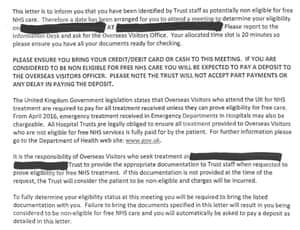
An extract from a letter sent out by the NHS.
“Please ensure you bring your credit/debit card or cash to this meeting. Please note the trust will not accept part payments or any delay in paying the deposit,” one letter sent by Barking, Havering and Redbridge University Hospitals NHS trust states. “Failure to pay a deposit for treatment may result in your future appointments being cancelled. In addition, overseas visitors who incur costs for treatment and do not pay will be reported by the trust to the Home Office and debt collecting agencies. The Home Office will review all records of bad debt and this could be detrimental to any future applications to visit the UK.”
NHS rules stipulate that it is legitimate to ask for payment from those who are not eligible for free care (because they are not ordinarily resident in the UK or because they are living here illegally), but emergency treatment cannot be withheld if a patient cannot pay.
A Department of Health spokesperson said staff should be “especially careful to inform pregnant patients that further maternity healthcare will not be withheld, regardless of their ability to pay … our guidance specifically says that maternity care should never be denied or delayed while a patient’s eligibility is established”.
The Barking, Havering and Redbridge University Hospitals NHS trust said that it had recently “updated” the standard letter to make “it clearer that maternity care would never be withdrawn or appointments cancelled”.
Le Déaut said: “It is bad practice to send these letters demanding credit cards. You are not supposed to threaten pregnant women – documented or undocumented – that you are going to withhold services. We are seeing this kind of letter quite often now. These people have no means whatsoever to pay this debt.”
One patient was telephoned weekly by a debt collection agency, which had a negative effect on her mental health, according to staff at the charity.
The pregnancy discrimination charity Maternity Action runs a helpline for women in this situation and has also noted a rise in demand for its services. “We regularly hear from women who are very distressed about receiving large bills from the NHS for their maternity care. It is pointless sending letters of demand to women who can’t afford to pay for their food and housing,” said its director, Ros Bragg.
The Department of Health spokesperson said no one should be denied urgent treatment and “vulnerable people, including those seeking asylum and refugees, are not charged for NHS care they receive”.
The case of a Nigerian woman who gave birth to quadruplets at London’s Queen Charlotte’s and Chelsea Hospital and incurred a bill of several hundred thousand pounds triggered popular hostility earlier this year, but the charity stressed that its patients had not travelled to the UK in search of free medical treatment.
Sarah Pillai, a volunteer GP who works at the east London clinic, said: “This is not health tourism by any stretch of the imagination. These are people at the outer reaches of society, cleaning, cash in hand jobs, providing the infrastructure for society, but unable to access healthcare.
“The women I’ve seen tend to be very anxious and nervous. A lot of these have been women in hiding until now. Lots of these women present late in pregnancy, which has an adverse effect on their pregnancy because delayed antenatal care can create problems for the mother and baby.”
Staff said there was growing awareness among patients of a controversial memorandum of understanding jointly published by the Home Office and NHS Digital that came into effect on 1 January and set out how the Home Office could request information on immigration offenders from the NHS.
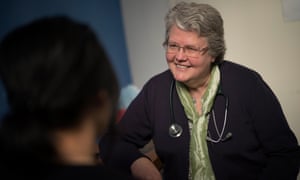
Dr Sarah Pillai, a volunteer at the east London clinic: ‘A lot of these have been women in hiding until now.’ Photograph: Sarah Lee for the Guardian
“When they hear if you go to the doctors, the Home Office might be knocking on your door, they choose to stay away,” Le Déaut said. “The results have serious implications; we see women who are nine months’ pregnant coming to our clinic. We assume that some people are giving birth at home”
She said she understood the need to ensure health tourists paid “but a trafficked woman or an undocumented migrant, who has no way of paying bills should be refused care when she is at her most vulnerable?”
Binta, a pharmacist from Sudan, arrived in 2010 to visit her husband, a doctor from Sudan who had a British passport and who had fled Sudan for political reasons. While she was trying to organise permanent residencyshe became pregnant. She was told by the Home Office that she needed to return home to apply for a new visa but did not feel able to travel because she was in the late stages of pregnancy. She was given leave to remain on appeal, but the papers did not come through immediately so she found herself ineligible for NHS treatment.
When the GP referred her for a scan, she was sent a bill for £2,669. “I was very frightened. I thought that they would deport us or that I would be sent to jail,” she said.
Her husband, who has now requalified and is working as an NHS doctor, was unemployed while he studied for UK medical exams and was receiving only £65 a week. “They kept resending the invoice; we received many letters. We couldn’t afford to pay. It distracted me from that beautiful moment of giving birth – all the time I was thinking about the money, are they going to take me to court? It is a part of my life I don’t want to remember again.”
Li arrived in the UK in 2012 after fleeing China because she was being targeted for promoting Christianity. She paid traffickers to get her out of China and arrived in the UK on a false passport. She spent more than a year locked in a house, forced to work for her traffickers, who produced illegal DVDs, to pay back some of her debts. Later she was freed and moved to live with a boyfriend. During her pregnancy, she was wrongly turned away by a GP when she tried to register because she had no papers.
“They asked me to pay £5,000 before I delivered the child. At one of my antenatal appointments, they brought me to a small room and explained I would have to pay more if I needed a caesarean. I felt very scared. There’s no way I can pay that much. I thought about not going to hospital, but I knew I couldn’t deliver a child by myself. I couldn’t cut the umbilical cord.
“When I was in the little room, explaining about the payment plan, I had to fill in a form with my immigration status, my names and address. They said they would hand that to the Home Office. I didn’t know what the Home Office would do – if they could deport me back to China. When I was in labour I was thinking about money all the time.”
She has subsequently begun the process of applying for asylum. She is not working because she is looking after a baby, so is not yet able to begin paying back her debts to the NHS.
England’s public health chief is urging hospitals to give every pregnant woman a carbon monoxide test to see if they smoke, as part of an NHS-wide drive to persuade patients to kick the habit.
Duncan Selbie wants midwives and nurses to routinely screen mothers-to-be when their pregnancy is first “booked”, monitor them at all their antenatal appointments and support those who want to quit.
Hospitals would also ban smoking shelters used by staff and patients, hand out nicotine gum and patches and include helping smokers to quit in patients’ treatment plans under Public Health England (PHE)’s plans. It also wants doctors and nurses to use their conversations with patients to advise them how to give up tobacco or encourage them to switch to e-cigarettes instead.
“One in four hospital inpatients smokes, but too many hospitals do too little to try to help them to give up. I want people who are in a hospital bed or in a consulting room to have a conversation about their smoking with a member of staff and, if they want to quit, refer them on to stop smoking services”, Selbie, PHE’s chief executive, told the Observer.
“This isn’t about scaring or hectoring people. It’s about making people aware that if they want to give up, NHS staff can help them. The evidence shows that if someone is helped to quit, they are four times more likely to succeed than if they do it on their own.
“We talk a lot about sugar and diet as health risks, but smoking remains the UK’s biggest killer and is responsible for near half a million admissions to hospital each year. One in four beds is occupied by a smoker and seven in 10 of them want to quit. It is time to consign tobacco to history and for the NHS to help people to give up.
“There’s something anachronistic about the NHS being associated with smoking,” he added.
The Royal College of Midwives (RCM) backed carbon monoxide testing for expectant mothers as long as they had the right to refuse to undergo it if they chose not to.
“The RCM is supportive of pregnant women being offered carbon monoxide testing at a time when it is appropriate to do so. Depending on the circumstances, it could be at the initial antenatal booking or during subsequent antenatal visits. Women should have the ability to decline testing as with any other area of antenatal screening,” said Janet Fyle, the RCM’s professional policy adviser.
But the NHS needed to understand that some women, especially those from poorer backgrounds, smoke as a way of helping relieve the stress of preparing to have a baby, Fyle added. “Having a baby and caring for a newborn along with other family members is one of the most stressful life events for some women, as some new mothers struggle to adapt to their new roles with little or no social support,” she said.
“We know that the incidence of smoking is higher in lower socioeconomic groups. We cannot ignore the psychological, social or economic circumstances of new mothers when developing strategies for how we communicate the risks of smoking and health care.”
PHE officials are frustrated that hospitals are doing too little to tackle smoking. In a strongly worded blog for the British Medical Journal, Dr Mary Black, its head of digital strategy, accused them of displaying “a kind of misguided sympathy [that] keeps the last vestiges of tobacco acceptability alive in the NHS.
“We falter before ill patients in pyjamas dragging their IV fluid stands out into the winter street in front of a hospital to have a fag, we pass with no comment past colleagues clustered around the emergency department exit having a communal smoke – some staff even smoke with patients at the exits of mental health units or in the last few remaining smoking shelters. Tolerating smoking on NHS premises is a form of collusion,” she said.
Black was especially critical of NHS personnel who light up outside their hospital. “Staff who smoke in NHS uniforms are sending a very clear pro-tobacco signal. Health staff who smoke with patients are empathising in a harmful way,” she said.
The National Institute of Health and Care Excellence (Nice) already advises hospitals to screen pregnant women to see if they smoke. However, many do not do so, even though recent evidence shows that it helps double the number of women who quit smoking during pregnancy and that those who do go on to have heavier and healthier babies. Smoking in pregnancy increases the risk of stillbirth, babies being small for gestational age, having trouble breathing and other problems.
Selbie praised Taunton and Somerset NHS Trust for playing messages recorded by children over the loudspeaker system in its grounds to ask those who are smoking to stop. The South London and Maudsley NHS Foundation Trust tells patients in all the letters it sends them that they should not bring tobacco, cigarettes, lighters or matches on to its premises or smoke anywhere in its grounds.
Selbie also highlighted Medway NHS Foundation Trust in Kent’s raft of anti-smoking measures, including its use of wardens to patrol the grounds telling people to stop smoking and a policy of frontline staff checking a patient’s smoking status and referring them for specialist help to quit if wanted.
The “global gag rule” imposed by Donald Trump, blocking US funds to any organisation involved in abortion advice and care overseas, could impact millions of women and girls, endangering their lives and those of their babies, Bill and Melinda Gates have warned.
The changes are expected to result in funding from the world’s biggest donor to family planning and women’s health programmes in the developing world being slashed. It could, Bill Gates told the Guardian, “create a void that even a foundation like ours can’t fill”.
Gates and his wife spoke out as they published a progress letter to Warren Buffett, the businessman who 10 years ago invested a large part of his fortune in the couple’s foundation which has at its centre the mission to save children’s lives. Empowering women and girls, the couple said, was central to that aim.
Trump signed an executive order reimposing the Mexico City policy, also known as the global gag rule, on his first full day in office. Republican presidents since Ronald Reagan in 1984 have imposed the policy, while their Democrat counterparts have lifted it. The rule strips funds from any organisation that “performs or actively promotes abortion as a method of family planning” overseas.
But Trump’s order goes further, applied to any organisation that receives funding from US Aid , not just those involved in family planning. That expansion, said Melinda Gates, was a surprise.
“We’re concerned that this shift could impact millions of women and girls around the world,” she said. “It’s likely to have a negative effect on a broad range of health programs that provide lifesaving treatment and prevention options to those most in need.
“This includes programmes that prevent and treat HIV, TB and malaria, and provide healthcare to women and children around the world. Enabling women to time and space their pregnancies and providing access to treatment and prevention of infectious diseases is lifesaving work. It saves moms’ lives and it saves babies’ lives, and that has long had wide support in the United States.”
Bill Gates said their foundation would not be able to bridge the potential funding gap. “The US is the No 1 donor in the work that we do. Government aid can’t be replaced by philanthropy. When government leaves an area like that, it can’t be offset, there isn’t a real alternative. This expansion of this policy, depending on how it’s implemented, could create a void that even a foundation like ours can’t fill.”
He had an early phone call with Trump in November and then a meeting in December with the president-elect in New York, he told the Guardian. They talked about the eradication of polio, which Gates hopes could come as early as this year, and the research his foundation is supporting towards an Aids vaccine and ways to protect people from pandemics such as Ebola in west Africa.
“So that was a good discussion – the fact that he was interested in having me talk about the Foundation’s work – I was pleased,” said Gates. But the philanthropist did not anticipate the scope of the executive order affecting family planning, an issue at the centre of the foundation’s work, that Trump was to sign.
Bill and his Melinda Gates with investment veteran Warren Buffett (R) in 2006. Photograph: Nicholas Roberts/AFP/Getty Images
The letter to Buffett is an assessment of the progress the Gates Foundation has made since 2006, when he pledged 10m shares in his company Berkshire Hathaway in annual instalments worth a total of $ 31bn at the time. The couple write of the progress that has been made in saving children’s lives, particularly through immunisation and vaccine development, and the work that lies ahead in making childbirth safer and tackling malnutrition.
Their letter makes clear what is at stake with Trump’s move to reimpose the global gag rule, arguing that women and maternal health are key to so many global health issues.
Empowering women is a key theme of the letter in which the couple argue that enabling women to access contraceptives control over the number of pregnancies they have is crucial. When women have a gap of at least three years between births, their children are more likely to survive and be healthy and well educated, the couple say. “Like vaccines, contraceptives are one of the greatest lifesaving innovations in history,” writes Bill Gates in the letter.
What is the ‘global gag rule’, and why does Trump support it?
Since they set up their foundation its focus has shift from the hunt for technological solutions towards social change. The attention to women’s empowerment came from the evidence, the couple say.
“You cannot go out and be in the developing world and then come back and look at the data and turn away from the importance of women in the developing world,” said Melinda Gates.
Whether they breastfeed and take their children to be vaccinated makes a profound difference to how the child grows and his or her life chances, and men are not always there, she added. “So you have to look at the woman’s role and when you look at it you realise it can be an accelerator to every single thing you want to have happen in the world for global health and global development and social change.”
In their letter, Bill Gates sats that poverty is sexist, a phrase he first heard from the U2 frontman Bono.
“The poorer the society, the less power women have. Men decide if a woman is allowed to go outside, talk to other women, earn income. Men decide if it’s acceptable to strike a woman. The male dominance in the poorest societies is mind-blowing.”
In the letter, Melinda Gates adds: “It’s also crippling. Limiting women’s power keeps everyone poor.”
She and her husband tell of their visits to sex workers in India whom the couple say they encouraged to form self-help groups, thinking the women would help each other insisting their clients wore condoms to protect themselves from HIV. That vision, said Bill Gates, “was way too narrow”. The sex workers began to support each other in every aspect of their lives.
“Warren, if Melinda and I could take you anywhere in the world so you could see your investment at work, we probably would take you to meet sex workers. I met with a group in Bangalore, and when they talked about their lives, they had me in tears,” writes Bill Gates.
“One woman told us she turned to sex work after her husband left her – it was the only way to feed her children. When people in the community found out, they forced her daughter out of school, which made the girl turn against her mother and threaten to commit suicide.
“That mother faced the scorn of society, the resentment of her daughter, the risks of sex work, and the humiliation of going to the hospital for an HIV test and finding that no one would look at her, touch her, or talk to her. Yet there she was, telling me her story with dignity.”
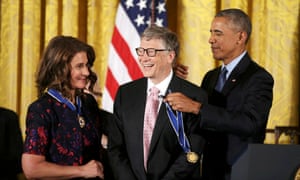
Bill and Melinda Gates receive medals from Obama at presidential medal of freedom ceremony in November 2016. Photograph: Carlos Barria/Reuters
There have been setbacks, such as the failure yet to end polio, but the couple emphasise the enormous progress that has been made in the last couple of decades in global health and speak in the letter of their optimism for the future.
“Polio will soon be history. In our lifetimes, malaria will end. No one will die from AIDS. Few people will get TB. Children everywhere will be well nourished. And the death of a child in the developing world will be just as rare as the death of a child in the rich world.
“We can’t put a date on these events, and we don’t know the sequence, but we’re confident of one thing: The future will surprise the pessimists.”