Wanted etiketine sahip kayıtlar gösteriliyor. Tüm kayıtları göster

18 Nisan 2017 Salı

The agony of ending a wanted late-term pregnancy: three women speak out

Last year, Donald Trump suggested that current abortion laws allowed doctors to “rip the baby out of the womb of the mother just prior to the birth of the baby”. His statement erroneously described abortion procedures, and also triggered an uproar among the women and men who know firsthand the devastation of ending a late-term pregnancy.


Nearly 99% of abortions occur before 21 weeks, according to the Center for Disease Control and Prevention, but when needed pass that point it is in response to harrowing circumstances.


“Abortions that occur at this stage in pregnancy are often the result of tragic diagnoses and are exactly the scenarios wherein patients need their doctors, and not obstructive politicians,” says Dr Jennifer Conti, clinical assistant professor at Stanford University. “Asking a woman to carry a fatally flawed pregnancy to term is, at the very least, heartbreaking. I’ve often heard women say that they chose to end such pregnancies because of unselfish reasons: they couldn’t bare the thought of putting their fetus through even more pain or suffering.”


Just this year, 400 abortion restrictions were introduced in 41 states, according to the Guttmacher Institute, a research organization that supports abortion rights. Among them, Republicans introduced the first ever federal “heartbeat” bill earlier this year – which would ban abortions after a heartbeat is detected. Meanwhile, Congress is considering a bill that would also ban abortion at 20 weeks nationwide – which is when ultrasounds can offer the first signs of fetus anatomy anomalies.


Here, three different women agreed to share their experiences to end misconceptions about late-term terminations, and to explain to politicians and the general public why they’re necessary in the first place.


Kate Carson, teacher, outside of Boston, Massachusetts


That warm June day, the recovery room was silent. The doctor entered carrying Laurel, a bundle of just five pounds wrapped in a pink-and blue striped cotton blanket. He gently passed her to her mother, Kate. She bent forward to smell her. She touched her skin. Her daughter was warm, but not as warm as she should have been.


“I just needed to know it happened. I needed to know that I had a baby,” Kate Carson says.


At 27, Kate had her life planned out. She and her husband were going to have four kids, and she was going to be an engineering professor. Her first pregnancy went fine, and she had a healthy baby girl. But while pursuing her PhD in engineering, she suffered three miscarriages. “It was a long road,” she says, but at by 29, she was finally expecting another girl, Laurel. She was due in the summer of 2012, and both parents were elated.
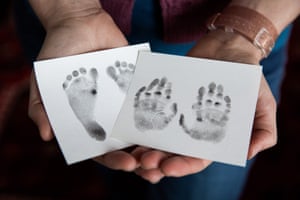


Kateholds her baby Laurel’s foot and hand prints that were made by nurses at the clinic.


Kate holds her baby Laurel’s foot and hand prints that were made by nurses at the clinic. Photograph: Kayana Szymczak for the Guardian

At 19 weeks, an ultrasound revealed a shadow of concern but the finding was reversed with full confidence at a level two ultrasound. “I’m not seeing any problems. Everything looks fine,” the specialist told the parents.


But Kate had a nagging worry. “My husband and I did not feel like everything was fine,” she says. She asked the nurse how sure the specialist was. “He would have to be so certain. They would never reverse a diagnosis without being super sure about it,” the nurse replied.


Yet her husband encouraged her to book another second level two ultrasound, a “piece of mind ultrasound”.


Expecting only reassurance, Kate knitted a pink sweater for Laurel while chatting freely with the technician who quickly grew silent. There was a big black spot on Laurel’s brain. “This baby is different,” the technician said. She left the room and returned with a maternal fetal specialist and a specialist in training.


“That’s when they started telling me,” Kate says. The fetus had Dandy-Walker malformation, a set of abnormalities of the cerebellum.


“The problems we didn’t see last time, we are seeing today,” said the specialist. She offered Kate adoption and abortion, “if it was still a legal option”. They used to send women to Kansas for abortions, she told her, but that was before Dr Tiller was shot in the face at a Sunday church service.


Kate asked if children with Dandy-Walker malformation are ever normal. “Yes,” said the specialist.


“And that, honestly, is so hard to hear because you just want something definitive”, Kate recalls. “On the one hand, of course you want your child to be normal. On the other hand, you want to know, is your kid going to be okay, is your kid going to receive a devastating diagnosis?” But the specialist had no definitive answers and recommended an MRI to determine whether Laurel would be okay or “incompatible with life”.


Kate couldn’t get the MRI for the next 48 hours. The wait was excruciating. At home, she could find no peace and substituted knitting her baby’s sweater for sleeping. She curled up on her living room sofa and cried until her husband scooped her up each night and took her to bed.


“When you’re imagining futures beyond the miracle happy ending, it’s sinking in,” she says.


The day of the MRI finally arrived. She was 35 weeks, 0 days. By the end of it, Kate and her husband had the hardest answers they’ve ever received.


Their daughter had moderate to severe Dandy-Walker malformation. But that wasn’t the only diagnosis; Laurel also had a brain condition in which fluid builds up in the ventricles, eventually developing into hydrocephalus and possibly crushing her brain. She had a congenital disorder too, in which there was complete or partial absence of the broad band of nerve fibers joining the two hemispheres of the brain.


What this meant was Laurel was expected to never walk, talk, or swallow. That was if she survived birth.


Kate asked her doctor, “What can a baby like mine do? Sleep all the time?”


“Babies like yours are not generally comfortable enough to sleep,” the neurologist said.


“That is when it became very clear what I wanted to do,” she says. “The MRI really ruled out the possibility of good health for my baby.”
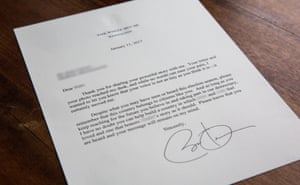


A personal letter of support from Barack Obama. Kate wrote to President Obama after her abortion experience, in an effort to educate politicians about the realities of late-term abortion.


A personal letter of support from Barack Obama. Kate wrote to President Obama after her abortion experience, in an effort to educate politicians about the realities of late-term abortion. Photograph: Kayana Szymczak for the Guardian

For Kate, giving a child life and peace are the two gifts a mother can offer. “Most babies get to have life and get to have peace, but this baby, I had to choose. I could choose life, with the outside chance of peace or occasional peace, or I could choose certain peace without life. And for me, certain peace without life was the choice I wanted to make.”


On their ride home, Kate and her husband were silent as they drove in rush hour traffic across the Zakim Bridge. Unable to say it herself, Kate’s husband uttered the word abortion. “I think we should ask about it,” he said.


“I had been in this dark, awful prison of a place inside myself,” she says. Her husband’s words comforted her.


When they arrived home, Kate immediately called the doctor and left her a message. Her mother arrived to pick up their daughter and before leaving said she would have done the same. An hour later, the phone rang. Kate grabbed it. If they wanted the abortion, they had 30 minutes to call a clinic in Colorado before closing time or wait the weekend. The procedure would last four days. And they would need $ 20,000. Massachusetts doesn’t allow abortion after 24 weeks unless it’s necessary to save the life of the mother.


Kate and her husband live a modest life, certainly not one with $ 20,000 readily available. Kate’s younger brother offered his life savings of $ 5,000, but it was her parents who gave them the money from their retirement fund. “This is exactly why these abortions exists,” said her father.


Three days later, they were driving up to Dr Hern’s Boulder Abortion Clinic, where surveillance cameras and razor wired fences surrounded them. She was 36 weeks.


I felt like the only one in the entire world … but we are not entirely alone. Just hidden


Kate Carson


Inside the clinic, Kate took a blood test followed by exhaustive counseling sessions, then the consent form. Dr Hern wanted to make sure she was doing this of her own free will.


By the end of the day, Kate and her husband knew it was time. Dr Hern took Kate to a room for the injection. It would slow her baby’s heart to a stop as soon as it penetrated. Sometimes, it happens quickly. For Kate, it happened over the course of a couple of hours. Just as she and her husband were planning to grab a bite of food, Laurel kicked. “I lost it,” says Kate. She retreated to her hotel room and lay there until the moving stopped. When Laurel went still, Kate’s stomach sagged low and lifeless, she says. “It was really sad and really hard.”


“I did not ever doubt I was doing the right thing for her but that did not make it easier,” she says. Kate says Laurel got the “tightest hug”. Her body was hugging her.


Next, it was time to get dilated, which was painful for Kate because she couldn’t receive an epidural. On the last day in Colorado, on an early June day, Kate, who was in labor for two and a half hours, delivered Laurel.


In the recovery room, Dr Hern brought Laurel to her. She smelled right, she felt warm, but not as warm as a live baby.


“She was beautiful,” Kate says.


When Kate returned home, they scattered Laurel’s ashes in the ocean. It was time for closure, but Kate worried about judgment so she didn’t tell anyone what happened for months. Then the self-doubt came.


“I feel like myself got fragmented into a million different selves. And I had my angry guard dog piece and my jealous piece, had my sad piece, I had the guilt, the religious piece. All of these pieces, and I had to figure out who I was”.


For some time, Kate wondered about the human error piece in the equation and wondered if her first doctor might have mislead her on purpose. A little research later proved it was just an honest mistake. “I can live in a world where people make mistakes,” she says. “I felt like the only one in the entire world who had had such a later abortion and it is true that we are rare, but we are not entirely alone. Just hidden.”


Since Laurel, Kate gave birth to another healthy daughter.


Kate Carson speaks about her experience to doctors, lawyers, and neighbors. You can also read about her experience here


Lindsey Paradiso, wedding photographer, Virginia
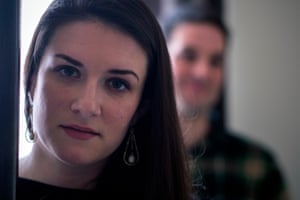


Lindsey and Matt Paradiso, photographed inside their home.


Lindsey and Matt Paradiso, photographed inside their home. Photograph: Justin Ide for the Guardian

The moment Lindsey, 27, found out she was pregnant, she wrapped the positive test strip in a used gold metallic gift bag and surprised her husband, Matt, with it. Two months later, they named her Omara Rose.


This was not the easiest pregnancy for Lindsey. She suffered from sciatica nerve pain and had to undergo daily injections for her blood clotting disorder. But she was over the moon about the pregnancy.


At first, it looked like a bubble floating on the ultrasound. At the routine 18-week visit in February 2016, the doctor speculated the peculiarity could be cystic lymphangioma, a group of cysts found mostly in the neck. Or it could be nothing. They immediately booked an appointment with the University of Virginia (UVA).


After seeing the ultrasound at UVA, Lindsey noticed the growth had enveloped half of Omara’s face and spread around her neck to the back of her head. When the doctor entered, they expected the worst. Again, the term lymphangioma came up. But so did cervical teratoma. Only an MRI could determine decisively, but whether it was malignant or benign, it could be fatal to the baby.


“You could just tell the energy in the room was like you should end it, it’s not going to turn out well,” she says. The doctor told them they could terminate the pregnancy since Omara’s chances of survival were slim. Matt and Lindsey were crushed by the prospect. They wanted to fight.


Twenty days after seeing the first signs of trouble, they learned that Omara had an aggressive form of lymphangioma growing out of her neck. The diagnosis came in the form of a dense two-page MRI report. The fast-growing, inoperable tumor had grown into her brain, heart, and lungs. It had wrapped around her neck, eyes, and deep into her chest. It was so invasive, it was pushing her tongue out of her mouth.


Her chances of living to age of viability or birth were slim. Lindsey and Matt made the heartbreaking decision to follow through with an abortion at around 24 weeks. They were just a few days away from it being an illegal termination.
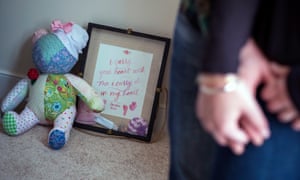


A shadow box of memories of their daughter, including her hand and foot prints, sits with a teddy bear.


A shadow box of memories of their daughter, including her hand and foot prints, sits with a teddy bear. Photograph: Justin Ide for the Guardian

On 26 February 2016, Omara Rose’s heart stopped beating. Shortly after, Lindsey was admitted into the hospital for labor induction but the epidural stopped working. “I felt like my insides were being ripped apart,” she says. When the doctor administered a second epidural, Lindsey became nauseous. Her ears rang. The room spun. The doctor rushed in to administer a third epidural.


She was conflicted the whole time because while she was in pain, she didn’t want it to stop because she knew by the end of it “your child is going to be dead”, she says. Matt held her hand the whole time.


To hide something because you’re ashamed of it is just going to perpetuate misunderstanding


Lindsey Paradiso


When she finally delivered Omara Rose 40 hours later, she was so small, “I barely felt her leave me but I knew she had,” she says.


Over the next few hours, Lindsey and Matt got to hold Omara Rose, dressed in a tiny dress with a hat the size of the cup of Lindsey’s hand. Then Lindsey’s and Matt’s family came, each taking turns to say their goodbyes. “I wanted her to be alive so badly but I knew it was for the best. She went without pain,” she says.


The next day, they buried their daughter in a cemetery four hours away from where they live now.


“I don’t think people understand the gravity of how sick she was. How fatal her tumor was,” says Lindsey.


But it took some time for them to be open about it, especially Matt. Lindsey found comfort in blogging while Matt focused on completing his education at Virginia Tech.


“To hide something because you’re ashamed of it is just going to continue to perpetuate misunderstanding,” says Lindsey. People automatically assumed that if she had the abortion, it was out of convenience. On the contrary, she says. “It’s something that will stick with you forever.”


For those who believe these babies are unwanted, Matt says: “You’re not going to wait until halfway through your pregnancy to finally have an abortion.”


Prompted by Donald Trump’s statements on late-term abortions, Lindsey shared more widely her experience in a Facebook post, which was shared over 100,000 times.


“Abortions are hard decisions made by real people,” she says. “Being open is a call for empathy.”


Lindsey Paradiso testifies against bills to limit access to safe and legal abortions. She’s also blogged about her experience here


Darla Barar, Austin, Texas, copyrighter
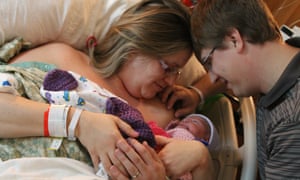


Darla Barar and her husband Peter. Darla was pregnant with twins - Catherine and Olivia - when they discovered that Catherine had a number of serious health issues.


Darla Barar and her husband Peter. Darla was pregnant with twins – Catherine and Olivia – when they discovered that Catherine had a number of serious health issues. Photograph: Courtesy of the Barar family

On 22 June, at 3.30pm, the doctor let them see Cate one last time. She danced for them and then kicked. Her mom told her it was going to be okay. And then, guided by the ultrasound, the doctor injected a medication into Cate’s heart, stopping it. When they checked for a heartbeat 30 minutes later, the silence was deafening.


Darla, then 29, and her husband Peter had tried for years to get pregnant. When treatments failed, they traveled to the Czech Republic to use donated eggs. A week after the transfer, Peter got a dinner dessert with a message: “Congratulations daddy.” They were expecting twins.


Darla and Peter had named their twins Catherine “Cate” and Olivia, and by their 20-week anatomy scan they already knew their distinct personalities. Olivia was a “diva” and Cate was shy, a “cuddle bug”. “We loved them more fiercely than I ever thought possible,” Darla says.


But during a routine anatomy scan, the technician was abnormally quiet. Cate was measuring a little behind but she was always the smaller of the two, so Darla didn’t worry much. After a long wait, the OBGYN entered the room and asked Darla to sit next to her husband. “I just knew something was wrong,” Darla says.


Finally, we just looked at each other and said it was okay. We had to do what was best for her


Darla Barar


Darla recalls hearing the doctor say he had never seen this combination of anomalies before.


Darla and Peter saw additional specialists, and all confirmed a number of issues. Cate had encephalocele, which is a neural defect that causes brain matter to leak out, slow growth, microcephaly, a very large cleft lip and possible fused digits. Her cerebellum was so underdeveloped that one doctor had trouble finding it and her brain’s midline was shifted, indicating “severe disorganization”.


To make matters worse, Olivia’s life was in danger. Cate’s amniotic sac was growing and restricting the growth of Olivia’s sac.


If she carried to full term, the restriction on Olivia’s sac would likely mean an early delivery. Darla says that every specialist they saw disclosed there was a high probability that Cate would not survive the delivery but if she did, there was no guarantee the surgeries – removing the encephalocele and placing her brain tissue back into her skull – would save her.


Darla cried and Peter prayed. “We needed a miracle and we knew as the day went on we weren’t going to get one.”
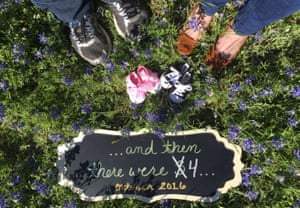


‘And then we had to grasp that we were only a family of three.’


‘And then we had to grasp that we were only a family of three.’ Photograph: Courtesy of the Barar family

Their other option was abortion, one they did not take lightly, but one that felt rushed because of Texas’ restrictive abortion laws, which bans abortions after 22 weeks. Darla and Peter had 12 days to decide. “If laws were different … we would have done more testing – one doctor mentioned an MRI, for example, to try to test the level of her brain function. But we didn’t have that, and knowing what timeline we were on, we spent a lot of sleepless nights researching, making appointments, talking to each other and our therapist, and really just spending time being the four of us,” she says.


“Finally, we just looked at each other and said it was okay. We had to do what was best for her. So we knew what we had to do to bring home one”. Darla says she was prepared to deal with it all, but “if it meant Cate was going to suffer, we just couldn’t do that to her.”


At 21 weeks and 6 days, Darla had an injection, and Cate’s heart stopped. “For us, it was completely humane,” she says.


In the case of an additional fetus that gets aborted in the womb, the tissue is usually reabsorbed back into the body, but that wasn’t the case this time.


“I kept telling Peter, I’m carrying our healthy baby and our dead baby. I can’t reconcile that in my brain. At the same time, it was a comfort to know that I didn’t have to say goodbye right then,” she says.


Thirteen weeks after the diagnosis, Darla delivered Cate and then gave birth to Olivia, a healthy five-pound baby. The family took turns holding Cate and later in the afternoon, the chaplain came to take her away.


“And then we had to grasp that we were only a family of three,” she says.


Darla says she couldn’t face people after the abortion. She called it a stillbirth. “I knew I was dealing with more than just grief and I couldn’t explain that to people,” she says. She was also dealing with guilt. But she never felt regret, she says. She knew she did the right thing.


Spurred on by Donald Trump’s comments about later abortions, Darla took to social media to share her story and the response was overwhelming, both good and bad. The meaner comments focused on abortions as a version of birth control, or a way to rid oneself of an imperfect child.


“I can tell you, knowing how much the procedure cost, nobody is doing that for birth control,” she says. “Ask us why we’re getting it. Don’t assume that you understand our lives.”


Nonetheless, “being open has allowed me to be a better mom. I’m much more free with my emotions,” she says. Knowing that she could become a voice for women and men who needed it empowered her.


“It’s always the health of the mother but the health of the baby is never taken into consideration [into laws] and in situations like ours, it could have meant two dead babies on our hands,” she says.


Darla Barar blogs about her experiences here


The agony of ending a wanted late-term pregnancy: three women speak out

16 Ocak 2017 Pazartesi

Everything you wanted to know about cancer diets

While there is no magic diet that will cure or prevent cancer, intervention in a patient’s diet will help them maintain an acceptable quality of life – as long as that intervention comes from a medically qualified professional with no vested interests. Which brings us to the case of Australian blogger Belle Gibson, who is facing legal action for “unconscionable conduct” after promoting a book in which she talked of curing herself of multiple cancers by eating the right things. The publisher, Penguin, paid more than A$ 264,000 (£160,000) for the book and Gibson also made more than A$ 420,000 from app sales before it emerged that she had never had cancer. Her claims to have donated over A$ 300,000 to charities also turned out to be false.


In contrast, a recipe book for cancer patients experiencing weight loss from University College, Cork, and one for patients with swallowing difficulties from Breakthrough Cancer Research have been developed by dieticians and are available free of charge.


What is an oncology dietician?


Oncology dieticians provide expert, evidence-based advice to cancer patients to help maintain their strength, wellbeing and quality of life. They can, for example, develop plans using fluids or tube feeding to help maintain weight and muscle mass. They also address side effects of treatment that affect a patient’s ability to eat. Qualifying as an oncology dietician involves a four-year undergraduate degree in human nutrition and dietetics, with a hospital placement. Alternatively, people with a related science degree can obtain a postgraduate qualification in dietetics, followed by at least three years of post-qualification hospital work.


Ruth Kilcawley and Fiona Roulston are oncology dieticians. Frustratingly, says Kilcawley, much of the misinformation about diet and cancer her patients receive comes from well-intentioned loved ones, while Roulston’s patients often get information online. “If you enter ‘nutrition and cancer’ into Google, you get over 123m results. With so much conflicting information, it makes it so confusing and overwhelming for cancer patients at an already stressful time.”


What about a vegan diet?


There isn’t currently any strong evidence that eating too much red meat causes cancer. Some studies have shown a weak possibility that red meat may be associated with colorectal cancer in men. But an association is not a cause. There is some evidence that vegan diets may aid weight loss in certain people (though this may partly relate to vegans simply being more aware of what, and therefore how much, they eat). However, a healthy diet hinges on avoiding overindulgence and ensuring that we get enough nutrients to meet our essential needs. The few scientific studies on veganism and vegetarianism refer to a lack of data on vegan diets, but some vegan diets have been shown to result in calcium levels that are below minimum dietary regulations. In a small study of men with early-stage prostate cancer, a vegan diet resulted in vitamin D deficiency.


“Unnecessary diet restrictions of food groups are not recommended during cancer treatment,” says Roulston. Kilcawley adds: “The negative consequences include accelerating muscle loss. This leads to reduced ability to tolerate treatment, inadequate micronutrient intake (particularly calcium, which may compound bone mineral density issues with some types of chemotherapy), lack of energy, low mood and fatigue.”


But surely we all know that sugar is carcinogenic


Eating too much fatty and sugary food is not good for anyone. But the idea that cancer has a sweet tooth and that a patient can “starve” their cancer by cutting all sugars and carbohydrates is a gross oversimplification for a complex disease that behaves differently from patient to patient. It simply isn’t the case that cake feeds cancer while eggs feed healthy cells, and cutting carbs completely puts patients at increased risk of malnutrition. A study of more than 1,000 patients across three Irish hospitals found alarming levels of malnutrition amongst cancer patients.


The case study of a 65-year-old woman who recovered from a brain tumour has been used to promote the idea that a low-carb, high-fat “ketogenic diet” is a cure for cancer. However, this patient had also received standard chemotherapy and radiotherapy. Disturbingly, a proponent of this diet, Dr Thomas Seyfried of Boston College, has said it “can replace chemotherapy and radiation for almost all cancers”.


Nutrition is complex. Patients should seek advice on their individual needs from a qualified professional. No competent professional will ever tell a patient to forgo evidence-based medicine in favour of a diet.


What about supplements and superfoods?


Anything that alters how your body works is a drug, even if it’s “natural”. Supplements not recommended by a dietician can interact with other drugs, including anti-cancer therapies, and make them less effective. The Memorial Sloan Kettering Cancer Centre urges patients to stop taking any herbal supplements before starting treatment and lists some of the dangerous effects such “natural remedies” can have. The term “superfoods” is simply part of a marketing strategy, not based on science.


“There is huge manipulation of people’s emotions going on when someone tries a fad diet, hoping against hope it will cure them, and then subsequently fails because it is restrictive, unpalatable, or the patient is simply too ill,” says Kilcawley. “They risk blaming their own failure in keeping to the diet on any progression of disease, which is excessively cruel of those promoting diets without sufficient evidence that the diet if kept to would be effective. I see this a lot.”


Further information: Cancer Research UK, Macmillan and the Irish Cancer Society are all reliable sources for advice and support.


Everything you wanted to know about cancer diets

27 Ekim 2016 Perşembe

Emily wanted to die when her son was taken. Nurses gave her a future

“If my children were ever taken off me, I wouldn’t survive the day,” was my sister’s emotive, yet understandable, comment when we were discussing the impact losing your children could have on your mental health. It made me think of a woman I had worked with, Emily.


Emily had her son taken off her after she had attempted to kill herself. The boy, Jacob, was pre-school, and the decision by social services was made in her best interests. Emily had been in an abusive relationship and was struggling to cope. She had serious mental health problems as well as a history of childhood abuse, so coping was not something she was good at. She had always refused to engage with mental health services for fear that it would result in Jacob being taken away. The tragedy is that engaging with services was probably the only thing that would have kept their family together.


After further attempts to take her own life, Emily was detained under the Mental Health Act and admitted to the mental health ward where I worked. At this point, Jacob had been taken away by social services. Emily was told Jacob would be adopted; she could have phone contact until then and one final visit to say goodbye.


Initially she could not accept this and just wanted to die. It was one of the hardest cases I have experienced. She was right – what did she have to live for now she had lost Jacob? How could she continue feeling this pain and despair for life? As a team – nurses, doctors, occupational therapists and psychologists – we worked tirelessly with her to instil some sense of a future. Jacob was going to grow up loved, in a safe and secure environment unlike anything Emily had ever experienced. Her son had a positive future and she could take some comfort in that.


We focused on preparing Emily for her last contact with her son. She made her own plans about what she wanted for the two of them, and we supported her to achieve it. Emily was brave and made sure she could hold it together until Jacob had left, and then her world came crashing down.


Part of the preparation included talking to Emily about her suicidal thoughts and talking to her about what we could do to minimise the risk. We kept her safe while she grieved the loss of her daughter. We then worked with her to create the positive future she wanted for herself. This started with her keeping herself safe on the ward, one day at a time. We then looked at a longer term placement where she could get the intensive psychotherapy she needed to manage her mental health issues, heal from the hurt of the past and come to terms with losing Jacob.


Every day mental health nurses help people like Emily, who feel they have nothing to live for. Every day mental health nurses save lives. According to a report by the Mental Health Taskforce Strategy (2016) more than 14,000 people who have killed themselves between 2003 and 2013 had been in contact with mental health services; this is only just over a quarter of all suicides in that time. The same report acknowledges that suicide rates for mental health inpatients are declining, but sadly it is only the people we don’t manage to save that make the headlines. I am glad that we were able to help Emily and she hasn’t become another statistic.


Names and some details have been changed


If you would like to contribute to our Blood, sweat and tears series which is about memorable moments in a healthcare career, please read our guidelines and get in touch by emailing sarah.johnson@theguardian.com.


Join the Healthcare Professionals Network to read more pieces like this. And follow us on Twitter (@GdnHealthcare) to keep up with the latest healthcare news and views.


Emily wanted to die when her son was taken. Nurses gave her a future

17 Ekim 2016 Pazartesi

Bitter irony: I wanted to speak out about mental health but my anxiety stopped me | Marian Faa

I think and write a lot about mental health. Since being diagnosed with anxiety and clinical perfectionism, writing has become an important way of coming to terms with my own psychiatric ailments, while trying also to raise public awareness. It’s not an easy task. Despite my eagerness and many importunate attempts to give a voice to mental illness, I am often left feeling like the world isn’t ready to listen.


But when mental health week ticked around this year, ears pricked up. My news feed was awash with articles about mental health, friends brandishing popular hashtags and events popping up all around my city.


Finally, a week where mental health was a hot topic, where my issues were on the frontline. If ever there was a time when my humble opinions on the human brain might count for something, this was sure to be it. I panicked.


Determined to seize the opportunity, I started bashing out stories and pitches with intensity, like I was trying to give my computer’s motherboard some kind of frantic deep tissue massage. My mind turned cartwheels. Within 20 minutes I had chewed all my fingernails back to the quick and yanked out a few generous handfuls of hair – telltale symptoms of my escalating anxiety.


I forgot to have lunch. I forgot to pick my little sister up from school. I missed two calls from my partner. But somehow I still managed to singlehandedly pluck all the tiny hairs on my leg, another delightful habit I tend to deploy with fervour whenever I need to curb my anxiety.


As time ticked by and the pressure mounted, I realised I was heading for a nervous breakdown. Maybe I was making too big a deal of mental health week, but that is the very nature of my mental illness – the tendency to inflate and catastrophise. It was a bitter irony: my anxiety was the very thing that stopped me from writing about it.


So I closed my laptop and resolved to stay silent for mental health week. I decided that protecting my own mental state was more important than writing about it. And I reassured myself there would be other opportunities.


See, that’s just it with mental illness. Often we cannot talk about it when the world wants us to – whether that be our families, therapists or the media. And when we are ready to speak up, we can’t find the ears.


Even with efforts to reduce stigma, mental health is an extremely sensitive topic. It takes a long time to develop the personal insight and vocabulary to be able to communicate about our mental states. In my experience, you can only really talk (or write) about it on your own terms and in your own time. This means we need a culture that is receptive to discussions the year round, not just at designated calendar points.


While initiatives like mental health week are exceedingly important, they are not always as beneficial to sufferers in the ways they intend to be. The sudden spike in publicity may feel like a fleeting injection of sympathy that leaves us even more isolated once the week is over and our issues fall into the background once again.


The ephemeral support for mental illness shines with a suspicious veneer, tarnished by the knowledge that talking about mental illness might earn you a hundred likes on Facebook on one day but compromise your job application the next.


On the other hand, the sudden spotlight on mental health can also cause people with mental illness to cringe and withdraw, unnerved (so to speak) by the unfamiliar pressure of public exposure. And then there is the risk of triggers that comes with a disordered flurry of news articles and tweets about mental health.


I am not disputing the merits of mental health week and the media’s reporting of it. I think these initiatives are noble and necessary. I think they are crucial to creating a society that makes it easier to live with a mental illness. But if listening to people with mental illness and understanding their experiences is the most important step in dissolving the silence and stigma, we need to be open on a more general, everyday basis.


We need a culture that is attuned to the nuances of mental illness and accepting of the silences as well as the disclosures. We need a world where mental health is an acceptable topic regardless of time and place, beyond the field days and short-lived social media campaigns.


Bitter irony: I wanted to speak out about mental health but my anxiety stopped me | Marian Faa

9 Eylül 2016 Cuma

DfE emails show officials wanted to silence mental health tsar

Department for Education (DfE) officials appear to have been working to sack Natasha Devon, the government’s schools’ mental health champion, over her criticism of government policies even as they publicly denied doing so, according to internal emails obtained by Devon.


Devon, who was dropped from her role after she repeatedly argued that the government’s own education policies were contributing to poor mental health among young people, said the DfE emails confirmed her fears that the department had been trying to silence her.


In March, two months before her role was axed, one DfE official wrote that although they wanted to avoid the appearance that the department was dropping her because of her criticism, “it cannot be feasible that she continues”.


In another email a month later, an official writes: “Every day is another day she could be saying something damaging – and if that happens we will kick ourselves for not acting sooner.” But after the Guardian broke the news that Devon would be axed, she received a text that read: “What the Guardian have printed is ludicrous – We want to work with you more, not less!”


After reading the emails, Devon said they showed that the government’s policies on children’s mental health was little more than “a PR exercise” and confirmed her fears at the time that the department had been trying to silence her.


She said the emails revealed a government more worried about her comments on Twitter than the crisis in mental health among young people. “I can’t believe the ineptitude,” she said. “It’s like a script from [the BBC political satire] The Thick of It.”


Devon, who was appointed with some fanfare by the government in August 2015 to raise awareness of and reduce the stigma surrounding young people’s mental health, put in a subject access request to see government emails concerning her role after her dismissal in May.


At one point one official exclaims: “I know I keep saying this but please can everyone monitor her Twitter?”


Elsewhere the tone changes. After the news broke that her role was being cut, one DfE email read: “I think we now need to take ND down a peg or two.” A couple of days later, another said: “She is having her fifteen minutes and hopefully she is nearly at the end.”


Devon, who has almost a decade of experience of working in schools as the founder of the Self-Esteem Team and Body Gossip which deliver mental health education to young people, said her experience of working with government had “played havoc” with her own mental health.


When she was appointed she was told it was an important role – though unpaid to ensure impartiality – and would give her an opportunity to influence policy. In the end, it was “window dressing”, to help the government get coverage on GMTV and in other lifestyle media, she said.


Though Devon was hired because of her ability to talk to young people, department officials objected to her choice of language on social media.


When she uses the word “dickwad” in response to a story about a young woman being bullied for speaking out about sexism, one DfE email reads: “It is obviously totally unacceptable for a government-endorsed champion to swear and use offensive terms as she does … I have just called Natasha and she was surprisingly unapologetic.”Asked on Friday to respond to the internal emails and Devon’s criticism of the government’s policies on young people’s mental health, a DfE spokesperson said: “Natasha did a great job of helping us to raise the profile of young people’s mental health during her appointment.


“Since that time, the independent NHS taskforce report has been published which recommended that a cross-government mental health champion be created – for this reason we had to reconsider the department’s own role.”


Devon has now compiled a comprehensive report on children’s and young people’s mental health based on what she uncovered during her nine-month tenure as government mental health champion and her own work in schools.


She said of the government’s approach to young people’s mental health: “They talk a good game but they don’t get it. There was no real understanding of the severity of the situation. They would say the words, but I did not feel there was any kind of urgency.”


DfE emails show officials wanted to silence mental health tsar

24 Ağustos 2015 Pazartesi

Female Viagra? Almost everything You Wanted to Know About Sex Drug Flibanserin But Have been Afraid To Request

[unable to retrieve complete-text content material]


Female Viagra? Every thing You Wanted to Know About Flibanserin But Had been Afraid To Inquire I&rsquom a 37-yr-old married female with two small young children, a total-time work, and not enough hours in the day. Putting my occupation as a journalist aside, you&rsquore darn straight I have a lot of queries about the [...]


Female Viagra? Almost everything You Wanted to Know About Sex Drug Flibanserin But Have been Afraid To Request