smoking etiketine sahip kayıtlar gösteriliyor. Tüm kayıtları göster

5 Nisan 2017 Çarşamba

Smoking causes one in ten deaths globally, major new study reveals

One in 10 deaths around the world is caused by smoking, according to a major new study that shows the tobacco epidemic is far from over and that the threat to lives is spreading across the globe.


There were nearly one billion smokers in 2015, in spite of tobacco control policies having been adopted by many countries. That number is expected to rise as the world’s population expands. One in every four men is a smoker and one in 20 women. Their lives are likely to be cut short – smoking is the second biggest risk factor for early death and disability after high blood pressure.


The researchers found there were 6.4m deaths attributed to smoking in 2015, of which half were in just four populous countries – China, India, USA, and Russia.


Major efforts to control tobacco have paid off, according to the study published by the Lancet medical journal. A World Health Organisation treaty in 2005 ratified by 180 countries recommends measures including smoking bans in public places, high taxes in cigarettes and curbs on advertising and marketing.


Between 1990 and 2015, smoking prevalence dropped from 35% to 25% among men and 8% to 5% among women. High income countries and Latin America – especially Brazil which brought in tough curbs on tobacco – achieved the biggest drops in numbers of smokers.


But many countries have made marginal progress since the treaty was agreed, say the authors of the study from the Institute of Health Metrics and Evaluation at the University of Washington in the US. And although far more men smoke than women, there have been bigger reductions in the proportions of men smoking also, with minimal changes among women.


Senior author Dr Emmanuela Gakidou said there were 933m daily smokers in 2015, which she called “a very shocking number”. The paper focused only on those who smoke every day. “The toll of tobacco is likely to be much larger if we include occasional smokers and former smokers and people who use other tobacco products like smokeless tobacco. This is on the low end of how important tobacco is,” she told the Guardian.


There is much more that needs to be done, she said. “There is a widespread notion that the war on tobacco has been won but I think our evidence shows that we need renewed and sustained efforts because the toll of smoking in 2015 is much larger than most people would think, so we absolutely have a lot more to do. We need new and improved strategies to do it and a lot of effort and political will.”


Traditionally there have been far fewer women smoking around the world than men, but it was a huge problem for both, she said.


“There are some really worrisome findings – for example in Russia female smoking has increased in the last 25 years significantly. There are also some western European countries where about one in three women are smoking. So it is true globally that a lot fewer women smoke than men but there are some countries where it is a big problem for women,” she said.


Dr Kelly Henning of Bloomberg Philanthropies, which is committed to tobacco control and co-funded the study with the Bill and Melinda Gates Foundation, said: “I think the study highlights the fact that the work is not finished on tobacco. The good news is the decline in daily smoking among men and women … however there are still many smokers in the world and there is still a lot of work to do. I think we have to keep our eye on the issue and really do more.”


Countries with some of the highest death tolls such as China and Indonesia “really don’t need those health problems – they have so many other issues they are trying to address. But tobacco control is critically important in those places,” she said.


“China has more than a million deaths a year from smoking related diseases and China is only beginning to see the effects of their high male smoking rate. That is only one instance of what is expected to become an extremely major epidemic,” she said.


Writing in a linked comment, Professor John Britton from the University of Nottingham said: “Responsibility for this global health disaster lies mainly with the transnational tobacco companies, which clearly hold the value of human life in very different regard to most of the rest of humanity.” British American Tobacco, for instance, sold 665bn cigarettes in 2015 and made a £5.2bn profit.


“Today, the smoking epidemic is being exported from the rich world to low-income and middle-income countries, slipping under the radar while apparently more immediate priorities occupy and absorb scarce available human and financial resources,” he writes. “The epidemic of tobacco deaths will progress inexorably throughout the world until and unless tobacco control is recognised as an immediate priority for development, investment, and research.”


Smoking causes one in ten deaths globally, major new study reveals

7 Mart 2017 Salı

Smoking numbers hit new low as Britons turn to vaping to help quit cigarettes

The number of smokers in Britain has reached its lowest point since records began in 1974, according to new data, while more than a million people say they are using e-cigarettes to help them quit smoking.


The latest data from the Office for National Statistics shows that 17.2% of adults in the UK smoked in 2015, down from 20.1% in 2010.


Smoking levels are highest in Scotland, at 19.1%, followed by Northern Ireland, where it is 19%, Wales on 18.1% and England on 16.9%. The numbers have been dropping fastest in recent years in Scotland and Wales. Among local authorities, Blackpool is the only one to feature consistently in the 10 heaviest smoking areas between 2012 and 2015. In 2015, 25.3% of adults in Blackpool smoked.


Smoking by country

The data also shows that 2.3 million people were e-cigarette users in England, Scotland and Wales in 2015, about 4% of the population. Their survey also shows that 4 million more people describe themselves as former e-cigarette users. A further 2.6 million say they have tried them but not gone on to use them regularly.


Half of the 2.3 million who were current users of e-cigarettes at the time of the survey said they were doing it to quit smoking. A further 22% said they were vaping because it was less harmful than smoking. Only 10% said they chose to vape because it was cheaper than buying cigarettes. Others – 9% – said they used e-cigarettes mainly because they were permitted indoors.


The figures will bolster the arguments of those who believe e-cigarettes have a major role to play in ending the tobacco epidemic. The issue has been hugely controversial among public health doctors and campaigners, some of whom consider e-cigarettes to be a stalking horse for the tobacco industry which hopes to make smoking acceptable again and has invested in vaping.


e-cigarette users

The World Health Organisation has expressed concern over e-cigarettes, but Public Health England has said vaping may be 95% safer than smoking tobacco.


Half of current smokers say they have tried e-cigarettes, and 14.4% of current smokers also vape.


Some of the statistics suggest that it is often the heavier smokers who turn to e-cigarettes. Those who also vape smoke marginally more cigarettes per day on average than those who do not – 11.8 versus 11.3. Smokers who have given up on e-cigarettes smoke 12.2 per day versus 10.6 among those who have never used an e-cigarette. Smokers who have children at home are also more inclined to use e-cigarettes.


The ONS vaping data is from the opinions and lifestyle survey 2014-15 and relate just to Great Britain. The ONS figures on general smoking trends include northern Ireland.


smoking graphic

Men are more likely to smoke – 19.3% do, compared with 15.3% of women. Smoking is most common in the 25-34 age group, where 23% smoked in 2015. It is least common in the over-65s, among whom 8.8% smoke. But the biggest decline since 2010 has been among the 18-24 year-olds, where it has dropped five percentage points to 20.7% in five years.


Figures for Great Britain also show that smokers have been cutting back on the numbers of cigarettes they consume. Average consumption is down to 11.3 cigarettes per day, the lowest number since 1974.


Deborah Arnott, chief executive of ASH said: “The decline in smoking is very encouraging and shows that strong tobacco control measures are working. However, the government can’t leave it to individual smokers to try to quit on their own. If the downward trend is to continue we urgently need a new tobacco control plan for England, and proper funding for public health and for mass media campaigns. That’s essential if the prime minister is to live up to her promise to tackle health and social inequality.”


Smoking numbers hit new low as Britons turn to vaping to help quit cigarettes

26 Şubat 2017 Pazar

Test all pregnant women for smoking, say NHS chiefs

England’s public health chief is urging hospitals to give every pregnant woman a carbon monoxide test to see if they smoke, as part of an NHS-wide drive to persuade patients to kick the habit.


Duncan Selbie wants midwives and nurses to routinely screen mothers-to-be when their pregnancy is first “booked”, monitor them at all their antenatal appointments and support those who want to quit.


Hospitals would also ban smoking shelters used by staff and patients, hand out nicotine gum and patches and include helping smokers to quit in patients’ treatment plans under Public Health England (PHE)’s plans. It also wants doctors and nurses to use their conversations with patients to advise them how to give up tobacco or encourage them to switch to e-cigarettes instead.


“One in four hospital inpatients smokes, but too many hospitals do too little to try to help them to give up. I want people who are in a hospital bed or in a consulting room to have a conversation about their smoking with a member of staff and, if they want to quit, refer them on to stop smoking services”, Selbie, PHE’s chief executive, told the Observer.


“This isn’t about scaring or hectoring people. It’s about making people aware that if they want to give up, NHS staff can help them. The evidence shows that if someone is helped to quit, they are four times more likely to succeed than if they do it on their own.


“We talk a lot about sugar and diet as health risks, but smoking remains the UK’s biggest killer and is responsible for near half a million admissions to hospital each year. One in four beds is occupied by a smoker and seven in 10 of them want to quit. It is time to consign tobacco to history and for the NHS to help people to give up.


“There’s something anachronistic about the NHS being associated with smoking,” he added.


The Royal College of Midwives (RCM) backed carbon monoxide testing for expectant mothers as long as they had the right to refuse to undergo it if they chose not to.


“The RCM is supportive of pregnant women being offered carbon monoxide testing at a time when it is appropriate to do so. Depending on the circumstances, it could be at the initial antenatal booking or during subsequent antenatal visits. Women should have the ability to decline testing as with any other area of antenatal screening,” said Janet Fyle, the RCM’s professional policy adviser.


But the NHS needed to understand that some women, especially those from poorer backgrounds, smoke as a way of helping relieve the stress of preparing to have a baby, Fyle added. “Having a baby and caring for a newborn along with other family members is one of the most stressful life events for some women, as some new mothers struggle to adapt to their new roles with little or no social support,” she said.


“We know that the incidence of smoking is higher in lower socioeconomic groups. We cannot ignore the psychological, social or economic circumstances of new mothers when developing strategies for how we communicate the risks of smoking and health care.”


PHE officials are frustrated that hospitals are doing too little to tackle smoking. In a strongly worded blog for the British Medical Journal, Dr Mary Black, its head of digital strategy, accused them of displaying “a kind of misguided sympathy [that] keeps the last vestiges of tobacco acceptability alive in the NHS.


“We falter before ill patients in pyjamas dragging their IV fluid stands out into the winter street in front of a hospital to have a fag, we pass with no comment past colleagues clustered around the emergency department exit having a communal smoke – some staff even smoke with patients at the exits of mental health units or in the last few remaining smoking shelters. Tolerating smoking on NHS premises is a form of collusion,” she said.


Black was especially critical of NHS personnel who light up outside their hospital. “Staff who smoke in NHS uniforms are sending a very clear pro-tobacco signal. Health staff who smoke with patients are empathising in a harmful way,” she said.


The National Institute of Health and Care Excellence (Nice) already advises hospitals to screen pregnant women to see if they smoke. However, many do not do so, even though recent evidence shows that it helps double the number of women who quit smoking during pregnancy and that those who do go on to have heavier and healthier babies. Smoking in pregnancy increases the risk of stillbirth, babies being small for gestational age, having trouble breathing and other problems.


Selbie praised Taunton and Somerset NHS Trust for playing messages recorded by children over the loudspeaker system in its grounds to ask those who are smoking to stop. The South London and Maudsley NHS Foundation Trust tells patients in all the letters it sends them that they should not bring tobacco, cigarettes, lighters or matches on to its premises or smoke anywhere in its grounds.


Selbie also highlighted Medway NHS Foundation Trust in Kent’s raft of anti-smoking measures, including its use of wardens to patrol the grounds telling people to stop smoking and a policy of frontline staff checking a patient’s smoking status and referring them for specialist help to quit if wanted.


Test all pregnant women for smoking, say NHS chiefs

16 Şubat 2017 Perşembe

Britons spending more on food and leisure than booze, smoking and drugs

Britons are spending less on cigarettes, drugs and alcohol and more on eating out and hotels, according to the latest official snapshot of family spending.


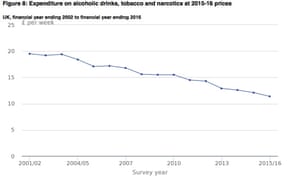
Weekly spending on booze, fags and narcotics fell below £12 for the first time since the survey began, partly reflecting the decline in the number of people who smoke.


On the other hand, households spent more than £45 a week on restaurants and hotels for the first time in five years, the Office for National Statistics said. The figures are for the year ending March 2016.


Jo Bulman, ONS statistician, said: “While overall household spending didn’t change much in real terms since the previous year, we did see some interesting shifts in the types of things people are spending their money on.”


Spending on alcohol, cigarettes and drugs has fallen below £12 a week


Spending on alcohol, cigarettes and drugs has fallen below £12 a week.

The report showed that households have still not fully recovered from the financial crisis, with family spending still below the levels seen before 2007.


Average total spending – adjusted for inflation – was unchanged from a year earlier at £528.90 a week. Low income families continued to spend a higher proportion of their spending on food and energy compared with people on higher incomes.


Transport was the biggest costs for households over the year, averaging £72.70 a week or 14% of spending. It was closely followed by housing – excluding mortgage interest payments and council tax – fuel and power, which averaged at £72.50 a week.


Average weekly family spending in the year ending March 2016


  • Transport: £72.70

  • Housing, fuel and power: £72.50

  • Recreation and culture: £68

  • Food and non-alcoholic drinks: 56.80

  • Restaurants and hotels: £45.10

  • Miscellaneous goods and services: £39.70

  • Household goods and services: £35.50

  • Clothing and footwear: £23.50

  • Communication: £16

  • Alcoholic drinks, tobacco and narcotics: £11.40

  • Health: £7.20

  • Education: £7


Britons spending more on food and leisure than booze, smoking and drugs

10 Ocak 2017 Salı

Poorer countries fail to act on smoking due to big tobacco threats, says WHO

Many low- and middle-income countries are too scared by the threats and misinformation of big tobacco to raise the price of cigarettes, even though it would hugely benefit both health and the economy, according to a major new report.


The most effective measure to help people stop smoking is to impose high taxes on cigarettes, says the report by the World Health Organisation and the US National Cancer Institute. But even though smoking costs the world economy $ 3trn (£2.5trn) a year, poorer countries are afraid to tackle it in the most effective ways, it says.


“They are scared because of the issues raised by the tobacco industry,” said Jeremiah Paul of the WHO’s tobacco control economics unit. The industry warns of an increase in smuggling and illicit trade in tobacco, for instance, which the WHO and the US National Cancer Institute, the co-producers of the report, say does not happen.


“They are afraid of being taken to court if they increase tobacco taxes,” said Paul. “They [the industry] will scare you that tobacco taxes are anti-poor, that government revenue will go down.” But there is no evidence to support any of these claims, he said.


Six million people die every year as a result of smoking tobacco and although smoking rates are slowly going down, the numbers are increasing as the population of the world grows. There are also fears of a big expansion in Africa and the Middle East as big tobacco targets poorer countries now that hardline control measures such as bans on smoking in public places have taken effect in wealthier ones.


There are 1.1 billion smokers globally over the age of 15 and already 80% are in low- and middle-income countries. Many are already poor – an estimated 226 million smokers live in poverty. Those are the people who would benefit most from stopping, because they are least likely to get good healthcare and most likely to suffer from the disabling and economic effects of tobacco, such as losing their job.


The monograph says that global tobacco excise taxes generated nearly $ 269bn (£221bn) in government revenues in 2013-2014 – yet less than $ 1bn was invested in tobacco control.


High tobacco taxes raise money for governments while deterring smokers. The monograph says annual excise revenues from cigarettes globally could increase by 47%, or $ 140bn, if all countries raised excise taxes by about 80 cents per pack. This tax increase would raise cigarette retail prices on average by 42%, leading to a 9% decline in smoking rates and up to 66 million fewer adult smokers.


Controlling tobacco does not harm economies, the report says. The number of jobs dependent on tobacco has been falling in most countries, and when smokers quit they spend their money on other sectors of the economy instead. Tobacco farmers, who mostly do not earn a good living, can be helped to diversify into other crops.


“Tobacco use remains one of the world’s leading causes of preventable death, and increasingly, the health and economic burden is borne by the poorest countries and people,” said the WHO’s global ambassador for noncommunicable diseases, Michael R Bloomberg, whose philanthropic foundation has invested nearly $ 1bn into tobacco control. “By accelerating the adoption of the many cost-effective tobacco control policies available today, we can save millions of lives,” he said.


José Luis Castro, chief executive of the global health organisation Vital Strategies, warned that the death toll from tobacco will rise if tougher controls are not brought in. “While governments are committed to reduce tobacco deaths, the lack of effective tobacco control laws in many countries means that tobacco will kill one-third more smokers and non-smokers by 2030: 8 million deaths every year,” he said.


“This is avoidable. We urge governments to implement strong tobacco control policies, particularly high tobacco taxes that have the greatest, fastest impact on consumption, while also potentially funding better access to healthcare.”


Poorer countries fail to act on smoking due to big tobacco threats, says WHO

2 Ocak 2017 Pazartesi

I’ll say it again: E-cigarettes are still far safer than smoking

[unable to retrieve full-text content]


Despite evidence suggesting e-cigarettes are far less harmful than smoking, more people than ever believe them to be just as harmful. Professor Linda Bauld discusses the evidence


January is a time for New Year’s resolutions and if you’re one of the world’s one billion smokers, your resolution may be to stop smoking. For some people, this year’s quit attempt might involve an electronic cigarette, and a recent study in England, published in the BMJ, suggested that these devices helped at least 18,000 smokers to stop in 2015 who would not otherwise have done so. That’s very good news, but will there be as many quit attempts in 2017 as there have been in the past with e-cigarettes? I’m not so sure.


Since I last wrote about e-cigarettes in this column one year ago, headlines about the dangers of these devices have continued to appear and show no sign of abating. The result is clear. More people believe today, compared with a year ago, that e-cigarettes are as harmful as smoking. In fact these incorrect perceptions have risen year on year, from fewer than one in ten adults in Great Britain in 2013 to one in four this past summer. Surveys of smokers show similar patterns, with an increasing proportion believing that e-cigarettes are more or equally harmful than tobacco.


Related: Why can’t scientists agree on e-cigarettes?


Related: Does a tobacco-free world need to be nicotine free?


Continue reading…


I’ll say it again: E-cigarettes are still far safer than smoking

15 Aralık 2016 Perşembe

Smoking and drinking among young people at lowest level on record

Young people in England born since the turn of the century are the most clean-living generation in recent times, with the rates of those choosing to smoke cigarettes and drink alcohol the lowest on record.


Fewer than 5% of children aged eight to 15 have smoked, down three-quarters since 2003, while only about 17% admitted ever drinking alcohol, a fall of two-thirds, according to an annual survey of health trends.


At the same time, the proportion claiming to eat five portions of fruit and veg has almost doubled in the same period to a fifth. Despite that, 28% of children aged two to 15 were overweight or obese in 2015, and only one in five were as physically active as they ought to have been.


Nine in 10 mothers and eight in 10 fathers of overweight children did not recognise the problem, according to the Health Survey for England 2015, published by NHS Digital on Wednesday, with charities warning that obesity is still an urgent public health epidemic.


The dramatic fall in the number of young smokers follows a cultural shift in the perception of smoking, as well as significantly tighter restrictions on tobacco sales.


In the past decade, the government raised the legal age for buying tobacco from 16 to 18, banned smoking in enclosed public spaces, introduced graphic health warnings and introduced rules that hide tobacco products from view in shops.


At the same time, off-licences have become far stricter about sales to teenagers, and bars and clubs have introduced stringent ID requirements for entry.


Gillian Prior, the head of health at the National Centre for Social Research, which carried out the survey of 8,034 adults and 5,714 children on behalf of the NHS, said: “Changes to the law mean that under-18s are prohibited from buying cigarettes and the Challenge 25 policy adopted by many retailers has meant that these laws are more rigorously enforced than they have been in the past.


“But we should not underestimate the importance of changes in the nature of childhood; changes in technology and society mean that teenagers in particular spend their time in a very different way compared to teenagers 15 years ago.”


A Department of Health spokesperson said: “We are committed to helping people lead healthier lives so it is encouraging to see a decline in smoking rates and fewer children drinking alcohol.


“However, this survey reaffirms that we can’t let up in our efforts to tackle childhood obesity – and we are confident our world leading plan will make a real difference in the long term.”


Smoking and drinking among young people at lowest level on record

29 Kasım 2016 Salı

NHS patients told to lose weight and quit smoking or face operation delays

Obese people and smokers will be asked to lose weight and give up cigarettes or face delays to routine operations after a health authority’s proposals were approved by NHS England.


Patients with a body mass index (BMI) of at least 30 will be asked to lose weight or face a 12-month delay for elective surgery while smokers will be asked to quit for two months or face a six-month postponement, the Vale of York Clinical Commissioning Group (CCG) announced.


The North Yorkshire CCG ruled out a “blanket” ban and said each patient would be dealt with on a “case-by-case basis” when the plan comes into force in January.


The CCG said: “Smokers and obese patients that need routine surgery, but do not wish to access the support services or fail to meet the criteria will not be denied their operation, but it could mean they have to wait longer than they otherwise would have done.”


Dr Shaun O’Connell, the CCG clinical lead who is also a local GP, said the plans would give patients the “best possible health outcomes in the long term” while helping to protect finances.


O’Connell said: “There is no ban and no blanket policy … decisions about what is in the best interests of their health, will be made on a case-by-case basis.”


The CCG, which serves a population of more than 351,000 in areas including York, Selby and Tadcaster, said there would be exclusions from the plan, which will probably include emergency and bariatric surgery and operations on patients under 18.


This year, NHS England intervened in the policy after the Royal College of Surgeons raised concerns that the proposals went against clinical guidance and made smokers and overweight patients soft targets for financial savings.


But the public body has now approved the plan.


An NHS England spokeswoman said: “Vale of York CCG has made clear its commitment to supporting patients to achieve better health and clinical outcomes by referring them to an established weight loss or stopping smoking programme, where appropriate.


“However, every patient’s case will be considered in the light of their own particular circumstances and on the basis of clinical need.”


NHS patients told to lose weight and quit smoking or face operation delays

13 Kasım 2016 Pazar

Hollywood film studios beat lawsuit over smoking in PG-rated films

Hollywood film producers have beaten a lawsuit which alleged that the depiction of tobacco use in films rated as appropriate for children led directly to deaths from smoking.


A class action launched by Timothy Forsyth claimed that the rating system used by the Motion Picture Association of America (MPAA) amounted to misrepresentation, since it was established that viewing tobacco imagery caused children to smoke.


“In 2012 the surgeon general concluded that the scientific evidence established that exposure of children to tobacco imagery in films causes children to smoke,” the lawsuit said.


“In 2014, the Centers for Disease Control and Prevention concluded based upon the scientific evidence that if defendants continued to assign the PG and PG-13 ratings to films with tobacco imagery the youth ratings would cause 3.2 million children to become addicted to nicotine and one million of those children would die prematurely from tobacco related diseases.”


In its defence, the MPAA, a trade body that represents the six major Hollywood studios, argued that film ratings amount to opinions, and cited the first amendment protecting freedom of speech. It said the ratings system is not intended to “prescribe socially-appropriate values”, but to offer guidance based on what most American parents would think about a film’s suitability for children.


Forsyth contended that all films depicting smoking should receive the restrictive R rating, meaning that anyone under 17 should be accompanied to cinemas by a parent or guardian.


“Saying that some material ‘may’ not be suitable when defendants know that some material is not suitable – that it will kill kids by the hundreds of thousands – is false and misleading,” the lawsuit claimed.


But the judge rejected that argument. The Hollywood Reporter quoted him as saying: “Forsyth insists that a rating less stringent than R is a representation that ‘the film is suitable for children under 17 unaccompanied by a parent or guardian’. The ratings plainly make no such representations. Rather, the PG and PG-13 ratings caution parents that material in such movies may be inappropriate for children … as such, neither intentional nor negligent misrepresentation claims are tenable as pleaded.”


The World Health Organisation has called in the past for films featuring smoking to be restricted to adult audiences, noting that 44% of all Hollywood films, and 36% of films rated for young people in 2014 contained smoking.


There have been laws in place restricting paid product placement of tobacco since 1998, and the MPAA’s rating system has taken instances of smoking into account since 2007.


The ratings board, which is made up of parents, now considers three questions where smoking is depicted: whether it is pervasive in the film, whether it glamorises the act, and whether there is a historic or other mitigating context.


Hollywood film studios beat lawsuit over smoking in PG-rated films

3 Kasım 2016 Perşembe

DNA study lays bare devastating damage caused by smoking

The devastating impact of cigarette smoke on the body’s DNA has been laid bare by the first comprehensive study into the damage tobacco inflicts on human cells.


People who smoke a pack of cigarettes each day for a year develop on average 150 extra mutations in every lung cell, and nearly 100 more mutations than usual in each cell of the voice box, researchers found. More still build up in the mouth, bladder, liver and other organs.


While chemicals in tobacco smoke have long been known to raise the risk of at least 17 forms of cancer, the precise molecular mechanisms through which they mutate DNA and give rise to tumours in different tissues have never been clear.


“This is about running down the root cause of cancers,” said David Phillips, a professor of environmental carcinogenesis at King’s College London and a co-author on the study. “By identifying the root causes, we gain the sort of knowledge we need to think more seriously about cancer prevention.”


More than 70 of the 7,000 chemicals found in tobacco smoke are known to cause cancer. Some damage DNA directly, but others ramp up mutations in more subtle ways, often by disrupting the way cells function. The more mutations a cell acquires, the more likely it is to turn cancerous.


The reason why some people can smoke for years without getting cancer, while others develop the disease, is down to the way mutations arise. When a person smokes, the chemicals they inhale create mutations at random points in the genome. Many of these changes will be harmless, but others not so benign. The more smoke a person is exposed to, the greater the chance that the accumulating mutations will hit specific spots in the DNA that turn cells cancerous.


“You can really think of it as playing Russian roulette,” said Ludmil Alexandrov, a theoretical biologist at Los Alamos National Lab in New Mexico and the first author of the study. “You can miss the right genes. But if you smoke you still play the game. It’s a very strong message for people not to start smoking. If you smoke even a little bit you’ll erode the genetic material of most of the cells in your body.” Smoking is the most preventable cause of cancer in the world and accounts for more than 1 in 4 UK cancer deaths.


With researchers at the Wellcome Trust’s Sanger Institute near Cambridge and others, Alexandrov analysed the DNA of more than 5,000 cancers. The team then turned to pattern recognition software to tease apart the various mutational signatures found in tumours from smokers versus non-smokers. To find the signatures – the patterns of mutations present in cancer cells – researchers performed the genetic equivalent of recording the chatter at a party and then extracting individual conversations from the hubbub.


The scientists spotted more than 20 mutational signatures in 13 types of cancer linked to tobacco smoking. But only five of these were more common in smokers’ tumours. One pattern of mutations, dubbed signature four, was found to be a major driver for lung cancer. It is thought to be caused by benzopyrene, a chemical found in tobacco smoke.


More intriguing was how tobacco caused mutations in tissues that are not directly exposed to smoke, such as the bladder, kidneys and pancreas. The study found that chemicals from tobacco smoke found their way to different organs and tissues and then sped up the molecular clocks in the cells. This ramped up the natural rate at which mutations built up in the tissues.


“We knew there was direct damage from smoking in the lungs. What we didn’t expect was to see smoking speed up the molecular clocks inside cells,” said Alexandrov, whose study appears in the journal Science. “In bladder cancer, the only thing that causes the extra mutations in smokers is the speeding up of the clock, and that will be very dependent on the intensity of smoking. For every pack of cigarettes you smoke per year, you accumulate 18 mutations in all of your bladder cells,” he added.


Scientists hope that by understanding how the individual ingredients of tobacco smoke raise the risk of various cancers, they can develop new ways to prevent the disease. The same techniques used in the latest study will now be used to tease apart how alcohol, obesity and other factors also increase a person’s cancer risk.


“There is a message here for people who are occasional or social smokers who think it doesn’t do anything,” said Alexandrov. “If you smoke four to five packs of cigarettes in your lifetime it doesn’t sound that much, but you still get several mutations in every cell in your lungs and these are permanent, they do not go away. There are a lot of things that do revert back when you stop smoking, and this shouldn’t discourage people from giving up, but the specific mutations in the lung cells are like scars. If you stop smoking, they’ll still be there.”


DNA study lays bare devastating damage caused by smoking

24 Ekim 2016 Pazartesi

Coping Techniques To Help Quit Smoking

Quitting smoking can be a difficult task. Creating a list of activities that can keep you busy is a very important coping techniques for those that want to quit smoking. Statistics has shown that about 47% of smokers want to quit the addiction. Statistics have shown that only 13% of those that want to quit smoking are able to completely quit the harmful habit. This is why it is important to have some coping techniques at hand to help reduce your urge for smoking. Your risk of a heart and lung related diseases is greatly reduced if you are able to quit smoking at an early age. One in five deaths recorded in the US is caused by smoking; this amounts to about 440,000 deaths annually. As difficult as it seems, you can get your mind off smoking if you adopt a lifestyle based on some of the following tips.


  1. Distract yourself


Put up a list of things you can engage yourself to reduce your urge for smoking. Idleness will make you resort to the dangerous habit. Always surround yourself with people and get into meaningful discussions instead of being alone. Take a glass of water, stroll down the street anytime you feel like having a hit.


  1. Find out the triggers


Identify a list of things or moments when the urge to smoke is highest. You can easily avoid these triggers as a way of reducing your addiction to smoking. Avoid going to pubs, stop being around smokers and reduce your presence at parties. Inform some of your friends that are smokers of your intention to quit smoking and make sure they respect the decision.


  1. Engage in regular exercises


Exercising a lot will reduce your addiction to smoking. Apart from making you healthy, exercises keep you busy and prevent you from being alone. Regular exercise also helps to lower stress levels in your body. Do a few pushups, jog for few minutes; seek pleasure in doing some physical activities. This will eliminate your addiction to smoking.


  1. Switch to honey


Honey, with its rich components, can be a perfect substitute while you are working on quitting smoking. It is rich in essential nutrients that can help you get over the harmful effects of smoking while also helping you to suppress the urge to smoke. Honey has been proven in the treatment of certain ailments apart from its other health benefits.


  1. Eat candies and fruits


You should always keep your mouth busy whenever you craving for smoking. You can eat carrots, apples, sweets, chocolates, nuts and other chops. Snacks are also a great option for you to reduce your urge for smoking. Eat whatever you have to anytime you have the urge to smoke.


  1. Watch a movie


Use the time for smoking to watch a movie with a friend. You will find that more enjoyable. You can also listen to music anytime you feel the urge to smoke. Doing these little things will keep you busy and helps to reduce your craving for cigarettes.


Sources:


Huffington Post


Report from the Global Adult Tobacco Survey


Reasons to stop smoking weed


Report from the World Health Organization


Coping Techniques To Help Quit Smoking

10 Ekim 2016 Pazartesi

Parental absence increases risk of smoking and drinking in children

Parental absence increases the risk of children drinking and smoking before they become teenagers, research suggests.


The study found that children who had experienced the absence of a parent during their first seven years, whether as a result of death, separation or otherwise, were more than twice as likely to have tried smoking and nearly 1.5 times as likely to have drunk alcohol by the age of 11.


Rebecca Lacey, one of the authors of the study from University College London, said the research highlighted the impact of stressful events in early life. “Some children, perhaps, seem to be taking up smoking and alcohol as ways of coping with this,” she said, adding that children might need extra support should a parent become absent.


Writing in the journal Archives of Disease in Childhood, Lacey and colleagues describe how they examined data from 10,940 children who took part in the Millennium Cohort Study – an ongoing UK project that has been following the health of almost 19,000 children born between September 2000 and January 2002.


The children were surveyed at nine months old, then at ages three, five, seven and 11. Parental absence was monitored up to age 7, while information on smoking and drinking was self-reported at the age 11 by the children.


“What we know from previous studies is that parental absence experienced in childhood is associated with smoking and alcohol consumption in adulthood,” said Lacey. “What we have tried to look at here is to see whether parental absence is associated with those behaviours in childhood.”


The results reveal that around 4% of boys and 2% of girls said that they had tried smoking by the age of 11, with almost 15% of boys and more than 10% of girls admitting to trying alcohol.


More than a quarter of the children had experienced the absence of a biological parent at some point before their seventh birthday, with those children more than 2.5 times as likely to have tried smoking by the age of 11 than those who had always lived with both parents. The figure dropped to just over 1.5 times once factors such as maternal age at birth, parental education level and the child’s birth weight were taken into account.


Parental absence was also linked to a 46% increase in the likelihood of a child consuming alcohol by the age of 11, with the figure at 27% once the same factors were taken into account.


No link was found between smoking and drinking in children and which parent was absent, or the age of the child at which the absence began. It is also not clear whether the absence of a parent actually triggers children to engage in smoking and drinking.


“We know these things are associated but we don’t know that one causes the other,” said Lacey.


Lacey also points out that it is possible that some children experienced parental absence after the age of seven, while inaccuracies in the self-reporting of behaviour by the children cannot be ruled out.


Professor Russell Viner, officer for health promotion for the Royal College of Paediatrics and Child Health, said


“Significant changes early in life are already known to have an impact on a child’s development, their later health and risky behaviours, so this latest paper not only adds to an already increasing wealth of knowledge telling us that our life trajectories are partially set very early on, but also that we need to do everything we can to put our children onto trajectories towards positive health. Early intervention can be particularly important for children who have suffered a bereavement or parental separation.


“With personal, social, health and economic education (PSHE) currently lacking from school curriculums, not all children are receiving the education required early in life to raise awareness and deter them from some of these risky behaviours. Therefore it is vital that the government makes PSHE compulsory for all schools,” he said.


Parental absence increases risk of smoking and drinking in children

25 Eylül 2016 Pazar

Environmental health officers call for smoking ban in playgrounds

Smoking should be banned in all parks and playgrounds to reduce the chances of children growing up thinking that using cigarettes is normal, environmental health officers have told ministers.


Zoos, theme parks and anywhere else children play should also become no-smoking zones, in a significant proposed expansion of the outdoor areas in which smokers cannot light up.


Smoking has been illegal in enclosed public places such as bars, nightclubs and restaurants, as well as public transport and work vehicles, across the UK since 2007.


But the Chartered Institute of Environmental Health said on Monday it wants local councils to designate any place where children play or learn as a smoking exclusion zone, although adherence would be voluntary, not statutory. Banning it in those locations would also protect children from secondhand smoke, it says.


A new YouGov poll commissioned by the CIEH shows that 89% of 4,300 adults surveyed back a ban on smoking in children’s play areas, while 57% want it to end in public parks. “It is abundantly clear that the vast majority of people would support restrictions on smoking in children’s play areas. We would like to see smoking being stubbed out wherever children play or learn,” said Anne Godfrey, the CIEH chief executive.


“This would not only include children’s playgrounds but could see no-smoking zones extended to public parks, zoos and theme parks. Children should be able to have fun and enjoy themselves without seeing someone smoking and thinking this is normal behaviour,” she added.


Some councils have already moved to try to stop people smoking in some outdoor places. For example, Coventry city council has asked parents not to smoke outside the gates of its 82 primary schools. The policy has gone down well with parents and headteachers, the council said.


Wrexham has also decreed that playgrounds, school gates and bus shelters should be regarded as smoke-free places, while Nottingham city council seeks to ensure that all its outdoor attractions are smoke-free for the six weeks of the school summer holidays.


“Public opinion – and not just among parents – has swung heavily in favour of protecting children from exposure to tobacco smoke and from the behavioural cues children pick up from seeing adults smoking. This is a real opportunity to make it easier for children to grow up healthy,” said Jim McManus, the director of public health at Hertfordshire county council.


“Parents and children, when given the choice, are overwhelmingly supportive of smoke-free playground. Local voluntary schemes have been popular. It’s time to give parents what they are asking for. You might feel like this is the nanny state – you’d be wrong,” McManus added.


Forest, the smokers’ rights group, called to the plan “Orwellian”. Its director, Simon Clark, said: “Extending the smoking ban to outdoor parks and play areas would be a gross overreaction. There’s no evidence that a significant number of people smoke near children in outdoor areas, nor is there evidence that smoking outside is a threat to anyone else’s health.”


Clark added: “Public parks are for the enjoyment of everyone, including smokers. Most smokers use their common sense and smoke accordingly. They don’t need government dictating how they behave. The idea that children should be protected from the sight of someone smoking is Orwellian. Adults can’t be expected to be perfect role models for other people’s children.”


The owners of zoos and theme parks, because they are private businesses, should be allowed to decide whether smoking is banned, Clark said.


It became illegal last October to smoke in a car in England or Wales carrying anyone under the age of 18. New figures last week showed that the proportion of adults in England who smoke had fallen to a record low of 16.9%.


Deborah Arnott, the director of Action on Smoking and Health, said: “While the ban on smoking in indoor public places resulted in significant health benefits, thousands of children are still exposed to smoke in the home and elsewhere. Growing up in a smoke-free environment is one of the best ways of ensuring that they are not attracted to smoking and lured into a lifelong addiction and ill-health.”


Environmental health officers call for smoking ban in playgrounds

6 Eylül 2016 Salı

E-cigarette ads may cause children to underestimate smoking risks – study

E-cigarette advertising may be leading children to believe occasional tobacco smoking is not harmful, and is potentially prompting more young people to experiment with smoking, a study has claimed.


Researchers from the University of Cambridge and the University of North Carolina recruited more than 400 English children for the study.


Aged 11 to 16, they had never smoked or vaped before and were randomly allocated to one of three groups. One group was shown 10 adverts that depicted e-cigarettes as glamorous, a second group was shown 10 adverts that portrayed them as healthy, and a third control group was shown no adverts.


The children were then asked a series of questions aimed at determining their attitudes towards smoking and vaping.


Children shown the adverts were no more or less likely than the control group to perceive tobacco smoking as appealing and all three groups understood that smoking more than 10 cigarettes a day was harmful.


However, the groups exposed to the e-cigarette adverts, both healthy and glamorous, were less likely to believe smoking one or two tobacco cigarettes occasionally was harmful.


There is concern that the increasing exposure of children to e-cigarette adverts could be contributing to high rates of experimentation.


In the US, adolescents’ exposure to e-cigarette adverts on TV more than trebled between 2011 and 2013, researchers said.


They added that estimates suggest that, among children who try smoking, between a third and a half of them were likely to become regular smokers within two to three years.


Dr Milica Vasiljevic, from the department of public health and primary care at the University of Cambridge, said: “While we can be optimistic that the adverts don’t seem to make tobacco smoking more appealing to young people, they do appear to make occasional smoking seem less harmful.


“This is worrying, as we know that even occasional tobacco smoking is bad for your health, and young people who smoke occasionally believe they are somehow immune to its effects and do not feel the need to quit.”


The children who were shown adverts depicting e-cigarettes as glamorous also believed vaping to be more prevalent than did the other two groups.


Researchers also highlighted a 2014 study that showed more children aged 11 to 15 experimented with e-cigarettes than tobacco (22% compared with 18%).


Prof Theresa Marteau, director of the behaviour and health research unit and a fellow of Christ’s College at University of Cambridge, said: “E-cigarette marketing across Europe is regulated under the new EU Tobacco Products Directive, which came into effect on 20 May.


“The directive limits the exposure of children to TV and newspaper e-cigarette adverts. However, it does not cover advertising in the form of posters, leaflets, and adverts at point of sale, nor does it cover the content of marketing materials depicting e-cigarettes as glamorous or healthy.


“The findings from our study suggest these omissions could present a threat to the health of children.”


The research, funded by the Department of Health, was published in the journal Tobacco Control.


Deborah Arnott, chief executive of pressure group Action on Smoking and Health (Ash), said: “The most recent survey found the lowest recorded smoking rates among children ever: only 18% of 11- to 15-year-olds had tried smoking in 2014 compared with 42% in 2003.


“It doesn’t look like e-cigarette advertising has had an impact on smoking uptake so far, and from May this year all TV, radio and newspaper advertising has been banned anyway.”


E-cigarette ads may cause children to underestimate smoking risks – study

19 Ağustos 2015 Çarşamba

Cancer Council unaware tobacco giant behind FOI request on child smoking habits

Cancer Council Victoria says it had no concept a British American Tobacco worker was behind a freedom of details request for information on the tobacco use and acquiring habits of 1000′s of school children.


For the past 30 years, the council has surveyed youngsters aged among 12 and 17 about their age, gender and location, accessibility to income, alcohol and tobacco consumption and getting habits, and preferred brands.


The director of the Victorian Cancer Council, Todd Harper, stated a attorney had requested the survey information underneath the Freedom of Information Act, but the request was rejected since it was not in the public interest to release it.


Relevant: Australian teens major charge in eschewing consuming and smoking


It was not right up until Fairfax Media reported the lawyer had appealed towards the determination to Victoria’s Civil and Administrative Tribunal, that the council became mindful the attorney was an employee of the tobacco giant, Harper said.


“We had no idea that British American Tobacco was behind the request,” he said. “All we knew was it was an person from a law firm who wanted the information. I’m disappointed that the tobacco firm wasn’t upfront about its involvement.”


Harper stated the council was concerned that, as soon as manufactured public, the data could be utilized by tobacco and alcohol firms to acquire insight into the purchasing and drug consumption routines of younger folks, as nicely as the varieties of brand names that appealed to them.


The information is utilized by the Cancer Council to assist it recognize exactly where and how to direct publishing health messaging, as effectively as for scientific scientific studies. When mothers and fathers consented to their young children finishing the survey, the did so believing the information would be used only in the curiosity of public health, Harper explained.


Fairfax Media also exposed that the identical attorney utilised the Freedom of Information Act to get info from surveys of adult smokers in that state, which integrated queries about their attitudes toward smoking.


“The Cancer Institute NSW was compelled to give tobacco survey information requested underneath the NSW Government Info [Public access] Act,” its chief cancer officer, David Currow, told Fairfax.


A spokeswoman for British American Tobacco advised Guardian Australia the Victorian data request “wasn’t about children”.


“This is about plain packaging,” she stated. “We did not look for any individual data or info in respect of youngsters. We’ve asked for figures by way of a standard freedom of info request because we want to discover out if plain packaging, a measure introduced with out evidence and that straight influences our business, is possessing the effect the Australian government claims it is.”


In a globe very first, Australia passed plain packaging legislation in 2011, requiring all cigarette packaging to be stripped of marketing and branding, apart from the organization name and health warnings. All tobacco now comes in olive green cardboard containers with graphic overall health messages.


In a series of papers published by the Cancer Council in the BMJ journal Tobacco Control in March, plain packaging was related with an enhance in the variety of men and women pondering about quitting and trying to quit. The investigation also identified kids aged in between twelve and 17 found standardised packaging much less attractive.


An appeal date for the freedom of details request is nevertheless to be set.


Cancer Council unaware tobacco giant behind FOI request on child smoking habits

Public Wellness England: vaping safer than smoking - video


Kevin Fenton, director of health and wellbeing at Public Wellness England, explains why the physique has officially recognised that e-cigarettes are better for smokers than tobacco. It says e-cigarettes are 95% much less damaging than their standard rivals this kind of as tobacco cigarettes, and suggests that e-cigarettes be dispensed as a licensed medicine


Public Wellness England: vaping safer than smoking - video

18 Ağustos 2015 Salı

Public well being agency backs e-cigarettes as safer than smoking

Vaping is safer than smoking and could lead to demise of the standard cigarette, Public Wellness England (PHE) has said in the very first official recognition that e-cigarettes are much less damaging to overall health than smoking tobacco.


The well being physique concluded that, on “the best estimate so far”, e-cigarettes are about 95% significantly less harmful than tobacco cigarettes and could one day be dispensed as a licensed medicine in an different to anti-smoking merchandise this kind of as patches.


Even though stressing that e-cigarettes are not free from threat, PHE now believes that e-cigarettes “have the potential to make a significant contribution to the endgame for tobacco”.


The message was backed by the government’s chief healthcare officer, Dame Sally Davies, who however cautioned that “there continues to be a lack of evidence on the lengthy-phrase use of e-cigarettes”. She mentioned they ought to only be used as a signifies to assist smokers quit.


“I want to see these products coming to the market place as licensed medicines. This would give assurance on the security, quality and efficacy to consumers who want to use these products as quitting aids, specially in relation to the flavourings employed, which is exactly where we know least about any inhalation risks.”


The 111-web page evaluation raises considerations about the length and expense of the the government’s licensing process, which is a essential portion of the revised technique to minimize tobacco use.


No e-cigarettes have however been licensed, unlike other nicotine-substitute therapies such as gums, lozenges and patches. Pilot schemes in Leicester and the City of London allow stop-smoking experts to provide totally free e-cigarette starter kits, but smokers elsewhere can’t be presented e-cigarettes on prescription.


The Medicines and Healthcare Products Regulatory Company began its perform in this location more than two years ago, and makers have complained that it expenses them hundreds of thousands to go by way of the process.


Jane Ellison, the public wellness minister in England, reminded smokers that the best point they could do to avoid falling victim to the country’s variety one killer was to quit entirely.


“Although we recognise the e-cigarettes may possibly help adults to quit, we even now want to safeguard children from the dangers of nicotine, which is why we have made it unlawful for under-18s to buy them,” she said.


The evaluation found that almost all of the 2.six million grownups in the Uk now thought to be employing e-cigarettes are existing or former standard smokers, most using them to help them quit tobacco or to avert them going back to smoking.


There was no suggestion that the goods were a gateway into tobacco smoking, with less than 1% of adults or younger men and women who had never smoked becoming regular cigarette customers.


The PHE decision comes right after cautiously choreographed moves by anti-tobacco campaigners and public wellness experts to aid move the NHS towards providing better smoking cessation help and to be less damaging about e-cigarettes.


Providers are getting urged to adhere to people in the north-east of England in providing behavioural support to individuals wanting to quit tobacco and utilizing e-cigarettes to try out to do so.


Smoking kills about one hundred,000 men and women a 12 months in the United kingdom, most of these in England in which there are thought to be eight million tobacco users. But official figures recommend smoking is now at its lowest prevalence because information started out in the 1940s.


Costs are highest in several of the most deprived places of England, and acquiring smokers off tobacco is increasingly noticed as a single of the ideal ways of minimizing overall health inequalities.


Worryingly for numerous of these behind the policy modify, rising numbers of individuals – up to 22%, compared with eight% two many years ago – believe e-cigarettes are equally or a lot more dangerous than tobacco. This is top some smokers to avoid switching, studies have advised.


Tobacco reduction campaigners say the public requirements to be educated to recognise that although e-cigarettes, like tobacco cigarettes, have addictive nicotine, they do not have much more hazardous chemicals such as tar and arsenic.


PHE is also advocating careful monitoring of the e-cigarette industry, notably of organizations closely concerned with or portion of huge tobacco companies. It says the government have to meet its obligations “to defend public overall health policy from commercial and other vested interests of the tobacco industry”.


Kevin Fenton, director of overall health and wellbeing at PHE, mentioned: “E-cigarettes are not fully risk-totally free but when in contrast to smoking, evidence shows they carry just a fraction of the harm.


Associated: Vaping is ever more common, but is it a smoking remedy or a new hazard?


“The issue is folks more and more consider they are at least as damaging and this might be keeping millions of smokers from quitting. Nearby quit-smoking companies ought to look to assistance e-cigarette end users in their journey to quitting completely.”


Peter Hajek, of Queen Mary University, London, one of the independent authors of the review, stated: “My reading of the proof is that smokers who switch to vaping remove virtually all the risks smoking poses to their health. Smokers vary in their demands and I would advise them not to give up on e-cigarettes if they do not like the very first a single they try out. It may get some experimentation with various merchandise and e-liquids to discover the right a single.”


Ecita, a trade association of e-cigarette makers, explained: “There could be large long-phrase advantages to taxpayers and the NHS as properly as to former smokers and their households. The proposed ban in public areas across Wales is really worrying, as are a lot of of the bans in pubs and eating places across the United kingdom. This appears to be driving a increasing number of people to feel the harm is the very same, deterring smokers from moving to e-cigarettes, and damaging public overall health.”


The smokers group Forest questioned whether prescribing e-cigarettes on the NHS would be a justifiable use of taxpayers’ money. Simon Clark, its director, said promoting them “as a state-accepted smoking cessation assist ignores the fact that many individuals take pleasure in vaping in its personal correct and use e-cigs as a recreational not a medicinal item.”


He said e-cigarettes had been successful because the consumer, not the state, was in charge. “If they want much more smokers to switch to e-cigarettes, public wellness campaigners should embrace consumer selection and oppose needless restrictions on the sale, marketing and advertising and promotion of this potentially game-changing merchandise.”


The switch in policy towards e-cigarettes coincided with publication in the Journal of the American Health care Association of study from Los Angeles suggesting that high college students who had use e-cigarettes are more probably to go on to try out tobacco.


But Hajek stated this did not demonstrate that vaping prospects to smoking. “It just exhibits that men and women who are attracted to e-cigarettes are the exact same people who are attracted to smoking. Men and women who drink white wine are more very likely to try out red wine than people who do not drink alcohol.”


Public well being agency backs e-cigarettes as safer than smoking

16 Temmuz 2014 Çarşamba

Why millions of us nevertheless cannot quite kick the smoking habit

Catherine Zeta-Jones can oft be spotted lighting up a secret stogie, despite the fact that this might be considered essential stress relief for a lady whose husband blamed amorous pursuits for his throat cancer.


Barack Obama promised to renounce his thirty-yr habit in return for his wife letting him run for the White House. Not remarkably, becoming leader of the free planet did not bestow the calm necessary for this kind of abstinence. In spite of chewing Nicorette gum in the method of a ketamined horse, the president is explained even now to cadge gaspers from his aides.


For the duration of an episode of the BBC’s Question Time in 2011, our very own David Cameron confessed to currently being a reformed smoker, remarking: “I surely help No Smoking Day and, in contrast to in some earlier many years, I hope to meet its requirements in total.” Earlier he had recalled: “When I was 14, 15, sixteen, I was carrying out factors that teenagers do in terms of drinking as well much, currently being caught having the odd fag, items like that.” This appeared to be a reference to cigarettes rather than arcane Etonian practices.


Nigel Farage: unashamed smoker


The Resplendent Smoker


Aka the Unashamed Fagger. Rock chicks Cameron Diaz and Kate Moss fall into this class the former faring greater than the latter in the “not seeking like she’s on forty-a-day” stakes.


For Nigel Farage and Ken Clarke, smoking is all part of the what you see is what you get/man of the men and women stance (the cheroot-toting Clarke also possessing been in the employ of British American Tobacco).


Nick Clegg experimented with, and failed, to emulate this bravura when he advised Radio 4’s Desert Island Discs that his castaway luxury would be a “stash” of cigs an attempt to play it great, second only to his declare to have slept with “no a lot more than 30” unfortunate girls.


The Skinny Smoker


For “skinny”, study “thin at all costs”, in the manner of the Mses E Hurley, J Aniston and T Woodall. Marketing Charles Saatchi’s non-throttling credentials is not the only purpose why Trinny favours an outdoors table at Scott’s, for she – like her fellow slimline smokers – is steadfast in preferring cancer to calories. They could favour state-of-the art “youthening” therapies, but they can not drop the old skin parchers. As one death-stick dieter reveals: “I live off air – cigarette smoke.”


The Rebellious Smoker


Seditious smokers are life’s eternal teenagers, with a homicidal (that is, suicidal) phobia of being advised what to do, regardless of whether by mothers and fathers, employers or society at huge.


A single has only to stand outdoors The Globe of an evening and spot all the ruff-sporting puffers to know that theatre varieties favour the odd fag. If pushed, the thespian will drawl: “It’s so poor for the voice, darling, but brilliant for the nerves and so much naughty fun. I’ve been at it because my days in rep.” The truth that Very good Existence sweetheart Felicity Kendal has her fag-ash Lil moments only endears her to her fawning public.


Kate Winslet, so rock-and-roll try-challenging that she is married to a chap known as “Rocknroll”, and right royal rogue Prince Harry should never really feel obliged to kick the habit.


Elsewhere, there are non-smokers who have never ever puffed more than because the 2006 ban, myself integrated. I detest cigarettes, but not as a lot as I detest having my behaviour policed. (As I said: teenage.)


Jennifer Saunders: provoked outrage:


The Taboo Smoker


The comedian Jennifer Saunders happily provoked outrage in January when she was spotted enjoying an Ab Fab-style cigarette three many years soon after currently being given the all-clear from cancer.


Wander outside any hospital and one will locate medical doctors, nurses, guests and patients with drips lining up for a spot of kill-throat activity.


The ultimate taboo smoker I have encountered was a heavily pregnant comrade at a dinner get together. A fellow guest launched into a relentless, didactic monologue concerning all the items my staunchly unmaternal friend should be performing by way of massaging her perineum. Coolly, my good friend poured herself a second glass of burgundy and languorously lit up: exit irate earth mom in a puff of smoke. My good friend smiled beatifically as she exhaled and uttered, as any taboo smoker would: “I just had to.”


Why millions of us nevertheless cannot quite kick the smoking habit

15 Temmuz 2014 Salı

Welsh government bans smoking in cars with little one passengers

Smoking in car

The Welsh government says Wales is the very first nation in the United kingdom to tackle the problem of smoking in cars when children are existing. Photograph: Alamy


A ban on smoking in automobiles when young children are current is to be introduced by the Welsh government, 1st minister, Carwyn Jones, announced on Tuesday. The government in Cardiff stated a consultation on what it called a “landmark proposal” will be introduced shortly.


Two years in the past the Labour-run government launched its Fresh Start off Wales campaign to try to persuade men and women from smoking in private automobiles when young children were current.


It is claiming some accomplishment with new study concluding that the quantity of people who do not let smoking in their principal car has enhanced, from 71% in September 2011 to 76% in November 2013.


The analysis identified that the quantity of children who said that smoking was permitted in the family auto when they have been in it had halved to all around ten%.


But Jones explained: “We created clear during that campaign we would think about the probability of legislation when proof of prevalence of smoking in cars carrying kids in Wales is offered.


“Although I welcome the fact the variety of kids being exposed to smoking in vehicles has declined, a sizeable minority of young people are still being exposed and grownups carry on to smoke in their cars when children are existing.”


He additional: “We will press ahead with ideas to ban individuals smoking in autos carrying children.”


The government says Wales was the first nation in the United kingdom to tackle the situation of smoking in vehicles when young children are present.


Legislation on banning smoking is a devolved matter and new laws would apply only to Wales. But the Cardiff administration mentioned it was liaising with the division of overall health in England to coordinate the two government’s approaches. In England, MPs voted earlier this 12 months to ban the practice.


Welsh government bans smoking in cars with little one passengers

26 Haziran 2014 Perşembe

German pensioner evicted from residence of forty many years for smoking


In a case which has attracted national interested and divided viewpoint in Germany, a court in Düsseldorf has ruled that Friedhelm Adolfs, a retired caretaker, need to vacate his flat by the end of the year.


In many countries, he would have been forced to depart extended just before now. But tenants’ rights are strictly protected in Germany, and Mr Adolfs’ lawyers efficiently argued that he could not legally be evicted just for smoking.


But the court upheld the eviction due to the fact the pensioner had not taken adequate actions to ventilate his flat or prevent smoke passing into the communal hall. He had not even emptied his ashtrays, the court said, and his neighbours had been forced to endure an “unacceptable and intolerable odour”.


His neighbours’ right to dwell cost-free from smoke outweighed Mr Adolfs’ correct to smoke inside his very own property, the court ruled.


Accurate to character, right after the verdict Mr Adolfs instantly lit up a cigarette outdoors the court area.


The pensioner’s attorneys say the case has made him the 2nd most renowned smoker in Germany, soon after former Chancellor Helmut Schmidt, who famously chain-smoked on tv.


Germany has a reasonably liberal attitude to smoking, compared to its European neighbours. Although smoking bans are in force in all of Germany’s states, there are numerous exemptions, and it is nevertheless typical to locate smoke-filled bars in Berlin and other cities.


Modest privately run bars that do not serve foods are exempt from the ban in many states, and more substantial establishments can set aside a space for smokers.


German pensioner evicted from residence of forty many years for smoking