bill etiketine sahip kayıtlar gösteriliyor. Tüm kayıtları göster

5 Mayıs 2017 Cuma

Donald Trump"s homicidal healthcare bill will kill some, and enrich others | Adam Gaffney

Let us imagine that you would like to redistribute hundreds of billions of dollars from working class people to the rich, and wouldn’t hesitate to risk the lives of tens of thousands of people to do so. Well, as luck would have it, there is a bill— the “American Health Care Act” (AHCA)—that does precisely that.


On Thursday, it squeezed through the House of Representatives. Trumpcare – at least for the moment – has been triumphant.


Many of us thought – or hoped – that Paul Ryan’s bill was as good as dead on 24 March, when, in a pleasurable political moment (a rare event these days), he admitted he lacked the votes to push it through. But where there is a will to degrade the healthcare safety net, there is a way. And, to the House Republicans’ credit, they indeed found a way to ram this grotesquerie through.


To do so, the hard right had to compromise with the harder right, which made the current version of the AHCA fouler than the original.


The harder right found much to like about the original bill – like its historic gouging of Medicaid. The problem was that it left too much of the regulatory infrastructure of the Affordable Care Act (ACA) intact. Rules that insurers must cover 10 “essential health benefits” and cannot discriminate against those with pre-existing conditions? Eliminate those provisions, and let healthcare freedom reign.


The compromises worked. First, there was the MacArthur amendment, which permits states to redefine “essential health benefits” (this would allow insurers to exclude coverage of some types of healthcare, such as maternity care), or to allow insurers to charge people with pre-existing conditions higher premiums if they failed to maintain coverage.


Trump lauds House vote to repeal and replace Obamacare – video

As Timothy Jost noted on the Health Affairs blog, the latter provision “could effectively make coverage completely unaffordable to people with pre-existing conditions”, notwithstanding the clearly inadequate high-risk pools.


So far, so good.


However, in appeasing the harder right, the House leadership risked estranging the less hard right. But the latter proved to be a cheap date: they were bought off by the Upton amendment, added at the eleventh hour, which gave another $ 8bn to the fund theoretically designed to cover those left behind by the AHCA. Though this was a drop in the bucket relative to the size of the problem created by the AHCA, it brought just enough moderates back on board to secure a winning vote.


If the AHCA were signed into law by Trump – an unlikely but not impossible proposition given the headwinds it faces in the Senate – the negative impact on ordinary Americans would be enormous.


Given that the House GOP didn’t bother to wait for the Congressional Budget Office (CBO) score before voting, we don’t know just how bad it will be. But relying on the CBO’s initial estimates, we can say that the AHCA will, over a decade, reduce spending on Medicaid alone by more than $ 800bn.


Together with savings from having less adequate, skimpier insurance subsidies, these reductions will allow hundreds of billions of dollars to be channeled to the wealthy and corporations in the form of tax cuts.


US House passes Republican healthcare bill – video

By enriching the rich in this manner, the AHCA would leave an estimated 24 million more uninsured by 2028. Similar calculations have already been done, but it’s worth briefly revisiting the blood-arithmetic on this.


Colleagues of mine recently reported estimates, in the American Journal of Public Health, of how many newly insured people there would have to be to prevent one death per year. These estimates, which, being estimates, aren’t perfect, were based on five studies. The numbers ranged from 300 to 1,239 people.


If we were to pick a round number on the conservative end of that range – say 1,000 – we would estimate that stripping insurance from 24 million people would produce an estimated 24,000 additional deaths annually. That is 40% more than the sum total of all murders, estimated by the FBI at 14,429 for 2014 (using somewhat different numbers, Vox’s Julia Belluz makes this point and comes to the same figure).


Now, in all fairness to House Republicans, as a critical care physician, I too get blood on my hands when I go to work. The only difference is I can wash mine off.


Modern medicine saves lives, while stripping healthcare coverage from millions to fund tax breaks for millionaires takes lives. There’s no way around it, whatever some may tell themselves to help them sleep at night.


This, of course, raises an even larger issue, namely the injustices of the healthcare status quo, wherein 28 million remain uninsured and even more without adequate coverage – shortcomings that leave open the door to continued attack from the right.


This execrable, homicidal bill must obviously be stopped. But that’s not all we must do. The most enduring defense against the rightwing saboteurs is not continued championship of a flawed status quo, but instead the promise of a better tomorrow: healthcare for all, through a single-payer universal system. That alone will put an end to these deadly assaults on healthcare.


Donald Trump"s homicidal healthcare bill will kill some, and enrich others | Adam Gaffney

28 Şubat 2017 Salı

Mandatory Memory Wipe – California Senate Bill No. 86

“Mandatory Memory Wipe”


SACRAMENTO, CALIF. – State Senator Richard Pan, (D), architect of California’s notorious SB-277, (mandatory school vaccination), today proposed SB-86, which calls for mandatory erasure of all painful “memories, thoughts, and emotions” from the memory banks of all school age children.


Proponents of the bill seek to protect children.  But critics, who dub it the “mandatory memory wipe,” believe it’s a diabolical scheme to plunge society farther into the more dimly lit regions of the darkside.  Many believe the radical procedure is unreasonably dangerous.


SB-86 Summary


If it becomes law, SB-86 will require: “Mandatory elimination, eradication, and removal of all brain matter that may contain painful memories, thoughts, or emotions that might cause potential harm to children.”  Ironically, in popular jargon, the term “to 86” something means to eliminate, eradicate, or remove it.


No Opt-Out – No Exemption – No Informed Consent 


The bill does not allow for children to opt-out of the procedure, except for the children of State lawmakers and judges who may opt-out.  The bill recognizes no medical exemptions.


Under the bill, the actual “wiping” procedure is deemed to be a “non-medical” event, and therefore, informed consent is not required – nor is a medical license – for the State to administer the “wipe.”


Similarities to Orwell’s 1984


Critics are quick to remark that SB-86 feels a bit like Orwell’s Nineteen Eighty-Four, in which the protagonist, Mr. Smith, works at the government’s propaganda agency, the Ministry of Truth, which they humorously call “Minitrue.”  Mr. Smith’s job is to re-write newspaper articles – so they conform to the current political landscape.  “Who controls the past controls the future.”


When Facts Cease to Exist


In a future world where nobody remembers that Abraham Lincoln freed the slaves or that George Washington chopped down the cherry tree, then factually speaking, these events never occurred.  They cease to exist.


Soon, nobody will remember that, back in the 50s and 60s, many brave American mothers would throw “measles parties.”  Sadly, over time, the wisdom and success of these parties may eventually go extinct, especially if internet search engines continue to display nothing but industry-slanted search results – which unanimously warn against the (supposed) dangers of “measles parties.”


Nobody remembers that medical protocol once considered it harmful to vaccinate a child with eczema.  Sadly, modern pediatricians have forgotten this former protocol, and it may soon go extinct because the CDC no longer objects to vaccinating children with eczema.


Today, too few people remember that smallpox met its demise – not by vaccines or indoor plumbing – but because the once-deadly variola virus simply fizzled itself out after having mutated into variola minor, a less-hardy strain, (aka “mild smallpox”), which was then pronounced eradicated a few decades later.


Inner Ear Extraction Method


A hypodermic syringe is inserted into the inner ear, where substances are not injected, but extracted.  The syringe extracts, from the temporal lobe, certain memory substances which then exit the body as a foamy goo – a slimy, jellylike substance that was once the patient’s memories, thoughts, and emotions.


Because the procedure targets the temporal lobe, it extracts only “long-term” memories, while leaving “short-term” memories intact, thus allowing the children to continue performing their daily routines.


But the question arises:  After extracting the gelatinous substance – which holds the children’s deepest, darkest memories – what will the State then do with it?  Safely dispose of it?  Store it in liquid nitrogen?  Or harvest the foamy goo for nefarious medical research?


Enter Revolt Revoke Restore! 


Enter revoltrevokerestore.com – and the unsinkable Sharon Brown – who oppose the tyranny of SB-86!  Brown explains: “The State may not mandate medical procedures known to be unavoidably unsafe.”  The group’s attorney, T. Matthew Phillips, added: “Freedom means nothing if you can’t keep the government out of your body.”  The bill is now in the Senate Thought Police Committee.


~~T. Matthew Phillips, Esq. (Feb. 24, 2017)


Mandatory Memory Wipe – California Senate Bill No. 86

18 Şubat 2017 Cumartesi

Bio-terrorism could kill 30 million people in a year, says Bill Gates – video

Bill Gates, the co-founder of Microsoft who has spent billions on philanthropic efforts over the past several decades, speaks at the Munich security conference on Sunday and says that the world must be on guard for bio-terrorism attacks. Telling the audience that “a synthetic version of the smallpox virus … or a super contagious and deadly strain of the flu” could kill more than 30 million people in a year, Gates says there is a “reasonable probability” that such an event could occur in the next 10 to 15 years


Bio-terrorism could kill 30 million people in a year, says Bill Gates – video

14 Şubat 2017 Salı

Trump"s "global gag" aid rule endangers millions of women and children, Bill Gates warns

The “global gag rule” imposed by Donald Trump, blocking US funds to any organisation involved in abortion advice and care overseas, could impact millions of women and girls, endangering their lives and those of their babies, Bill and Melinda Gates have warned.


The changes are expected to result in funding from the world’s biggest donor to family planning and women’s health programmes in the developing world being slashed. It could, Bill Gates told the Guardian, “create a void that even a foundation like ours can’t fill”.


Gates and his wife spoke out as they published a progress letter to Warren Buffett, the businessman who 10 years ago invested a large part of his fortune in the couple’s foundation which has at its centre the mission to save children’s lives. Empowering women and girls, the couple said, was central to that aim.


Trump signed an executive order reimposing the Mexico City policy, also known as the global gag rule, on his first full day in office. Republican presidents since Ronald Reagan in 1984 have imposed the policy, while their Democrat counterparts have lifted it. The rule strips funds from any organisation that “performs or actively promotes abortion as a method of family planning” overseas.


But Trump’s order goes further, applied to any organisation that receives funding from US Aid , not just those involved in family planning. That expansion, said Melinda Gates, was a surprise.


“We’re concerned that this shift could impact millions of women and girls around the world,” she said. “It’s likely to have a negative effect on a broad range of health programs that provide lifesaving treatment and prevention options to those most in need.


“This includes programmes that prevent and treat HIV, TB and malaria, and provide healthcare to women and children around the world. Enabling women to time and space their pregnancies and providing access to treatment and prevention of infectious diseases is lifesaving work. It saves moms’ lives and it saves babies’ lives, and that has long had wide support in the United States.”


Bill Gates said their foundation would not be able to bridge the potential funding gap. “The US is the No 1 donor in the work that we do. Government aid can’t be replaced by philanthropy. When government leaves an area like that, it can’t be offset, there isn’t a real alternative. This expansion of this policy, depending on how it’s implemented, could create a void that even a foundation like ours can’t fill.”


He had an early phone call with Trump in November and then a meeting in December with the president-elect in New York, he told the Guardian. They talked about the eradication of polio, which Gates hopes could come as early as this year, and the research his foundation is supporting towards an Aids vaccine and ways to protect people from pandemics such as Ebola in west Africa.


“So that was a good discussion – the fact that he was interested in having me talk about the Foundation’s work – I was pleased,” said Gates.
But the philanthropist did not anticipate the scope of the executive order affecting family planning, an issue at the centre of the foundation’s work, that Trump was to sign.


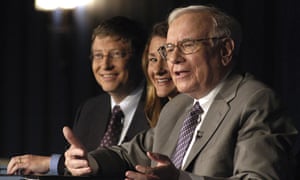
Bill (L) and his Melinda Gates (C) with Warren Buffett as the latter pledge of 10m shares of Berkshire Hathaway to the couple’s foundation.


Bill and his Melinda Gates with investment veteran Warren Buffett (R) in 2006. Photograph: Nicholas Roberts/AFP/Getty Images

The letter to Buffett is an assessment of the progress the Gates Foundation has made since 2006, when he pledged 10m shares in his company Berkshire Hathaway in annual instalments worth a total of $ 31bn at the time. The couple write of the progress that has been made in saving children’s lives, particularly through immunisation and vaccine development, and the work that lies ahead in making childbirth safer and tackling malnutrition.


Their letter makes clear what is at stake with Trump’s move to reimpose the global gag rule, arguing that women and maternal health are key to so many global health issues.


Empowering women is a key theme of the letter in which the couple argue that enabling women to access contraceptives control over the number of pregnancies they have is crucial. When women have a gap of at least three years between births, their children are more likely to survive and be healthy and well educated, the couple say. “Like vaccines, contraceptives are one of the greatest lifesaving innovations in history,” writes Bill Gates in the letter.


What is the ‘global gag rule’, and why does Trump support it?

Since they set up their foundation its focus has shift from the hunt for technological solutions towards social change. The attention to women’s empowerment came from the evidence, the couple say.


“You cannot go out and be in the developing world and then come back and look at the data and turn away from the importance of women in the developing world,” said Melinda Gates.


Whether they breastfeed and take their children to be vaccinated makes a profound difference to how the child grows and his or her life chances, and men are not always there, she added. “So you have to look at the woman’s role and when you look at it you realise it can be an accelerator to every single thing you want to have happen in the world for global health and global development and social change.”


In their letter, Bill Gates sats that poverty is sexist, a phrase he first heard from the U2 frontman Bono.


“The poorer the society, the less power women have. Men decide if a woman is allowed to go outside, talk to other women, earn income. Men decide if it’s acceptable to strike a woman. The male dominance in the poorest societies is mind-blowing.”


In the letter, Melinda Gates adds: “It’s also crippling. Limiting women’s power keeps everyone poor.”


She and her husband tell of their visits to sex workers in India whom the couple say they encouraged to form self-help groups, thinking the women would help each other insisting their clients wore condoms to protect themselves from HIV. That vision, said Bill Gates, “was way too narrow”. The sex workers began to support each other in every aspect of their lives.


“Warren, if Melinda and I could take you anywhere in the world so you could see your investment at work, we probably would take you to meet sex workers. I met with a group in Bangalore, and when they talked about their lives, they had me in tears,” writes Bill Gates.


“One woman told us she turned to sex work after her husband left her – it was the only way to feed her children. When people in the community found out, they forced her daughter out of school, which made the girl turn against her mother and threaten to commit suicide.


“That mother faced the scorn of society, the resentment of her daughter, the risks of sex work, and the humiliation of going to the hospital for an HIV test and finding that no one would look at her, touch her, or talk to her. Yet there she was, telling me her story with dignity.”


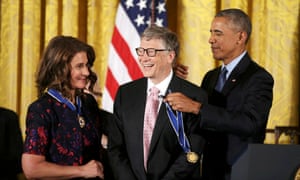
Bill and Melinda Gates receive medals from Obama at presidential medal of freedom ceremony in November 2016.


Bill and Melinda Gates receive medals from Obama at presidential medal of freedom ceremony in November 2016. Photograph: Carlos Barria/Reuters

There have been setbacks, such as the failure yet to end polio, but the couple emphasise the enormous progress that has been made in the last couple of decades in global health and speak in the letter of their optimism for the future.


“Polio will soon be history. In our lifetimes, malaria will end. No one will die from AIDS. Few people will get TB. Children everywhere will be well nourished. And the death of a child in the developing world will be just as rare as the death of a child in the rich world.


“We can’t put a date on these events, and we don’t know the sequence, but we’re confident of one thing: The future will surprise the pessimists.”


Trump"s "global gag" aid rule endangers millions of women and children, Bill Gates warns

30 Aralık 2016 Cuma

Bill Gates: world faces decade at risk from antibiotic-resistant bugs

People across the world, particularly those in developing countries, face a decade at risk from pandemics spread by antibiotic-resistant bugs, the billionaire Bill Gates has warned.


Gates, who made his fortune with the Microsoft Windows operating system before becoming a philanthropist, said the success of antibiotics had created complacency that was now being exposed by the rise of microbial resistance to the drugs.


“I cross my fingers all the time that some epidemic like a big flu doesn’t come along in the next 10 years,” Gates told a special edition of Radio 4’s Today programme guest-edited by Dame Sally Davies, the chief medical officer for England.


“I do think we will have much better medical tools, much better response, but we are a bit vulnerable right now if something spread very quickly like a flu that was quite fatal – that would be a tragedy and new approaches should allow us to reduce that risk a lot.”


Gates said it was crucial for wealthier countries to step in to help the developing world fight disease, both for humanitarian reasons and for their own health security.


Although mistakes were made, criticism of the World Health Organisation (WHO) during the Ebola crisis in west Africa was unfair, he said, because it was not funded or staffed to do all the things that observers wanted it to do.


International cooperation had led to the eradication of smallpox, and was on the verge of eradicating polio, he added.


“The cooperation that we have seen, I think, needs to intensify,” Gates said. “It’s the only way that global problems like epidemics will get solved and so [for] all the people who are negative on WHO, the message to take away from that is not that that kind of multilateral cooperative effort is doomed and the money is not well spent, rather that we actually need to broaden their capacity. We actually need to dedicate ourselves to this global cooperation.”


In September the UN secretary general, Ban Ki-moon, warned that antimicrobial resistance was a “fundamental threat” to global health that risked making high quality universal healthcare impossible.


It is estimated that more than 700,000 people die each year from drug-resistant infections, though it could be much higher because there is no global system to monitor the figures. There has also been difficulties in tracking death tolls even in places where they are monitored, such as the US, where tens of thousands of deaths have not been attributed to superbugs, according to a Reuters investigation.


The European Centre for Disease Prevention and Control reported in November that illnesses resistant to so-called last-line antibiotics – drugs kept in reserve for use against pathogens that have proved resistant to all other antibiotics – were on the rise in the continent.


Without them, some infectious diseases could become untreatable and some forms of major surgery would again become perilous.


Davies said Britain’s health service was well placed to handle a flu pandemic, although it would still take as long as six months to “produce enough vaccine to start putting it into people”. She was less optimistic about how resilient the rest of British society would be to an outbreak.


“It’s not just the NHS,” she said. “It’s how would our social care system cope with people who aren’t ill enough to be in hospital but need extra support? It’s how would our economy cope if a large proportion are too ill to work? When we have a just-in-time ordering policy for delivery of food, petrol, whatever.


“And if you think about the issues that could happen here if we had a recurrence of the 1918 type flu, then what would it be like in middle- and low-income countries where they don’t have the health systems to look after the patients?”


Bill Gates: world faces decade at risk from antibiotic-resistant bugs

9 Aralık 2016 Cuma

Ohio "heartbeat" abortion bill could be test case for overturning Roe v Wade

The Ohio state legislature threw down the gauntlet this week to the supreme court, passing a new anti-abortion “heartbeat” bill that would ban terminations from as early as six weeks, the most severe restrictions in the country.


Ohio politicians say they were motivated to push through the bill by Trump’s win, believing they might find a more friendly US supreme court that would uphold the law.


If passed by Governor John Kasich, the bill could serve as a test case for the limits of constitutional protections of abortion, and even for overturning the landmark decision Roe v Wade, which enshrines a woman’s right to choose abortion until the fetus is “viable” (between 24 and 28 weeks gestation). But activists on both sides of the issue doubt that strategy is likely to succeed, and say it could do more to harm the legal movement than help it.


The bill passed by the Ohio state legislature Tuesday night stops just short of banning abortion from the time a fetus’s heartbeat is detectable, which is usually around six weeks. The new law states that if a doctor terminates a pregnancy without listening for a heartbeat or when a heartbeat is audible, then the physician would be committing a fifth-degree felony and facing up to a year in jail, disciplinary action and civil lawsuits.


Many women do not even realize they are pregnant at this early stage.


“If this law would take effect, it really is a flat out abortion ban,” said Amanda Allen, senior state legislative counsel at the Center for Reproductive Rights.


Many other states have also tried to get “heartbeat bills” through in the past. North Dakota and Arkansas state legislature passed similar laws in March 2013, however the eighth circuit appellate court ruled them unconstitutional in 2015 and the laws were never enacted.


Ohio lawmakers have considered their own bill in the past. But lawmakers said that Trump’s election and a free seat on the supreme court gave them new impetus for the bill and make it more likely that the bill would be upheld in the courts.


“A new president, new supreme court appointees change the dynamic, and there was consensus in our caucus to move forward,” Senate president Keith Faber.


But despite lawmakers’ views, many anti-abortion activists in the state are not celebrating the move.


Mike Gonidakis from Ohio Right to Life, an anti-abortion lobby group, says his group is officially “neutral” on the bill because he fears the law would be struck down, after an expensive and lengthy court battle. He believes the six-week ban would be so dramatic that even the supreme court would vote 5-4 to strike it down, even if another conservative justice were confirmed to replace the vacancy on the court.


“You have to be patient and strategic with the courts,” said Gonidakis.


“That doesn’t even take into account millions of dollars Ohio would be forced to pay the lawyers for Planned Parenthood and the ACLU,” he added.


Gonidakis thinks it may even strengthen Roe v Wade.


“We will be inviting nothing more than damage and danger to all we’ve accomplished for the past 40 years,” said Gonidakis.


And while some are worried that the law sets up a test case that might become a referendum on the supreme court’s Roe v Wade president, Ohio’s arm of the American Civil Liberties Union says it’s ready to declare a legal challenge if the bill becomes law. Allen says she’s not too worried the legal challenge would have an adverse effect at the high court, since another court has already judged the North Dakota and Arkansas laws unconstitutional.


“These types of bans are completely unconstitutional and have very little chance of standing up in court,” said Allen, noting that Roe v Wade has been settled law for over 40 years.


Ohio has tightened abortion restrictions in recent years, and this legislation was tacked on to an unrelated bill last minute in Ohio this week.


This was the third time Ohio attempted to pass it, after it failed in 2012 and 2014.


On Thursday, the Ohio state legislature passed another anti-abortion bill, which would ban abortion from 20 weeks. Currently 18 states have enacted some form of 20-week abortion ban, and Allen noted that lawmakers may be pushing the “heartbeat” bill as a red herring while the other, also controversial measure flies under the radar.


“That could certainly be part of the strategy,” noted Allen. “Both bans are prohibitions on abortion prior to viability and the US Supreme Court has been very clear that states may not do that.”


Kasich, who ran as a moderate during the Republican primaries but has signed several restrictions on abortion into law in the last few years, will have to decide whether to sign one or both bills into law, veto them, or ignore them, in which case they would automatically be enacted into law within a few weeks.


Ohio "heartbeat" abortion bill could be test case for overturning Roe v Wade

22 Kasım 2016 Salı

‘Stark choice’ as schools struggle to foot bill for poorer students

Kevin Prunty is executive head teacher at Cranford community college, a high-achieving school in Hounslow, west London. His pupils are ambitious and successful, but many come from disadvantaged backgrounds.


Like other schools serving deprived areas, Cranford find itself increasingly playing a sophisticated welfare role in its community. It is also footing the bill for uniforms, PE kits, shoes, lunches and educational trips from a diminishing budget, to subsidise parents who cannot afford to meet the costs.


But with school budgets under pressure and further cuts expected there are fears they will not be able to continue to fill the gap.


“Schools know already that there are sizeable further cuts to funding on the way – and whilst we are currently able to fund these additional needs – it will soon become more difficult and perhaps impossible to justify doing so,” says Prunty.


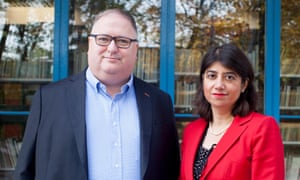
Kevin Prunty and Seema Malhotra


Kevin Prunty, head of Cranford community college in west London, with Seema Malhotra MP. Photograph: Alicia Canter for the Guardian

He says it’s not possible to measure the additional cost in the sense of how many uniforms, how many trips, how many meals. Instead he describes the kind of scenarios his staff deal with on a daily basis to illustrate the level of need.


A year 7 boy needs additional support but his symptoms don’t meet the threshold to qualify for child and adolescent mental health services (Camhs).


An educational welfare officer helps a family where the father is suffering from a mental illness and keeps telling his children they are terminally ill. Another colleague intervenes to help a child with impaired hearing.


Someone else takes a pupil out to buy a suit for a job interview for a traineeship. It’s not just the money – they coach them for the interview and make sure the suit fits properly. “There’s nobody to say whether the arms are too long, so some of our staff take the responsibility,” says Prunty.


And things are getting worse. Since pupils returned to school in September, staff have noticed an increase in the number of children who are not eligible for free school meals who come in without any money for lunch. Inevitably the school provides – it all costs and meanwhile budgets are shrinking.


The Institute for Fiscal Studies has estimated that increasing costs and growing pupil numbers will result in an 8% cut in funding per student by 2020 and an inquiry has been begun by the public accounts committee to examine the financial sustainability of schools.


The sector would like to hear there is more money for schools in the autumn statement later this week – the reality is that schools like Prunty’s are likely to lose out in the long-awaited redrafting of the national funding formula (NFF) in which money from well-funded urban schools working with disadvantaged families is expected to move to less well-funded schools in less needy areas.


He has already had to address a £1m shortfall in the budget caused by a cut in grant funding from the government and rises in pension costs, national insurance costs and below-inflationary salary rises. He has managed to balance the budget but twelve jobs had to be cut – four teachers and the rest support staff.


At another school in the area, a principal who asks not to be named says he increasingly feels like a debt collector, having to chase up parents who owe the school money. As families at his school struggle to make ends meet, many are building up large debts. Some owe hundreds of pounds for school lunches and he estimates that parental debt is costing the school £10,000 a year.


Last year the school handed out 45 uniform grants worth £100 each to parents in need. Then there are equipment grants for things like scientific calculators. He feels for the parents, many of whom are in low paid jobs and are surprised to find they are not entitled to free school meals for their children. “There’s a lot that’s adding to pressure on parents. It’s uncomfortable to be talking to them about the money they owe the school. But that money is money we are not spending on teachers,” he says. “Schools are not in the debt management business. It’s not sustainable to be running this level of debt.”


The issue has been raised by Seema Malhotra, Labour MP for Feltham and Heston, who has become increasingly concerned about the hidden burden on schools’ budgets. “Schools are being faced with a stark choice,” she said. “Let children from poorer backgrounds miss out on educational opportunities and experiences, or pick up the costs and take on financial debt. Budgets are already under pressure and with further cuts to school funding, helping families in need is set to get harder.”


At Springwest Academy in nearby Feltham, which also serves a community with high levels of disadvantage, there are similar concerns. Pastoral mentors deal with calls day in and day out from families with worries about housing and finances; school uniforms and shoes are being paid for more frequently out of the school’s hardship fund and almost four out of ten pupils (38.3%) are referred for counselling or other mental-health support.


Victoria Eadie is chief executive of the Tudor Park Education Trust which includes Springwest. “It does worry me what’s going to happen. I don’t know a school in Hounslow that is not having to go though some form of restructuring and quite severe cuts.” Until now her school, like others, has been able to step in to support the neediest. With further cuts, she says, “schools will not be able fill the gap”.


‘Stark choice’ as schools struggle to foot bill for poorer students

4 Kasım 2016 Cuma

Woman who gave birth in her car gets $7,400 bill for hospital delivery room

Paula D’Amore was never expecting to give birth in the backseat of her Jeep. A few hours after she felt a contraction on 7 April, she loaded into the car and her husband started driving to the hospital, only to feel a burning sensation as the car pulled into its driveway.


“Never in a million years wouldI havethought this would happen,” D’Amore said.


Her husband ran into the hospital to tell the staff his wife was in labor. As he came back and opened the door, the baby began crowning and he was forced to deliver the head. Moments later, a few nurses joined at the car and a midwife helped complete the delivery of her newborn daughter, Danielle.


Only after giving birth in her car was she taken to a recovery room because all the labor rooms at the Boca Raton regional hospital were full.


Given that she gave birth in her car, D’Amore was shocked to receive a hospital bill that charged her more than $ 7,400 for a delivery room. She is also disputing an additional $ 4,000 bill for a time her daughter spent in the neonatal intensive care unit.


“I laughed,” she said when she got the bill. “You gotta be kidding right? How do you charge for something that you didn’t do?”


D’Amore and her husband switched to a $ 5,000 high deductible insurance package that she had saved up for in preparation for the pregnancy, so her expenses will be capped at $ 5,000 and she has not disputed payment for other services, including the midwife. But she refuses to accept the hospital room charges given that she gave birth in the car.


“I cannot swallow seeing that they have the audacity to charge $ 7,000,” D’Amore said.


Labor and delivery are among the most expensive healthcare costs in the US. According to a 2013 study by Truven Health Analytics, the cost of childbirth in the US has tripled since 1996. Truven also found the average price of pregnancy and newborn care for a baby was approximately $ 30,000 for vaginal delivery, and $ 50,000 for a C-section. Delivery costs alone are an average of $ 10,000 and over more than $ 15,000 for a vaginal or C-section respectively, according to the International Federation of Health Plans (IFHP).


After working with counsel provided by her husband’s employer, she took her grievances to the hospital who said they found nothing wrong with the charges after two reviews.


“Boca Raton Regional Hospital has reviewed the matter, understands the concerns of this patient, and has previously attempted to resolve the outstanding balance concerns with the patient,” Thomas Chakurda, vice-president of marketing at Boca Raton regional hospital, said in a statement. “The hospital appropriately bills for the medical services and care it provides and has determined that the level of care provided and billing were appropriate in this instance. We take all of Mrs D’Amore’s concerns seriously and are willing to review them further.”


Woman who gave birth in her car gets $7,400 bill for hospital delivery room

9 Ekim 2016 Pazar

The week in TV: Westworld; A World Without Down’s Syndrome; The Apprentice; Real Time With Bill Maher

Westworld (Sky Atlantic/Now TV)
A World Without Down’s Syndrome? (BBC2) | iPlayer
The Apprentice (BBC1) | iPlayer
Real Time With Bill Maher (Sky Atlantic/Now TV)


The much-vaunted Westworld, HBO’s grandiloquent bid to sew our carcasses ever more tightly into a cocoon of weekly fantasy – Game of Thrones officially runs out of breasts and dying heroes some time in 2018 – arrived with low-key splendour. Muted title sound, yet an opening sequence of such technical magnificence it looked as if it had been beamed back to us from about 2048. The fetlocks of horses were being 3D-modelled with filigree’d and granular precision, as were the noses of crooked barmen (as if there’s any other kind) and doughty sheriffs, and the very ivories of nags’ teeth and of pianolas, and suddenly we were into Westworld, a panorama of haughty big skies, aching beauty and spitefully small human dreams.


A world, in case you missed all the media hype (and where on earth were you? Possessing a life?), in which guests will pay handsomely for a week or so in a wild west in which they can go riotously tootsie: sleep with every perfumed whore, gut-shoot every sweaty dog-breath hoodlum. Even, if addled and bourbonned enough, shag the bandit and gun the girl. They’re all robots, programmed to hurt and bleed like us, but also to wake the next day mended and with no memories.


It’s an intriguing premise, of course, and, of course it will all go wrong: a sudden aberrant line of source code will risk not only the lives of the guests but, more crucially, the psyches of the androids in the park, who suddenly have twitches of memories. For the moment, we care more about the robots, who seem more human than the visitors, who cannot be physically harmed in the park: a depressing number have chosen to go all black hat with their moneyed freedom, murdering and fornicating at any whim: be advised that this is often nasty viewing.


[embedded content]


Watch a trailer for Westworld.

It could have been just another tricksy CGI fantasy. But it came from the pen of Michael Crichton, responsible for Jurassic Park, which also asked pertinent questions about humanity and technology. I would happily class Crichton with Ray Bradbury and Philip K Dick, because they also wrote wisely about ourselves: even when it might have been spuriously about robots, or dinosaurs, it was always about us. What might we do? Are we happy with discovering the people we truly are or only happy with the people we want to be? And if you can’t tell the difference between the humans and the androids, should it matter?


This is existentially and morally mired, in that it raises questions not of the narrative in itself but of us, the reader/viewer. This opener was tremendously, deliberately confusing: the good guy is a robot, the bad guy (a tremendous Ed Harris, playing the part he was born to play) a veteran vicious tourist on the hunt for darker levels, to assuage all he lacks in real life, which is shaping up as a howdy-doody lot of a lack. It’s all rather scintillating, not least because if features Borgen’s Sidse Babett Knudsen as the searingly blue-eyed head of quality assurance, off stage and chain-smoking high on the controllers’ gantry, intent not on money but simple control: of robots, the “livestock”, but also of every human around her.


Could it be a worthy successor to GoT? Absolutely. HBO has another global heavyweight on its hands, thanks to the authors: I’m hooked, in a way I never was with early Thrones. Again: this is not about robots: it’s about us. Yet every time I am tempted to worry about robots taking over the world any time before about 2416 I simply think of self-service tills. Smile my usual smile.


Most winning programme of the week was undoubtedly A World Without Down’s Syndrome?, in which Sally Phillips, with quizzical wit and just the right salting of lip-trembling anger, asked whether we’re right to hail with such a blizzard of approbation a new non-invasive test for pregnant mothers.


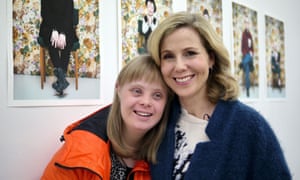
Halldóra, one of the few people in Iceland with Down’s, and actor Sally Phillips.


Halldóra, one of the few people in Iceland with Down’s, and actor Sally Phillips. Photograph: Not Known/BBC/Dragonfly

Some of the statistics were frightening. In Iceland, where they have had the test for a while, every positive diagnosis for Down’s has resulted in termination: 100% in the past five years. There are now fewer than 40,000 people with Down’s in Britain. Phillips, whose dear son Olly is one, made a passionate yet refreshingly unsentimental case for the right to have Down’s extant in this world. It’s not a disease, it’s a set of characteristics (and ones that, actually, genetically predispose the child to happiness).


Hugely set against this comes the understandable set of fears of any mother: of an inability to cope, of a child’s being bullied, even of their own prejudices. Yet Down’s remains the one disability it has become socially acceptable to “cleanse” and Sally was more than troubled (as was I) by medical professionals’ universal embracing of one and only one tenet: Down’s is always bad, choice is always good. This lucid and strangely uplifting programme should be only the very beginning of a debate we should have been busily having for about 30 years.


“I’m the business equivalent of a diamond. I can sparkle, and light up a room, but if you’re not careful I can cut you.” Was this contestant perhaps confusing “a diamond” with “scissors”? I can’t think of anyone in the history of ever who has actually been cut by a diamond. Just by the people who wear them.


The women’s team discuss how to turn a whelk stand into a pig’s ear in The Apprentice.


The women’s team discuss how to turn a whelk stand into a pig’s ear in The Apprentice. Photograph: BBC

Yes, The Apprentice is back, complete with ol’ Lord Bearded Man-Stoat and the usual basket of deplorables. And back this year to guys v gals, an intriguing reversion that shouldn’t in an ideal world work, but does. It might be my imagination but some of the candidates seem a little more sympathetic than in recent years. Some, and it’s all relative, of course, and they managed as usual to turn a whelk stall into a pig’s ear with their first task. The women called back into the boardroom made a masterclass only of being able to turn viciously, wheel and blame each other, and regroup in nanoseconds to re-blame another other: bitchy death by scuffed Louboutin heels. Bring it on.


For those not yet driven forlorn by attemping to make sense of America, I cannot recommend highly enough Real Time with Bill Maher. Like a Democrat version of PJ O’Rourke, Maher is suave, angry, pithily funny and possessed of a fine foul mouth when necessary.


He makes no secret of his loathings for Mr Trump, the most badass black hat of this and most other years. “Welcome to another week of ‘yes, this is really happening,’” he began a more than usually confrontational show. It’s not perfect: some humour strains in the translation and I wish these shows wouldn’t always rely on visual gags that always flash up for about six seconds longer than it has taken to get the often negligible “joke”. Yet Maher, and John Oliver, proves that there’s space to manage both satire and deadly serious within the very same hour, and I wonder anew why we don’t quite have the equivalent here: a TV version of Private Eye. Eddie Mair for the job.


The week in TV: Westworld; A World Without Down’s Syndrome; The Apprentice; Real Time With Bill Maher

23 Ağustos 2016 Salı

​Ukraine"s medicine bill slashed by 25% after UK firm brought in to handle procurement

A British company hired to buy medicines for Ukraine’s health ministry has succeeded in cutting prices by up to a quarter, in a rare success for anti-corruption efforts.


Last year, under pressure from activists demanding action against graft, the health ministry brought in Crown Agents, a not-for-profit development company that specialises in the procurement of medicines, and two UN agencies, in the hope this would both lower prices and drive corrupt intermediaries out of business.


Public anger over corruption was a major cause of Ukraine’s 2014 revolution. Shady middlemen dominated state procurement, using offshore companies to syphon cash to insiders, while inflating prices the government paid for crucial goods.


On the eve of the uprising, Transparency International rated Ukraine alongside Nigeria and Iran on its Corruption Perceptions Index.


Christine Jackson, the senior procurement expert who signed Crown Agents’ contract last November, said: “In the main, I think progress has gone very well.”


The British team is supplying Ukrainian doctors with cancer medicines, while the UN agencies are procuring HIV/Aids medicines and vaccines. Jackson said preliminary figures suggested a saving of 20% to 25%.


However, although Crown Agents succeeded in negotiating lower prices than their Ukrainian predecessors, they have struggled to actually get many drugs to the people who need them. Officials have either failed to sign off on documents, or actively obstructed shipments, meaning the final deliveries arenot due until November, some 11 months late.


Members of Ukraine’s parliament have demanded Crown Agents lose its contract for next year as a result – something that Jackson said she found extremely frustrating. She cannot buy drugs until the health ministry gives final approval, which it has been increasingly reluctant to do. One letter had not been replied to for 139 days and counting, she said, while drugs worth $ 6m (£4.6m) were still held up at customs.


The SBU, Ukraine’s equivalent of the FBI in the US, said it wanted to check all of Crown Agents’ correspondence.


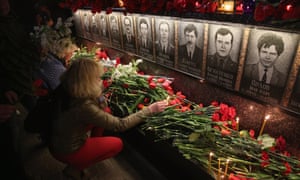
Service on the 30th anniversary of the Chernobyl disaster in April


Service on the 30th anniversary of the Chernobyl disaster in April. The disaster has contributed to Ukraine’s high cancer rate. Photograph: Sean Gallup/Getty Images

“It’s incompetence, corruption, or just not the will to make a decision,” Jackson said. “From my experience this is quite extreme, so much pushback from so many quarters. You expect it maybe from some of the Ukraine distributors, suppliers having to share the market … we don’t usually have the same from the client who’s actually contracted with us, so that’s been a real difficulty.”


Healthcare failures


Ukraine’s government is nominally committed to fighting corruption, but has failed to jail any senior figures from the previous regime, and what little progress there is has been largely driven by Ukrainian activists and foreign diplomats, rather than ministers or officials.


At present, prosecutors and anti-corruption investigators are locked in a turf war over who exactly has the right to conduct surveillance, which is threatening to paralyse much of their work.


Cancer is Ukraine’s second-biggest cause of death, with rates driven by widespread smoking and – at least in part – residual radiation from the Chernobyl disaster. Corruption has long blocked effective treatment, starving hospitals of medicines, and keeping doctors’ salaries low. By 2014, the country’s leading oncological centre, the Cancer Institute, had become a post-revolution symbol of how bad things had got, with its doctors in open revolt against its management.


Doctors described having to ask patients for money just to afford spare parts for diagnostic machinery, while patients’ organisations had to arrange black market shipments of drugs to make up for the hospital’s failure to provide them.


Following a Guardian investigation into the institute, its workforce elected a new director, Dr Olena Kolesnyk. By staging transparent tenders for supplies, she too has succeeded in driving down prices. She said that inpatients had started getting meat with their meals for the first time in at least eight years, with new contractors knocking 40% off the institute’s food bill. “Previously, they just had buckwheat porridge, or some pasta maybe,” she said.


She hoped to finally fulfil a long-delayed building project to expand the institute, and to start cooperating with major western centres to make up some of the research ground lost over the years, but was facing exactly the same problems as Crown Agents. Officials at the health ministry were failing to reply to letters, or to make basic decisions – such as about the registration of new medicines – paralysing any hopes of progress.


“Crown Agents didn’t know what they were dealing with,” she said. “But we can’t go back to the past, people won’t allow it. People have changed, their worldview has changed, I don’t think they’ll allow these old schemes to come back.”


Ukraine is now on its fourth health minister since 2014’s revolution, with the appointment of Ulana Suprun last month. She said that she signed about 5,000 documents within two weeks of taking office, just to try to remove the blockages that had built up under the previous administration, and to get the drugs procurement process moving again.


“It’s a steep learning curve but I think we are tackling it. The important thing is to identify the problem and mistakes, and to fix them so it’s smoother,” she said. “This has cut out a lot of corruption, but these forces that caused the corruption in the past are the ones that don’t want us to move forward, and they have a lot of money and a lot of strength.”


She said Ukraine hoped to have its own independent procurement agency by 2019, but would continue to employ international agencies until then.


This story was supported by the Pulitzer Center on Crisis Reporting


​Ukraine"s medicine bill slashed by 25% after UK firm brought in to handle procurement

21 Ağustos 2016 Pazar

Corbyn’s support for my NHS reinstatement bill was not inept | Letters from Caroline Lucas MP and others

I have no wish to intrude on the Labour leadership debates and I have no idea whether former shadow health minister Heidi Alexander is right in her critique of Jeremy Corbyn’s leadership style, but for her aides to pick out Corbyn’s support for my NHS reinstatement bill as evidence both of his “ineptitude” and of his shadow chancellor’s “undermining” her strikes me as both desperate and depressing (Shadow cabinet inept and shoddy, says MP, 20 August). My private members’ bill, drawn up after extensive consultation with health experts and health service users, would have reversed the creeping marketisation of the NHS – under both New Labour and the Conservatives – and stripped away the costly market mechanisms that waste NHS money and lead to inefficiencies and the fragmentation of services.


Perhaps a more interesting question is why the rest of the Labour party didn’t join their SNP, Plaid and Lib Dem colleagues in giving it their backing too. With a few honourable exceptions, they chose to abstain instead. Yet this is precisely the kind of policy a successful Labour party would surely be expected to promote – as well as demonstrating a greater willingness to work alongside colleagues from other parties on those areas where there is common ground between us.


Overcoming party tribalism and finding practical ways of working together will be crucial to any hope of progressive policies finding a majority at the next election – whether that be on the NHS, tackling inequality, putting rail in public hands, or seriously addressing the climate crisis. Real leadership means being bold and honest enough to recognise that there’s far too much at stake to refuse to cooperate for the common good.
Caroline Lucas MP
Green, Brighton Pavilion


Heidi Alexander’s self-justifying piece would have made David Brent blush. Alexander had perhaps the easiest job in Labour front-rank politics – defending a properly funded, publicly run health service free at the point of use – yet she managed to reduce her portfolio to dull, uninspiring managerialism. On every count she flings at John McDonnell for “undermining” her – his joining a junior doctors’ picket line, his gathering the views of frontline health activists and his support for Caroline Lucas’s NHS reinstatement bill – McDonnell clearly spoke for the vast majority of Labour supporters and members.
John Medhurst
Hove, East Sussex


Jeremy Corbyn’s support for a National Education Service is welcome but hardly “courageous” (Zoe Williams, 15 August). None of his statements to date have spelt out the urgent reforms needed to England’s segregated and hierarchical system of secondary schools. He could confront the need for an integrated 14-19 curriculum and discuss the future of the GCSE. He could propose new forms of local and regional accountability. He could discuss fair admissions, measures to reduce religious segregation and how to end, not extend, the 11-plus. Without more detail Labour’s policy on secondary schools will, sadly, remain an empty space. Even more courage is needed, Jeremy.
David Chaytor
Todmorden, West Yorkshire


It is a sad day for British democracy that Momentum – the left-wing ginger group active within the Labour Party – has seemingly turned its back on non-violence (Momentum no longer rules out acts of violence, 20 August). Momentum’s unwillingness to sustain its previous principled opposition to violence is because some of the fringe groups who are associated with them want a licence from the left to face down neo-fascist groups fist-by-bloody-fist. Aligning this sort of macho political posturing with what the brave men and women who resisted the Nazis did is an insult.
Martin Jones
New Barnet, Hertfordshire


Corbyn’s support for my NHS reinstatement bill was not inept | Letters from Caroline Lucas MP and others

18 Ağustos 2015 Salı

NHS sounds compensation alarm right after £120,000 attorney bill for £5,000 claim

A third of the £1.1bn paid out by the NHS in compensation final year was handed to attorneys, with one company submitting a £121,700 bill following a £5,000 declare.


The value to the taxpayer is expected to rise to £1.4bn next year, with the NHS conceding that it faced an “increasingly hard task” in managing the degree of payouts.


In its annual report, the NHS Litigation Authority (NHS LA) added that the behaviour of numerous law companies was leading to concern, with massive bills getting submitted and a large quantity of unjustified claims becoming created.


Ian Dilks, the chair of the NHS LA, said: “The fees of litigation are placing a burden on NHS finances of a magnitude that was never ever imagined when the NHS LA was established.”


Associated: Clampdown on lawyers overcharging NHS in clinical negligence situations


The NHS LA also raised worries about the coalition government’s overhaul of legal help, saying it had “influenced the behaviour of some claimant lawyers” and led to growing legal costs in numerous situations.


The authority highlighted one case the place an NHS trust agreed to pay out £5,000 for the failure to diagnose a patient’s tumour on the kidney. Even so, right after the provide of £5,000 was accepted, the patient’s solicitors claimed expenses of £121,700.


More evaluation of the bill revealed that the company was claiming a price of £400 an hour, despite the fact that a important sum of the operate was carried out by unqualified staff. The company then claimed a one hundred% achievement charge on leading of this, raising the hourly charge to £800.


The NHS ultimately had the declare struck out.


In yet another situation, the NHS agreed to spend £2,000 to settle a declare. The claimant’s solicitors then presented a bill for £53,529.60 – even though the ultimate amount paid by the NHS was reduced.


The report explained that it was “impossible to justify” the increasing quantity of situations exactly where substantially much more funds was billed by claimant solicitors for legal expenses than was paid in compensation.


Due to law firms’ actions, the legal charges of smaller claims have risen substantially. Where sufferers get damages of up to £100,000, the typical claimant’s legal expenses are now much more than 50% of the total payment.


By tough charges, expenses have been reduced by an average of 33%. The Department of Health is currently thinking about programs to cap the fees charged by attorneys in clinical negligence claims.


Connected: Legal support overhaul – what the adjustments will indicate for you


After the introduction of the legal support legislation, the NHS LA anticipated to see a fall in the quantity of circumstances. Alternatively, it discovered that solicitors had been finding other ways to enhance costs.


“We are seeing an escalating variety of plainly excessive and disproportionate costs expenses, the presentation of which coincides with the banning of success charges and the reduction of the recoverability of the full value of following-the-occasion (ATE) insurance coverage against the defendant,” mentioned the report.


The NHS LA additional that it continued to obtain a significant amount of unjustified claims, generating no payments at all for far more than 46% of clinical claims.


The NHS LA’s chief executive, Helen Vernon, warned that it was turning out to be more difficult to make sure that patients acquired fair compensation even though reducing the inappropriate claims produced on the NHS.


“The emergence of non-expert attorneys coupled with extreme claims for legal charges by some firms has essential a modify in approach,” she mentioned in the report.


In order to end unjustified claims, the NHS LA is tough far more claims for expenses and contesting far more situations in court. The quantity of instances in which no compensation is paid has nearly doubled in five years, from two,533 instances to 4,909.


In 2014-15, the authority mentioned that it had saved much more than £1.2bn for the NHS by rejecting claims that had no merit.


NHS sounds compensation alarm right after £120,000 attorney bill for £5,000 claim

18 Temmuz 2014 Cuma

Assisted dying: Lord Falconer campaigns for proper to die bill


“Great good quality end of daily life care can alleviate considerably of the struggling of the dying process. We must carry on to strive to enhance it. For a minority of individuals who are dying, no matter how great the end of life care they do not want to go on struggling.


He insisted his Bill, which he said was equivalent to the Oregon model, had help amongst both the disabled and wider population.


But some 47% stated they believed legalising assisted suicide would “inevitably” lead to some vulnerable men and women opting to end their lives to avoid becoming a burden on their loved ones.


Lord Falconer’s prior attempts to get the legislation onto the statute guide have constantly run into fierce opposition and a lack of parliamentary time.


A list of around 130 peers have put their names down to communicate in the course of the debate, which is anticipated to final for ten hrs. They will be offered cost-free votes on the problem as it is a matter of conscience.


But Prime Minister David Cameron on Wednesday spoke of his “worry” about legalising euthanasia, saying he was “not convinced that more actions need to be taken”, and that “people might be being pushed into issues that they will not actually want for themselves”.


Assisted dying: Lord Falconer campaigns for proper to die bill

17 Temmuz 2014 Perşembe

Assisted dying: this Bill has so numerous flaws I will not know the place to start off


The Residence of Lords is debating, on Friday, a question the answer to which has an effect on every man or woman in the land – must we permit medical professionals to aid and abet the suicides of some of their patients? Because this is what Lord Falconer’s Private Member’s Bill quantities to.


Lord Falconer seems to be below the misapprehension that his Bill has the backing of the Supreme Court. The Court has surely known as for Parliament to take into account whether or not the law must be altered. But, insofar as it has ventured into the dangerous territory of how it may possibly be altered, its pondering seems to be far eliminated from what Lord Falconer’s Bill is proposing.


In his judgment 3 weeks in the past the President of the Court speculated – no a lot more than that – that the balance among providing some individuals the selection of assisted suicide and guarding other people from harm as a result may perhaps be accomplished if (and allow us quote him verbatim) “no support could be given to a particular person who wishes to die except if and right up until a Judge of the Substantial Court has been content that his wish to do so was voluntary, clear, settled and informed”.


My own examination of Lord Falconer’s Bill demonstrates it to be deeply flawed. Its so-known as safeguards are feeble: they are similar to placing up a discover not to go close to the edge of a cliff but not placing a railing there to stop men and women falling above. It defines terminal illness in this kind of a way as to carry huge numbers of people with chronic illnesses and disabilities within its ambit. It has no compliance system. I could go on and on. But, given that the Supreme Court has known as on Parliament to deal with this query and as Lord Falconer’s Bill is on the table, we need to give it our complete consideration.


In this procedure I hope the House of Lords will devote rather significantly less time focusing on philosophical rules, like autonomy, and far more on the challenging practicalities of life that numerous of us face in our every day lives. It is all very effectively for a minority of sturdy-willed and self-assured individuals to assert that they want for themselves what they call (incorrectly, as it presently exists) a “proper to die”. I am far more concerned with the plight of the underdog – of significantly ill and disabled folks who are struggling to cope with existence amid poor social care, inadequate housing and loneliness (that growing ailment of our society) and who do not want to die – but who could all as well easily locate themselves drawn into ending their lives out of depression or despair.


Choice is a wonderful issue but it has to be true choice, and many folks just do not have that. As peers we are used to taking decisions for ourselves, we know how the law operates and we are normally capable to look after our personal interests with no difficulty. But we must remember nowadays that many people’s encounter of lifestyle, specifically the sick and the disabled, is much less about undertaking and far more about becoming completed to. These are the men and women who want our help and safety.


Patronising, some might say. But as legislators we have a duty to ensure that any laws we make do not expose other men and women to harm. That is what leads to me to fret about the notion of supplying help with suicide inside the NHS.


Baroness Grey-Thompson is a crossbench peer


Assisted dying: this Bill has so numerous flaws I will not know the place to start off

Assisted dying: this Bill has so many flaws I never know in which to commence


The Residence of Lords is debating, on Friday, a question the solution to which affects every single particular person in the land – should we allow medical professionals to aid and abet the suicides of some of their sufferers? Due to the fact this is what Lord Falconer’s Personal Member’s Bill quantities to.


Lord Falconer seems to be below the misapprehension that his Bill has the backing of the Supreme Court. The Court has undoubtedly referred to as for Parliament to contemplate whether the law should be modified. But, insofar as it has ventured into the harmful territory of how it may well be transformed, its thinking would seem to be far removed from what Lord Falconer’s Bill is proposing.


In his judgment three weeks in the past the President of the Court speculated – no much more than that – that the stability among giving some men and women the option of assisted suicide and guarding other folks from harm as a result may well possibly be achieved if (and allow us quote him verbatim) “no support could be given to a man or woman who wishes to die except if and till a Judge of the Large Court has been content that his want to do so was voluntary, clear, settled and informed”.


My own examination of Lord Falconer’s Bill demonstrates it to be deeply flawed. Its so-named safeguards are feeble: they are related to putting up a recognize not to go close to the edge of a cliff but not putting a railing there to cease individuals falling more than. It defines terminal sickness in such a way as to bring big numbers of individuals with continual illnesses and disabilities inside of its ambit. It has no compliance system. I could go on and on. But, because the Supreme Court has named on Parliament to deal with this query and as Lord Falconer’s Bill is on the table, we have to give it our total consideration.


In this process I hope the Property of Lords will devote rather less time focusing on philosophical concepts, like autonomy, and much more on the tough practicalities of life that numerous of us encounter in our everyday lives. It is all extremely effectively for a minority of sturdy-willed and self-assured men and women to assert that they want for themselves what they call (incorrectly, as it previously exists) a “right to die”. I am a lot more concerned with the plight of the underdog – of significantly sick and disabled individuals who are struggling to cope with daily life amid bad social care, inadequate housing and loneliness (that growing disease of our society) and who do not want to die – but who could all too easily locate themselves drawn into ending their lives out of depression or despair.


Option is a wonderful point but it has to be genuine selection, and numerous folks just do not have that. As peers we are employed to taking decisions for ourselves, we know how the law functions and we are generally able to seem right after our own interests without issues. But we should keep in mind right now that several people’s experience of lifestyle, specially the sick and the disabled, is much less about performing and a lot more about getting completed to. These are the individuals who require our assist and safety.


Patronising, some may possibly say. But as legislators we have a duty to make sure that any laws we make do not expose other people to harm. That is what leads to me to fret about the notion of offering support with suicide within the NHS.


Baroness Grey-Thompson is a crossbench peer


Assisted dying: this Bill has so many flaws I never know in which to commence

Assisted dying: this Bill has so numerous flaws I never know in which to commence


The Home of Lords is debating, on Friday, a question the answer to which impacts each individual in the land – ought to we allow doctors to assist and abet the suicides of some of their sufferers? Simply because this is what Lord Falconer’s Personal Member’s Bill amounts to.


Lord Falconer would seem to be underneath the misapprehension that his Bill has the backing of the Supreme Court. The Court has definitely called for Parliament to contemplate whether the law must be changed. But, insofar as it has ventured into the unsafe territory of how it might be transformed, its contemplating would seem to be far eliminated from what Lord Falconer’s Bill is proposing.


In his judgment three weeks in the past the President of the Court speculated – no much more than that – that the balance between providing some people the decision of assisted suicide and safeguarding other folks from harm as a end result may well perhaps be attained if (and allow us quote him verbatim) “no assistance could be given to a man or woman who wishes to die unless of course and until finally a Judge of the High Court has been content that his wish to do so was voluntary, clear, settled and informed”.


My very own examination of Lord Falconer’s Bill displays it to be deeply flawed. Its so-referred to as safeguards are feeble: they are similar to putting up a observe not to go close to the edge of a cliff but not putting a railing there to stop folks falling more than. It defines terminal sickness in this kind of a way as to deliver big numbers of folks with continual illnesses and disabilities inside of its ambit. It has no compliance system. I could go on and on. But, given that the Supreme Court has referred to as on Parliament to deal with this query and as Lord Falconer’s Bill is on the table, we should give it our complete consideration.


In this procedure I hope the House of Lords will spend rather significantly less time focusing on philosophical principles, like autonomy, and more on the tough practicalities of life that numerous of us encounter in our daily lives. It is all quite well for a minority of powerful-willed and self-confident people to assert that they want for themselves what they get in touch with (incorrectly, as it currently exists) a “proper to die”. I am far more concerned with the plight of the underdog – of seriously unwell and disabled individuals who are struggling to cope with daily life amid bad social care, inadequate housing and loneliness (that increasing ailment of our society) and who do not want to die – but who could all as well simply discover themselves drawn into ending their lives out of depression or despair.


Selection is a fantastic issue but it has to be actual option, and a lot of people just do not have that. As peers we are utilised to taking selections for ourselves, we know how the law operates and we are normally capable to look right after our personal interests with no trouble. But we ought to don’t forget right now that many people’s knowledge of existence, especially the sick and the disabled, is much less about performing and far more about getting done to. These are the folks who require our aid and protection.


Patronising, some could say. But as legislators we have a duty to ensure that any laws we make do not expose other people to harm. That is what triggers me to fear about the notion of providing assistance with suicide inside the NHS.


Baroness Grey-Thompson is a crossbench peer


Assisted dying: this Bill has so numerous flaws I never know in which to commence