endangers etiketine sahip kayıtlar gösteriliyor. Tüm kayıtları göster

14 Şubat 2017 Salı

Trump"s "global gag" aid rule endangers millions of women and children, Bill Gates warns

The “global gag rule” imposed by Donald Trump, blocking US funds to any organisation involved in abortion advice and care overseas, could impact millions of women and girls, endangering their lives and those of their babies, Bill and Melinda Gates have warned.


The changes are expected to result in funding from the world’s biggest donor to family planning and women’s health programmes in the developing world being slashed. It could, Bill Gates told the Guardian, “create a void that even a foundation like ours can’t fill”.


Gates and his wife spoke out as they published a progress letter to Warren Buffett, the businessman who 10 years ago invested a large part of his fortune in the couple’s foundation which has at its centre the mission to save children’s lives. Empowering women and girls, the couple said, was central to that aim.


Trump signed an executive order reimposing the Mexico City policy, also known as the global gag rule, on his first full day in office. Republican presidents since Ronald Reagan in 1984 have imposed the policy, while their Democrat counterparts have lifted it. The rule strips funds from any organisation that “performs or actively promotes abortion as a method of family planning” overseas.


But Trump’s order goes further, applied to any organisation that receives funding from US Aid , not just those involved in family planning. That expansion, said Melinda Gates, was a surprise.


“We’re concerned that this shift could impact millions of women and girls around the world,” she said. “It’s likely to have a negative effect on a broad range of health programs that provide lifesaving treatment and prevention options to those most in need.


“This includes programmes that prevent and treat HIV, TB and malaria, and provide healthcare to women and children around the world. Enabling women to time and space their pregnancies and providing access to treatment and prevention of infectious diseases is lifesaving work. It saves moms’ lives and it saves babies’ lives, and that has long had wide support in the United States.”


Bill Gates said their foundation would not be able to bridge the potential funding gap. “The US is the No 1 donor in the work that we do. Government aid can’t be replaced by philanthropy. When government leaves an area like that, it can’t be offset, there isn’t a real alternative. This expansion of this policy, depending on how it’s implemented, could create a void that even a foundation like ours can’t fill.”


He had an early phone call with Trump in November and then a meeting in December with the president-elect in New York, he told the Guardian. They talked about the eradication of polio, which Gates hopes could come as early as this year, and the research his foundation is supporting towards an Aids vaccine and ways to protect people from pandemics such as Ebola in west Africa.


“So that was a good discussion – the fact that he was interested in having me talk about the Foundation’s work – I was pleased,” said Gates.
But the philanthropist did not anticipate the scope of the executive order affecting family planning, an issue at the centre of the foundation’s work, that Trump was to sign.



Bill (L) and his Melinda Gates (C) with Warren Buffett as the latter pledge of 10m shares of Berkshire Hathaway to the couple’s foundation.


Bill and his Melinda Gates with investment veteran Warren Buffett (R) in 2006. Photograph: Nicholas Roberts/AFP/Getty Images

The letter to Buffett is an assessment of the progress the Gates Foundation has made since 2006, when he pledged 10m shares in his company Berkshire Hathaway in annual instalments worth a total of $ 31bn at the time. The couple write of the progress that has been made in saving children’s lives, particularly through immunisation and vaccine development, and the work that lies ahead in making childbirth safer and tackling malnutrition.


Their letter makes clear what is at stake with Trump’s move to reimpose the global gag rule, arguing that women and maternal health are key to so many global health issues.


Empowering women is a key theme of the letter in which the couple argue that enabling women to access contraceptives control over the number of pregnancies they have is crucial. When women have a gap of at least three years between births, their children are more likely to survive and be healthy and well educated, the couple say. “Like vaccines, contraceptives are one of the greatest lifesaving innovations in history,” writes Bill Gates in the letter.


What is the ‘global gag rule’, and why does Trump support it?

Since they set up their foundation its focus has shift from the hunt for technological solutions towards social change. The attention to women’s empowerment came from the evidence, the couple say.


“You cannot go out and be in the developing world and then come back and look at the data and turn away from the importance of women in the developing world,” said Melinda Gates.


Whether they breastfeed and take their children to be vaccinated makes a profound difference to how the child grows and his or her life chances, and men are not always there, she added. “So you have to look at the woman’s role and when you look at it you realise it can be an accelerator to every single thing you want to have happen in the world for global health and global development and social change.”


In their letter, Bill Gates sats that poverty is sexist, a phrase he first heard from the U2 frontman Bono.


“The poorer the society, the less power women have. Men decide if a woman is allowed to go outside, talk to other women, earn income. Men decide if it’s acceptable to strike a woman. The male dominance in the poorest societies is mind-blowing.”


In the letter, Melinda Gates adds: “It’s also crippling. Limiting women’s power keeps everyone poor.”


She and her husband tell of their visits to sex workers in India whom the couple say they encouraged to form self-help groups, thinking the women would help each other insisting their clients wore condoms to protect themselves from HIV. That vision, said Bill Gates, “was way too narrow”. The sex workers began to support each other in every aspect of their lives.


“Warren, if Melinda and I could take you anywhere in the world so you could see your investment at work, we probably would take you to meet sex workers. I met with a group in Bangalore, and when they talked about their lives, they had me in tears,” writes Bill Gates.


“One woman told us she turned to sex work after her husband left her – it was the only way to feed her children. When people in the community found out, they forced her daughter out of school, which made the girl turn against her mother and threaten to commit suicide.


“That mother faced the scorn of society, the resentment of her daughter, the risks of sex work, and the humiliation of going to the hospital for an HIV test and finding that no one would look at her, touch her, or talk to her. Yet there she was, telling me her story with dignity.”
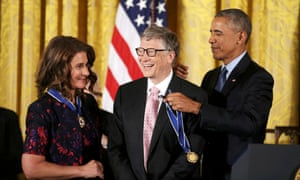


Bill and Melinda Gates receive medals from Obama at presidential medal of freedom ceremony in November 2016.


Bill and Melinda Gates receive medals from Obama at presidential medal of freedom ceremony in November 2016. Photograph: Carlos Barria/Reuters

There have been setbacks, such as the failure yet to end polio, but the couple emphasise the enormous progress that has been made in the last couple of decades in global health and speak in the letter of their optimism for the future.


“Polio will soon be history. In our lifetimes, malaria will end. No one will die from AIDS. Few people will get TB. Children everywhere will be well nourished. And the death of a child in the developing world will be just as rare as the death of a child in the rich world.


“We can’t put a date on these events, and we don’t know the sequence, but we’re confident of one thing: The future will surprise the pessimists.”


Trump"s "global gag" aid rule endangers millions of women and children, Bill Gates warns

20 Şubat 2014 Perşembe

Shambolic record-retaining by NHS wastes funds and endangers patients | Jenny Rohn

As a naturalised British citizen born and raised below the shark-like US healthcare program, I have a deep appreciation for the Nationwide Wellness Service. I am genuinely grateful that my son will never have to make the agonising decisions that I have had to, choices which pit the worth of lifestyle towards drastic economic repercussions.


For instance, at the age of eleven, I had to work out whether my mother was “ill enough” to phone an ambulance right after she collapsed and I was the only one particular property. I was outdated ample to know that we did not possess the thousands of dollars we’d be charged, but not outdated enough to come to feel assured that her symptoms weren’t existence-threatening. In the finish I called the ambulance, and my mom was diagnosed with a severe heart difficulty. But later on on as a starving graduate pupil, I lost the same lottery, racking up a $ 2,500 bill in the ER after mistaking a abdomen bug for appendicitis. It took nearly a 12 months to recover financially from that small blunder.


So the criticisms I am about to degree in no way indicate I do not really like and help the NHS. Not too long ago, it even saved my existence. But I have been really troubled by what I have come to see as a systemic failure in the way it records, holds and shares patient information.


Very good record-retaining is essential for any understanding-searching for exercise that requires continuity. As a scientist who performs challenging experiments for a residing, I can attest that creating down specifically what I have accomplished in minute detail is the only way that my experiments – at times lasting up to a month in duration – can ever be valuable. Even if I managed to get a very good consequence on the fly, I most likely would not be in a position to repeat it, and if the experiment did not operate, I would struggle to pinpoint why. Lax record-trying to keep leads to a waste of time, sources and eventually, cash.


Diagnosis and treatment is not unlike scientific study. Home MD might have taken this notion to the extreme, but clinicians usually experiment on their individuals, going forward with approaches when the patient responds effectively and altering tack when they do no great. Regrettably sufferers seldom see the very same clinician for prolonged consultation intervals. For instance, I gave birth at St Thomas’ Hospital last autumn but was taken by ambulance to King’s College Hospital for postpartum problems. King’s did not want obligation for my stick to-up, so I was discharged back into the neighborhood, instructed to get my blood pressure checked everyday by the midwives.


But they didn’t have the sources to visit me each and every day, and my GP also refused, saying that my ailment was not 1 they have been acquainted ample with. Eventually a medical colleague of mine, employing personal connections, managed to get the interest of a St Thomas’ consultant who ultimately agreed to see me by means of to completion. She was great, but unfortunately was not ready to entry any of my notes from King’s, which includes the essential brain scan and the record of which drugs I’d been on.


I was shocked was this regular, that hospitals really do not share information? I have a unique NHS amount: certainly that is all that is needed?


Apparently not. Meanwhile, I’d been suffering from some rather extreme cardiac arrhythmia, which commenced troubling me soon right after providing birth. I was 1st attended by a newish medical professional at my GP surgical procedure, who ordered a 24-hour ECG. The ECG was administered by King’s. When a extended time had elapsed with no word, I rang my GP to find that the original medical doctor was extended gone and no one particular had taken up my file, which had been lying in some disused in-tray with the end result for weeks. Extremely thankfully it was not a result that needed immediate action to conserve my life. I spoke to a locum medical professional by mobile phone at the surgery, who referred me to St Thomas’ for a cardiac outpatients appointment. There, the registrar had to order another 24-hour ECG, due to the fact I’d had it done someplace else.


“I can write King’s to inquire if they can send it on,” she confided. “And I can chase them. But to be truthful, it’s not probably to ever arrive.”


As I wondered how hard it could probably be for 1 medical professional to securely share a consequence with an additional, and exactly how considerably time and income would be wasted by running that check a second time, she asked, “Are you sure you really don’t bear in mind what dose of beta-blockers they had you on?”


Why ought to I have to keep in mind? Shouldn’t all this be written down somewhere, in a central place, in which any NHS clinician can access it? It must be, but it isn’t.


Ambulance Entrance, King
Obtaining to the hospital is the effortless part. But who keeps track of what takes place up coming? Photograph: Richard P Grant

And then there’s the inherent problem of paper records. Half of the scrawls in my antenatal notes have been frankly illegible to subsequent care suppliers, like probably important details like blood stress. I was amused when a consultant couldn’t read his personal note dashed off a couple of months previously. Paper, even typed printouts, are also much more susceptible to human error: a single obstetrician grabbed the incorrect sheet off the pile and consulted with me about my “normal” blood outcomes – it was only when I acquired house I realised we’d been seeking at an additional patient’s printout altogether (and it turned out my own had an abnormal result that essential follow-up).


Paper is also poorly searchable. Not too long ago I was invited to go on the ward rounds with a medical colleague. At each end, a junior medical professional would scrabble through a thick sheaf, attempting to update her consultant on the story so far.


“Walk me through the medicines we’ve had him on because the beginning,” my colleague would inquire – cue extended paper shuffling and muttering for many lengthy minutes whilst we all looked on awkwardly and the clock ticked and the consultant could easily have completed with one particular patient and moved on to several a lot more. Piecing collectively the chain of events, and deciphering the scribbles of hasty ink, appeared as painstaking as translating fragments of ancient text on pottery fragments. I am pretty sure, at this certain hospital, that none of individuals particulars were logged electronically. Scans and bloodwork, yes histories, standard observations and drug regimens, no.


So what’s the solution? I am of course not the 1st individual to recognize this dilemma. An ambitious programme to deal with both universal access and to make data electronic was infamously scrapped in 2011 for spiralling out of manage. The overall health minister at the time, Simon Burns, stated: “The nationally imposed program is neither essential nor appropriate to supply this. We will let hospitals to use and create the IT they currently have and include to their environment either by integrating methods bought by way of the current national contracts or elsewhere.”


Maybe a best-down resolution was never going to be affordable or even workable, but I doubt that a sprawling network of property-grown efforts cobbled together with “integrating systems” could ever ensure true universality – is there any way even a fraction would be compatible? 3 many years on, I’ve noticed no proof of excellent data sharing between clinicians in the London region. And I’ve seen no evidence of hospitals going paper-cost-free either, which is the needed initial phase. But if hospital trusts can’t even afford ample frontline workers to run an productive service, how are they ever going to be ready to divert the required money to IT? It seems an insurmountable problem – but unless of course it is solved, individuals will endure, and a great deal of time and money will be wasted.


Jenny Rohn is a cell biologist at University School London. Follow her continuing journey on twitter at @JennyRohn


Shambolic record-retaining by NHS wastes funds and endangers patients | Jenny Rohn