Group therapeutic work had never appealed to Kerina, who was diagnosed with borderline personality disorder and obsessive compulsive disorder in her 30s after suffering from mental health issues all her life. “You sit there reading paperwork and it feels like you’re in a classroom,” she says.
Then two years ago the community mental health team in Mid Ross in the Scottish Highlands gave her a “social prescription” – referring her to Branching Out, a Forestry Commission Scotland programme designed to help people recover from long-term mental health problems. For 12 weeks she spent five hours a week in the woods doing conservation work, bushcraft and environmental art.
“I enjoyed it straightaway,” says Kerina, who now volunteers as a mentor with the Abriachan Forest Trust, where she completed the course. “It’s so different from your normal life. You go out there and all your worries leave you. We built shelters, tables, workbenches, a kitchen. We chopped wood, we cooked, we sat around the campfire.
“It just seemed to really work for me. I remember saying: ‘I feel like I’ve been here for ages.’ I’d only been there a day.” Though she still has good and bad days, she says she now finds her problems easier to deal with, and is working towards a formal award in volunteering.
The use of social prescribing – where GPs and other primary care professionals refer patients to non-medical activities, such as gardening, arts and sports, normally delivered by the voluntary sector – is growing, with many schemes tackling mild to moderate mental health problems. Studies have suggested a range of positive mental health and wellbeing outcomes.
But in January a report commissioned by Natural England warned that the lack of a standardised referral mechanism, or funding for the activities offered in the majority of services, posed “fundamental barriers” to the NHS’s ambition to increase the scale of social prescribing.
It identified Rotherham’s service for people with long-term health conditions, which started in 2012, as having many of the ingredients for good practice – including a simple and effective referral system, well-informed link workers to help patients choose an intervention, and, crucially, funding for those interventions.
The report also highlighted the service Rotherham has since started for people with mental health issues, which began as a one-year pilot in 2015 and has just been extended for a third year. In an evaluation of its first year, 93% of service users reported progress against at least one of eight wellbeing outcome measures, and 64% reported progress on four or more.
While the service initially focused on those who had been using services for five to 20 years and needed a support network and meaningful activities to help with a successful discharge, it is now expanding to work with people earlier on.
But Janet Wheatley, chief executive of Voluntary Action Rotherham, which coordinates the programme, backs up the warning in the Natural England report: “You can’t direct more and more people to use resources in the community without providing funding to support that.”
Sarah never planned to take antidepressants for 14 years. Three years after she began taking them, when she was 21, she went to her GP and asked to stop: 20mg of Seroxat a day had helped her live with anxiety and panic attacks, but she began to feel uncomfortable about being on medication all the time. Her doctor advised her to taper down her medication carefully.
At once, “I was a mess,” she says. “I thought I was losing my mind. My appetite completely went. I lost the best part of two stone. I was anxious constantly. My mouth was dry. It was difficult to sit and be calm.” She became withdrawn, refusing to see friends, and remembers asking her mother to get her a couple of boxes of paracetamol, thinking, “I’m going to have to take all these tablets, because I can’t live like this.”
Sarah’s doctor encouraged her to go back up to 20mg. “Within a week, I was much better. I feel anger when I look back. That wasn’t me relapsing, that was withdrawal. But I was so unwell, I didn’t stop to think, ‘I’ve never had this before.’ I truly thought it was me. Now the only reason I am on the drug is because I am dependent upon it. And that is not good enough.”
Prescriptions of SSRIs (selective serotonin reuptake inhibitors), the most common type of antidepressant, have doubled in the past decade. There are now more than 70m prescriptions dispensed in the UK in a year, the “greatest rise” of any drug in the last year, according to NHS research. But while the side-effects of starting and then withdrawing from these drugs are reasonably well known (the patient information leaflet accompanying the SSRI Seroxat is six pages long), there is very little research into the long-term effects of using antidepressants.
Last year, an all-party parliamentary group began hearing evidence as to whether there is a link between a measurable rise in mental health disability claims – 103% between 1995 and 2014 – and that in antidepressant prescriptions. (Claims for other conditions fell by 35% in the same period.) “We need to have a serious rethink about current levels of prescribing, because it may well be that the drugs are in fact contributing to the disability burden,” Dr Joanna Moncrieff, a consultant psychiatrist and senior lecturer at University College London, told the committee.
Reports both anecdotal and clinical have included side-effects such as constant pain, an altered sense of smell, taste or hearing, visual problems, burning hands and feet; food or drug intolerances and akathisia (the medical term for a deep inner restlessness). When a patient begins tapering down their dosage, these effects are generally ascribed to the drug leaving their system; if it is long after withdrawal is supposed to be over, however, patients are often disbelieved (according to the drug companies, withdrawal should take just two weeks for most people, though they acknowledge that for some it can be months).
Professor David Healy, director of the department of psychological medicine at Cardiff University and author of 22 books on psychopharmacology, believes that antidepressants are overprescribed. “If you go into your average doctor – if you’ve been off the drug for half a year or more – and you complain [of a range of symptoms] and say, ‘I think it’s caused by this pill I was on’, he or she would say, ‘It’s been out of your body for months. You’re neurotic, you’re depressed. All we need to do is put you on another pill.’”
GPs, Healy says, are “relying on your word, and if it’s a choice between believing what you say and relying on what drug companies say to them, they [tend to] believe the drug companies”. Healy, who has been a consultant for, and expert witness against, most of the major pharmaceutical companies, has long argued that long-term side-effects are routinely ignored or misunderstood.
But many experts believe these drugs do more good than harm. “Most of the people I see who have moderate to severe depression benefit from them,” says Daniel Smith, a professor of psychiatry and researcher into bipolar disorder at the University of Glasgow. For some, medication can be no less than “transformative. It can get them through a really critical period of their life.”
However, when it comes to long-term impact, especially after a person stops taking SSRIs,Smith says it can be hard to work out which symptoms relate to the drug use and which to the underlying conditions. “There’s obviously an issue of cause and effect. How can we be certain the SSRI caused it? Depression affects libido and sexual interest. How much [of the reported effects] is depression and/or anxiety symptoms coming back?”
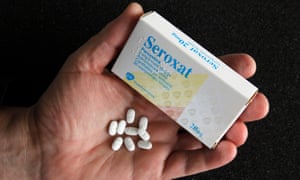
By 2003, worldwide sales of Seroxat, manufactured by GlaxoSmithKline, were worth £2.7bn. Photograph: Alamy
SSRIs have beenaround for more than 40 years, but grew in popularity in the late 1980s and 90s after pharmaceutical companyEli Lilly launched fluoxetine, otherwise known as Prozac. Time magazine put the drug on its cover twice, asking, “Is Freud finished?” and describing SSRIs as “mental health’s greatest success story”. In 2001, a landmark report on a clinical trial into paroxetine (sold as Seroxat in North America and Paxil in the UK), called Study 329, concluded that it demonstrated “remarkable efficacy and safety”. Study 329 led directly to a massive increase in prescriptions: by 2003, worldwide sales of Seroxat (manufactured by GlaxoSmithKline) were worth £2.7bn.
But concerns were raised about the study –the US food and drug administration (FDA) officer who reviewed the data disagreed with the findings, calling it a failed trial – and in 2015 the British Medical Journal published a re-evaluation. Seven authors went through as many of the thousands of individual case reports as they could, and found not only that “the efficacy of paroxetine… was not statistically or clinically different from placebo”, but that “there were clinically significant increases in harms, including suicidal ideation and behaviour”. The original study reported 265 adverse reactions; the BMJ found 481. The re-evaluation also found that psychiatric responses were grouped together with “dizziness” and “headaches”, rather than given their own category. In 2003, the UK banned the use of Seroxat by anyone under 18; and in 2004 the FDA required a “black box warning” on all antidepressants, its strictest level of patient warning.
“Patient safety is our number one priority,” a GlaxoSmithKline (GSK) spokesperson tells me. “We believe we acted responsibly in researching paroxetine, monitoring its safety once it was approved and updating its labelling as new information became available.”
It’s more reliably predictable that they’re going to get rid of sexual function than get rid of depression
Many SSRI users report blunted emotions, even long after they have ceased taking pills, and an impact on sexual function. “They should be called anti-sex drugs rather than antidepressant drugs,” says Jon Jureidini, a child psychiatrist of 30 years’ standing, a professor of psychiatry and paediatrics at the University of Adelaide and co-author of the BMJ study, “It’s more reliably predictable that they’re going to get rid of sexual function than it is that they’re going to get rid of depression.” Again, some people find this persists long after they cease taking the drug. One person I spoke to, Kevin, had taken Prozac for six months when he was 18; now 38, he hasn’t had an erection since.
Last September, Healy and colleagues published a further examination of the data gathered for Study 329. This data followed the trial participants for six months after they started taking paroxetine (the “continuation phase”) and while they were tapered off it. GSK, which in 2004 published a clinical study report, had argued that “the long-term safety profile of paroxetine in adolescents appears similar to that reported following short-term dosing”. Healy and co, however, concluded that the “continuation phase did not offer support for longer-term efficacy”. More alarmingly, they found that the taper phase, when patients were being taken off the drugs, was the riskiest of all, showing a “higher proportion of severe adverse events per week of exposure”. This, they said, opens up the risk of a “prescribing cascade”, whereby drug side-effects are thought to be symptoms, so are treated with further drugs, causing further side-effects and further prescriptions – thus increasing the risk of long-term prescription drug-dependency.
In October, the British Medical Association published its response to a two-year fact-finding exercise into long-term use of psychoactive drugs. It noted that while benzodiazepines, z-drugs, opioid and antidepressants are “a key therapeutic tool”, that their use can “often lead to a patient becoming dependent or suffering withdrawal symptoms… the evidence and insight presented to us by many charity and support groups… shows us that the ‘lived experience’ of patients using these medications is too often associated with devastating health and social harms”; it was therefore, the report concluded, a “significant public health issue”.
The BMA made three key recommendations: first, and most urgently, that the UK government establish a 24-hour helpline for prescribed drug dependence; second, that it establish well-resourced specialist support units; and third, that there should be clear guidance on prescription, tapering and withdrawal management (they found the current approach to antidepressants, in particular, to be inconsistent: too many patients were suffering “significant harm”). There are also increasingly urgent calls for studies into long-term effects that are not funded by drug companies, because, Moncrieff says: “We don’t have very much data. This research is really important, but hasn’t been done. It’s a massive blind spot. It’s extraordinary – or maybe, given the pressures and interests at work, not extraordinary at all – that it hasn’t been filled.”
In March this year, members of the BMA, along with MPs and researchers from Roehampton University, went to parliament to lobby Public Health England, armed with research estimating that there are 770,000 long-term users of antidepressants in England alone, at a cost of £44m to the NHS per year (a figure that does not account for the cost of GP appointments, or the impact of side-effects, withdrawal effects and disability payments).
“I think you have to adopt a very conservative approach,” says psychiatrist Jon Jureidini. “These are brain-altering drugs, and our overall experience with brain-altering drugs of all kinds is that they tend to have a detrimental effect on some proportion of people who take them long term. All we know about the benefits is from short-term symptom-reduction studies. The careful prescriber needs to say, ‘Well, in balancing the likely benefits and harms, I need to be very cautious about how much benefit I’m expecting, and I need to be very generous about the possibility that the harms might be more than they appear to be.’”
Quite a few long-term users, such as those I spoke to below (and who wished to be anonymous), would agree.
‘Tapering off is the hardest thing I’ve ever done’:Sarah, 32; has taken Seroxat for 14 years
I was prescribed Seroxat when I was 18, the year I started university. I grew up with a disabled sister, so things at home were very stressful, and I had a history of anxiety and panic attacks. I had counselling, but the problems persisted, so I went back to the GP. I don’t remember everything that was said, but there was no conversation about side-effects.
Within the first two weeks of starting Seroxat, I remember I was sitting in the front room watching TV when out of nowhere I had this intense feeling of heat, like an electric shock. It started in my hands, went all the way up my arms and through to my head.
The GP said it was probably just my body getting used to the drug. And after a few weeks the weird sensations did ease off. I had a fabulous time at university. I still had panic attacks, and there were certain situations I would avoid – as I still do – so it wasn’t a wonder drug, but there were no major problems.
But in 2006 I tried to come off it. There were a couple of Panorama documentaries about the side-effects and I was starting to become concerned. The GP said, “That’s fine, but do it gradually, over three weeks.”
I thought I was losing my mind. I was going to work, but it was difficult to get through the day. My mouth was so dry
I immediately became incredibly unwell. I thought I was losing my mind. I was going to work, but it was difficult to get through the day. My mouth was so dry, I was constantly drinking water. I had bizarre thoughts – not hallucinations – that were frightening or distressing. I had a strong sense of detachment from reality.
Eventually, the doctor said, “Look, you coming off is obviously not working: we need to get you back to 20mg.” Within a week I was much better.
A few years later, when I realised my mental health was getting worse, even though I was on the medication, I started to do some research, reading case studies about withdrawal. I find it so offensive when a GP says, “This is who you are.” I didn’t have these symptoms 10 years ago. I didn’t have this sense of detachment. I saw various psychiatrists. They just kept saying, “The drug is safe, you need to be on it.” A couple of others told me the reason I was having these problems was because I wasn’t taking enough. Another said, “If you were diabetic, you’d take insulin and you wouldn’t have an issue. Why are you so bothered about taking this drug?”
I’ve been on it since I was 18, so I don’t know who I am without it, as an adult. Who knows? I might have all kinds of problems, but I need to know I’ve tried. Tapering off is the hardest thing I’ve ever done. It’s taken me three years just to get from 20mg to 5mg. I’m no longer with my partner – we were together for six years. I believe Seroxat has played a part: it affected my moods, it made my anxiety worse and, by necessity, I’ve had to be selfish, really. I don’t want to say all my problems are to do with Seroxat, because they’re not. But I do believe that it has caused me harm.
‘I don’t have much of an interest in interacting romantically or physically with the opposite sex’: Jake, 24; took SSRIs for eight years
I had been dealing with symptoms of OCD and anxiety for a lot of my childhood. It’s in my family, affecting two siblings and one parent. I was prescribed Zoloft when I was 12; I took a variety of SSRIs, Zoloft to Prozac to Lexapro, and then two others, for eight years.
Did they help? You know, I can’t really tell you, because I got through school. I got high marks, I had a lot of friends. So, in that sense, they must have helped. That’s the thing: for people with major depression, it’s easy to say, this has a measurable effect. But I kept taking them just because that’s what I’ve always done.
I went to university right out of school. I did very poorly. I had a bit of a breakdown, isolating myself, not sleeping. I was still on medication. I came home and enrolled at a community college. That was my worst period – I was very depressed. And I started to think, “I’ve been on these medications a long time. I’m not doing well – why not get off them?” I don’t recommend this at all to anyone, but I stopped going to a psychiatrist and took myself off.
Prozac. Photograph: Getty Images
For months I had trouble sleeping. I was jittery. I had brain zaps. My anxiety was pretty ramped up. I would feel numbness in my extremities – generally my arms. My psychiatrist told me these were just normal withdrawal symptoms, and they’d be gone in four to six weeks: “Anything you feel beyond that is your anxiety and depression returning.” Basically, if you still feel anything beyond this window that the medical community has established, it’s all in your head.
Eventually I went back to school full-time, and I remember doing OK, feeling somewhat better.
I’ve now been drug-free for four years. What’s lasted are the sexual side-effects. They were definitely worse in withdrawal than they had been on the drug, even though I didn’t really realise or understand it at the time, primarily because I started to take SSRIs at 12. While my brother took the same medicine over the same period and had a normal sexual life, I had a lack of sexual interest. I had erections, and I have regularly masturbated my entire life. But I don’t have much of an interest in interacting romantically or physically with the opposite sex.
I didn’t even start thinking about sex until a couple of years ago. It’s almost like I woke up one day and thought, “OK!” I started getting these windows – days or weeks – when normal sexual feelings would appear. But they’re new to me and I don’t know what to do about them. And because I don’t know what to do, I get anxious, and the anxiety kills any feeling – and then I’m anxious because I’ve lost all my feeling.
Online, I’ve come across a big asexual community. Some also took antidepressants; I think there are a lot of people like me out there. I’d like to think that if I keep going to counselling and sleeping and eating properly, I can rectify these things.
In the end, it’s about pros and cons. If you’re lying in bed and can’t get up, is it better to function? If it was up to me, I’d say that, barring extreme circumstances, nobody under 18 should be prescribed these things. Your brain develops around them. Drug companies should be thinking of the long-term effect on people who can’t even consent.
‘If I missed a dose, I’d get shocks down the side of my body’:Chris, 43; has been taking Seroxat for 26 years
I was originally prescribed Seroxat for mild anxiety about my GCSEs. It was 1991, about the time GlaxoSmithKline released Seroxat. I was one of the first people to be given it.
I was prescribed 20mg, the basic dose, to start with. It helped me: I got through school, I went to uni, I went to work. But I had side-effects from the off: profuse sweating, low libido. I’m quite a placid person, but I became aggressive. I never suffered, in the beginning, with the suicidal thoughts that people talk about now, but what I did notice was that if I missed a dose – especially after eight years of taking it – I’d get shocks down the side of my body. I’d be nauseous, my limbs would become weak. I’d be in a constant state of confusion and was very impatient. I couldn’t communicate well with people. I said this to the doctor, and he said, “We’ll up the dose to 40mg.” That was 1998.
I tried to go back to 20mg, but my words became slurry, so the doctor put me back up to 60mg
The 10 years after that weren’t too bad. I managed to work, as a sales rep, for 18-20 years. But by 2012, by which time I was up to 60mg, I had tried on numerous occasions to withdraw. I tried to go back to 20mg, but my words became slurry, so the doctor put me back up to 60mg.
By the time I was 38, even that wasn’t enough. I tried to take my life. The doctor wouldn’t prescribe a higher dose. I couldn’t do my job, I couldn’t concentrate, I couldn’t drive. A psychiatrist once said to me that coming off Seroxat is harder than quitting heroin. That really hit home.
I have now been unable to work for four years. I’m still seeing a psychiatrist. I’ve also been diagnosed with fibromyalgia: constant tiredness, aches in the neck, and in the lower back and lower limbs. I’m 43 and still live with my mum and dad.
I also have no libido. Since the age of 30, I have had no feelings in that regard whatsoever. I have had relationships, but they’ve all failed. I haven’t been in a relationship for 10 years, which is a long time to go without sex, but I just don’t get the urge.
I don’t really have emotions, to tell you the truth. The drug takes your emotions away. I’m sort of existing, not living.
And when the drugs do work…
‘I wanted to be able to feel good when good things were happening, bad when bad things were happening’
BySimon Hattenstone
I suppose I was a depression snob. A purist. Why should I take antidepressants? Yes, there was something rubbish about crying all the time, not functioning, being unable to answer simple questions because of the fug in my head. But, hey, at least I was true to myself.
My depression went back to my late teens. I didn’t like to think of myself as depressive, because depressives were losers. And I didn’t think I fitted the bill: I was pretty funny and able, and I could get girlfriends. I guess most depressives don’t think they fit the bill.
It might have been genetic. My dad had paralysing depression, and so did his father. As a young boy, I’d spent three years off school with encephalitis – an inflammation of the brain that is often fatal. Survivors are often left with depression.
I remember as a teenager being on holiday in Greece with friends. The weather was gorgeous, and I thought, “Why can’t it piss down, because then at least I’d have a reason to feel this way?”
That is what I always craved – objectivity. To be able to feel good when good things were happening, to feel bad when bad things were happening. I hated the fact that my feelings rarely correlated to what was going on in my outer world.
In my 20s, I got by. I held down a good job, fell in love, had kids, made friends, had a pretty good life. But things came to a head when my best friend killed herself. I’d find myself weaving in between traffic wondering what the impact would be like. I took a period off work and gratefully accepted my Prozac prescription.
Things had changed since I first rejected them. Prozac looked cool (lovely green-and-white pills) and rock bands wrote great songs about it (even if REM’s Shiny Happy People was supposed to be dystopic). After telling people I was off work with depression, I ended up feeling like a priest at confessional. It turned out that virtually everybody I knew was a depressive and pilling their way out of it; now it was “our secret”.
I would try to come off the pills and felt rubbish again – not more rubbish than before, but the same. So I returned
Initially, Prozac made me feel sick. And then magically, after a couple of weeks, I felt lighter, as if something had been lifted. I could hear questions properly, answer logically, enjoy a sunny day.
My partner said I was transformed. Occasionally, I would try to come off the pills and felt rubbish again – not more rubbish than I had before, but the same. So I returned, and after a while, I thought, “What’s the point of even thinking about coming off the pills if they make life work for me?”
There are times now when I wonder if I weep and fret and withdraw too much, and whether I’m becoming immune to the Prozac. But on balance I think not, because life is still so much better than it was.
If Prozac was no longer working for me, would I stop taking it? Probably. Would I stop taking antidepressants full stop? I doubt it. I’d simply look for another super pill.
• Are you a long-term user of antidepressants? Tell us about your experiences
If you are affected by the issues raised in this piece, contact the Samaritans here.
It’s the photo that launched a thousand memes. The freshly inaugurated Donald Trump, surrounded by a posse of white dudes signing a directive reinstating a “global gag rule” banning US-funded groups around the world from discussing abortion.
I saw the news about it on social media, shuddered, donated to Planned Parenthood and then felt just a little bit more grateful that I live in this country, a place where abortion and reproductive rights aren’t the hysterical hot button issues they are in the United States. I’ve only recently learned that while we might not share their toxic politics around reproductive rights, we have in the past taken America’s lead on the implementation of the global gag rule. It was last removed in Australia in 2009 by Kevin Rudd.
If the Australian Christian Lobby had its way, we’d follow America’s lead yet again. They are currently engaged in a pretty intense letter writing campaign calling for the re-instatement of an Australian global gag rule.
What is the ‘global gag rule’, and why does Trump support it?
Groups like Family Planning NSW are calling for funding to aid programs, specifically in Pacific Island countries, to be maintained in the May budget and with good reason. The Pacific has some of the worst reproductive and sexual health outcomes globally, with high rates of maternal and infant deaths, unintended and teenage pregnancies, sexual violence and unacceptably high rates of cervical cancer deaths.
Women giving birth in the Pacific are dying at 34 times the rate of women in Australia. Women in the Pacific are dying at up to 10 times the rate of women in Australia from cervical cancer. In developing regions, eight in 10 women with curable sexually transmitted infections do not receive treatment. Every two minutes, a woman dies in pregnancy or childbirth – the majority of these deaths are preventable. The main purpose of the global gag rule might be to stop aid agencies providing advice about abortion but the direct consequence is also to stop them providing a whole range of other services associated with sexual and reproductive health.
The people pushing for a gag rule in this country like to think they speak for the silent majority of Australians. Yet there is no evidence they do. Figures from last week’s Essential Report show Australians strongly support the nation’s commitment to providing important health services to women in Pacific Island nations.
In fact, 89% of Australians feel it is important women in Pacific Island countries have access to sexual and reproductive health services like contraception, cervical cancer screening and family planning. A strong majority of men (85%) and an even stronger majority of women (91%) support Pacific Island women having access to these services. There is very little variation in support across generations and party affiliation.
How important is it that women in Pacific Island countries have access to sexual and reproductive health services – like contraception, cervical cancer screening and family planning?
On the issue of whether our foreign aid budget should support the provision of these services in those countries, again there is strong support across gender and generation. This isn’t a women’s issue, it’s a community concern.
How important is it that Australia, through its foreign aid budget, supports Pacific Island countries to provide sexual and reproductive health services including contraception, cervical screening and family planning?
Finally, on the question of the global gag rule, 67% of Australians (64% men and 70% women) would be concerned if Australia also introduced this rule and stopped aid to groups that provide family planning and sexual and reproductive health services in Pacific Island countries. While opposition to the rule is highest among Greens voters, 62% of Coalition voters report being concerned about such a move.
How concerned would you be if Australia introduced a global gag rule and stopped aid to groups that provide family planning and sexual and reproductive health services in Pacific Island countries?
So much for the silent minority. Only 6% of those polled in the Essential Report would be unconcerned about a gag rule being reinstated. It’s clear that bringing vaccines, maternal health care, family planning and cervical cancer screening to the Pacific Island region is the intent of men and women across Australia.
Australians might be fascinated with Donald Trump. They might applaud his recent action in Syria and some of us might even sympathise with the idea of a ban on Muslim immigration. But the research shows there is no widespread support for a Trump-style gag rule that puts a rightwing Christian agenda before the health and wellbeing of Pacific Island women.
When justice is done, we should be glad. But the champagne-swigging jubilation that greeted the reduction of “Marine A” Alexander Blackman’s murder conviction to manslaughter on the grounds of diminished responsibility, went far beyond the acknowledgment that this was an appropriate outcome. To many of his supporters he is a “hero soldier” persecuted for shooting dead an injured Taliban fighter in Afghanistan. The judgment, however, was no exoneration: he killed a defenceless man, tried to make sure it was not witnessed, and attempted to cover up what he did. The judges considered mitigating factors, including his combat stress disorder. Nonetheless, they concluded that his crime was a severe one, that he held substantial responsibility for it, and that his dismissal from service was justified.
Drum-beating coverage of “our brave boys” veils the fact that British troops, like any others, are capable of terrible violations of the laws of war and the dictates of basic decency. Perhaps the catastrophe of Iraq, and the consciousness of the toll it took overwhelmingly on Iraqi civilians but also on coalition forces, has sensitised the public to the immense pressures facing soldiers and the often limited support they receive. More often than not, such abuses occur when there is an absence or failure of leadership. Another marine – briefly Blackman’s commanding officer – described the leadership and oversight in place as shockingly bad, and insisted he was not a single rotten apple. The answer is not to give soldiers a free pass to abuse and kill by attacking attempts to hold them to account, but to ask who else is responsible and how such behaviour can be prevented in future.
Blackman knowingly broke the rules of war (“I just broke the Geneva convention,” he told comrades). These are not a matter of etiquette, but morality; not a luxury, but a necessity. It is precisely because of the extremity of the situation, and the pressures upon troops, that clear rules are needed. They protect both civilians and soldiers. It took more than a century of campaigning to establish such standards. That they have often been ignored is a reason to uphold them vigorously, not to lower them.
It is not only that the end cannot justify the means. Believing that it can often leads to a different end, whether on the soil of Afghanistan or in the skies over Mosul. The fight against Islamic State there has seen a frightening acceleration of civilian casualties. Too many Iraqis and Syrians are dying in coalition strikes that are supposed to save them; and that fact, besides causing untold tragedy, is likely to fuel future radicalisation.
The increase in deaths began in the last weeks of the Obama administration – around the time that procedures were changed to make calling in strikes easier – but has gathered pace. It may reflect a tactical change in response to the heavy punishment that Iraqi forces took as they reclaimed eastern Mosul; and, around Raqqa, perhaps poor on-the-ground intelligence. But many fear that the Trump administration’s announcement of a review of the rules of engagement has been enough to lower the threshold in reality.
Western intervention in recent wars has been couched largely in moral terms. Intentions are not enough. Blackman told the fighter he killed: “It’s nothing you wouldn’t do to us.” But being better than the Taliban, let alone Isis, is no kind of baseline.
When I was 16, I spent two months in Italy with my maternal grandparents – then both 88. My grandmother had fallen over some months previously and was bedridden, but my grandfather was still active, physically and mentally; we would regularly play Scopa – an Italian card game – together. His memory rendered him unbeatable.
The family would take it in turns to attend to my grandmother; the more senior adults doing the more serious jobs such as cleaning her, with me doing the softer jobs: combing her hair, giving her a manicure, applying lip salve. When she was very sick, my young cousins and I took it in turns to do the nights. The community nurse, Sabino, visited daily, taking coffee with us in between administering medications. Thirty years later, we are still friends with him. Both grandparents died aged 89, cared for almost exclusively at home (at the very end, my grandfather went to hospital) and by the family.
So it has been for all my elderly relatives in Italy, all of whom lived with, or close to, family. So far, pretty idyllic. That wasn’t the case for my London-based aunt who, because of geographical sprawl and tragedy, ended up in a residential home at the age of 92 – sagacious but frail – and died there three months later. Her main carer, before that, had been my 86-year-old father who most days made the unsustainable three-hour round trip to see her. The last time I saw her in the home, she lamented the lack of family around her. Surrounded by apricot paint and floral soft furnishings, neither of which she had chosen, I cried, feigning a bad cold. The home was nice, but she didn’t leave her life as she had entered it, surrounded by loved ones. And when family matters to you, as it did to her, that is a big deal.
Elder care are two words that strike fear into even the most optimistic soul, because, who really wants to think about getting old and frail, aching and dependent? And when you do have to think about it, because you are at that gate, or a loved one is, you realise you are looking at a fairly challenging landscape. In the next 20 years, the number of people in England over 85 – the most likely to need elder care – is set to more than double, projected to rise from nearly 1.3 million people to just under 2.8 million. This is our fastest growing group (remember that when I talk about the ballot box later).
Added to this, there was a £160m cut in real terms in spending on social care for older people in England in the past five to six years, meaning fewer of them now have the help they need. Age UK predicts that an extra £4.8bn a year is needed just to meet the most basic of elder care needs (such as helping an older person get dressed or washed). Instead, further cuts are predicted. The recent budget promised an extra £2bn over three years, which is a) not enough and b) there’s no indication of where it’s going to come from. Unless it’s “new money” it will just be taken out of someone else’s budget.
Get cancer and your care is paid for. Get dementia and it’s a different story
Sally Greengross, chief executive of the International Longevity Centre, says, “Things have changed enormously because the population has changed – there are many more older people than there were. Part of the trend now is to live longer but one in three of us is going to get some form of dementia [those with dementia account for 80% of people in nursing homes in England, Wales and Northern Ireland] and we will need some sort of care.”
The NHS was founded in 1948. Right at its birth, social care, from whence elder care is funded, and health – doctors, hospitals – were separate branches of the NHS family tree. Nevertheless, in the past 10 years or so, the NHS, like a helpful sibling, has been propping up the social care system to the tune of 16% in 2015-16, equivalent to £1.33bn, something that insiders say is unsustainable and undesirable. If you are ill, your care is free. If you are old, your care might not be – it all depends how much you are worth. Get cancer and your care is paid for until you get better or die. Get dementia and it is a different story. This wasn’t so obvious, 10, 20 years ago when there were far fewer elderly people, but now it matters very much indeed. The Local Government Association estimates that there will be a £2.6bn gap in three years between the money needed and the money in the pot. Caroline Abrahams, charity director of Age UK, says, “If you or I have a medical problem, we go to the GP, who refers us [to a specialist], and we don’t pay. But with social care, very early on it’s about how much money you’ve got in the bank.”
But hang on, you might be thinking. This all sounds a bit negative – I read reports recently that say we’re all living longer, especially if we are from South Korea. That’s true, but there is a difference between life expectancy (going up) and disability-free life expectancy (going down) all with less access to help. In other words, yes, we are living longer, but with increasing needs. By our late 80s, one in three of us will have difficulties with five or more activities of daily living such as washing, going to the toilet or eating.
Although both health and social care are paid for by our taxes, the way they are handled is different. The NHS is funded centrally and social care funding is given to local authorities (councils) from the Treasury according to various criteria. There is no separate allocation for elder care within social care, and how much is allocated to it is decided at local authority level depending on what else is needed within that borough. There may be some adults with disabilities whose needs are very high, for example, who, quite rightly, need a lot of the social care budget. This is why there is such a discrepancy around the country.
The NHS, justly, gets a lot of press, but elder care? Not so much. This is probably because of a mixture of things: healthcare seems relevant to all of us, but elder care is something we can shove into a drawer to think about later. “It’s not a very sexy issue,” says one campaigner, “and we don’t like to think of ourselves or our parents getting old. And politicians know that, even if they put a lot of money into it, they won’t get a lot of reward at the ballot box.” Perhaps that will change when you consider the sheer number of elderly people who can still vote, and the power that they will hold.
While facts and figures are all very good, what does this mean for you or your loved ones? Let’s imagine someone called Donald, who lives in England. Donald is 85 and frail. He needs help to carry out basic tasks such as dressing and washing. Or maybe, later, his care needs will be more encompassing and he will need to go into a home (a nursing home and a residential home are two different things: the former provides medical care and costs more). What then? Donald’s local authority, accessed via social services, should provide him with an assessment of needs, regardless of his financial status.
That is really the only free bit and, even then, there have been cases of some desperate local authorities trying to charge for this (which they are not allowed to do). After assessment, he should have options and these may include a carer at home. But wait! This will only apply if Donald is worth less than £23,250 – that is including all his savings, his house, everything. (In Wales, the figure is £23,750 and in Scotland £25,250.) There were talks of this rising substantially, to £118,000 in 2020, but that has, according to an insider, been kicked into the long grass. If Donald has any more than that, he has to fund, and pretty much find, the care himself.
According to Paying For Care, weekly fees for a home start at £600. In London, £1,000 is not unusual. And in 96% of cases, self-funders tend to pay more – 43% more – than the local authority would have to pay for a room in the same home. In effect, the self-funders are propping up the local authority, which has bargained to drive down the price it pays for beds in homes to stay within budget.
The picture for LA-funded care, at home or in homes, is bleak; this is because it is not financially viable for a lot of home care providers and nursing/residential homes to provide LA places when the private market is so much more lucrative. If you were a nursing home and you could get nearly 50% more for a place and you had a business to run, would you take a private client or a local authority one?
There are now more than nine million carers in England looking after family members
Part of the huge problem we are facing – funding is the big one – is that our health and social care are not integrated and many people now think they should be. “We think it’s a good idea to join things up,” says Abrahams. “We think that for a very simple reason. The people who typically need care are older than 85 and the reason they need social care is because they’re not very well: they may have heart disease, arthritis and may be struggling to look after themselves. Many are spending lots of time engaging with the NHS and they are in need of social care. So it’s much more helpful if all those people are talking to each other. I’m sure if we started again [with the NHS], we’d have it all in one place.” But you still need funding to integrate, and funding comes from taxes and no politician wants to touch that hot potato.
There are now more than nine million carers in England caring for family members; two million of them are over the age of 65 and 417,000 are, like my father was, caring for his sister, over the age of 80 – more than a third of these over-80s provide 35 hours of caring a week. Old people caring for old people. Furthermore, two-thirds of older carers have a health condition or disability themselves. “Without these carers, the whole system would fall to bits,” says Greengross.
You don’t have to be a social scientist to work out that if very old people are caring for older people, that will affect their health, which in turn will make them more in need of help. It is all rather short-sighted.
That rather idyllic scene I described at the beginning isn’t possible or desirable for many – the culture in the UK is usually different, which makes that sort of pooled help, the sharing of the “burden” I described, more difficult. In Italy, none of my elderly relatives are isolated because their children all live with them or are so close that they can bring each other a cup of coffee without it getting cold. Some old folks in this country have no family to look after them or the family simply can’t. In an ideal world, those who can and want to should be able to look after elderly loved ones, but with help as and where needed – with the heavy lifting for instance – not just left to languish and having to fight bureaucracy. There was a letter to the Observer last month from a reader who had looked after her elderly mother in 1993, talking about “the gulf between the soft-focus image of caring for an elderly relative and the grimy reality” and the “lavish by today’s standards” help she got from the council, “but I still suffered from sleep deprivation, stress and physical exhaustion. I was expected to lift my mother from her bed on to a commode, a task usually undertaken by two paid workers.” This woman lasted six weeks before giving in to her mother’s “pleas to be put in a nursing home”.
Before we all rush to book one-way tickets to Dignitas when we are 80, it is important to remember that many older people have no social care needs. I asked everyone interviewed for this piece what they were doing, knowing what they did about old age, to prepare for it. The advice went something like this: make a will, make a living will, put in place power of attorney, have a pension, avoid being overweight, don’t smoke, drink moderately, stay active, think about your needs in old age before you get there and, if necessary, downsize and move to somewhere more suitable, don’t stick your head in the sand about old age, have a social network, stay mentally active, keep out of hospital if you can (a geriatrician told me that 10 days in hospital is equivalent to 10 years of muscle wasting in elderly people), work for as long as you can, and find what you enjoy and do it. That is as much as we have control over. Except, knowing all this, we may also want to start voting for a political party that invests in elder care. You know, just in case.
On Friday 10 March, I will perform an operation in public for the first time. In a live demonstration, I will aim to show how robots can assist surgeons to cut more safely, with greater precision, and achieve better results for patients.
I should say at the outset that no patient’s life will be put at risk during this event. I will be operating on a surgical mannequin – a specially adapted version of the shop mannequin designed to respond like a human body – and the event will take place at the Science Museum in London.
I will be using the same surgical robot that I used in 2001 when I performed the first such operation on a patient in the UK. It has three arms controlled from a console a few feet away, where I sit, allowing me to cut and stitch with great precision. Almost 16 years on, this will be a nostalgic moment for me. From cutting-edge technology to museum piece in less than two decades.
I am taking part in this demonstration, together with Professor Roger Kneebone, head of the Centre for Engagement at Imperial College, because I know that technological innovation of the kind represented by the robot has transformed surgery. But it will only continue to do so in the future if we have the vision and the courage to support it.
Critics will say that past technological advances have not delivered on their early promise. Certainly there have been challenges. Last year a research paper published in the Lancet comparing robotic with non-robotic surgery for prostate cancer found both achieved similar outcomes after three months.
The Times reported the story under the headline “Robots no better than human surgeons”. The Daily Mail, however, went with “Robots are better than humans at cancer ops”, on the grounds that the patients who had the robot surgery suffered less pain immediately after the operation. Is the glass half-full? Or half-empty?
I am firmly in the former camp. As I wrote in the Lancet at the time, the fact that the robot-assisted surgery achieved an equivalent outcome should be seen as a positive result. It shows that the innovation has preserved the intended purpose of the surgery. Advances in technology such as this provide the platform on which additional innovations can be developed, to further improve the quality and safety of surgery.
The device, called the iknife, can detect almost instantly whether tissue is cancerous or not
Consider where we have come from: in little more than 100 years since the two-part silver scalpel, with handle and replaceable blade, was invented by Morgan Parker in 1915, it has increasingly been replaced by the electrosurgical knife – a probe carrying an electric current that burns through tissue, sealing the tiny capillaries as it cuts, reducing blood loss, improving the surgeon’s field of view and the speed of the surgery.
Now a third advance is imminent, with the invention of an electronic “nose” attached to the electrosurgical knife. This absorbs the smoke given off as the blade burns through tissue and analyses it in a mass spectrometer. The device, called the intelligent knife or iknife, can detect almost instantly what kind of tissue the surgeon is cutting through – whether, for instance, it is cancerous or not. Instead of sending tissue samples to the laboratory and waiting days or weeks for them to be tested, the surgeon will in future be able to tell whether all the cancer has been removed before the operation is complete.
Membership Event: Robot Surgery Live
Advances such as this are ushering in a new era of precision surgery, in which established clinical and pathological signs are linked with state-of-the-art molecular profiling, enabling us for the first time to tailor specific interventions to the individual biology of the patient.
I was delighted with the interest and enthusiasm shown by the Science Museum in displaying the first surgical robot ever used in Britain as part of their robotics exhibition. It will remain with the museum as a donation from the department of surgery at Imperial College London.
But if we are to continue moving forward, we need disruptive innovators who are ready to challenge dogmatic practice and an environment in which they are free to experiment. What today looks revolutionary is tomorrow’s museum exhibit.
In India, childbirth has turned into a moneymaking racket, with caesarean sections pushed by unscrupulous medical practitioners in search of profit. Healthy young women who could easily have had normal, natural deliveries are lied to, told that they and their babies are at risk, and advised to have invasive surgery. Worried families feel helpless and afraid to refuse doctors’ orders. Thousands of women in even the smallest towns are put through this ordeal for no medical reason at all.
Until 2010, C-sections were limited to 8.5% of all deliveries in India, just under the recommended level of 10-15%, according to a World Health Organisation report. However, during the past decade the numbers have shot up. In Kerala, India’s most educated, aware state, 41% of deliveries are C-sections and Tamil Nadu, another relatively well-off state, has 58% of its deliveries by C-section, reports the ICMR School of Public Health. Major cities in particular have seen an exponential growth in C-sections in both private and public hospitals, while one study revealed a rise from 31% to 51% over just six years in rural Haryana.
As a result, many women are taking unnecessary risks and young couples ending up in debt they can ill-afford and suffering financially for years. Why hasn’t there been a huge noise from Indian women’s organisations and female politicians about this issue? That is the question my daughter asked after she heard about a friend of a friend who had died after a C-section.
“Why does the feminist movement shut up totally when it comes to women and childbirth,” she asked. “Everyone’s vocal about everything connected to a woman’s body before she gives birth. But the minute a woman decides to become a mother, the silence is deafening. Does she cease to be a feminist because she decided to have a child?”
I was nonplussed. I’d never thought about this, in spite of having borne three children, two under pretty tough circumstances. But suddenly three decades of suppressed anger against the medical negligence I’d endured returned. After being admitted into hospital when my waters broke, I was ignored. I didn’t scream – as was considered “normal” – because I had a higher pain threshold than other women.
Finally after 12 hours, at 5am, the nurse appeared armed with a drip to put me on Pitocin, a drug to induce labour. “This is my third child and that drug will harm the baby. I know I’m at the end of the labour, not the beginning,” I pleaded. Ignoring my words, the nurse advanced determinedly, muttering, “Nowadays these patients think they know everything.” Desperate, I screamed, “If you bring that thing near me I will kick you.” Furious, she stormed off to call the head nurse. The senior woman approached me, reprimand ready. “What’s your problem? Why don’t you just obey the nurse?” she scolded. On examining me, her tone changed. “Oh my God,” she shouted, “the baby’s almost out. Rush her into the delivery room.”
My son delivered himself. The gynaecologist whose fees I’d paid for nine months was nowhere in sight. The nurse cut me badly. She then stitched me up and triumphantly announced to her helper “my first delivery”! I honestly wished I’d kicked her hard when I’d had the chance. It would perhaps have saved me a lot of post-pregnancy problems. At the end of 12 hours I was exhausted and weak, both physically and emotionally.
In traditional systems, women are encouraged to squat, because that was the most normal way for the baby to be naturally pushed out. In one tribal community in southern India, the women have a strong rope, like a bell pull, to hold on to while they squat in the final stage.
The rise in C-sections is not restricted to poorer countries. But in India the figures are particularly stark. Meenakshi Gautham, India country coordinator for a maternal and newborn health programme at the London School of Hygiene and Tropical Medicine, accuses private hospitals of being the most “scalpel happy”. Gautham’s survey says that the charges for the procedure, hospital stay and anaesthesia can range from about Rs5,000 (less than $ 75) in a government hospital to upwards of Rs40,000 ($ 600) in a private hospital.
Hope lies in the fact that some gynaecologists are now calling for change. Mumbai obstetrician Sheetal Sabharwal is co-founder of the Tulip Women’s Health Care Centre. She has been in the forefront of the ethical practitioners’ movement demanding that doctors and clinics charge an equal, flat fee for caesarean and vaginal births.
The sharply rising rate of C-sections, though, is only one of many issues surrounding birthing practices and pre- and postnatal care. Perhaps the rights of pregnant women and mothers will find their way into the International Women’s Day debates. They certainly should do.
The I.R.S has been instructed by the Trump Administration via Executive Order not to collect ObamaCare Penalties. Giving millions of Americans and small businesses a huge break and boosting the economy. Ordering the I.R.S. not or ask about your healthcare situation makes sure no further penalties can be assessed. Effectively throwing a monkey wrench into the ObamaCare tax and penalty system that has wrecked the American economy. As Congress sits on their hands and does nothing this one act alone has given millions of families much needed help. Millennials who don’t get ObamaCare will actually get a tax return this year. Small business can expand not having to worry about the mandates. Majorly boosting the consumer confidence and adding to the stock market rally. Trump can do this because the President has the responsibility to direct all employees of the federal government. Congress may wait and try to introduce ObamaCare Lite but Trump has beat them to the punch back on January 20th.
Why is this not more widely reported onmainstream fake news? Nothing on nightly news. A couple begrudging mentions in the national papers. Local or city newspapers and television? Forget about it. Alternative sources and conservative economic media have reported on it. The answer is obvious. It is not politically convenient.
This is such cause for celebration for all Americans yet almost nothing is being done by the 5th column to advertise the fact to the people. This is important. A lot senior citizens who rely on these “news sources” are not even aware of this. Lower income people and even low information consumers are still making financial and healthcare decisions based on old information.
Executive Order Minimizing the Economic Burden of the Patient Protection and Affordable Care Act Pending Repeal
Section 2 of the Executive Order of Jan 20th reads.
Sec. 2. To the maximum extent permitted by law, the Secretary of Health and Human Services (Secretary) and the heads of all other executive departments and agencies (agencies) with authorities and responsibilities under the Act shall exercise all authority and discretion available to them to waive, defer, grant exemptions from, or delay the implementation of any provision or requirement of the Act that would impose a fiscal burden on any State or a cost, fee, tax, penalty, or regulatory burden on individuals, families, healthcare providers, health insurers, patients, recipients of healthcare services, purchasers of health insurance, or makers of medical devices, products, or medications.
Small businesses over 50 people that don’t comply with the Obamacare can pay as much as $ 5000 per employee as places like Macdonalds get waivers. The penalty to an individual can be as high as $ 2800 in the higher tax brackets. Even at the lower end even $ 600 can be be a low income earner’s entire tax return. The effect goes far beyond that.
Now families and individuals can effectively ignore the disastrous law all together. No longer saddled with having to get useless health insurance with high premiums. Saving many hundreds of dollars a month for an average family. Choosing alternative means of healthcare not prescribed under the draconian ObamaCare. If they know about it.
A lot gets said about how it feels to be overweight, but what is the psychology of having to tell someone that they’re fat if you’re a health professional? Does it feel rude, abrasive, maybe even counter-productive to do so? But perhaps neglectful and harmful not to? A survey of 1,141 GPs by Pulse magazine found that almost one third (32%) of them said that patients became offended and resentful when their excess weight was pointed out.
Of course, there are GPs who feel that “political correctness” has no place in medicine and patients should just be told the truth, however it goes down. But for other GPs, the issue is more complicated. Some wonder whether they should bring the topic up at all, even when the problem is something like knee pain, which could be exacerbated by weight. They feel that to do so would only upset the patient and have a negative impact on their ongoing relationship.
Others believe that some patients are avoiding GPs because they don’t wish to feel pressured about their weight – although the patient is frequently more upset about being overweight than by the discussion.
At this point, some might say, what’s the problem? Britain has an obesity epidemic, and if weight contributes to an individual’s health problems, it should be part of the health advice. At the moment, the NHS approach is to offer all obese patients free places in slimming clubs, and when patients are being spoken to about their weight, there are guidelines suggesting that “the tone and content of all communications is respectful and non-judgmental”. Certainly, there are compelling arguments for telling patients that they’re obese – such as helping them to avoid unnecessary medical interventions.
This last one clinched it for me – a few seconds of tension is surely better than the patient undergoing unnecessary treatment. However, like many of these more sensitive GPs, I’m loath to go along with any narrative that tries to caricature overweight people as thin-skinned children throwing tantrums.
Weight isn’t just physiological, it’s emotional. Someone talking to you about it, while probably not a revelation, would still be painful. Moreover, in Britain today, it’s improbable that any fat person is getting away with living in denial.
Only this week, there was a case where a woman wearing heels fell down nightclub steps, and the judge ruled that she had no case because she was drunk and obese. Fair enough about the alcohol, but what did the woman’s weight have to do with anything? Heels or not, if excess pounds made people fall over more readily, then western civilisation would be full of images of overweight citizens rolling about on pavements like upturned human beetles.
Nor is this behaviour confined to courtrooms – increasingly, casual fat-shaming has become normalised. Which perhaps sheds light on why some GPs instinctively feel that they need to be cautious. Far from the patient being oblivious about their weight, they’re living in a world which, one way or another, never stops pointing it out. Instead of having too little insight into their weight problem, they’re likely to have become over-sensitised.
For these people, a GP surgery may feel like a sanctuary compared to the outside world, so to have their weight mentioned there may be momentarily jarring. Framed this way, the fact that two thirds of GPs aren’t encountering offended patients is a pretty good result. However, that still leaves the farcical situation where obese people are constantly told about their weight by everyone apart from the only people who need to mention it – namely health professionals. While something has gone very wrong here, the blame doesn’t lie with sensitive GPs.
Farage made a demon of himself
Do you want to drink in a pub with this man? Photograph: Oli Scarff/AFP/Getty Images
Former Ukip leader Nigel Farage is upset because he feels that he’s been “demonised” by the British media, to the point where he’s living like a “virtual prisoner” and is “frightened” to leave the house. Does this explain why Farage has been taking so many hols in America recently – at that well-known international leisure destination, Camp Trump?
As for Farage being “demonised” by the British media, could you excuse me a moment while I go hunting on the internet for the world’s tiniest violin? Nope, sorry, it’s going to have to be tinier than that.
I suppose that some could make a compelling argument for Farage being demonised. However, it doesn’t end there. Farage has also been promoted and feted, far beyond the size and political standing Ukip ever merited. Along the way, he was also reinvented, as a voice-of-the-people folk hero – an entertaining turn, someone you could “have a pint at the pub with”. To which, all I can say is: in all my years of going to pubs, I’ve never been that thirsty.
Which, of course, is just my personal opinion of a man who has always reminded me strongly of a malevolent sock puppet, conjured into life by some demented anti-EU Geppetto, and dressed as though permanently in lickspittle-hope of being invited to a grouse shoot at a grand house in 1953. But I digress.
The point is that, like Boris Johnson before him, Farage has enjoyed quite the “amusing British character” makeover – one which he continues to struggle to deserve in this tumultuous post-Brexit climate.
Indeed, while Farage might claim that he has been demonised, others might say that he and his views have been over-publicised, not to mention assimilated and normalised, to an absurd and dangerous degree.
We should call an amnesty on this shameful chapter
Britain’s smallest library, run by the Brockley Society in London. Photograph: Facundo Arrizabalaga/EPA
A startling 25 million British library books are estimated to be overdue. At the close of 2016, libraries had around 50 million books, which was 25 million fewer than they had in 1996. It has only now been discovered because cuts mean that there aren’t enough librarians to carry out proper stocktaking.
That’s an awful lot of unreturned Terry Pratchett and Hilary Mantel. If Britain continues to lose books at this rate, by the end of the century all that will be left is a Ruth Rendell with the last chapter missing and a DVD of In The Night Garden.
Perhaps even as I write this, some people are staring shamefacedly at bookshelves holding tomes encased in incriminating plastic book coversdust jackets, thinking: “Why didn’t I take that Dan Brown book back? And why did I take it out in the first place?”
But enough of recriminations. This national unreturned library book conundrum seems to resurface periodically. Clearly, people are frightened about incurring gigantic fines. Surely there could be a designated period of library-amnesty for returning overdue books? For a limited period only, no penalty at all … unless you’re returning the Dan Browns?