Nations etiketine sahip kayıtlar gösteriliyor. Tüm kayıtları göster

5 Mayıs 2017 Cuma

Air pollution plan: sacrificing the nation"s health to save an election campaign

For seven years, people in Britain have been forced to hold their breath and wait for a comprehensive plan to tackle the nation’s toxic air crisis. After a series of humiliating defeats in the courts, Friday’s government plan was meant to finally deliver.


But instead ministers hit the brakes and slammed the policy into reverse – the farcical new strategy has even less detail than the one already ruled illegal. What was the impassable roadblock in the way of finally starting to cut the 23,000 early deaths diesel pollution causes every year? Nothing but pure political expediency.


The only sure way to bring the toxic nitrogen dioxide spewed out by dirty diesel vehicles down to legal levels is to keep them out of cities and towns. The law demands the fastest possible action, which means deterring polluting drivers with charges – as will happen in London. But backing new taxes on drivers in the heat of an election campaign promises a political car crash, so ministers have simply swerved and crashed into the nation’s health instead.


The most shocking aspect is that buried in the documents are candid admissions that the crisis is the “largest environmental threat to public health in the UK” and that it is a “direct result” of car makers gaming emissions tests for years, so that their vehicles pump out far more pollution on the road than in the official lab tests.


Ministers even say: “We will continue to press car manufacturers to develop options for recalling existing vehicles to improve their real world emissions performance.” But unlike in Germany and France, the government’s pressing of car makers has driven precisely zero action.


Rather than tackle air pollution head on, the government has passed the buck to local authorities, daring them to impose the needed charges instead and face the electoral consequences. Ministers suggest councils should penalise any diesel cars more than two years old – most of them – but lack the courage of their convictions.


In place of meaningful action, the government’s plan suggests gimmicks such as removing speed bumps and re-phasing traffic lights, measures as likely to increase traffic and emissions as to cut them.


One of the few good parts of the new plan is funds to clean up older buses, lorries and taxis but even this is old money, already announced in the budget. The much vaunted scrappage scheme is mentioned only as a possibility and even then would only cover 0.1% of all diesel cars.


The new plan will leave the nation gasping for years to come and it seems likely that ClientEarth, the lawyers who have twice had the government’s plans declared illegal, will return to the courts for a third time.


The government is likely to view its manoeuvring as a political success, having buried its feeble plan under the local election results. The government’s cynical calculus is that diesel drivers are more of a political force to be feared than people angry about the health damage being caused to them and their children.


Air pollution plan: sacrificing the nation"s health to save an election campaign

27 Nisan 2017 Perşembe

The Guardian view on air pollution: playing politics with the nation’s health | Editorial

Thanks to this government’s intransigence about tackling air pollution, the battle to improve the quality of the air we breathe has played out not in the political arena, but in the courts. Time after time, the government has found itself on the wrong side of the law: first for its failure to meet legally binding European targets on harmful nitrogen dioxide emissions; then, for failing to produce an adequate plan to address these. Its latest delaying tactic has been to claim it could not meet this week’s court-imposed deadline for publishing a new draft plan, because of the “purdah” convention ruling out new government announcements in the run-up to an election.


And so it has fallen to judges yet again to take the government to task over its failure to act. Today’s ruling took apart the government’s case: its own purdah guidance sets out exemptions where public health is at risk. As the judge pointed out, why would it be better to have parties debating what ought to be in a draft air pollution plan, when it could be debating what is actually in it?


The government’s real motivations are political, not procedural. Having delayed taking meaningful action for seven years, it is clearly nervous about proposing any measures that hit drivers of diesel cars during an election campaign. Its political cowardice is astounding – and pointless. Public attitudes have shifted in recent years, and London’s Labour mayor, Sadiq Khan, has made tackling air pollution one of his top priorities. The government is unlikely to face opposition to tougher action from any of its mainstream political opponents, and is enjoying double-digit poll leads.


Yet it continues to shirk its responsibilities to the nation’s public health. Today’s air pollution may be less visible than the smogs that settled over our cities in the 1950s, but it is a deadly killer, responsible for upwards of 40,000 premature deaths per year. London breached its annual air pollution limit just five days into 2017, and legal limits were easily surpassed in the vast majority of local authorities. The effects are particularly pernicious for children whose lungs are still developing.


The human cost makes the government’s latest attempts to delay a disgrace. The two-month extension it was seeking for its final plan could have meant thousands of avoidable premature deaths, all in service of not wanting to jeopardise a marginal number of votes in an election that it is on course to win handsomely. It’s a sick calculus.


The good news is that air pollution is easier to tackle than other environmental and public health challenges. Unlike climate change, it is relatively localised: city-scale actions to address pollution levels can have a marked effect on their air quality. Much (though by no means all) of the problem comes down to emissions from diesel vehicles and, to a greater extent than in other areas of public health, consumers are highly responsive to financial incentives. The irony is that we know this because many have switched from petrol to diesel as a result of sweeteners introduced back when diesel was thought to be more environmentally friendly due to its lower carbon emissions.


But heavy lobbying from the car industry in Westminster and Brussels has staved off firm action. European emissions tests for diesel cars have been far easier to manipulate than in the US; as a result, 97% of modern diesel cars exceed the official limit for NOx pollution. Behind the scenes, the British government has tried to block tougher testing. It’s a familiar story: the government similarly watered down plans to tackle childhood obesity in the face of special pleading from the food and drink industry.


The high court ruling puts the ball back in the government’s court. It should choose to accept it, rather than appeal. But either way, it has been exposed as a government willing to privilege marginal political advantage and the lobbying efforts of big business over the health of the nation.


The Guardian view on air pollution: playing politics with the nation’s health | Editorial

27 Ocak 2017 Cuma

Donor pledges C$380,000 for suicide prevention in First Nations community

A private donor is being lauded by aboriginal leaders for stepping in “where the government of Canada has failed” after anonymously pledging C$ 380,000 to provide mental health workers for a suicide-stricken First Nations community in northern Ontario.


One week ago, Wapekeka First Nation – reeling from the recent suicides of Jolynn Winter and Chantel Fox, both 12 years old – declared a state of emergency. Suicide had tightened its grip on the remote community of 430 people, forcing officials to fly out four young girls to be placed on 24-hour suicide watch and label another 26 students as high risk for suicide.


“Our community is in crisis,” said Joshua Frogg, the spokesman for Wapekeka First Nation. Months earlier the community had approached federal officials, detailing a spike in drug use and suicide attempts. Noting concerns about a potential suicide pact among young women, the community requested C$ 376,706 to hire and train four mental health workers.


The request was denied by Health Canada, who later said the request arrived at an “awkward” time in the federal funding cycle. As the community grieved the loss of two girls, leaders drew a direct link between their deaths and the denied funds. “Our community plan was turned down by government and now two are dead,” said Frogg.


Others saw the denied request as part of a larger pattern, one that has left basic health and mental health services on reserves chronically underfunded, with deadly consequences. Across Canada, indigenous youth are five to six times more likely to die by suicide than their non-indigenous counterparts.


“The healthcare system on reserves is far inferior to what other people get,” said Mike Kirlew, a physician who works in Wapekeka First Nation. “The cost of our complacency will be paid for, in full, in the cost of children’s lives.”


This week the community said an anonymous donor had pledged to fund the full amount of the denied request. “Words cannot express how grateful we are that this donor has committed to helping our young people with their mental health struggles,” Chief Brennan Sainnawap said in a statement.


The donor contacted the community last week, moved by reports of the suicide crisis, said Grand Chief Alvin Fiddler of the Nishnawbe Aski Nation, which represents First Nations in northern Ontario. “The continued loss of First Nation youth to suicide is unacceptable to the Canadian public.”


An initial installment of C$ 30,000 was wired to the community on Monday and the community has already begun hiring mental health workers. “We are grateful that a private donor has stepped in where the government of Canada has failed,” added Fiddler.


Health Canada said it was aware of the donation. After news of the suicides broke, the government reversed its decision and said it would be able to provide the funding. Government officials are in talks with Sainnawap but have yet to confirm the exact amount that will be provided, the agency said in a statement.


Donor pledges C$380,000 for suicide prevention in First Nations community

20 Ocak 2017 Cuma

Ebola, war … but just two psychiatrists to deal with a nation"s trauma

The history of Africa’s oldest psychiatric hospital is written on the walls of its isolation units, desperate messages chiselled into the woodwork like scars. “I came here for I don’t have any money,” reads one note in a corner of the room. “People want me to run from my father’s house,” reads another. “You go nowhere,” announces a third. “Stay out.”


Since the hospital opened in the early 19th century, most Sierra Leoneans have aspired to do exactly that, avoiding this imposing building perched high on a hill above the capital, Freetown.


Still the country’s only mental healthcare facility, the Sierra Leone psychiatric hospital is known in the local Krio language as the “crase yard” or “place for crazy people”. During the civil war in the 1990s, rebel fighters got as far as the staff quarters before turning back, too afraid of what they might find inside, witnesses say.


We do counselling, though it’s not the type of counselling they do in America or Europe


Edward Nahim, psychiatrist


When the world’s worst Ebola outbreak began there two years ago, Sierra Leone had just 136 doctors working in the public sector, according to the World Health Organisation, a massive shortfall for a population of 6 million.


There was only one psychiatrist: Edward Nahim, a wry, Soviet-trained 70-year-old who spent his mornings scribbling prescriptions in the foyer of the hospital, where many patients were kept chained and treatment consisted of little more than a daily dose of expired antipsychotic drugs. Electricity flickered and rusting buckets served as makeshift toilets on the days the pipes ran dry, which was most of the time.


The mental health toll that Ebola exacted – depression, anxiety and post-traumatic stress disorder – was massive. But the hospital’s fearsome reputation meant few of those affected considered looking there for support. In the early days of the outbreak, many people considered hospitals to be dumping grounds for the dying or, worse, the places that had made them sick.


Those suffering from the virus’s psychological side-effects viewed the psychiatric facility in a similarly negative light.


“Because we have so few professional resources, people are used to understanding mental illness in their own way and most would never even think of coming to a hospital for psychiatric treatment,” says Stephen Sevalie, who this year became the country’s second psychiatrist, working for the Sierra Leone armed forces.


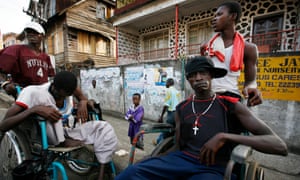
Boys and men in wheelchairs in Freetown


About 25% of disabled people in Sierra Leone are amputees who were wounded in the civil war. Photograph: David Levene for the Guardian

But Nahim says this caution may not be entirely a bad thing. Places such as Sierra Leone needs fewer formal mental health services than western countries, he says, because its people are able to rely so heavily on community structures – families, traditional healers and religious leaders – during times of emotional distress.


“We do counselling, though it’s not the type they do in America or Europe,” Nahim says. “Here, if you have a problem, someone talks to you. Your parents talk to you. Your church talks to you. Your traditional healers treat and counsel you. In America they need professional counsellors because no one talks to anybody – if you try to talk to somebody, they’ll probably call the police.”


But a lack of formal treatment options for those struggling the most has led to desperation, too. Bars selling cheap sachets of gin and whisky are crowded long before noon, and weather-battered men wander the streets of Freetown, mumbling to themselves and begging for change and discarded food. Drug abuse is rampant, particularly among the war veterans, many of whom were children when they fought.


For those working in the mental health sector, this is not the way things were supposed to be. In the years after the decade-long civil war which, according to the UN, led to the deaths of more than 70,000 people and to hundreds of thousands being maimed by amputation, international charities poured into Sierra Leone with promises to heal its emotional wounds.


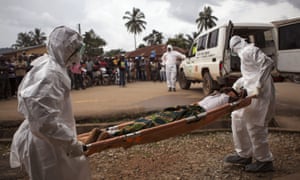
Healthcare workers carry a man suspected of having Ebola to an ambulance in Kenema, the country’s third largest city.


Healthcare workers carry a man suspected of having Ebola to an ambulance in Kenema, the country’s third largest city. Photograph: Tanya Bindra/AP

“Many of these programmes were excellent,” says Dr Florence Baingana, who works for the World Health Organisation’s Sierra Leone office. But they were also temporary. “You can’t run a mental healthcare system with outsiders – NGOs have a life cycle; they come and they go.”


Mental health in particular proved a hard sell to international donors over the long term – the wounds it healed were largely invisible and the progress drawn out.


Slowly, the international money dwindled, says Edward Bockarie, executive director of the Community Association for Psychosocial Services (Caps), a Sierra Leonean NGO that has provided counselling since the end of the war.


Map

On a recent morning, counsellors at one of his regional offices in the eastern province of Kailahun hunched over a few shared computers, planning projects. None of them had been paid for nearly six months, after their last spurt of funding ran dry.


“This is our initiative. We can’t just leave it,” says Maxwell Makieu, a counsellor who has worked with the association since its launch in a refugee camp in Guinea 20 years ago.


Back then, he and the other Caps counsellors were refugees fleeing conflict in Sierra Leone, hired by an American nonprofit organisation to provide peer counselling to others in the camp. When the centre retreated from Sierra Leone a few years later, its local counsellors started their own group.


For the past decade, they have scraped together grants to keep their shoestring operation running in two districts in the war-ravaged east.


That meant that when Ebola broke out they were among the only counsellors prepared to respond. Their staff were quickly scooped up by Médecins Sans Frontièresand other international charities to work in their treatment centres.


But when the outbreak ended, predictably, so did most international interest in their work.


At the Kailahun district hospital, there are signs that changes to the mental health system are at last being institutionalised.


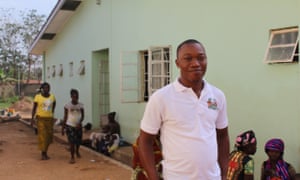
Martin Senesie is referred to as the ‘crase doctor’ by locals.


Martin Senesie is referred to as the ‘crase doctor’ by locals. Photograph: Ryan Lenora Brown

Martin Senesie, Kailahun’s first trained mental health nurse, arrived last year as part of a programme that placed 21 such nurses at hospitals around the country, and now has a bright office.


However, he admits the work at times feels never-ending. He has grown used to whispers of “crase man doctor” when he walks through town. His pay of approximately 750,000 leones (about £108) a month, feels like a slight, given the many years he spent earning his qualifications.


Each month, dozens of Ebola survivors and their families queue outside his office seeking help for depression and anxiety. Without him, he wonders, where would they go?


In Freetown, Sevalie hopes the enthusiasm around mental health services will continue. “Whether Ebola is here or not, these systems are essential. This is an opportunity for us. It could be the turning point.”


A version of this article first appeared on Bhekisisa, centre for health journalism


Ebola, war … but just two psychiatrists to deal with a nation"s trauma

27 Kasım 2016 Pazar

Castro"s legacy and the envy of many nations: social care in Cuba

To his critics, the late Fidel Castro was a totalitarian despot, an opponent of free speech and a man determined to preserve his hard-won revolution whatever the cost.


But to his defenders and admirers, he was a leader whose enlightened and practical approach to social care provided Cuba with enviable health and education systems.


Figures from the UN children’s agency, Unicef, show that Cuba’s youth literacy rate stands at 100%, as does its adult literacy rate. In Mexico, youth literacy is around 98.5%, while adult literacy is at 93.5%. In the Dominican Republic, meanwhile, youth literacy is at 98.1% for females aged 15-24, 96.1% for males of the same age, and adult literacy is at 90%.


Many of the educational gains were made in the early years of the revolution, not least during the 1961 literacy campaign that saw hundreds of thousands of Cubans, including schoolchildren, mobilising to educate their compatriots.


The statistics, however, tend to mask today’s commonplace shortages of housing, food and transport and the high costs of such basic items as books, soap and clothes.


Perhaps even more vaunted are claims about the standard of Cuba’s healthcare. The island’s reputation for medical excellence – a boon long enjoyed by both allied governments and countries struck by natural disaster and medical emergencies – was most recently boosted by the deployment of Cuban medical staff to parts of west Africa during the ebola crisis.


In October 2014, some 15,000 medical workers volunteered to participate in the relief effort. More than 450 specially trained Cuban doctors and nurses arrived in Liberia, Guinea and Sierra Leone to combat the disease, making them the largest single national medical force.


One doctor told Reuters at the time that he and his colleagues felt they had a responsibility to help: “We know what can happen. We know we’re going to a hostile environment. But it is our duty. That’s how we’ve been educated.”


The country’s high ratio of doctors to patients and its proactive, community-centred approach to healthcare has long been the envy of many western countries – not least the UK, which in 2000 sent 100 GPs and a delegation from the department of health to discover how it managed to deliver care on a far smaller budget. Despite serious shortages of food and drugs, the country has consistently managed to keep its population of 11 million people healthy into old age.


Life expectancy in Cuba is 81 years for women and 77 for men. In the UK, it is 83 years and 79, respectively. And while the former spends $ 2,475 per capita on healthcare, the latter spends $ 3,337. Cuba dedicates 11.1% of its GDP to health; the UK 9.1%.


Some, however, argue that the success of Cuba’s social care owes as much to politics and pragmatism as it does to equality and governmental magnanimity.


As a senior western diplomat told the Guardian in 2007: “Health and education are the revolution’s pillars of legitimacy so the government has to make them work. If they don’t, it loses all its moral authority.”


Castro"s legacy and the envy of many nations: social care in Cuba

4 Ağustos 2014 Pazartesi

As Nations Build, Women Get Smarter More rapidly Than Males, Study Says

How the brains of guys and ladies are distinct is a subject that fills bookshelves. Just as provocative is the query of regardless of whether the differences are predominantly hardwired or discovered. On one side of the discussion is the argument from inherited biology on the other is the argument from social and cultural influence. As with most debates involving nature and nurture, it is far from clear no matter whether biology or culture has the upper hand.


Researchers from the Global Institute for Applied Methods Evaluation in Vienna just lately took a various approach to the query by commencing with cognitive variations women and guys are identified to have, and then asking what function economic prosperity and social factors play in shaping individuals distinctions.


Researchers analyzed data culled from interviews with 14,000 females and 17,000 men, ages 50-84, which had been carried out as portion of the European Survey of Well being initiative from 2006 to 2007. Participants lived in 13 nations spanning a range of financial, social and public wellness circumstances in northern Europe, central Europe and southern Europe.


Each country in the study was assigned a regional development index (RDI) that benchmarked a mixture of gross domestic merchandise (GDP), schooling ranges, existence expectancy and infant mortality rates. Alterations in RDI for each country had been plotted across the lives of the research participants, thereby exhibiting the economic, social and public health situations these men and women have been exposed to from birth onward.


The interviews evaluated three places of cognitive overall performance: (1) episodic memory (the capacity to recall phrases) numeracy (the capacity to reason with standard mathematical concepts) and group fluency (the capacity to name examples from categories).  Typically men outperform girls in numeracy and ladies outperform men in episodic memory. The genders are about even in category fluency.


This review showed similar check outcomes: girls did as effectively or much better on episodic memory tests for each geographic area and across age groups. Likewise, males outperformed females on numeracy in each area and age group. Class fluency functionality showed negligible distinctions.


These outcomes have been as expected, but when RDI was factored in, a outstanding and less expected result emerged: improvements in RDI for every nation correlated with cognitive efficiency enhancements for each genders — but considerably far more so for ladies.


Much better designed countries, specifically these in northern Europe (followed in line by central Europe and southern Europe) showed the most cognitive improvements for both genders above time. But girls plainly benefited more as RDI improved, the two in episodic memory and numeracy. Girls amongst the ages of 50-54 in northern Europe showed especially notable improvements.


The final results might indicate that financial and social improvement opens far more possibilities for girls than males, perhaps simply because girls usually begin at a far more disadvantaged social and financial degree and have far more to obtain from RDI improvements. Quoting from the research: “These changes consider spot as a end result of ladies gaining much more than men from societal enhancements more than time, thereby escalating their common cognitive potential more than males.”


No matter whether or not that explanation nails the lead to of the adjustments, what seems clear is that financial and social elements strongly influence cognitive overall performance. Even if males and ladies do biologically inherit specific cognitive strengths and weaknesses, this review suggests that our societal influences play an tremendous part in how potently individuals strengths and weaknesses are expressed, and how they change more than time.


The research was published in the Proceedings of the Nationwide Academy of Sciences.


You can discover David DiSalvo on Twitter @neuronarrative and at his website The Daily Brain. His most current guide is Brain Changer: How Harnessing Your Brain’s Electrical power To Adapt Can Alter Your Existence.


Related on Forbes…


As Nations Build, Women Get Smarter More rapidly Than Males, Study Says

19 Temmuz 2014 Cumartesi

Western nations" "neglect" eroding fight against Aids

Man injecting drugs

HIV prevention providers for drug injectors are dropping out due to “changing donor policies and national government neglect”, the report warns. Photograph: Chris Youthful/PA


The global try to end Aids is becoming undermined as western countries, including the United kingdom, pull funding in the locations that require it most, according to major well being groups.


On the eve of the 20th Global Aids Conference, held in Melbourne, authorities are warning that funding for HIV prevention for folks who inject medication is in crisis. They say that attaining an “Aids-cost-free generation” will be extremely hard without concerted action.


Harm Reduction International, the International Drug Policy Consortium and the Worldwide HIV/Aids Alliance – which is mourning the loss of many colleagues who died in Thursday’s Malaysia Airlines jet crash – will publish a report that confirms HIV prevention companies for drug injectors are losing out due to “shifting donor policies and national government neglect”. The report warns that a failure to offer funding will carry a large rise in HIV transmission, which in turn will result in additional expenses to government well being sectors.


UNAids, the joint UN programme on HIV/Aids, claims that $ two.3bn is needed in 2015 alone to fund HIV prevention between people who inject medication. But international donors have invested only $ 160m – roughly 7% of what is required.


The Division for Worldwide Improvement has been pushing for the Global Fund, the principal distribution mechanism for HIV remedy programmes, to focus on minimal-earnings countries. However, the report demonstrates that 75% of folks who inject drugs reside in middle-cash flow countries.


“The cost effectiveness of harm reduction interventions in stopping new HIV infections is well documented,” explained Catherine Cook, senior analysis analyst at Harm Reduction Worldwide. “In numerous middle-earnings countries, much more than two-fifths of new HIV infections are amid individuals who inject medicines. But donors are nevertheless withdrawing due to their middle-revenue status with no responsible exit techniques in area.”


As a result of the reprioritisation, half of the 58 nations that have previously obtained harm reduction funding are now either ineligible for support or have not been assigned any “new” HIV money.


“We’re facing a ideal storm of donor retreat, national neglect and substantial overspending on ineffective and frequently counterproductive drug enforcement,” stated Susie McLean, senior adviser on drug use and HIV at the Global HIV/Aids Alliance.


Western nations" "neglect" eroding fight against Aids

20 Mayıs 2014 Salı

Newborn overall health: which are the safest nations to be born in?

Much more than 5.5m babies are born and die every year without a birth or death certificate, in accordance to new research published in The Lancet.


The findings from the Every single Newborn Series published on Tuesday in the health-related journal declare that one particular in three newborns, or more than 45m babies, do not have a birth certificate by their initial birthday.


Wellness editor Sarah Boseley writes:


3 million of the deaths are amongst newborns and 2.six million a lot more infants are stillborn. Practically all the deaths are preventable – half take place throughout labour. The stillborn infants are over 28 weeks gestations and capable of surviving. [Professor Joy] Lawn blames fatalism, lack of interest and lack of investment.


The numbers are a lot more than deaths from Aids, she stated, which caused 2.3 million to die in the peak year of 2005. The death toll is dropping thanks to medical professionals and activists who marched on the streets and campaigned for better treatment. The identical does not happen for newborn and stillborn babies.


They also found that infants who are born too early, are stillborn or who die as well quickly right after birth are least probably to be registered, even in large cash flow countries. The release stresses the value of counting births and deaths as an indicator of progress in the direction of enhancing newborn wellness.


Note: for 177 nations with birth registration information

Joy Lawn, professor of maternal, reproductive and youngster health at the London College of Hygiene &amp Tropical Medicine and lead researcher of the study, stated:


Each day, 15,000 infants are born and die with out ever receiving a piece of paper. The lack of recording displays the world’s acceptance that these deaths are inevitable. This fatalism, lack of consideration and lack of investment are the motives behind lagging progress in reducing newborn deaths – and even slower for progress in reducing stillbirths. In reality, these deaths are virtually all preventable


A table of 195 nations is also presented, ranking the safest and least secure countries to be born in, the countries in which infants are least likely to get a birth certificate, and the large-income nations with the slowest progress on neonatal mortality. The table beneath shows the safest spots to be born in accordance to the ranking which is based on neonatal mortality charge per thousand reside births in 2012.


Sierra Leone is ranked as the least risk-free nation to be born in with a neonatal mortality charge of 49.five per thousand live births in 2012. The table of the least risk-free nations to be born in according to the rankings can be discovered under.


The report identified that South Asia and sub-Saharan Africa are the areas with the highest burden of newborn deaths, with India (779,000), Nigeria (267,000), and Pakistan (202,400) topping the listing.


These 3 countries – which also have the most births – have exhibited the slowest prices of progress in decreasing deaths in accordance to the release. In 2012, eight of the nine countries with neonatal death rates higher than forty for every one,000 reside births have been in sub-Saharan Africa half of these nations have been affected by conflict.


The table under demonstrates the most current figures on a range of indicators employed in the rankings such as stillbirth price per thousand complete births, neonatal mortality charge per thousand live births and the percentage of reside births in 2012 registered by first birthday.


The total information including figures on the higher revenue countries with the slowest progress can be identified in the downloadable spreadsheet.


Download the information


• Data: download the complete spreadsheet


Much more open data


Data journalism and information visualisations from the Guardian


Advancement and aid information


• Search the world’s global growth information with our gateway


Can you do far more with this information?


• Speak to us at information@theguardian.com
• Adhere to us on Twitter
• Like us on Facebook


Newborn overall health: which are the safest nations to be born in?

3 Nisan 2014 Perşembe

Cardiovascular Illness Declines in Wealthy Nations but Grows Elsewhere

A new Worldwide Cardiovascular Condition (CVD) Atlas portrays a divided globe the place wealthy countries are slowly freeing themselves from the yoke of CVD but in which numerous bad and middle-income countries are even now struggling.


Ischemic heart illness and stroke have been the two largest contributors to the global burden of disease in 2010, accounting for 5.2% and 4.one%, respectively, of all disability adjusted existence many years (DALYs). From 1990 to 2010 the global age-standardized mortality charges of heart illness and stroke decreased, but the absolute quantity of deaths increased from 5,211,790 to 7,029,270 deaths for heart illness and from 4,660,450 to five,874,180 deaths for stroke.


Diet program, large blood strain, and tobacco had been the three foremost chance elements throughout the world. Tobacco’s role was significantly more substantial in East Asia and Southeast Asia than in Australasia, Western Europe, and North America, in which efforts to curb smoking have been successful. Alcohol was the fifth most essential danger factor in Eastern Europe, but ranked no greater than 10th in other areas.  In East Asia air pollution was the fourth most essential risk factor. Higher entire body mass index was the third most essential threat issue in Australasia, North America, Europe, Central Asia, Latin American/Caribbean, North Africa, and the Middle East.


From 1990 to 2010 Norway, Ireland, the U.K., and Israel almost cut in half the crude DALY burden per a hundred,000 individuals.  “The reductions in CVD burden per capita in substantial earnings areas are extraordinary, and have occurred despite aging populations,” stated Andrew Moran, the first writer of a summary published in Worldwide Heart. “Other studies of CVD trends recommend that CVD reductions in the large revenue world are due to a mixture of reduced smoking, enhanced danger element management, and improved treatment options. Some adjustments in diet regime, life style, and broader social and economic forces could perform a position too, but are tougher to measure.”


By contrast, the nations of the former Soviet Union had huge increases of at least thirty% in their DALY burden.  Said Moran, “the big contributions of alcohol and tobacco factors to underlying social and economic forces at perform.”


Weight problems, bad diet regime, and substantial blood pressure have caused increases in the burden of CVD in North Africa and the Middle East. In Kuwait the incidence of CVD DALYs improved by 28%.


In the U.S., per capita DALYs decreased by 33% in between 1990 and 2010, but the general crude DALY charge of 4485.86 per 100,000 men and women left it in the middle of the pack of higher-cash flow nations. In 2010, Brunei had the lowest fee in this group — 2321.97  per a hundred,000 — whilst Greece had the highest price — 6455.03 per 100,000.


Moran stated that the only way to lower the higher burden of CVD in significantly of the globe “will be to lengthen the CVD manage successes of the high earnings planet to lower and middle revenue nations. In some instances this may imply adapting past effective applications in other circumstances locally tailored and modern approaches will be required.”


Cardiovascular Illness Declines in Wealthy Nations but Grows Elsewhere

26 Mart 2014 Çarşamba

Loved ones arranging groups in developing nations set for Bloomberg increase

MDG : Bloomberg to improve family planning and reproductive health services in Nicaragua

Assisting hand … Nicaragua is one of 4 countries chosen for Bloomberg’s family members arranging and reproductive overall health help scheme. Photograph: Mike Goldwater/Alamy


Grassroots organisations are to share in a multi-million dollar project to enhance loved ones arranging and reproductive overall health providers for ladies and girls in Africa and Latin America.


Groups in Uganda, Burkina Faso, Senegal and Nicaragua will be capable to apply for advocacy grants as part of a three-pillar, $ 50m (£30m) package to assistance loved ones arranging companies. The scheme was announced on Thursday by Bloomberg Philanthropies, set up by Michael Bloomberg, the former mayor of New York.


Bloomberg will work with the Planned Parenthood Federation of America to identify groups that could advantage from extra funding in each of the 4 nations. Organisations working amongst marginalised groups such as youthful men and women and unmarried women will be a certain target for the scheme, which will also support companies that lobby their governments for legislation and policies that help access to providers.


As part of the package, Bloomberg is partnering with the UN Basis to launch a rapid-response grants programme to assistance governments and companies in delivering reproductive health providers in 69 of the world’s poorest countries. This could incorporate offering grants to pay for emergency supplies of contraceptives when there is a stockout at a well being centre, or having to pay for specialised instruction for health workers.


The UN Foundation supports the Household Organizing 2020 (FP2020) worldwide partnership, which was set up as a outcome of the 2012 London family preparing summit with the aim of escalating access to contraception for 120 million more ladies and girls in developing nations.


According to the UN population fund, at least 200 million females and girls are unable to accessibility loved ones arranging services that would permit them to management when they have young children and to area their pregnancies. The company predicts that unmet need will increase by forty% over the up coming 15 many years if action is not taken.


At the 2012 conference, hosted by the UK’s Department of International Advancement and the Bill and Melinda Gates Basis, wealthy countries committed $ 2.6bn in excess of the following eight many years to assist plug the gap in poorer nations.


The four nations to advantage from the Bloomberg funds, pledged to the FP2020 initiative, have substantial unmet contraceptive needs and, consequently, higher fertility rates. According to Planned Parenthood, females in Uganda and Burkina Faso will, on common, give birth to far more than six children above the program of a lifetime. Burkina Faso has a contraceptive prevalence price of just over 16%. In Uganda, 24% of 15- to 19-yr-outdated women are either pregnant with their very first little one or currently mothers.


Nicaragua has the highest adolescent fertility price in Latin America, with 109 births for each and every one,000 15- to 19-year-olds. About half of youthful females give birth ahead of they are 20. The nation has higher incidences of sexual violence, and abortion is illegal.


Kelly Henning, who heads the public health programme at Bloomberg Philanthropies, said targeting money in the direction of local organisations was essential to make certain specific country wants are met. “Neighborhood groups comprehend what the troubles are for ladies and the considerations for females in these nations, and they comprehend the policymakers and what they are thinking,” she said. “We want this work to be sustainable.”


Bloomberg, mayor of New York City from 2002 to 2013, said: “By providing vital health services closer to mothers’ homes, and by empowering ladies to make informed choices about when they want to have youngsters, we can support conserve 1000′s of lives.”


Bloomberg Philanthropies also announced ideas to increase its perform in Tanzania, a nation it has worked in because 2006. It will enhance its help for comprehensive reproductive overall health solutions, like publish-abortion care, in the ten rural clinics with which it has existing back links. Bloomberg’s function in Tanzania has so far integrated education much more than one hundred physician assistants and nurses to complete life-saving operations, which includes caesarean sections, as effectively as creating operating amenities.


Loved ones arranging groups in developing nations set for Bloomberg increase

17 Şubat 2014 Pazartesi

Nations Unite to Support Avert Disease Outbreaks

Nations unite to aid prevent condition outbreaks.  A Worldwide Health Agenda to avert and battle infectious condition outbreaks ahead of they spread globally is taking place with the aid of the United States and 26 other nations.


Overall health officials in the U.S. say there are also numerous countries lacking the well being care capable of notifying other countries all around the globe when infectious conditions surface in their remote areas.  According to Kathleen Sebelius, Secretary of Well being and Human Solutions, much less than 20 percent of nations are prepared to act in response to emerging infectious conditions.  She points out:


“Germs do not recognize or stop at nationwide borders.  A risk anywhere is indeed a threat everywhere.”


Nations unite to assist avoid illness outbreaks


The meeting took location on February 13, 2014, with the U.S. and other nations, like France, Russian Federation, Argentina, Republic of Korea, Australia, Canada, Chile, China, Germany, Ethiopia, United Kingdom, Finland, Georgia, India, Indonesia, Italy, Japan, Kazakhstan, Netherlands, Norway, Saudi Arabia, Turkey, Uganda, South Africa, Vietnam, and Mexico.


Reviews from scientists assert they detected the spread of a amount of older ailments in new spots, which consists of the 1st manifestation of mosquito-borne chikungunya virus in the Caribbean.  Nonetheless, at this most current meeting, the U.S. praised China for alerting other nations about the emergence of last year’s bird flu.


Saudi Arabia attended the meeting, as well.  Their attendance is significant, in that nations are playing near attention to a mysterious new respiratory virus emerging in Saudi Arabia.  According to the Centers for Disease Handle and Prevention (CDC), the Middle East Respiratory Syndrome (MERS) was 1st reported in Saudi Arabia in 2012.  MERS is a viral respiratory sickness triggered by coronavirus referred to as MERS-CoV.


Targets of the Worldwide Health Agenda to fight illness outbreaks


The purpose of this new energy entails the U.S. collaborating with other nations to boost nearby condition monitoring and avert disease outbreaks, build exams for various pathogens, and aid areas develop and strengthen programs to respond and report to public health emergencies.


The Obama administration is in the hunt for $ 45 million for new funding to expand the work.  In addition, the CDC strategies to redirect $ forty million from its present spending budget for equivalent tasks in 10 other unnamed countries.


Nations Unite to Support Avert Disease Outbreaks

2 Şubat 2014 Pazar

There Is An Urgent Need To Tackle The "Terrible Scenario Of Chronic Ailment In Creating Nations"

As mortality charges from chronic disease decline in developed nations, creating nations are dealing with a double-barreled wellness risk.In addition to the burden of infectious conditions (malaria, tuberculosis, HIV-AIDS), modifications in diet and way of life are driving increases in persistent diseases, which includes cancer, diabetes, and heart ailment.And this trend is magnified by population growth.The cancer burden in low-resource countries has doubled in the previous 25 many years and is projected to double again by 2030.


In September 2013 the International Prevention Study Institute (IPRI) issued a almost 500-web page report entitled “The State of Oncology 2013” assessing the developing burden of cancer and other continual ailments in developing nations. Last week The Cancer Letter, a newsletter for oncologists and cancer researchers, published an interview with IPRI’s president Peter Boyle, professor of international wellness at Strathclyde University and former head of the International Company for Research on Cancer, in which he explains the goal of the new report.


Throughout the interview, Boyle emphasizes the magnitude of the challenge and the want for new, bold contemplating.


First, there is the obvious need for critiAcal infrastructure to supply cancer therapies that are regular in large-cash flow countries to patients in reduced-cash flow countries.To cite just a single instance, about 30 countries in Africa have no radiotherapy machines.This applies across the board to screening, surgical treatment facilities, and availability of chemotherapeutic drugs.But Boyle can make clear that provision of these amenities alone is not sufficient without all the required supporting infrastructure – you need to have a trustworthy source of electrical energy to energy the radiotherapy machines, etc.


Equally crucial is the training of technicians, nurses, and professionals to use these resources to supply care. “So there is a enormous educational need, there is a massive training need to have that is definitely essential if we’re going to give radiotherapy machines, or whatever equipment or no matter what drugs – you require expertise to deliver them appropriately and make confident they carry on to be delivered. It is not a simple predicament.”


Even though stressing the glaring need to have for modern amenities to treat patients with cancer, another contributor to the IPRI report, Otis Brawley, chief medical and scientific officer at the American Cancer Society, stresses that the largest gains in minimizing cancer deaths will come from prevention rather than remedy. For that reason, efforts aimed at reducing the spread of cigarette smoking and enhancing diet plan and countering bodyweight obtain are vital. Furthermore, prevention can be accomplished more rapidly and cheaply than prolonged-term efforts required to create a sustainable well being care infrastructure.


Even although the emphasis of the report is on cancer, Boyle raises the question of whether the technique shouldn’t be broadened to include chronic ailments typically, because diabetes may outstrip cancer in coming decades in establishing countries, and given that heart disease rates are also anticipated to enhance.This kind of an method also tends to make sense in view of the truth that cancer, diabetes and heart condition share a variety of underlying risk aspects.


In accordance to Boyle, the IPRI report differs from earlier reviews in that it is “very patient-oriented” and “highlights extremely clearly the enormous disparities that exist throughout the planet.”


“I feel we’ve acquired to believe in a quite lengthy time frame.I feel it is a myth that if we invest millions and billions of bucks on the cancer difficulty that we’re going to locate a remedy for cancer, or certainly if we’re going to resolve the disparities that exist.”


“It’s actually not a process for a generation or two generations, but we require to have a strategy in spot so that we can carry on to make progress in the long phrase.”


But if absolutely nothing is accomplished to adjust this state of affairs, “the gap among outcomes, in standard terms, amongst the sufferers in greater-resource countries and the reduced resource countries, is just bound to improve.It is a really worrying scenario that we’re sitting right here in the 21st century and the gap between higher- and reduced-resource nations is rising.”


“I consider we can invest our lives – this generation and the following generation – in large-resource countries, we can compose reviews, we can sit on committees, we can do all sorts of items from a distance, but unless society in fact goes and does anything on the ground in reduce-resource countries, then we’re not truly going to make significantly of an improvement in their situation.”


What is essential according to Boyle are partnerships in between the public sector and the private sector.Each have crucial encounter and perspectives that need to have to be brought together. “I consider there is a want for a new model that will get with each other all the groups in the public sectors who want to operate with each other in great faith, get the personal sector concerned and come up with a coherent prepare for dealing with the terrible situation of continual disease in reduce-resource nations.”


In accordance to Boyle, there is no unified global cancer motion – or international persistent disease movement.Rather, “there are disparate organizations and groups fighting for their very own corner.” Even though the dimensions of the difficulty are so great that it would be effortless to throw up one’s hands, Boyle holds up positive accomplishments and applications that can serve as models.He points to incredible success of the AIDS motion over the past twenty years and to the “fabulous lesson” of PEPFAR (the President’s Emergency Prepare for AIDS Relief).


A single could also stage to the GAVI Alliance’s system to make the human papillomavirus (HPV) vaccine accessible to millions of preteen women in lower-resource nations in order to minimize deaths from cervical cancer, the major lead to of cancer death in females in several establishing countries.


Boyle holds up glowing examples of high-top quality, present day cancer hospitals in Eldoret, Kenya and Lahore Pakistan that have been developed by way of inventive strategies.He refers to these as “gems.”


He also has higher praise for the U.S Nationwide Cancer Institute’s reshaping of its international plan to make it much more practical and sensible in implementing applications and supplying sources and instruction.


Boyle argues that the most crucial characteristic of programs devised to address the persistent disease burden in minimal-resource countries is sustainability. Applications need to be tailored to the realities of a specific country, its greatest wants, its institutions, and assets, as well as to the availability of support for certain initiatives from the international community. Obviously you can’t do every little thing all over the place. We shouldn’t assume uniform plans or progress in all locations.A single has to target demonstration plans and assets to locations where they have the greatest possibility of currently being successful.


“Another lesson from PEPFAR: PEPFAR did not try to do it in each and every nation and each and every area of every country, but started to do it in areas where the process was possible and the place they recognized a group or an person who could be trusted to do what was required. PEPFAR then empowered the local sources to make it a accomplishment.I think that’s model that we’ve got to search very closely at for continual condition.”


Rather than setting unrealistic ambitions, Boyle stresses the require to capitalize on experience with what has worked and what has not worked.This is a difficulty, he says, that will not be solved in decades and will not be solved by throwing billions of bucks at it.What is needed is to acknowledge the dimensions of the dilemma and to build a concerted movement with all events contributing and tackling different facets of the difficulty.


The IPRI report is meant to commence a critical worldwide conversation between all of the essential events and commence taking concrete steps.


Geoffrey Kabat is a cancer epidemiologist at the Albert Einstein College of Medicine and a contributing editor at STATS (Statistical Assessment Service) at George Mason University.He is the writer of Hyping Wellness Risks: Environmental Hazards in Every day Existence and the Science of Epidemiology. Follow Geoffrey on Twitter .


There Is An Urgent Need To Tackle The "Terrible Scenario Of Chronic Ailment In Creating Nations"

28 Ocak 2014 Salı

Palliative care unavailable for majority of individuals in developing nations

Nurse treats tuberculosis patient in India

A tuberculosis patient receives treatment method in India. There is an escalating need to have for palliative care for drug-resistant strains of the situation. Photograph: Anupam Nath/AP


9 out of 10 individuals in require of palliative care to alleviate the ache and symptoms of a existence-threatening sickness – the vast majority of whom reside in poor nations – are not acquiring it, according to a report published on Tuesday.


The Global Atlas of Palliative Care at the Finish of Existence, published by the Globe Overall health Organisation and the Worldwide Palliative Care Alliance (WPCA), located that only twenty countries have palliative care firmly integrated into their healthcare systems. According to the report, most palliative care is offered in substantial-earnings countries, but nearly 80% of the global need for providers is in low- and middle-cash flow nations.


“Assessing palliative care requirements is in several techniques equivalent to assessing an urgent humanitarian need to decrease needless struggling of individuals and their families,” said the report.


The WHO defines palliative care as an holistic strategy to boost the top quality of daily life of patients and their families who have a existence-threatening illness. It gives relief of physical, psychosocial and spiritual ache at the finish of existence and throughout treatment method for severe situations to prolong life, this kind of as throughout chemotherapy. Around one third of individuals requiring palliative care have cancer but there is an increasing awareness of the need to have for more assistance for other persistent problems, this kind of as HIV, heart disease or drug-resistant tuberculosis.


Every 12 months, more than twenty million sufferers are estimated to want palliative care at the end of their lives. The figure doubles if the individuals needing care just before death are included. In 2011, about three million individuals acquired palliative care, the bulk at the finish of their lives.


“The numbers are large and so is the unmet require as only a handful of countries have implemented equitable palliative care programmes by way of a public health method,” mentioned Oleg Chestnov, the WHO’s assistant director-standard for noncommunicable ailments and mental health, in the foreword to the report. “Additionally, in a lot of nations opioid analgesics are not available or available to the majority of sufferers suffering moderate or extreme ache.”


The report is understood to be the first to map the need to have for, and availability of, palliative care globally. It calls on all nations to incorporate palliative care as an essential component to all healthcare techniques. It also urges governments to introduce policies recognising the need to have for care at the finish of lifestyle and devote a lot more money on providers, such as entry to soreness relief. Overall health pros must be educated about the significance of palliative care and the benefits outlined to the public, it adds.


David Praill, co-chair of the WPCA, stated: “Our efforts to broaden palliative care want to concentrate on bringing relief of struggling and the positive aspects of palliative care to people with the least sources. This will take courage and creativity as we understand from each and every other how to integrate palliative care into present but extremely limited healthcare systems.” 


The report’s publication comes a week following the WHO executive board called on member states to strengthen palliative care and suggested the World Wellness Assembly adopts a resolution on the issue when it meets in Might.


Praill said the WHO announcements had been “groundbreaking development and a clear indicator that palliative care has lastly moved greater up the global overall health agenda”.


He added: “This resolution will provide the impetus for person countries to integrate palliative care into their healthcare programs and tackle barriers avoiding access to ache relief medicines. These will assist deal with the marked worldwide gaps in palliative care and ought to enable a lot of more people to obtain this crucial kind of care.”


Palliative care unavailable for majority of individuals in developing nations

9 Ocak 2014 Perşembe

Nations with highest and lowest lifestyle expectancies for individuals born in 2013 charted

The United Kingdom has a existence expectancy of 80, putting it in 15th spot within Europe.


Europe has 22 countries with a daily life expectancy of much more than 80 years outdated, with San Marino, Andorra, Switzerland and Italy ranking the highest.


In Asia Taiwan, Jordan, Israel, Hong Kong, Singapore, Japan and Macau all have lifestyle expectancies more than the age of 80.


Nevertheless there are also 13 nations where the lifestyle expectancy is in the 60s, and Afghanistan has a daily life expectancy of only 50.


In North Korea folks born in 2013 can count on to dwell to 69 which is 6 years higher than in Cambodia or Laos.


The vast majority of countries in the Americas have a daily life expectancy in the 70s, with the United States falling behind six other countries including Bermuda and Canada with a lifestyle expectancy of 79.


Africa has an regular lifestyle expectancy of only 60 with numerous nations possessing life expectancies in their 50s which includes Uganda (54) and Nigeria (52).


Those born in South Africa last 12 months can expect to live to only 49 in accordance to the visualisation.


It also is made up of a timeline of how life expectancy has altered throughout background.


In the Neolithic Era era daily life expectancy was only twenty.


The visualisation was created by visual journalist Marcelo Duhalde who mentioned he desired to create a “waterfall” impact.


The countries nearer the black abyss have a decrease existence expectancy than the ones further away from it.


The information was compiled from the CIA’s Planet Factbook and the Encyclopedia Britannica


Nations with highest and lowest lifestyle expectancies for individuals born in 2013 charted