The history of Africa’s oldest psychiatric hospital is written on the walls of its isolation units, desperate messages chiselled into the woodwork like scars. “I came here for I don’t have any money,” reads one note in a corner of the room. “People want me to run from my father’s house,” reads another. “You go nowhere,” announces a third. “Stay out.”
Since the hospital opened in the early 19th century, most Sierra Leoneans have aspired to do exactly that, avoiding this imposing building perched high on a hill above the capital, Freetown.
Still the country’s only mental healthcare facility, the Sierra Leone psychiatric hospital is known in the local Krio language as the “crase yard” or “place for crazy people”. During the civil war in the 1990s, rebel fighters got as far as the staff quarters before turning back, too afraid of what they might find inside, witnesses say.
We do counselling, though it’s not the type of counselling they do in America or Europe
When the world’s worst Ebola outbreak began there two years ago, Sierra Leone had just 136 doctors working in the public sector, according to the World Health Organisation, a massive shortfall for a population of 6 million.
There was only one psychiatrist: Edward Nahim, a wry, Soviet-trained 70-year-old who spent his mornings scribbling prescriptions in the foyer of the hospital, where many patients were kept chained and treatment consisted of little more than a daily dose of expired antipsychotic drugs. Electricity flickered and rusting buckets served as makeshift toilets on the days the pipes ran dry, which was most of the time.
The mental health toll that Ebola exacted – depression, anxiety and post-traumatic stress disorder – was massive. But the hospital’s fearsome reputation meant few of those affected considered looking there for support. In the early days of the outbreak, many people considered hospitals to be dumping grounds for the dying or, worse, the places that had made them sick.
Those suffering from the virus’s psychological side-effects viewed the psychiatric facility in a similarly negative light.
“Because we have so few professional resources, people are used to understanding mental illness in their own way and most would never even think of coming to a hospital for psychiatric treatment,” says Stephen Sevalie, who this year became the country’s second psychiatrist, working for the Sierra Leone armed forces.
But Nahim says this caution may not be entirely a bad thing. Places such as Sierra Leone needs fewer formal mental health services than western countries, he says, because its people are able to rely so heavily on community structures – families, traditional healers and religious leaders – during times of emotional distress.
“We do counselling, though it’s not the type they do in America or Europe,” Nahim says. “Here, if you have a problem, someone talks to you. Your parents talk to you. Your church talks to you. Your traditional healers treat and counsel you. In America they need professional counsellors because no one talks to anybody – if you try to talk to somebody, they’ll probably call the police.”
But a lack of formal treatment options for those struggling the most has led to desperation, too. Bars selling cheap sachets of gin and whisky are crowded long before noon, and weather-battered men wander the streets of Freetown, mumbling to themselves and begging for change and discarded food. Drug abuse is rampant, particularly among the war veterans, many of whom were children when they fought.
For those working in the mental health sector, this is not the way things were supposed to be. In the years after the decade-long civil war which, according to the UN, led to the deaths of more than 70,000 people and to hundreds of thousands being maimed by amputation, international charities poured into Sierra Leone with promises to heal its emotional wounds.
“Many of these programmes were excellent,” says Dr Florence Baingana, who works for the World Health Organisation’s Sierra Leone office. But they were also temporary. “You can’t run a mental healthcare system with outsiders – NGOs have a life cycle; they come and they go.”
Mental health in particular proved a hard sell to international donors over the long term – the wounds it healed were largely invisible and the progress drawn out.
Slowly, the international money dwindled, says Edward Bockarie, executive director of the Community Association for Psychosocial Services (Caps), a Sierra Leonean NGO that has provided counselling since the end of the war.
On a recent morning, counsellors at one of his regional offices in the eastern province of Kailahun hunched over a few shared computers, planning projects. None of them had been paid for nearly six months, after their last spurt of funding ran dry.
“This is our initiative. We can’t just leave it,” says Maxwell Makieu, a counsellor who has worked with the association since its launch in a refugee camp in Guinea 20 years ago.
Back then, he and the other Caps counsellors were refugees fleeing conflict in Sierra Leone, hired by an American nonprofit organisation to provide peer counselling to others in the camp. When the centre retreated from Sierra Leone a few years later, its local counsellors started their own group.
For the past decade, they have scraped together grants to keep their shoestring operation running in two districts in the war-ravaged east.
That meant that when Ebola broke out they were among the only counsellors prepared to respond. Their staff were quickly scooped up by Médecins Sans Frontièresand other international charities to work in their treatment centres.
But when the outbreak ended, predictably, so did most international interest in their work.
At the Kailahun district hospital, there are signs that changes to the mental health system are at last being institutionalised.
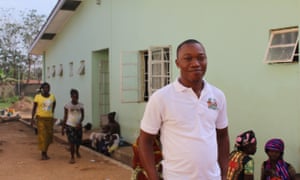
Martin Senesie, Kailahun’s first trained mental health nurse, arrived last year as part of a programme that placed 21 such nurses at hospitals around the country, and now has a bright office.
However, he admits the work at times feels never-ending. He has grown used to whispers of “crase man doctor” when he walks through town. His pay of approximately 750,000 leones (about £108) a month, feels like a slight, given the many years he spent earning his qualifications.
Each month, dozens of Ebola survivors and their families queue outside his office seeking help for depression and anxiety. Without him, he wonders, where would they go?
In Freetown, Sevalie hopes the enthusiasm around mental health services will continue. “Whether Ebola is here or not, these systems are essential. This is an opportunity for us. It could be the turning point.”
A version of this article first appeared on Bhekisisa, centre for health journalism
Ebola, war … but just two psychiatrists to deal with a nation"s trauma
