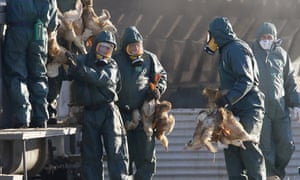
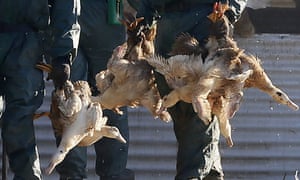
Workers wearing masks and protective clothes have gassed thousands of ducks in south-west France, in a massive cull that was ordered in an attempt to prevent a spread of the H5N8 bird flu virus.
At one farm in the village of Latrille, in the heartland of duck and geese rearing country, 8,000 ducks were taken by hand and put in coloured metal containers where carbon dioxide was piped in to kill them, normally within seconds.
Workers clad in head-to-toe protective suits, face-visors and gas masks, finished the slaughter in the space of a few hours.
France, which has the largest poultry flock in the European Union, has reported 95 outbreaks of the virus.
Most of the cull is taking place in and around the Gers area of south-west France, where geese and ducks are reared in vast numbers to make foie gras.
About 800,000 birds out of a population of about 18m in the whole of the south-west are due to be killed in the coming week.
Workers carry ducks before placing them in a bin filled with carbon dioxide at a poultry farm in Latrille, south-west France. Photograph: Bob Edme/AP
The operation is part of mass cull of poultry in France, which has reported 95 outbreaks of the H5N8 bird flu virus. Photograph: Bob Edme/AP
France, which has the largest poultry flock in the EU, has ordered the cull of ducks in its three most-affected regions. Photograph: Regis Duvignau/Reuters
Your main concerns when you attend a festival might include any of the following: how will I identify my tent at 5am? Is glamping worth it? Will Este from Haim do bassface?
But one thing you should not have to worry about is: will I get measles?
Public Health England has confirmed a significant number of infections linked to music festivals and other large public events. There have been reports of 38 suspected measles cases at events in June and July alone. Glastonbury had 16 cases, with seven cases reported from the NASS festival near Bristol; six at the Triplicity festival in north Devon; three at Tewkesbury medieval festival; two at Nozstock: the Hidden Valley in Herefordshire; two at Noisily in Leicester; one at the Secret Garden Party near Huntingdon; and one at Yeovil Show.
In all, 234 cases have been confirmed between January and June, compared with 54 for the same period last year.
Why is this happening now? One possibility is that the Wakefield generation has come of age. The fraudulent study by Andrew Wakefield that incorrectly linked the MMR vaccine and autism was published 18 years ago. Although later discredited (with Wakefield being struck off the medical register), the rate of vaccination against measles plummeted after the study’s appearance in The Lancet. There were 56 cases of measles the year before its publication in England and Wales; by 2008 there were 1,370.
Many parents of the Wakefield era chose not to vaccinate their children and were understandably swayed by breathless media coverage, inconsistent messages from health providers, and apparent validation of Wakefield’s findings by the scientific community; it took The Lancet 12 years to retract the publication. If you were the parent of a toddler in those years, what would you have done?
Now, those unvaccinated children have grown up. They go to festivals. The virus is so contagious that if one person has it, 90% of those in close contact will also become infected if they are not immune themselves. And so Public Health England has urged teenagers and adults to check with their GP if they have been vaccinated and to receive two doses of the MMR vaccine if required.
The Wakefield-era children also grew up to account for most of the 1,219 measles cases in the Swansea measles epidemic in 2012, in which one person died. Although some recovered quickly from fever, conjunctivitis and a rash, others suffered more significant complications. According to the US Centers for Disease Control and Prevention, one or two out of every 1,000 children who become infected with measles will die from respiratory and neurologic sequelae including blindness, seizures and encephalitis. Since 2006, there have been three deaths from measles in England and Wales.
This historical legacy is compounded by anti-vax sentiment that has become more visible in recent years, albeit not necessarily more widespread. The consequences of this movement travel beyond forums and Facebook posts. It is easy to imagine it to be as infectious as the virus itself, but I think there is a more nuanced subtext, too.
Measles arrived at Disneyland, California with one case in December 2014. Within four months, there were 145 confirmed cases in seven states and three countries, all linked to Disneyland. The authors of an analysis in JAMA Pediatrics journal said the outbreak was directly associated with substandard vaccination compliance: “The ongoing measles outbreak linked to the Disneyland Resort in Anaheim, California, shines a glaring spotlight on our nation’s growing anti-vaccination movement and the prevalence of vaccination-hesitant parents.”
Vaccination is more than a personal choice; the inaction of others can affect even vaccinated children and adults
Vaccination is more than a personal choice; the inaction of others can affect even vaccinated children and adults. Community vaccination helps to halt the spread of the virus and thus protects the wider population. The sum is greater than its parts. But here’s what is crucial. Each outbreak is different, there are nuances to each one, and not all can be attributed simplistically to a groundswell of anti-vax sentiment. Swansea is definitely not California.
For example, early 2014 cases were linked to unvaccinated travellers returning home who had acquired the virus abroad (an outbreak in the Philippines was an important factor) and then infected others in communities with lower vaccination rates. Despite the concerns expressed in pockets of unvaccinated residents, there is no nationwide loss of confidence in vaccines. Sometimes it’s a case of missed doctors’ appointments or single vaccines refused rather than staunch dissent. And vaccine refusal does not correlate with a lack of knowledge. Moral outrage is too easy.
Julie Leask, an associate professor at Sydney University’s school of public health, provides level-headed discussion on this topic: “To be committed to the science of immunisation ideally comes with a commitment to the science of immunisation behaviour. Media often present this problem as refusal to vaccinate. But the evidence is clear and it’s more complex: under-vaccination is broadly about a lack of acceptance and a lack of opportunity to vaccinate fully or on time. It’s not just the haves, but the have-nots who don’t fully vaccinate.
“A typical measles outbreak will reveal this. There will be children whose parents refused vaccination; children whose parents were unwittingly not up to date for lack of access; affordability or awareness; adults and travellers who didn’t get a needed booster; and babies who are too young to be vaccinated.”
So although “festival measles” seems to largely fit with the coming of age of the Wakefield generation and more particularly a broader anti-vax narrative, it is too simplistic to conclude that this is applicable to all. But it does provide an opportune moment to discuss issues around vaccination, to strengthen public health infrastructure to deliver effective programmes, and to ensure there is never even the possibility of a Wakefield generation occurring again.
Related: Measles warning to young people at festivals after series of outbreaks
Young people planning to go to festivals or other mass events are being warned to make sure they have been fully vaccinated after a number of measles outbreaks.
Public Health England says anyone visiting a music festival should ensure they have had two shots of the measles, mumps and rubella (MMR) vaccine. Some younger people may be at risk because they were not vaccinated as small children, after the scare generated by the suggestion of the now discredited scientist Andrew Wakefield that there was a link between the vaccine and autism.
There has already been an increase in measles cases this year, with 234 confirmed between January and June, says PHE, which has to be notified of every case. That is a more than fourfold increase over the 54 cases in the same six months last year.
Festivals have added to that. There have been 36 suspected measles cases in young people who attended events in June and July. Glastonbury – the biggest music festival of the year – had the most cases, at 16. There were seven cases reported from the NASS festival near Bristol; six at the Triplicity festival in north Devon; three at Tewkesbury medieval festival; two at Nozstock: the Hidden Valley in Herefordshire; two at Noisily in Leicester; one at the Secret Garden Party near Huntingdon; and one at Yeovil Show.
At least three of the cases were people who had measles symptoms but decided to go to the festival anyway rather than staying at home.
PHE is anxious to avoid further spread at festivals and gatherings where thousands of young people are in close contact and some may be susceptible to infection. Measles can be more complicated in teenagers than in small children.
“Measles is a highly infectious viral illness that can be very unpleasant and sometimes lead to serious complications,” said Dr Mary Ramsay, PHE’s head of immunisation.
“So if you think you might have measles, please don’t go to any of these big events. Measles isn’t common these days because most of us are vaccinated, but young people who missed their MMR jab as children are vulnerable, especially if gathered in large numbers at an event.
“If you think you’ve got it, call your GP or NHS 111. Please don’t turn up at the surgery or at A&E as you could infect other patients.”
Measles commonly causes diarrhoea and vomiting, which can lead to dehydration, earaches, conjunctivitis, fits caused by fever and pneumonia or bronchitis if the infection reaches the lungs.
Very rarely it can lead to serious eye disorders and even a fatal brain complication years later. Before vaccination, it was a regular killer. In 1941, there were 1,145 deaths from more than 400,000 cases. In 1998, the year in which the Wakefield paper was published in the Lancet, there were more than 3,700 cases and three deaths. In 2013, the latest year with published figures, although they are incomplete, there was a surge to 6,102 cases because of the Swansea outbreak – in an area of Wales where many parents had opted not to vaccinate their children – but only one death.
The MMR vaccination rate fell slightly in 2014-15 to 92.3% of eligible children. The previous year it was 92.7%, the highest rate ever achieved. But the overall figure obscures the problem of low vaccination rates in specific regions. In some places, less than 80% of children were vaccinated.
Anxieties about the vaccine have led to outbreaks in the US as well. In 2014, there were a record 667 cases, according to the Centers for Disease Control and Prevention. A substantial number of those were among the unvaccinated Amish communities in Ohio.
Last year there was an outbreak in California among children whose parents had refused to have them vaccinated, which began when somebody with measles visited Disneyland – another place where there are mass gatherings.
Standing in line at the airport safety final year, a poster caught my eye. “We are this close to ending polio”, Jackie Chan was saying, displaying a small gap with his fingers. You could uncover Desmond Tutu, Jane Goodall, and Itzhak Perlman doing the very same on billboards all around the globe. There was even a Gangnam Fashion version of the poster. A year later on that modest gap that celebrities have been demonstrating with their hands looks to be widening, with a pace that now gives cause for alarm.
The Globe Health Organization (WHO) declared polio as a Public Wellness Emergency of International Concern on Might 5, 2014. The variety of circumstances has increased considerably this 12 months and, in accordance to the WHO, especially in conflict-stricken areas, like the Middle-East and Central Asia. One of the primary worries is that the virus has re-appeared in locations the place the condition had been eradicated. For instance, Syria was polio-free of charge for 14 years till an outbreak started out in 2013.
Polio and Cold War
The history of polio vaccination has been riddled with conflict. The Sabin vaccine itself, which is used nowadays in eradication efforts, was created in the midst of a international political crisis: the Cold War.
The ailment opened avenues between the two sides of the Cold War that otherwise would have been unimaginable. The American Albert Sabin and the Russian Mikhail Chumakov worked together to orchestrate one particular of the greatest vaccine trials in history, testing the dwell virus vaccine in the Soviet Union. West Germans answered the distress calls of Hungarian revolutionaries on Free of charge Europe Radio and sent life-conserving health-related products throughout a polio outbreak in the 1956 revolution, 1 of the crucial moments of the Cold War. Mass vaccination campaigns in countries like Cuba served as the basis of the WHO’s eradication techniques with the Sabin vaccine decades later.
The Cold War partly explains why polio due to the fact so crucial in the 20th Century. For Americans, polio meant President Roosevelt’s heroic struggle and, by way of the March of Dimes campaign, the triumph of the voluntary cooperation of American citizens, who funded polio care and vaccine analysis, the latter resulting in the Salk vaccine. For the Soviets, testing the oral Sabin vaccine on in excess of 7 million citizens symbolized the victory of the communist ideal, while curbing polio with the reside virus vaccine was a strong demonstration of state authority. The stakes have been higher for each sides: polio threatened to cripple the bodies of the new, submit-war generations. And in war, nonetheless cold, bodies matter.
David Henseley, youthful American child crippled by polio with the two legs in braces, soliciting funds in public fund-raising driver for a new polio hospital. Photograph: Martha Holmes/Time & Life Pictures/Getty Image
Eradication and priorities
Around the world polio eradication began in 1988, with the launch of the International Polio Eradication Initiative, spearheaded by the WHO. Though Sabin and Chumakov had previously mentioned the dwell vaccine as a instrument for eliminating polio in the 1950s, it was the effective eradication of smallpox, the initial condition to be wiped off the face of the Earth, that provided the institutional infrastructure for a international task. The unique goal was the eradication of polio by the 12 months 2000. But polio is a tricky disease to tackle: most folks who contract the virus have really mild signs and symptoms and do not become paralysed. In addition, in unusual cases, the reside vaccine itself can lead to polio. Still, it appears to be the most efficient technique of curbing the disease in regions where polio is even now present (polio-totally free nations, like the Uk, are utilizing inactivated vaccine to sustain immunity). Though the authentic target – and some later on ones – have been not met, polio had been drastically reducing worldwide, with new supporters of the enterprise, like the Bill and Melinda Gates Foundation. There have been no polio situations in India because 2011: the WHO declared the nation officially polio totally free just above a month in the past, a fantastic milestone in the eradication efforts.
Nonetheless, eradication itself can lead to new difficulties or develop its own hurdles. In places the place polio is a distant memory for most, some former polio patients, now faced with the submit-polio syndrome, complain that physicians are no longer ready to provide sufficient care for them. Given that polio is not noticed as a threat in the Global North, it is of low priority and its treatment method is not element of doctors’ coaching. Frequently, the repositories of the expertise of polio care are the former patients themselves. In spots the place polio is – or is turning out to be – an everyday reality, some argue that it is not high sufficient on the priority listing. In Nigeria, for instance, some mother and father are far more concerned about the lack of entry to simple health care care than about a condition that is normally not lifestyle-threatening, and therefore resist vaccination. In countries going through extended armed conflict, like Syria, men and women are less probably to go by means of the trouble of vaccinating or carry their vaccination cards with them when they flee – understandably so. Conflict can also affect eradication efforts in more direct ways, top to distrust in vaccinators and occasionally to violence against them.
In the 1950s and 60s, political and military conflict proved to be productive in avoiding polio. Curbing the condition, which became especially important in the Cold War, warranted worldwide cooperation at a time of antagonism. Now, conflict is bringing polio back into the limelight, generating it a substantial international problem again. It remains to be seen if the charm can operate twice, and collaboration can conquer the unfolding of new global epidemics.
Earlier this month, Jenny McCarthy, the anti-vaccine movement’s loudest proponent, disavowed her earlier arguments. As an alternative, she claimed that she by no means advised anybody not to vaccinate their kids and that she simply opposes doctors providing children several immunization shots at as soon as.
That McCarthy at some point took a single modest phase toward the nearly universally agreed upon truth that vaccines conserve lives and never trigger autism is excellent information, but it may be as well minor also late: the anti-vaccination motion in the United States has helped to usher in outbreaks of preventable conditions in states coast to coast.
In New York and California, measles outbreaks are bigger than they’ve been in decades. A lower of vaccinations across Europe brought with it 26,000 situations of measles in 2011. And one Australian survey discovered that 83% of Sydney homeopaths suggested their customers against vaccinating.
Opting out of vaccines or insisting on a schedule for administering them, as McCarthy now suggests, that puts other individuals at chance (simply because your own kid could be protected by herd immunity) is unconscionably selfish. That the very good that comes from vaccinating youngsters towards deadly diseases can be characterized as a “gray zone” – allow alone topic to national debate – is the height of Initial Globe Problems.
And yes, as McCarthy asserted, each youngster is distinct – but the actually “diverse” kids we must be anxious about are the 22m youngsters who overwhelmingly reside in building countries like India, Indonesia and Nigeria, who are denied even basic entry to immunizations, let alone the proper to choose their own distinctive vaccine routine.
As significantly as McCarthy and other folks might want to think that immunizations are an problem of personalized option, decisions not to vaccinate influence young children outside of your very own home and, more and more, across borders and oceans.
I go through McCarthy’s Chicago Sun-Times editorial just a number of days after going to a tiny local community healthcare clinic outside of Sao Paulo, the place immunizations are part of the regimen care its sufferers get. Brazil’s immunization program is 1 of the most amazing in the planet. The government tends to make most of its personal vaccines in the country and distributes them cheaply and universally, which led to a steep decline in infant mortality and deaths from infectious ailments right after the national vaccination program started in the 1970s – one particular chart illustrating polio infection rates exhibits a total drop-off a couple of years right after nationwide immunization campaigns. Now, although, Brazil is seeing tiny outbreaks of illnesses like measles. But they are not homegrown – they’re reportedly coming in from Europe and the United States, thanks to anti-vaxxers.
In a lot of techniques, Brazil is a model for how national vaccination packages can function, and how vaccines can accelerate a country’s advancement, health and development. The country’s implementation of widespread cost-effective vaccinations, coupled with an expanding public health program, induced infant mortality to plummet and contributed to a greater regular of residing, a more healthy populace and a more robust economic climate. But right now, Brazilian pubic overall health officials are newly concerned that some of the richest, most produced nations on the planet threaten their achievement
In accordance to Dr Homma, the Globe Cup is specifically troubling – the influx of vacationers, he mentioned, might bring with it unvaccinated Americans and Europeans, putting Brazilians at threat. Brazil has not experienced a measles outbreak in more than a decade and the Americas take into account the condition eradicated – but with half a million new site visitors coming into Brazil for the June sporting occasions, the Pan American Well being Organization and the WHO accredited an emergency program to fight likely outbreaks.
The most scary affect of vaccine denialism is the straightforward fact that when we are capable to cross borders with ease and accessibility data from all around the globe, it’s significantly easer to spread both deadly diseases and bad suggestions.
The anti-vaccine contingent – whose most recent celebrity proponent is Alicia Silverstone – that argues vaccines can negatively have an effect on kids, and in some instances, even go so far as to say vaccines cause autism, largely has the privilege of living in locations in which numerous deadly communicable illnesses are uncommon. This means that even the unvaccinated children of anti-vaxxers have a rather very good chance of in no way contracting the illnesses for which they eschew the shots – simply because of the herd immunity brought on by the identical vaccines these grownups oppose. Which is a luxury not afforded to mother and father and youngsters in much of the globe.
In accordance to the WHO, vaccination prevents among two and 3 million deaths every yr. Vaccines shield individuals who are immunized, but also infants also little for vaccinations, immune-compromised people such as people undergoing specific cancer remedies, and individuals who are resistant to immunizations. You can also aid the 22 million kids who lack accessibility to vaccinations around the world get the standard shots they require by providing to the Gavi Alliance.
Plus, up coming week is Planet Immunization Week – so there is no much better time to stick it to the Jenny McCarthys of the globe by generating positive that your own stickings (and your kids’) are up to date.
Yesterday, reports hit the information of one more Princess Cruise with a boatload of sick passengers. This time it was the Crown Princess, on a weeklong voyage along the coast of Southern California and Mexico, with an outbreak of norovirus.
The Crown Princess pulled into port in San Diego Thursday with far more than a hundred passengers and crew sick with the gastrointestinal bug, which spreads simply in tight confines.
Eleven passengers elected to disembark in San Diego (paying a $ 300 per man or woman charge, according to an ABC news report) but the ship and its a lot more than 3100 other passengers are now back at sea following the planned itinerary.
Also this week came the news that two consecutive trips on the Royal Caribbean ship Grandeur of the Seas departing to the islands from Baltimore had been afflicted with outbreaks of norovirus, one of them affecting more than one hundred passengers. What’s going on?
Cruise Ship Sickness in the Headlines
It is been a hard yr so far for the cruise business.
• In late February and early March, two virus outbreaks, one of them definitively norovirus, afflicted Holland America’s ships ms Maasdam and ms Veendam whilst on 7-day journeys by way of the Caribbean.
• In early February a norovirus outbreak sickened more than 600 folks, producing it one of the largest this kind of outbreaks on any cruise ship in the final 20 years. That journey, a Royal Caribbean voyage aboard the luxurious Explorer of the Seas, was minimize two days brief.
• Just prior to that, the Caribbean Princess also had a norovirus outbreak that affected close to 200 men and women, and that journey also ended two days early, although Princess Cruises cited fog as the official reason for the early return.
In all, according to CDC information, epidemics of gastrointestinal illness have broken out on eight cruise ships so far in just the initial 13 weeks of 2014. Of these, norovirus is the established lead to of the outbreak in at least five.
For comparison, the CDC lists only 9 gastrointestinal outbreaks for all of 2013, of which eight had been due to norovirus. (In other phrases, it’s a excellent guess that much more of the 2014 outbreaks will sooner or later be attributed to norovirus.) Nonetheless 2012 was worse, with 16 cruises going through condition outbreaks, all of them due largely to norovirus.
It is critical to note that the CDC’s data include only cruise ships that participate in the agency’s official Vessel Sanitation System (VSP) ships in this program are needed to report the variety of individuals who saw a medical professional for gastrointestinal (GI) sickness even though on board.
Whilst Princess, Royal Caribbean and Holland America seem to be to be possessing the bulk of the bad luck this 12 months, they aren’t the only cruise lines coping with norovirus. in 2013, Celebrity Cruises had four boats infected with the bug and Cunard, Crystal, Prestige, and Lindblad Expeditions have all had issues with outbreaks too.
Like nursing homes, hospitals and other institutions that have grappled with norovirus in current years, cruise ships are vulnerable since of the massive variety of individuals confined to a restricted room whilst dining and mingling collectively, specialists say.
The Navy prevents norovirus by right away quarantining sick sailors, one thing that is significantly more challenging for a cruise ship to call for of its guests.
A donkey throws up dust in Chad’s Mao area. Research suggests wind and dust levels can be employed to predict meningitis. Photograph: Rebecca Blackwell/AP
Scientists could soon be in a position to forecast ailment outbreaks in sub-Saharan African’s “meningitis belt” using climate information. The forecasts could be used to strategy early vaccination drives aimed at preventing or limiting casualties.
In the “meningitis belt” of sub-Saharan Africa, which stretches across the Sahel from Senegal to Ethiopia, major epidemics of lethal meningitis are schedule. A devastating 1996-97 outbreak killed about 25,000 individuals.
An powerful new vaccine has driven a decrease in meningitis, but the common method in the area has been to carry out vaccination drives and antibiotic therapy of the condition in districts previously struggling outbreaks. In some cases, assist arrives as well late to make a substantial influence, overall health officials say.
In the close to future, although, scientists may well be ready to use climate factors this kind of as wind and dust circumstances to forecast these epidemics and develop earlier vaccination methods to prevent or limit casualties.
New research carried out in Niger by the Nasa Goddard Institute for Room Research and Columbia University’s Global Study Institute for Climate and Society found that measured amounts of wind and dust can be utilised to predict some of the yearly variability in meningitis outbreaks, at both nationwide and district levels.
“We’ve recognized that the disease is associated to climate and environmental problems for a extended time, due to the fact it really is quite seasonal,” explained Carlos Pérez García-Pando, one of the report’s lead authors.
The challenge, he said, was to figure out which climate factors have been essential in buy to greater equip public wellness selection-makers to act.
“The idea was to try to use designs and observations from satellites and all kinds of data on possible (climate-connected) parameters that might be affecting the ailment, and consider to use that data to provide advance warning,” Pérez said.
What the group of researchers found was a notably shut correlation in between wind and dust levels and meningitis outbreaks.
Madeleine Thomson, another researcher concerned in the task, named the strength of the romantic relationship astonishing.
“A lot of professionals have known for a prolonged time that setting is crucial, but not how important,” she stated.
The analysis on meningitis follows equivalent perform with malaria, connecting climate aspects to the mosquito-borne condition.
Thomson explained that the distinctions in between the two illnesses produced them effectively-suited for comparative scientific studies.
“We had some experience working on malaria, and chose to function on meningitis, because it truly is an essential ailment, specifically for the Sahel area in Africa, and it is a dry season condition, as an alternative of a moist season ailment … So it permitted us to investigate some of the issues of dealing with a diverse sort of the condition, but again with environmental and climate elements.”
“What we have realized is that yes, this strategy can be utilized to climate sensitive illnesses, writ huge,” she said.
The researchers stated their operate was made to assist wellness officials make successful decisions about meningitis vaccination campaigns. “We have been collaborating extremely closely with decision makers,” extra Pérez.
The following actions are to increase the investigation outdoors of Niger and build models for other elements of the affected area, he explained.
“What we’ve developed is a valuable tool that can assist selection makers to think, organise, distribute medicine, and make their choices much more in advance,” Pérez said.
Nations unite to aid prevent condition outbreaks. A Worldwide Health Agenda to avert and battle infectious condition outbreaks ahead of they spread globally is taking place with the aid of the United States and 26 other nations.
Overall health officials in the U.S. say there are also numerous countries lacking the well being care capable of notifying other countries all around the globe when infectious conditions surface in their remote areas. According to Kathleen Sebelius, Secretary of Well being and Human Solutions, much less than 20 percent of nations are prepared to act in response to emerging infectious conditions. She points out:
“Germs do not recognize or stop at nationwide borders. A risk anywhere is indeed a threat everywhere.”
Nations unite to assist avoid illness outbreaks
The meeting took location on February 13, 2014, with the U.S. and other nations, like France, Russian Federation, Argentina, Republic of Korea, Australia, Canada, Chile, China, Germany, Ethiopia, United Kingdom, Finland, Georgia, India, Indonesia, Italy, Japan, Kazakhstan, Netherlands, Norway, Saudi Arabia, Turkey, Uganda, South Africa, Vietnam, and Mexico.
Reviews from scientists assert they detected the spread of a amount of older ailments in new spots, which consists of the 1st manifestation of mosquito-borne chikungunya virus in the Caribbean. Nonetheless, at this most current meeting, the U.S. praised China for alerting other nations about the emergence of last year’s bird flu.
Saudi Arabia attended the meeting, as well. Their attendance is significant, in that nations are playing near attention to a mysterious new respiratory virus emerging in Saudi Arabia. According to the Centers for Disease Handle and Prevention (CDC), the Middle East Respiratory Syndrome (MERS) was 1st reported in Saudi Arabia in 2012. MERS is a viral respiratory sickness triggered by coronavirusreferred to as MERS-CoV.
Targets of the Worldwide Health Agenda to fight illness outbreaks
The purpose of this new energy entails the U.S. collaborating with other nations to boost nearby condition monitoring and avert disease outbreaks, build exams for various pathogens, and aid areas develop and strengthen programs to respond and report to public health emergencies.
The Obama administration is in the hunt for $ 45 million for new funding to expand the work. In addition, the CDC strategies to redirect $ forty million from its present spending budget for equivalent tasks in 10 other unnamed countries.