For seven years, people in Britain have been forced to hold their breath and wait for a comprehensive plan to tackle the nation’s toxic air crisis. After a series of humiliating defeats in the courts, Friday’s government plan was meant to finally deliver.
But instead ministers hit the brakes and slammed the policy into reverse – the farcical new strategy has even less detail than the one already ruled illegal. What was the impassable roadblock in the way of finally starting to cut the 23,000 early deaths diesel pollution causes every year? Nothing but pure political expediency.
The only sure way to bring the toxic nitrogen dioxide spewed out by dirty diesel vehicles down to legal levels is to keep them out of cities and towns. The law demands the fastest possible action, which means deterring polluting drivers with charges – as will happen in London. But backing new taxes on drivers in the heat of an election campaign promises a political car crash, so ministers have simply swerved and crashed into the nation’s health instead.
The most shocking aspect is that buried in the documents are candid admissions that the crisis is the “largest environmental threat to public health in the UK” and that it is a “direct result” of car makers gaming emissions tests for years, so that their vehicles pump out far more pollution on the road than in the official lab tests.
Ministers even say: “We will continue to press car manufacturers to develop options for recalling existing vehicles to improve their real world emissions performance.” But unlike in Germany and France, the government’s pressing of car makers has driven precisely zero action.
Rather than tackle air pollution head on, the government has passed the buck to local authorities, daring them to impose the needed charges instead and face the electoral consequences. Ministers suggest councils should penalise any diesel cars more than two years old – most of them – but lack the courage of their convictions.
In place of meaningful action, the government’s plan suggests gimmicks such as removing speed bumps and re-phasing traffic lights, measures as likely to increase traffic and emissions as to cut them.
One of the few good parts of the new plan is funds to clean up older buses, lorries and taxis but even this is old money, already announced in the budget. The much vaunted scrappage scheme is mentioned only as a possibility and even then would only cover 0.1% of all diesel cars.
The new plan will leave the nation gasping for years to come and it seems likely that ClientEarth, the lawyers who have twice had the government’s plans declared illegal, will return to the courts for a third time.
The government is likely to view its manoeuvring as a political success, having buried its feeble plan under the local election results. The government’s cynical calculus is that diesel drivers are more of a political force to be feared than people angry about the health damage being caused to them and their children.
Prince Harry and the Duke and Duchess of Cambridge have enlisted a rapper, a Royal Marine and a Labour spin doctor to try to push stigma about discussing mental health beyond what they believe is a “tipping point” and into public acceptability.
The royals are trying to use their high profile to convince the public that “shattering stigma on mental health starts with simple conversations”. The rapper Stephen Manderson, known as Professor Green, and the comedian Ruby Wax have joined other public figures and individuals who have suffered mental illness to make short films for their mental health campaign, Heads Together, and talk openly about their experiences of depression, anxiety and suicidal thoughts.
“Attitudes to mental health are at a tipping point,” the royals said in a joint statement. “We hope these films show people how simple conversations can change the direction of an entire life.”
[embedded content]
Alastair Campbell and Fiona Millar discuss mental health
In the clips Alastair Campbell, Tony Blair’s former director of communications in Downing Street, discusses his depression and breakdowns with his wife, Fiona Millar, including recalling how he got so low he punched himself in the face repeatedly. In another encounter the former England cricket captain Andrew Flintoff told Manderson: “The hardest thing for me initially was talking. I’m not a big talker. I’m from the north of England. I’m from a working-class family. We don’t talk about our feelings.”
“It was no different for me growing up in a council estate in east London,” replied the rapper. “It is just not something you spoke about.”
The royals also released the largest ever survey of public attitudes to mental health, conducted by YouGov, which found almost half the population had a conversation about mental health in the last three months. Women are more likely to talk about the issue than men and young adults are almost twice as likely to discuss it than people aged over 65.
[embedded content]
Freddie Flintoff and Professor Green
However, very few of the 5,000 surveyed – just 3% – said they had approached someone from a local support organisation, and a similar amount, 2%, spoke to someone in the human resources department at work about the issue, despite almost 12m working days being lost to work-related stress, anxiety and depression in 2015-16.
Heads Together is a coalition of eight mental health charities, including Mind and the Campaign Against Living Miserably (Calm), organised from Kensington Palace. Prince Harry is championing the issue after fellow servicemen suffered post-traumatic stress disorder and following his time volunteering in the army’s personnel recovery units. Prince William is understood to have been motivated after attending several suicides as an air ambulance pilot, and the Duchess of Cambridge is said to be interested in how mental health affects family life.
By campaigning for people to help each other by talking more, the royals hope to avoid a more politicised issue: claims that funding for NHS mental health services is being effectively cut. Last November an analysis by the King’s Fund thinktank showed 40% of mental health trusts saw their income fall in 2015-16. This was despite the government’s commitment to parity of esteem for mental health and assurances from NHS England that almost 90 per cent of plans submitted by clinical commissioning groups (CCGs) last year included mental health funding increases.
[embedded content]
Ruby Wax and producer Ed Bye
Heads Together will be the London Marathon’s lead charity this year, and the former England footballer Rio Ferdinand and the comedian Stephen Fry have also recorded testimonies set to be released next month.
People from other professions have also contributed. Phil Eaglesham, a Royal Marine who completed tours of Afghanistan and Iraq, is filmed talking with his wife, Julie, about how his struggle with a debilitating illness resulted in him trying to take his own life, although he told no one.
“I was ashamed,” he said. “There’s a stigma around mental health and how that was perceived and at that point I felt I was weak.”
When he finally did speak out, “things improved and I got help”.
“There is no way out without talking,” he said.
The TV journalist and newscaster Mark Austin discusses with his daughter Maddy how he handled her anorexia.
“I couldn’t even come to terms with how to stop it or how to help you,” he told her. “It was like you were determined to kill yourself. I remember at one stage saying if you want to go ahead and starve yourself to death, you go ahead. I obviously didn’t mean it but I was so helpless.”
In the UK, the Samaritans can be contacted on 116 123. In the US, the National Suicide Prevention Hotline is 1-800-273-8255. In Australia, the crisis support service Lifeline is on 13 11 14. Hotlines in other countries can be found here
Campaigners have accused the French fashion house Saint Laurent of featuring models in degrading poses for a publicity campaign they say should be banned.
The poster campaign in Paris consists of one image showing a reclining woman in a fur coat and fishnet tights opening her legs, and another of a model in a leotard and roller-skate stilettos bending over a stool. It has caused fury on social media.
The French advertising authority said most of the complaints were from people who saw the images as an “incitement to rape”. Its director, Stéphane Martin, said the brand appeared to have “incontestably breached” the rules.
“I am not sure that [Saint Laurent’s] female clients would like to be associated with these images,” he said. “We had a similar type of porno chic [in fashion advertising] a decade ago, and here we have it coming back again, which isn’t acceptable.”
sophiasept (@sophiasept)
@YSL Tout y est : culture du #viol, #soumission, #objectivation, #infantilisation invisibilisation et invitation à l’#anorexie ! pic.twitter.com/ozBDHQKtrL
March 4, 2017
Martin said they would decide on what action to take after a meeting with the label on Friday. The authority bars all “degrading and humiliating representations of people” and can demand that advertisers withdraw or change their campaigns.
France’s leading women’s group, Oséz le Feminisme! (“Dare to be Feminist!”), called for the campaign to be pulled, saying this was not the first time Saint Laurent had crossed the line.
It had previously raised hackles with another campaign that used “a very young hypersexualised woman”, its spokeswoman, Raphaëlle Rémy-Leleu, said.
She said this time the subtext was “extremely violent”. “It ticks all the sexist boxes. The women are objectified, hypersexualised and put in submissive positions,” she said.
“How do they think they will sell anything today to women with that? But you have to ask if that wasn’t intentional, that this was all about creating a scandal so we would talk about them.”
Saint Laurent was not available for comment.
Britain’s advertising watchdog banned a Saint Laurent advert two years ago that featured a model whose ribcage was showing.
Martin, who said the latest campaign had been created by the brand’s in-house team, questioned whether its new young designer, Anthony Vaccarello, had gone too far.
The Belgian creator has flirted with bad taste in his first two shows for the brand in which he radically ramped up the sex factor. In his latest show last Tuesday, he gift-wrapped models in tight shiny leather mini dresses while his debut collection featured a dress that exposed one breast.
“We have a rather young designer known for his rather ‘specific’ looks,” Martin said. It is possible that “in this rather closed world, with its specific codes, that they did not realise” the effect the adverts would have.
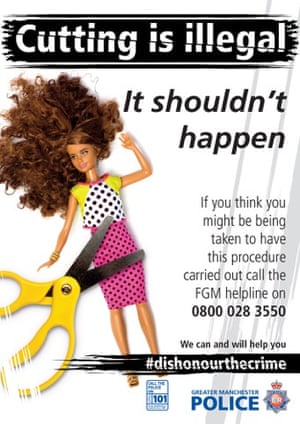
A national campaign carrying the symbol of a red triangle will be rolled out across the UK to mark the International Day of Zero Tolerance for Female Genital Mutilation.
The National Police Chiefs’ Council has partnered with the Freedom charity to encourage people to provide the police with information that can help detect and prevent FGM in the UK and abroad.
Commander Mak Chishty, the police national lead on “honour”-based violence, has written to every police force in the country reminding them that while progress has been made, there is yet to be a successful prosecution for FGM.
He wrote: “This is a particular area of political and public scrutiny and I would urge each force to maximise every opportunity to demonstrate that we as a service are doing everything that is possible to combat FGM.”
His letter also cited a prevalence study published in July 2015 by City University and Equality Now, the human rights group, which showed that no local authority in the UK was unaffected by FGM.
Chishty told the Guardian: “We are raising awareness that FGM is a crime and that anybody involved in the process – from turning a blind eye to the act of cutting – commits a criminal offence. This is form of child abuse and violence against women and girls.”
More than 13,000 posters promoting the Red Triangle initiative have been distributed to police forces to display inside police buildings and within appropriate community settings.
Police leads have been asked to evaluate the campaign’s impact by monitoring any increased reporting, receipt of intelligence or new engagement opportunities.
Aneeta Prem, a writer and the founder of Freedom, has written a novel warning about FGM, called Cut Flowers, that is being distributed to schoolchildren to raise awareness of the illegal practice.
She said: “Over 200 million women and girls have gone through the horrors of FGM and we know that girls are being cut here in the UK. Unofficial figures estimate that 137,000 girls and women in Britain are affected.
“Through education we can stop FGM in a generation. Through teaching we can explain the long-term health dangers and dispel the myths that have kept this barbaric practice alive. The help of boys as well as girls is needed to change opinions.”
She added: “We are asking that people wear the red triangle badge to mark the International Day of Zero Tolerance to FGM.”
A 25-year-old from Somalia who suffered FGM and now lives in London said: “I was cut when I was five years old. I still feel pain and relive that moment every day. I completely support the Red Triangle campaign and hope it will encourage girls to ask for help.”
FGM protection orders intended to safeguard girls at risk came into effect in the UK in July 2015. The latest figures from the Ministry of Justice showed 97 applications and 79 orders had been made up to the end of September 2016.
The home secretary, Amber Rudd, said the government was taking “world-leading action” to tackle FGM by strengthening the law to improve protection for those at risk and by removing barriers to prosecution.
She said: “This government has introduced FGM protection orders, a new offence of failing to protect a girl from FGM, a mandatory reporting duty for frontline professionals, new guidance for the police, and lifelong anonymity for victims to encourage them to come forward.
“We are sending a clear message that FGM will not be tolerated, and as part of this I am determined to see the country’s first successful prosecution for FGM.”
The Red Triangle campaign, which will run until International Women’s Day on 8March, iwill officially launch at Haverstock school in Camden, north London, on Monday.
The first hint that the word “empowerment” had been hijacked by a force with sinister intentions came, for me, back in 2005 during an episode of ITV pop show CD:UK. That dark space.
You might remember the incident: during a quick interview about the single Don’t Cha, Pussycat Dolls spokeswoman Nicole Scherzinger put forward the view that the song was about female empowerment. The interviewer, when told this, looked briefly puzzled.
For Scherzinger – or the media team who’d prepped her to sell CDs – “Don’t cha wish your girlfriend was hot like me? Don’t cha wish your girlfriend was a freak like me?” was strong feminist rhetoric about sisterhood, a cry for women to support one another and fight the harmful effects of patriarchy as a united front. It certainly wasn’t a narcissist telling a dude she likes that his girlfriend looks crap – it was deeper than that.
Or so the Pussycat Dolls and their marketing department were hoping viewers of Saturday morning TV would think, giving them permission to sing along with the mean lyrics, and go buy the song for their brick-sized MP3 player or Walkman. Dark spaces indeed.
The word “empowerment” being linked to products aimed at women that are actually kind of cruel to women is now ubiquitous. Selling an action film that features one lonely female character who can spin-kick, while also showing full cleavage? Marketers marketing will tell you that she hasn’t been added to the roster of characters as a token to fool the feminists, and she isn’t just there to add boobs’n’buttocks to the poster. No, she’s an “empowering female character”.
When launching any product designed to exploit women who feel insecure about aspects of their physical form, the message isn’t that women are disgusting and sure to die alone if they don’t use it. No: just that using the product will “empower them to feel confident”. Confident that they’re putting in the correct amount of work to fit an ideal instituted by people with more money and influence than them – sure – but mainly, confident. Until the tube runs out.
If you haven’t yet found the word ringing hollow with all this happening, here comes Protein World with another heavy hint of the sinister shenanigans going on with the word “empowerment”: its new campaign featuring Khloé Kardashian. You might remember Protein World as the meal replacement powder company that had its “Are you beach body ready?” ad banned by the Advertising Standards Authority a few years back, after many complaints and defaced train station posters. And you might remember Khloé Kardashian as … one of the Kardashians. According to the press release announcing the six-month campaign we’re heading for, the team-up will be “celebrating empowered young people who want to be their best selves, by looking good and feeling great”. There’s the magic word again: empowered.
The Protein World homepage currently yells the question “Can you keep up with a KARDASHIAN?” – and those who wouldn’t answer that with “Why ever would I want to?” can click through to assorted pictures of Khloé wearing unpractical-looking exercise gear while looking pensive, mixed with an extended testimony about the protein powders. When studying this presentation for signs of empowerment, you can detect straight away that Khloé feels empowered to sit down while looking blankly at a beaker full of liquid.
“Authority of power given to someone to do something” – Khloé is doing something, so it fits the Oxford Dictionary definition of empowerment. “The process of becoming stronger and more confident, especially in controlling one’s life and claiming one’s right” – sort of that, too. It’s not the empowerment of, say, swinging an axe around, learning a new skill, or flexing intelligence and integrity, but then again, maybe sometimes power lies in being able to sit and stare at a plastic container while being paid to do so. No one is definitely lying.
But, if it’s true, then the word “empowerment” no longer holds any meaning at all now. It’s a word – a feeling, too; a necessity – that has been carefully co-opted and, as a result, drained of its power by those looking to sell. Whenever you hear the word “empowerment” as part of an advertising campaign (Kardashian and Scherzinger-affliated or not) you can be sure those behind it have no genuine motivation to help you, not even inadvertently. See it as a shortcut through the bullshit, and silently thank the marketeer that decided to be exploitative by using it. Empower yourself into considering the word when you see it, and don’t be fooled into buying.
Jeremy Hunt has launched a nationwide campaign to help parents spot the signs of sepsis.
The health secretary is hoping to raise awareness of the “devastating” condition, which causes about 37,000 deaths each year in England.
Hunt said: “We need to get far better at spotting it across the NHS. By raising awareness and improving clinical practice we will save lives in the fight against this horrible illness.”
The campaign, delivered by Public Health England and the UK Sepsis Trust, is part of measures by the NHS to tackle the condition, which arises as a complication of an infection.
It is aimed at parents and carers of newborns to four-year-old children. Millions of leaflets urging parents to take their child to A&E or call 999 if their child is displaying symptoms will be delivered to GP surgeries and hospitals across the country.
Parents should take immediate action if their child looks mottled, bluish or pale, appears lethargic or difficult to wake, is abnormally cold to touch, is breathing rapidly, has a rash that does not fade when pressed or has a fit or convulsion.
Melissa Mead, who lost her baby son William to sepsis two years ago, will appear in a new film, which forms part of the campaign. She said: “Sepsis is a cruel, ruthless condition which doesn’t discriminate and can affect anyone. I hope this campaign reaches as many people as possible, so all parents out there know about sepsis and how serious it can be. The more parents know, the quicker they can act if they suspect their child may be suffering from sepsis – it could be life-saving.”
William Mead, who died two years ago. Photograph: Family Handout/PA
Mead, who is an ambassador for the UK Sepsis Trust, added: “I will never hear my sweet child say, ‘Mummy, I love you.’ I will never know the man that William would have grown to be. So please, it is too late for me to ‘think sepsis’, but it’s not too late for you.”
Hunt praised Mead and other “families who have tragically lost children to sepsis” for their help with the campaign.
Sir Bruce Keogh, the national medical director for NHS England said: “This campaign is an important addition to our ongoing work – we will never treat sepsis in time unless everyone ‘thinks sepsis’.”
Dr Ron Daniels, the chief executive of the UK Sepsis Trust, said: “With sepsis claiming over 37,000 lives annually in England, this awareness campaign is a crucial step forward. Clinicians and members of the public can save thousands of lives every year if they just ask: could it be sepsis?
“The UK Sepsis Trust welcomes this initiative, but system-wide improvements to sepsis care must follow. We’re delighted to have developed campaign materials that will empower parents to identify sepsis symptoms in their children and seek medical attention immediately.”
Sam Morrish, three, from Devon, died on 23 December 2010 from severe sepsis because of a catalogue of errors, including how his mother’s call was handled by NHS Direct, now replaced by the 111 service.
Call handlers failed to categorise the call as urgent, despite indications that his vomit contained blood. Even when hospital staff realised he was critically ill, they waited three hours before administering the antibiotics that could have saved his life.
His mother, Sue Morrish, said: “The sepsis campaign is hugely important to us and I know it will also be incredibly significant to other campaigning parents who have lost children to sepsis. We had never heard of the condition before Sam died. Had we known about it and what the signs were, then he could have survived.
“On the day that he died, he was going to be a shepherd in a nativity play. I know that the run-up to Christmas is incredibly busy for families but I appeal to all parents, if you see something about sepsis awareness on social media please share it. Sam never got the chance to be a shepherd – we don’t want other families to experience the same tragedy.”
Prof Paul Cosford, a medical director at PHE, said: “It is important that these messages are widely received, which is why I am writing with Sir Bruce Keogh to all NHS medical directors to highlight this campaign and the importance of making all staff aware of the signs of sepsis.”
A little more than two years ago, I was in the kitchen with my friend, Julia Jones, in a state of helpless sorrow. My father, John, was still alive then, although he was in his desolating last stages. His slow-motion dying had gone on for months and would continue for several more. While it endured we half wanted him gone, and when it ended, of course we wanted him back – a living ghost rather than a dead man who might haunt us but would never return.
My father’s drawn-out death lasted nine months: he went into hospital as someone living well with dementia; he came out quite lost and broken, and all the love in the world couldn’t have found him or put him together again.
It was Julia who suggested (and why hadn’t I thought of this before; why hadn’t it been obvious?) that carers of people living with dementia should have the same right to accompany them in hospital as the parents of sick children: that they should be welcomed by the bedside, to feed them, talk to them, hold their hand, stroke their hair, meet their gaze, be their memory, keep them safe, take them home whole. And after my father died, it was the Observer – which had 50 years earlier championed the demand by parents to be able do just that for their children – which gave me a place where my voice could be heard, and where sorrow, guilt and regret could be redeemed into change and rescue.
My father was beyond all help, but there are thousands of men and women with dementia who go into hospital each year and who come out diminished, through no fault of nurses and doctors, but because hospital is a hazardous place for those who are frail.
It was nearly two years since I wrote the piece in the Observer that launched John’s Campaign. Founded and run by Julia and me, its aim is simply that carers should be made welcome in hospital. Its beginnings were in a kitchen, but it is now part of a great movement for more enlightened and compassionate care for those with dementia.
At a conference last Wednesday dedicated to the campaign, tribute was paid to the paper’s honourable tradition of giving a voice to the voiceless, power to the powerless, hope to those in despair. The hall was full of generous people who had helped us on our journey – people with influence and connections, NHS leaders, consultants, chief nurses, heads of charities – but at the heart of the conference were the people whose voices are not usually heard, whose sorrow and anger and passion get drowned out in the great noise of the world.
As James Munro, chief executive of Patient Opinion, said: “Listening is the beating heart of healthcare” and in the act of listening “both speaker and listener are changed”.
In a session entitled “Voices”, 10 people, many of whom had never spoken in public before, courageously told of their experiences and were listened to. Sometimes what they said was hard to hear. Their stories, both the ones of anguish and the ones of kindness and optimism, illustrated why we started the campaign.
Tommy Dunne, who lives with dementia, described what it feels like to be in hospital, a “strange place surrounded by strangers”, where something tight squeezes your arm and something cold is put into your mouth; where a chicken pie is placed in front of you and then taken away, a mug of tea loudly offered and then removed; where, startled and scared, “you become dehydrated and delirium sets in … and the quick decline in your health begins. Yet no one knows or understands why.”
Several carers – partners, children, grandchildren, people who, as one of them had it, were the “voice and the memory” of the person with dementia – spoke about their experiences of heartbreak.
Teresa Canale-Parola’s partner, John, was 60 when he died. The hospital in which he spent his final days was too far away for her and her daughters to visit regularly, and – in spite of their battle to get this reversed – there were strict visiting hours, so that for much of the time he was quite alone. In his dementia, John had become violent and was placed under a mental health order. He was medicated and, even when he was placid, he was restrained.
He stopped eating and drinking. Soon he could no longer walk. Thirty-five days after his admission, Teresa had a call to say his health had deteriorated: she and her daughters found John, by now starved and badly dehydrated, “restrained in a chair, dying” . It was a brutal way for a man to go.
The death of someone with advanced dementia can be a sad blessing for those who have loved them, restoring that person to all the selves they have ever been – but a bad or lonely death makes mourning painfully difficult, full of anger and regret and terrible failure, of almost unendurable memories of distress. Not to be with them, not to comfort them, not to rescue them from abandonment and fear, not to accompany them up to the threshold.
Alongside stories of anguish, there were ones of hope: a junior geriatrician (of whom I am the proud aunt) spoke about being part of a cultural change in hospitals. Liz Charalambous – a nurse who has been fighting to get unrestricted visiting for carers for years – said that “one day we will look back in astonishment” at the time when carers were not made welcome.
Rebecca Myers, a health professional whose mother had dementia at a cruelly young age, spoke movingly about the “pragmatic empathy” that lies at the heart of healthcare: “One human being connected to another, in the moment, in the environment, for a shared purpose – to take care, of and with, each other.”
And Theresa Clarke, a former nurse from Northern Ireland now living with dementia, spoke with clarity and spirit about how people with the condition “need to be part of the conversation … not just spoken about, like an object, but talked with and to”. She certainly did not like her diagnosis, she said, and being left in hospital was “deadly, like being in deep space”, but she urged us all to remember that “we can live well with dementia, we can still contribute to society, our family and the world beyond”.
Seeing Theresa, this diminutive firecracker of a woman, hearing her talk, hearing Tommy’s vivid account, was a forceful reminder that people with dementia – who we often reduce to statistics, to costs, to problems, even (horrible words) to “bed blockers”, are not “them” but “us”, valuable and human and precious, with stories to tell and voices to be listened to.
The session ended with Kate Kellaway, of the Observer, beautifully and tenderly describing her father’s last weeks. Her words, republished here, illustrate the ideals of our campaign and show how, up and down the country, nurses and doctors are bringing extraordinary compassion and empathy to the lives of people who are vulnerable, and to their deaths: to live as well as we possibly can; to have, as they say in Ireland, a gentle passing.
Kate Kellaway and her father on his 90th birthday, two months before he died. Photograph: Courtesy of Kate Kellaway
‘My dad’s care made us believe in the goodness of people’
My father died five months ago at Whittington hospital in Archway, north London – he’d had a fall, broken a hip, had an operation, recovered and been discharged. Then he had another fall and had to be readmitted and it turned out he’d had a silent heart attack. He was 90. He had for some time suffered from chronic kidney disease.
So – a medley of misfortunes, including, towards the end, dementia. He had an intermittent belief he was back in the war and that there was a soldier in the bed next to him – he was determined to know the soldier’s name. I helplessly selected “Jim”, which seemed to pacify Dad. But, of course there was no bed and no soldier other than Dad himself, gallantly fighting on.
When it was clear he was dying, the Whittington found him a room to himself. And that was just the first of the blessings of being in that hospital during Dad’s final three weeks.
The care was, in every way, exemplary. The staff were happy to waive visiting hours without question. We could come and go as we pleased and sit up all night with Dad if that was what we wanted to do. The number of visitors at any one time was left to our discretion.
My brother, sister and I were bowled over by one nurse in particular and the compassionate intelligence with which she grasped the emotional picture. Sam Hunt talked to Dad with warmth, respect and gentle humour. She tried to find out how he was feeling. At one point, he admitted he was frightened and she listened, smiled and reassured. And she reassured us too – she made us believe in the goodness of which people are capable.
The doctor, Dr Mitchell, was outstanding – a model of intelligence, sympathy and tact. She was exceptionally clear in her information – impressive, in particular, in telling us what she was not sure of as well as informing us about whatever she knew.
Towards the end of his life, Dad had given us instructions about not prolonging his life unnecessarily – we had power of attorney. The staff listened to us but as Dad became less and less able to speak, Dr Mitchell never neglected to address him first: “Mr Kellaway, I’m just talking to your daughters about how we can try to make you more comfortable…”
The palliative care team was first rate: educating us in the art, or science, of dying comfortably.
And when Dad gently breathed his last – it seemed to me that it resembled what a friend of mine once described as pushing your boat out – I was with him, and when he was gone, it was the nurse and doctor I embraced. They had retained the necessary professional distance and yet had allowed us to feel, if only for a moment, that they were – almost – family.
Hillary Clinton’s campaign has acknowledged mishandling news of her pneumonia, as Donald Trump sought to capitalize on growing questions over his opponent’s trustworthiness at a critical moment in their race for the White House.
“We could have done better yesterday,” wrote Clinton communications director Jennifer Palmieri on Monday, after some Democrats began questioning whether the campaign had been fully transparent in its weekend accounts of her health.
“In retrospect, we could have handled it better in providing more information. That’s on us. We regret that,” added press secretary Brian Fallon.
Clinton was filmed losing her footing and being assisted into a waiting van after leaving early from a memorial for 9/11 victims in New York on Sunday.
Initially, campaign aides said she had “overheated”, though Clinton later insisted “I’m feeling great, it’s a beautiful day in New York,” after she left her daughter’s apartment, where she was taken to rest.
But once the video footage emerged – which appeared to support eyewitness accounts of a more serious incident – the campaign issued a short statement from a doctor revealing she was being treated for pneumonia.
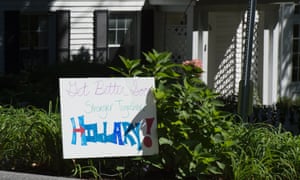
A sign along a road near Hillary Clinton’s home on Monday in Chappaqua, New York. Photograph: Don Emmert/AFP/Getty Images
Clinton had been diagnosed on Friday but the condition went undisclosed despite the campaign chastising reporters who had questioned bouts of coughing at recent public events.
The campaign now says Clinton will release “additional medical information” from her doctor in the next few days “to further put to rest any lingering concerns”, but insists there are “no other underlying conditions, the pneumonia is the extent of it”.
“I expect by the middle or back end of the week she will be back out there on the campaign trail,” Fallon told MSNBC. “If it was up to her she would be travelling to California today but it was her doctor’s advice [to rest at home].”
However, even if Clinton does bounce back quickly, the incident is raising fresh questions over trust which could cause more lingering political complications.
“Antibiotics can take care of pneumonia. What’s the cure for an unhealthy penchant for privacy that repeatedly creates unnecessary problems?” wrote Barack Obama’s former adviser David Axelrod.
His tweet prompted Palmieri’s first acknowledgement of regret, in which she added: “But it is a fact that [the] public knows more about HRC than any nominee in history”.
Their public exchange was seized on by the Trump campaign, which said it demonstrated a familiar pattern of secrecy by the Clintons.
“It’s incredibly important to be forthcoming,” said the Republican’s campaign manager Kellyanne Conway. “If you have a diagnosis of pneumonia, just be honest about it when you’re saying you’re overheating. Just say, ‘by the way, I’m on antibiotics’.”
Trump immediately claimed he would soon be releasing the results of a recent physical examination of his own, telling interviewers: “It’s interesting because they say pneumonia, but she was coughing very, very badly a week ago … It’s very interesting to see what’s going on.”
Clinton’s campaign and its backers nonetheless pushed back against criticism regarding transparency. Trump, they pointed out, had thus far declined to release his tax returns and refused to offer policy specifics on issues ranging from immigration to the fight against Islamic State.
The state of Trump’s own health was also unclear, with a brief statement from his personal doctor of 25 years in December providing few medical details and serving as the only record offered by his campaign.
The doctor’s statement described the Republican nominee in the sort of hyperbolic language typically associated with Trump, declaring him “the healthiest individual ever elected to the presidency” if successful in his pursuit of the White House. Trump’s physician, Dr Harold Bornstein, said last month he put the document together in five minutes while awaiting a limo sent by Trump to collect the letter.
Republican presidential candidate Donald Trump attends the ceremony in New York Sunday. Photograph: Andrew Harnik/AP
Despite repeatedly criticizing Clinton’s “stamina” in recent weeks, Trump was cautious on the topic of the former secretary of state’s health on Monday, saying in an interview: “I hope she gets well soon.”
The Republican nominee instead focused his fire on Clinton’s comments on Friday about half of Trump’s voters being in “the basket of deplorables”. Although she has since expressed regret for being “grossly generalistic” in saying “half”, she still stood by her characterization of Trump supporters. Clinton has continued to reiterate: “Trump has built his campaign largely on prejudice and paranoia and given a national platform to hateful views and voices.”
The Trump campaign has seized on these remarks and is now airing a television ad highlighting them in several swing states. The ad includes footage of Clinton grouping “the racists, sexists, homophobic, xenophobic, Islamophobic, you name it” into the basket of deplorables.
The stumbles for Clinton come as polls appear to show Trump reducing a previously large gap, to an average of three points.
Even as her campaign sought to rein in any political damage from the past few days, several Democrats argued that the focus on Clinton’s health had been overblown by the media.
“Every candidate I have ever worked for has gotten sick on the trail and worked through it because you can’t take days off in a close race,” wrote Dan Pfeiffer, a former senior advisor to Obama.
Bill Burton, who served as Obama’s national press secretary in 2008, said campaign aides would have been “understandably skittish about making announcements about secretary Clinton’s health” while Trump was pushing conspiracy theories about her wellbeing.
“Will it feed a narrative? Sure,” he said in an interview. “But only because the media gets led around by the nose by Donald Trump.”
And while the media was quick to cast the incident as problematic for Clinton, Burton said it could in fact provide her with a small boost in the polls.
“People respond when they think someone’s being treated unfairly,” he said.
“For Hillary Clinton to have pneumonia and even still give a press conference, convene a national security meeting, attend a memorial service in the hot sun for an hour and a half, and then take criticism for having pneumonia all the while … I don’t think the American people are going to punish her for actually performing quite well in the face of what’s an exhausting illness.”
My mum, Patricia, has polycystic kidney disease (PKD), a genetic disorder that ends in kidney failure. We always knew she would eventually need a transplant and I was the only one in the family who was able to donate. My two sisters also have the disease and my dad has been living with cancer and receiving chemotherapy, on and off, for over 20 years.
Mum didn’t want to take a kidney from me, even though she was slowly dying – she didn’t want to put her child through surgery. We were both scared it wouldn’t work and what impact that could have on us emotionally.
But when her health deteriorated so much that there was a risk she would be too sick to receive a kidney if she waited any longer, we decided to go ahead. I donated my kidney in February this year.
I was asked what I wanted to do if the surgeons found they couldn’t give my kidney to my mum after all. The options were to either destroy it, pop it back inside me or donate it to someone else who needed it desperately. The choice was easy. Even though my sisters have PKD and will one day need a kidney, they didn’t need it yet – and someone else did. I suddenly realised the significance of what I had to give and the difference it would make.
The transplant changed our lives – we don’t have that constant worry any more. We spent two years visiting the renal ward in hospital and met other patients, their families and friends. I spent time in recovery with some patients who had received an organ from a stranger. The joy and relief in these patients and their families is indescribable. To be able to give new life to someone makes organ donation something very special.
I’m a human resources consultant, and have been working with the League Against Cruel Sports, where chief executive Eduardo Goncalves and his team supported me through my recovery after the operation. I received many personal messages, cards and flowers from my colleagues.
When Eduardo, who has himself donated a kidney to one of his sons, asked me to work with him on building awareness of organ donation, I was delighted, as I knew that the staff would be very engaged. They all have a passion for animal welfare, but also really care about people.
We wanted to encourage staff to consider joining the donor register and we did so by sharing our experiences of kidney donation. After telling our stories, and how we felt as a result, 98% of all staff at the league joined the donor register online.
I made a difference to my mum’s life, and to mine, when I donated my kidney. I made a difference by being involved in the awareness project – and thanks to the project, 40 people at the league will now make a difference to other people’s lives by being on the register.
Organ Donation Week runs until 11 September.
The day I made a difference is the Guardian Voluntary Sector Network’s series that showcases the work of people involved with charities. If you have a story you want to share email voluntarysectornetwork@theguardian.com with a short summary of your experience.
For more news, opinions and ideas about the voluntary sector, join our community – it’s free!
Thousands of lives could be saved by urging unwell patients and their loved ones to ask doctors to check for sepsis, experts said as they announced a new campaign to raise awareness of the devastating condition.
Every year, sepsis, or blood poisoning, kills nearly a third of the 150,000 people it affects. But campaigners say better care could save as many as 13,500 lives, as well as up to £314m from NHS budgets.
After a report this month strongly criticised hospital bosses and doctors over the avoidable death of a 12-month-old boy from sepsis, Jeremy Hunt, the health secretary, has agreed to help lead a campaign to encourage patients and doctors to look out for the symptoms of the condition.
The announcement came after Melissa Mead, whose infant son William died in 2014, and representatives from the UK Sepsis Trust (UKST) met Hunt at the Department of Health on Tuesday. Mead said she was “relieved and delighted” by the decision to launch the campaign.
“There’s going to be posters, there is going to be leaflets, there is going to be symptom cards, there is going to be a 90-second video which is going to be blanketed across social media to make sure we engage with the community when they are sitting on their sofas at home,” she said.
“It is really, really important that this is a campaign which continues to roll and have a journey and an evolution.
“Personally, I feel relieved because I’m here because William died but, equally, I’m stood here and we represent 44,000 people who die every year and 150,000 people who suffer with sepsis. This isn’t a one-off story, it affects so many people’s lives and it’s very important.”
Ron Daniels, chief executive of UKST, said the campaign was due to launch in mid-September. “This is being seen by the government as a priority, and an ongoing campaign. We discussed budgeting for next year, as well as for this year, and in the years beyond,” he said.
“What we are going to see is heightened awareness of the word ‘sepsis’, through the use of social media, direct marketing, posters in GPs surgeries, emergency departments and pharmacists, [as well as] the use of corporate partners to get the message out there.”
A major aim of the campaign, Daniels said, would be to prompt patients and their carers to ask: “Could it be sepsis?” He cited research published last year that found that where sepsis patients presented at hospital late, in more than 60% of cases it was because they had not contacted doctors.
“It wasn’t GPs missing it, it wasn’t ambulance services or 111 saying you’re fine to stay at home. It was people not picking up the phone to start with,” Daniels said. “And the delays were not a few hours, they were typically one to four days, and that can obviously be the difference between life and death. So it’s that piece of evidence that’s really spurred us to engage with the public, to get sepsis into their vocabulary, and empower them to ask the question.”
Sepsis can be triggered by any minor infection, or an injury as simple as a cut or an insect bite. Sufferers’ immune systems go into overdrive as they try to fight off the infection, causing their bodies to begin self-destructing by attacking their own tissues and internal organs.
Without early treatment, it can lead to shock, multiple organ failure, and death. But survivors also face serious consequences if they are not treated in time. Daniels said: “Between a fifth and a quarter of survivors have life-changing after effects. These can be physical. They can, in extreme circumstances, lose limbs. They can be more subtle physical problems like chronic fatigue or problems with muscle and joint pain.
“They can be psychological, which ranges from sleep disturbances, personality changes and anxiety through to post-traumatic stress disorder. And they can have cognitive problems. Around 15% of people who survive sepsis, particularly if they’ve needed intensive care, can’t perform as well as they did previously.
“What this means is that people struggle to return to work in their previous roles, and the psychological issues, as well as the physical issues, mean that people’s relationships are strained and relationships break down. Survival, if recognition has been delayed, can be life-changing and the potential consequences to the economy from this fiscal burden of people not being able to return to work [is] huge.”
Early symptoms of sepsis include fast breathing or a fast heartbeat, high or low temperature, chills and shivering. However, sufferers may or may not have a fever. Severe symptoms can develop soon after and include blood pressure falling low, dizziness, disorientation, slurred speech, mottled skin, nausea and vomiting.
Following the death of William Mead, the National Institute for Health and Clinical Excellence (Nice) said that doctors and nurses should treat people who show signs of sepsis with the same urgency as those suspected of suffering heart attacks. A separate report into the boy’s death criticised GPs, out-of-hours services and a 111 call handler who failed to spot he had sepsis caused by an underlying chest infection and pneumonia.
His mother said she hoped that the campaign, Nice guidelines, and the investigation into her son’s death would help to prevent future tragedies. “William died in 2014 and it was a year later that we received the NHS England report,” Mead said earlier on Tuesday.
“It’s taken seven months to reach this stage but, equally, you can’t put something out there that is not going to work and is not going to be engaging.
“Especially with the Nice guidelines, which came out last week, on sepsis, we’re in a position now we’re going to have joined-up writing and joined action and everyone is going to be thinking the same thing.
“I’m hoping today will be the last meeting, I’m not anticipating any more meetings.”
At 3am on Thursday morning, a group of police, border officers and charity workers joined the throng of holidaymakers at Manchester airport of to begin their summer campaign against female genital mutilation (FGM).
Photograph: Greater Manchester police
Sometimes known as the ‘cutting season’, the school summer holidays are the most common time for girls in the UK to be taken abroad, usually to their family’s country of origin, and subject to mutilation.
Operation Limelight will see Greater Manchester police and their partners speaking to outbound passengers in July about FGM and again to inbound passengers at the end of August and into September.
Travellers will be made aware of the signs that indicate someone could be at risk and informed that it is illegal for UK nationals or permanent residents to perform FGM in the UK or abroad, with a maximum sentence of 14 years imprisonment.
The facts you should know about female genital mutilation
The first ever FGM figures in England were released last week showing that there have been nearly 6,000 new cases in the last year and that a further 65,000 girls under the age of 13 are at risk of the procedure, which can result in severe pain, shock and death as well as psychological problems such as post-traumatic stress disorder.
People who carry out the procedure, or ‘cutters’ are also known to come to the UK during this time to carry out FGM in the UK.
Now in its third year, Operation Limelight was designed to coincide with the school holidays of Greater Manchester and the surrounding areas of Liverpool, Yorkshire and Lancashire, which are also served by the airport.
‘Spread the word: it’s child abuse’
Detective Inspector Nathan Percival, Greater Manchester’s lead on FGM, has overseen a change in approach to FGM in the area.
“For so many years the police have gone off and done their own thing but we don’t do that anymore,” he told the Guardian. “We don’t charge in, but have a softly, softly approach. We’re learning each day from charities and voluntary sectors on how to approach – police shouldn’t be the baddies.
We need friends, siblings and community members to come forward
“For FGM it’s never just the police deciding we need to make arrests. Policy dictates now that FGM work should be multi-agency so we share information with partners at a strategy meeting to discuss the best thing for the child. We always aim to support the child and the family involved.”
Operation Limelight focuses more on raising awareness than chasing convictions (of which there have been none for FGM in the UK so far). All passengers are approached, without families being isolated. “It’s just basically chatting to people. We explain who we are, and ask whether they’ve heard of FGM or cutting. My tagline has always been: Spread the word: it’s child abuse, it’s illegal and there are serious health implications. If a criminal investigation springs, that is all well and good, but child safety is always the priority.”
In 2015, new FGM laws came into force in the UK. Under the Serious Crime Act, FGM protection orders can now be issued whereby potential victims or third parties can apply for an order to protect the person at risk. These orders can include the confiscating of passports. It is now mandatory for health and social care professionals and teachers to make a report to the police if they learn that a girl under 18 has been subject to FGM.
Percival believes mandatory reporting especially has helped to protect girls and Greater Manchester police has seen an increase in reports made to them of FGM – only nine reports were made to them three years ago, but last year, there were 94. The taboo nature of FGM remains one of the biggest obstacles to eradication, however.
“We need friends, siblings and community members to come forward, people who know that this child will be at risk this time of year. This is what we cry out for – for people to please come forward. It’s hard though, people have been carrying out FGM for thousands of years and believe that not doing it will bring shame on the family. We rely on partnerships and voluntary sector, charities like Afruka and Nestac who work in communities. These agencies work on a cultural level. They know they have a police officer who is really passionate about combatting FGM. I try and understand and put myself in their shoes. You have to with child abuse.”
Angie Marriot, a former nurse and independent consultant in honour based violence, forced marriage and FGM, worked on Operation Limelight for the first time this year.
“It’s been excellent to give out information and target a diverse population of people coming through the airport,” she said. “The opportunity is absolutely outstanding. We’re targeting everybody. I would say that 85% of people have been very positive endorsing the information they’ve been given.”
“Some of the people who’ve taken leaflets have said: ‘Oh we’ve heard about that’ and others have said: ‘What’s this? so we still know there’s a lot of work to do. There are lots of professionals out there who still don’t know about FGM. They don’t feel confident to report and overcome those cultural barriers and lots of people are fearful about being accused of being racist.
“There’s also an issue with funding. We hear about this 80 million pounds for violence against women, unfortunately that’s not trickling down to BME groups or specialists who’ve got that expertise.
“To see the police embrace a sensitive issue openly is remarkable, and GMP need to be commended for the outstanding work they’re doing here today.”
Everyone involved in the operation (police, border agents, consultants and charity workers) have volunteered their time for free.
Signs that a child may be at risk of undergoing FGM include
being taken ‘home’ to visit family
a special occasion to ‘become a woman’
an older female relative visiting the UK
Signs that a child may have recently been a victim of FGM include
the child is frequenting the toilet
the child is complaining of pelvic pain
a change in behaviour after going on holiday. For example, becoming suddenly submissive or anxious.
Anyone with concerns is asked to contact police on 101 or Crimestoppers anonymously on 0800 555111 or the FGM Helpline on 0800 028 3550. You can also contact the NSPCC on 0808 800 5000.
Experimentation with e-cigarettes is increasing among eleven- to 18-year-olds in Britain but is most common amid people who currently smoke or who have completed in the past, according to anti-tobacco group Action on Smoking and Health (Ash).
It says outcomes from its third annual on the web survey of youthful people’s attitudes to e-cigarettes suggest that it is “unlikely” they are currently acting as a gateway to tobacco.
Although 10% of virtually 2,300 surveyed for Ash by YouGov in March said they had experimented with e-cigarettes “once or twice”, up from four% two years in the past, standard use remained rare.
Only two.four% mentioned they used them at least once a month and virtually all have been young men and women who explained they had been, or have been still, normal tobacco smokers. The increases in use have took place as regular tobacco smoking by 11- to 15-12 months-olds has dropped to a reduced of 3%.
Ash is concerned, however, that a expanding proportion of young folks believe vaping is as dangerous as smoking cigarettes – a figure that has enhanced from 11% in 2013 to 21% this yr, even if most accurately considered e-cigarettes significantly less damaging.
The discovering comes just days soon after the Royal Society for Public Well being referred to as for a public education campaign that may possibly support smokers not nevertheless ready to give up their nicotine habit switch to e-cigarettes, because these did not also have the much more hazardous chemicals, this kind of as tar and arsenic, discovered in tobacco cigarettes.
Final results from Ash’s 2015 survey coincided with analysis, in the journal Public Health, of its 2013 and 2014 statistics by personnel at Public Well being England (PHE), Ash, the Uk Centre for Tobacco and Alcohol Studies, and other experts.
Authors of the journal report, although it only covers the very first two surveys, also express issues at the rising proportion of young individuals perceiving e-cigarettes to be as hazardous as tobacco ones. This, it warns, may possibly reduce numbers of young men and women “willing to attempt and/or use what is evidently a considerably much less hazardous supply of nicotine”.
They also even so say youthful folks are “still relatively inexperienced” in the use of e-cigarettes and recognise worries above their attraction to young folks. Shut surveillance have to proceed on any romantic relationship in between e-cigarette use and that of traditional cigarettes, “and the extent to which engagement in 1 use precedes or replaces the other”.
Hazel Cheeseman, director of policy at Ash, stated: “These outcomes need to reassure the public that electronic cigarettes are not linked with any rise in youthful men and women smoking. Although more young men and women are making an attempt electronic cigarettes and numerous a lot more younger folks are aware of them, this has not led to widespread typical use or an increase in smoking.”
A new law will prohibit their sale to beneath-18s in England and Wales from 1 October and Scotland is planning to adhere to suit quickly. In Wales, e-cigarette use will also be banned in enclosed public locations, as tobacco smoking previously is.
Kevin Fenton, national director for health and wellbeing at PHE, explained this would “further reduce youngsters accessibility to these goods and will reinforce the message that they are meant for adult smokers who want to minimize down or stop smoking”.
The Welsh government said: “We are concerned the use of e-cigarettes could re-normalise smoking, especially for a generation who have grown up in a largely smoke-cost-free society.
“We are not alone in our worries – the Globe Health Organisation and other global bodies have known as for better regulation of e-cigarettes and forty other nations have previously taken equivalent steps.”
Hollie Clark with mothers and fathers Laura and Stephen and younger brother Sam. Photograph: Anthony Nolan Believe in/PA
A bone marrow donor has been located for a young lady who was at the centre of a social media campaign that noticed supporters posing for selfies with pants on their heads.
Gareth Bale, the Welsh footballer who plays for Actual Madrid, Sam Warburton, the Wales rugby union captain, and Russell Howard, a comedian, had been between the stars who posted a picture of themselves on-line sporting their underwear on their heads in a bid to inspire individuals to sign up to the register in buy to find a matching donor for eight-yr-old Hollie Clark.
Hundreds of photos with the phrases HelpHollie connected, have appeared on Facebook and Twitter.
Hollie, from Cardiff, has a uncommon bone marrow syndrome called myelodysplastic syndrome (MDS) and required a bone marrow donor, according to a spokeswoman for the charity concerned, the Anthony Nolan register.
The youngster was diagnosed with MDS, which leads to a fall in the variety of wholesome blood cells, in April right after building unusual bruising. She was surviving on blood transfusions until finally a appropriate donor was found.
This has happened and Hollie will start chemotherapy in preparation for the transplant, which will consider area later this month.
Her mother and father, Laura and Stephen, started the campaign to encourage men and women to sign up to the Anthony Nolan charity’s bone-marrow register: to join it you have to be amongst sixteen and 30 and in great wellness. The youngster and her household also posed for pictures with their underwear on their heads.
There was a 2,580% enhance in the number of men and women in Wales signing up to the bone marrow register compared to the very same two-week time period last yr, the charity mentioned.
Across the United kingdom there was a 170% leap.
Hollie’s mother, a GP, said: “Even though we are complete of happiness we still have a prolonged way to go. We know there are a lot of mums and dads hunting out of a window appropriate now, pondering if that special individual will join a bone marrow register to conserve their child’s daily life.
“It is not a position you ever want to be in. It is despair, concern and terror. Attempt and envision seeking for that a single specific person in the world who could conserve your child’s existence. It does not have to be like this, it could be various. The solution is to register as a bone marrow donor and tell your buddies to do the same.”
Karen Archer, regional register advancement manager at Anthony Nolan, added: “We are completely delighted that a match has been discovered for Hollie and we want her and all of her family the greatest of luck for the future.
“The ‘pants on your head selfie’ idea really took off and produced a massive distinction in terms of the numbers joining the register. It’s our objective to find a match for absolutely everyone who demands a transplant so it truly is great that Hollie’s friends and family are carrying on the battle and urging even a lot more folks to come forward and help the function of Anthony Nolan.”
• To locate out far more pay a visit to: www.anthonynolan.org
Their campaign inspired an extraordinary response with the world’s most expensive footballer, Gareth Bale lending his help.
He was joined by other well-known names which includes comedian Russell Howard, Wales rugby captain Sam Warburton, Tv presenter Gethin Jones and EastEnders actor Richard Elis.
The appeal led to a two,580 per cent increase in the variety of folks in Wales joining the Anthony Nolan register in contrast to the very same period final 12 months.
Right after waiting a gruelling 3 months, Hollie discovered out last week that a donor had been located.
Sharing the information on Hollie’s campaign Facebook webpage, Mrs Clark wrote: “We want to thank everyone who has acquired off their BOTT and aided us.
“There are virtually also several to identify, suffice to say, you know who you are and what you did Its difficult to make clear how we really feel so we will not try out, it would be messy.
“We get massive power and comfort from you all. We could not have began this journey without having the response to this campaign. You all genuinely did Assist Hollie. You really did #putyourpantsonyourhead.”
She urged individuals to carry on registering to help others like Hollie in require of a donor.
“Although we are full of happiness we still have a lengthy way to go,” she wrote.
“We know there are many Mums and Dads looking out of a window right now. Hunting and asking yourself if that special man or woman will join a bone marrow register to save their child’s lifestyle.
“Trust us, it’s not a nice feeling. Trust us when we say, it truly is not a place you EVER want to be in. It is despair, fear and terror.
“Try & envision just for a minute. Try out and imagine seeking for that one particular special person in the globe who could conserve your child’s life. It does not have to be like this. It could be distinct. It is simple, here is the remedy, right here is the secret. Register as a bone marrow donor and tell your close friends to do the exact same.”
Mrs Clark added: “In a brief time Anthony Nolan have turn into part of us. They were there for us and we Positive AS HELL will be there for them. We cannot and will not walk away from them.
“We will get Hollie fixed & be back to aid soon. We will be returning the favour.
“Parents in a similar place, preserve constructive & stay powerful.
“We will be there for you, that is a promise.”
Hollie, of Roath Park, Cardiff, was diagnosed with Myelodysplastic syndrome (MDS), a blood disorder which triggers a drop in the quantity of healthier blood cells in the body, three months in the past.
Mrs Clark, a GP, mentioned: “It was an absolute shock, it is practically the worst factor as a parent you could be informed.
“It was difficult to believe because she’d been so active at the time, she loves swimming and cycling and taking part in with her pals, and she’d been doing all these things with no us even knowing that her haemoglobin levels have been dangerously reduced.”
Right after discovering her younger brother Sam was not a match, her mothers and fathers made the decision to take action to locate one as quickly as achievable which led to the campaign.
In Cardiff, there was a 2,600 per cent enhance in individuals joining the register and, in the United kingdom as a total, the figure was 170 per cent compared to the exact same time last 12 months.
Karen Archer, regional register development manager at Anthony Nolan stated: “We are absolutely delighted that a match has been located for Hollie and we want her and all of her household the greatest of luck for the potential.”
To indicator up to the register visit www.anthonynolan.org/helphollie.
Their campaign inspired an amazing response with the world’s most high-priced footballer, Gareth Bale lending his help.
He was joined by other well-known names like comedian Russell Howard, Wales rugby captain Sam Warburton, Television presenter Gethin Jones and EastEnders actor Richard Elis.
The appeal led to a 2,580 per cent boost in the variety of people in Wales joining the Anthony Nolan register in contrast to the same period last yr.
Right after waiting a gruelling 3 months, Hollie discovered out last week that a donor had been discovered.
Sharing the information on Hollie’s campaign Facebook page, Mrs Clark wrote: “We want to thank every person who has acquired off their BOTT and helped us.
“There are virtually too numerous to title, suffice to say, you know who you are and what you did Its tough to explain how we truly feel so we will not consider, it would be messy.
“We take huge power and comfort from you all. We could not have started out this journey with out the response to this campaign. You all truly did Help Hollie. You genuinely did #putyourpantsonyourhead.”
She urged men and women to continue registering to assist other individuals like Hollie in need to have of a donor.
“Although we are full of happiness we nevertheless have a extended way to go,” she wrote.
“We know there are a lot of Mums and Dads hunting out of a window correct now. Looking and wondering if that specific individual will join a bone marrow register to conserve their child’s lifestyle.
“Trust us, it is not a nice feeling. Believe in us when we say, it’s not a place you EVER want to be in. It is despair, concern and terror.
“Try & picture just for a moment. Consider and envision seeking for that one particular specific individual in the planet who could save your child’s daily life. It does not have to be like this. It could be various. It is straightforward, here is the answer, right here is the secret. Register as a bone marrow donor and inform your close friends to do the exact same.”
Mrs Clark added: “In a short time Anthony Nolan have grow to be component of us. They were there for us and we Confident AS HELL will be there for them. We cannot and will not walk away from them.
“We will get Hollie fixed & be back to assist soon. We will be returning the favour.
“Parents in a equivalent place, hold positive & remain sturdy.
“We will be there for you, that is a guarantee.”
Hollie, of Roath Park, Cardiff, was diagnosed with Myelodysplastic syndrome (MDS), a blood disorder which triggers a drop in the amount of wholesome blood cells in the physique, three months in the past.
Mrs Clark, a GP, stated: “It was an absolute shock, it is literally the worst point as a mother or father you could be advised.
“It was tough to believe simply because she’d been so lively at the time, she loves swimming and cycling and taking part in with her buddies, and she’d been performing all these issues without having us even understanding that her haemoglobin ranges were dangerously minimal.”
Following finding her younger brother Sam was not a match, her mother and father decided to take action to find 1 as speedily as attainable which led to the campaign.
In Cardiff, there was a two,600 per cent enhance in folks joining the register and, in the United kingdom as a total, the figure was 170 per cent compared to the same time final 12 months.
Karen Archer, regional register growth manager at Anthony Nolan mentioned: “We are completely delighted that a match has been discovered for Hollie and we want her and all of her loved ones the greatest of luck for the potential.”
To sign up to the register go to www.anthonynolan.org/helphollie.