Vanessa etiketine sahip kayıtlar gösteriliyor. Tüm kayıtları göster

9 Aralık 2016 Cuma

Over 200 years of deadly London air: smogs, fogs, and pea soupers | Vanessa Heggie

On 9 December 1952 the Great Smog officially ended – for five days a thick layer of air pollution, mostly caused by coal fires, had covered London and caused the deaths of thousands of residents. 64 years later the London Mayor has committed £875 million to tackle the problem. This week the Royal Society of Biology hosted an event on air pollution and health (#greyskythinking) and the Royal Society of Chemistry will run their annual Air Pollution conference next week. After two centuries of fatal London fogs, what have we learnt?


Fogs were relatively common in London in the 1700s, but by the early 1800s these had become deadly, as the smoke and fumes from industrialisation and urban growth were trapped by calm, still air. It was not just the pollution that was a threat to life and health, but also the traffic, and newspapers were full of tragic stories of accidents: in the 1837 December fog the Times reported that “an aged female named Jane Wilson” was “knocked down by a cart and severely injured” and Chelsea resident Mr Phillips was thrown out of his chaise into the road where a “cart passed over his right thigh, and fractured it dreadfully”. Animals suffered too – in 1873 the annual cattle show at Smithfield market was ruined by a December fog that left the “fat cattle…panting and coughing”, and many of the animals collapsed and died.


The Victorians are famous for their public health activity – ambitious sewer schemes, the introduction of Medical Officers of Health, and vaccination programmes – so why did they struggle, as we do, to deal with deadly air pollution?
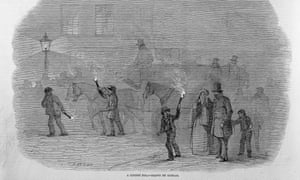


black and white illustration showing foggy street scene; two men with burning torches lead a horse and carriage, while in the foreground a small boy with a torch leads a family group.


The Illustrated London News, Volume 10, 1847. The men and boy carrying lighted torches are acting as guides to the carriage and pedestrians: fogs were often so thick it was impossible to see across a street. Illustration: Wellcome Library, London/Wellcome Library, London. Wellcome Images

If it’s everyone’s fault, it’s no one’s fault


One problem lay in the fact that the smogs had many causes. Heavy industry was one source, but so too were the railways and steamer-boats,and particularly domestic coal-burning fires. Various societies were formed to campaign for what was often called ‘smoke abatement’, but they met with resistance. At a meeting of the ‘Noxious Vapours Abatement Association’ in Manchester, a representative from the Health Committee of the Salford Corporation (like a modern city council) won applause from a working class audience when he objected to smoke abatement because


“he would be sorry to see a persecution commenced against the manufacturers, for if they were driven from the borough, where would the bread of the working man come from?”


If ‘big business’ wasn’t going to reform, why should individuals? Smoke abatement campaigners seem to have thought that education was all that was needed: in 1881 the Smoke Abatement Committee opened a smoke-prevention technology exhibition in London which attracted an extraordinary 116,000 visitors in just a few months; all the installations were independently tested to make sure that the manufacturers’ claims were accurate. Yet this did not lead to a mass take-up of smoke-reducing technology, and an attempt to force changes by passing a law regulating domestic smoke failed in 1884.


Some industries had been regulated by the Smoke Nuisance Abatement (Metropolis) Act of 1853, but only in London, and this excluded some factories such as glass works and potteries. Rather oddly, a lot of the discussion about this Act focused not on the health risks of smoke, but on the expense of laundry caused by the dirty air of London (estimated as high as £2 million) – as one member of the House of Lords suggested: “The smoke so affected the clothing of the working classes that it was computed every mechanic paid at least five times the amount of the original cost of his shirt for the number of washings rendered necessary.”
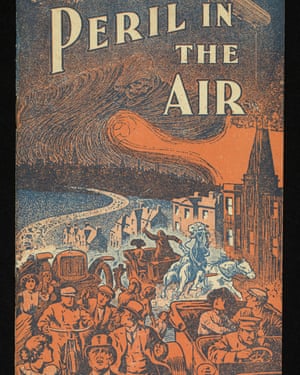


Sensational cover (orange and blue) of a skull-faced Death in a swirling dark cloud over a city from which terrified inhabitants are fleeing on foot, in cars, bicycles and horse-drawn carriages.


Front cover for booklet advertising Peps cough and cold tablets in 1913. The ‘peril’ refers to deaths from respiratory diseases during heavy fogs in cities. Photograph: Wellcome Library, London/Wellcome Library, London. Wellcome Images

Who pays the price?


Even if it saved on washing bills, there was a genuine fear that over-regulation might lead to job losses. Worse, the Victorians were also concerned that reforming domestic fireplaces would actually make people sicker, rather than healthier. Although open fire places were serious sources of coal smoke pollution, they had one advantage over more efficient systems: they created draughts. Through most of the nineteenth century medical professionals thought that disease was spread by ‘miasmas’, clouds of harmful matter. One way to tackle the danger of miasma was to ensure air did not become ‘stagnant’, and open fireplaces helped to create a ‘healthy’ circulation of air.


While the larger, airier homes of the middle and upper classes could be ventilated in other ways, investigations into the slums and basement dwellings of the poor suggested that open fires were vital. Of course, this could be solved with serious slum clearances and massive investment in homes for the poor, but it proved hard to justify that expense on the grounds that it would prevent air pollution. In any case, reformers worried, people were ‘sentimentally attached’ to their open fires, and resisted technological change.


Suggestions to solve the smoke problem remained small scale: taxes on new stoves or fireplaces, restrictions on certain manufacturing plants, the formation of small local societies to help people buy efficient stoves ‘by instalments’, and so on. But one problem not tackled was the rather obvious one: pollution travels. Responsibility for enforcing anti-pollution and anti-smoke laws rested, by the late 19th century, with local governments and the London County Council, so if pollution was blowing in from a factory in an uncooperative neighbouring jurisdiction, there was nothing councils could do to enforce the limited rules that existed. In 1914 central government was finally persuaded to set up a committee to reconsider the legislation about pollution, but its work was interrupted by the outbreak of war.


It was not until 1956 that a Select Committee’s recommendations, pushed by backbenchers against a sceptical Conservative government, led to the passing of the 1956 Clean Air Act, a direct response to the smog of 1952. For the first time, this Act regulated domestic fireplaces as well as industrial furnaces, and created smoke control areas where only smokeless fuels could be burnt.


Although a milestone in public health, just 60 years later Londoners are dying, again, from polluted air. Although the London Mayor has announced that funding for this problem will be doubled the challenges remain essentially the same faced by the Smoke Abatement Leagues in the 1800s: the causes are complex, some pollution is (thought to be) linked to economic growth and jobs, there are social reasons why people resist changes (especially if they require personal sacrifices, such as giving up car or air travel) and the miasma of pollution still travels across regional and national boundaries. Do we have any new solutions?


Over 200 years of deadly London air: smogs, fogs, and pea soupers | Vanessa Heggie

3 Şubat 2014 Pazartesi

Providing away your information: from Galton and Google to care.data | Vanessa Heggie

Every ruler would like statistical info about their kingdom, whether or not it’s about the variety of their soldiers, size of their territory, or wealth of their taxable citizens. Some of the earliest innovations in mathematics have been driven by the want to calculate the region of odd-shaped parcels of land, or figure out repayments which includes compound curiosity. More than the last two centuries the demand for statistical details has rocketed, and now really complicated, comprehensive, and personalized information can be collected.


1 cause for this demand – which I touched on in an earlier publish – was a new ideology in philosophy and science which advised that the complex all-natural world could be diminished to mathematical equations (or at least, that if you desired to recognize the world, mathematics was the ideal way to do so). When astronomers, like Adophe Quetelet, began gathering information about human populations they often identified crime, suicide, birth and death as predictable as the movements of the planets.


We can collect data about planets by constructing an observatory how do we get data about human beings?


Human Observatories: Making us give up our data


One particular clear way to get info is to pass laws generating it compulsory to give the data up. In the Uk the registration of births, deaths and marriages was created compulsory in 1875 (virtually forty many years right after the Common Register Office was set up as a central point to collate all this data). In a lot of countries, including the Uk, fines and other punishments have been employed as penalties for refusal to fill in census types.


While we may possibly be accustomed to sharing this sort of info, and of program giving up our financial information for the purposes of taxation, there is typically strong resistance to compulsory data collection in other regions of our lives. Would we accept laws that required us to have our bodyweight and height measured, our sexual exercise recorded, our intimate health difficulties kept in a database? Specifically this kind of information is stored in our healthcare data, which is most likely why numerous people are very anxious about how such details may possibly be employed (or hacked, or leaked). There are some great factors to fear about the UK’s new care.data database, which will collect overall health, health-related and personal info from the NHS. But it is not compulsory, and it is possible, and easy, to opt out.


Alternatively of force of law, two other tactics are utilised to persuade us to give up this kind of information: first of all, laziness. We really don’t have to do anything at all specific to have our data harvested. It is collected as component of our program medical care on the NHS, so we really don’t have to go to any energy to give the information it requires. Alternatively we’d have to fill in a special type to avoid it becoming reused elsewhere – and the chances are most of us won’t bother.


The 2nd tactic is to appeal to our far better natures: to level out that the information will be utilised to advantage us, or folks we really like, or our nation, or science. This technique is employed to justify the care.information database, but is also the fundamental strategy for most citizen science projects, which ask us to give up our time or our data so that it can be collated for the greater great.


Poster with details of Francis Galton
Height measurement? five foot 4 inches price of proving you’re taller than your brother-in-law? thruppence your information? priceless… Photograph: /Wellcome Library, London

Francis Galton’s Great Occasions


If men and women can’t be forced or persuaded to give up their information, you can often shell out them, but ahead of you pull out the chequebook bear in mind that there is nonetheless a effective third choice: make it fun. Significant world wide web companies, from Facebook to Google, supply us with a support which is ostensibly totally free, but which is funded in component by the sale and use of the information we offer by making use of the support. This might sound like a quite modern data-assortment technique, but it has a solid pedigree – it is at least 129 years old.


In 1885 Francis Galton, the ‘father of eugenics’, set up an Anthropometric display in the Worldwide Overall health Exhibition in London. Members of the public could shell out to have their information collected, and he measured all kinds of things, from their height to their bicep strength to the acuteness of their eye sight. For Galton this was essential info for his investigations into human heredity and racial traits, and part of his attempts to learn how a far better race may be created, bred, or maintained.


In accordance to historian of science Dr Elize Smith, attempts to get individuals to volunteer this info, or organise for medical doctors and qualified anthropologists to go and gather it, had repeatedly failed. It was too high-priced to collect adequate reports, people objected to getting measured, and data collectors didn’t often get the correct measurements or fill in types effectively. Rather Galton applied the exciting principle the place the public had previously refused to be measured or weighed, here they had been paying out for the privilege of being examined and recorded, for the sake of a certificate or possibly lured by the aggressive aspects of tests of power and senses.


If you have ever filled in a ‘how a lot of of this list of top a hundred books have you read?’ survey or finished a ‘which Harry Potter character are you?’ quiz, or have designed a Facebook profile, then you’ve fallen for rather significantly the very same strategy if the Victorians have been willing to give up their data for a eugenic venture because it was a great afternoon out, what may possibly we be persuaded to do? Would we fear much less about care.information and equivalent projects if we were promised a certificate or a ‘ranking’ to say how healthful we are?


If Galton’s exams sound like exciting, you may still be in time to participate in one more anthropometric experiment by sending your measurements to historian Dr Efram Sera-Shriar – particulars right here – it won’t even expense you thruppence!


Providing away your information: from Galton and Google to care.data | Vanessa Heggie