A record number of EU nationals left the NHS last year, renewing fears that Brexit could exacerbate a staffing crisis.
The figures, compiled by NHS Digital, prompted medical leaders to call for more reassurances to European workers about their future in the UK. A total of 17,197 staff, including nurses and doctors, left their posts in 2016, compared with 13,321 in 2015 and 11,222 for 11 months in 2014.
Even though EU staff numbers rose across the period analysed, experts fear the number of people leaving is the more significant trend.
As Britain embarks on fraught Brexit negotiations, the Royal College of Physicians (RCP) and the British Medical Association (BMA) blamed the increase in departures on the prime minister’s lack of assurances about the position of EU nationals resident in the UK. Theresa May has said such a pledge would weaken her ability to negotiate a good deal for Britain as it prepares to leave the trade bloc.
Prof Jane Dacre, the RCP president, said: “These figures confirm our fears that EU doctors are feeling unsettled and, at worst, leaving or planning to leave the UK. We need the government to provide reassurance that we will be able to keep our European colleagues, in the NHS and research, as we will not be able to replace them with homegrown doctors for many years to come.”
The BMA’s council chair, Dr Mark Porter, said: “Following the EU referendum, thousands of EEA [European Economic Area] nationals working in the NHS and wider health and social care system have been left feeling uncertain as to whether they and their families will have the right to live and work here.
“Worryingly, one in four EEA doctors working in the UK have told the BMA that they are considering leaving following the referendum, with many feeling substantially less appreciated by the government. These are people who have dedicated years of service to healthcare, staffing our hospitals, GP surgeries and leading medical research.”
Analysis by the Guardian shows 2,348 doctors from the 27 other EU states left NHS England between July and September 2016 compared with 1,281 in the same period in 2015. That is a rise of 83% year on year. The figures mirror concerns raised about the growing numbers of nurses leaving the health service and the falling number EU nationals registering as nurses in England, which dropped by 92% since the Brexit vote last June.
Number of EU doctors who left NHS England each month between February 2014 and November 2016
The NHS Digital data also shows an increase in other members of NHS staff leaving the health service. In total, 6,391 EU workers quit in the three months after the EU referendum, compared with 4,125 in the same period in 2015 – a 55% increase. The increase in the number of EU staff employed by NHS England in the same period was 15%.
A number of NHS staff told the Guardian they knew colleagues who were considering leaving. One health worker from London, who asked to be anonymous, said: “I am worried. I work in operating theatres and I walk into some of them and they are all EU staffed.
“Every theatre in London has a European citizen in it. Heaven help us if they leave. A few of my colleagues have already left – the good ones.”
A midwife from Worcester, an EU national, said: “I do know of quite a few of my colleagues who are considering leaving. Also junior doctors who aren’t eligible for permanent residency because they don’t meet the criteria. It’s a total disaster.”
Jonathan Ashworth, the Labour party health spokesman, said: “Safeguarding the future of these staff should be an absolute priority in the Brexit negotiations. Theresa May and Jeremy Hunt [the health secretary] have been totally negligent in failing to guarantee a future for these staff before article 50 was triggered.”
Concern has also been raised about a slowdown in EU nationals joining the NHS since the referendum. Figures from the Nursing and Midwifery Council show a 90% drop in the number of nurses from EU states registering to join in December.
Barry Pactor, the managing director of TTM Healthcare, an international recruitment company, said: “Since Brexit TTM Healthcare has seen a marked difference in UK perception among EU healthcare professionals.
“Overwhelmingly concern centres on a lack of clarity around their status and not knowing whether they should plan a long-term future in the UK. With such concerns it is unavoidable that EU specialists will choose alternative countries to continue their careers.”
Some were more cautious about linking the departures with the Brexit vote. Jackie Smith, registrar and chief executive of the Nursing and Midwifery Council, said: “This is the first sign of a change and it is too early to say definitively that changes in this area are due to any one reason.”
The Department of Health sought to downplay fears of a staffing crisis. “As the secretary of state has repeatedly made clear, overseas workers form a crucial part of our NHS and we value their contribution immensely,” a spokesperson said.
“We are continuing to invest in the frontline: there are over 34,800 more professionally qualified clinical staff, including over 11,600 more doctors and over 13,400 more nurses on our wards since May 2010. Furthermore, there are 30,000 students training to be doctors and over 52,000 training to be nurses.”
I have lived a very long time. Tomorrow, it will be exactly 94 years ago that a midwife with a love of harsh gin and rolled cigarettes delivered me into my mother’s tired, working-class arms. Neither the midwife nor my mother would have expected me to live to almost 100 because my ancestors had lived in poverty for as long as there was recorded history in Yorkshire.
Nowadays, when wealth is considered wisdom, too often old age is derided, disrespected or feared, perhaps because it is the last stage in our human journey before death. But in this era of Trump and Brexit, ignoring the assets of knowledge that are acquired over a long life could be as lethal as disregarding a dead canary in a coal mine.
I have been living on borrowed time since my birth in Barnsley all those years ago: I survived both the depression and the second world war. Even in advanced old age, because I walked free of those two events, I feel like a man who beat all the odds in a high-stakes casino. It’s why I’ve embraced each season of my life with both joy and wonderment because I know our time on Earth is a brief interlude between nonexistence.
Still, many people persist in thinking that old age is the end of one’s usefulness or purpose, which could explain why the news that women in South Korea can expect to live into their 90s has been badly received. Some fear the indignity that old age may bring, or the dependence it may cause because of physical or mental impairment. On occasion I too worry that before death sets in on me that it may rob me of the elements that make me who I am. But ultimately, having experienced the profound indignity of extreme poverty during the 1930s and the sheer terror of war in the 1940s, I know that life must be battled until the bitter end.
Eternity is just around the corner for me but I don’t fear my death. I only regret that death will end my dance to the music of time, no matter how slow the waltz has become to allow me keep up. I know that my physical wellbeing and dignity may yet be affected adversely by the government’s self-created social care crisis but I will not spend either my last years or days living in fear of the Tories. I cannot because I have seen their kind before in the 1930s and 1980s and know that the only way we can beat the tyranny of austerity is through our own personal defiance.
People should not look at their approaching golden years with dread or apprehension but as perhaps one of the most significant stages in their development as a human being, even during these turbulent times. For me, old age has been a renaissance despite the tragedies of losing my beloved wife and son. It’s why the greatest error anyone can make is to assume that, because an elderly person is in a wheelchair or speaks with quiet deliberation, they have nothing important to contribute to society. It is equally important to not say to yourself if you are in the bloom of youth: “I’d rather be dead than live like that.” As long as there is sentience and an ability to be loved and show love, there is purpose to existence.
I learned a long ago time ago that there was wisdom and beauty that could be mined from the memories of those in the sunset of life. It is why as a boy I listened in rapt attention to my granddad as he lay dying from cancer and told me about his life both as soldier and miner during the reign of Queen Victoria.
All of you, when young, will make your own history: you will struggle, you will betray some and others will betray you. You will love and lose love. You will feel profound joy and deep sorrow and during all of this you will grow as an individual. That’s why it is your duty when you get old to tell the young about your odyssey across the vast ocean of your life. It is why when death does come for me – even if it mauls me with decrepitude before it takes me – I will not lament either my old age or my faded youth. They were just different times of the day when I stood in the sun and felt the warmth of life.
At least 4 million people were left without access to an out-of-hours doctor at some point last year because of inadequate staff cover and pressure on resources, it has been revealed.
The figures, which have raised alarm about patient safety in the NHS, were obtained by the GP’s magazine Pulse in a freedom of information request to 104 out-of-hours commissioners of care.
Ten of the providers, covering about 4 million people, admitted that on some occasions last year shifts had been left unfilled, leaving patients with no out-of-hours cover.
In the areas hit, patients were told to go to A&E, while services had to rely on non-medically qualified urgent health practitioners, or nurses and paramedics.
Pulse identified five of the areas worst hit in 2016 as:
Peterborough, where there were nine shifts and 230,000 patients were left without access to an out-of-hours GP. All children under the age of four were “defaulted” to A&E, the magazine said.
Tower Hamlets, east London, where no GP was available on 12 occasions. This meant a population of more than 250,000 was told to contact A&E or the “community night team”.
Doncaster, where nurses and paramedics had to cover a population of 300,000 patients on three occasions, with no GP available by phone on one occasion.
The Highlands, which has a population of 340,000, where there were 31 times when out-of-hours centres were closed due to lack of staff. Shifts there had to be covered by centres up to a 30-minute drive away.
In southern and western Northern Ireland, the survey found that one GP regularly had to cover 370,000 patients overnight.
Many of the doctors in those areas spoke of their concern for the safety of patients.
Dr Frances O’Hagan, who works for the out-of-hours service in southern and western Northern Ireland told Pulse the system was “broken”. She added: “Having only one doctor on call used to be rare but is becoming the norm.”
Dr Dean Eggitt, medical secretary for Doncaste’sr local medical committee, said “the system is not safe”. He added: “I think 24-hours-a-day patients should be able to contact a senior clinician, a GP. If that is not available that is a very serious situation that must be remedied asap.”
Dr Alan Woodall, an out-of-hours GP in England and a GP partner in Wales, told Pulse: “The pressures on the out-of-hours service are approaching critical.
“I cover an area that stretches 800 sq miles on the evening shift because there is nobody else. It only takes two sick people at either end of the patch to result in doctors having to be pulled in from other patches, leaving their area uncovered. We are constantly trying to firefight demand.
“Because of the rota gaps and pressure on resources, we will have to employ a lot of urgent care practitioners and paramedics to help us cope.” Other GPs told Pulse high insurance costs were a factor in why doctors turned down shifts.
Dr Emma Rowley-Conwy, who works in south-east London, said: “Indemnity is a deterrent as it costs about 10 an hour to get insurance from a defence organisation.”
The Royal College of GPs urged the government to do more to make out-of-hours working more attractive to family doctors.
Prof Helen Stokes-Lampard, chair of the organisation, said more GPs were needed to tackle a national shortage, but the high cost of insurance was also to blame.
She said patients should be able to access GPs when they need it, and that it “very concerning” that this was not always the case.
Stokes-Lampard said the Pulse report “hammers home how important it is for the government to make good on its promise to deliver 5,000 more extra GPs by 2020”.
Ruth Rankine, deputy chief inspector of general practice at the Care Quality Commission, said
“If we find on our inspections that staffing levels are leading to patients receiving unsafe care and treatment, including delays in response times, then we have a range of enforcement powers we can use to ensure that appropriate action is taken.”
Hospitals cancelled a record number of urgent operations last year as bed shortages left them struggling to cope with the growing number of patients needing surgery, NHS figures show.
Hospitals in England cancelled a total of 4,093 urgent procedures during 2016, which equates to 341 per month. That was 8% more than the 3,777 they had to put off in 2015 and 27% up on the 3,216 such operations they cancelled during 2014.
While some cancellations occur because of the patient’s health, the large majority are due to hospitals having too few beds, especially in intensive care or high-dependency units in which patients can recover afterwards, often because a more urgent case has arrived. A few involve staff shortages or a surgeon becoming unexpectedly unavailable.
The latest figures mean that in all 17,598 patients have had their urgent operation cancelled over the past five years, often at the last minute, despite their condition requiring surgery without delay.
Opposition parties claimed the figures, published on Friday by NHS England, showed that problems in the health service were deepening and that the government was not giving it sufficient money to keep up with the rising demand for treatment.
“Theresa May’s NHS crisis continues, and the problems are worse and more widespread than in previous years. By underfunding and overstretching the NHS, the Tories have pushed health services to the brink”, said Jonathan Ashworth, Labour’s health spokesman.
Norman Lamb, his counterpart for the Liberal Democrats, added: “The government’s stubborn refusal to give the NHS emergency funding means record numbers of operations are being cancelled as hospitals face weeks on end of intolerable pressure. This will inevitably have serious repercussions for patient care and the morale of NHS staff.”
The NHS England data shows that hospitals also cancelled 38,129 non-urgent elective operations between April and October – again, the largest-ever number for those six months.
Of those patients, 2,204 did not have their rescheduled surgery within 28 days, as the NHS Constitution says they should, in another sign of the huge pressures on the service.
However, NHS England’s latest winter situation reports data showed on Frida that hospitals came under slightly less strain last week than during the “winter crisis” that unfolded in the early weeks of January.
Overall 43 acute hospital trusts were forced to divert A&E patients to another emergency department because they could not cope with the large numbers of people needing care, down from 52 the week before. Similarly, 51 trusts declared some sort of alert during the week, down from 68 a week earlier.
A further Eleven people died from flu last week, bringing the total to 53 since the start of December, and 65 needed to be treated in an intensive care or high-dependency unit.
NHS England and Public Health England said the number of flu cases hospitalswere treating was worrying and linked to the particularly cold weather affecting much of England recently.
The world is full of interesting phobias. Consecotaleophobia, for example, is the terror of chopsticks. Aulophobiacs are scared of flutes. But the irrational fear of my youth – “fear of dying in Peterborough” – has yet to be recognised.
As a teenager, Peterborough was the furthest I could usually make it in the world. It was 15 minutes from my home and I knew I would die there. Nuclear war. Heart attack. Burst appendix. The cause changed but the fear didn’t. I could list a million ways to kick the bucket. All intricately thought out and very, very real. Platform 5 of Peterborough station was the sum of all fears.
Chronic anxiety made me mainly housebound. I tried to move on. I lasted five days at Essex University. They had a special freshers’ week showing of Women on the Verge of a Nervous Breakdown. That was a portent of doom. I couldn’t cope. I wore the same clothes for nearly a week and took the world’s most half-arsed overdose – four co-codamol. I didn’t want to live. I didn’t want to die either.
I returned home a failure. I did some work, but not much. While my mates were raving in Ko Samui my daily routine was based around watching This Morning.
Then my best friend Mort told me that Unesco wanted people to go and teach in summer schools in eastern Europe. Would I like to go with her? I said yes. I was terrified, but at least I’d be terrified with my best mate. I knew I had to do something with my unexpected “year off” so we went to Świdnica in south-west Poland.
The Rocky Horror Picture Show: ‘I got out of bed and taught the Poles the Hokey Cokey and the Time Warp.’ Photograph: Allstar/20TH CENTURY FOX/Sportsphoto Ltd./Allstar
There are places in the world where we just fit and our skill set is appreciated. For me that was Poland in 1991. It had just emerged from behind the iron curtain. British pop was revered. I taught English by showing tapes of the BBC series The Rock ‘n’ Roll Years. MTV Europe was pumped in. One girl, transfixed by Paula Abdul’s hit Rush Rush, would dance vigorously, intensely, to it every night. This was a place I could understand. One student asked me to transcribe the song Why? by Bronski Beat. I did it word for word. I was useful. I was having a great time. We partied every night. We had Polish vodka with a buffalo label and a piece of long grass in it. I got drunk. I got very drunk.
I hit my head. I blacked out. I started to die. Yeah, the joke was on me. Finally I’d found a place I could vaguely cope with (there had been panic attacks that Mort had fended off) and now I was definitely dying.
An ambulance that resembled a converted Volvo estate came to pick me up. I made my verbal will, told Mort she could have my vinyl, and went to hospital.
There wasn’t much of a wait at Polish casualty. There were three other people and some bats fluttering merrily in the corner. I don’t think the bats were there for treatment. I remember thinking they probably had rabies though. If brain damage didn’t get me, incurable diseases would. A doctor who looked like a cross between Clark Gable and Gomez from The Addams Family appeared with perfect English. He was snarky yet sweet – an adorable combination. He examined me thoroughly, suggested possible mild concussion, told me to lay off the booze and prescribed bed rest for a few days. I went back to the school to die. I knew he was wrong.
As every minute passed and I remained conscious, a strange, new concept entered my mind. Perhaps I wasn’t going to die and my brain was wrong. Perhaps the next time my head did decide to go into red-alert mode I could remind it of this moment – of the moment I didn’t die in Poland.
‘Back home in Britain, Bryan Adams was still No1, but the world had changed entirely. I had not died.’ Photograph: Sinead Lynch/AFP
I got out of bed and taught the Poles the Hokey Cokey and the Time Warp. They taught me exquisite folk dances. Eventually it was time to leave. One of my students gave me a one zloty coin. At the time there were 18,600 zlotys to the pound. It literally had no economic worth but she told me it was lucky and she wouldn’t forget what I’d taught her (mainly song lyrics).
Back home in Britain, Bryan Adams was still No1, but the world had changed entirely. I had not died. I had managed to do something good. For the first time ever, anxiety had not won. I walked to Morrisons in bare feet. I hadn’t spoken to my mum in weeks. You had to book an international phone call in Poland in those days. My mum looked almost pleased to see me. Things would definitely never be the same again.
Nearly 26 years later there is a one Zloty 1990 coin on a bracelet that is permanently around my wrist. It reminds me of three things – of a best friend who has always understood, of the kindness of strangers who saw me at my worst and tried to help and of the first time I truly told my brain it was talking utter bollocks.
• Rae Earl’s latest book, #Help: My Cat’s a Vlogging Superstar, is published in March
The NHS has been accused of letting down patients in pain by shutting London’s last community-based A&E-style service for people needing emergency dental treatment.
NHS England’s closure of the “urgent dental service” in Kentish Town will leave the capital’s 8.7 million residents with only two busy hospitals to go to with teeth problems. Dentists have warned that it will force more patients to seek help at overcrowded GP surgeries and A&E units. The disappearance is the latest loss of walk-in services across England for people with emergencies such as a broken tooth or abscess.
NHS England said the service would shut on 31 March, even though 5,451 people used it last year and patients come from all over London to get treatment. People should in future call the NHS111 helpline or seek an appointment with their regular dentist, they said.
“Access to emergency dental care is increasingly a postcode lottery. Inadequate provision is simply piling more pressure on GPs and A&Es that are not equipped to provide dental treatment”, said Henrik Overgaard-Nielsen of the British Dental Association.
“It’s absurd that NHS111 operators are asking patients to do ring-rounds [of dental surgeries looking for a free slot at short notice],” he said.
The association is urging the NHS to tackle the growing shortage of emergency dental services by arranging for high-street dentists to always have a certain number of emergency appointments available.
“It is irresponsible to shut a fantastic service that provides emergency dental care to patients without providing an alternative. Where do they think these patients are going to go?” said Dr Francesca Silman, a doctor whose practice is near the closing walk-in centre. “It is not acceptable to leave people in pain and in need of treatment, and this will only worsen the pressures already on GPs and A&E who can offer very little help to those that attend.”
Andrew Dismore, a Labour member of the London Assembly, has voiced concern about the service going, NHS England’s lack of public consultation, and the fact that it has been taken “against the wishes” of Whittington Health, the NHS trust that staffs it.
The dental association recently estimated that 135,000 dental patients a year end up attending A&E because they cannot easily gain access to care for a sudden problem. A further 600,000 seek treatment from a GP, adding to the pressure on family doctor services, it believes.
Guy’s limits emergency dental treatment to 55 patients a day. Photograph: Frank Baron for the Guardian
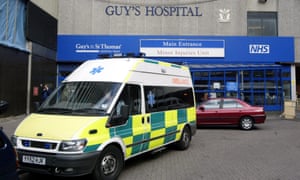
From April, Londoners needing urgent dental care will have only two options: specialist clinics at King’s College Hospital and Guy’s Hospital, both in south London, though the Guy’s service limits treatment to 55 patients a day and those needing care must be there as early as 7.30am to secure an appointment. The Royal London Hospital in east London recently shut its clinic.
An NHS England spokeswoman said: “We recently reviewed the service and found that there is sufficient capacity for patients who need urgent dental care at existing dental practices and so the closure of the service would not negatively impact patients in the area.
“There are more than 1,250 high-street dentists across London where patients can access dental care when they need it. Londoners in need of urgent dental care should call NHS111, who can then signpost them to the most appropriate service for their treatment.”
Am I the only one who laughs myself to tears when I read the meme: “Either my house is clean and I look like a dirty truck driver, or my house is a mess, and I look like JLo. There is nothing in between?” I’m so tired, and I can’t do it all and myself, or my house is generally always in disarray. I am 38 years old and have three small children, who suck the life from me. I’m trenched in tantrums, diapers, laundry and sleepless nights. For these three reasons – I didn’t get to check off any of my New Years resolutions from last year, so is setting resolutions this year even worth it?
Almost half of the people in the United States make New Years Resolutions, and eight percent actually keep their New Years goals. These numbers are a little discouraging, and I admit I am rarely a part of the coveted eight percent, but honestly my conscience would suffer too much if I didn’t at least try to commit to doing better.
So this year I’m going to lower my expectations, and set goals that make more sense for a young mom raising three children under six. I hope the goals will be as good for my kids as they are for me. The following are my 2017 goals in no particular order:
I’ll cut down on Facebook, Instagram, and Pinterest usage. During my downtime instead of spending time on social media, I’ll take in the sound of silence. When I am with my kids, I’ll watch them play and interact with them, instead of my iPhone.
It’s too hard to pack up the kids and take them to the daycare at the gym or to your friends. It takes twice the time to do. I used to swear off of at home workouts, but now they seem like the only option that actually makes sense. My little ones might get in the way a little, but most of the time they work out right alongside of me.
When you realize a 300-calorie workout is destroyed with a handful of chocolate chips, you are more particular about what you eat. I won’t walk away from sugar completely this year; I’ll just have one less handful of chocolate a day.
I’m going to leave my house without my kids more often. This year I will go on more dates, I will take more ‘me’ time, go to bed an hour earlier, or whatever else it takes to regain some of the sanity my children robbed me of during the day.
It’s a long-standing tradition of moms to pile on the responsibilities, and I am no exception to this rule. I’m going to set more boundaries in 2017. Take unnecessary things off of my plate. Learn to say ‘no’ more often to friends, family, and co-workers.
Young motherhood is one heck of a season. I never thought I would spend so much time crying over sappy commercials. Or laughing at really goofy things my toddlers says. Or wondering how long it will be before my kids are off to college.
Being an older mother of young children is tough and spare daytime hours are not generally on my side. But when I look at the bigger picture it does make sense to make and keep goals. Right now really is the best time to set New Year’s resolutions. My kids are still young, and I am still their world. Wish me luck this time around, because I hope to make 2017 count for my kids and for me.
I had always thought I could swim. It may have been because I could run. It may have been because I wanted to swim. Or because I only ever did 10 minutes of breaststroke at a time, or splashed off a warm beach. But I really couldn’t swim.
It took 12 months of lessons and practice before I was able to swim in open water, beyond the pool or my home beach in Brighton. Then I could let myself believe I was up to taking on a challenge I had been dreaming of for more than a year: I wanted to swim in the Greek waters of the Ionian Sea. Specifically, I wanted to swim to Ithaca, the island home of Greek hero Odysseus.
Since childhood, I had been fascinated by Greek myths and the heroic tales of the Trojan war. As I grew older and read classics at university, it became Odysseus who captured my imagination more than any other. Legend has it that Odysseus was within sight of Ithaca when he was blown hundreds of miles off course. It took him several years to get home after that. Meanwhile, his wife Penelope stayed at home on Ithaca, spending every night unpicking the embroidery she had completed during the day, having promised her suitors that she would marry one of them just as soon as her sewing was finished. Eventually, a decade after Odysseus set out from Troy to return home, they were reunited. Sometimes you have to wait for the one you love.
I never wanted to be Penelope; instead, I had fought for years to be my own hero, my own Odysseus. I wanted my sense of belonging to come from within, and as soon as I found that, I found D, my husband. Now that I had my own Ithaca, I wanted to see the real one.
There was a deadline to contend with: after a year of marriage and even longer of trying for a baby, we had recently been referred for IVF treatment. I was shaken by the news. My relationship with my body had changed radically over the last few years. Finally learning to have a little faith in what it was capable of had been one of the most rewarding experiences of my life. Now, I was being told that positive thinking was not going to be enough.
Six weeks later, I was on my way to the island of Lefkada, where I was going to spend a week on a guided swimming trip around the islands of the Ionian. It would be an opportunity to see what I was capable of in the water, and to remind myself of the barriers I had overcome, even as I was now confronting a new one.
The evening I arrived was heavy with heat. We all gathered on a terrace overlooking the sea to introduce ourselves and eat together under the vines. J, the leader of the trip, encouraged us to go around the table saying a little about ourselves.
“Hi, my name is Jess and I recently swam the English Channel as part of a relay with some mates.”
“Hi, my wife and I are regular Masters swimmers in the south of France; these are our times…”
“Hi, I’m on this trip with my teenage daughter as a rest before her Olympic tryouts.” And so it went, on and on. These were people who had swum for their country, across their country and to their country. They may as well have been a different species.
The first morning, we boarded a beautiful wooden boat with a taciturn Greek captain who made no effort to hide the fact that he despaired of us all and our sanity. The pattern for the week was quickly set. The boat headed out to wherever the swim was to begin, then we would be briefed on deck about what type of swim it would be. Some were coastal, all the way around an island, with plenty to look at below us; some would be crossings from island to island – more satisfying, but potentially much harder work. And some would be a combination of the two. For most of the week, we would have a morning swim, lunch somewhere nearby, then a bit of time on the boat before a second swim. Friday would be the exception, because that was the day of the heroic 5km swim from Kefalonia to Ithaca.
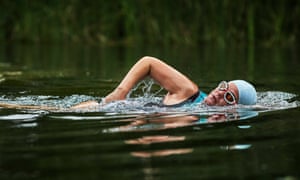
‘The barriers were not merely physical, but mental.’ Photograph: Chris Floyd
Being in an entirely unfamiliar environment was all-consuming. I was used to wading into the water; a slow walk with a gradual drop-off. Now, we were clambering or jumping off a boat, straight into deep water. The most striking thing was its clarity. I had never seen anything like it. In Brighton there are only a few days when the water is clear enough to see through, and even more rarely is the ocean floor visible. Now, I could see a whole new universe. In our underwater world, body type had little effect on how we moved. The strength, the glide, the ease of the reach through the water was all that counted.
I found the sensation of travelling between two bodies of land dizzyingly intimidating. Once, managing a single length of the pool had been too much for me. Then, swimming in open water, albeit close to the shore. Then, the unknown length and depth of the river. Each time, I had persuaded myself that if I could relax and focus, I could do it. Each time, I had been proved right. The barriers were not merely physical, but mental.
This was something else entirely. As we reached the farthest point between the islands, the sea became so deep, it was beyond blue; a dark purple, almost charcoal, with shimmers of yellow as the current moved on and on below us. We found ourselves righting and re-righting our course, having to fight to stay straight, rather than being dragged somewhere else. That pull in the water, begun as a ripple on the other side of the world, reached me then, in that moment, as if gently to tug my sleeve and let me know that, perhaps, I was reaching the limitations of what my body could do. And the thought stayed with me all week as we approached Friday, the day of the 5km swim.
We had a pre-6am start that morning, to be ready for a boat trip of more than two hours. I was tired and beginning to ache in places I had never felt before. The mood on the boat was noticeably quieter than usual. Until now, I had enjoyed conversations with the group, getting tips on my technique, as well as hearing stories of their entrancing swims around the world. Today’s early start and the task ahead, though, had left us all but silent.
It’s all about the breath, I reminded myself. Keep the breath steady and you’ll keep yourself steady
My nerves were mounting. Not only was it farther than I had ever swum continuously – by more than a kilometre – but we would be negotiating a busy channel, competing with swells and currents, as well as holidaymakers’ boats and billionaires’ superyachts. And there was the added pressure that we had been told to swim tightly in our groups during the crossing, directly alongside each other for safety: there was no option to slow down to catch my bearings or indulge in panic. I would either let the team down or find myself drifting dangerously alone in the currents.
I sat in the prow of the boat, my legs dangling over the water as she moved slowly through the still, flat, unbroken surface, the sun rising behind the distant islands, and I felt horribly alone. I missed home with a longing I was sure only Odysseus had ever felt. For the others, this was an energetic holiday, but for me it felt like a last chance to prove to myself what I was capable of before I faced the uncertainties of IVF.
As I stared down into the water, a dolphin’s fin broke the surface and danced ahead of us. I yelped; the captain cut the engine. In that instant, I saw that I had been a fool. Only seconds before, I had been feeling so utterly alone while mere metres from such a magnificent sight. The dolphin leapt and pranced ahead, before approaching the boat and swimming alongside it for a little while. I sobbed, overwhelmed at how appallingly close the lowest and the most beautiful moments can be to each other. Yes, we swim alone. But we can never truly know what swims alongside us.
Half an hour later, people started to ready themselves to head into the water. My heart was hammering. It’s all about the breath, I reminded myself. Keep the breath steady and you’ll keep yourself steady.
Now it was time to swim. I became lost in sensory overload within the first few minutes. The light seemed liquid, leaping up and circling me every time I drew my hand through the water, trying to push against the current that was moving with such strength beneath me.
The first hour or so went smoothly, the group moving steadily as one. About halfway, something changed. We were approaching a tiny island, barely big enough to lay a picnic blanket on, and until this point we had been using it as a sighting point, keeping it in view in order to steer a straight course. We were to swim north of it as we passed, which we were all on course to do. As we approached, the ocean floor came up and back within sight. There was some comfort in seeing the sloping patterns of the underside of the island beneath us. Until I realised that it wasn’t moving.
‘I had never stood toe to toe against nature in this way before.’ Photograph: Chris Floyd
We were swimming at our hardest. Perfectly in rhythm, well warmed up, pulling hard, breathing hard. At last, I felt like a real swimmer. Except I was going absolutely nowhere. An anxiety dream come to life. I was pulling and pushing at the water with all my might, but we had hit the point where the currents were at their strongest. The harder I swam, the less I moved. The rocks below me were entirely static.
I continued like this for five or 10 minutes before panic set in. I knew that to stop was instantly to slide back, away from the group. Exhale. Keep going. Exhale. Believe. Exhale. Glide. But the demons were chasing me now. I had never stood toe to toe against nature in this way before. You can’t fight nature, I thought, and felt tears choke in my throat. I forced an exhale. I wouldn’t let myself think it. But I did. If you can’t fight nature, what about pregnancy? And with that I was lost in a world of worry. Would I ever get pregnant? What would IVF do to me? What would IVF do to us? Would it be worth it? Would we get there? When would I know?
The water swirled around me and roared in my ears. I forced the air out of my lungs, again and again. The salt water was crusting my mouth, and every breath felt like a punch as the sunlight hit my eyes.
Your body might never be the same after this summer, I told myself. Enjoy what you have
Think of home. Be your own hero, be your own Odysseus, be ship, cargo and crew. I repeated these things to myself again and again, forcing physical relaxation until mental solace came. I made myself feel the power in my limbs and lungs, and love it. I was strong. Your body might never be the same after this summer, I told myself. Enjoy what you have.
Eventually, I won the battle. The rocks beneath me slid slowly out of sight. The deep blue returned. I have never been so glad to be swimming so utterly out of my depth. But the horror wasn’t over. About half an hour later, a sort of fizziness began in the tips of my fingers. I had only felt it once or twice before, in the final few metres of running events. I knew it meant that I needed oxygen, and fuel. I realised what was happening and tried to power my way through with positive thinking. Success was limited. My mind had got me thus far, but my lungs had not had the chance to catch up.
I needed help. I called to the rescue boat, and clung to it. J told the others to carry on, while I hauled myself in. My breathing was laboured and erratic, my head spinning and the tips of my feet and fingers numb. I breathed. I gulped at the orange juice on board to get some sugar into my system. I grabbed a handful of nuts. Devastated not to be in the water, I sat, breathing, for five minutes. We were so close to Ithaca. I could make out individual trees on the mountainside. Ten minutes later, I knew I couldn’t let the dream go.
“Can I get back in?” I asked.
J checked me over, to make sure that I wasn’t still delirious.
“I have to reach Ithaca. It’s why I came.”
She nodded. I leapt off the boat and headed for the grey rock. I couldn’t believe there was any strength left in me, and I vowed never to forget the moment that the island’s sea life started to make itself apparent to me. Once again, the sea shallowed, and fish shimmied between crags, sea urchins perched on ridges and starfish danced on the side of the island.
Finally I touched the rock, and burst into tears. Huge sobs, shaking my shoulders, forcing me to cling on to the island to keep myself steady. I had done it. I had discovered a grit I hadn’t known I had. I had slowly, over a year of marriage and a year spent in the water, learned that strength does not always mean merely ploughing forward in the face of adversity; it means changing your plans when what you’re doing isn’t getting you where you need to go; and it means nurturing the confidence to adapt without panicking. The relaxation that swimming demanded of me had taught me that calmness is strength. As I clung to that rock, I had no idea of the extent to which my adaptability and survival skills were about to be tested.
***
As the plane landed back on English soil, I smiled, knowing that I would be home soon and that there were still a few months before the most difficult stages of the IVF swung into action. I was gleeful to be returning to my Penelope, but it was tinged with the melancholy of knowing this summer was past full bloom. I wanted to carry on swimming outdoors, putting my new-found strength and confidence into practice.
I was sure I would be pregnant soon. I was anxious about the side-effects of doing a cycle of IVF, but I was not anxious about it failing.
I was wrong. It proved a brutal and disorienting experience. The cycle ended in early September with me battle-scarred, exhausted and with a streak of red blood that confirmed that I was not pregnant. The Saturday morning after we realised the treatment had not been successful, I woke up at 6am and stared at the ceiling as the tears rolled slowly, silently, down the sides of my face and on to the pillow. What now?
Slowly, the overwhelming duvet of sadness that had swamped us began to shift. While the summer had not been the idyllic sea frenzy I had hoped for, once I looked up and beyond myself, I saw that we were being treated to an exceptionally beautiful autumn. We had agreed to try one more round of IVF, but for now I had a chink of time in which to use my body for as much adventure as it could manage.
As autumn progressed, I swam and I swam, feeling the strength flowing gently back. I had been utterly unprepared for the havoc that the drugs and surgery would wreak on my body. There were extra rolls of flesh that seemed to have sprouted within a fortnight. The belly that appeared as I grew eggs stayed, as did the soft pouches sitting on my hips. My boobs were uncontrollably enormous – the sort of thing mothers-to-be so often take delight in. But, for me, they did not represent an exciting new life change, merely a daily reminder of what I didn’t have. As did the significant amount of internal pain in which the egg collection surgery had left me and which meant that running, and its associated jiggle, was out of the question.
Slowly I emerged from this body that bore no relationship to the one I had built for myself over the previous five years, and took on more and more swims, enriched weekly by the sights, smells and sounds.
Soon, we had a second round of IVF scheduled. I felt fiercely protective towards my own body. Ours was a relatively new love, hard won over miles run and distance now swum. It had taken years to accept that, yes, my body had value, but that value lay more in where it could take me, what it could show me, than in any perceived visual pleasure it could provide for others. I tried to approach this latest quest with the spirit of adventure that had sprung so late in me but proved such a source of joy. I would not yield to any suggestion that my life or my body were lesser if they didn’t incorporate motherhood.
Resolute about keeping my fitness up, I swam lengths twice a week in the pool and continued to swim in the sea, even as the heat slowly started to ebb from it. The day before my second egg collection surgery, I swam in the mouth of Shoreham harbour, feeling my muscles read the movement of the water and warm my blood against the autumn chill. I had rebuilt myself. I was ready.
This time, the treatment went well, and a few weeks later we had a positive pregnancy test. It was followed by the heartbreak of miscarriage. The first round had been disappointment, a setback. This round was crushing grief. My body had betrayed me. Where I had found strength, I now saw inadequacy, insufficiency, weakness. Where I had found beauty, I now saw flesh that served no purpose: a nascent belly, swollen from medication but aching with emptiness, uncontainable breasts bursting with anything but sexuality. Where I had felt self-love, I now saw an unwelcome stranger in the mirror. My body had been rejected, and in turn I rejected my body.
‘I have learned not to be frightened.’ Photograph: Chris Floyd
The first time I felt strong enough to get back into the water was in December. I underwent a full winter of cold-water swimming. I never chose to do it; I just chose not to stop doing it. Where so many other plans around me had turned to dust, in one area at least I just had to keep going.
Jumping into cold water if you are not accustomed to it can put huge pressure on your heart, send your breathing into potentially unrecoverable erratic fits and starts, and leave you woozy with hypothermia – too sleepy to swim, too cold to recover. You can’t fight thermodynamics any more than you can fight infertility. But you can adapt. You can acclimatise. You can find joy where others see pain. And this was what I chose. To keep swimming, week in, week out, until what had seemed like an impossibility became golden, a delight.
Through January, February and on towards March, the coldest month, I carried on swimming. Though the sea temperature dropped incrementally each week, my body, as it slowly acclimatised, felt the same each time. After five minutes or so, my body would start to warm me from within, the hard work of the swimming pushing heat as far as it could out into my limbs. My skin would glow red, as if I’d received a thousand tiny slaps. Within half an hour, I would be glowing from within, warm for the rest of the day. Like a hangover in reverse, I had done something that was painful for moments but that left me feeling well for hours. I had made the difficult habitual, the habitual easy and the easy beautiful.
That winter of swimming was a sort of inadvertent exposure therapy. A type of behavioural therapy used to treat anxiety disorders, exposure therapy usually involves helping people to confront their fears by exposing them in tiny, almost insignificant amounts to the thing they are most afraid of.
There are people all around us dealing with sickness, injury and upset, but they choose to keep moving
Over the winter, I repeatedly exposed myself to the elements. As I hit the water day after day, I took myself to a place I never thought I could go. Previously distressed at having reached the limits of what my body could do for me, I rediscovered pride in what it could achieve and where it could take me.
More importantly, I was exposing myself to myself. That winter, I was the heaviest I had ever been. At the time, it felt like weakness, like surrender, but now I see that what felt like unnecessary blubber from hormones, grief or greed was keeping me warm, keeping me in the water to do what I needed to do. To thrive at the weight I was felt not just subversive, but a triumph.
I was emerging from the water calm but energised. I could do more than I’d imagined, and the more I swam, the more I witnessed others experiencing this alongside me. As I glided along in the lido, I saw women slowly easing themselves down the steps, scars the length of their thighs. I saw injured shoulders ahead of me, struggling to swing their arms around but finding fluidity and peace in the water. I saw women who arrived at the seafront jangling with panic or sadness, leaving it serene an hour later.
These quiet, everyday gladiators battling the wet and the cold showed me time and again that it wasn’t just me who headed for the water in times of distress. There are people all around us dealing with sickness, injury and upset, but they choose to keep moving instead of standing at the edge of life, peering in.
When I think about never having a child, a sort of breathlessness, almost a vertigo, comes over me. The same metal vice tightens around my ribcage, the one I felt as I entered the sea those first few times. I don’t know if we will ever have a child. I don’t even know if we have it in us to try IVF again. But I never know for sure what swims beneath me as I push myself through open water.
Swimming has taught me about my adaptability. It is not enough simply to train hard. You must adjust how you move, refine how you approach the water and embrace your environment. In swimming, as in life, I found fortitude and resilience when I needed them most; but I also found the courage to change depending on the weather, the tide or my own body. I have learned not to be frightened; that life is to be lived as a participant, not a spectator.
The most useful thing anyone said to me about grief is that you never really get over it. When you have difficulties with fertility or staying pregnant, the whole experience is a process of accepting that grief might be round the corner. But is that not the very nature of love? To fall in love is to expose yourself to infinite potential for rejection or pain, and to be a parent is to accept a lifelong commitment to the unknown. To love truly is to know that you might lose it in a heartbeat. In the same way that you never know if the wind will change when you’re half a mile from the shore, or the waves might smash you in the face just as you gasp to breathe. We must stand on the shore, proud of the life our bodies offer us, and accept that we’ll never truly know what lies beneath the surface any more than we’ll know what lies ahead. And then we must leap in.
• This is an edited extract from Leap In: A Woman, Some Waves And The Will To Swim, by Alexandra Heminsley, published next week by Hutchinson at £12.99. To order a copy for £10.65, go to bookshop.theguardian.com, or call 0330 333 6846.
Every so often, as an anaesthetist, you know the patient may not wake up and that you will be the last person they ever speak to. This operation may be their last chance at survival but it may also be the very instrument which ends their life. Something has ruptured. They may be bleeding. You don’t know if you can “turn off the tap”. The patient may be frail but you must at least give them the chance.
Getting them through the operation can be the easy part but the body has suffered enough and simply does not have the reserve to deal with the trauma. They remain sedated as the feeling of a breathing tube and the nature of being a patient in intensive care would be as unpleasant as the operation itself. You keep them alive but only under the immense power of an arsenal of drugs reserved for these circumstances. You keep them alive with the hope they may pull through, but occasionally only so their loved ones can be by their side at the moment of passing.
Barriers may unintentionally fall and their true feelings are revealed, possibly followed by a knowing laugh
A patient’s last words can be deeply profound, even prophetic of their own mortality. They can be completely ignorant of their condition through delirium or dementia. Vital organs only take minutes to become irreversibly damaged. They need oxygen, they need blood and the body’s systems are failing, often before your eyes. Sudden confusion, unconsciousness, abnormal breathing, all signs of impending shutdown. You have to take over, you have to replace that which has failed. A tube to deliver life-sustaining oxygen, fluids or blood to replenish what was lost, and anaesthesia to rest a frantic brain and spare the memory of any suffering.
Those who you can talk to you reassure. You tell them everything will be done to wake them and that there will be no pain, they will not suffer. They understand. Reassurance is easy, a few simple words spoken honestly and calmly. You gauge the mood and ask them about who is waiting for them when they awaken. How long have you been married? What kind of dog do you have? Find the right path to follow and they will lead you down a road of conversation which lasts until the point of unconsciousness. Barriers may unintentionally fall and their true feelings are revealed, possibly followed by a knowing laugh. They know their secrets are safe.
Revelations range from patients, previously brave-faced, who confess their terror at the prospect of never waking, to those who divulge a sense of abandonment of life. They have suffered enough and want this sleep to guide them gently to death. One patient admitted to having enjoyed a cheeky slug of whisky a friend had smuggled to him just before coming to theatre. People share a joke and a smile. The release of a smile is echoed in the slowing heart rate only associated with feeling calm and relaxed. The beeping machine that monitors their heart becomes a metronome of their emotion.
I remember one man who was brought to theatre for an emergency operation. He was dying but nobody knew when. The cancer had spread and was now blocking his gut. He knew the operation might kill him but wanted to take the chance that he may survive long enough to leave hospital to organise his affairs and be with his loved ones at the end. His mood struck us all. He was dying yet had a smile on his face and was quick to share a joke. No one said “see you afterwards” as we most often do, we just invited him to think of somewhere he would rather be. He smiled again – “anywhere but here” – and laughed. He never spoke again. He passed away under anaesthesia the following day with his family by his side.
Only in the hours or days following the event does the poignancy hit you. You start to reflect on not only the words themselves but the underlying emotions the patient was experiencing. There is a sadness, especially when speaking to a patient’s loved ones, but the opportunity to reflect provides a chance to learn and question your own practice. Your normal bedside manner was aimed at inducing calm before the anaesthesia itself. Did it work? Did you quell the fear in any way? Could anything have been said differently or not at all?
A person’s last words can be a defining moment. You speak to families and you tell them there was a smile, even a giggle. The fact that this was their last conscious, communicated thought will hold in the memory of anyone who cared for them. “Yep, that sounds like him!” Another smile. A seemingly impossible moment of happiness.
If you would like to write a blogpost for Views from the NHS frontline, read our guidelines and get in touch by emailing sarah.johnson@theguardian.com.
Join the Healthcare Professionals Network to read more pieces like this. And follow us on Twitter (@GdnHealthcare) to keep up with the latest healthcare news and views.
Men and women have grown taller over the last century, with South Korean women shooting up by more than 20cm (7.9in) on average, and Iranian men gaining 16.5 cm (6.5in). A comprehensive global study looked at the average height of 18-year old men and women in 200 countries between 1914 and 2014.
The results reveal that while Swedes were the tallest people in the world in 1914, Dutch men have risen from 12th place to claim top spot with an average height of 182.5cm (5ft 11.9 inches).
Latvian women, meanwhile, rose from 28th place in 1914 to become the tallest in the world a century later, with an average height of 169.8cm (5ft 6.9in).
With an increase in height seen across the century in every country around the world, the British have also gained a few inches. Both men and women have added around 11cm (4.3 in) to their height since 1914, with the average man now 177.5cm (5ft 9.8in) tall and the average woman boasting a height of 164.4cm (5ft 4.7in).
Mean height change since 1914 – women
James Bentham, a co-author of the research from Imperial College, London, says that the global trend is likely to be down primarily to improvements in nutrition, hygiene and healthcare. “An individual’s genetics has a big influence on [their] height … but once you average over whole populations genetics plays a less key [role],” he added. “Most populations would grow to roughly similar heights if they were all in the same conditions.”
A little extra height brings a number of advantages says Elio Riboli, co-author of the paper and director of the School of Public Health at Imperial College, London. “The good news is that being taller is associated with longer life expectancy,” he said. “This is largely due to a lower risk of dying of cardiovascular disease among taller people.” But, Riboli warns, while taller people have been found, on average, to have larger salaries and higher levels of education, there are downsides, with greater height potentially associated with an increased risk of some cancers.
The research was published in the journal eLife by the NCD Risk Factor Collaboration, a network of nearly 800 health scientists worldwide. The scientists drew on almost 1500 sources, including government health studies and military data, to model changes in the height of 18-year-olds across 200 countries over 100 years from 1914.
The results show that men are taller than women around the world, while for both sexes European countries now scoop the top 10 positions for height, with Dutch men and Latvian women the tallest for their sex. That, says Bentham, could be down to the introduction of a welfare state in many European countries.
By contrast, men from Timor-Leste are the shortest, with a height of 159.8cm (5ft 3in), while the title for shortest women remains with the female population of Guatemala, who have an average height of 149.4cm (4ft 10.8in).
But while height has increased around the world since the eve of the first world war, the researchers found that the degree of change varied greatly between countries.
Mean height change since 1914 – men
While South Korean women have shot up by just over 20cm (7.9 in) since 1914, men in South Africa have grown by just 1.4 cm (0.55 in) over the century. American men, meanwhile, have plateaued in height since the 1960s, resulting in a drop from third place in 1914 to 37th place in 2014. That, the authors suggest, could be down to worsening levels of nutrition and greater inequalities.
The trend in many countries of north and sub-Saharan Africa is also cause for concern says Riboli. While the research shows that height increased in countries such as Uganda and Niger during the early 20th century, the trend has reversed in recent years, with height decreasing among 18-year-olds.
“One reason for these decrease in heights in Africa is the economic situation in the 1980s,” said Alexander Moradi of the University of Sussex, who was not involved in the study. The nutritional and health crises that followed the policy of structural adjustment, he says, led to many children and teenagers failing to reach their full potential in terms of height. “I think one thing that one should keep in mind in these studies is that height is a useful indicator of how nutrition and health is developing and that these are closely related to the overall economic development [of a country], ” he added.
Bentham believes the global trend of increasing height has important ramifications. “How tall we are now is strongly influenced by the environment we grew up in. In turn, our height affects both our life expectancy and our health as adults,” he said. “If we give children the best possible start in life now, they will be healthier and more productive for decades to come.”
And as she reached out and registered the residing legacy of her son, anything that had been empty was filled, a connection that was severed was restored
Stirring, strong and the type of daily life-affirming moment that ought to have every single last one particular of us registering as a donor. And however. And yet it is not so basic, is it?
Organ donation is an uncomfortable, gruesome topic. If it weren’t, there wouldn’t be this kind of an indignant fuss in excess of government proposals this week – to coincide with Nationwide Transplant Week – that anybody applying for a bus pass, a tv licence or a marriage licence or a birth registration should be asked if they want their organs donated in the occasion of death.
Buttonholing misty-eyed brides and gurgling infants for their livers and corneas? How crass, how inappropriate, how MORBID!
If only we could flip our mindset and see organ donation as giving to the living rather than taking from the dead. I’m all for a tick-the-box normalization of the complete approach I’d like to make it necessary, so agonizing above the pros and cons or burying our heads in grief merely isn’t an selection.
Somebody who grasps the horrible dilemma much better than most is Shelley Wealleans, whose infant son, Lewis died of a heart defect aged just 3 months in 2004. At the time she was asked if she would take into account organ donation but, horrified to even be approached, she rejected the concept out of hand.
She went on to have two a lot more youngsters, but with bitter irony, her infant son, Mackenzie was born with a diverse heart defect and desperately required a transplant.
And as she waited and waited for a donor heart of the proper dimensions to become accessible, she ruminated more than her earlier determination.
“When Mackenzie fell ill I felt I was as two-faced as they come,” she explained. “I felt guilty being aware of a mum in the previous was sitting feeling just as I did. I’d said no when I could have saved a child’s existence merely by saying ‘yes’. And then I required some other mom, with much more power and courage than I had, to say ‘yes’ for me.”
But no one did. Two months later, shortly just before his 2nd birthday, Mackenzie died.
When Mrs Wealleans then had a daughter, Madison, she was added to the organ donation register when she was just 52 hrs previous.
There are at the moment 10,000 individuals on transplant waiting lists in the United kingdom. Close to 1,000 desperately ill patients die a 12 months – 3 a day – waiting for donor organs since so few people carry and card and so handful of family members are prepared to permit donation.
But to have any hope of acquiring we have to be ready to give. Some many years in the past the New York Times ran an extraordinary story of a kidney transplant chain that linked thirty residing donors to thirty recipients.
Kidneys can be really effective transplanted from the residing, so the idea was that when patient A needed a kidney but there was no immunological match in the loved ones, he would acquire a kidney from household B supplying an individual from family A donated a kidney to family members C, one particular of whom donated a kidney to family D and so on.
At one point loved ones Q have been donating to loved ones F, but by some means the cat’s cradle of crossed connections “like playing 3-dimension chess” worked and, astonishingly, within six months 30 people had offered and thirty had obtained.
Relying on the organs of the dead is obviously much less predictable. Fate deals its hand at random, but that is all the far more explanation to draw up a count-us-all-in contingency program.
Until finally then, we urgently require to enhance organ donation with national initiatives like National Transplant Week which ends tomorrow, and with local action. At Derriford Hospital in Plymouth, for instance, doctors, nurses and patients, organ recipents and the households of donors, have joined forces in a ‘‘viral’’ campaign to increase awareness with the distribution of rubber bracelets (lanyards for clinical staff) bearing the message ‘‘Join the register. Share your selection. Conserve lives.’’ The concept is as soon as an personal has registered he or she passes on the bracelet/lanyard to one more – and so on.
Selfless humanity comes simpler when we’re in the rudest of well being, nobody’s unwell, nobody’s dead and nobody’s racked with conflicting feelings. And there’s no far better time than proper now to join the register with a keystroke at the pc: www.organdonation.nhs.uk