Thousands of stroke patients will be saved from lifelong disability after NHS England decided to invest millions of pounds in a new treatment hailed as a “gamechanger”.
About 8,000 people a year who have a stroke will benefit from a massive expansion in the number of hospitals offering mechanical thrombectomy.
Currently only a few hundred patients a year receive the treatment and just a handful of hospitals in England offer it, despite its proved effectiveness. Stroke experts say the procedure can produce remarkable results, with patients who would otherwise have ended up in a wheelchair instead able to walk out of hospital within 48 hours of having it.
“Thrombectomy is a real gamechanger which can save lives and reduce the chances of someone being severely disabled after a stroke,” said Juliet Bouverie, the chief executive of the Stroke Association.
“This decision by NHS England could give thousands of critically ill stroke patients an increased chance of making a better recovery. It could also mean more stroke survivors living independently in their own homes, returning to work and taking control of their lives again as a result,” she added.
A thrombectomy is used to remove a blood clot in someone’s brain which has not dissolved despite the patient receiving clot-busting thrombolytic drugs. It involves a doctor putting a thin tube into a patient’s artery, usually through their groin, and then feeding it up through their body to where the clot is in their brain. Once there, a wire mesh tube called a stent – usually used in heart or vascular surgery – on the top of the tube is wrapped around the clot and it is then pulled out by a doctor called an interventional neuroradiologist.
Doing that restores normal blood flow to the brain and greatly reduces damage to brain tissue, which is what causes patients to suffer long-term, often serious damage to their physical and mental functions. Patients are either sedated or under general anaesthetic during the procedure, which must be carried out within six hours of the stroke occurring.
“This major national upgrade to stroke services puts the NHS at the leading edge of stroke care internationally,” said Simon Stevens, NHS England’s chief executive. “It’s another practical example of the NHS quietly expanding innovative modern care that will really benefit patients, but which tends to be invisible in the public debate about the NHS.”
Stevens is keen that the NHS follows the lead of Germany and France, which undertake 7,500 and 3,500 thrombectomies a year respectively. While the procedure can help 10% of the 90,000 people a year in the UK who are admitted to hospital following a stroke, fewer than 600 patients a year in England have one.
Although the procedure costs about £12,000 to perform, the big savings in medical and social care for patients who would otherwise have been left seriously disabled have convinced NHS England that it represents value for money.
St George’s in London is the only hospital in the UK to offer thrombectomy around the clock every day of the week. NHS England hope the massive expansion will lead to 24 NHS trusts which are centres of excellence in neuroscience operating on the same 24/7 basis as the NHS becomes more of a seven-day service.
Dr Jeremy Madigan, a consultant diagnostic and interventional neuroradiologist at St George’s, said: “Our patients are benefiting from the thrombectomy service we provide, with an 80-90% chance of opening up blocked vessels via this technique, compared to 30% with traditional clot-busting drugs.
“Providing a thrombectomy service at all times of day, as we do at St George’s, radically improves the range and mix of interventions available to us as clinicians.”
However, Bouverie said that creating 24 centres to perform the procedure would compel the NHS to centralise acute stroke services in fewer places, which would likely prove controversial.
It would also require a big increase in the number of interventional neuroradiologists the NHS employs – currently about 90 – especially if the service is to operate around the clock.
Dozens of hospital stroke units should be shut and the service reorganised into fewer centres of excellence in order to improve care, the charity representing stroke survivors has insisted.
Centralising stroke treatment at a much smaller number of hospitals will increase patients’ chances of survival and reduce their risk of long-term disability, the Stroke Association says.
Juliet Bouverie, the charity’s chief executive, accused hospitals of risking lives by retaining stroke units when medical evidence suggests they should be moved. While reconfiguration is controversial, patients and their families generally understand that travelling longer distances to get a higher standard of care and reduce the risk of dying is worthwhile, she insisted.
“At the moment there are 126 hospitals in England which routinely admit stroke patients. That number needs to be reduced to somewhere between 75 and 100. But progress on that is very variable across the country and so unnecessary costs are being incurred and unnecessary mortality is happening,” she said.
She urged hospital and NHS chiefs to learn lessons from studies showing that scores of lives are being saved every year by the reorganisation of stroke units in the capital in the 2000s. “Previously there were more than 20 hospitals providing acute care in London and there was strong evidence that actually reducing the number of acute stroke units and creating a hub and spoke model [of bigger hospitals supporting smaller ones] on stroke would not only save lives but it would also save the NHS money.
“So they reduced the number of acute stroke units from 20 down to eight and the evidence shows that each year more than 100 patients extra are saved as a consequence. That’s now been replicated in Manchester, with equivalent numbers of lives saved.”
Tony Rudd, the national clinical director for stroke at NHS England, says: “The changes to stroke services in London have saved lives, proving it is right to concentrate expertise in selected centres. One advantage of the local planning arrangements is they can identify where there are opportunities to provide this more focused care for stroke patients.”
Centres of excellence would offer better care by having larger numbers of patients and would tackle the shortage of specialist doctors and nurses by concentrating them in fewer places. They could then offer patients clot-busting drugs and, potentially, 35 to 50 could undergo a new surgical procedure called mechanical thrombectomy, in which even large blood clots in the brain can be enclosed in a stent. Many more hospitals than the current handful should be offering the £7,000-a-time “game-changer” operation, said Bouverie.
Hospitals’ self-interest is “stalling” what should be an NHS-wide drive to improve stroke care, she claimed. “Too many hospitals are protecting their own interests and not doing what is in patients’ best interests. No hospital wants to give up some of those life-saving treatments, but it’s not in patients’ interests for these smaller hospitals to be delivering services.”
Too many of the sustainability and transformation plans drawn up by NHS leaders in 44 areas of England do not include clear ways of reorganising stroke care, despite evidence that fewer units reduce the risk of death and disability.
Hyper acute stroke units usually administer life-saving treatment for three days and then transfer patients to a stroke unit, with patients then moving to a rehabilitation unit or going home. Centres of excellence would help overcome the postcode lottery that means that 82% of stroke patients treated at Ipswich hospital, for example, receive clot-busting drugs within the recommended four hours but only 15% of those attending Wexham Park hospital in Slough.
Bouverie blamed the NHS for neglecting survivors after their discharge from hospital: “More than 46% of patients told us in our most recent survey that when they’re discharged from hospital they feel isolated and abandoned. They say that physiotherapy is not adequate and they’re not given access to the right psychological support. People are not getting access to speech and language therapy in a timely manner,” she added.
“Many stroke survivors have a physical disability, depression or psychological needs, suffer chronic fatigue or have aphasia, where they cannot speak. You’ve got stroke survivors at home with serious disability, often still in wheelchairs, unable to communicate, suffering the damaging psychological effects of what is a life-changing condition and not being given the proper support. ”
She criticised NHS bosses and ministers for refusing to draw up a strategy to reduce the UK-wide toll of 40,000 deaths caused by the 100,000 strokes that occur every year, despite the government’s pledge to reduce premature deaths. Stroke campaigners feel “ignored” because NHS England chief executive Simon Stevens is concentrating on improving cancer, mental health, maternity care and dementia services rather than prioritising Britain’s fourth biggest killer.
Stroke, or “brain attack”, is the third biggest killer in the western world, after cancer and heart failure. The life-changing effects associated with this simple, Anglo-Saxon word are readily explained: a stroke occurs when the blood supply to the brain is disrupted by a blood vessel either bursting or blocking, so that the part of the brain supplied by this blood vessel dies.
The brain is a much more complex organ than the heart. While strokes are a common feature of everyday life, precisely how and why they occur is far from straightforward.
Each year in the UK, there will be about 50,000 brain attacks. One-third of those affected will die; one-third will be left severely disabled; and about one-third will make some kind of recovery. In the time it takes to read this article, approximately nine people in Britain, from across all age groups, will have suffered a stroke.
Or did they? For the brain is not only super-sensitive territory – as the human animal’s command HQ – it is also top secret. Despite extraordinary progress in MRI scans, the brain remains essentially mysterious and the symptoms of its dysfunction can be hard to diagnose with certainty. An elderly man presenting himself at A&E with unsteady gait and a slurring of his words could be suffering a stroke – or he might just be intoxicated. Treat him for the former, and you’ll save his life; treat him as a drunk, and he might die.
This is not the only way in which stroke sufferers find themselves trapped in a medical lottery. From the beginning of a stroke, every minute, even every second, becomes a matter of life or death in which the patient’s response is crucial. The onset of a brain attack is bewildering and confusing. For patients in the midst of a medical emergency, the key to the best recovery is rapid recognition of the attack followed by the prompt implementation of brain-saving treatment. But rapid recognition is easier said than done.
All strokes are unique, with a multiplicity of symptoms ranging from a drooping facial muscle to total unconsciousness. But paramedics’ guidelines, such as facial paralysis or slurred speech, do not offer a foolproof diagnostic tool: up to 50% of all pre‑hospital stroke diagnoses turn out to be inaccurate.
The diagnostic predicament is also bedevilled by the phenomenon of “mimics”. For example, a patient might come to A&E with a very bad migraine, exhibiting all the symptoms of stroke. Devoting the resources of stroke treatment to such a mimic is costly in both time and resources, the last thing a cash-strapped NHS can afford.
In A&E, one of the biggest – and potentially most expensive – problems faced by doctors and nurses is how to weed out the mimics and decide if a patient has or has not suffered a stroke. This decision can be fateful. Send the patient for immediate treatment, and all kinds of good outcomes might follow. Delay an hour, and the patient might be on the road to severe disability, even death.
As long ago as 1998, the complex challenges of stroke diagnosis began to intrigue an inquisitive Scottish neuroscientist named Nicholas Dale. He takes up the story: “Some strokes are really obvious. The brain scan shows exactly what’s happened, and everyone is in agreement. But then there are those strokes where the brain scan doesn’t really show anything, even though the symptoms are there. Those are what you might call ‘possible strokes’. What is a clinician supposed to do?” To this last question, Dale would come eventually up with an answer about the size of a thumbnail: the SMARTChip.
Twenty years on, Dale’s tortuous journey into the dark maze of neurological emergency is reaching a climax. After a series of nationwide clinical trials, the Observer can report exclusively that Dale and his biosensor company, Sarissa, an offshoot of Warwick University, are on the threshold of a remarkable breakthrough in stroke diagnosis.
Dale’s pioneering contribution to stroke medicine is a classic tale of scientific innovation replete with accidental discoveries, chance meetings and frustrating setbacks. Add this to the sheer slog of a determined neuroscientist who seems professionally addicted to finding bees in his bonnet, and you begin to approach the story of the smart chip that saves lives.
Dale’s breakthroughs in stroke prevention had mundane beginnings. “My original work,” says Dale with a wry smile, recalling his graduate years in Bristol and St Andrews, was “on how tadpoles swim”.
We need not dwell on Dale’s career in the society of the tadpole. Suffice to say that by 1997, he needed to invent a biosensor to measure the substance adenosine. “I wanted to measure adenosine,” he says, “because I thought that its gradual accumulation in the tadpole’s spinal cord controlled how its swimming slowed over time and ultimately stopped.”
Dale duly published his tadpole findings. It was then, in 1998, articulating a vague thought in the back of his mind, that he uttered to himself the sentence – “This biosensor must be useful for other things” – that would not only change his life, but profoundly influence the fates of many UK stroke patients. At this stage, his aspirations were half-formed, and he had no plan. All he knew was: he was done with tadpoles.
Dale admits that he wanted to do work that did not – as tadpoles always did – provoke smiles of disbelief. “I wanted to find an application for these sensors that was real and important.”
He pauses to recall another turning point. “One of my colleagues in Scotland said: ‘The person you need to talk to is Bruno Frenguelli. He’s interested in models of stroke.’ So I met Bruno,” says Dale, with disarming simplicity, “and told him about my biosensor.”
Dale and Frenguelli were a perfect match. Dale was becoming a master of biosensor technology, whose microchips could measure anything. Frenguelli, a neuroscientist at the University of Dundee, had things he wanted to measure, but no way to make the measurement. Soon, Dale was ferrying his biosensor kit in his car across the Tay Bridge to Dundee, and setting up in Frenguelli’s lab. “We both vividly remember our first joint experiment,” says Dale, “because it was so exciting.”
But then what? The bees in Dale’s bonnet began buzzing again. His biosensor was too cumbersome and fragile for any serious medical applications. “I started to think: could we not make something smaller?”
In 1999, Dale was puzzling over how he might do this – “I realised I would need polymers” – when there was a knock at his door. “And in came this guy I’d never seen before.”
“Hello”, said the newcomer. “I’m Enrique Llaudet.”
Llaudet, a Spanish organic chemist, was a whiz with polymers. Just what Dale needed to create new ways of making tiny biosensors.
So began an eight-year relationship, partly sponsored by seed money from a small Scottish charity, and later by the Wellcome Trust. Now Dale and Llaudet, with Frenguelli in the background, began to develop a tiny biosensor, the ancestor of Sarissa’s smart chip.
There were, inevitably, setbacks. At times, the technology let them down; at times, the funding dried up. But Dale, a natural team player, continued to develop his group, which now included Chris Imray (a heart surgeon at University Hospitals Coventry and Warwickshire NHS Trust), Christine Roffe (a stroke specialist at University Hospitals of North Midlands), Gary Ford (Oxford Academic Health Science Network), Everard Mascarenhas (Sarissa’s CEO), and Faming Tian and Shabin Joshi (both also at the Coventry and Warwickshire).
Survival rates for heart attack victims have risen dramatically. By comparison, stroke patients have got a raw deal
By now Dale had moved to Warwick to take up a chair in neurosciences. In 2004, Sarissa filed its first biosensor patent, but then Dale found himself in a blind alley. “We had the means, and we had the ideas, but we were getting nowhere. We tried to raise funds for treating foetal hypoxia.” He laughs: “I soon realised that the middle-aged white males who controlled the purse-strings just aren’t interested in babies.”
Finally, Dale returned to stroke. He had puzzled over its mysteries for years, but had never really grappled with the practicalities. Now he began to advance a brilliant hypothesis, developed in collaboration with Chris Imray. This – the measurement of purines in the blood – had the elegance of simplicity. Imray and Dale had begun to prove that, at the onset of stroke, the brain releases a detectable quantity of purines into the blood. If Dale’s smart chip could measure this surge, it could provide positive proof of stroke. For Dale, “elevated purines” would be the criterion by which he would definitively determine the onset of a brain attack.
Today, in the stroke units where Dale’s hypothesis is being tested, nurses have come to recognise that a high purine reading immediately indicates that stroke is a probable diagnosis.
In 2004, that was all in the future. First, Dale had to persuade the medical profession to undertake a clinical trial. It was his contention that Sarissa’s biosensor could weed out the “mimics” that bedevil stroke treatment.
Sarissa made its first commercial sales in 2005. Its biosensors (aka Sarissaprobe) had potential in clinical diagnosis, but, says Dale “we still didn’t have a product that was close to being useful for clinicians and nurses”. In simple terms, Dale’s biosensor would not work in blood.
Blood is the one thing that medics the world over like to test. But blood, as Dale puts it, “is a complex environment. We had to make our sensors a whole lot more selective if we were to measure a surge in purine levels. This was Faming Tian’s brilliant contribution.”
At the same time, Dale was stepping up the presentation of his biosensor to funding bodies. In 2013, he made a pitch to Invention for Innovation, a committee of the National Institute for Health Research. He will probably never forget this moment:
“I made my presentation, and then this clinical biochemist launched into a statement – it was nowhere near an inquiry – which became so hostile that I felt as if I were a delinquent teenager. There was, he told me, no need for this kind of technology. I was stunned by the aggression and the hostility. When this man had finished, I could not think initially how to respond, so I just said, ‘Was there a question?’” The committee burst out laughing. Dale left the meeting with a sense of failure, but he was wrong.
The committee decided to take a punt on his smart chip, after all. Three years ago, Dale and his colleagues began clinical trials in three UK hospitals, Salford, Coventry and Stoke-on-Trent.
Royal Stoke University Hospital, on the west of the city, is just over 10 years old, and a showcase of New Labour’s commitment to a revitalised NHS. Once, in the bad old days, Stoke was served by two separate, Victorian hospitals, with patients ferried between A&E and the stroke unit, which were in different buildings. Now, with A&E just a lift ride away, everything is under one roof with acres of parking space for doctors, nurses, patients and their families.
Inside, long shiny corridors and blinking tiers of lifts take the visitor into the heart of an impressively modern teaching hospital that caters for a population of about 600,000 in Stoke and Stafford. Add Derby, Macclesfield, Wolverhampton, Walsall, and Telford and you are looking at a catchment of 1.5 million. This is Nick Dale’s designated stroke laboratory, and it’s here, for the past three years, that his biosensor has been tested, under Professor Christine Roffe, a dynamic, highly practical director who has placed her team at the forefront of stroke research in the UK, especially as a pioneer of mechanical thrombectomy. She has been here since 1996, heading a unit that consists of six consultants, two specialists and 10 research nurses.
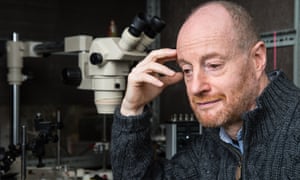
Nicholas Dale: ‘enhanced patient recoveries will dramatically reduce the cost of providing stroke care’. Photograph: Antonio Olmos for the Observer
Roffe has been trialling Sarissa’s chip in Stoke’s acute stroke unit since 2014. It is one of 10 designated hyper-acute stroke centres in the UK, and prides itself on providing a 24/7 response to the emergencies of “brain attack”. Roffe has 26 dedicated stroke beds and another 19 spaces for rehab. The unit will see 1,000-1,200 patients per annum. She also collaborates with Dale at Warwick and teams in Coventry and Salford.
Roffe confirms the starting point of Dale’s initiative: that the first problem in A&E is diagnosis. One-third of all stroke patients are mimics. “Only yesterday,” she says, “we had a patient who turned out to be suffering from migraine.” If they could eliminate the mimics, they could focus all their energies and resources on stroke care.
As we sit in a crowded office adjacent to the acute stroke unit, Roffe reflects on the mystery of the brain. She says, thoughtfully: “There’s still a whole world to be discovered there. We know so little.”
Roffe’s other issue is time. “We want to get them in quick. Time is of the essence. The NHS guidelines suggest that it is vital to treat within four hours.” One problem can be the patients themselves: “They often don’t ring 999 until it’s too late.”
Roffe’s senior research nurse is Holly Maguire, who has been with the unit since 2006. It’s Maguire’s job to integrate the Sarissa’s biosensor with the practice of the stroke unit while at the same time keeping the research separate from the clinical side. Like all medics working in stroke care, Maguire stresses the urgency of her work. Patient consent is a fundamental part of her responsibilities. “Most people are glad to be in the programme”, she says. “We treat first, and then get the consent.”
Maguire and her nursing team will place a pinprick of blood on one of Dale’s biosensors to test for elevated purines, the symptom of a cerebral emergency. She repeats Dale’s stroke-diagnostic mantra: “Normal people (apart from gout patients) don’t have elevated purines.”
At first, the SMARTchip’s performance was rather hit and miss. Now it has become a state-of-the-art device with impressive results. By April 2017, this stage of a three-year trial will be complete. Data from Salford, Coventry, and here at Stoke will be collated by Dale’s team for presentation to the National Institute for Health Research and subsequent publication in clinical journals.
Now that the clinical trials are drawing to a close, Dale can take stock of both its progress and future prospects, contrasting the treatment of brain attack and heart disease. “Survival rates for heart attack victims have risen dramatically over the last 20 years. In part, this has come from faster diagnostic tools such as ECG monitors, and rapid biochemical tests. By comparison, stroke patients have got a raw deal. No equally simple biochemical tests exist in stroke. For neuroscientists, this is depressing.”
“The key to getting the best recovery is rapid recognition of the stroke followed by prompt action to implement brain-saving treatment. This is where SMARTChip is most likely to be transformative.”
In five years’ time, if Dale gets his way, his technology will be a routine part of A&E. He believes that its natural home is “the NHS ambulance, as an indispensable tool in the paramedic’s diagnostic armoury, helping them to recognise stroke patients with greater precision”.
Further, he says, the SMARTChip can be used to monitor the patient’s progress. He concludes with this prediction: “For health providers around the world, enhanced patient recoveries will dramatically reduce the cost of providing stroke care. The resources saved can be diverted to other aspects of quality healthcare as the populations around the globe age and become needier of medical interventions.”
Looking into the future, Dale has ambitious aspirations: “In 10 years time, I’d hope that our SMARTchip would be in the defibrillator boxes that enable the public to treat cardiac arrest. These boxes have been instrumental in saving lives. Upgraded with Sarissa’s SMARTChip, they should become multifunctional, enabling the public to contact the health service with more complete information.”
Dale’s ambition, shared by his team, is that their technology should provide the healthcare professional with a simple and reliable test. Unquestionably, this will have a dramatic impact on the post-stroke life of the patient.
“Personally,” Dale concludes, with quiet satisfaction, “this would be a great source of pride.”
I’ve been working as an occupational therapist with stroke patients for the past three years. It’s a privilege to be let into people’s lives and to get to know them and their families; but if they’re not getting better, it can be heartbreaking.
Working for a full stroke service in Hull, I am always busy. It is stressful and even though I know we do a good job, we always know we could be doing better if only we had the time to sit down and really work it out. Although the day-to-day reality of my job is always different, I could never have envisaged the impact one project would have on me, my colleagues and our patients.
In December 2014, I was asked to go to a workshop with the Royal Philharmonic Orchestra (RPO), which was coming to run music sessions with us as part of its community outreach work.
We met Tim Steiner from the RPO to brainstorm what the issues might be for people with cognitive and physical problems. My first thought was: “We’re very busy, how are we going to fit this in?” I’ve done group work before and while it can be really powerful, it’s hard. I was concerned but I could also see this was an amazing opportunity if we could pull it off.
We went through the instruments and thought about the problems that someone attending the group might have – from whether they could hold it to any discomfort they might experience. We adapted some of the instruments and arranged for a healthcare professional to sit with patients who might have problems concentrating, communicating or processing information at speed.
At the first session with the patients, none of us, not even the therapists, really knew what we were doing or what was going to happen. I was very nervous. The instruments looked like the ones we had used at school and I was worried that it would be a bit demeaning. But by the end of the session, we’d structured this incredible piece of music and that suddenly made me realise what this could potentially do.
Over the course of the project, Strokestra, I saw all these people go on a similar journey. At first, they felt embarrassed to pick up an instrument and make a sound. But after six months we did a performance of the work they had done in the city hall.
I remember how Steiner set us a task where we all had to clap at the same time and hold a rhythm. He’d stop and we’d carry on because we weren’t paying attention. It seems trivial but it was so funny and it helped us realise that it was OK to make mistakes and not be perfect. A lot of people told us this was the first time they had belly laughed since their stroke.
There were also times when people broke down in tears. Sometimes it’s difficult for people to realise what they’ve lost and Strokestra brought that into focus. Because the group became such good friends and everybody had been through a similar thing, people could understand and knew what that person was experiencing.
I noticed a change in confidence among the participants. Some people would come in their wheelchair but by the end, they’d start to walk. I saw a massive improvement in concentration.
I’m reticent to say that the group directly impacted on things, but I definitely saw some people being able to process information better and I wonder if it helped one person return to driving. It feels like that was part of his journey.
I love my job and I think what I do is really important but I have been doing it a long time and sometimes you can forget what you do, what you contribute and the importance of it. Strokestra brought that into sharp relief. I saw myself through a new set of eyes and thought: “Actually, what I do is pretty cool.”
Having an orchestra come in to help us was snazzy but I felt that I had an ownership of the project. It was about therapy and how we were using this music to help people recover. They were bringing their expertise of music and how to structure a music group and we were helping them with how we needed to adapt things for people with particular needs.
We’ve not stopped since. We’re running our own groups using music in one of our rehab units. We’re starting small but we’ve got big ideas to run this for the long-term. It’s given us the confidence to use music in therapy and to have an orchestra come and show us the potential of it has given us the confidence to carry on.
If you would like to contribute to our Blood, sweat and tears series which is about memorable moments in a healthcare career, please read our guidelines and get in touch by emailing sarah.johnson@theguardian.com.
Join the Healthcare Professionals Network to read more about issues like this. And follow us on Twitter (@GdnHealthcare) to keep up with the latest healthcare news and views.
Strokestra, a pioneering collaboration between the Royal Philharmonic Orchestra and Hull integrated community stroke service uses group music-making to drive recovery in stroke survivors. Patients try out instruments, listen to and play alongside world-class musicians. With funding from Hull Public Health, the pilot programme involved 50 patients and carers and ran from May to October 2015. This is their story
Broadcaster Andrew Marr said a new treatment he received after having a stroke has resulted in subtle changes, but not the “dramatic improvements” he hoped for.
The BBC presenter, who had a stroke almost four years ago and remains semi-paralysed on his left side, travelled to Florida to try a new anti-inflammatory drug called Etanercept.
Marr, who had described the treatment – which involved having the drug injected into the spinal fluid while hanging upside down – as a Christmas present to himself, said he will now work to build on the small changes he has seen.
Marr said in a statement: “Although I haven’t seen the dramatic improvements that I hoped for, there have been subtle and useful changes which I am going to work on through physiotherapy and exercise over the coming months.
“It hasn’t been ‘pick up thy bed and walk’ but it hasn’t been nothing, either. We will tell the fuller story in a BBC documentary scheduled to be broadcast in January.”
Marr’s stroke in January 2013 left him spending two months in hospital and undergoing extensive physiotherapy to help him walk.
In a piece for the Spectator recently, talking about the new treatment, he detailed some of the effects of the stroke.
He wrote: “I’m not complaining too much: I can work, drink, see friends, paint, listen to music and irritate my children like before. I’m a lucky fellow.
“But I can’t run or cycle or swim, and I walk very unsteadily and slowly. I drop things and take ages to get dressed.”
Thousands of stroke patients in the UK may be missing out on a treatment that involves physically unplugging blood vessels in the brain, research suggests.
Scientists estimate that about 9,000 patients with blood clots in the brain – a tenth of the total – could benefit from mechanical thrombectomy (MT) each year. Currently, fewer than 600 patients a year undergo the procedure.
The catheter technique uses an expandable grabber or suction to clear clots from large blood vessels and is said to be more effective than relying on clot-busting drugs.
Dr Martin James, one of the researchers from the Royal Devon and Exeter hospital, said: “Delivering mechanical thrombectomy to the 9,000 people who need it will require major changes to the configuration and skill sets of existing acute stroke services.
“We must work quickly to establish what needs to be done so that more people in the UK can benefit from a treatment which can dramatically reduce disability after a stroke as well as cutting associated costs to the NHS and social care.”
The study’s authors analysed all the available results from clinical trials of the procedure and compared them with the prevalence of stroke in the UK. They concluded that large numbers of British patients who qualified for MT were not being offered the treatment.
Between 8,770 and 9,750 stroke patients admitted to UK hospitals each year stood to benefit from the procedure, said the researchers, whose findings were presented at the UK Stroke Forum Conference in Liverpool.
Very few UK hospitals have enough specialists and the necessary support to provide MT treatment 24 hours a day, they claimed.
Co-author Professor Phil White, from the University of Newcastle, said: “Mechanical thrombectomy is a highly effective treatment for acute ischaemic stroke, with eight clinical trials showing a significant reduction in disability after stroke if it is used immediately in the right patients.
“The challenge is to make this technique more widely available, as current figures suggest that fewer than 600 patients receive this treatment each year in the UK.”
It started with an innocuous drooping of the right side of my face late one Tuesday evening in January. While talking to Amy, my wife, I suddenly couldn’t match the thoughts in my head to the lip movements to make the words. Amy asked if I was having a stroke, to which I answered: “There’s no way, I’m too young and healthy.” When she questioned again, I uttered the immortal words: “I should know, I’m a doctor.”
It was so painless and gentle that I thought little of it at the time. I was tired and perhaps overstressed. Pressures of work and maintaining a life balance had perhaps been taking their toll. My first consideration was that this was a Bell’s palsy, which involves a virus in the nerve endings in the face causing them to go offline for a while. This can be brought on by stress and not looking after yourself, so I felt it fitted what was happening. As it was late and I had to get up early the next day for work I thought I’d sleep on it and reassess in the morning.
At breakfast the next day the severity of the situation hit. I read up on the symptoms over breakfast and saw that if your eyebrows were still working (as mine were), this was far more serious. The potential option list read: brain tumour, multiple sclerosis and stroke.
Four days, one brain scan and a battery of tests later at the hospital in which I work, I had been diagnosed with an embolic stroke. I was 34, a marathon runner, recently married, a junior doctor and had no risk factors. This wasn’t meant to happen to me.
The immediate aftermath of the diagnosis was a proverbial rollercoaster of emotion, an odd combination of a doctor’s curiosity about the disease process and a strange inability to think. The shock, interest and well wishes of the outside world contrasted with the suffocating moments on my own wondering if another would happen; the sense of bafflement that this could have happened to me and the painful realisation that it had. One memory I have is being struck by how life can literally change in a heartbeat, even when lying in bed.
I had gone into work a doctor on the Monday and returned home a patient on Tuesday. The transition was seamless. One day I was helping others, the next I needed help myself.
One of the greatest lessons it has taught me so far is something that no amount of study in medical school could have prepared me more – being ill is often a profoundly lonely process.
While we study and work hard to understand the objective reality of disease with its variety of pathology and manifestations, we can only ever understand what is happening with half the information. The other half is what that disease means to the patient.
A huge element that defined my own recovery from the stroke was the post-stroke fatigue. The tiredness was like something I’ve never experienced. Boiling an egg became an exercise in total concentration; I could only talk to people for 10 minutes before feeling shattered. Some days, getting out of bed was almost impossible.
Becoming a patient, but also retaining the identity of a doctor, allowed for a duality of perspective. One part of me was able to step back and observe and be interested by what was happening. Another lived and breathed the tough new reality I found myself in. No one could really understand what I was going through. Illness and recuperation became a lonely place, with some days much harder than others.
The desire to be listened to is powerful. One thing I learnt was how suffocating it could be to be given answers such as “don’t worry, you’ll be ok” or “it’s happening for a reason” when others perhaps didn’t know what else to say.
Among many things, this has taught me the value of just being there to listen and support, without the need to necessarily control the situation and only offer solutions. This is something that as often over-stretched doctors we do not always feel we have time for, but the value of it can never be underestimated. I hope to take this back into my own personal life and professional practice – both with loved ones and future patients.
Giles Dawnay has self-published a book about his experience on Amazon – Brushstrokes – Thoughts, poems and reflection on having had a stroke at the age of 34
If you would like to contribute to our Blood, sweat and tears series which is about memorable moments in a healthcare career, please read our guidelines and get in touch by emailing sarah.johnson@theguardian.com.
Join the Healthcare Professionals Network to read more pieces like this. And follow us on Twitter (@GdnHealthcare) to keep up with the latest healthcare news and views.
[unable to retrieve complete-text content material]
As engineering now allows us to work anywhere and anytime, thereby extending our normal doing work hours, it turns into a lot more crucial to keep a balance in existence. In truth, individuals lengthy days that flip into nights in the workplace could not be good for you in the extended run, and may possibly truly [...]
The very likely toll of extended operating hours is uncovered in a significant new study which demonstrates that workers nevertheless at their desks into the evening run an increased risk of stroke – and the longer the hours they put in, the larger the threat.
The biggest study ever conducted on the problem, carried out in 3 continents and led by scientists at University University London, discovered that these who perform far more than fifty five hrs a week have a 33% increased threat of stroke compared with those who operate a 35- to forty-hour week. They also have a 13% increased risk of coronary heart ailment.
The findings will confirm the assumptions of numerous that a prolonged-hrs culture, in which men and women function from early in the morning until finally effectively into the evening, with function also intruding into weekends, is possibly dangerous to well being.
The researchers, publishing their findings in the Lancet health-related journal, say they are not able to state categorically that long hours result in folks to have strokes – but their research demonstrates that there is a hyperlink, and it gets more powerful as thehours people place in get longer.
“Sudden death from overwork is often induced by stroke and is believed to outcome from a repetitive triggering of the anxiety response,” they write. “Behavioural mechanisms, this kind of as physical inactivity, may well also link prolonged doing work hours and stroke a hypothesis supported by evidence of an enhanced risk of incident stroke in men and women who sit for extended intervals at function.
“Physical inactivity can boost the threat of stroke by means of numerous biological mechanisms and hefty alcohol consumption – a threat factor for all sorts of stroke – might be a contributing element simply because staff working lengthy hours appear to be somewhat more prone to risky drinking than are people who operate normal hours.”
Folks who operate long hrs are also far more probably to ignore the warning indicators, they say – leading to delays in obtaining treatment.
Mika Kivimäki, professor of epidemiology at UCL, and colleagues looked individually at heart condition and at stroke. For coronary heart illness, they pulled together 25 studies involving far more than 600,000 males and girls from Europe, the USA, and Australia who have been followed for an common of 8.five many years.
They then pooled and analysed the information that had been collected. This developed the locating of a 13% boost in the possibilities of a new diagnosis of heart condition or hospitalisation or death.
For stroke, they analysed data from 17 research involving virtually 530,000 males and ladies who were followed up for an typical of seven.two years. They located a 1.3 times larger chance of stroke in people working fifty five hours or more, in contrast with individuals doing work a regular 35- to forty-hour week.
Relevant: How to avert a stroke in middle age
This association remained even right after taking into account health behaviours such as smoking, alcohol consumption and bodily exercise, and normal cardiovascular threat aspects which includes large blood strain and large cholesterol.
The longer the functioning week, the larger was the danger of stroke. People working amongst 41 and 48 hrs had a 10% greater chance of stroke, and individuals working 49 to 54 hours had a 27% elevated risk.
Prof Kivimäki said the scale of the study had allowed the crew to be much more exact about the well being toll of long hours than ever just before. He suggested that doctors should get note of the achievable hazards to their difficult-working patients. “Health professionals should be conscious that operating extended hrs is connected with a considerably enhanced chance of stroke, and possibly also coronary heart ailment,” he explained.
In a commentary in the journal, Dr Urban Janlert from Umeå University in Sweden writes that the European Working Time Directive, meant to limit the day to 48 hrs, is not in result in all nations. “Long working hours are not a negligible occurrence. Amongst member nations of the OECD, Turkey has the highest proportion of people functioning far more than 50 hrs per week (43%), and the Netherlands the lowest (much less than 1%).
“Although some nations have legislation for doing work hours … it is not always implemented. For that reason, that the length of a operating day is an essential determinant mostly for strokes, but probably also for coronary heart disease, is an essential obtaining.”
Dr Tim Chico, reader in cardiovascular medication at the University of Sheffield, said the research did not demonstrate extended doing work hours can lead to stroke or heart disease. “It is practically undoubtedly impossible to show regardless of whether there is a direct website link as this would need 1000′s of men and women to be randomly allotted to function a lot more or less hrs and followed up for many years to see if this changes the chance of stroke, even though retaining all other behaviours the very same in between groups,” he said.
For a lot of folks, cutting down on working hours would be hard or extremely hard, he explained. “Most of us could lessen the amount of time we commit sitting down, enhance our physical exercise and increase our diet plan whilst doing work and this may well be much more crucial the far more time we commit at perform. We must all contemplate how the operating setting could be altered to advertise healthier behaviour that will lessen strokes, irrespective of how long we perform.”
Following a neck adjustment — also recognized as cervical manipulative treatment and typically employed by chiropractors and other healthcare providers — men and women are at enhanced chance for cervical dissections (tears), which can lead to stroke, according to a scientific statement released by the American Heart Association/American Stroke Association. Despite the fact that a lead to-and-impact connection is far from being proved, the groups say that healthcare providers ought to inform their sufferers about the association prior to starting up the procedure.
“Most dissections involve some trauma, stretch or mechanical stress,” mentioned José Biller, lead writer of the scientific statement, in an AHA press release. “Sudden movements that can hyperextend or rotate the neck — such as whiplash, particular sports activities movements, or even violent coughing or vomiting — can outcome in CD, even if they are deemed inconsequential by the patient.”
Recent knowledge about cervical dissection is limited to situation-management research and clinical reviews, making it extremely hard to set up a result in-and-effect connection. In some circumstances, an option explanation might be that patients in the early stage of cervical dissection may possibly go to a chiropractor or other healthcare provider for relief of their neck soreness.
“Although a cause-and-impact relationship in between these therapies and CD has not been established and the risk is most likely low, CD can end result in critical neurological injury,” stated Biller.
Superficial dissection of the proper side of the neck, showing the carotid and subclavian arteries. (Photo credit score: Wikipedia)
Though thrombolysis for ischemic stroke has been extensively recognized as useful, its use has been limited due to the fact of issues about its effects on sufferers taken care of after 3 hrs, on older sufferers, and on patients with mild and with extreme strokes. Now a new metaanalysis published in the Lancet offers proof that the use of thrombolysis need to be more aggressively pursued.
Researchesr from the Stroke Thrombolysis Trialists’ Collaborative Group combined patient information from 9 randomized trials testing alteplase (Activase, Roche Pharmaceuticals) with placebo or open control in 6756 sufferers. Thrombolysis was a lot more very likely to lead to a excellent stroke outcome, defined as no considerable disability at 3–6 months, in patients treated inside of four.5 hours:
Remedy within three hours: 32.9% for alteplase versus 23.one% for control (OR 1.75, CI one.35–2.27)
Treatment method in between 3 and 4.5 hours: 35.3% versus thirty.1%(OR 1.26, CI 1.05–1.51)
Treatment method between 3 and four.five hours: 32.six% versus 30.six% (OR 1.15, CI .95–1.40)
The chief disadvantage to thrombolysis was an early and substantial boost in intracranial hemorrhage (fatal ICH at 1 week: 2·7% vs 0·4%). This resulted in a important increase in early mortality, but this distinction was no longer significant at 90 days, even though a trend remained (17.9% versus sixteen.five%, HR 1.eleven, CI .99–1.25, p=0·07)
There were no considerable variations in benefit and chance based on age or stroke severity. Regardless of the early boost in mortality, the authors concluded that thrombolysis was connected with an average absolute improve in disability- cost-free survival of roughly 10% and five% for individuals treated inside three hours and in between three-four.five hrs, respectively.
In an accompanying editorial, Michael Hill and Shelagh Coutts compose that the finding of the metaanalysis is “definitive.” “The question now,” they create, “is not whether or not we can lengthen the window for remedy. Rather, how do we get absolutely everyone taken care of faster and how do we dispel preconceived notions about not treating older patients or those with milder strokes? We should move from the verified science to policy and programs of care.”
On the first occassion she took herself to A&E but by the time she got there she discovered the signs had subsided. The hospital ran tests but they came back normal and so she was diagnosed with anxiety and provided some ideas on how to far better handle the signs and symptoms.
Nevertheless, Ms Yepes, a legal secretary, was not convinced. So when she felt the senstion commence although she was driving, she right away pulled in excess of and began filming.
She then took the video to an additional physician and was right away advised she had suffered a transient ischemic attack (TIA) or what’s recognized as a “mini-stroke.”
Further exams confirmed that she had a little blockage in one of the arteries supplying her brain.
Thankfully for Ms Yepes, she caught it just in time, as it was very likely the blockage would have led to a considerably worse outcome.
Video courtesy of University Overall health Network, Toronto
Consuming a high protein diet significantly lowers the threat of stroke and could avoid ten,000 deaths in Britain each year, a research has advised.
Consuming as minor as one chicken breast, or a salmon fillet – the equivalent of 20g – lowers the threat of stroke by twenty per cent. And for each and every further twenty grams per day of protein that people ate, their threat of stroke decreased a even more 26 per cent.
“If everyone’s protein consumption have been at this degree, that would translate to far more than one.four million fewer deaths from stroke each and every 12 months around the world, plus a decreased level of disability from stroke, “ said study writer Dr Xinfeng Liu, of Nanjing University School of Medication in Nanjing, China.
Dr Liu stated that men and women should steer clear of red meat, which has been associated with increased stroke chance.
Two of the research had been performed in Japan, where men and women eat significantly less red meat than westerners do and a lot more fish, which has been related with decreased threat of stroke.
“These outcomes indicate that stroke risk might be decreased by replacing red meat with other protein sources, this kind of as fish,” Liu mentioned.
Protein has the effect of decreasing blood strain, which may possibly play a position in reducing stroke chance.
The decreased danger of stroke was more powerful for animal protein than vegetable protein.
The analysis was published in the journal Neurology.
When Valerie Haigh was diagnosed, aged 64, with the heart rhythm disorder atrial fibrillation (AF), her cardiologist assured her it wasn’t daily life-threatening. “My symptoms incorporated dizziness and a rapidly racing heart,” says the retired secretary, 75 (pictured, proper) from New Malden, south-west London.
AF occurs when the upper chambers of the heart contract randomly, creating an irregular, occasionally abnormally quickly, heart charge. This permits blood to pool in the heart, potentially forming clots, which can result in a stroke if they travel to the brain. The National Institute for Overall health and Care Excellence (Good) has advisable anticoagulant therapy such as warfarin to minimize danger of clots in AF patients given that 2006.
Final year, the Royal University of Doctors found that a quarter of AF sufferers admitted to hospital with strokes have been on no preventative medication at all, and 38 per cent were only taking aspirin. “While aspirin might be adequate for healthy AF patients in their forties, it lowers AF-connected stroke danger by only 19 per cent, compared with warfarin at 64 per cent, so is not ample for most AF patients,” says Prof Cowie.
Glyn Davies MP, Chair of the All Get together Parliamentary Group on Atrial Fibrillation which sponsored the report, says: “People are dying unnecessarily and others’ lives are ruined. And stroke care is really costly for the NHS.”
Concern about side-effects is a single reason doctors shy away from prescribing anticoagulants, believes Prof Cowie. “They overestimate the risk of anticoagulation, and underestimate the danger of stroke,” he says. “In any situation, aspirin carries the identical bleeding risk as warfarin.” For individuals who struggle on warfarin, he says, there are great choices named novel anticoagulant medication (NOACs), this kind of as rivaroxaban (Xarelto) and dabigatran (Pradaxa).
“These medication are simpler to handle, but doctors are not discussing them with sufferers. Only three.four per cent of AF patients are taking NOACs – Great forecast twenty per cent would be on them by now.”
Up to half of AF situations are undiagnosed. “AF can result in evident signs and symptoms such as a racing heart, but numerous have no clear signs nevertheless are still at threat of stroke,” says Prof Cowie. “If you are above 45, check out your pulse. If it is often irregular and skipping about, see your GP.”
For most of us with busy lives it is fairly frequent to feel underneath the climate at times – faint, dizzy, exhausted or weak. Typically it truly is a passing disturbance, caused by anxiety, an infection or not enough sleep. But it can be a terrible, and at times fatal, blunder to dismiss this kind of episodes as “just a funny turn”. For 46,000 people every single year, these symptoms are caused by a TIA – a transient ischaemic attack – which is a mini-stroke. If not taken significantly, there is a true risk of a total stroke occurring.
I now know a good deal about TIAs, but knew nothing at all two years ago. Which is when my husband, the broadcaster Andrew Marr, had a couple of “humorous turns” but believed they had been practically nothing significant. A handful of months later on he went on to have a major, daily life-modifying stroke, which resulted in four months in hospital eight months off work and permanent disability.
We only realised that he had had a couple of TIAs when the hospital surgeon informed him that brain scans uncovered two earlier “incidents” ahead of his total stroke. At very first we were puzzled, but then realised that the clues were there.
In retrospect, Andrew’s most clear TIA occurred whilst he was filming for a BBC history series in northern Greece. He acquired up early one particular morning to do a piece to camera in a cave in Macedonia and, most unusually for him, simply couldn’t get the words out.
He informed me his mouth just stopped functioning and he had an mind-boggling sensation of tiredness. He was aided into the crew auto and left to rest for the afternoon in a regional village, after which he felt much better and was capable to complete filming. At the time he put it down to jet lag (he had been crossing a number of diverse time zones in the course of the course of the filming, travelling to Japan, China, the US and Russia.)
A month or so later, when back in the Uk, he blacked out briefly and could not comprehend why. This time he was alone, and so was not conscious of any speech difficulties. Yet again, the episode passed off very quickly and he considered no much more of it. Right after all, he was only 53 and stored himself match with typical prolonged runs and cycle rides close to Richmond Park. If only we had recognised what was going on, Andrew could have had support just before his stroke happened. But he did not comprehend it, and neither did I.
What was in fact taking area was that a little clot was blocking the blood provide to the brain. In most situations of TIA, the blockage both dissolves itself or moves, so that the blood supply is restored and the individual feels regular once more, with no long term injury getting done. Usually the entire thing will be above in a matter of hours. But sometimes a TIA can lead to a complete stroke inside a day or two. Sometimes it is the precursor of a stroke in the months ahead, as it was with Andrew.
Which is why I am supporting a new campaign from the Stroke Association which aims to increase awareness of the possibly catastrophic consequences of TIAs. A current survey it carried out amongst 2,000 members of the public located very tiny awareness of TIAs, their signs and symptoms and significance. A later on survey of 670 folks who had lately suffered a TIA uncovered that a lot more than half had never heard of a TIA or mini-stroke, and had no concept what was happening to them. According to the Stroke Association, ten,000 strokes a year could be prevented if all TIAs were treated urgently. Which is 10,000 individuals who could be spared death or disability and ten,000 families who could be spared an immense trauma. We need to take into account the economic value, too. Stroke is the third greatest cause of death in the United kingdom, and also the greatest result in of disability. The price to the economy, including direct fees to the NHS as nicely as informal care, benefits paid and misplaced productivity, is around £9bn, according to a report from the National Audit Workplace.
It’s not just the public who do not know adequate about TIAs. The very same survey by the Stroke Association identified that sixteen% of individuals didn’t feel they had been taken seriously when describing their symptoms and 25% reported that well being pros did not realise that they had had a TIA. Stories of misdiagnosis assortment from patients getting told they had a migraine, becoming referred for eye tests or believing they had sciatica.
The tv presenter Chris Tarrant, who suffered a mini-stroke in March on a flight from Bangkok to London, initially imagined he was struggling from asthma.
To be fair, TIAs are often difficult to diagnose, because the symptoms can vary. The most clear signs are the exact same as those for stroke: facial weakness, frequently resulting in a drooping mouth arm or leg weakness, speech difficulty, blurred vision and dizziness. Nevertheless not all of these come about all of the time. Andrew had no arm or leg weakness during his TIAs. Some of individuals surveyed declared they hadn’t had any facial weakness, so did not consider they could be possessing a mini-stroke.
The advantages of rapid diagnosis are immense. Clot-busting medication can be provided early to ensure that the blood clot dissolves prior to any brain damage occurs. Often exams will reveal higher blood stress or high cholesterol, in which case medicine such as ACE inhibitors and statins can be prescribed, along with life-style alterations – yes, much more fruit and vegetables and far more exercising. Atrial fibrillation is yet another problem, frequently undetected, which impacts heart rhythm and increases the danger of clots. So even these who like to feel of themselves as youthful and match should not rule out acquiring tests if they do endure “a humorous turn”.
As with so many wellness problems, there is a postcode lottery when it comes to TIAs. Some parts of the nation now have specialised clinics for speedy diagnosis and employees in the ambulance service and in GP surgeries have obtained superb coaching in how to spot the symptoms of a mini-stroke. But in other areas you could nicely get sent property with a paracetamol. Adhere to-up care is also patchy. A single patient reported that she only realised she had suffered a TIA when she read her healthcare notes – no one at the hospital had bothered to tell her, nor followed up her signs.
Southend University hospital is 1 that leads the way. Its TIA clinic utilized to open only five days a week and could only see 3 patients a day. But because 2012 the service has grow to be a seven days a week operation – essential, given that strokes and mini-strokes never respect weekday operating hrs – and all higher-threat sufferers are noticed inside of 24 hrs. A speedy referral method making use of the internet and mobile phones indicates that there is a lot significantly less likelihood of a patient becoming left to have a complete stroke even though waiting to be noticed. The important factor in producing a good recovery from a stroke is velocity: the sooner a patient is taken care of, the less likelihood there is of permanent damage. So the guidance to those with no a excellent TIA clinic close by is to go straight to A&E.
What occurs if you don’t act quickly? Effectively, sixteen months on from his stroke, my husband is even now left with a pretty ineffective left arm and has to wear an electronic gadget with an ankle brace to aid him stroll. He endures or enjoys (dependent on no matter whether you talk to Andrew or the physiotherapists) 5 hrs of physiotherapy every week and performs endless repetitive exercises to attempt to recover much better perform in his left arm and leg. And he was 1 of the fortunate ones: his cognitive capabilities and memory had been not impacted, as they often are with a stroke.
No one particular can commit their lifestyle saying “if only”. You have to accept where you are and get on with it. But if only we had known a bit far more about TIAs a couple of years in the past, lifestyle would have been really diverse. If this new campaign from the Stroke Association can avoid any strokes at all, allow alone ten,000 a year, then it will be very worthwhile.
A funny flip could otherwise flip out to be not extremely humorous at all.
Dr Porter referred to as East Midlands Ambulance Services at one.53pm on November 5 and informed the operator his patient, who had previously suffered a stroke, necessary intravenous fluids when he arrived at hospital.
The ambulance failed to arrive, so Dr Porter dialled 999 to say it was an emergency, but the pensioner was not picked up right up until six.19pm since the dispatcher did not log the contact effectively.
When Mr Maltby ultimately arrived at the Queen’s Healthcare Centre (QMC) in Nottingham, he was admitted to Ward D57, but even more delays meant he was not offered fluids till 3.50am the following morning.
But even he was offered an intravenous drip, he was not offered the proper dose, which meant he acquired just two litres within 24 hrs as an alternative of the advised five litres.
Mr Maltby died the subsequent day on November 7 right after struggling kidney failure.
Recording a narrative verdict, Assistant Coroner Jane Gillespie condemned the healthcare personnel who handled Mr Maltby.
“These failures were far-reaching and impacted on all aspects of his care, from basic observations and recordings, to a delay in the escalation of his care and a failure to overview his problem by an appropriately senior physician when essential,” she mentioned.
“All the even though, Mr Maltby’s problem continued to deteriorate and those caring for him were oblivious to the same.
“During the time period of his admission, there had been several missed possibilities when the right treatment program could and must have been pursued. I uncover that had this been so, the end result could have been distinct.”
Speaking right after the inquest, Mr Maltby’s household criticised the medics who failed to care for their father.
“It is clear that the first reply from the ambulance services to our complaint about the delayed response to the get in touch with for an ambulance that they were ‘very busy’ was just paying lip services to their preliminary failings in this unfortunate and distressing series of events,” they mentioned in a statement.
“In his short and tragic time at the QMC, Stewart was dealt with by close to 36 men and women.
“Some have been obviously shown by the inquest to be hard-operating, committed individuals struggling in a extremely-pressured surroundings with tiny support from management in spite of direct and repeated requests for added help.
“Stewart was a character who produced us laugh with his mischievous sense of humour. He invested a lot of time caring for other individuals, typically to his personal detriment. Eighteen months on he is nevertheless very considerably missed by us all.”
Both the QMC and East Midlands Ambulance Services have apologised to the household.
Peter Homa, chief executive of Nottingham University Hospitals NHS Trust, mentioned: “We extend our condolences and reiterate our unreserved apologies to Mr Maltby’s household for the failings in our care and for letting them and their father down so badly.
“The absence of standard clinical observations, handovers among employees and failure to administer fluids appropriately meant Mr Maltby’s rapidly deteriorating issue was not acted on as it ought to have been.
“We have learnt from this unhappy and tragic situation and manufactured alterations to boost safety and outcomes for our future patients.”
A spokesman for the ambulance services extra: “The support we supplied to Mr Maltby fell brief of the large common our sufferers should assume, and we are extremely sorry about that.
“We have given that initiated a amount of changes and issued advice to all manage staff to guarantee that the exact same error can not be made when coming into bookings in potential.”
Nevertheless new research published in the journal Stroke, from the American Heart Association, identified that lowering delays by just a number of minutes could lead to massive gains.
Researchers mentioned that across the total sample of much more than 2,200 men and women “every 15 minute lessen in remedy delay supplied an average equivalent of 1 month of further disability-totally free lifestyle.”
“‘Save a minute, save a day’ is the message from our study, which examined how even tiny reductions in remedy delays might benefit sufferers measurably in the extended run,” stated Dr Atte Meretoja, lead writer of the study and associate professor of neurology at the University of Melbourne.
“Clot-busting treatment method operates equally properly, irrespective of race, ethnicity or gender.
“Speedy restoration of blood movement to the brain is essential for brain cell survival everywhere.”
Data for July to September 2013 displays that it took an regular of two hours and 25 minutes for stroke victims in England to acquire clot-busting medication from the onset of their signs.
The standard time it took from a patient arriving at hospital to receiving the drugs was 59 minutes.
Nonetheless in Helsinki, Finland and Australia the common time is just twenty minutes from hospital arrival to start off of treatment method.
Researchers found that people who have been aged 80 and had suffered a extreme stroke could get half a day of healthier residing further for every single minute of decreased delay in getting therapy.
Individuals the identical age with a mild stroke could appreciate virtually a total extra day although people aged about 50 with a mild stroke would achieve practically six added days.
Recent advice from the National Institute for Overall health and Care Excellence (Wonderful) in 2012 stated alteplase should be offered no much more than 4.five hours soon after stroke signs and symptoms begin.
But charities believe it must happen sooner.
Dr Shamim Quadir, study communications manager at the Stroke Association, mentioned: “These findings suggest that just a minute saved in delivering clot-busting drugs could include nearly two days of wholesome living to stroke patients’ lives.
“In England, Wales and Northern Ireland, it at the moment requires an typical 59 minutes for stroke sufferers to acquire clot-busting therapy.
“If our national average response time could be enhanced by 40 minutes, we could significantly reduce the level of disability for stroke survivors.
“We think that every step on the road to recovery from stroke matters – and that journey need to get started when you contact 999.”
Some paramedics are trained to administer clot-busting drugs at properties of heart assault victims or in the ambulance and Sir Bruce informed the overall health secretary Jeremy Hunt final 12 months that he would like to make the practice more widespread.
However stroke patients are not offered anti-clotting treatment method by ambulance employees, as with out a CT scan of the patient, physicians can’t know no matter whether they are suffering from a clot-induced stroke or a bleed.
The Royal University of Doctors said there was a “better clinical outcome” for patients taken straight to a expert centre.