Music etiketine sahip kayıtlar gösteriliyor. Tüm kayıtları göster

17 Nisan 2017 Pazartesi

Tea, biscuits and classical music: inside an ECT clinic

Electroconvulsive therapy is such a serious treatment that there is something almost prosaic about the place where it happens. There is a sense that the therapy is no more dramatic – or time-consuming – than visiting a blood bank. There is even a tea and biscuit station at the end.


Within a suite of five rooms at the Barnet, Enfield and Haringey Mental Health NHS trust, classical music floats across the airwaves casting an uplifting atmosphere over the standard hospital decor of blue lino, magnolia walls and no-nonsense chairs.


Robert Tobiansky, the lead ECT consultant, talks us through a typical procedure.


“We treat anywhere between 30 and 50 patients per year and it has been like that for as long as I have been around,” he says, adding that numbers for the clinic, held twice a week, vary throughout the year. “Our list today was five – we have been very busy lately.”


The ECT machine.


The ECT machine. Photograph: Linda Nylind for the Guardian

We pass through a small waiting room and then an office-like space where each patient is talked through the process of ECT and asked for their consent.


Next is the treatment room, a clinical space with one trolley bearing anaesthetic equipment and another carrying the ECT machine.


“It might not look like much, but that blue box cost 25 grand,” says Tobianksy. He picks up the electrodes, or paddles – each about the size of a coffee jar – and demonstrates how they are placed on a patient’s head.


The machine is also connected to what appears to be a jumble of cables. These, says Tobiansky, are for monitoring the patient’s brain activity throughout the procedure. “As well as being able to give an electric stimulus, in such a way that it is giving minimal amounts of electricity but sufficient to induce a seizure, it also monitors the duration of the seizure,” he explains.


After lying down on a trolley the patient is given an anaesthetic and muscle relaxant, with blood oxygen and heart rate monitored. The paddles are then placed on their head and a current applied for just a few seconds – inducing a short seizure.


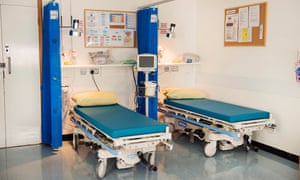
A stint in the recovery room follows – an airy space with four beds each bearing a green mattress and yellow pillow. On the walls are paintings, while blue blinds are half drawn at the window.


The ECT recovery room at Chase Farm hospital.


The recovery room. Photograph: Linda Nylind for the Guardian

Typically, says Tobiansky, patients are a little groggy, perhaps with a headache or nausea as they come round. “We check how quickly people become re-oriented by asking: ‘Do you know where you are? Do you know the date?’ etc, and we are documenting how long that takes.” Within 15 minutes most patients are back on their feet.


The final room contains a kettle – patients are offered tea or coffee and a biscuit before they leave the suite, an important step since the general anaesthetic means they have had to fast for six hours prior to the treatment.


Typically, says Tobiansky, ECT is used to treat patients with severe depression, often accompanied by psychotic symptoms, a high risk of suicide or a refusal to eat or drink.


“This is somebody who through their depression feels that they are not worthy of eating or drinking, who through their illness is starving – that is a life-threatening condition,” says Tobiansky. “You have not got time to wait for other things not to work. Likely things have been tried and failed.”


But, he adds, negative, dramatic depictions of the treatment in film and other media have left their mark. “Although it is small numbers of people who have the treatment we usually have a big battle against the stigmas and the very negative press ECT has,” he says.


While Tobiansky admits ECT can cause memory problems, and it is difficult to predict to what degree that will affect each patient, he says there is no evidence that it causes brain damage or dementia.


“I have seen it help so many people over so many years where nothing else has helped them,” said Tobiansky.


“In my opinion, ECT is underused. [But] it is not a panacea.”


Tea, biscuits and classical music: inside an ECT clinic

13 Nisan 2017 Perşembe

As a music therapist I can do something no drugs can do

I first encountered music therapy at a day centre for older adults in Hackney, east London. I was shadowing a music therapist for the afternoon and helping her run a group for older adults with severe dementia.


Each person’s dementia was different. One woman spoke and sang every spiritual song known to her; she was on her journey to meet her maker, she kept saying. Another woman was quiet and polite; it was difficult to know if she knew what was happening around her. There was one man in the group. He was nodding off but every now and again would startle himself, say something and then close his eyes. There was another woman in the group whose eyes sparkled when we looked at each other. She tried to speak – she opened and closed her mouth but no words came out.


As the therapist initiated the beginning of the session, taking her lead from the lady singing spiritual songs, I watched something miraculous happen. All four of the adults began to come alive – vacant gazes transformed into laser-sharp eye contact and they began to say hello to each other.


The music was lively and invigorating, yet at times it was reflective, poignant and sincere. It brought them to life and enabled them to connect with themselves and others.


As the session went on, the music picked up pace. People were getting up on their feet, dancing and singing. The woman with sparkling eyes couldn’t stand unaided. She reached out her hand to me and before I knew it, we were dancing together with everyone else. As I leaned into her and thought I heard her sing a little. As the singing and dancing continued, her voice grew stronger and her gentle “la la la” started to become beginnings of other words. She was beaming the biggest smile at me as the song came to an end. After the music had stopped, she held my hand and said a few words to me. I felt she was trying to thank me.


Later, the music therapist told me that was the first time anyone had heard her say anything in years. It was also the moment that I knew I wanted to train as a music therapist. Playing a role in this profound experience changed my understanding and relationship with music. Six years later, I am still working as a music therapist with people of all ages who have a diverse range of needs. From adults with severe and enduring mental health conditions, to young children with profound and multiple learning disabilities.


I can’t cure the children I work with of their autism, or reverse their congenital condition or learning disability. Not even drugs can do that. But I can do something drugs can’t do, which is help them communicate and, in turn, support their quality of life, relationships with their families and their experience and understanding of the world around them.


When a parent tells me that they have given up hope after receiving a diagnosis for their child and feel their world has caved in, I know that music therapy can have a role to play.


I finished working with a boy at the end of last summer. He had been referred to music therapy for emotional issues. The first time we met, when I tried to play music with him, he simply said no and wouldn’t let me play a note. His grandmother looked anxious and alarmed, worried that the music therapy wouldn’t work. No means no surely?


After six weeks, when it came to our last session together, he sang for 30 minutes about what his music meant to him: “It’s my music time, it’s all about the music, the music, it’s all about the music.” Offering time each week for this little boy to play and explore enabled him to express himself. He had found his voice. At the end of the session, his tearful grandmother wrapped her arms around him and said, “I love you”.


Music really does have the power to transform lives.


If you would like to contribute to our Blood, sweat and tears series about memorable moments in a healthcare career, read our guidelines and get in touch by emailing sarah.johnson@theguardian.com.


Join the Healthcare Professionals Network to read more pieces like this. And follow us on Twitter (@GdnHealthcare) to keep up with the latest healthcare news and views.


As a music therapist I can do something no drugs can do

22 Ocak 2017 Pazar

How music affects the brain | Daniel Glaser

La La Land is tipped for Oscar success following its triumph at the Golden Globes. Some have wondered if its appeal is partly as an escapist response to these troubled times.


Whether or not such a retreat is politically helpful, there is sound neurobiology behind it. Patients with even fairly advanced dementia can still respond to a piece of music if they were familiar with it in their youth. It can be comforting, but also allow them to engage and even dance.


Evidence suggests music and dance have therapeutic value for patients with Parkinson’s disease, inspiring them to perform movements which they normally can’t do. But the most moving biological phenomenon is in stroke patients who have lost the power of speech. For some, the brain areas responsible for singing words are distinct and can be spared from damage which destroys the main speech areas. These patients can sing all the words of a song, but can’t repeat them in prose or even say their own name.


If politics renders us speechless, there is comfort to be had in activating our neural song centres, if only for refuge.


Dr Daniel Glaser is director of Science Gallery at King’s College London


How music affects the brain | Daniel Glaser

19 Ocak 2017 Perşembe

Seeing stroke recovery through music reminded me why I love my job

I’ve been working as an occupational therapist with stroke patients for the past three years. It’s a privilege to be let into people’s lives and to get to know them and their families; but if they’re not getting better, it can be heartbreaking.


Working for a full stroke service in Hull, I am always busy. It is stressful and even though I know we do a good job, we always know we could be doing better if only we had the time to sit down and really work it out. Although the day-to-day reality of my job is always different, I could never have envisaged the impact one project would have on me, my colleagues and our patients.


In December 2014, I was asked to go to a workshop with the Royal Philharmonic Orchestra (RPO), which was coming to run music sessions with us as part of its community outreach work.


We met Tim Steiner from the RPO to brainstorm what the issues might be for people with cognitive and physical problems. My first thought was: “We’re very busy, how are we going to fit this in?” I’ve done group work before and while it can be really powerful, it’s hard. I was concerned but I could also see this was an amazing opportunity if we could pull it off.


We went through the instruments and thought about the problems that someone attending the group might have – from whether they could hold it to any discomfort they might experience. We adapted some of the instruments and arranged for a healthcare professional to sit with patients who might have problems concentrating, communicating or processing information at speed.


At the first session with the patients, none of us, not even the therapists, really knew what we were doing or what was going to happen. I was very nervous. The instruments looked like the ones we had used at school and I was worried that it would be a bit demeaning. But by the end of the session, we’d structured this incredible piece of music and that suddenly made me realise what this could potentially do.


Over the course of the project, Strokestra, I saw all these people go on a similar journey. At first, they felt embarrassed to pick up an instrument and make a sound. But after six months we did a performance of the work they had done in the city hall.


I remember how Steiner set us a task where we all had to clap at the same time and hold a rhythm. He’d stop and we’d carry on because we weren’t paying attention. It seems trivial but it was so funny and it helped us realise that it was OK to make mistakes and not be perfect. A lot of people told us this was the first time they had belly laughed since their stroke.


There were also times when people broke down in tears. Sometimes it’s difficult for people to realise what they’ve lost and Strokestra brought that into focus. Because the group became such good friends and everybody had been through a similar thing, people could understand and knew what that person was experiencing.


I noticed a change in confidence among the participants. Some people would come in their wheelchair but by the end, they’d start to walk. I saw a massive improvement in concentration.


I’m reticent to say that the group directly impacted on things, but I definitely saw some people being able to process information better and I wonder if it helped one person return to driving. It feels like that was part of his journey.


I love my job and I think what I do is really important but I have been doing it a long time and sometimes you can forget what you do, what you contribute and the importance of it. Strokestra brought that into sharp relief. I saw myself through a new set of eyes and thought: “Actually, what I do is pretty cool.”


Having an orchestra come in to help us was snazzy but I felt that I had an ownership of the project. It was about therapy and how we were using this music to help people recover. They were bringing their expertise of music and how to structure a music group and we were helping them with how we needed to adapt things for people with particular needs.


We’ve not stopped since. We’re running our own groups using music in one of our rehab units. We’re starting small but we’ve got big ideas to run this for the long-term. It’s given us the confidence to use music in therapy and to have an orchestra come and show us the potential of it has given us the confidence to carry on.


If you would like to contribute to our Blood, sweat and tears series which is about memorable moments in a healthcare career, please read our guidelines and get in touch by emailing sarah.johnson@theguardian.com.


Join the Healthcare Professionals Network to read more about issues like this. And follow us on Twitter (@GdnHealthcare) to keep up with the latest healthcare news and views.


Seeing stroke recovery through music reminded me why I love my job

28 Kasım 2016 Pazartesi

Music shone through my wife’s Alzheimer’s | Letters

Laura Barton’s description of Hannah Peel’s relationship with her gran through music (Waking moments, G2, 23 November) brought back so many memories of my wife’s struggle with Alzheimer’s. Denise died last year having struggled with Alzheimer’s for five years. She had been a music teacher and church organist in her early life but, even though I was able to care for her at home until the end, her memory and recognition failed early on in the disease. However, even when she slept most of the time, hymns would sometimes bring a smile to her lips, not least the weekly Songs of Praise on a Sunday afternoon. Such was the awakening that she would join in with most hymns and was word perfect. As the final credits rolled Denise would close her eyes and return to her abyss of darkness.
Dennis Ruston
Derby


Join the debate – email guardian.letters@theguardian.com


Read more Guardian letters – click here to visit gu.com/letters


Music shone through my wife’s Alzheimer’s | Letters

30 Mayıs 2014 Cuma

Stephen Sutton vigil: coffin to be carried out to the music of Olympic Games drummers

As the 11th bell chimed at eleven.00, everyone’s thumbs went up and this was followed by a minute of applause.


The Staffordshire cathedral is hosting a two-day vigil for the teenager, whose white coffin was yesterday witnessed by seven,000 mourners in what the Dean of Lichfield, the Quite Reverend Adrian Dorber, named a “phenomenal” display of human unity for the man he mentioned “has turn into everybody’s favourite son about here”.


As the clapping died away, a lone voice from the crowd cried “Go Steve”, and a large cheer went up.


Sarah Deeley, a care employee from Tamworth in the West Midlands, mentioned she essential to come and say “thank you” to Stephen for his instance.


“He was just such a great particular person, this is the least I could do,” she stated.


It comes as record producers announced a charity record is to be launched in Stephen’s memory.


The record, called Hope Ain’t A Undesirable Thing, has been created by the Neon Brotherhood, as a individual tribute by forty musicians inspired by the work of the 19-year-previous.


It will attribute a speech from Stephen that he had intended to use on his very own charity single, whilst he is also heard enjoying the tambourine.


The record featuring Stephen has been reduce at the Neon Sound Studios in his house town of Burntwood in Staffordshire, the place he jammed as a drummer with band Nothing Personalized.


Mike Wood, who coordinated the single, posted an advert on Facebook back in April when Stephen initial brought the result in of the TCT to the fore. The response to his appeal was “mind-boggling”, the 29-12 months-old explained.


“We had so numerous individuals that in the finish I had to flip musicians away,” stated Mike, who plays bass on the 5 minute 25 2nd recording.


Shane Mason, 19, of Brownhills in the West Midlands, plays piano on the record.


“I was by no means lucky sufficient to meet Stephen, but he was an inspiration,” he mentioned.


“We’ve had the blessing from the loved ones, and each Chris (Stephen’s older brother) and Jane (his mother) came to see us in the studio last week, and are behind us a hundred%.”


He extra: “I was playing piano on the track, and there was a picture of Stephen hanging up on the studio wall above me, where he is smiling and posing.


“I sort of liked to think he was there with us even though we were recording.”


All the proceeds from the sale of the record, which will be released on iTunes and Amazon on Monday, will go to the TCT.


A photograph of Stephen Sutton stands in Lichfield Cathedral (PA)


Properly-wishers have streamed into the 14th-century cathedral, with numerous unable to enter the packed constructing, as an organist played Toccata from Symphony V by French composer Charles Marie Widor.


Ahead of the vigil at began at 7pm on Thursday £20,000 was donated to his JustGiving page in an hour.


Donations had been becoming produced at a charge of far more than £1,000 an hour to his campaign, which rose from £4.23 million at seven.30pm to £4.24 million by 8pm.


Stephen 1st commenced raising cash for TCT right after he was advised his cancer was terminal, prompting him to generate a bucket checklist of 46 “weird and fantastic things” he wished to do just before he died.


Yet another item on Stephen’s bucket record was a lad’s holiday in Ibiza (Movie UNITED)


His original target was a modest £10,000 but he elevated this to £1 million soon after donations soared and his appeal attracted the focus of celebrities. He reached his £1 million target following posting a ‘final thumbs up’ selfie when his issue worsened and he went into hospital shortly prior to his death on May 14.


Opening the ceremony, the Dean of Lichfield, the Really Reverend Adrian Dorber, described Stephen as an “extraordinary example and inspiration” for absolutely everyone.


He mentioned: “We have gathered simply because we do not want to forget how Stephen has touched so several lives, how his optimistic perspective turned his own cancer into a force for existence.


“We want to don’t forget what Stephen has taught us not to waste time on his sickness, but to grab hold of every single single factor that enhances daily life and tends to make the world a much more joyful area.


“In these up coming few hrs we are attempting to do what Stephen did brilliantly, and that is to make the unacceptable meaningful and beautiful.”


He then read through the poem “Dust” by Elizabeth Jennings before Julia Hayburn, the assistant head of Stephen’s former school, Chase Terrace Technological innovation College, also paid tribute.


She advised of how, when he was diagnosed, the “established” teenager’s instant reaction was to phone a meeting with teachers simply because he refused to consider doctors’ advice to “neglect his Yr 11 examine”.


As an alternative he would go on to complete his GCSEs and AS-amounts, she additional.


“Words like wonderful, awe-inspiring and inspirational grew to become synonymous with Stephen – but they only touched the surface of what he has turn out to be on a national and international scale,” said Mrs Hayburn.


Following the end of the hour long formal component of the services, the Dean invited the congregation to do 5 factors in flip, like signing the books of condolence and giving the “thumbs-up” signal that has turn out to be synonymous with the teenager’s campaign.


Scattered all around the church had been photographs of Stephen, badges printed with the phrases “thumbs up for Stephen” and cards telling folks where to donate.


Stephen Sutton achieved several of his bucket-listing wishes and raised hundreds of thousands for cancer analysis just before his death (PA)


Also on the cards were Stephen’s most famous quote: “I never see the stage in measuring the worthiness of your lifestyle in terms of time, but rather you should measure lifestyle in terms of what you attain.”


Among individuals attending and providing their thumbs-up were Celia Houghton and her 14-year-previous daughter Freya, who had gone to college with Stephen.


The teenager remembered a potent speech Stephen gave to the school’s assembly a 12 months ago, saying “he was one particular man or woman who stood out”.


“The one particular factor that spoke to me was when he said ‘don’t measure time by the clock, measure it by what you do’,” extra Freya.


“When he died, folks cried at college.


“I keep in mind strolling along the corridor and folks have been making use of Publish-It notes to stick goodbye messages on the wall.”


The teenager’s favourite records – including You’ve Acquired A Friend In Me, by Randy Newman – have been played.


Other songs on the 38 minute compilation like Time To Say Goodbye, by Russell Watson The Circle Of Daily life from Disney’s The Lion King Track Five, by Foo Fighters Do You Understand, by The Flaming Lips One Day Like This, by Elbow I’ll Be Missing You, by Puff Daddy and Faith Evans You may Never Stroll Alone and I’ve Had The Time Of My Life, by Bill Medley and Jennifer Warnes.


A queue of men and women waiting to pay out their respects to the teenager stretched outside Lichfield cathedral and lasted for far more than an hour soon after the Dean concluded his deal with.


Pamela Milligan, whose daughter attended the exact same college as Stephen stated: “I just feel it is fantastic what he has accomplished. The town has come with each other to pay out its respect, it’s covered in yellow. He was an inspiration.”


Peter Robinson, 70, a chartered surveyor stated: “He has done a great issue, raising an amazing amount of income, and we wanted to display our respect for what he has accomplished.


“We cannot believe how the boy next door can raise £4 million. It’s so moving. The ceremony was really appropriate and definitely packed out.”


People laid bunches of yellow flowers outdoors the Cathedral.


1 bouquet left by 1 of the 19-year-old’s former band members held a tribute that explained: “Ste, it was a pleasure to share the stage with you. Hold on drumming buddy.”


One more bunch was left by a female who met Stephen as he worked to reach his very first fundraising purpose of £10,000 in 2013 and became close friends with him in the final year of his existence.


Charlotte Aspley, 24, who also raises money for TCT said: “I’m just quite unhappy. He was the most wonderful person, the most jolly man or woman I have ever met. When I initial met him he was going for his 1st target of £10,000 and now it is £4 million.


“He was extraordinary. He grew to become a lot more and more determined to increase a lot more and far more funds with each milestone he reached.


“This services would have meant everything to him. He often needed to get himself out there, to meet individuals. We are so proud of him, and now we want to preserve his function going.”


The teenager documented his battle with cancer on his Facebook page, Stephen’s Story.


The funeral cortege of Stephen Sutton arrives at Lichfield Cathedral (GETTY Photos)


More than £25,000 was donated overnight on Wednesday to reach £4 million by Thursday afternoon for Teenage Cancer Believe in (TCT).


Simon Fuller, director of companies at TCT stated: “Stephen’s method to cancer, indeed his technique to existence has inspired and motivated a lot more individuals than we could ever count.


“There is never ever a great time to get cancer but for a teenager the timing looks notably cruel.


“I never cease to be amazed by the courage and resilience that youthful folks discover in response to cancer diagnosis.


“His story was not a story about cancer – it was a story about lifestyle and residing it to the complete.


“When I last saw Stephen I asked him if he had any ideas on in which the funds he aided increase ought to be invested.


“He informed me to carry on performing precisely what we are carrying out. His wishes will be quite considerably honoured.


“We will make positive Stephen and all younger men and women with cancer are by no means forgotten.


“Stephen asked us to place the fun into fundraising but he didn’t stop there, he needed us to put the fun into funeral – so we’ve offered it a go.


“Stephen’s positivity and quiet determination to attain some thing quite profound has brought a sense of perspective and emphasis to our lives, displaying us that even little gestures can have a large impact.”


The service was due to finish at midnight ahead of the cathedral reopens at 7am on Friday just before a private family funeral is held in the afternoon.


Donations continued to be created during the service and far more than 172,000 had pledged money to his campaign by Thursday evening, which will shell out for more nurses and beds for other youngsters with cancer.


Evie wrote on his Justgiving page : “Very touched by your journey, your mindset, your positivity, humour and your massive superb heart. Massive thumbs up for you.”


Toddlr also posted: “Inspirational youthful guy whose legacy will dwell on by means of TCT.”


As the ceremony drew to a near in Lichfield more than £30,000 had been donated in 5 hrs – taking the complete to a lot more than £4 million.


When Present Support is extra to the donations, the campaign has raised much more than £4.5 million for the charity.


Stephen Sutton vigil: coffin to be carried out to the music of Olympic Games drummers
17 Ocak 2014 Cuma

Mental and Physical Positive aspects of Music

You may well have noticed that music can improve your mood or help you concentrate on the process at hand at times. It may have also assisted you run that extra mile you considered you have been as well tired for, or fall asleep more rapidly when your thoughts was restless. You may possibly have not known, nevertheless, that these and other helpful qualities of music on your physique and mind have really been established by numerous research.


Physical Rewards


Ache Relief


Quite a few research have proven that music can alleviate discomfort in patients with various health care circumstances, partially since of its capacity to act as a distraction. A examine by the University of Utah Discomfort Investigation Center, in specific, identified that using music to divert the sufferers resulted in profitable ache manage. The findings were published in The Journal of Pain in 2012.


Much better Rest Top quality


A 2008 study in the Journal of Superior Nursing showed that music leads to far better rest quality amongst college students. Participants with prior rest complaints listened to soothing classical music. When compared to people who listened audiobooks or didn’t pay attention to anything at all before bed, they have been in a position to obtain far better muscle rest, reduced respiratory and heart price, and decreased anxiousness, amid other positive outcomes.


Larger Endurance


Researchers also proved that listening to upbeat tracks although operating, biking or performing other kinds of workout prospects to elevated endurance. A review by the Brunel University in London found that music can increase endurance by as a lot as 15%, and enhance energy efficiency by one% to 3%.


Other documented physical benefits of music contain the capability to decrease blood stress and heart price, and faster recovery charges for stroke sufferers. Listening to satisfied music was even shown to dilate blood vessels, which can outcome in much better heart well being. Music can lead to faster publish-physical exercise recovery as well and slower tracks will slow down your eating pace, making you more mindful of satiation and eventually helping you eat much less.


Mental Benefits


Stress Relief


A psychology dissertation from the University of Gothenburg showed that listening to music on a daily basis leads to a decrease in pressure hormone cortisol. The participants in the investigation showed the most optimistic results when they listened to the sorts of music they loved.


Enhanced Concentration


Many people uncover it less complicated to concentrate on operate or studying when they pay attention to quiet music in the background. An older study conducted by the Middlesex University in England identified that background music led to far better cognitive efficiency, helping college students score greater on their cognitive exams.


Reduce Anxiety Levels


A research published in the journal Depression and Nervousness discovered that 10 one particular-hour massage sessions had the identical extended-phrase effect on decreasing anxiety as lying down and listening to music for the same amounts of time.


Amid other psychological positive aspects, music was also proven to unwind sufferers ahead of and for the duration of surgical procedure, assist folks perform much better when underneath strain, and lead to dopamine release in the brain – the come to feel-good chemical responsible for elevated mood.


Movies: Great Listening


Sources for this post contain:


Mental and Physical Positive aspects of Music