‘It etiketine sahip kayıtlar gösteriliyor. Tüm kayıtları göster

6 Mayıs 2017 Cumartesi

‘I don’t know who I am without it’: the truth about long-term antidepressant use

Sarah never planned to take antidepressants for 14 years. Three years after she began taking them, when she was 21, she went to her GP and asked to stop: 20mg of Seroxat a day had helped her live with anxiety and panic attacks, but she began to feel uncomfortable about being on medication all the time. Her doctor advised her to taper down her medication carefully.


At once, “I was a mess,” she says. “I thought I was losing my mind. My appetite completely went. I lost the best part of two stone. I was anxious constantly. My mouth was dry. It was difficult to sit and be calm.” She became withdrawn, refusing to see friends, and remembers asking her mother to get her a couple of boxes of paracetamol, thinking, “I’m going to have to take all these tablets, because I can’t live like this.”


Sarah’s doctor encouraged her to go back up to 20mg. “Within a week, I was much better. I feel anger when I look back. That wasn’t me relapsing, that was withdrawal. But I was so unwell, I didn’t stop to think, ‘I’ve never had this before.’ I truly thought it was me. Now the only reason I am on the drug is because I am dependent upon it. And that is not good enough.”


Prescriptions of SSRIs (selective serotonin reuptake inhibitors), the most common type of antidepressant, have doubled in the past decade. There are now more than 70m prescriptions dispensed in the UK in a year, the “greatest rise” of any drug in the last year, according to NHS research. But while the side-effects of starting and then withdrawing from these drugs are reasonably well known (the patient information leaflet accompanying the SSRI Seroxat is six pages long), there is very little research into the long-term effects of using antidepressants.


Last year, an all-party parliamentary group began hearing evidence as to whether there is a link between a measurable rise in mental health disability claims – 103% between 1995 and 2014 – and that in antidepressant prescriptions. (Claims for other conditions fell by 35% in the same period.) “We need to have a serious rethink about current levels of prescribing, because it may well be that the drugs are in fact contributing to the disability burden,” Dr Joanna Moncrieff, a consultant psychiatrist and senior lecturer at University College London, told the committee.


Reports both anecdotal and clinical have included side-effects such as constant pain, an altered sense of smell, taste or hearing, visual problems, burning hands and feet; food or drug intolerances and akathisia (the medical term for a deep inner restlessness). When a patient begins tapering down their dosage, these effects are generally ascribed to the drug leaving their system; if it is long after withdrawal is supposed to be over, however, patients are often disbelieved (according to the drug companies, withdrawal should take just two weeks for most people, though they acknowledge that for some it can be months).


Professor David Healy, director of the department of psychological medicine at Cardiff University and author of 22 books on psychopharmacology, believes that antidepressants are overprescribed. “If you go into your average doctor – if you’ve been off the drug for half a year or more – and you complain [of a range of symptoms] and say, ‘I think it’s caused by this pill I was on’, he or she would say, ‘It’s been out of your body for months. You’re neurotic, you’re depressed. All we need to do is put you on another pill.’”


GPs, Healy says, are “relying on your word, and if it’s a choice between believing what you say and relying on what drug companies say to them, they [tend to] believe the drug companies”. Healy, who has been a consultant for, and expert witness against, most of the major pharmaceutical companies, has long argued that long-term side-effects are routinely ignored or misunderstood.


But many experts believe these drugs do more good than harm. “Most of the people I see who have moderate to severe depression benefit from them,” says Daniel Smith, a professor of psychiatry and researcher into bipolar disorder at the University of Glasgow. For some, medication can be no less than “transformative. It can get them through a really critical period of their life.”


However, when it comes to long-term impact, especially after a person stops taking SSRIs,Smith says it can be hard to work out which symptoms relate to the drug use and which to the underlying conditions. “There’s obviously an issue of cause and effect. How can we be certain the SSRI caused it? Depression affects libido and sexual interest. How much [of the reported effects] is depression and/or anxiety symptoms coming back?”



A Seroxat box and pills


By 2003, worldwide sales of Seroxat, manufactured by GlaxoSmithKline, were worth £2.7bn. Photograph: Alamy

SSRIs have beenaround for more than 40 years, but grew in popularity in the late 1980s and 90s after pharmaceutical companyEli Lilly launched fluoxetine, otherwise known as Prozac. Time magazine put the drug on its cover twice, asking, “Is Freud finished?” and describing SSRIs as “mental health’s greatest success story”. In 2001, a landmark report on a clinical trial into paroxetine (sold as Seroxat in North America and Paxil in the UK), called Study 329, concluded that it demonstrated “remarkable efficacy and safety”. Study 329 led directly to a massive increase in prescriptions: by 2003, worldwide sales of Seroxat (manufactured by GlaxoSmithKline) were worth £2.7bn.


But concerns were raised about the study –the US food and drug administration (FDA) officer who reviewed the data disagreed with the findings, calling it a failed trial – and in 2015 the British Medical Journal published a re-evaluation. Seven authors went through as many of the thousands of individual case reports as they could, and found not only that “the efficacy of paroxetine… was not statistically or clinically different from placebo”, but that “there were clinically significant increases in harms, including suicidal ideation and behaviour”. The original study reported 265 adverse reactions; the BMJ found 481. The re-evaluation also found that psychiatric responses were grouped together with “dizziness” and “headaches”, rather than given their own category. In 2003, the UK banned the use of Seroxat by anyone under 18; and in 2004 the FDA required a “black box warning” on all antidepressants, its strictest level of patient warning.


“Patient safety is our number one priority,” a GlaxoSmithKline (GSK) spokesperson tells me. “We believe we acted responsibly in researching paroxetine, monitoring its safety once it was approved and updating its labelling as new information became available.”


It’s more reliably predictable that they’re going to get rid of sexual function than get rid of depression


Many SSRI users report blunted emotions, even long after they have ceased taking pills, and an impact on sexual function. “They should be called anti-sex drugs rather than antidepressant drugs,” says Jon Jureidini, a child psychiatrist of 30 years’ standing, a professor of psychiatry and paediatrics at the University of Adelaide and co-author of the BMJ study, “It’s more reliably predictable that they’re going to get rid of sexual function than it is that they’re going to get rid of depression.” Again, some people find this persists long after they cease taking the drug. One person I spoke to, Kevin, had taken Prozac for six months when he was 18; now 38, he hasn’t had an erection since.


Last September, Healy and colleagues published a further examination of the data gathered for Study 329. This data followed the trial participants for six months after they started taking paroxetine (the “continuation phase”) and while they were tapered off it. GSK, which in 2004 published a clinical study report, had argued that “the long-term safety profile of paroxetine in adolescents appears similar to that reported following short-term dosing”. Healy and co, however, concluded that the “continuation phase did not offer support for longer-term efficacy”. More alarmingly, they found that the taper phase, when patients were being taken off the drugs, was the riskiest of all, showing a “higher proportion of severe adverse events per week of exposure”. This, they said, opens up the risk of a “prescribing cascade”, whereby drug side-effects are thought to be symptoms, so are treated with further drugs, causing further side-effects and further prescriptions – thus increasing the risk of long-term prescription drug-dependency.


In October, the British Medical Association published its response to a two-year fact-finding exercise into long-term use of psychoactive drugs. It noted that while benzodiazepines, z-drugs, opioid and antidepressants are “a key therapeutic tool”, that their use can “often lead to a patient becoming dependent or suffering withdrawal symptoms… the evidence and insight presented to us by many charity and support groups… shows us that the ‘lived experience’ of patients using these medications is too often associated with devastating health and social harms”; it was therefore, the report concluded, a “significant public health issue”.


The BMA made three key recommendations: first, and most urgently, that the UK government establish a 24-hour helpline for prescribed drug dependence; second, that it establish well-resourced specialist support units; and third, that there should be clear guidance on prescription, tapering and withdrawal management (they found the current approach to antidepressants, in particular, to be inconsistent: too many patients were suffering “significant harm”). There are also increasingly urgent calls for studies into long-term effects that are not funded by drug companies, because, Moncrieff says: “We don’t have very much data. This research is really important, but hasn’t been done. It’s a massive blind spot. It’s extraordinary – or maybe, given the pressures and interests at work, not extraordinary at all – that it hasn’t been filled.”


In March this year, members of the BMA, along with MPs and researchers from Roehampton University, went to parliament to lobby Public Health England, armed with research estimating that there are 770,000 long-term users of antidepressants in England alone, at a cost of £44m to the NHS per year (a figure that does not account for the cost of GP appointments, or the impact of side-effects, withdrawal effects and disability payments).


“I think you have to adopt a very conservative approach,” says psychiatrist Jon Jureidini. “These are brain-altering drugs, and our overall experience with brain-altering drugs of all kinds is that they tend to have a detrimental effect on some proportion of people who take them long term. All we know about the benefits is from short-term symptom-reduction studies. The careful prescriber needs to say, ‘Well, in balancing the likely benefits and harms, I need to be very cautious about how much benefit I’m expecting, and I need to be very generous about the possibility that the harms might be more than they appear to be.’”


Quite a few long-term users, such as those I spoke to below (and who wished to be anonymous), would agree.


‘Tapering off is the hardest thing I’ve ever done’: Sarah, 32; has taken Seroxat for 14 years


I was prescribed Seroxat when I was 18, the year I started university. I grew up with a disabled sister, so things at home were very stressful, and I had a history of anxiety and panic attacks. I had counselling, but the problems persisted, so I went back to the GP. I don’t remember everything that was said, but there was no conversation about side-effects.


Within the first two weeks of starting Seroxat, I remember I was sitting in the front room watching TV when out of nowhere I had this intense feeling of heat, like an electric shock. It started in my hands, went all the way up my arms and through to my head.


The GP said it was probably just my body getting used to the drug. And after a few weeks the weird sensations did ease off. I had a fabulous time at university. I still had panic attacks, and there were certain situations I would avoid – as I still do – so it wasn’t a wonder drug, but there were no major problems.


But in 2006 I tried to come off it. There were a couple of Panorama documentaries about the side-effects and I was starting to become concerned. The GP said, “That’s fine, but do it gradually, over three weeks.”


I thought I was losing my mind. I was going to work, but it was difficult to get through the day. My mouth was so dry


I immediately became incredibly unwell. I thought I was losing my mind. I was going to work, but it was difficult to get through the day. My mouth was so dry, I was constantly drinking water. I had bizarre thoughts – not hallucinations – that were frightening or distressing. I had a strong sense of detachment from reality.


Eventually, the doctor said, “Look, you coming off is obviously not working: we need to get you back to 20mg.” Within a week I was much better.


A few years later, when I realised my mental health was getting worse, even though I was on the medication, I started to do some research, reading case studies about withdrawal. I find it so offensive when a GP says, “This is who you are.” I didn’t have these symptoms 10 years ago. I didn’t have this sense of detachment. I saw various psychiatrists. They just kept saying, “The drug is safe, you need to be on it.” A couple of others told me the reason I was having these problems was because I wasn’t taking enough. Another said, “If you were diabetic, you’d take insulin and you wouldn’t have an issue. Why are you so bothered about taking this drug?”


I’ve been on it since I was 18, so I don’t know who I am without it, as an adult. Who knows? I might have all kinds of problems, but I need to know I’ve tried. Tapering off is the hardest thing I’ve ever done. It’s taken me three years just to get from 20mg to 5mg. I’m no longer with my partner – we were together for six years. I believe Seroxat has played a part: it affected my moods, it made my anxiety worse and, by necessity, I’ve had to be selfish, really. I don’t want to say all my problems are to do with Seroxat, because they’re not. But I do believe that it has caused me harm.


‘I don’t have much of an interest in interacting romantically or physically with the opposite sex’: Jake, 24; took SSRIs for eight years


I had been dealing with symptoms of OCD and anxiety for a lot of my childhood. It’s in my family, affecting two siblings and one parent. I was prescribed Zoloft when I was 12; I took a variety of SSRIs, Zoloft to Prozac to Lexapro, and then two others, for eight years.


Did they help? You know, I can’t really tell you, because I got through school. I got high marks, I had a lot of friends. So, in that sense, they must have helped. That’s the thing: for people with major depression, it’s easy to say, this has a measurable effect. But I kept taking them just because that’s what I’ve always done.


I went to university right out of school. I did very poorly. I had a bit of a breakdown, isolating myself, not sleeping. I was still on medication. I came home and enrolled at a community college. That was my worst period – I was very depressed. And I started to think, “I’ve been on these medications a long time. I’m not doing well – why not get off them?” I don’t recommend this at all to anyone, but I stopped going to a psychiatrist and took myself off.



prozac


Prozac. Photograph: Getty Images

For months I had trouble sleeping. I was jittery. I had brain zaps. My anxiety was pretty ramped up. I would feel numbness in my extremities – generally my arms. My psychiatrist told me these were just normal withdrawal symptoms, and they’d be gone in four to six weeks: “Anything you feel beyond that is your anxiety and depression returning.” Basically, if you still feel anything beyond this window that the medical community has established, it’s all in your head.


Eventually I went back to school full-time, and I remember doing OK, feeling somewhat better.


I’ve now been drug-free for four years. What’s lasted are the sexual side-effects. They were definitely worse in withdrawal than they had been on the drug, even though I didn’t really realise or understand it at the time, primarily because I started to take SSRIs at 12. While my brother took the same medicine over the same period and had a normal sexual life, I had a lack of sexual interest. I had erections, and I have regularly masturbated my entire life. But I don’t have much of an interest in interacting romantically or physically with the opposite sex.


I didn’t even start thinking about sex until a couple of years ago. It’s almost like I woke up one day and thought, “OK!” I started getting these windows – days or weeks – when normal sexual feelings would appear. But they’re new to me and I don’t know what to do about them. And because I don’t know what to do, I get anxious, and the anxiety kills any feeling – and then I’m anxious because I’ve lost all my feeling.


Online, I’ve come across a big asexual community. Some also took antidepressants; I think there are a lot of people like me out there. I’d like to think that if I keep going to counselling and sleeping and eating properly, I can rectify these things.


In the end, it’s about pros and cons. If you’re lying in bed and can’t get up, is it better to function? If it was up to me, I’d say that, barring extreme circumstances, nobody under 18 should be prescribed these things. Your brain develops around them. Drug companies should be thinking of the long-term effect on people who can’t even consent.


‘If I missed a dose, I’d get shocks down the side of my body’: Chris, 43; has been taking Seroxat for 26 years


I was originally prescribed Seroxat for mild anxiety about my GCSEs. It was 1991, about the time GlaxoSmithKline released Seroxat. I was one of the first people to be given it.


I was prescribed 20mg, the basic dose, to start with. It helped me: I got through school, I went to uni, I went to work. But I had side-effects from the off: profuse sweating, low libido. I’m quite a placid person, but I became aggressive. I never suffered, in the beginning, with the suicidal thoughts that people talk about now, but what I did notice was that if I missed a dose – especially after eight years of taking it – I’d get shocks down the side of my body. I’d be nauseous, my limbs would become weak. I’d be in a constant state of confusion and was very impatient. I couldn’t communicate well with people. I said this to the doctor, and he said, “We’ll up the dose to 40mg.” That was 1998.


I tried to go back to 20mg, but my words became slurry, so the doctor put me back up to 60mg


The 10 years after that weren’t too bad. I managed to work, as a sales rep, for 18-20 years. But by 2012, by which time I was up to 60mg, I had tried on numerous occasions to withdraw. I tried to go back to 20mg, but my words became slurry, so the doctor put me back up to 60mg.


By the time I was 38, even that wasn’t enough. I tried to take my life. The doctor wouldn’t prescribe a higher dose. I couldn’t do my job, I couldn’t concentrate, I couldn’t drive. A psychiatrist once said to me that coming off Seroxat is harder than quitting heroin. That really hit home.


I have now been unable to work for four years. I’m still seeing a psychiatrist. I’ve also been diagnosed with fibromyalgia: constant tiredness, aches in the neck, and in the lower back and lower limbs. I’m 43 and still live with my mum and dad.


I also have no libido. Since the age of 30, I have had no feelings in that regard whatsoever. I have had relationships, but they’ve all failed. I haven’t been in a relationship for 10 years, which is a long time to go without sex, but I just don’t get the urge.


I don’t really have emotions, to tell you the truth. The drug takes your emotions away. I’m sort of existing, not living.


And when the drugs do work…


‘I wanted to be able to feel good when good things were happening, bad when bad things were happening’


BySimon Hattenstone


I suppose I was a depression snob. A purist. Why should I take antidepressants? Yes, there was something rubbish about crying all the time, not functioning, being unable to answer simple questions because of the fug in my head. But, hey, at least I was true to myself.


My depression went back to my late teens. I didn’t like to think of myself as depressive, because depressives were losers. And I didn’t think I fitted the bill: I was pretty funny and able, and I could get girlfriends. I guess most depressives don’t think they fit the bill.


It might have been genetic. My dad had paralysing depression, and so did his father. As a young boy, I’d spent three years off school with encephalitis – an inflammation of the brain that is often fatal. Survivors are often left with depression.


I remember as a teenager being on holiday in Greece with friends. The weather was gorgeous, and I thought, “Why can’t it piss down, because then at least I’d have a reason to feel this way?”


That is what I always craved – objectivity. To be able to feel good when good things were happening, to feel bad when bad things were happening. I hated the fact that my feelings rarely correlated to what was going on in my outer world.


In my 20s, I got by. I held down a good job, fell in love, had kids, made friends, had a pretty good life. But things came to a head when my best friend killed herself. I’d find myself weaving in between traffic wondering what the impact would be like. I took a period off work and gratefully accepted my Prozac prescription.


Things had changed since I first rejected them. Prozac looked cool (lovely green-and-white pills) and rock bands wrote great songs about it (even if REM’s Shiny Happy People was supposed to be dystopic). After telling people I was off work with depression, I ended up feeling like a priest at confessional. It turned out that virtually everybody I knew was a depressive and pilling their way out of it; now it was “our secret”.


I would try to come off the pills and felt rubbish again – not more rubbish than before, but the same. So I returned


Initially, Prozac made me feel sick. And then magically, after a couple of weeks, I felt lighter, as if something had been lifted. I could hear questions properly, answer logically, enjoy a sunny day.


My partner said I was transformed. Occasionally, I would try to come off the pills and felt rubbish again – not more rubbish than I had before, but the same. So I returned, and after a while, I thought, “What’s the point of even thinking about coming off the pills if they make life work for me?”


There are times now when I wonder if I weep and fret and withdraw too much, and whether I’m becoming immune to the Prozac. But on balance I think not, because life is still so much better than it was.


If Prozac was no longer working for me, would I stop taking it? Probably. Would I stop taking antidepressants full stop? I doubt it. I’d simply look for another super pill.


Are you a long-term user of antidepressants? Tell us about your experiences


  • If you are affected by the issues raised in this piece, contact the Samaritans here.


‘I don’t know who I am without it’: the truth about long-term antidepressant use

6 Nisan 2017 Perşembe

Gareth Parry: ‘I knew a lot about mental health but I didn’t recognise it’

Gareth Parry has spent almost three decades supporting people with disabilities and mental health issues find work, but a recent mental health crisis of his own has given him a personal insight into the remit of the organisation he leads.


Parry has only ever worked for Remploy, starting as a trainee administrator and becoming chief executive a year ago. Problems in his personal life two years ago triggered depression. At the time, he was overseeing a government contract for workplace mental health support. “I knew a lot [professionally] about mental ill health, but I didn’t recognise it,” he says. “Suddenly I was on the other side. It reinforced the importance of organisations like Remploy; work gave me routine, structure, focus, when everything else in my life was in chaos.”


Parry became chief executive in May 2016, several months after disclosing his condition (“all credit to the board”), which he manages with antidepressants, cognitive behaviour therapy-style self-help and maintaining a reasonable work-life balance. Living with depression, he says, “has made me a better person to run an organisation like Remploy”.


Remploy is a big provider of welfare-to-work services, running £50m worth of contracts for national and local government, and for a range of employers from retailers and supermarkets to construction firms and facilities management companies in Great Britain. About 95% of its contracts are with government or other public bodies and agencies, such as the Care Quality Commission, the BBC and GCHQ, and for local authorities. Its government contracts include providing mental health support to employees and people in work who are referred to Remploy or who self-refer through the access to work programme; disability employment support through the work choice scheme; and running part of the much-criticised work programme for the long-term unemployed. It helps disadvantaged people to start, keep or return to employment, supporting 130,000 people into work over the past decade.


These 130,000 are just a proportion of the total who have accessed Remploy in some way. Some are helped to keep jobs when going through mental health issues, or supported in less direct ways, through internships, walk-in advice in high street branches, applications for work or training, online access for help with CVs or letters, and phone support.


For the workplace mental health support scheme, of 7,000 people helped by Remploy over the past five years, 92% still had their jobs six months later. In addition, supported internships have helped people with learning disabilities. “For a good supported internship scheme, let’s say a cohort of 10 people, it’s reasonable that six of the 10 will end up in work,” Parry says. He adds: “There is a challenge around what happens about the four who did not get work, but the point is you’ve got six into work.”


According to government figures, in mid-2016 in the UK, 49% of disabled people aged 16–64 were in work, compared with 81% of non-disabled people. The disability employment gap – the difference between the employment rates of disabled and non-disabled people – therefore stood at 32 percentage points.


Of Remploy’s own staff of 750, just under one-third are disabled. So how can you get more disabled people into work when government policy and cuts seem to undermine that end? Parry fudges the question somewhat. “Regime and government administrations change and evolve and have different types of impact,” he says. “Our role is regardless of that to get disabled people who want to work, into work.”


What does he make of a damning report published by the Equality and Human Rights Commission on Monday, showing that progress towards real equality for disabled people over the past 20 years is insufficient and “littered with missed opportunities and failures”, including a lack of equal opportunities in education and employment?


“I realise that we still have a long way to go to achieve true equality of opportunity for disabled people in our communities,” he says.


“Achieving real social inclusion has to be the goal and while having structures and regulation in place to support and protect people with disabilities and health conditions is important, societal change is vital. We must recognise, harness and nurture people’s abilities rather than see only a disability. I am heartened by the attitude of employers large and small that we work with and among whom this recognition is evident and increasing. Genuinely putting ability first not only makes sense in working towards a more equal society, but it makes good business sense, which in turn will increase employment opportunities for disabled people.”


Remploy has changed a lot in its 72 years of existence. Launched by the postwar government in 1945 to employ disabled second world war veterans in sheltered factories producing everything from furniture to shoes, the last factories closed in 2013, as the government and many campaigners regarded mainstream employment as preferable to segregated or sheltered employment. While some welcomed the move, others felt the closures abandoned disadvantaged people.


In April 2015, Remploy was outsourced to a joint venture between US-born international outsourcing giant Maximus – which has come under fire as the provider of the Department for Work and Pensions’ controversial “fit for work” tests – and Remploy’s employees, who have a 30% stake in the business.


But Parry denies that being owned by Maximus undermines Remploy’s status as a champion of disabled people. “I can understand why people would see it that way, but we have a strong social conscience, the employee ownership keeps us focused on that, the profits don’t go overseas to America, they go back into the [Remploy] business.


“We have to be commercially successful and sustainable – so we want to make a profit because that will ensure we continue to exist for another 70 years and impact positively on the lives of disabled people,” he says.


While Remploy is financially secure – it declared £2m profits in 2015 – it is having to seek more business outside the public sector. “The business will reshape because our core market – welfare to work – is resizing and reshaping,” says Parry. This autumn sees the government’s work programme and work choice scheme replaced by a single work and health programme – Remploy may get the contract in Wales – but there are fears that such reforms decimate the welfare to work sector. Austerity, says Parry, “speeds up the need to diversify”. Hence Remploy does more “commercial work” like supported employment schemes with big retailers, although 95% of its business is still with the public sector.


Parry wants more supported internships for learning disabled people (the employment rate for learning disabled people is 5.8%). No longer state-owned, he says Remploy is not apolitical, but “constructively critical”: “We think government could do a lot more for supported internships for people with learning disabilities.” He wants young people with an education care and health plan (for additional support to those with special educational needs) to get “automatic entitlement” to supported internships.


For now, Parry wants to challenge the negative language used to describe people with higher support needs as “unemployable” or “hardest to help”. “The welfare-to-work market needs to develop a much more aspirational language … it’s not about lecturing people to get a job.” Raising aspirations, he says, is the responsibility of business leaders. Parry’s own experience of depression underlined to him the importance of senior staff advocating for and demystifying mental ill-health. “You get sports stars and personalities talking about it, but not many business leaders. There’s still a taboo we need to break.”


CV


Age: 50.


Lives: Leamington Spa, Warwickshire.


Family: Separated, three children (14, 12 and 10).


Education: Mosslands comprehensive, Wirral, Merseyside; University of Hertfordshire: social sciences degree.


Career: May 2016-present: chief executive, Remploy; 2013-May 2016: director of strategy, Remploy; 1988-2013: various roles at Remploy, including factory manager, HR manager, head of learning; 1988-90: administrator, Remploy


Public life: 2015-present: board member of Remploy’s employee ownership association.


Interests: Cycling, music and spending time with the children.


We must recognise, harness and nurture people’s abilities rather than see only a disability


Gareth Parry


Gareth Parry: ‘I knew a lot about mental health but I didn’t recognise it’

6 Ocak 2017 Cuma

My swimming odyssey: ‘It felt like a last chance to prove what I was capable of’

I had always thought I could swim. It may have been because I could run. It may have been because I wanted to swim. Or because I only ever did 10 minutes of breaststroke at a time, or splashed off a warm beach. But I really couldn’t swim.


It took 12 months of lessons and practice before I was able to swim in open water, beyond the pool or my home beach in Brighton. Then I could let myself believe I was up to taking on a challenge I had been dreaming of for more than a year: I wanted to swim in the Greek waters of the Ionian Sea. Specifically, I wanted to swim to Ithaca, the island home of Greek hero Odysseus.


Since childhood, I had been fascinated by Greek myths and the heroic tales of the Trojan war. As I grew older and read classics at university, it became Odysseus who captured my imagination more than any other. Legend has it that Odysseus was within sight of Ithaca when he was blown hundreds of miles off course. It took him several years to get home after that. Meanwhile, his wife Penelope stayed at home on Ithaca, spending every night unpicking the embroidery she had completed during the day, having promised her suitors that she would marry one of them just as soon as her sewing was finished. Eventually, a decade after Odysseus set out from Troy to return home, they were reunited. Sometimes you have to wait for the one you love.


I never wanted to be Penelope; instead, I had fought for years to be my own hero, my own Odysseus. I wanted my sense of belonging to come from within, and as soon as I found that, I found D, my husband. Now that I had my own Ithaca, I wanted to see the real one.


There was a deadline to contend with: after a year of marriage and even longer of trying for a baby, we had recently been referred for IVF treatment. I was shaken by the news. My relationship with my body had changed radically over the last few years. Finally learning to have a little faith in what it was capable of had been one of the most rewarding experiences of my life. Now, I was being told that positive thinking was not going to be enough.


Six weeks later, I was on my way to the island of Lefkada, where I was going to spend a week on a guided swimming trip around the islands of the Ionian. It would be an opportunity to see what I was capable of in the water, and to remind myself of the barriers I had overcome, even as I was now confronting a new one.


The evening I arrived was heavy with heat. We all gathered on a terrace overlooking the sea to introduce ourselves and eat together under the vines. J, the leader of the trip, encouraged us to go around the table saying a little about ourselves.


“Hi, my name is Jess and I recently swam the English Channel as part of a relay with some mates.”


“Hi, my wife and I are regular Masters swimmers in the south of France; these are our times…”


“Hi, I’m on this trip with my teenage daughter as a rest before her Olympic tryouts.” And so it went, on and on. These were people who had swum for their country, across their country and to their country. They may as well have been a different species.


The first morning, we boarded a beautiful wooden boat with a taciturn Greek captain who made no effort to hide the fact that he despaired of us all and our sanity. The pattern for the week was quickly set. The boat headed out to wherever the swim was to begin, then we would be briefed on deck about what type of swim it would be. Some were coastal, all the way around an island, with plenty to look at below us; some would be crossings from island to island – more satisfying, but potentially much harder work. And some would be a combination of the two. For most of the week, we would have a morning swim, lunch somewhere nearby, then a bit of time on the boat before a second swim. Friday would be the exception, because that was the day of the heroic 5km swim from Kefalonia to Ithaca.


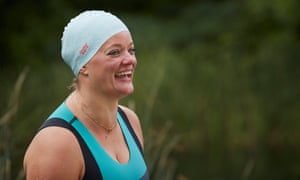
Alexandra Heminsley


‘The barriers were not merely physical, but mental.’ Photograph: Chris Floyd

Being in an entirely unfamiliar environment was all-consuming. I was used to wading into the water; a slow walk with a gradual drop-off. Now, we were clambering or jumping off a boat, straight into deep water. The most striking thing was its clarity. I had never seen anything like it. In Brighton there are only a few days when the water is clear enough to see through, and even more rarely is the ocean floor visible. Now, I could see a whole new universe. In our underwater world, body type had little effect on how we moved. The strength, the glide, the ease of the reach through the water was all that counted.


I found the sensation of travelling between two bodies of land dizzyingly intimidating. Once, managing a single length of the pool had been too much for me. Then, swimming in open water, albeit close to the shore. Then, the unknown length and depth of the river. Each time, I had persuaded myself that if I could relax and focus, I could do it. Each time, I had been proved right. The barriers were not merely physical, but mental.


This was something else entirely. As we reached the farthest point between the islands, the sea became so deep, it was beyond blue; a dark purple, almost charcoal, with shimmers of yellow as the current moved on and on below us. We found ourselves righting and re-righting our course, having to fight to stay straight, rather than being dragged somewhere else. That pull in the water, begun as a ripple on the other side of the world, reached me then, in that moment, as if gently to tug my sleeve and let me know that, perhaps, I was reaching the limitations of what my body could do. And the thought stayed with me all week as we approached Friday, the day of the 5km swim.


We had a pre-6am start that morning, to be ready for a boat trip of more than two hours. I was tired and beginning to ache in places I had never felt before. The mood on the boat was noticeably quieter than usual. Until now, I had enjoyed conversations with the group, getting tips on my technique, as well as hearing stories of their entrancing swims around the world. Today’s early start and the task ahead, though, had left us all but silent.


It’s all about the breath, I reminded myself. Keep the breath steady and you’ll keep yourself steady


My nerves were mounting. Not only was it farther than I had ever swum continuously – by more than a kilometre – but we would be negotiating a busy channel, competing with swells and currents, as well as holidaymakers’ boats and billionaires’ superyachts. And there was the added pressure that we had been told to swim tightly in our groups during the crossing, directly alongside each other for safety: there was no option to slow down to catch my bearings or indulge in panic. I would either let the team down or find myself drifting dangerously alone in the currents.


I sat in the prow of the boat, my legs dangling over the water as she moved slowly through the still, flat, unbroken surface, the sun rising behind the distant islands, and I felt horribly alone. I missed home with a longing I was sure only Odysseus had ever felt. For the others, this was an energetic holiday, but for me it felt like a last chance to prove to myself what I was capable of before I faced the uncertainties of IVF.


As I stared down into the water, a dolphin’s fin broke the surface and danced ahead of us. I yelped; the captain cut the engine. In that instant, I saw that I had been a fool. Only seconds before, I had been feeling so utterly alone while mere metres from such a magnificent sight. The dolphin leapt and pranced ahead, before approaching the boat and swimming alongside it for a little while. I sobbed, overwhelmed at how appallingly close the lowest and the most beautiful moments can be to each other. Yes, we swim alone. But we can never truly know what swims alongside us.


Half an hour later, people started to ready themselves to head into the water. My heart was hammering. It’s all about the breath, I reminded myself. Keep the breath steady and you’ll keep yourself steady.


Now it was time to swim. I became lost in sensory overload within the first few minutes. The light seemed liquid, leaping up and circling me every time I drew my hand through the water, trying to push against the current that was moving with such strength beneath me.


The first hour or so went smoothly, the group moving steadily as one. About halfway, something changed. We were approaching a tiny island, barely big enough to lay a picnic blanket on, and until this point we had been using it as a sighting point, keeping it in view in order to steer a straight course. We were to swim north of it as we passed, which we were all on course to do. As we approached, the ocean floor came up and back within sight. There was some comfort in seeing the sloping patterns of the underside of the island beneath us. Until I realised that it wasn’t moving.


Alexandra Heminsley


‘I had never stood toe to toe against nature in this way before.’ Photograph: Chris Floyd

We were swimming at our hardest. Perfectly in rhythm, well warmed up, pulling hard, breathing hard. At last, I felt like a real swimmer. Except I was going absolutely nowhere. An anxiety dream come to life. I was pulling and pushing at the water with all my might, but we had hit the point where the currents were at their strongest. The harder I swam, the less I moved. The rocks below me were entirely static.


I continued like this for five or 10 minutes before panic set in. I knew that to stop was instantly to slide back, away from the group. Exhale. Keep going. Exhale. Believe. Exhale. Glide. But the demons were chasing me now. I had never stood toe to toe against nature in this way before. You can’t fight nature, I thought, and felt tears choke in my throat. I forced an exhale. I wouldn’t let myself think it. But I did. If you can’t fight nature, what about pregnancy? And with that I was lost in a world of worry. Would I ever get pregnant? What would IVF do to me? What would IVF do to us? Would it be worth it? Would we get there? When would I know?


The water swirled around me and roared in my ears. I forced the air out of my lungs, again and again. The salt water was crusting my mouth, and every breath felt like a punch as the sunlight hit my eyes.


Your body might never be the same after this summer, I told myself. Enjoy what you have


Think of home. Be your own hero, be your own Odysseus, be ship, cargo and crew. I repeated these things to myself again and again, forcing physical relaxation until mental solace came. I made myself feel the power in my limbs and lungs, and love it. I was strong. Your body might never be the same after this summer, I told myself. Enjoy what you have.


Eventually, I won the battle. The rocks beneath me slid slowly out of sight. The deep blue returned. I have never been so glad to be swimming so utterly out of my depth. But the horror wasn’t over. About half an hour later, a sort of fizziness began in the tips of my fingers. I had only felt it once or twice before, in the final few metres of running events. I knew it meant that I needed oxygen, and fuel. I realised what was happening and tried to power my way through with positive thinking. Success was limited. My mind had got me thus far, but my lungs had not had the chance to catch up.


I needed help. I called to the rescue boat, and clung to it. J told the others to carry on, while I hauled myself in. My breathing was laboured and erratic, my head spinning and the tips of my feet and fingers numb. I breathed. I gulped at the orange juice on board to get some sugar into my system. I grabbed a handful of nuts. Devastated not to be in the water, I sat, breathing, for five minutes. We were so close to Ithaca. I could make out individual trees on the mountainside. Ten minutes later, I knew I couldn’t let the dream go.


“Can I get back in?” I asked.


J checked me over, to make sure that I wasn’t still delirious.


“I have to reach Ithaca. It’s why I came.”


She nodded. I leapt off the boat and headed for the grey rock. I couldn’t believe there was any strength left in me, and I vowed never to forget the moment that the island’s sea life started to make itself apparent to me. Once again, the sea shallowed, and fish shimmied between crags, sea urchins perched on ridges and starfish danced on the side of the island.


Finally I touched the rock, and burst into tears. Huge sobs, shaking my shoulders, forcing me to cling on to the island to keep myself steady. I had done it. I had discovered a grit I hadn’t known I had. I had slowly, over a year of marriage and a year spent in the water, learned that strength does not always mean merely ploughing forward in the face of adversity; it means changing your plans when what you’re doing isn’t getting you where you need to go; and it means nurturing the confidence to adapt without panicking. The relaxation that swimming demanded of me had taught me that calmness is strength. As I clung to that rock, I had no idea of the extent to which my adaptability and survival skills were about to be tested.


***


As the plane landed back on English soil, I smiled, knowing that I would be home soon and that there were still a few months before the most difficult stages of the IVF swung into action. I was gleeful to be returning to my Penelope, but it was tinged with the melancholy of knowing this summer was past full bloom. I wanted to carry on swimming outdoors, putting my new-found strength and confidence into practice.


I was sure I would be pregnant soon. I was anxious about the side-effects of doing a cycle of IVF, but I was not anxious about it failing.


I was wrong. It proved a brutal and disorienting experience. The cycle ended in early September with me battle-scarred, exhausted and with a streak of red blood that confirmed that I was not pregnant. The Saturday morning after we realised the treatment had not been successful, I woke up at 6am and stared at the ceiling as the tears rolled slowly, silently, down the sides of my face and on to the pillow. What now?


Slowly, the overwhelming duvet of sadness that had swamped us began to shift. While the summer had not been the idyllic sea frenzy I had hoped for, once I looked up and beyond myself, I saw that we were being treated to an exceptionally beautiful autumn. We had agreed to try one more round of IVF, but for now I had a chink of time in which to use my body for as much adventure as it could manage.


As autumn progressed, I swam and I swam, feeling the strength flowing gently back. I had been utterly unprepared for the havoc that the drugs and surgery would wreak on my body. There were extra rolls of flesh that seemed to have sprouted within a fortnight. The belly that appeared as I grew eggs stayed, as did the soft pouches sitting on my hips. My boobs were uncontrollably enormous – the sort of thing mothers-to-be so often take delight in. But, for me, they did not represent an exciting new life change, merely a daily reminder of what I didn’t have. As did the significant amount of internal pain in which the egg collection surgery had left me and which meant that running, and its associated jiggle, was out of the question.


Slowly I emerged from this body that bore no relationship to the one I had built for myself over the previous five years, and took on more and more swims, enriched weekly by the sights, smells and sounds.


Soon, we had a second round of IVF scheduled. I felt fiercely protective towards my own body. Ours was a relatively new love, hard won over miles run and distance now swum. It had taken years to accept that, yes, my body had value, but that value lay more in where it could take me, what it could show me, than in any perceived visual pleasure it could provide for others. I tried to approach this latest quest with the spirit of adventure that had sprung so late in me but proved such a source of joy. I would not yield to any suggestion that my life or my body were lesser if they didn’t incorporate motherhood.


Resolute about keeping my fitness up, I swam lengths twice a week in the pool and continued to swim in the sea, even as the heat slowly started to ebb from it. The day before my second egg collection surgery, I swam in the mouth of Shoreham harbour, feeling my muscles read the movement of the water and warm my blood against the autumn chill. I had rebuilt myself. I was ready.


This time, the treatment went well, and a few weeks later we had a positive pregnancy test. It was followed by the heartbreak of miscarriage. The first round had been disappointment, a setback. This round was crushing grief. My body had betrayed me. Where I had found strength, I now saw inadequacy, insufficiency, weakness. Where I had found beauty, I now saw flesh that served no purpose: a nascent belly, swollen from medication but aching with emptiness, uncontainable breasts bursting with anything but sexuality. Where I had felt self-love, I now saw an unwelcome stranger in the mirror. My body had been rejected, and in turn I rejected my body.


Alexandra Heminsley


‘I have learned not to be frightened.’ Photograph: Chris Floyd

The first time I felt strong enough to get back into the water was in December. I underwent a full winter of cold-water swimming. I never chose to do it; I just chose not to stop doing it. Where so many other plans around me had turned to dust, in one area at least I just had to keep going.


Jumping into cold water if you are not accustomed to it can put huge pressure on your heart, send your breathing into potentially unrecoverable erratic fits and starts, and leave you woozy with hypothermia – too sleepy to swim, too cold to recover. You can’t fight thermodynamics any more than you can fight infertility. But you can adapt. You can acclimatise. You can find joy where others see pain. And this was what I chose. To keep swimming, week in, week out, until what had seemed like an impossibility became golden, a delight.


Through January, February and on towards March, the coldest month, I carried on swimming. Though the sea temperature dropped incrementally each week, my body, as it slowly acclimatised, felt the same each time. After five minutes or so, my body would start to warm me from within, the hard work of the swimming pushing heat as far as it could out into my limbs. My skin would glow red, as if I’d received a thousand tiny slaps. Within half an hour, I would be glowing from within, warm for the rest of the day. Like a hangover in reverse, I had done something that was painful for moments but that left me feeling well for hours. I had made the difficult habitual, the habitual easy and the easy beautiful.


That winter of swimming was a sort of inadvertent exposure therapy. A type of behavioural therapy used to treat anxiety disorders, exposure therapy usually involves helping people to confront their fears by exposing them in tiny, almost insignificant amounts to the thing they are most afraid of.


There are people all around us dealing with sickness, injury and upset, but they choose to keep moving


Over the winter, I repeatedly exposed myself to the elements. As I hit the water day after day, I took myself to a place I never thought I could go. Previously distressed at having reached the limits of what my body could do for me, I rediscovered pride in what it could achieve and where it could take me.


More importantly, I was exposing myself to myself. That winter, I was the heaviest I had ever been. At the time, it felt like weakness, like surrender, but now I see that what felt like unnecessary blubber from hormones, grief or greed was keeping me warm, keeping me in the water to do what I needed to do. To thrive at the weight I was felt not just subversive, but a triumph.


I was emerging from the water calm but energised. I could do more than I’d imagined, and the more I swam, the more I witnessed others experiencing this alongside me. As I glided along in the lido, I saw women slowly easing themselves down the steps, scars the length of their thighs. I saw injured shoulders ahead of me, struggling to swing their arms around but finding fluidity and peace in the water. I saw women who arrived at the seafront jangling with panic or sadness, leaving it serene an hour later.


These quiet, everyday gladiators battling the wet and the cold showed me time and again that it wasn’t just me who headed for the water in times of distress. There are people all around us dealing with sickness, injury and upset, but they choose to keep moving instead of standing at the edge of life, peering in.


When I think about never having a child, a sort of breathlessness, almost a vertigo, comes over me. The same metal vice tightens around my ribcage, the one I felt as I entered the sea those first few times. I don’t know if we will ever have a child. I don’t even know if we have it in us to try IVF again. But I never know for sure what swims beneath me as I push myself through open water.


Swimming has taught me about my adaptability. It is not enough simply to train hard. You must adjust how you move, refine how you approach the water and embrace your environment. In swimming, as in life, I found fortitude and resilience when I needed them most; but I also found the courage to change depending on the weather, the tide or my own body. I have learned not to be frightened; that life is to be lived as a participant, not a spectator.


The most useful thing anyone said to me about grief is that you never really get over it. When you have difficulties with fertility or staying pregnant, the whole experience is a process of accepting that grief might be round the corner. But is that not the very nature of love? To fall in love is to expose yourself to infinite potential for rejection or pain, and to be a parent is to accept a lifelong commitment to the unknown. To love truly is to know that you might lose it in a heartbeat. In the same way that you never know if the wind will change when you’re half a mile from the shore, or the waves might smash you in the face just as you gasp to breathe. We must stand on the shore, proud of the life our bodies offer us, and accept that we’ll never truly know what lies beneath the surface any more than we’ll know what lies ahead. And then we must leap in.


This is an edited extract from Leap In: A Woman, Some Waves And The Will To Swim, by Alexandra Heminsley, published next week by Hutchinson at £12.99. To order a copy for £10.65, go to bookshop.theguardian.com, or call 0330 333 6846.


My swimming odyssey: ‘It felt like a last chance to prove what I was capable of’

10 Eylül 2016 Cumartesi

‘It hits you over the head’: can I survive my midlife crisis?

As a well-adjusted middle-aged man, I like to define myself by the things I don’t have. I don’t have a scarlet Lamborghini or a conspicuous tattoo or a 22-year-old girlfriend to jumpstart my libido. Nor do I possess a penchant for extreme sports or expensive psychotherapy. Midway through my fifth decade, I’ve avoided the obvious pitfalls and reckon I’m coping quite well, which is why I am on my way to discuss the male midlife crisis with the therapist Andrew G Marshall, who has written a book on the subject. It’s a task that requires a cool and dispassionate eye. We will be like two doctors, I decide, objectively diagnosing the problems of others.


Inside his therapy room, Marshall directs me to an armchair and stoops to pour out some water. First impressions could hardly be more reassuring: Marshall is a soothing, sober man in colourful clothes. He asks about my background and my health, moving from my childhood to my present circumstances. I respond as honestly as I can, still confident I’ll be given the all-clear. I tell him I sailed past my 40th birthday with no problem at all. After that, admittedly, there was a difficult spell, one that lasted perhaps four years. I list all the things that happened. I tell him that my relationship broke down and I moved out of my home. I tell him my best friend died suddenly, which threw me for a loop. I mention that my father fell ill. Oh, and that I also got married. I tell him that I then had a second child to set alongside my 11-year-old daughter from the previous relationship. I tell him I quit my job and quit London, and that we now live out west. I tell him I think that’s about it, although there might be some stuff I’ve forgotten. But by now I’m out of breath, shaken. Recited as a list, those past four years sound positively existential.


Marshall jots notes in his pad. He asks who I turned to for help during this difficult period. I tell him I didn’t really turn to anybody: I went through the worst parts alone. Why would I want to have people seeing me as a mess?


“It’s quite interesting,” he says. “You belonging to what we nowadays call the metropolitan elite. Most of my clients, by your age, have had at least three therapists. Whereas you went through this incredible period and not only did you not seek professional help, you actually detached yourself from your friends.”


Lots of people flunk the test. They anaesthetise themselves – with drink, generally. Or computer games, or porn. Or work


I nod dutifully, and yet something he said has already stuck in my craw. I don’t consider myself part of the metropolitan elite, and I’m annoyed that he would blithely stick me in that box. Nor, for that matter, am I convinced I’ve had a midlife crisis, despite the bald evidence of those torrid four years. But that’s the nature of cliche. We may see ourself as one thing, unique and specific; the world sees us as another – as a social demographic or a cluster of symptoms.


Marshall’s own interest is based on both personal and professional experience. His partner died when he was in his late 30s and this pitched him into what he describes as “the bleakest period of my life”. Meanwhile, all around, his patients were navigating a similar set of hurdles. The Office for National Statistics reports that 40- to 59-year-olds are the most anxious age group. Marshall believes this anxiety is sparked by a sudden awareness of mortality and a fear of failure; the nagging, nightmarish sense that we will never fulfil our true potential.


No one wants to own up to a midlife crisis: the condition is redolent of too many bad jokes. On setting out to write his new book, Marshall even deliberated before putting the term in the title, concerned that the mere mention might scare readers away. Finally, he opted for a cunning disguise, referencing the condition while denying its existence. The book is called It’s Not A Midlife Crisis, It’s An Opportunity, subhead: “How To Be Forty- Or Fifty-Something Without Going Off The Rails”.


Marshall has seen many casualties in his time – people who, when faced with the challenges of middle age, promptly crash and burn. “A lot of people flunk the test,” he says. “They anaesthetise themselves – with drink, generally. Or with computer games, or pornography. Or with work. And if you don’t answer the questions, you become bitter, closed off and cynical.”


Fail and you suffer an L-shaped life, you plummet and flatline. Pass, and win the U-shaped life: a brilliant late bloom


I start to wonder whether I flunked the test. Marshall certainly seems to think I was guilty of closing myself off. He says, “I’m getting a very strong message that you’re not allowed to be vulnerable. That you need to be loved, yet, when things get difficult, you withdraw from everybody. It’s a strange dichotomy. Because on the one hand you’re an open book in a rather controlled way, in that you’re a journalist and therefore in charge of the words. But the rest of you is completely closed.”


“I don’t think I was completely closed,” I say. “I just didn’t want people to see me in disarray.”


“I’m sorry,” he says firmly, “but that’s completely closed. You only wanted people to see the mask.”


“OK,” I say. “Fine.”


And yet, actually, it’s not fine: his whole premise is bullshit. Look at us here. Look at what we are doing. Almost shouting, I say, “It’s a ridiculous thing, you saying I’m closed. I’m going to write this bloody session up for everybody to read.”


Marshall smiles, unperturbed. “Yes, well,” he says. “Often in the second half of our lives, we have to do all of the things we didn’t do in the first.”


***


The term “midlife crisis” was coined in 1965 by the Canadian psychologist Elliott Jaques. Marshall believes the label has now outlived its usefulness. He prefers to call it “the midlife passage”. Approached in the right spirit, he says, this is a chance to engage with the big questions: who am I? What are my values? What gives my life meaning? You can meet your true self. You can become your own person.


Marshall has devised exercises to smooth our progress. He describes a simple counting meditation to reduce anxiety, explains how to “record your feelings”, and the events that trigger them. He also invites us to chart the highs and lows of our lives on a graph, moving from infancy through to middle age. I try this last one myself. The line leaps and dips with abandon. It makes my life look like a series of cardiac arrests.


The way Marshall tells it, there are three obvious routes through the midlife passage. Fail the challenge, and you suffer what he describes as an L-shaped life, where you plummet to Earth and then essentially flatline until death. Pass the test, and you win the U-shaped life: a glorious upswing, a brilliant late bloom. Then there is the third option, the joker in the pack, the switchback ride of the W-shaped life. This occurs when you reach for the quick-fix solution (the thrilling affair, the scarlet Lamborghini), or what Marshall calls “the myth of the great other”. The effect can be instant, galvanic. But it’s an artificial high, a dead cat bounce that leads only to more heartache.


Naturally, this makes me wonder about my own circumstances. The storm has passed; I have a new life in a new city. My days are a whirl of nappy changes and country rambles, augmented with odds and sods of semi-regular work. I’m pretty sure it’s not an L-shaped life. But is it a W or is it a U?


Is the midlife crisis a first-world problem? Marshall disagrees: ‘It’s intrinsic in mankind. It hits you over the head’


Out of the blue, I find myself telling Marshall about a man named Miroslav Novotny. I think he’s originally from the Czech Republic; he speaks rudimentary English. I picture Miroslav Novotny as something out of an Edward Hopper painting, a study in urban loneliness. He wears his trousers too high on his waist. He uses too much hair tonic, smokes discount cigarettes. I explain that my wife and I devised a game we would play when driving the outskirts of south London, in which we work out where Novotny would most like to live. So we place him in that impersonal block of flats out by the A20, or eating egg and chips inside some sad greasy spoon. Novotny, of course, does not exist – we made him up – yet the uncomfortable truth is that he’s the alternative me. He asks nothing of anyone and gives nothing in return.


All at once, I can see it clearly. “If I had taken a different route out of all this, I’d be Miroslav Novotny,” I say. “And I’m glad I’m not. But there’s a certain comfort in being Miroslav Novotny.”


Marshall nods. He says, “Life is small but it’s safe.” And I nod back in relief, because that’s it exactly.


Did I have a midlife crisis, I ask Marshall.


“Yes, you did.” He adds that it is not always advisable to throw absolutely everything in the air, as I seem to have done. But that’s by the by. Stable door, horse bolted. “You have been through it and navigated it and have had a reasonably soft landing.”


He asks if I have any further questions. So I ask whether he sees the midlife crisis as a peculiarly first-world problem, a kind of luxury accessory afforded to those with too much time on their hands. I’m not sure you have one if you’re under siege in Aleppo.


Marshall has his doubts. “It’s not a case of having too much time on your hands,” he insists. “It comes with a great mallet and hits you over the head. So I think it’s something intrinsic in mankind. The first world-third world distinction is the wrong idea.”


My second question is more personal: I ask if he believes it’s possible to be both horribly anxious and basically happy, because that’s how I’ve been feeling for the past year or so.


“Yes, I think you can,” he answers. “But if we were to continue working together, the anxiety is something we would be looking at. I think that anxiety and anger could be the keynotes for you.”


If you’ve done the work of the middle passage, then you’re in a very good place, the sunny uplands of life


He is keen to accentuate the positive, though. “It sounds to me like you have completely transformed your life. You’ve gone from closed to open. From work focused to family focused. From self-sufficient to more connected. From the small world of…


“Miroslav Novotny.”


“From the small world of Miroslav Novotny to the larger world of family and children and a new city. But the anxiety is something I would be working on. Anxiety and depression are like brother and sister.”


I walk back to the tube in something of a daze. I feel as though I’ve spent the past 90 minutes being dangled upside down by the ankles, watching all the detritus falling from my pockets. Some of this clutter was harmless ephemera, but other bits were jagged and rusted. Some were foul-smelling, some smeared with dried blood. With them gone, I feel lighter.


***


One month later, I meet Marshall again, this time in a bookshop above a cafe. It’s late August, and the therapist is on holiday. He’s bare-kneed in tan shorts, with a natty straw hat perched on his pink scalp, a copy of Graham Swift’s Waterland parked in the crook of one arm. Seeing him here is slightly disconcerting, like bumping into a teacher away from school.


He asks how I’ve been and I assure him I’m fine. I tell him, in fact, that I’ve been suspiciously fine. I’ve started to wonder whether the session itself was a kind of quick fix. I worry I painted myself in too positive a light; I worry he moved too quickly to endorse my depiction. This would normally be about a six-month process. We went through it in about 90 minutes flat.


“Well, yes,” Marshall agrees. “It’s not the best way of doing it, so you have to be careful. I mean, if I had been aware of some really horrible stuff, I would have skated over it, because I don’t want to open up that can of worms. If we saw there was a total car crash in the wings, I might well have acknowledged it – but I wouldn’t go up and peer through the window.


“But, happily, there wasn’t. And even if there was, I had the sense you’d come through it relatively unscathed.”


I feel I’ve made peace with my crisis, but what comes next? I want to know what other hurdles I’m going to face in my 50s, to steer clear of more trouble, if I can.


But the therapist grins. He’s in holiday mode. “What comes next? Well, wonderful times. If you’ve done the work of the middle passage, then you’re in a very good place, the sunny uplands of life. The next question is not what gives your life meaning, but what gives meaning to everyone’s life. It’s a more spiritual inquiry: the self versus the infinite.” Another grin. “I’m not even sure whether therapy is the right place to answer those questions. You may need to roll up your sleeves and go and do it yourself.”


The house where I now live is perched high on a hill, a steep 15-minute climb from the nearest train station. I try to make this journey on foot as often as I can (if I’m losing my hair, I figure I can at least shed some weight along with it). Sometimes I wonder how I must look to the motorists driving by. A sweaty, middle-aged man with a red face and bad posture, sometimes pushing hard at a buggy for added comedy value. The man is a wreck. Every step’s an ordeal. But near the top of the hill, the road swings out from the shadows. The city drops away and the horizon is endless. And this, I decide, is my favourite part of the journey. One might almost be entering the sunny uplands of life, approaching a house that feels very nearly like home.


‘It hits you over the head’: can I survive my midlife crisis?