Female etiketine sahip kayıtlar gösteriliyor. Tüm kayıtları göster

12 Mayıs 2017 Cuma

Female mannequins aren"t just skinny, they"re emaciated


There have have been several observations in the press and on social media in the past few years that some of the mannequins used to sell women’s fashion represent unrealistic and unhealthy body sizes. But until we started to look into it, the issue had not been researched properly, and the evidence was mostly anecdotal.


Back in 1992, researchers surveyed a handful of mannequins from the 1930s-1960s housed in museums. They concluded that real women of a similar body size would be so thin that they would be unable to menstruate. More than 80 years on, and with women in a very different societal position than previously, you might expect things to have changed.


Sadly, however, that’s not the case. Our newly published research concludes that the body sizes of mannequins being used to sell female fashion on the British high street today represent those of severely underweight women.


Unhealthily thin


In 2015, we conducted a formal study of mannequins by surveying all national chain fashion stores on the high streets of two cities in England – Liverpool and Coventry – that were using mannequins. In total, we visited 17 stores and got acquainted with 58 mannequins, 32 of which were “female” and 26 “male”.


What we found was that all of the female mannequins in these shops had body sizes that corresponded to that of an underweight human. We didn’t find a single female mannequin that was a normal body size on display.


Samantha Jenkins (@samanthajenkins)

Is it even humanly possible to be as skinny as this Topshop mannequin? pic.twitter.com/fDJSO88v2L


October 30, 2014


The “ultra-thin ideal” is something that I, and many others across the world, loathe. Size zero culture and glamorisation of unrealistic and unobtainable body sizes has meant that the “ideal” body size frequently and implicitly communicated to women is dangerously unhealthy.


Promotion of the ultra-thin ideal has been shown to cause women to be dissatisfied with their body size. And, in turn, this dissatisfaction is thought to be one step along the path of developing an unhealthy desire or “drive” for thinness, and subsequent eating disorders.


Not everyone will develop an eating disorder from having the ultra-thin ideal pushed upon them, and it is difficult to say why some people develop them and others don’t. However, the academic community is pretty convinced that promotion of ultra-thinness is a major player in eating problems, and that it is responsible for the propagation of body image problems in young women.


An ideal model?


Interestingly, we found that most of the male mannequins in our survey didn’t look underweight – only 8% of those surveyed were too thin. This fits well with what we know about ultra-thin body ideals and gender: it is primarily communicated to women, who are a lot more likely than men to develop an eating disorder like anorexia.


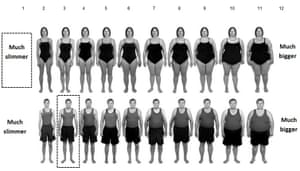
Mean mannequin sizes rated using the BMI-based body size guide rating scale.


Mean mannequin sizes rated using the BMI-based body size guide rating scale. Photograph: Eric Robinson

Our observation of male mannequin shows that there is no legitimate reason why mannequins used to sell female fashion have to be ultra-thin. If their male counterparts can be a “human” shape and size, then why can’t they?


Although some nation fashion stores say they are using larger bodied mannequins, we found no evidence of this in any of the stores that we visited. Of course, we can’t rule out that there may be some larger mannequins knocking about in a small number of stores, but we found that unhealthily thin mannequins are the norm on the high street.


Mannequins aren’t people, nor do they have a sign on them saying “you need to look like this”. But they are representations of the human body that are used to sell fashion and the idea of beauty. There is clear evidence showing that the ultra-thin ideal is contributing to the development of mental health problems and eating disorders.


There is no excuse for the continued use of emaciated mannequins.


Eric Robinson is a senior lecturer in the department of psychological sciences at the University of Liverpool.


This article was originally published on The Conversation. Read the original article.


Female mannequins aren"t just skinny, they"re emaciated

24 Şubat 2017 Cuma

Call the Midwife tackles female genital mutilation in latest storyline

This Sunday’s episode of Call The Midwife (BBC1 8pm) will chart new territory as the sisters of Nonnatus House tackle female genital mutilation in 1960’s Poplar.


The BBC One drama will take a sympathetic look at the plight of Nadifa, a mother-to-be from Somaliland, who has undergone the procedure and is struggling with the after-effects.


Heidi Thomas, creator and writer of the series, told Woman’s Hour she had wanted for some time to explore the issue: “I have been interested in FGM for some time and it did seem to me that if we waited until 1962, the Somali community were beginning to settle and establish a foothold in the East End.”


An estimated 200 million girls have undergone FGM worldwide. The procedure involves the partial or total removal of the female genitals for non-medical reasons. UK hospitals now treat one FGM survivor every hour.


Call the Midwife


In 1962, the Somali community were beginning to settle and establish a foothold in the East End. Photograph: BBC/Neal Street Productions

Nimco Ali, anti-FGM campaigner and co-founder of Daughters of Eve, advised the programme makers on the episode. It’s loosely based on the experiences of her close relatives who moved from Somaliland (an independent state north of Somalia) in the 1960s.


Ali, who underwent FGM at just seven years old says that while the episode’s approach may “ruffle some feathers”, she was impressed with the “immense level of knowledge” the writers showed. .


“[It’s about] setting yourself in the mindset that it was set in the 1960s – this was the language that they used,” she told the Guardian. “There is that authentic thread that runs from the realities of 1960s to the privileges and the work that’s waiting for us [as anti-FGM activists] in 2017.”


Ali hopes that viewers won’t feel overwhelmed by the trauma that FGM brings, but that they will feel heartened to act and support anti-FGM causes.


“If you look at the statistics around FGM they look massive, and there’s no way to come at it, but it’s one girl in one generation. It’s about breaking the cycle.”


“I’m hoping that… a lot of my sisters will see that they can have these conversations. That a midwife might not necessarily be of this culture but they understand and as women they can appreciate their experiences from a Somali perspective.”


Call the Midwife tackles female genital mutilation in latest storyline

28 Ekim 2016 Cuma

Male contraceptive jab almost as effective as female pill, trial shows

A male contraceptive jab has been shown to be almost as effective as the female pill in a trial that could pave the way for men and women being able to share equal responsibility for birth control.


In the study, 350 men were given injections of hormones that were shown to dramatically lower their sperm count by “switching off” the male reproductive system. The drugs caused some unpleasant side-effects, however, meaning that the trial had to be halted early.


The men, who were all in long-term relationships, relied on the drugs to prevent unplanned pregnancies – and the combination of hormones was found to be nearly 96% effective.


Richard Anderson, a professor of clinical reproductive science and author of the study, said: “If you’re comparing it to other reversible male methods, it’s far better than the condom and it puts it in the same ballpark as the pill.”


However, the treatment was judged to have unacceptable side-effects, including depression, acne and increased libido, which caused 20 men to drop out of the study and ultimately led to the trial be stopped earlier than planned.


The trial involved injections of two hormones. A long-acting form of progestogen was designed to act on the pituitary gland to switch off sperm production. Testosterone was added to offset a drop in the male hormone triggered by the progestogen. “You need the testosterone to feel OK,” said Anderson.


After an initial period, when couples used both the injections and other birth control methods, the men entered the study’s “efficacy phase”. This lasted up to a year and the men relied on the jabs alone, which they received every two months.


Only four pregnancies occurred among partners of the 274 men, indicating a similar level of efficacy to the female combined pill and significantly better protection than condoms, which in real-life conditions are about 82% effective.


However, scientists stopped enrolling new participants into the study in 2011 due to the rate of reported side-effects.


Of the 1,491 incidents, 39% were found to be unrelated to the treatment. This included one suicide. One man experienced an abnormally fast and irregular heartbeat when he stopped receiving the injections.


Despite the side effects, at the end of the trial, three-quarters of the men said they would be willing to continue using the contraceptive jab. The scientists said it might be possible to reduce the side-effects by changing the dose of hormones or the way they are delivered.


“The results provide us with confidence that this can be done,” said Anderson.


He added that it would be difficult to convert the treatment to a pill form because the hormones are quickly metabolised by the liver, but the scientists are planning a new trial in which the combination is delivered through a gel that the men could rub on their chest each morning.


Other scientists were less convinced that the side-effects of could be overcome, however. Sarah Jones, a reader in pharmacology at the University of Wolverhampton, said: “Most previous attempts at male contraception that have involved hormonal targets have led to severe side-effects or have been irreversible. This study does seem better than previous ones, but it still doesn’t seem very good to me.”


Jones recently published research demonstrating that certain compounds could be used to impede sperm’s ability to swim, which she argues offers a more realistic route to reversible male contraceptives in the future.


Allan Pacey, professor of andrology at the University of Sheffield, agreed that the side-effects found in the study were a “major concern”. However, he said the efficacy was impressive. “Using long-acting injectable forms of [progestogen and testosterone] the authors were able to suppress the production of sperm to a remarkable degree,” he said. “As such, this contraceptive was extremely effective and therefore certainly has promise.”


The findings are reported in the Journal of Clinical Endocrinology & Metabolism.


Chris Barratt, professor of reproductive medicine at the University of Dundee, said: “This is high quality research from a very experienced group of investigators, and as there has been no progress in male contraceptives for 40 plus years this is a very significant and welcome development. Additionally, the fact that the study reports relatively low side-effects and good ease of use are real-world developments. The study involved a reasonable number of patients so the results are likely to be robust.”


Male contraceptive jab almost as effective as female pill, trial shows

11 Ekim 2016 Salı

Female genitals are still in the closet. We need to talk more about vaginas | Catharine Lumby

When I was a young law student I went for my first pap smear at a local GP. As he was removing the speculum he commented casually, “You know, you have a really nice pussy”.


It took me five years to go for another test. I was 19 and I didn’t think about complaining to anyone. I just took a very long shower.


I also did something else that day. I got out a mirror and had a proper look. The whole shebang – outer lips, inner lips, clitoris and urethra. And my vagina – the opening that my beautiful babies eventually came out of.


Like many young women, I’d never acquainted myself with the features of what my GP had taken a way too interested look at. Male genitalia is out there. It’s dangly. Boys joke and talk about it all the time.


But female genitals are still in the closet – despite some fabulous feminist attempts to get them out of our undies and proudly on display. The Guardian has recently posted a fabulous series on our VGs. Vagina isn’t technically a catch-all term but it’s the best one we have for now, which shows us what many of us don’t know about our downstairs bits.


A disturbing new study by Dr Magdalena Simonis from the University of Melbourne’s department of general practice, published in the British Medical Journal, found that there has been a threefold increase in women requesting labiaplasty – cosmetic surgery to their vaginas.


She interviewed over 400 GPs, most of them specialising women’s health. They reported an alarming rise in the number of women requesting advice on labiaplasty.


So what are we to make of this? Vaginas come in all sizes, shapes and colours. Like all good things. But do most women, particularly young women, know that?


Simonis is concerned that fashion, online pornography and beauty ideals are playing into this new trend. And she’s probably right. The reality is we don’t really know. We need more interdisciplinary research across medical science and the humanities to understand this trend.


Many young women in my study told me how shamed they felt about their bodies


As someone who has done recent large scale research into young people and online media, I’m aware that most young people are not watching the Barbie Doll style porn older generations associate with porn. You know – the 90s Hollywood porn where women called Bambi, Mandi and Candi pretend to be lesbians with fake breasts and nails? You can take the Fifth Amendment if you want but you do know.


That’s not the kind of sexually explicit material that most younger people look at. A lot of it they create themselves. Old people call it “sexting”. Young people don’t. They call it sharing images of their bodies, which suggest there are many kinds of vaginas involved.


Young women don’t go looking for online porn. On the other hand, they are drowning in a culture where perfecting their bodies is seen as paramount.


Many young women in my study told me how shamed they felt about their bodies – if they flaunted their conventional attractiveness too much they were shamed for that. If they didn’t stack up to male ideals of beauty they were shamed for that.


And when I asked young women, in an age-appropriate way, about whether they had access to information about how to have sexual pleasure, many of them averted their gaze. The young guys laughed it up when I asked the same question.


There’s a core issue here – we don’t talk about vaginas. We don’t talk about how they can be a source of pleasure for women. We don’t talk about how they are all different. And we don’t tell young women and men that there’s no “normal” vagina.


I understand that young men are increasingly coming under pressure about their bodies and their genitalia too. But a good start in changing the relationship young women have to their bodies – and young men do too – might be to start talking more openly about women’s vaginas.


I’d like to see sex education classes where someone explains the role of the clitoris. Then we could move onto talking about how fabulously multitasking vaginas are – a bit like breasts. Western society obsessively sexualises breasts and vaginas but ignores the wonderful work they also do in bringing children into this world and feeding them.


In the meantime, we should applaud Simonis for her study. We need to know a lot more about young women and why they are so anxious about their bodies.


Her research confirms a large study conducted in the UK in 2012, which found there is a growing trend for women to request cosmetic surgery – for all areas of the body. Figures have continued to increase since then and the vast majority are still women.


As a feminist I was hoping things would have changed by now. Time, perhaps, for all us girls to get out that mirror and say, “Looks fab to me.”


Catharine Lumby is a professor of media at Macquarie University. She led a 2014 Australian Research Council funded project examining young people, media, sex and relationships.


Female genitals are still in the closet. We need to talk more about vaginas | Catharine Lumby

26 Eylül 2016 Pazartesi

Female playwrights deliver Manchester"s global festival of childbirth

In 2010, the UN secretary general Ban Ki-moon wrote that every year millions of women and children die from preventable causes. “These are not mere statistics,” he said. “They are people with names and faces.”


His remarks were part of the inspiration for Birth, a four-day festival of “drama and debate” to be held next month at the Royal Exchange theatre in Manchester. Planned to coincide with Manchester’s year as European city of science, Birth presents seven new works by female playwrights from around the world (Kenya, India, China, Syria, UK, the US and Brazil), all focusing on different experiences of childbirth.


‘Theatre doesn’t give answers, it provokes questions’ … Emma Callander


‘Theatre doesn’t give answers, it provokes questions’ … Emma Callander

The playwrights, including Stacey Gregg, Mũmbi Kaigwa and Kirsten Greenidge, have examined issues as wide-ranging as modern maternity intervention (IVF, caesarean, Pitocin), population control and the socio-economics of birth in some of the world’s most densely populated countries. “We wanted to talk about global health inequality and the place that it really comes into sharp focus is in birth practice,” says the festival’s creative director Emma Callander, co-founder of the global theatre movement Theatre Uncut.


She cites statistics that show the US is the most expensive country in which to give birth, but it also has some of the highest maternal mortality rates in the developed world;and that every year 3,000 Kenyan women develop fistula during childbirth – a tear between the rectal and vaginal passages that leaves women incontinent – and only 7.5% of them receive treatment.


One of the commissioned playwrights, 24-year-old Swati Simha, has used her play to look at the subject of mass sterilisation in India. The work focuses on a doctor haunted by her role in the country’s population control effort, where women are often given incentives to be sterilised and doctors have targets to reach in insanitary conditions.


“The big question is why spend so much money and resources on birth control as opposed to providing [better] healthcare,” says Simha. “Of course the birth rates are very high, but so are the infant mortality rates. It’s an agrarian society so you do require hands in the field and you know that at least three of your five kids are going to die in the first 10 years of their life, so of course the birth rate is going to be high in those regions. Why not provide medical facilities?”


To research her play, Simha spent two weeks in a rural village in the state of Jharkhand. “It was quite revealing,” she says. “There’s no electricity in the primary health centres and there’s no transportation. Women in labour can have to walk 10 kilometres to get to the nearest health centres.”


[embedded content]

Swati Simha talks about the Birth festival

Liwaa Yazji, a playwright, documentary film-maker and poet, left Damascus in 2013 and her mother, a gynaecologist, still lives in the war-torn city. Her play looks at the lives of three Syrian women – one in Damascus, one in Lebanon and one in Calais – and how they deal with the effects of conflict, displacement and the cruelty of war.


She says her play is not about documenting one woman’s story, but about bringing together lots of the stories she came across during her research. “It’s a kind of collage of so many details that I’ve heard,” she says.


Yazji says that the reasons women become pregnant in war and as refugees are complicated. “Some of them want to have children because it’s a very natural and instinctive reaction to people dying in the war,” she says. “There are women in the camps for six years and they are really doing nothing. They are sitting there and waiting for when they can move, so they decide ‘why not live?’”


[embedded content]

Liwaa Yazji talks about the Birth festival

Callander says that theatre is the richest area for such complex conversations to be had. “Having a person standing on stage, live, speaking to another person, is so provocative in terms of the element of debate,” she says. “Theatre doesn’t give answers, it provokes questions and if we want to provoke debate and provoke action then being in the same room as somebody and looking them dead in the eyes seems to be the most effective way to do that.”


After each play, experts from science, the arts, academia and politics will discuss the issues raised. Panellists for these debates will include human rights campaigner Shami Chakrabarti, Chinese-born British artist Aowen Jin and Professor Lesley Regan, who was elected as the first female president of the Royal College of Obstetricians and Gynaecologists in May.


Callander stresses that the festival is not supposed to function as a campaign, though there will be charity stalls promoting volunteering opportunities at the venue. Instead, she says, “we’re hoping that it will feel like a celebration of this incredible miracle. Because, in my view, [birth] is the only thing you can really say is a miracle.”


Female playwrights deliver Manchester"s global festival of childbirth

17 Ağustos 2016 Çarşamba

What working as an FGM counsellor taught me about female sexuality

I had the birds and the bees conversation with my daughter when she was around four years old. I told her that sex is an act that two consenting adults choose to do and I stressed that nobody should touch her body in any way that makes her uncomfortable.


We have revisited this conversation over the years. I told her that her genitals are called a vagina, not fanny, nunnie, minnie or down there. I was sick and tired of the pervading belief that women and girls can’t describe our body parts directly.


Now nearly 10 years after that conversation (she’s just turned 14) teenage hormones are in full swing, with eye rolling and tuning me out while listening to Rihanna. But I love the fact we have frank open conversations about most things and I truly treasure the times we don’t agree. I love that she has her own views about the world.


With that in mind, I want to share some thoughts about my work that made me think of my daughter and the pressure girls around the world face in relation to their sexuality.


Related: Feminism is breaking through the rigid patriarchy in Pakistan


As part of my work with the Dahlia Project, a counselling service I founded for women and girls who have undergone female genital mutilation (FGM), I run sessions for refugee women where I talk about the cultures they grew up in.


The discussion always leads to sex, and a recurring theme is virginity. Many of the women are educated and considered liberal in their way of thinking. They say their daughters are equal to their sons. However, they also say they want their daughters to remain virgins to protect them from harm and so that future husbands will respect them.


What interests me about these conversations is that the women openly talked about being cheated on or beaten by their so-called respectful husbands. I nudged the women to reflect. “Did remaining a virgin work for you?” I asked. “Did it prevent the violence and betrayal he had caused you?” Many were baffled by my questions. By our second session some of the women were starting to realise that cultural patriarchy was alive and well in their homes, and they were complicit in committing the oppression they had endured against their own daughters.


Society high-fives men with multiple sexual partners


Sadly I only had two sessions with these women, and they left me questioning this universal obsession with virginity. I remember newspaper articles about Kate Middleton, being slut-shamed in newspaper articles for not being a virgin before marriage and rumour has it Diana had to prove her virginity before marrying Prince Charles. If a woman is sexually free or has multiple partners, society shames her and makes her feel bad about herself.


While dating I’ve been asked how many men I’ve slept with. This idea of being judged based on the history of my vagina is absolutely ludicrous and another form of control of women’s sexuality. My brother and all the men in my life are never asked such questions yet alone judged on them. Society high-fives men with multiple sexual partners.


I had my first sexual experience at the age of 18 with my then husband (I’m currently happily divorced). I didn’t make the choice to stay a virgin. I did so for two reasons. Firstly, I wasn’t the girl boys were lining up to date. I was a super nerd who didn’t wear makeup or pluck her eyebrows. So, no temptation or struggle for me. Secondly, my mother told me sex was great and nothing to be ashamed about. As a teenager I wasn’t keen to try something my mother enjoyed (remember that trick, parents).


Related: Anti-FGM campaigner Leyla Hussein: the women who made me


I remind my daughter that whenever the day comes that she wants to lose her virginity (why is it something you lose, like a precious possession?), it is no one’s business but hers. If anyone tries to judge her based on her genitals, I tell her to just walk away.


I tell her that our vaginas are very special and powerful, we bleed and give birth from them, and it’s her right as a woman to enjoy sex one day. It’s a beautiful and enjoyable act. Patriarchy tried to prevent me and over 200 million FGM survivors from living as sexual beings, but through therapy and a loving supportive partner many of these women can and are enjoying sex. There is hope.


Dear world, women have sex and enjoy it, so get over the idea that virginity is something to protect.


Join our community of development professionals and humanitarians. Follow @GuardianGDP on Twitter. Join the conversation with the hashtag #SheMatters.


What working as an FGM counsellor taught me about female sexuality

12 Ağustos 2016 Cuma

The female strength on display in Rio is worth getting excited about | Van Badham

It’s not only Leslie Jones who’s having an emotional Olympics experience. While the Ghostbusters star has achieved a happy notoriety for her pro-Games enthusiasm – and fellow actor Samuel L. Jackson impressed for something best described as tweet-length joyous fury – the intensity of peak international sporting competition seems to provoke in the famous and unknown, supporters and detractors, a collective psychological thrall both of some mass and diversity.


— Samuel L. Jackson (@SamuelLJackson) August 8, 2016

Most MUTHAFUKKA OF A LEG by AquamanPhelps!!! Hella swim by All!! Go USA!!!!


The tender instrument of social media has exposed to me those spectators who tremor with an unexpected patriotism in moments of national victory. And that others are moved to Scrooge-sized humbug of the expense, the scale, the spectacle, the sponsorships. And yet others whose habitual stoicism crumbles amid the sporting narratives of personal triumph and disappointment.


Related: Rio Olympics: Phelps v Lochte in the 200m individual medley – live!


I write this as one among many surprised at the depth – and the type – of my own emotional reaction to the Games, for they’ve inspired in me a sudden, confusing contradiction in my feminist politics. Watching female athletes sweat and jostle, leap, thrust, charge and tear in sporting competition, I am, for the first tangible time in my adult life, consumed with female body envy.


I am short, bespectacled and – otherwise happily – a little plump. As a teenager I was never quite sincere in any expressed admiration for the willowy models, actors and popstars that contemporary pop culture encouraged me to ape.


It always struck me as odd – when it was, more than once, suggested to my face in change rooms – that to remedy a dress that didn’t stretch over my breasts I should cut myself to fit the garment rather than, you know, alter the material.


When the late-teenage realisation dawned that a little plumpness was no disincentive at all to the attentions of young gentlemen, I dispensed self doubt entirely, and helped myself to many pies.


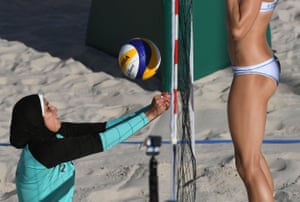
Egypt’s Doaa Elghobashy controls the ball in front of Canada’s Kristina Valjas during the women’s beach volleyball


Egypt’s Doaa Elghobashy controls the ball in front of Canada’s Kristina Valjas during a women’s beach volleyball qualifying match. Photograph: Yasuyoshi Chiba/AFP/Getty Images

But I gaze at today’s Olympian women, like the extraordinary Simone Bines, and I suddenly regret almost all my physical choices in life, longing to have worked out, toughened up, added muscle. Perhaps it is a combination of Bines, as well as the inclusion of women’s rugby this Olympiad, the harder competition demanded of those working to break records on the track or in the pool, the exposure given the brutality of women’s cycling, the singular physical adeptness of Caster Semanya or the refreshing recontextualisation given beach volleyball by the Egyptian women who took proudly to the sand to play their game well covered up, but this year like no other have I been attuned to the Olympics as a showcase of growing pride in female bodily strength.


It could just be me; I’m hitting my 40s, one of my knees is a little wobbly, and the demands of mid-life domestic duty has left me more than disappointed that I’m strained and out of breath. But it could be a silent zeitgeist of feminist realisation that one of the final great taboos restricting the agency of women – the social policing of femininity – is finally, finally starting to wither.


In the west, we inherit terrible, powerful messages that disassociate what it means to a woman from what it means to be physically strong. The New Testament’s insistence that women should be desired for being “weaker vessels” obliging men to dominate and steer them is an example of what’s created if we perform gender as one of only two cultural options, defined in opposition. As Australian gender theorist Jamila Rosdahl puts it: “that men should be strong, aggressive and in control and women should be weak, passive and powerless.”


It’s why the Victorians found erotic appeal in the corset for fetishising womanly “physical weakness and vulnerability … juxtaposed with man’s strength.” It’s why in the second world war, the American military purposely excluded “masculine” women from service in the belief that physically strong women performing in traditionally male roles would “produce lesbians” and destabilise the social order. Ooh, imagine.


Serena Williams playing at the Rio Olympics.


Serena Williams of the United States in action against Elina Svitolina of Ukraine during a women’s singles third round match. Photograph: Cameron Spencer/Getty Images

Related: Mack Horton has set something in motion. Is this the line in the sand on doping in sport? | Caroline Riot


And it’s informed an outspoken sexism that persists in sport: like in 1999, when Martina Hingis described a teenage Amelie Mauresmo as “half a man”, or in 2012 when Dominika Cibulkova said playing Sam Stosur was “like playing a man”, or 2014, when a Russian tennis official referred to Serena and Venus as “the Williams brothers”. And that’s just in the sport of tennis where, by the way, Tomasz Wiktorowski, the coach of Agnieszka Radwanska, boasted – in 2015! – of a decision to keep his player “as the smallest player in the top 10.” Why? “Because, first of all she’s a woman, and she wants to be a woman.”


But maybe it’s the sport of tennis that’s also helped to de-lace the cultural corset of the old gender binary, because when I think of the woman I want to be, it’s Serena Williams’s example to which I aspire, not Agnieszka Radwanka’s.


Because while Williams may be leaving Rio after a shock upset to the Ukraine’s Elina Svitolina, the cultural victory is already hers. As one of the most decorated athletes, of either gender, in any sport, of all time, her example is proudly one amid the many women of this Olympic generation unafraid to define what it means to be a woman, free from the old traditions that oblige weakness – and entirely on her own terms. And that, more than any race, heat, triumph, loss or medal in this Olympics, is worth being excited about.


The female strength on display in Rio is worth getting excited about | Van Badham

1 Ağustos 2016 Pazartesi

Amy Winehouse charity sets up home for female recovering addicts

The Amy Winehouse Foundation has partnered with a housing provider to open a home for women recovering from alcohol and drug addiction, on the fifth anniversary of the singer’s death.


Known as Amy’s Place, the recovery house, which will be in operation from Monday, is based in east London and aims to help recovering female addicts reintegrate into society and sustain their recovery. It will be made up of 12 self-contained apartments, four of which are two-bed, and can house up to 16 women.


Dominic Ruffy, the special project director at the Amy Winehouse Foundation, said it decided to set up Amy’s Place because of the general lack of women-specific services for addiction treatment in the UK, despite research showing that women have a far greater chance of relapse without such support.


“There are about six women-only rehabs, and beyond that, there’s an even greater paucity of women-specific recovery housing beds,” he said. “There is only one other women-only recovery house in London and it’s only a four-bed with a six-month waiting list.”


Ruffy, who has been in recovery himself, said while traditional rehab was usually made up of detoxification and intensive psychological treatment, a recovery house was a safe place for people to come out of treatment and be reintegrated into society, with support workers to help guide them.


“Picture a person who is 14 years old, has come from a broken home, hasn’t engaged at school, ends on a path of addiction and winds up at 25-26 years old going to rehab, learning how to get clean, and then leaving rehab and being told to get on with it. It can be as simple as not knowing how to go about getting your benefits or engaging in college.


“Our experience shows if you give people an extended period of time post-traditional rehabilitation treatment, you will improve the percentage of people who stay clean [in the] long term. We have a saying in recovery that the drink and drugs aren’t our problem, it’s living life clean and sober.”


Residents at Amy’s Place will be supported using a “co-production model”, which gives them shared control over the services that aid their recovery. To come up with the programme, the foundation consulted several women at the women-only rehab centre Hope House in south London, who described what their perfect recovery house would look like in terms of activities, workshops, personal development pathways and length of stay. Together, they created a three-month programme for new residents of Amy’s Place, which includes holistic activities such as yoga, relapse prevention groups, and potential skills and employability based workshops.


Laura, 35, a former heroin addict and mother of three, is planning to move to the east London centre after an upcoming stint in rehab. She told the Guardian: “I think it’s really important to have a place like this when you’re in recovery. It’s a new experience to come off drugs. Some people suffer from anxiety, some people suffer from other stuff, and it’s reassuring to have some support and help with finding a home and getting a job, getting back into normal routine life, which you didn’t have before as a drug addict. You have to learn it all as new.”


Laura said an all-women’s home would give her time to concentrate on herself, adding: “There are no men around, no distractions to help you run away.


“My aim is to be drug-free and to get back into life, and deal with my underlying issues that made me want to use drugs in the first place. I really want to leave this chapter of my life behind and start a new future with my kids and husband-to-be.”


Ruffy said it was important to have women-only recovery houses because “women tend to come into recovery with a host of complex issues, whether that’s physical, mental or psychological abuse”.


He said the foundation’s consultation with women in rehab showed that they all preferred a women-only house because “they wanted to ensure they were either safe and away from ex-partners, or safe from their issues around co-dependency, around men … It was evident there was a clear need and the women would feel more secure in an environment [where] they knew they weren’t going to be troubled by aspects from their past.”


Amy Winehouse died aged 27 in July 2011 from accidental alcohol poisoning. The foundation was set up by her family following the singer’s death, and works to prevent young people misusing alcohol and drugs, as well as to support disadvantaged young people to help them fulfil their potential. It has set up Amy’s Place with the help of Centra Care and Support, part of not-for-profit organisation Circle Housing, one of the UK’s largest providers of affordable housing.


Michelle Davies, the London regional director of Centra Care and Support, said: “We want to empower young women to remain in control of their recovery by providing safe and secure homes, personalised services and a vibrant community that will build on their strengths, experiences and preferences.”


Jane Winehouse of the Amy Winehouse Foundation said: “This project will make such a profound difference to so many young women, enabling them to have a safe environment in which to rebuild their lives and put into practice all the learning they have acquired through their treatment journey. Fresh starts are difficult to make, full of challenges, but at Amy’s Place, we will give young women the tools and support to help make this a reality.”


Amy Winehouse charity sets up home for female recovering addicts

24 Ağustos 2015 Pazartesi

Female Viagra? Almost everything You Wanted to Know About Sex Drug Flibanserin But Have been Afraid To Request

[unable to retrieve complete-text content material]


Female Viagra? Every thing You Wanted to Know About Flibanserin But Had been Afraid To Inquire I&rsquom a 37-yr-old married female with two small young children, a total-time work, and not enough hours in the day. Putting my occupation as a journalist aside, you&rsquore darn straight I have a lot of queries about the [...]


Female Viagra? Almost everything You Wanted to Know About Sex Drug Flibanserin But Have been Afraid To Request

19 Ağustos 2015 Çarşamba

FDA approval of "female Viagra" leaves bitter taste for critics

It is the modest pink pill that its manufacturers hope will do for girls what Viagra did for men. The choice to give the drug a advertising licence in the US has been cheered on by campaigners for women’s rights, but the question remains no matter whether Addyi is the breakthrough medicine claimed.


Men have the blue diamond-shaped Viagra pill and 25 other individuals as well (even though 17 of individuals are kinds of testosterone), although there has so far been no counterpart for women until finally now. But sex and relationship therapists say Addyi is only moderately powerful, need to not be taken with alcohol, and has potentially severe side-effects which includes fainting and abnormally minimal blood pressure.


Related: FDA approves ‘female Viagra’ pill Flibanserin right after two rejections


Some of the women who testified before the US drug licensing committee, the Foods and Drug Administration, seemed to think the pill would bring back the passion and romance of times past, but there are fears they are currently being sold an unfulfillable dream.


“I am concerned about the expectations that ladies have,” said Cynthia Graham, professor in sexual and reproductive overall health at the University of Southampton. “Among women who spoke at the FDA there had been expectations that you can have sexual desire that is at a large level and absolutely nothing is going to influence it – that it will be correct back the place it was when you met your companion.”


The trials display that Addyi gave females who took it day-to-day a single added sexually satisfying expertise per month.


Graham and other critics believe the FDA was pressured and half-shamed into approving Addyi (generic identify flibanserin) by a campaign headed by a vocal group called Even the Score, which pitched the absence of medication to help females with reduced libido as a gender inequality issue.


It describes itself as a campaign for women’s sexual wellness equity which was “created to serve as a voice for American females who believe that it is time to level the enjoying field when it comes to the treatment method of women’s sexual dysfunction”. On the front page of its internet site now runs a banner saying “Thank you, FDA”. Sprout Pharmaceuticals, which owns Addyi, is one particular of the funders, as is Trimel, one more organization in the very same discipline.


Sprout strategies to enlarge the organization. Its shareholders ought to be in for a windfall if the drug generates even a fraction of the good results and profits Viagra did for Pfizer right after winning a licence.


Sprout’s chief executive, nevertheless, hailed the FDA selection as a victory for females. “It has been a outstanding journey to get to this breakthrough minute. Today we celebrate what this approval implies for all women who have prolonged awaited a medical remedy alternative for this daily life impacting condition,” stated Cindy Whitehead. “We applaud the FDA for putting the patient voice at the center of the conversation and for focusing on scientific proof.”


The determination was not clearcut. The drug, an antidepressant which works on the brain, in contrast to Viagra, was rejected twice by the FDA on the basis of a small benefit and considerable side-results. The last vote was an 18 to six, with none of the panel willing to endorse it without having caveats. Addyi will have a black box warning, that means there are significant side-effects. It is not accepted for girls past the menopause or anyone with an impaired liver. It can lead to lower blood pressure and reduction of consciousness. These dangers are increased if ladies drink.


“Because of a possibly critical interaction with alcohol, remedy with Addyi will only be offered by means of licensed wellness care pros and licensed pharmacies,” stated Dr Janet Woodcock, director of the FDA’s Center for Drug Evaluation and Analysis. “Patients and prescribers must completely realize the risks connected with the use of Addyi ahead of taking into consideration treatment.”


The FDA needs Sprout to do even more research of the impact of alcohol. The one it carried out concerned 25 folks, of whom 23 were males. Graham believes there is small possibility physicians will hold off prescribing it for women who drink or who are publish-menopause. Even in the hours right after the announcement of the licence “we could see indications that the drug is not going to be prescribed only to ladies who are pre-menopausal and really do not drink”, she stated.


Dr Irwin Goldstein, who heads the San Diego sexual medication centre and has been a advisor to Sprout, informed the New York Occasions he would not refuse to give it to casual drinkers.


There are also queries about the accurate scale of unmet need to have. The typically utilised statistic that far more than two-fifths of all women – 43% – knowledge loss of sexual desire dates from a survey in 1999 which failed to ask females no matter whether they have been actually bothered by that. The larger and more current National Attitudes and Sexual Lifestyles study in the Uk found that about ten% of girls had minimal libido and had been experiencing distress as a outcome.


Dr Petra Boynton, agony aunt and psychologist who has researched sexual working, says losing interest in sex is a actual worry for females, “But what are they truly worried about? They consider they are not standard because they do not want intercourse that a lot. They wonder ‘will my partner leave me?’ and ‘am I undesirable or inadequate?’”


There are some who wonder if they are missing out on pleasure, she mentioned, but that is not truly the principal anxiousness. “They are speaking about not currently being good adequate or not measuring up. Men and women have a perception that everyone else is possessing great intercourse all the time with exotic positions.” There is, Boynton explained, “anxiety brought about by misinformation about sex”, that is perpetuated by the media and particularly men’s and women’s magazines. “The cultural wallpaper is telling you that to keep somebody and be desirable and not left alone, which is a enormous fear, you must be possessing and providing regular intercourse.”


Addyi could support a modest number of females, but Boynton pointed out that, like the other medicines for sexual issues, it had only been examined against placebos. It would have been fascinating, she mentioned, to trial it towards candles and bathnights and sex toys – and, for that matter, romantic relationship treatment.


The drug will be on sale in the US from October. Sprout has not stated no matter whether it will apply for a licence to sell it in Europe, but if it did, the verdict may possibly not automatically be the same. “I would be stunned if it is licensed right here,” mentioned Boynton. “But regardless of whether it is licensed or not, it will nonetheless perpetuate the illusion that if you do not have desire, there is something wrong with you.”


FDA approval of "female Viagra" leaves bitter taste for critics

FDA Approves Addyi, But It Is Not The "Female Viagra"

[unable to retrieve total-text articles]


Will the new drug to &ldquotreat&rdquo lower female sexual want function, or leave a good deal disappointed females in its wake?


FDA Approves Addyi, But It Is Not The "Female Viagra"

Female rugby player"s tragic death exhibits why girls must tackle this sport head on


The 23-yr-outdated player was tackled to the ground for the duration of a game for her crew Longton but walked off the pitch, despite some discomfort. She later on suffered a stroke very likely due to a blood clot and died a month following being harm.


Some have pointed to this as proof that females shouldn’t be playing such a rough sport.


But, with respect to Sarah’s household and close friends, I should disagree.


Yes, rugby is a get in touch with sport it is the nature of the beast. Knocks will happen and a handful of are far more significant than others. As Sarah’s teammate Lesley Thompson said at the hearing into her death: “It was just a tackle, absolutely nothing malicious or heated”.


Anyone who queries the rougher edge and suggests that girls would be much better off steering clear of rugby, is missing the point.


The reality is that we achieve so a lot more, in spades.


Sarah ChestersSarah Chesters  Photograph: SWNS


We’re encouraged, by our coaches and teams, to search right after our bodies to stretch and problem them in purchase to avoid injury, acquire strength and consume nicely.


The teamwork doesn’t cease, ever. From instruction in the wind and rain on grim February nights to plaiting every single others’ hair on the bus to an away game. These are journeys when we shout, sing, get raucous and share cakes we stayed up producing the night before (it’s not just the staff, one particular of our star bakers is a player’s husband).


You feel ladies can’t perform nicely with each other? There’s no greater way to bust this ridiculous myth than seeing eight girls, working with each other in a pack to earn hard yards for the rest of their team.


We’re invariably called ‘butch lesbians’ and ‘man-hating hulks’.


Masculine, you say? Well, if you’d class strength, determination and a cracking sense of humour as masculine traits, we’d say: “too correct.”


There are even now too many lazy and hazardous stereotypes that surround women’s rugby. But shell out a pay a visit to to any club, and you will locate this kind of a selection of personalities, shapes, ages, sexualities, speeds and skill-levels – it’s the sport that brings us with each other.


Whether it’s busting our guts on the pitch for a single yet another, or busting our lungs singing S Club 7 songs in the showers afterwards although acquiring the mud out of our hair (3 shampoos and a rinse generally does the trick), there is amazing camaraderie that comes hand-in-hand with pushing your self to the limits in the worst climate circumstances Britain has to provide.


That is something that Sarah, who commenced playing rugby as a student at Manchester Metropolitan University, would have skilled initial hand and loved, just as we do.


Bath ladies in action  Photo: Paul Hughes


All the ladies I perform with are properly aware of the dangers involved. And they also have knowledgeable a tragic injury. Eight years ago, the team’s captain and a founder-player broke two vertebrae in her neck and broken her spinal cord. Her injuries had been life-changing. But she’s by no means blamed the sport, nor anybody concerned, merely saying it was “one of individuals items.”


In the days following her accident, she informed the crew they have to return to perform their largest rivals the following week. It was hard but they did. And they won.


I imagined of her this week, when I study a comment by Sarah Chesters’ father, right after the inquest. Michael, 65, explained that his daughter ‘loved’ rugby. “Despite her modest stature,” he additional, “she was really strong”.


To propose that ladies shouldn’t play rugby – that we are not physically capable – is to say we’re the weaker intercourse. Tragic accidents do take place in sport, as in numerous other walks of lifestyle. Only last month, 24-year-outdated Bavalan Pathmanathan died following currently being struck in the chest by a ball in the course of a regional cricket match in Surrey.


This kind of incidents need to not be taken lightly, of program. Any sports player is aware that severe damage is a real risk. But, as Sarah’s father rightly pointed out in saying how much his daughter loved rugby, it is just component of throwing oneself wholeheartedly into the game, with passion, enthusiasm and strength.


Sarah Chesters playing rugbySarah Chesters taking part in rugby  Photo: SWNS


Confident, as girls we occasionally appeal to a little concern from strangers who clock our black eyes and mutter quietly, “are you alright?”


But once they uncover out you play rugby, it problems their assumptions. It is not a bad conversation starter for your CV, too.


Player security is constantly proper at the best of the agenda. New protocols to deal with concussion are filtering down to grassroots degree from the prime tiers of the sport, with latest higher-profile circumstances – this kind of as the concussions experienced by Welsh player George North and Ireland’s Jonny Sexton – guaranteeing rapid progress.


• Rugby concussions soar by 59 per cent, says report


We have scrum caps, mouth guards, hi-tech strapping. There’s also been important advancement in sports armour for women’s bodies, which will give you even a lot more protection when you get that inevitable elbow to the nipple (ouch). All this means the game has never been safer.


England win WomenEngland win Women’s Rugby Globe Cup ultimate   Photo: AFP


Following the achievement of the England staff in winning the 2014 Women’s Rugby Globe Cup, a lot more girls than ever are scrumming down.


The Men’s Rugby World Cup lands in England (and Cardiff) this September, with tournament organisers stating that upping participation and engagement is one particular of their key objectives. Soon after that we’ve acquired fast and furious Sevens in the Rio Olympics to seem forward to.


Yes, there are aches, knocks and bruises. There’s crying, there is laugher – most of the time in my group, it is crying with laughter.


And there are the horrible (though thankfully scarce) times, when our community has to come with each other in the encounter of heartbreaking injuries.


But in women’s rugby, there’s also determination, strength, respect and joy. And the most entertaining you could ever have. There’s in no way been a much better time to tackle lifestyle head on.


Bath Rugby Women are element of Bath RFC. Last season, recruitment and advancement of new players was so effective that a Bath Rugby Women IIs staff was formed, and will compete for the very first time in the 2015/sixteen season. New players are extremely welcome – if you would like to come and train with us, just pop along, email bathrugbyladies@hotmail.co.united kingdom or follow on Twitter @bathrugbyladies


Female rugby player"s tragic death exhibits why girls must tackle this sport head on

18 Ağustos 2015 Salı

FDA approves "female Viagra" pill Flibanserin soon after two rejections

The FDA has ultimately accepted the tiny pink pill to assist females enhance their sex drive.


Flibanserin, to be offered as Addyi, finally received a green light from the US Foods and Drug Administration on Tuesday. This was the third time the agency has regarded approval for the drug, which is intended for ladies diagnosed with hypoactive sexual wish disorder, HSDD.


The drug, while usually referred to as “female Viagra”, is more akin to an antidepressant as it changes brain chemistry related to the way that dopamine and serotonin do. Viagra relaxes muscle tissue and increases blood movement to specific regions of the male body, assisting deal with erectile disfunction. Although the blue pill for men should be taken ahead of engaging in sexual action, girls are to consider the pink pill day-to-day.


“Today’s approval provides women distressed by their lower sexual desire with an authorized therapy choice,” stated Janet Woodcock, M.D., director of the FDA’s Center for Drug Evaluation and Research (CDER). “The FDA strives to protect and advance the health of females, and we are committed to supporting the development of safe and effective treatment options for female sexual dysfunction.”


But the FDA cautioned that care should be taken for prospective adverse reactions to the pill, like reduced blood strain and loss of consciousness.


“Because of a probably critical interaction with alcohol, treatment method with Addyi will only be offered by means of certified overall health care professionals and licensed pharmacies,” Woodcock mentioned. “Patients and prescribers should entirely understand the dangers connected with the use of Addyi before taking into consideration remedy.”


Connected: ‘Female viagra’: FDA panel backs Flibanserin with security restriction


In June of this 12 months, the pill took the 1st step to making it into US pharmacies. An FDA panel voted 18-6 in favor of approving Flibanserin on the problem that Sprout develops a strategy to restrict safety dangers. The panel had previously rejected the pill twice before.


When the FDA rejected Boehringer Ingelheim’s application for Flibanserin in June of 2010, it ruled that the drug worked no better than a placebo.


“I certainly hope Boehringer does not give up,” Sheryl A Kingsberg, a psychologist and Case Western Reserve University healthcare professor, informed the New York Times at that time. “Flibanserin showed an terrible good deal of guarantee. I’m going to have some quite, really disappointed patients if there’s practically nothing for them.”


However by October of that year, Boehringer did just that, announcing that it was discontinuing advancement of Flibanserin. Months later on, in 2011, the drug was acquired by Sprout. The pharmaceutical company attempted its luck ahead of the FDA in June of 2013, only to be thwarted when the company ruled that the dangers of sleepiness, dizziness, fatigue and nausea outweighed the rewards.


It was at about that time that the conversation about Flibanserin became heated, with opponents lobbying against the drug due to its side results and supporters accusing the FDA of gender bias.


In October of last year, Sprout, along with number of organizations supporting the approval of Flibanserin, launched a campaign referred to as “Even the Score”.


“There are 26 FDA accredited drugs to treat a variety of sexual dysfunctions for males (41 if you count generics!), but nonetheless not a single one for women’s most frequent sexual complaint,” the campaign argues on its site. “Why do we rapidly track the approval of medication like Viagra (1998) for men?”


According to the campaign, intercourse is “a standard human right” and now is the “time to even the score when it comes to treatment of women’s sexual dysfunction”.


But a coalition of organizations led by the National Women’s Overall health Network wrote in a letter to the FDA: “The problem with Flibanserin is not gender bias at the FDA but the drug itself.” The group expressed help of the FDA’s “evidence-primarily based evaluation and decision-making”.


Some healthcare authorities, like Dr Adriane Fugh-Berman, a professor at Georgetown University, fret about how such campaigns might influence the FDA in the potential now that Flibanserin has been approved.


“This may possibly set a precedent of risky medication getting accepted based on public relations campaigns rather than science,” she informed Marketplace.


Relevant: We shouldn’t push dubious ‘pink Viagra’ capsules on girls and contact it emancipation | Barbara Mintzes and Leonore Tiefer


“I believe whether or not or not this is eventually the proper decision for ladies is a story that will be advised in the marketplace,” Cindy Whitehead, the chief executive of Sprout, informed Quickly Business. Whitehead stated that building the drug and receiving it accepted grew to become “a cause” for her.


Ladies struggling from HSDD also argue that it’s up to them to decide if the benefits outweigh the risks. Testifying prior to the FDA in June, a number of them urged the company to approve the drug.


Amanda Parrish was a single of the more than eleven,000 women who have participated in Flibanserin’s trial. Prior to joining the trial, she would attempt to avoid her husband, Ben, come bedtime. Soon after she started taking Flibanserin, she stated she did not come to feel any distinct throughout the day but her evenings turned around.


“What it did do was at the finish of a prolonged day, no matter how tired I was, I desired to initiate and it was not operate to do that,” she told NBC Nightly Information.


“She was flirty once more. She was leaving me notes on my bathroom mirror in the morning,” explained Ben Parrish. “We know that it performs. We experienced it.”


FDA approves "female Viagra" pill Flibanserin soon after two rejections

22 Temmuz 2014 Salı

US to conduct major study into female genital mutilation

The Obama administration is to carry out a major study into female genital mutilation, in an effort to establish how many women are living with the consequences of FGM in the United States and how many girls are at risk.


The previous study was carried out in 1997 ,and new research is a central demand of a Guardian-backed campaign, led by Jaha Dukureh, which aims to put an end to the practice. Experts say that FGM, which involves the removal of a girl’s outer sexual organs and is often carried out without anaesthetic, often takes place during the summer holidays when American girls are taken out of the country for the purpose. A prevalence study is seen by campaigners as a vital first step in tackling FGM in the US.


Cathy Russell, the US ambassador for global women’s issues, confirmed that the study would be carried out by the US Department of Health and Human Services. Speaking to the Guardian at a major summit on FGM and child marriage in London, Russell praised the event for highlighting the issue. “This summit is important because it brings together government, civil society and activists who care and have been working on this issue,” she said.


FGM is carried out in 29 countries, and Unicef has estimated that more than 130 million women are living with the consequences, which include heavy bleeding, infections, infertility and death during childbirth. At least 228,000 American women and girls in the US are at risk of the practice, according to previous research from the African Women’s Health Center of the Brigham and Women’s Hospital, but the true number is thought to be much higher.


Young American women who were cut as girls and teenagers on trips back to their parents’ countries, a practice known as “vacation cutting”, told the Guardian that they had been left scarred physically and emotionally. Lesha, a 21-year-old from a southern state, said she and her sister were sent to Guinea when they were 11 and nine respectively. “I went to Africa to learn about my identity just to end up being scarred for life,” she said.


It also emerged that the Obama administration has set up a preliminary working group on FGM, as the first step to measuring the extent of the problem in the US and deciding how to tackle it. Russell said there had been an “initial meeting”‘, adding that the group would likely meet again to discuss developments at the London summit. “We’ve been engaged on this issue for a long time, and now we are trying it get a sense of where we stand”, she said.


It is understood the working group will look at how to fight FGM through education, and will also look at how to tackle “vacation cutting”.


Dukureh, whose petition calling for the new study on change.org has attracted more than 230,000 signatures, said the US had an opportunity to push for change in its own country and inspire change around the world.


“I’m so excited because this is exactly what we asked for,” she said. “It is a great success not just for me but for everyone who has fought for this. But it doesn’t stop here, we are not going away. This is a first step in ending FGM in the States, and where the US leads others might follow.”


Shelby Quast, policy advisor at Equality Now, which is working on the campaign, said the development was proof that people could make a difference.


“Civil society and survivors have raised their voices and the government has responded to that, she said. “This interagency meeting is a call from the president – it means he is bringing people together to talk about this issue. Now the Obama administration must ensure they get input from survivors like Jaha.”


US to conduct major study into female genital mutilation

US to perform key review into female genital mutilation

The Obama administration is to carry out a major study into female genital mutilation, in an effort to establish how many women are living with the consequences of FGM in the United States and how many girls are at risk.


The previous study was carried out in 1997 ,and new research is a central demand of a Guardian-backed campaign, led by Jaha Dukureh, which aims to put an end to the practice. Experts say that FGM, which involves the removal of a girl’s outer sexual organs and is often carried out without anaesthetic, often takes place during the summer holidays when American girls are taken out of the country for the purpose. A prevalence study is seen by campaigners as a vital first step in tackling FGM in the US.


Cathy Russell, the US ambassador for global women’s issues, confirmed that the study would be carried out by the US Department of Health and Human Services. Speaking to the Guardian at a major summit on FGM and child marriage in London, Russell praised the event for highlighting the issue. “This summit is important because it brings together government, civil society and activists who care and have been working on this issue,” she said.


FGM is carried out in 29 countries, and Unicef has estimated that more than 130 million women are living with the consequences, which include heavy bleeding, infections, infertility and death during childbirth. At least 228,000 American women and girls in the US are at risk of the practice, according to previous research from the African Women’s Health Center of the Brigham and Women’s Hospital, but the true number is thought to be much higher.


Young American women who were cut as girls and teenagers on trips back to their parents’ countries, a practice known as “vacation cutting”, told the Guardian that they had been left scarred physically and emotionally. Lesha, a 21-year-old from a southern state, said she and her sister were sent to Guinea when they were 11 and nine respectively. “I went to Africa to learn about my identity just to end up being scarred for life,” she said.


It also emerged that the Obama administration has set up a preliminary working group on FGM, as the first step to measuring the extent of the problem in the US and deciding how to tackle it. Russell said there had been an “initial meeting”‘, adding that the group would likely meet again to discuss developments at the London summit. “We’ve been engaged on this issue for a long time, and now we are trying it get a sense of where we stand”, she said.


It is understood the working group will look at how to fight FGM through education, and will also look at how to tackle “vacation cutting”.


Dukureh, whose petition calling for the new study on change.org has attracted more than 230,000 signatures, said the US had an opportunity to push for change in its own country and inspire change around the world.


“I’m so excited because this is exactly what we asked for,” she said. “It is a great success not just for me but for everyone who has fought for this. But it doesn’t stop here, we are not going away. This is a first step in ending FGM in the States, and where the US leads others might follow.”


Shelby Quast, policy advisor at Equality Now, which is working on the campaign, said the development was proof that people could make a difference.


“Civil society and survivors have raised their voices and the government has responded to that, she said. “This interagency meeting is a call from the president – it means he is bringing people together to talk about this issue. Now the Obama administration must ensure they get input from survivors like Jaha.”


US to perform key review into female genital mutilation

21 Temmuz 2014 Pazartesi

Parents who permit female genital mutilation will be prosecuted

Mothers and fathers will be prosecuted if they fail to stop their daughter being reduce, and all victims of female genital mutilation (FGM) will get lifelong anonymity, David Cameron will say on Tuesday.


As the prime minister hosts a Lady Summit with Unicef aimed at mobilising domestic and global efforts to end FGM and little one marriage, new measures will be announced aimed at ending the practices “after and for all”.


The announcement comes the day following it emerged that the variety of girls living in England and Wales who have been subjected to FGM is twice as substantial as previously imagined. A new research reveals more than 137,000 girls in England and Wales are residing with the consequences of FGM. The variety has substantially improved in the previous ten many years as ladies flee war-torn countries to discover security in Britain, in accordance to the report from City University and the human rights group Equality Now.


To mark the initial Girl Summit in the Uk, the prime minister will announce a modify to the law that will make it parents’ accountability to defend their daughters from FGM or encounter punishment. Presently it is towards the law to cut a child in Britain or take a kid out of the country for the purposes of FGM, but this new law will extend sanctions.


Cameron will also launch a £1.4m “avert programme” to help stop the practice currently being carried out on women and to care for survivors, and he is expected to unveil new police guidance on how to manage new instances, and a consultation on civil orders to safeguard these at chance of FGM.


A new professional FGM services, which will incorporate social providers, will recognize those at danger of currently being lower. Cameron will say: “All ladies have the right to reside free of charge from violence and coercion, with out currently being forced into marriage, or the lifelong bodily and psychological effects of female genital mutilation. Abhorrent practices like these, no matter how deeply rooted in societies, violate the rights of women and girls across the world, like here in the Uk.”


The new examine reveals that in England and Wales about 103,000 migrant females aged 15 to 49, ten,000 girls underneath 15 and about 24,000 women aged 50 or above had been subjected to FGM. The numbers of ladies from the Horn of Africa – exactly where the most severe form of FGM is widespread – had increased by 32,000, although the number of ladies from east and west Africa also improved by ten,000 above the past decade.


A 2007 report making use of 2001 census data stated that 66,000 females and girls had been subjected to FGM in England and Wales with an estimated 24,000 ladies below 15 at danger. Until finally now the most latest research, funded by the Believe in for London and the House Office, does not estimate the number of at-chance women, but reveals 60,000 girls under 15 had been born in England and Wales to mothers who had undergone FGM among 2001-eleven.


Earlier this yr, the then schooling secretary, Michael Gove, agreed to publish to headteachers about the dangers of FGM soon after 250,000 individuals joined a campaign backed by the Guardian and alter.org in the runup to the summer holidays when numerous girls are sent away to be reduce.


Efua Dorkenoo of Equality Now mentioned the government had manufactured positive actions but specialists essential clear guidance to identify at-danger ladies and give them assist. “The government demands to get a take care of over this excessive abuse of the most vulnerable girls in our society by implementing a robust nationwide strategy to deal with the issue,” she mentioned.


“There is no time to waste on platitudes as 1000′s of women residing in England and Wales are having their existence blighted by this damaging practice.”


The World Overall health Organisation estimates that up to 140 million ladies and females have been subjected to FGM, a cultural practice developed to curb female sexuality that requires the partial or total removal of the outer sexual organs and can lead to lifelong bodily and psychological problems.


The report states: “A widespread-held belief in FGM-practising communities is that ladies and females who have not undergone FGM have an insatiable sexual appetite, which has to be restrained to avoid bringing dishonour and shame to families.”


Measures to defend girls from FGM in the Uk have also been announced by police and Border Force agents, who are stepping up operations as the school summer holidays get started.


New Border Force youngster protection squads are joining with police to target particular flights in a bid to avoid vulnerable girls being taken out of the nation for FGM. The beefed-up teams at key airports and border crossings in the Uk are on alert for the start of the summer season holidays, when professionals say ladies are at the highest risk of becoming taken out of the country.


Specially qualified Border Force agents will be functioning with police forces, which are also set to acquire new advice stating that officers should place aside cultural sensitivities and fears of getting branded racist in purchase to pursue investigations into FGM. In the very first nationwide guidance issued to all police across the nation, the University of Policing warns officers not to let fears of getting branded a racist end them investigating FGM.


As the summer time holidays commence, an 80-robust crew of specialist officers at Heathrow, 65 at Gatwick and 21 at Manchester will be on the lookout for at-danger young children. The port of Harwich also has a new staff, although expert FGM training is also planned at Birmingham, London City, Stansted, Calais and Dunkirk.


Doing work with police intelligence, particular flights to nations which practise FGM – which includes Kenya, Ethiopia, Ghana, Nigeria, Dubai, Egypt and Turkey – will be targeted, stated Ingrid Smith, assistant director of the Border Force at Gatwick. “The message we are sending with this intensification of operations is that the practice of FGM will not be tolerated in this country,” she stated. ” Police, Border Force agents and social companies will act together to end this and folks trying to take young children out of the country will be caught.”


James Brokenshire, the immigration and security minister, explained border police had been effectively-positioned to collect intelligence on attainable perpetrators and avert FGM from becoming carried out.


“The school summer holidays are a time of specific threat for numerous girls,” he said. “Which is why we have teams of specially qualified officers at significant airports with the skills to recognize and safeguard likely victims and stop the perpetrators.”


The advice drawn up by the University of Policing is the 1st to deal with female genital mutilation and reflects developing public and political concern more than the mutilation and the lack of prosecutions of folks in the United kingdom.


Officers in England and Wales will be informed that when investigating the mutilation of young women in the Uk they must think about all little one protection measures, including removing a lady from her family if they believe she is at danger of FGM.


Below part 46 of the Children Act 1989 police officers can make a decision to remove a youngster who they think is at chance of “important harm” to a area of security for up to 72 hours. They can also apply to a court for an emergency safety buy when they think a youngster is in imminent danger.


Officers will also be advised that they must consider removal of younger sisters in a family in which there are issues that an older girl is at chance of FGM, due to the fact the younger siblings will also want protection.


Chief Constable Alex Marshall, chief executive of the College of Policing, stated: “We want to make sure that officers have the very best details feasible to aid them to shield the vulnerable and tackle this horrible crime. We should not allow perceptions of cultural sensitivities get in the way of action towards female genital mutilation.


“This guidance will help develop our comprehending and confidence in policing this crime so that we’re better ready to react to victims’ needs and ultimately carry perpetrators to justice.”


It warns officers not to be place off pursuing investigations because of the “cultural sensitivities” concerned. “Female genital mutilation is the deliberate cutting of the female genitalia. It is unlawful, very unpleasant and a kind of violence towards women and ladies … Officers must not stay away from tackling FGM for concern of performing or saying the wrong point or becoming regarded racist.”


Female genital mutilation has been unlawful in the United kingdom since 1985, and the law was tightened in 2003 to make it an offence for a British resident to travel abroad in buy to have FGM carried out on a little one. Stress has been increasing on police and prosecutors in excess of the failure – until earlier this yr – to carry a single case to the British courts. Alison Saunders, the director of public prosecutions, announced the initial ever charge relating to FGM earlier this year but the case has yet to go through the courts.


Parents who permit female genital mutilation will be prosecuted