Skinny etiketine sahip kayıtlar gösteriliyor. Tüm kayıtları göster

12 Mayıs 2017 Cuma

Female mannequins aren"t just skinny, they"re emaciated


There have have been several observations in the press and on social media in the past few years that some of the mannequins used to sell women’s fashion represent unrealistic and unhealthy body sizes. But until we started to look into it, the issue had not been researched properly, and the evidence was mostly anecdotal.


Back in 1992, researchers surveyed a handful of mannequins from the 1930s-1960s housed in museums. They concluded that real women of a similar body size would be so thin that they would be unable to menstruate. More than 80 years on, and with women in a very different societal position than previously, you might expect things to have changed.


Sadly, however, that’s not the case. Our newly published research concludes that the body sizes of mannequins being used to sell female fashion on the British high street today represent those of severely underweight women.


Unhealthily thin


In 2015, we conducted a formal study of mannequins by surveying all national chain fashion stores on the high streets of two cities in England – Liverpool and Coventry – that were using mannequins. In total, we visited 17 stores and got acquainted with 58 mannequins, 32 of which were “female” and 26 “male”.


What we found was that all of the female mannequins in these shops had body sizes that corresponded to that of an underweight human. We didn’t find a single female mannequin that was a normal body size on display.


Samantha Jenkins (@samanthajenkins)

Is it even humanly possible to be as skinny as this Topshop mannequin? pic.twitter.com/fDJSO88v2L


October 30, 2014


The “ultra-thin ideal” is something that I, and many others across the world, loathe. Size zero culture and glamorisation of unrealistic and unobtainable body sizes has meant that the “ideal” body size frequently and implicitly communicated to women is dangerously unhealthy.


Promotion of the ultra-thin ideal has been shown to cause women to be dissatisfied with their body size. And, in turn, this dissatisfaction is thought to be one step along the path of developing an unhealthy desire or “drive” for thinness, and subsequent eating disorders.


Not everyone will develop an eating disorder from having the ultra-thin ideal pushed upon them, and it is difficult to say why some people develop them and others don’t. However, the academic community is pretty convinced that promotion of ultra-thinness is a major player in eating problems, and that it is responsible for the propagation of body image problems in young women.


An ideal model?


Interestingly, we found that most of the male mannequins in our survey didn’t look underweight – only 8% of those surveyed were too thin. This fits well with what we know about ultra-thin body ideals and gender: it is primarily communicated to women, who are a lot more likely than men to develop an eating disorder like anorexia.
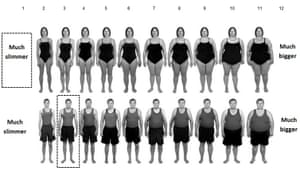


Mean mannequin sizes rated using the BMI-based body size guide rating scale.


Mean mannequin sizes rated using the BMI-based body size guide rating scale. Photograph: Eric Robinson

Our observation of male mannequin shows that there is no legitimate reason why mannequins used to sell female fashion have to be ultra-thin. If their male counterparts can be a “human” shape and size, then why can’t they?


Although some nation fashion stores say they are using larger bodied mannequins, we found no evidence of this in any of the stores that we visited. Of course, we can’t rule out that there may be some larger mannequins knocking about in a small number of stores, but we found that unhealthily thin mannequins are the norm on the high street.


Mannequins aren’t people, nor do they have a sign on them saying “you need to look like this”. But they are representations of the human body that are used to sell fashion and the idea of beauty. There is clear evidence showing that the ultra-thin ideal is contributing to the development of mental health problems and eating disorders.


There is no excuse for the continued use of emaciated mannequins.


Eric Robinson is a senior lecturer in the department of psychological sciences at the University of Liverpool.


This article was originally published on The Conversation. Read the original article.


Female mannequins aren"t just skinny, they"re emaciated

10 Eylül 2016 Cumartesi

Don’t blame the fashion world for the cult of skinny – even Roald Dahl plays his part | Hadley Freeman

It’s September, which means – exciting! – it’s fashion Groundhog Day again. This consists of fashion weeks starting up, followed swiftly by the announcement of a political initiative to protect women against this evil on the catwalk. (Another feature of fashion Groundhog Day, incidentally, is a slew of articles by male columnists expressing bafflement at why the models are so thin, which can be summed up as: “I don’t find this sexy, so why?!” However would we know how to look without men telling us what turns them on?)


Anyway, the latest initiative comes courtesy of the Women’s Equality party, which has launched a campaign demanding, among other things, that British designers and retailers stop using size zero clothes in shows and photoshoots. This, the WEP claims, “will tackle negative body image issues and eating disorders”.


I’m going to ignore the all-too-predictable connection between fashion models and eating disorders here, because I’ve written enough for this lifetime about how absurdly reductive it is to suggest that a mental illness is caused by Vogue. Instead, I’ll say this: the WEP is perfectly within its rights to address this issue, but – spoiler alert – it will not make a blind bit of difference. There have been efforts to legislate against fashion’s obsession with skinniness in the past; these laws, wherever they’re passed, always get a lot of play, because the media love a story that allows them to run a photo of a skinny model at least as much as the fashion industry likes the skinny model herself.


So it would be understandable if you were confused as to why things haven’t changed. The problem is not only that the laws are rarely enforced, but also that they are the equivalent of rearranging the Titanic’s deck chairs. For a start, fashion is too international for one country’s legislation to make a difference – especially, I’m sorry to say, when it’s this country doing the legislating. With the exception of Burberry, British-based fashion companies simply do not spend enough on international advertising for any laws to have an effect; the rest of the world won’t even see the photographs. Slapping legislation on a tiny British brand will not change the aesthetic if Chanel and Prada can carry on as before.


While fashion represents the connection between skinniness and perfection in its purest form, it is also the end point. By the time a woman is looking at fashion photography, she’ll have gone through years of indoctrination that the less of her there is, the better. It’s there in all the children’s books and films, in which the evil women are plump and the nice ones are slender (Roald Dahl is especially bad on this). It’s there in pretty much every film ever made (the only person I’ve interviewed with an evident eating disorder was not a model but an actress). And it’s there in the general atmosphere of being female today, the things you grow up hearing the adult women around you saying about their bodies, the way they decline dessert. According to a report just published by the Children’s Society, teenage girls are unhappier than ever, especially with their bodies, which they compare unfavourably with those of their friends and celebrities.


This masochistic tendency towards self‑erasure is a complicated issue, something a well‑meaning but overly simplistic campaign against thinness in fashion can’t fix. The WEP has also suggested including body-image lessons as part of the school curriculum, which is a better idea (and, tellingly, it has had less pick-up, what with it lacking the vital excuse for a photograph of a model). But instead of fussing about the meaningless phrase “size zero”, or conflating thinness with anorexia, the WEP would be more effective if it looked at the prevalence of eating disorders in the fashion industry and exposed this. Instead of pretending it can tell fashion editors what to put in their magazines, the WEP could talk to them to get a more realistic sense of the problem, and get them on side.


If we really want to end the association between female skinniness and female aspiration, women need to be doing this on an individual, focused level, not leaving it to politicians to act on an amorphous, collective one. Look at the way you talk about your body and what you eat, especially in front of young girls. Call out publications that condescend to larger women and feature photographs only of slim ones. Remind your female friends and your daughters that their jeans size is not a measurement of their personal value.


It is easy to damn the fashion industry for promoting skinny as the feminine ideal. It’s harder to admit that it is only echoing back too many of our own darkest thoughts, our own self-loathing.


Don’t blame the fashion world for the cult of skinny – even Roald Dahl plays his part | Hadley Freeman

17 Temmuz 2014 Perşembe

Dimension triple zero: why will not our obsession with super skinny disappear?

Size issues. For men, the common rule is the larger the much better. For women, it is the opposite — at least when it comes to dress dimension. Consequently the re-emergence of the size zero debate, reignited with the appearance of dimension triple zero. The authentic dimension zero, 1st brought to our interest 10 many years ago, is a British dimension four. But now we have the triple zero — just lately launched by American retailer J Crew and utilized by Abercrombie &amp Fitch which is obtainable in the United kingdom — is a British size zero. It would match a 23 inch waist, the typical size for a child age 6 – 8.


Of course there is outrage about such a dress dimension currently being promoted for grownup females and and I totally agree with condemning this ridiculous move. But the way several content articles report the incident — “Oh no, its back yet again, girls are once once more attempting to make themselves unhealthily skinny.” — doesn’t make sense. It implies that the world’s obsession with skinny and its influence on women’s physique picture had gone away and was only now returning.


It hadn’t. It was often with us. And pointing out a dilemma isn’t the same as fixing it. At the time of the introduction of double zero, many magazines stated how horrible it was, included a few positively captioned images of females with healthful entire body weights — and then it was back to the standing quo. Whilst so numerous women’s magazine appropriately say starving oneself skinny is not healthful and insist we find out to adore ourselves what ever our dimension, flick by means of a number of pages and there they are: incredibly slim younger women in each trend spread. Yet another number of pages and you discover them praising the stylishness of seriously thin women — Alexa Chung and Kate Bosworth are persistently held up as the world’s most stylish women but are definitely nowhere near the average British women’s dimension. Occasionally a slightly curvier women breaks through — Beyoncé for example — but its a rarity.


Alexa Chung: praised for her stylishness but to many appears to present an unrealistic body weight
Alexa Chung is also praised for her stylishness but to many she seems to current an unrealistic body weight Photograph: REX

A latest write-up in Grazia on the topic factors out that “vanity sizing” plays a huge function in the triple zero phenomenon. Retailers re-variety regular sizes to enhance the buyer’s self-esteem — so what was when a size twelve becomes a ten or 8 and as a result so smaller sizes get labelled “zero” or “double zero”. There has been a call to end vanity sizing and Grazia says that there need to be a standardisation of sizes across merchants in Europe and the US. But will this actually assist? Yes you are going to know precisely what size you are in any store, but why would that cease a person from becoming obsessed with currently being skinny? It is the photos that females are bombarded with every day that make the lasting affect: skinny is elegant and placing on excess weight gets you shame (and often a red circle close to the offending spot). Blaming the sizing itself shifts the blame from the magazines and sites to the merchants.


A model on the catwalk during London Fashion Week, 2007: seven years ago
A model on the catwalk for the duration of London Vogue Week, 2007, when dimension zero was in the news due to concern more than the health problems related with it. Seven years later on and we now have dimension triple zero. Photograph: LEON NEAL/AFP/Getty Images

Some of the articles have also blamed the rise of Instagram and the “skinny selfie”, saying the celebrities who post images of themselves looking extremely slim are the lead to of the triple zero’s creation. But once once again this is shifting the blame to people who naturally believe their self-worth is connected to their slimness. Why do they truly feel the need to have to do this? So they get attention, so they can be called fashionable, so they will not be known as fat. It is essential the media recognises its position in society’s coveting of skinny and actually addresses it — or in the subsequent couple of many years “the rise of the quadruple zero” is most likely to be the headline. Nothing at all alterations. Virtually.


@annamckie


Dimension triple zero: why will not our obsession with super skinny disappear?