forced etiketine sahip kayıtlar gösteriliyor. Tüm kayıtları göster

20 Mart 2017 Pazartesi

My ambulance crew is forced to put a plaster over society"s failure

However good the NHS is, it is not a lot of things; it isn’t social care, it isn’t a hotel and it most certainly isn’t a miracle worker. I work as an emergency care assistant on ambulances at the weekend. I can see the amazing things the health service does, but also why it sometimes appears to be falling apart at the seams. The NHS is stretched to breaking point every day. There are a lot of reasons for this and some of them are easy to see.


I’ve lost count of the number of times I have been called to patients who aren’t really patients at all. They are desperately in need of help, but not medical help. They need social care. Or social housing. They need their basic needs to be met, but not an ambulance crew. It’s just that there is no one else who they can call on a Sunday afternoon when, for example, they are at the end of their tether. When the loneliness hits hard, the prospect of not seeing a friendly face for another week is more than they can bear.


In the past this would have been dealt with by ringing another family member, or by a carer or a respite centre to give the family a break. These days, though, families are spread far apart and cuts to local authority budgets mean social care has been decimated. There is no one to call. There is no relief or respite in sight for a lot of these people and so, in desperation, they call an ambulance.


In turn, because the ambulance crew can see that the family cannot cope, that it’s just too much, we have no choice. We take them to hospital in the hope that given a few hours of space the family feels better, more able to continue in the thankless task of caring. We put a plaster over society’s failure.


And so there goes a hospital bed. A nurse, a doctor, all of whose time is taken up, instead of looking after the sick. There goes the protected NHS budget – the one that the government has pledged to increase. Only it’s not really an increase or protected at all, because now, instead of the money being spent on social care, and coming out of local authority budgets, it is coming out of the NHS one.


Then there are the lost souls. Those who drift, who sofa surf or sleep on park benches. Many of them mentally unwell but not acutely so. They don’t need a hospital, they just need somewhere warm and safe. It takes a cold-hearted person to leave someone on a park bench when you know they have nowhere else to go and it is -3C outside. Yet again we, the ambulance crew, paid for by the NHS, spend our time and your money phoning around charities, forgotten contacts in our patient’s phone, in the hope that we can find them a warm bed for the night. If not, due to cuts in social housing, there being no easy access hostels, we take them to the warm waiting room of the hospital. As we sit there sticking plasters on the plight of the homeless, another cardiac arrest call goes unanswered. Another person dies.


Other patients are just too old; their bodies far too weak. Sometimes it happens slowly, other times it is quick. I recently went to a patient who was in his 90s and barely lucid. His daughter insisted he had been fine until he got pneumonia and was taken into hospital for a month.


There was no point telling her that maybe it was just his time to go. That he had lived longer than most people, that the hospital she was blaming for the state of her father was probably to blame, only not in the way that she thought. Years ago, her dad wouldn’t have been taken to hospital to be treated for the pneumonia that nearly killed him. He would likely have just died at home. Instead we dragged him off to A&E for more interventions. When he isn’t restored back to full health, no doubt his daughter will claim that the hospital killed him. Blame, it would seem, is easier than the truth. Sometimes we just need to allow people to die and not play God and attempt miracles.


If you would like to write a blogpost for Views from the NHS frontline, read our guidelines and get in touch by emailing sarah.johnson@theguardian.com.


Join the Healthcare Professionals Network to read more pieces like this. And follow us on Twitter (@GdnHealthcare) to keep up with the latest healthcare news and views.


My ambulance crew is forced to put a plaster over society"s failure

7 Mart 2017 Salı

NHS forced to provide 4,500 extra beds a day

Hospitals had to provide 4,500 extra beds a day at the height of the pressures this winter to avoid “a full-blown crisis”, NHS bosses have revealed.


That is the equivalent of creating more than eight extra hospitals to cope with unprecedented demand in recent months when large numbers of patients were stuck on trolleys and in the back of ambulances outside A&E units.


The NHS in England came under such intense pressure that patients found hospitals “distressing and potentially dangerous”, according to a report from NHS Providers.


The organisation, which represents the majority of NHS trusts in England, claims hospitals are close to “breaking point” as they become overcrowded all year round.


Its analysis of NHS England data on how hospitals performed during December, January and February shows they had to add sometimes dozens of “escalation” beds at short notice so they could admit every patient who needed to stay in. Some used rehabilitation gyms and other areas not usually used for patients.


Chris Hopson, the chief executive of NHS Providers, said: “This has been the busiest winter ever for the NHS. Be in no doubt, these figures show a system running hot and – in particular times and places – overwhelmed by the demands placed on it, risking patient safety.”


In the NHS’s busiest week this winter, between 30 January and 5 February, hospitals opened up a total of 32,558 additional beds. They created almost as many overflow beds in the first half of February, when cold weather added to existing pressures.


Patients had to be diverted from one hospital A&E unit to another 476 times over the winter – almost double the 266 of last winter, NHS Providers says.


“As pressure continues to grow, the likelihood of more trusts reaching and moving beyond breaking point increases,” said Deborah Gulliver, a senior research analyst with NHS Providers. “For patients these difficulties are distressing and potentially dangerous. They are also demotivating and demoralising for the clinical workforce. It is thanks to the extraordinary efforts of frontline staff that we have made it through this winter period without a full-blown crisis. However, trusts are telling us that it was a close-run thing.”


The heavy demand on the NHS all year round was leading to worryingly high levels of bed occupancy, she added. Bed occupancy reached 96% this winter, above the 85% considered safe.


“So the resilience of trusts to deal with unexpected spikes in pressure, such as flu outbreaks and norovirus, is compromised. We cannot afford to ride our luck indefinitely,” Gulliver said.


Jonathan Ashworth, the shadow health secretary, said: “This stark warning from NHS Providers makes clear this has been an NHS winter like never before.


“Theresa May’s refusal to take seriously the twin threat of NHS underfunding and rising demand has pushed services to the brink. The direct result of the prime minister’s stubbornness has been a collapse in standards of patient care, with the worst performance on record for A&E and most hospitals dangerously overcrowded.”


NHS Providers is urging Jeremy Hunt, the health secretary, to order a review of how the NHS coped this winter in order to learn lessons and prevent hospitals from coming so close to not coping in future. The current situation is “not sustainable” for the NHS or patients, it argues.


Meanwhile, a poll of 96 MPs of all parties by the Royal College of Emergency Medicine, which represents A&E doctors, has found that only 33% of them believe A&E departments have enough money and staff to provide safe care. More than six in 10 MPs believe A&E departments need more money, said the college.


NHS forced to provide 4,500 extra beds a day

14 Ocak 2017 Cumartesi

NHS crisis: "My frail mum was forced to wait on the floor for eight hours"

Dozens of hospitals in England have had to declare a black alert – a status that means its emergency care facilities and beds are under extreme pressure – this week after becoming so overcrowded that they could no longer guarantee patient safety.


It follows a warning from the British Red Cross that the NHS is facing a “humanitarian crisis” this winter, claims that have been denied by Jeremy Hunt, the health secretary. We asked for your stories of the health service over the past few weeks. Here are a few of the responses we received:


Sylvie Newman, 63, Worcester: ‘A trolley isn’t the right place to put a person having a heart attack’


My husband got into bed at midnight on New Year’s Day and had trouble breathing. He also felt a tightness in his chest. He has a family history of heart disease so we called 999. We live in a rural part of Worcestershire but the paramedics were with us within 10 minutes. After their usual checks they said he needed to be admitted to hospital. We arrived there 20 minutes later.


My husband was wheeled into A&E on his ambulance trolley, and he stayed on that trolley for the next 12 hours.


The NHS staff there were working flat out to deal with the patients around them. While the staff were cool and collected there was chaos all around: patients on trolleys and ambulances arriving with new people. Three local hospitals had been diverting patients because they were swamped too. But there was no space here either – I saw an ambulance unable to unload a patient because of overcrowding. I counted 24 other ambulance trolleys around the corridors. There were a lot of older people around and everyone who was there looked like they needed to be there.


After five hours they said my husband wouldn’t be going home and that he’d had a heart attack. It was another seven hours before he went upstairs for an angioplasty and a stent. The A&E staff were under immense pressure, having to deal with far too many patients, but they did an amazing job.


It was shocking to find out he’d had a heart attack. That was a scary thing because you don’t know how it will end. The wait was worrying. We hadn’t gone to bed that night because he couldn’t rest on a trolley. It wasn’t the right place for a person in the middle of a heart attack.


I want to emphasise that the NHS staff were brilliant and reassuring; they kept us informed of progress the whole time. However, they are under unsustainable pressure and I fear for the future of our health service.


Robert Woodbridge, 57, Kent: ‘My wife had just had a stroke, but there were no beds and specialist staff to help’


Robert Woodbridge


Robert Woodbridge

My wife went outside to put the bin bags out when she got a headache on 5 January. She seemed disorientated, so I sat her down and then she started having a stroke. I immediately called 999. It took 30 minutes for the paramedics to get there but when they arrived they were brilliant.


The challenge came when we arrived at A&E. We had to wait in the ambulance because there were no beds. This meant the ambulance staff were forced to stay with us for three hours. During that time my wife got a CT scan. Eventually she went into accident and emergency in the middle of the night. It wasn’t until the next day, at 5pm, that she was placed on a ward.


My wife wasn’t comfortable at all during her trolley wait, but there was nothing anyone could do. It was so busy I thought something out of the ordinary had happened but staff said it was like this all the time.


My emotions were, and still are, all over the place. I don’t think I will relax until my wife is back home with me. While I was waiting with her I felt so helpless. In that situation all you want is for your loved one to be seen but help wasn’t forthcoming. Most of our stay that night was on a trolley in a room usually reserved for gynecology patients. It’s lucky there was no one there that needed the space.


I don’t want to blame the paramedics or any staff at the NHS. They do a wonderful job and do their best to take care of patients when they arrive. But the issue is with the government and the lack of funding to our healthcare services. The state we are in is because of policy decisions coming from higher up.


Barbara Procter, Wales: ‘No one as frail as my mum should lie on the floor for eight hours waiting for help’


On 5 January my 82-year-old mother had a fall and we had to wait eight hours for an emergency ambulance to arrive. She was in pain and lying on the floor. We couldn’t move her as we thought she had broken either her leg or hip. That was at 7.15pm and the ambulance turned up at 3.25am. She left for hospital at 4.45am. I sat next to her on the floor in one of the longest nights of my life.


I want to say now that paramedics, dispatchers and A&E staff were all excellent but resourcing was clearly the issue. Ambulances were in a queue at the hospital as there was no room in A&E. My mum was taken from the ambulance to get an x-ray and then back to the ambulance again. It wasn’t until later that they found her a space in accident emergency assessment.


Luckily my mother hadn’t broken any bones but she had badly sprained her knee. She is back home now. Nobody as frail as my mum should have to lie on the floor for eight hours waiting for an emergency service. How is that acceptable?


Andrew, 37, Wickham: ‘My frail mother was in the A&E unit for over 24 hours’


My mother was taken into hospital on 1 January. She had been complaining of serious chest pain, so an ambulance visited her care home – it took them four hours to arrive – and took her to our local A&E department.


My mother suffers from Alzheimer’s and upon arriving at hospital she was seen by the cardiac nurse before being moved to a corridor under the supervision of a nursing assistant for seven hours. There she waited for an assessment bed to become available. She became extremely agitated during this period. She had another ECG which showed a change to her sinus rhythm, which she received medication for. Finally, after 9pm an assessment bed was found and we left her in the care of the hospital in the understanding that she was being moved to a ward. But when I followed this up in the morning it turned out she hadn’t been moved because there was a lack of beds. They said she would be moved to a bed during the day as the consultant wanted to see her later. Reassured (but not entirely happy) I left, but when I called up in the afternoon I was told was she was being discharged that day. They said there weren’t any beds available in the hospital so they sent her back to the care home with tests not completed. My frail mother was in the A&E unit for over 24 hours. The staff even forgot to give us her discharge paperwork. I believe that the staff helped as much as they could but they are completely overworked.


Susan Perkins, 62, Hampshire: ‘We waited 13 hours to get on a ward. I was worried he’d have another stroke’


On Saturday my husband started to feel unwell and he described the symptoms of a minor stroke. He rang the 111 number and they said they would call him back but after two hours he had still not heard anything. I thought his symptoms sounded very worrying and that he needed medical attention quickly if it was a stroke. So I rang the 111 number again insisting we get help and they eventually called back an hour later.


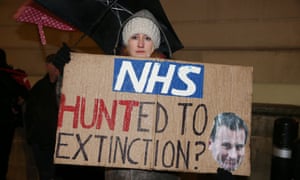
A woman protests outside the Department of Health in in London on 12 January


A woman protests outside the Department of Health in in London on 12 January. Photograph: Daniel Leal-Olivas/AFP/Getty Images

We were then given an appointment to see the out-of-hours GP located at our nearest hospital. We were there at 3.30pm. The GP ran tests and said she also was concerned my husband had suffered a minor stroke. She rang the medical registrar who said to send us straight through.


We thought the next stage would be quick, but we had a huge wait – it wasn’t until 9.15pm that someone saw us again. I complained twice that we got seen. They kept saying they were waiting for a doctor to see us but it just didn’t happen. This seemed odd as the medical registrar was supposed to be expecting my husband – it later transpired that the real reason for the delay was there was no cubicle for my husband to be seen in. During this time I was sick with worry that he could have another stroke. For two hours we were repeatedly told that he was next on the list.


My husband decided he had enough of waiting (after five hours in A&E) and decided to leave. I went to the reception desk and told them that my husband had insisted I take him home, that I didn’t think this was a good thing to do but I couldn’t persuade him to stay. This prompted some action and about five minutes later a doctor came out and helped to persuade my husband to go back in and be seen.


When a doctor came and we found out that he had most likely had a minor stroke, things sped up and he was admitted. He had a CT scan and an ECG later that evening, followed by an MRI on the Sunday and an ultrasound on the Monday. We would have been waiting even longer if we hadn’t complained and said we were leaving.


Tom Lawrence, 25, London: ‘My lung abscess was misdiagnosed. NHS staff make mistakes when overworked’


Around Christmas I developed a fever and pain in my chest. I was coughing up little bits of blood and when I was examined in A&E – because my lungs were clear – I was diagnosed with muscle pain. I was advised to get paracetamol and ibuprofen for the fever.


But it felt like it was more serious than that. I developed pneumonia and a lung abscess this time last year and it felt similar to that. So I waited a day and made my way back to hospital. When I arrived it was very overcrowded. The reception said there were no doctors and advised me to visit another A&E in London. I decided to wait another day, telling myself that I would go to my GP in the morning and get a referral. Unfortunately the next day my surgery was closed so I called 111 who arranged an appointment for me at another hospital.


They listened to my chest, also said it sounded clear, but that given my history it wasn’t worth taking the risk and would be best if I had an x-ray. When that came back the doctor said they had seen something they “didn’t like the look of” and I gave me a prescription for five days of amoxicillin, which she said would clear my infection up. I was due to travel the next day to Amsterdam to visit family for Christmas and was told that I could do so. But when I left the country my condition worsened and I went to the GP who called the lung specialist at one of the hospitals in Amsterdam. They arranged for me to go and have an x-ray and a CT scan. At hospital I was diagnosed with a lung abscess and was admitted into care. The doctors there were surprised that it hadn’t been spotted in the UK and that they had let me travel.


I suspect I slipped through the net because I’m young and the likelihood of lightening striking twice is slim. Most of the hospitals I visited were completely overrun. When there are too many patients for doctors and the medical staff are overworked mistakes are bound to be made.


Dr Liam Brennan, president, Royal College of Anaesthetists: ‘These are no longer winter pressures, but perennial pressures’


In my 34 years as a frontline doctor I have never seen the breadth and scale of the relentless demands across the whole health and social care system that I see today. These are no longer “winter pressures”, but perennial pressures. I fear these are indicative of a system too often at breaking point, in urgent need of additional funds and reform. All too often there are simply not enough beds, staff and other resources to go around.


All healthcare professionals are finding it harder and harder to deliver safe and effective patient care. Many of my colleagues are distressed, demoralised and exhausted, physically and mentally, as they battle every day to do their best for patients in an increasingly beleaguered system.


The UK is spending less of our national wealth on our healthcare needs than most comparable nations. At this existential point in the NHS 69-year history, we desperately need an urgent injection of funds to alleviate the immediate crisis followed by a national conversation involving patients, healthcare professionals and politicians about the future of our NHS.


Without these actions and as someone whose family relies heavily on the NHS, I fear for the future.


NHS crisis: "My frail mum was forced to wait on the floor for eight hours"

30 Kasım 2016 Çarşamba

Ireland compensates woman forced to travel to Britain for an abortion

Ireland has for the first time in its history compensated a woman for the trauma caused by forcing her to travel to Britain for an abortion.


Pro-choice campaigners in the Republic said the Fine Gael-led minority government’s agreement on Wednesday to pay compensation to Amanda Mellet was highly significant.


Mellet and her husband James took their case all the way to the UN’s Human Rights Committee after the couple were forced to obtain a termination of her pregnancy in England.


In 2013 Amanda Mellet became the first of three Irish women to formally ask the UN to denounce the prohibition on abortions in cases of fatal foetal abnormalities as “cruel and inhumane”.


Under Ireland’s strict anti-abortion laws, if Mellet and the other two women had remained in the Republic they would have been forced to give birth to babies who would be born dead.


Campaigners arguing for a referendum to repeal an amendment to the Irish Constitution that gives full citizenship rights to the embryo after conception welcomed today’s decision by the Dublin government.


Ailbhe Smyth, convenor of the Coalition to Repeal the Eighth Amendment and a long-time campaigner on reproductive rights, said: “To the best of my knowledge, this is the first time ever that the Irish government has compensated a woman for having to leave the country for an abortion. This is long overdue acknowledgement of the profound denial of women’s right to autonomy in this country.”


“The government must immediately ensure no other woman suffers similar human rights violations. The eighth amendment is a profound source of discrimination and national shame for Ireland. It is simply not good enough to pass the book to the Citizen’s Assembly and not make any commitment to undertake the necessary constitutional and legislative reforms to end, once and for all, Ireland’s violation of international human rights law and obligations under human rights conventions and treaties.


“We cannot, as a country, continue to oversee the violation of women’s human rights. We’re saying that women deserve better and Ireland can do much better.”


In June the UNHCR ruled that by forcing Amanda Mellet to leave Ireland for an abortion in Britain, the Irish state had inflicted trauma and distress on her.


Irish Labour party senator and long term campaigner for abortion reform in Ireland Ivana Bacik said the government’s decision to accept the UNHCR ruling was a crucial step towards changing Ireland’s abortion regime.


The Trinity College Dublin law lecturer said: “The UN Human Rights Committee’s ruling in June of this year constituted an important acknowledgement that the highly restrictive Irish law on abortion violates the human rights of women. The government’s acceptance of the ruling through the announcement of the compensation award, and Minister Harris’s sincerity in apologising to Ms Mellet, are both welcome.


“But we need now to see official recognition that thousands of other women are being denied their basic human rights through being denied access to legal abortion in Ireland, due to the eighth amendment to the constitution. The UNHCR ruling in favour of Ms Mellet made clear the need for us to hold a referendum to repeal the eighth amendment.”


Ireland compensates woman forced to travel to Britain for an abortion

12 Ekim 2016 Çarşamba

Patients forced to make appointments to boost profits, says Labour MP

Healthcare provider Virgin Care has been forcing patients to attend extra appointments to boost profits, says former employee and the Labour MP for Dewsbury, Paula Sherriff.


Speaking in the House of Commons, where she had been granted the first question to the prime minister, and where her words were protected by parliamentary privilege, Sherriff accused Virgin Care of insisting on, “extra consultations before surgery, boosting their profits at the expense of the taxpayer, and patient safety”.


Before she stood for parliament, Sherriff worked in Virgin Care’s dermatology service, in West Yorkshire. She claims patients were obliged to book a second, follow-up appointment before receiving treatment – for a suspect mole, for example – when the NHS would previously have carried out the same work in a single booking.


She told the prime minister this was “amongst many unethical practices” she had witnessed. The process of “double appointments” allows Virgin Care to levy the £100 to £150 appointment fee from the NHS twice, Sherriff said.


The MP, who has made a name for herself in her short time in parliament by campaigning against the so-called “tampon tax” on sanitary products, believes the outsourcing of NHS work increases costs, and produces worse outcomes for patients.


Virgin Care, which is part of the Virgin Group, has the contracts to carry out over 230 NHS and social care services, from running GPs’ surgeries to providing healthcare in prisons. Virgin bought up private healthcare provider Assura Medical in 2010 to capitalise on the fast-growing market in healthcare.


The prime minister replied that it was the last Labour government, not the Conservatives, that had significantly increased privatisation in the NHS.


Patients forced to make appointments to boost profits, says Labour MP

28 Mayıs 2014 Çarşamba

Chanel and Dior forced to reformulate perfumes below new EU laws

The scent combines jasmine, rose, sandalwood and vanilla with other background notes.


It is said that and it is stated that when Gabrielle ‘Coco’ Chanel sprayed the perfume around her table in an upmarket Paris restaurant in 1921, females passing by practically stopped in their tracks to ask her what the fragrance was and where it came from.


But under new rules the well-known fragrance could be altered forever.


Chanel and Dior have been functioning on utilizing altered versions, stripped of the molecules atranol and chloroatranol, regarded as prospective allergens by the EU.


“Adapting is a challenge but it is exactly the talent of our “nose” to be able to preserve the qualities and olfactive (scent) identity of our perfumes even though also taking into account new regulatory constraints,” a spokesman for Chanel mentioned.


Floris, the Queen’s parfumiere also explained they were checking their scents to see if any necessary to be reformulated.


“Floris is up to date with the current recommendations and awaits potential amendments at which stage it will adhere to the necessary changes in a timely trend to keep in line if and exactly where this applies to any of our merchandise,” a spokesman stated.


New labelling demands will also need products to be entirely labelled and include allergy warnings in the same way as prescription drugs, which could push up the expense of perfume.


In 2012, an advisory report recommended severely limiting the use of 12 ingredients, regarded as the pillars of the luxury perfume market – this kind of as citral, identified in lemon and tangerine oils coumarin, located in tropical tonka beans and eugenol, found in rose oil.


Even so just three, citral, atranol and chloroatranol, are now likely to be banned with an investigation taking area into the remaining 9 to see if tiny quantities could be tolerated.


“We realize that drastic reductions in the authorised concentrations of these components would have produced main disruptions to the industry,” stated David Hudson, spokesman for buyer policy at the European Commission.


However the perfume sector has complained that even modest changes could radically result scents and revenue.


“If we ban citral from perfumes, of which specified factors are allergens, we must ban orange juice. It is absurd. We must not ban nature, only learn how to dwell with it,” explained Frederic Malle, who founded the French luxury perfume firm Editions de Parfums Frederic Malle.


Malle mentioned he was forced to reformulate about a quarter of his scents due to the forthcoming EU laws, major to additional charges – but expenses which he identified challenging to quantify as they also represented time invested to rework the formulas.


“It can get far more than six months to reformulate a perfume, and a minimum of some thirty exams … and this is valuable time that can not be invested on making new perfumes. So to defend a tiny portion of the population, we are generating the rest endure,” he explained.


The EU is also organizing on banning HICC, a well-liked synthetic molecule which replicates the lily of the valley smell.


Hermes, Dior and Guerlain – each owned by LVMH – have also been getting ready themselves for the new principles by progressively modifying their formulas.


“The European Commission technique ensures the security of buyers and preserves Europe’s olfactive heritage,” explained a spokesman for LVMH.


A draft proposal could be given to EU member states by August and by the following month a final version sent for scrutiny by the European Council and Parliament, which have 3 months to oppose it.


The regulations will also demand perfume makers to inform shoppers about prospective allergens contained in their items but it has not but determined how this will perform in practice and how numerous of them need to be labelled.


It has raised the variety of substances that should be labelled from 26 to more than 80 and is looking at ways to allow perfume makers to offer information about them on the Internet or via smartphone scans to avoid getting to cram them on the package deal.


Chanel and Dior forced to reformulate perfumes below new EU laws

21 Mayıs 2014 Çarşamba

Hospitals forced to ask Government for emergency bail-out loans

Their letter said that the trust was becoming charged curiosity for late payments, that suppliers had threatened legal action, and that the electricity supplier had threatened power could be reduce off to a building on the trust’s West Cumberland Hospital web site.


The hospital also warned that far more than 70 per cent of its health-related products would be “beyond its expected life” with out a significant injection of income to purchase new hardware inside of the up coming 12 months.


The hospital’s accounts payable division was described as “spend[ing] most of their working day dealing with telephone calls from suppliers who are chasing payment.”


A loan request sent by University Hospitals of Coventry and Warwickshire (UHCW) Believe in for £9m warned of an “untenable level of tools breakdown and obsolescence”, with critical medical products such as dialysis machines for patients with kidney failure, critical care beds and surgical instruments all coming to the finish of their operable daily life.


Numerous trusts which sent loan request predicted a bleak monetary outlook for the years ahead. Medway Foundation Trust said it projected a £15m deficit in 2014/15 from an yearly turnover of £250m, whilst Bedford Hospital Believe in expected be in deficit by £7.6m by subsequent year.


A spokesperson for the NCUH trust said that the building threatened with getting its electrical power provide cut off was a “domestic building” in which “to the greatest of their knowledge” no clinical activity took place.


Steve Shanahan, director of finance for NCUH, stated that the trust’s bid for help was successful, making it possible for the trust to deal with “immediate funds movement issues”.


“We have also secured extra capital to change a quantity of pieces of medical gear,” he advised The Independent.


Gail Nolan, chief finance officer for the UHCW Trust stated: “While the bulk of our tools is replaced as component of our Personal Finance Initiative (PFI) contract, there is 1 off capital expenditure which falls outside this programme. At the beginning of the 2013/14 monetary yr our strategies included a modest component of external finance essential to facilitate this substitute.”


A Division of Overall health spokesperson advised The Independent: “We have improved the NHS spending budget in real terms and whilst we comprehend some trusts are dealing with much more demands, deficits have to be gripped and we will hold poor performers to account.”


Hospitals forced to ask Government for emergency bail-out loans

1 Mayıs 2014 Perşembe

Girl forced to phone national NHS variety to see physician in following area

“We are so cross and angry and what issues the household is that this could occur to a person who is in a vulnerable state and has no household or friends nearby to support.”


Ms Riddle, of Midsomer Norton, Somerset, was sooner or later capable to book in to see the doctor in the following room at Paulton Hospital close to Bath.


But there was a even more complication when the system showed she had been booked into the Royal University Hospital in Bath without having becoming advised.


The household is writing to the NHS to complain.


A spokesman for the Bath and North East Somerset Medical professionals Urgent Care explained: “Healthcare professionals which includes Small Damage Unit Nurses can contact our support directly employing a focused phone line to go over patient requirements with a single of our physicians who will then decide an proper program of action. An appointment for the patient to see 1 of our medical professionals for a face to encounter consultation will be organized by our service if suitable.”


He mentioned medical professionals primarily based in centres will talk to patients on the cellphone to give tips as well as see them encounter to face, meaning appointments are not always obtainable.


He added: “Appointment times presented to patients are primarily based on the patient’s assessed clinical want.”


Girl forced to phone national NHS variety to see physician in following area

15 Nisan 2014 Salı

Child adopted in Alessandra Pacchieri forced caesarean situation

The information came as James Munby, President of the Family Division, accepted the child’s adoption by ‘Mr and Mrs X’, who P has been living with because November 2013.


Sir James said the pair have been “very good and loving individuals” and said the youngster “was thriving in their care”.


The child was “really cheerful”, a social worker had reported.


But the judge also exposed Ms Pacchieri had sent a series of heartbreaking emails to Essex County Council, the last arriving just weeks in the past.


“It’s actually sad for me but I pray God daily that she will gonna be fine and that I will see her yet again”, the mother wrote.


“I would love to meet with her adoptive mother and father and have a chat with them so please make that take place for us.”


On 28 March, Ms Pacchieri said: “I want for my daughter the ideal.


“Me personally, I am striving to fail to remember this bad knowledge I had in England.


“I really like my daughter will all my heart and I pray to see her a single day again’.


But in spite of her pleas, Sir James mentioned he had obtained “no application of any sort” from either the mother or the Italian government.


In the situations, Ms Pacchieri is unlikely to be allowed to see her child just before it reaches adulthood.


Child adopted in Alessandra Pacchieri forced caesarean situation

10 Nisan 2014 Perşembe

NUT: menopausal ladies "being forced out of teaching"

“High workplace temperatures, bad ventilation, bad or non-existent rest or toilet amenities, or a lack of entry to cold consuming water at operate can make all these symptoms worse…


“Employers have a responsibility to take into account the troubles that women may experience in the course of the menopause and that female employees ought to be ready to expect assistance and help in the course of what is, for many, a extremely hard time.”


The NUT stated the union had heard “anecdotally” that a lot more teachers more than the age of 50 are getting subjected to formal disciplinary procedures than younger colleagues.


Speaking on Thursday, Christine Blower, common secretary, said: “We typically find that the approach in colleges now is that by some means or other, if you have been doing it for a extended time, you should be stale and not fairly the ticket that you would get with a younger instructor.


“We reject that. We consider it is essential you have a stability in the occupation of youth and age. And which is as correct for males as it is for girls.”


She added: “I think it is not just the menopause we have acquired experience of older girls finding that their abilities are not imagined of as becoming as very good as these of younger teachers.”


A resolution to be debated by the conference in excess of Easter weekend calls for the creation of an urgent advice document to allow colleges to take the situation a lot more critical.


NUT members are also calling for the union to take “strike action if schools refuse to make ideal changes to accommodate the needs of ladies experiencing symptoms that affect their capacity to educate during the menopause”.


NUT: menopausal ladies "being forced out of teaching"

3 Nisan 2014 Perşembe

GP-led local NHS bodies forced to place health solutions out to tender

NHS sign

Providers set to be place out to tender for competition integrated contracts for out-of-hrs GP care and ultrasound. Photograph: Graeme Robertson/Getty Photographs


Numerous GP-led local NHS bodies are being forced to place health solutions out to tender despite government assurances that that would not occur.


New analysis by Wellness Services Journal displays that 29.1% of the leaders of 93 clinical commissioning groups (CCG) which responded to a survey explained had opened up, or have been opening up, services to competition which they would not have carried out if they have been not concerned about the influence of new guidelines contained in the controversial Health and Social Care Act.


They incorporated contracts for out-of-hours GP care, older people’s services, audiology, ultrasound and podiatry.


In 2012, the wellness secretary Andrew Lansley wrote to all the 211 CCGs pledging unequivocally that they individually would be ready to choose, rather than ministers or the NHS regulator, Monitor, when to put contracts out to tender.


But HSJ identified that twenty% of CCGs had encountered a challenge under the new competitors guidelines to a choice they had taken about the commissioning of solutions, even though 57% had knowledgeable “informal challenge or questioning”.


In addition, 65% of the 103 bosses of the 93 CCGs mentioned that they had incurred further charges associated to commissioning as a result of the regulations, although 36% explained they had hampered programs for local hospitals to merge or grow to be foundation trusts.


Peter Melton, the co-chair of the NHS Commissioning Assembly, said that the competitors rules needed to be simplified to make tendering choices less complicated for CCGs.


Sir David Nicholson, who stepped down last week as NHS England’s chief executive, warned MPs final 12 months that the NHS was “obtaining bogged down in a morass of competitors law.”


GP-led local NHS bodies forced to place health solutions out to tender

18 Mart 2014 Salı

Dying forced to wait eight weeks as an alternative of eight days for assist amid "dire" advantages overhaul - MPs

They spoke of claims apparently vanishing into system, prolonged delays, cancelled appointments, clerical blunders and applicants becoming passed back and forth among officials on best of a mounting backlog of applications.


The MPs urged ministers to invoke penalty clauses in contracts with private businesses, this kind of as Atos and Capita, if needed, but pinned the principal blame mostly on an apparent rush to implement the new benefit just before the IT and call centre techniques had been appropriately examined.


The report also criticised the Division of Perform and Pensions for seemingly “spinning” statistics in a way which could more fuel public hostility toward disabled folks.


While the committee encountered issues across the technique it singled out troubles faced by people with terminal illnesses.


It noted that, underneath the previous the Disability Living Allowance system, men and women recognised as getting no a lot more than six months to reside have been generally processed inside eight operating days.


“Macmillan [Cancer Assistance] reviews that it is taking as prolonged as eight weeks for a PIP claim to move into payment,” the report remarks.


“Macmillan points out that the delays can indicate that terminally unwell claimants are dropping out on as significantly as £134 a week.


“It can also impact on caring provision as the PIP award wants to be in place ahead of Carer’s Allowance can be paid.”


They extra: “Urgent action is necessary. We advise that DWP closely examine its personal systems and that it operate with the contracted suppliers to resolve the existing dire scenario.”


Jason Feeney, benefits director at the DWP admitted that some terminally unwell men and women had had “awful experiences”.


But a spokeswoman said: “Claims for terminally ill people are fast-tracked and Macmillan has acknowledged that enhancements in the system have currently been produced.


“Latest statistics demonstrate over 99 per cent of individuals with terminal illnesses who have utilized have been awarded the benefit, which implies in excess of 9,500 terminally sick claimants are now getting PIP.”


Duleep Allirajah, head of policy at Macmillan, mentioned: “The enormous backlog of claims even now waiting to be processed is appalling.


“The Government need to deal with these delays in the first instance as a matter of urgency and commit to publishing waiting instances on a quarterly basis.”


Dying forced to wait eight weeks as an alternative of eight days for assist amid "dire" advantages overhaul - MPs

12 Mart 2014 Çarşamba

Sick youngster on a drip was forced to rest on plastic hospital chairs

The child, from Southampton, Hants, was rushed to hospital by ambulance at twelve.30pm on Friday after his temperature soared.


He had been to the hospital just a couple of days earlier amid fears that he was suffering from meningitis.


On that occasion, doctors carried out exams which ruled the deadly disease out. He was alternatively diagnosed with a viral infection.


But Callum was later re-admitted and located to have a blood infection.


He was provided a bed in the emergency division and remained in one when he was moved to a professional paediatric ward.


But he was wheeled to an evaluation ward at 4.30pm and taken off the bed.


Mrs Giles, 29, explained she was advised by nurses to sit on the blue chairs till a correct bed grew to become available.


She grew to become so frustrated soon after creating repeated requests for a bed that she ended up creating a makeshift a single herself with the two chairs.


Safety worker Mr Giles, 34, said: “The care we received at the hospital was definitely appalling.


“Callum was rushed to accident and emergency in an ambulance with a large temperature and blood infection.


“To be left lying across two plastic chairs in this day and age is unacceptable.


“The bad lad was so hot he was sticking to the plastic and discovered it extremely unpleasant. He was restless and unable to rest.


“How can you anticipate a boy of that age to remain seated for six hours.


“We asked if he could lie on a fold-up camp-bed that mothers and fathers use when they stay in hospital with their youngsters.


“But we were advised they did not have sides like a standard hospital bed and using them would breach overall health and security principles because he may well roll off.


“That is ridiculous since the chairs he was lying on did not have sides either – and had been much less appropriate.”


The father-of-7 added: “A two-12 months-previous must not be left connected to a drip without a proper bed in this state.


“We intend to complain and want an apology.”


Callum was ultimately given a bed at ten.30pm and was discharged the next afternoon.


He has been provided antibiotics and is producing a excellent recovery.


Mrs Giles, a childcare worker, explained: “I consider what took place is disgusting. He obtained quite poor care.


“We want an apology but also a modify in the way they treat people since it is just not very good enough.”


A hospital spokesman mentioned they had been not aware of any complaint by Mr and Mrs Giles.


But he said they were sorry to hear the loved ones were unhappy with the care their son obtained.


He extra: “We would be satisfied to go over any factor of Callum’s therapy with his mother and father directly and investigate any remaining worries they have to ensure we offer you them


comprehensive reassurance about our processes and procedures.”


Sick youngster on a drip was forced to rest on plastic hospital chairs

28 Ocak 2014 Salı

Scandal of elderly forced into A&E as faith lost in care outdoors hospitals

The numbers vastly outstrip the eight per cent rise in the population in excess of the age of 80 for the duration of the period.


Final 12 months, more than 362,800 individuals above the age of 90 arrived at A&ampEs — a rise of 93 per cent given that 2007-08.


The figures cover the last two years of the Labour government, when the steepest rises took place, as nicely as the 3 years because the final election.


Dr Mann, an A&ampE consultant, stated: “Increasingly, what we are seeing is a default circumstance where older people finish up in A&ampE, without even phoning GP out-of-hours services, simply because they, or these caring for them, have provided up on them.


“Staff in nursing residences will contact for an ambulance simply because they know one particular will be there swiftly — whereas they have learnt from experience that it is far more hard for them to consider to get a medical doctor out.”


Labour on Tuesday evening blamed the increases on cuts to social care and decreased council budgets for solutions such as home assists.


Even so, Jeremy Hunt, the Well being Secretary, explained that too a lot of elderly individuals had been ending up in hospital simply because of the flawed GP contract that allowed household medical doctors to abandon responsibility for out-of-hours care.


From April, GPs will have to get all around-the-clock duty for the care of all patients aged 75 and above.


Mr Hunt said: “Labour’s disastrous 2004 GP contract left a lot of vulnerable elderly patients without excellent out-of-hrs care, so it is rank hypocrisy for them now to complain about the consequences of their historic mistake. We have ripped up that contract and are bringing back appropriate family doctoring, with named GPs for older folks to assist alleviate A&ampE pressures.”


The figures also demonstrate a 65 per cent rise in A&ampE attendances among people in their 50s and 60s above the five many years, and a 56 per cent rise amongst people in their 70s. Across all age groups, the increase in sufferers attending A&ampE was 51 per cent.


Given that the 2010 election, there has been a 25 per cent rise in folks in their 80s attending A&ampE units in England, and numbers rose by 44 per cent for between people in their nineties.


Final 12 months, the head of the Care High quality Commission mentioned emergency providers were “out of control” in large parts of the country since of rising numbers of frail elderly sufferers getting admitted instead of being provided care to maintain them out of hospital.


In spite of mild weather in most places and unusually lower levels of flu in latest weeks, most NHS trusts with large A&ampE units have missed targets to deal with 95 per cent of individuals inside 4 hrs.


Caroline Abrahams, the charity director of Age Uk, explained: “It is important that older people get the treatment and care they need, and occasionally this indicates going to hospital. However, we know that in some situations getting admitted to hospital is the consequence of not acquiring excellent quality care at house.”


Andy Burnham, the shadow wellness secretary, mentioned: “The Government’s severe cuts to social care have left 1000′s of older people without having the assistance they need to have — at risk of going into hospital and acquiring trapped there. It is a single of the root causes of David Cameron’s A&ampE crisis.


“It is appalling to consider that, each and every week, there are thousands of frail and frightened people speeding through our towns and cities in the backs of ambulances to be left in a active A&ampE. This is frequently the worst place for them to be and a disorientating knowledge that can trigger real distress. With correct help in the home, this could all be averted.”


Scandal of elderly forced into A&E as faith lost in care outdoors hospitals

5 Ocak 2014 Pazar

Pancreatic cancer patients forced to look for existence-conserving surgical treatment in Germany

Individuals with pancreatic cancer are paying for surgical procedure abroad when it is not presented on the NHSNHS, as the amount of cases of the fifth most deadly type of cancer rises.


Deaths from pancreatic cancer could overtake those from breast cancer by 2030, say authorities. A number of dozen individuals have paid to have lifestyle-saving surgical treatment at Heidelberg university hospital in Germany because, under guidelines for treating pancreatic cancer in England, some sufferers are being told their cancer is also far sophisticated or has spread to other organs, generating surgical treatment inadvisable.


Experts say clinicians in some EuropeEuropean hospitals are significantly less “danger averse” than in England and more prepared to carry out surgical procedure. In wellness techniques in many EU nations, individuals have direct accessibility to a advisor or surgeon and wellness insurance schemes pay the cost of the surgical procedure.


A report published two weeks in the past by the all-party parliamentary group on pancreatic cancer referred to as for radical improvements in NHS remedy of the situation, which kills about 8,500 people a 12 months. It factors out that survival rates for pancreatic cancer have not enhanced in the Uk for about 40 many years, and that whilst 20% of individuals could benefit from surgical procedure, only 10% are operated on.


A lot of sufferers are not diagnosed early sufficient to benefit from surgical treatment, and some see their GP four or 5 occasions with signs and symptoms before they are referred to a hospital for investigation. Signs can selection from abdominal ache and persistent indigestion to jaundice, and are often misdiagnosed as other situations, this kind of as dyspepsia or ulcers. Richard Charnley, a advisor pancreatic surgeon at the Freeman hospital in Newcastle, explained: “One particular of the primary difficulties in diagnosing the illness is choosing up the early indicators and, unless of course a patient presents with jaundice, GPs may possibly not consider pancreatic cancer as a possibility.


“Then they may be referred for an endoscopy, which can take a few weeks, and then eventually a CT scan, which will take longer, and this picks up a lesion in the pancreas. Regrettably, delays are built into the program and GPs need to have to elevate pancreatic cancer on their radar.”


The prognosis even right after an operation is not very good – only three.five% of sufferers survive for five many years following successful surgery. On the constructive side, the amount of specialist pancreatic cancer surgeons has risen in recent many years and individuals are noticed in 25 specialist centres about the country, which enables surgeons to boost their abilities by treating a high variety of sufferers and a very good “situation mix”, which is crucial for maintaining competence. The quantity of patients surviving for a single yr soon after surgical procedure rose from 13.seven% in 1999 to 18.three% in 2009, according to Charnley, who is chairman of a expert entire body representing pancreatic cancer surgeons.


“An additional dilemma is that there are not numerous efficient drugs made to treat the problem, and we need a lot more study into what operates nicely,” he mentioned.


Steve Lewis, 59, from Swansea, was diagnosed in December last yr soon after seeing his GP only when. “I went to my GP as I had been getting steady indigestion for some time, and she referred me to hospital immediately. I was noticed inside of two weeks, had some investigations and a CT scan. I was then advised it was inoperable, which naturally I was not that content about, and was started out on a program of chemotherapy and radiotherapy. I would lost around 15kg in bodyweight before that, but following radiotherapy, I commenced to put fat back on.


“Before my radiotherapy, the surgeons in Heidelberg agreed with my consultants here that surgical treatment was not a good idea, but later, as I was undertaking properly, they explained they would be prepared to consider a shot at it, so I went for the operation in September. Unfortunately, as soon as they had gone in, they discovered that the tumour was wrapped around one particular of the arteries, and it would be also risky to proceed, so they stopped the operation. They had told me this was a probability, so I had to accept it. I took all around 10 days to recover in hospital and I’m now discussing next steps with my advisor in Swansea.” The operation expense €51,000, which is becoming paid for under Lewis’s firm wellness-insurance coverage scheme, and the hospital has agreed to refund a massive proportion of this as the operation was not finished. Lewis mentioned his expertise with the NHS in Wales was very excellent, but that GPs in general need to be more aware of the symptoms of the illness.


The report by the by the all-celebration parliamentary group calls for a “wholesale assessment” of pathways amongst primary and secondary care for referrals and investigation of the illness, a comprehensive nationwide audit of pancreatic cancer therapy comparable to that for bowel cancer, and an awareness-raising campaign about the symptoms of the ailment.


At an event at the Homes of Parliament to launch the report, the health secretary, Jeremy Hunt, stated pancreatic cancer was a condition that the NHS had been “least successful” at treating in recent many years. “We have invested £140m on bettering early diagnosis of cancer and we need to do the exact same as we did for breast cancer, namely, to set up targets and set better standards. I know this is a actual difficulty, as I have noticed a variety of circumstances in my personal constituency the place it has not been picked up early adequate,” he said.


The United kingdom has lagged behind many other European countries in survival prices across all cancers, with the most latest figures displaying the Uk coming 27th out of 35 countries surveyed.


Pancreatic cancer patients forced to look for existence-conserving surgical treatment in Germany