antiFGM etiketine sahip kayıtlar gösteriliyor. Tüm kayıtları göster

13 Mart 2017 Pazartesi

"My vulva cupcakes were confiscated" - a day in the life of an anti-FGM campaigner

Smuggling vulva-decorated cupcakes into the Somali region of Ethiopia was one of those moments where I thought: “My work as an anti-FGM campaigner gets me into interesting situations sometimes.”


Three years earlier I’d made vulva cupcakes as part of a documentary about FGM that I’d done for Channel 4. “We need you to bring them with you,” said Sagal Abdi, vice executive director of Maandeeq, when she invited me to an event in Jijiga, the capital of the region, part of 16 days of activism against gender-based violence.


Honestly, I was taken aback. I grew up in the UK as part of the Somali diaspora, and I’d assumed the people of Jijiga would not be ready for vulva cupcakes. But Abdi, also part of the diaspora, reassured me that the Ethiopian women had requested them. “Leyla, they watched the documentary and loved the concept of using art for campaigning,” she said.


On reflection, the fact that he recognised the icing decoration as vulvas was good


Abdi filled me in on the current status of the women from Jijiga. It was the usual story of inequality, gender-based violence, lack of employment and access to healthcare. But Abdi gave me hope as she described these negative situations. By the end of that phone call I couldn’t wait to meet her. The only snag was, how would I carry vulva cupcakes from London to Jijiga?


I am always up for a challenge. I managed to carry the cupcakes, made in London, in my hand luggage all the way to Addis Ababa. I really began to think I was going to pull this off. But just as I was about to embark on my final flight to Jijiga, one of the officers told me to step aside and opened the box. When he saw the cakes staring back at him he made a sound halfway between a gasp and a giggle. “Why would you bring these here?” he asked. “Oh, you know what they are then?” I thought. He said I needed permission to carry them and he needed to investigate. My flight was taking off in 10 minutes, so I sadly had to leave the cakes behind.


On reflection, the fact that he recognised the icing decoration as vulvas was good – many men and women don’t know what women’s genitals look like. I hope he enjoyed eating those red velvet pussies.


Something extraordinary came out of that trip. On the flight to Jijiga I suddenly realised that everyone around me was speaking Somali. My family isn’t from that region but the last time I was in Somalia was 25 years ago, when I was 10 years old. The heat hit me and felt so familiar. Tears streamed down my face. I tried to hold them back but it was overwhelming.


Abdi and her colleague, Hodan, were very sweet and comforted me when they picked me up. They were disappointed about the cakes, but as Somali women we weren’t going to let that setback stop us from getting our message getting across.


On my way to my hotel I felt a sense of belonging to a city I’ve never been to before, but also the fear that I would be targeted with threats, as I am known as an outspoken advocate for women’s and girls’ rights.


The next day I presented my work on gender equality and female genital mutilation (FGM), exploring how to create safe spaces for survivors of violence free from shame. I got a positive reaction from the local women and young people, even from the politicians in attendance. They asked me to come back as often as I could. I was deeply touched to be appreciated by my own people.
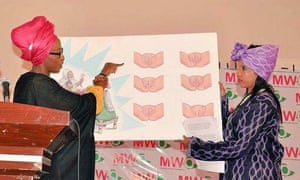


Leyla Hussein presenting in Jijiga

Leyla Hussein teaching young people and senior politicians about FGM. Photograph: Leyla Hussein

I was truly impressed with Hafsa Mohamed, the founder and director of Maandeeq. She, a diaspora born and raised in North America, has galvanised grassroot support and policy influence for many years to get to this point. As she shared a joke with the president of the Ethiopian Somali region, I could see she has built a respectful relationship with local politicians. It didn’t happen overnight, she told me. She had to work hard and prove herself to the local people. She knows that in order to make a change and build a safer world for women/girls we have to work with politicians to influence policies and ensure funding and resources are directed to this area.


She told me that she and her colleagues had got into physical fights with men to ensure they provided what the local women/girls needed. “At times we need get physical to get what we need for our women,” she said. I realised I needn’t be afraid when I was with such brave women.


The number of FGM cases are decreasing. Gender equality is becoming more and more a reality


Abdi M Omar, president of the Ethiopian Somali regional state


To have the most senior politician of this region attend and open this conference spoke volumes of Somali women’s leadership skills. Abdi M Omar, president of the Ethiopian Somali regional state, even made a statement: “We must prioritise the welfare and empowerment of women,” he said. “In the Somali region of Ethiopia, almost half of the regional parliament are women. The number of businesswomen are growing. The number of girls and women partaking in education are tremendously increasing. The number of FGM cases are decreasing. Gender equality is becoming more and more a reality.”


I had a strong sense of Somali sisterhood with Mohamed (from Jijiga), Abdi (originally from Somaliland) and Hoden (from Djibouti). We had a group hug to recognise this important moment in our lives. We women all face similar challenges and we are stronger by coming together.


There’s an assumption that diaspora who move back home are living the life of luxury. But these three women were living in a one-bedroom apartment. When I asked why they choose to live this way, their response was simple. They said they all left their privileged lives in the west, and have the option to go back, but they can’t leave the sisters who need them here.


The next steps for these amazing women is to keep building the grassroots movement for gender equality in Ethiopia. I urge you all to support these east African warriors by donating, volunteering or becoming their allies in this battle.


For me, the trip brought up feelings about how I can make the most of my skills and privilege to improve life for women and girls all over the world, particularly in the land where I was born.


On my flight out of Jijiga I got tearful again. I started thinking about how my mum and many families must have felt when they left their home without knowing when or if they are going to see it again. But I know for sure that I’m going to go back to that region. And next time, hopefully, I’ll get all the way with the vulva cupcakes.


Join our community of development professionals and humanitarians. Follow @GuardianGDP on Twitter. Join the conversation with the hashtag #SheMatters.


"My vulva cupcakes were confiscated" - a day in the life of an anti-FGM campaigner

6 Şubat 2017 Pazartesi

Anti-FGM campaign launched in UK to mark global day of opposition

A national campaign carrying the symbol of a red triangle will be rolled out across the UK to mark the International Day of Zero Tolerance for Female Genital Mutilation.


The National Police Chiefs’ Council has partnered with the Freedom charity to encourage people to provide the police with information that can help detect and prevent FGM in the UK and abroad.


Commander Mak Chishty, the police national lead on “honour”-based violence, has written to every police force in the country reminding them that while progress has been made, there is yet to be a successful prosecution for FGM.


He wrote: “This is a particular area of political and public scrutiny and I would urge each force to maximise every opportunity to demonstrate that we as a service are doing everything that is possible to combat FGM.”


His letter also cited a prevalence study published in July 2015 by City University and Equality Now, the human rights group, which showed that no local authority in the UK was unaffected by FGM.


Chishty told the Guardian: “We are raising awareness that FGM is a crime and that anybody involved in the process – from turning a blind eye to the act of cutting – commits a criminal offence. This is form of child abuse and violence against women and girls.”


More than 13,000 posters promoting the Red Triangle initiative have been distributed to police forces to display inside police buildings and within appropriate community settings.


Police leads have been asked to evaluate the campaign’s impact by monitoring any increased reporting, receipt of intelligence or new engagement opportunities.


Aneeta Prem, a writer and the founder of Freedom, has written a novel warning about FGM, called Cut Flowers, that is being distributed to schoolchildren to raise awareness of the illegal practice.


She said: “Over 200 million women and girls have gone through the horrors of FGM and we know that girls are being cut here in the UK. Unofficial figures estimate that 137,000 girls and women in Britain are affected.


“Through education we can stop FGM in a generation. Through teaching we can explain the long-term health dangers and dispel the myths that have kept this barbaric practice alive. The help of boys as well as girls is needed to change opinions.”


She added: “We are asking that people wear the red triangle badge to mark the International Day of Zero Tolerance to FGM.”


A 25-year-old from Somalia who suffered FGM and now lives in London said: “I was cut when I was five years old. I still feel pain and relive that moment every day. I completely support the Red Triangle campaign and hope it will encourage girls to ask for help.”


FGM protection orders intended to safeguard girls at risk came into effect in the UK in July 2015. The latest figures from the Ministry of Justice showed 97 applications and 79 orders had been made up to the end of September 2016.


The home secretary, Amber Rudd, said the government was taking “world-leading action” to tackle FGM by strengthening the law to improve protection for those at risk and by removing barriers to prosecution.


She said: “This government has introduced FGM protection orders, a new offence of failing to protect a girl from FGM, a mandatory reporting duty for frontline professionals, new guidance for the police, and lifelong anonymity for victims to encourage them to come forward.


“We are sending a clear message that FGM will not be tolerated, and as part of this I am determined to see the country’s first successful prosecution for FGM.”


The Red Triangle campaign, which will run until International Women’s Day on 8March, iwill officially launch at Haverstock school in Camden, north London, on Monday.


Anti-FGM campaign launched in UK to mark global day of opposition

24 Temmuz 2016 Pazar

Police and charities launch anti-FGM campaign at Manchester airport

At 3am on Thursday morning, a group of police, border officers and charity workers joined the throng of holidaymakers at Manchester airport of to begin their summer campaign against female genital mutilation (FGM).


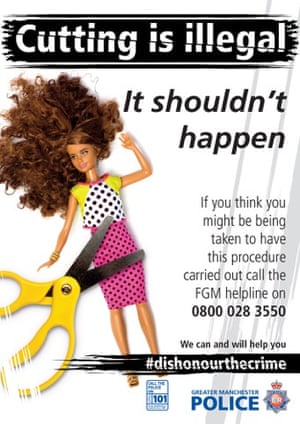
Cutting is illegal poster

Photograph: Greater Manchester police

Sometimes known as the ‘cutting season’, the school summer holidays are the most common time for girls in the UK to be taken abroad, usually to their family’s country of origin, and subject to mutilation.


Operation Limelight will see Greater Manchester police and their partners speaking to outbound passengers in July about FGM and again to inbound passengers at the end of August and into September.


Travellers will be made aware of the signs that indicate someone could be at risk and informed that it is illegal for UK nationals or permanent residents to perform FGM in the UK or abroad, with a maximum sentence of 14 years imprisonment.


The facts you should know about female genital mutilation

The first ever FGM figures in England were released last week showing that there have been nearly 6,000 new cases in the last year and that a further 65,000 girls under the age of 13 are at risk of the procedure, which can result in severe pain, shock and death as well as psychological problems such as post-traumatic stress disorder.


People who carry out the procedure, or ‘cutters’ are also known to come to the UK during this time to carry out FGM in the UK.


Now in its third year, Operation Limelight was designed to coincide with the school holidays of Greater Manchester and the surrounding areas of Liverpool, Yorkshire and Lancashire, which are also served by the airport.


‘Spread the word: it’s child abuse’


Detective Inspector Nathan Percival, Greater Manchester’s lead on FGM, has overseen a change in approach to FGM in the area.


“For so many years the police have gone off and done their own thing but we don’t do that anymore,” he told the Guardian. “We don’t charge in, but have a softly, softly approach. We’re learning each day from charities and voluntary sectors on how to approach – police shouldn’t be the baddies.


We need friends, siblings and community members to come forward


DI Nathan Percival


“For FGM it’s never just the police deciding we need to make arrests. Policy dictates now that FGM work should be multi-agency so we share information with partners at a strategy meeting to discuss the best thing for the child. We always aim to support the child and the family involved.”


Operation Limelight focuses more on raising awareness than chasing convictions (of which there have been none for FGM in the UK so far). All passengers are approached, without families being isolated. “It’s just basically chatting to people. We explain who we are, and ask whether they’ve heard of FGM or cutting. My tagline has always been: Spread the word: it’s child abuse, it’s illegal and there are serious health implications. If a criminal investigation springs, that is all well and good, but child safety is always the priority.”


In 2015, new FGM laws came into force in the UK. Under the Serious Crime Act, FGM protection orders can now be issued whereby potential victims or third parties can apply for an order to protect the person at risk. These orders can include the confiscating of passports. It is now mandatory for health and social care professionals and teachers to make a report to the police if they learn that a girl under 18 has been subject to FGM.


Percival believes mandatory reporting especially has helped to protect girls and Greater Manchester police has seen an increase in reports made to them of FGM – only nine reports were made to them three years ago, but last year, there were 94. The taboo nature of FGM remains one of the biggest obstacles to eradication, however.


“We need friends, siblings and community members to come forward, people who know that this child will be at risk this time of year. This is what we cry out for – for people to please come forward. It’s hard though, people have been carrying out FGM for thousands of years and believe that not doing it will bring shame on the family. We rely on partnerships and voluntary sector, charities like Afruka and Nestac who work in communities. These agencies work on a cultural level. They know they have a police officer who is really passionate about combatting FGM. I try and understand and put myself in their shoes. You have to with child abuse.”


Angie Marriot, a former nurse and independent consultant in honour based violence, forced marriage and FGM, worked on Operation Limelight for the first time this year.


“It’s been excellent to give out information and target a diverse population of people coming through the airport,” she said. “The opportunity is absolutely outstanding. We’re targeting everybody. I would say that 85% of people have been very positive endorsing the information they’ve been given.”


“Some of the people who’ve taken leaflets have said: ‘Oh we’ve heard about that’ and others have said: ‘What’s this? so we still know there’s a lot of work to do. There are lots of professionals out there who still don’t know about FGM. They don’t feel confident to report and overcome those cultural barriers and lots of people are fearful about being accused of being racist.


“There’s also an issue with funding. We hear about this 80 million pounds for violence against women, unfortunately that’s not trickling down to BME groups or specialists who’ve got that expertise.


“To see the police embrace a sensitive issue openly is remarkable, and GMP need to be commended for the outstanding work they’re doing here today.”


Everyone involved in the operation (police, border agents, consultants and charity workers) have volunteered their time for free.


Signs that a child may be at risk of undergoing FGM include


  • being taken ‘home’ to visit family

  • a special occasion to ‘become a woman’

  • an older female relative visiting the UK

Signs that a child may have recently been a victim of FGM include


  • the child is frequenting the toilet

  • the child is complaining of pelvic pain

  • a change in behaviour after going on holiday. For example, becoming suddenly submissive or anxious.

Anyone with concerns is asked to contact police on 101 or Crimestoppers anonymously on 0800 555111 or the FGM Helpline on 0800 028 3550. You can also contact the NSPCC on 0808 800 5000.


Police and charities launch anti-FGM campaign at Manchester airport

27 Şubat 2014 Perşembe

Camilla backs anti-FGM campaign

Ms Ali will be at the festival on March 8 talking about how to end FGM. She will be joined by Lynne Featherstone MP as nicely as Efua Dorkenoo who is major the Finish FGM/Cutting Social Alter programme supported by the Department for International Advancement.


As properly as Ms Ali, the Duchess spoke to McElhone who will be doing a paper review at the festival on March 9 with Liberty director Shami Chakrabarti and Baroness Doreen Lawrence.


McElhone stated the festival was crucial “because it really is to pull back assumptions we live by and do not agree with [but] are not mindful we have internalised”. She additional that she spoke to the Duchess about her approaching perform, Fatal Attraction, which begins following month at the Theatre Royal Haymarket.


The reception these days launched the festival, which is now in its fourth year. Camilla, dressed in a navy blue dress, spoke to the visitors like 3 teenagers from Mulberry School for Girls in Tower Hamlets, east London, which she visited last year.


Samihah Yasmin, 15, Jamila Ahmed, 14, and Nazifa Kamali, 15, proudly stated they have been feminists and searching forward to Malala Yousafzai’s talk on March eight which their college obtained 40 tickets for.


Nazifa spoke to the Duchess and said: “She was actually good, and she came to our school last 12 months. She brought up the go to when I spoke to her.”


The teenager additional she was excited about the festival. “Each and every yr it’s greater,” she explained.


The reception concluded with a speech by Jude Kelly, artistic director of the Southbank Centre, who thanked absolutely everyone for coming and for the Duchess’s assistance.


Ms Kelly praised Camilla for her curiosity in the anti-FGM campaign.


“For me the Duchess has courage and it’s really all-natural. She’s not afraid to talk about justice. She believes the monarchy is there to develop progress and she’s prepared to carry subjects to the fore,” Ms Kelly stated.


Camilla’s assistance comes following the Equality and Human Rights Commission (EHRC) nowadays wrote to Norman Baker, the minister accountable for the Government’s method to combat FGM.


In the letter to the minister, the EHRC expressed concern that the £100,000 fund identified for charities to increase awareness and educate the public about FGM is inadequate.


Baroness O’Neill of Bengarve, chairwoman of the EHRC, mentioned: “Even though the Government’s dedication [to end FGM] is welcome, we require a appropriately implemented and enforced nationwide strategy, appropriately funded, and which brings together all the proper authorities across the United kingdom if we are to successfully tackle this human rights violation.”


Camilla backs anti-FGM campaign