Omid, a 54-year-old man who lives and works in London, was diagnosed with multiple system atrophy in 2014, a condition that cannot be cured and affects the nervous system. He has a wife and children but rarely sees them in order to spare them the agony. He attempted suicide in 2015 and was then moved to a nursing home. Even with care and family support, Omid wants to die to relieve his suffering. The alternative is to seek assistance to die abroad, but this will cost £10,000-£14,000, and he can’t afford this.
Omid wants to change the assisted dying law in England and Wales – a courageous and selfless act considering his condition. He wants to help others and to leave a legacy. The current law, although it does not criminalise suicide, forbids helping or encouraging suicide.
Omid argues that the law violates his right to private life, in breach of the Human Rights Act. The law does not allow him, and other competent and informed people in his situation, to choose how and when to die. He wants the high court to declare the law incompatible with the concept of human rights.
Rather than being terminally ill Omid has several years to live in this unbearable condition. Previous, failed attempts to change the assisted dying law, by Lord Falconer and Rob Marris, restricted assisted dying to terminally ill people with six months to live. This is a crucial difference with the current, ongoing Noel Conway case. Omid is asking for a change of the law for those with incurable conditions who may have many years of misery and pain ahead. The passing of an assisted dying law for terminally ill people would not have helped him.
The most recent right-to-die case in the UK involved Tony Nicklinson and Paul Lamb in 2014. A majority of judges (5-4) in the supreme court said that, although the court could make a declaration that the law on assisted dying was incompatible with the concept of human rights, they would allow parliament the opportunity to debate the issue first.
Parliament has recently considered the law on two occasions: in 2013, Lord Falconer’s bill proposed that terminally ill, competent adults should be allowed to request and receive assistance in dying after approval by two doctors. The bill did not have enough time for a full review in parliament, but in any case, would have been too narrow to help Omid who has an incurable, yet non-terminal condition.
Rob Marris’s bill was hastily defeated by the House of Commons on 11 September 2015 by 330 to 118 votes. Many found the debate unimpressive, raising questions as to whether parliament is the right forum for such legally complex and morally charged questions.
The main arguments against Omid’s case are that it will lead to a “slippery slope” (for instance, assisted dying leading to the legalisation of euthanasia) and that it will make weak and vulnerable people susceptible to harm. But there is no evidence from other countries that problems of this sort have occurred. It would not be difficult to devise a system that makes sure that the system is not abused – for example by having two independent doctors certify that the decision is freely made and without pressure from relatives.
The courts have tried to duck out of the responsibility once for not making the decision – they cannot afford to do it again if society is to have confidence in the legal system. The pain and misery this is causing is unbearable for people like Omid. They require and deserve the protection of the courts. The time has come for a change in the law.
There are ways to cover for the fact that you can’t run like the other kids, or skate, or climb fences, or ride your flowered banana seat bike without training wheels. My own strategy was to suggest alternatives, offering to bring out a board game, colouring books and crayons, or my brand new, unopened jigsaw puzzle with the picture of a farm scene on its box. If my friends countered by asking to play hopscotch, a game that would require each of us to stand first on one foot, which I could do fine, then on the other, which I couldn’t do at all, I’d act like the idea was too dull to consider. If they suggested we play cards, I’d say yes, but reluctantly, willing someone else to insist on shuffling since it takes two good hands to bend and riffle each half of the deck. More often I told them, truthfully, that I’d rather grab our dolls and play house or store or any other game of pretend.
Pretending, after all, was the thing I was best at. It was the magic that allowed me to inhabit any capable, agile, graceful body I chose.
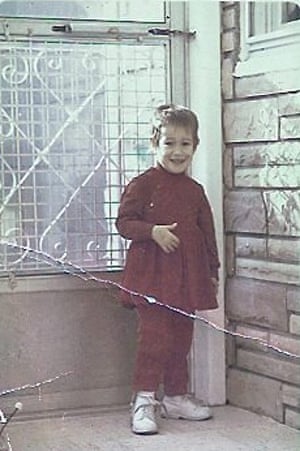
In our crowded box of curled family photos there is only one picture that includes the leg brace I was made to wear because of my cerebral palsy, though even here it is barely visible. A slight bulge beneath the fabric of my pants, a hint of metal peeking from the hem, the single angled strap that attached it to my shoe. I’m three years old in the photo, the same age I was the first time I held it in my hand. “Oh,” I said. I’d seen posters for the March of Dimes with images of children leaning on crutches or sitting in wheelchairs, and now I saw that I was like them in some way. This struck me as nothing more than an ordinary fact. “Oh.”
Shortly after that picture was taken, my doctor decided I only needed to wear the brace in bed at night. Daytimes, it lived in the back of my closet, tucked in a brown paper grocery sack. My mother allowed me to leave it home whenever I slept at a friend’s house, or in its hiding place when a friend slept at mine. Maybe this was how I got the idea that my cerebral palsy could and should be kept secret. This, coupled with the fact that my father never mentioned it, and that my mother, when she did discuss it, said, “It’s nothing, hardly noticeable”, dismissively waving her hand. To me, my body was simply my body, the only one I’d known, and so I thought the brace was my disability. As long as I kept it out of sight, I fitted in with my friends.
“Let’s pretend we walk like people who limp,” Lisa Lowenstein suggested one muggy afternoon in our sixth summer. She slid off the stoop and began hobbling in a circle, and though the game made me uneasy, I got up and did my best to imitate her awkward moves.
Lisa paused to observe me. “Just walk like you always do,” she advised. “You walk like people who limp.”
“Oh,” I said, just as I had when I first saw the photo where I’m wearing my brace. Only this time my throat tightened around the word.
In middle school, I found it helped to carry novels in my backpack. That way, if my friends decided to pay handball at the park or zip around the neighbourhood on their 10 speeds, I could pull out my book and say, “I’m too caught up in this right now”, which, soon enough, would be true.
I also got good at finding the girls who were happy to sit inside, listening to records, and the few left who, like me, were slow to give up Barbies and other daydreaming kinds of games.
Ona, aged three, with the leg brace she had to wear.
“What do you want to do?” Jody might ask me.
“I don’t know. You?”
“I don’t know.”
“Rock star wives?” one of us would finally ask, sighing like it was a last resort.
“I guess.”
After that we’d play for hours, immersed in the elaborate stories we created for Elton, Paul and beautiful grownup versions of ourselves.
Still, the next time Jody and I got together, whoever asked would be tentative about it, afraid the other would be the first to outgrow the game.
By high school, pretend games were no longer an option, unless you count pretending to have my period so I could sit on the sidelines in gym class. Or claiming to be too behind in homework to join my friends at the ice rink. Or acting as though my dislike of disco was the only reason I stood pressed against the wall at dances while the other girls mastered those perfectly synchronised steps.
“Why don’t we go to the movies?” I was always the one to suggest. There, in the comforting darkness, all I had to do was sit perfectly still, along with everyone around me. Row by row by row, we imagined together, lost in the drama of fictitious lives. The movies offered a means of playing pretend that was still sanctioned, a way to be social that asked nothing of my faulty limbs.
For college I chose a small, artsy school where the only team sport offered was Ultimate Frisbee and there were signs posted on the bulletin boards throughout campus that proclaimed It’s Okay to be Gay. I extrapolated from this that here, in this heady oasis, it was OK to be different. Among my classmates were girls with unshaven legs, boys who wore lipstick, kids of both genders with spiky magenta hair and splatters of safety pins on their clothes. Still, while I admired these outliers for their boldness and originality, I hid my uneven legs under long gauzy skirts in my usual attempt to blend in.
If my new classmates noticed my limp, or my childhood friends had seen through my excuses, they were kind enough not to say so. This allowed me to believe my own fabrications. I see it now as a wilful and instantaneous form of amnesia. As soon as I succeeded in avoiding a physical challenge or a potentially embarrassing moment, the memory, along with any thoughts about my disability, dispersed.
The young Ona: ‘If my new classmates noticed my limp, they were kind enough not to say so.’ Photograph: Leonard Gritz
Even so, as I settled in at college, an unnamed tension left me. I now lived in a place where I could curl up with my books hour after hour, not because my friends were off having adventures I couldn’t keep up with, but because this was the adventure. I majored in literature and had plans to become a writer. As I read and honed my craft, it felt as though the body, my body, with its limits and awkwardness, was the least of who I was. Finally, I could live the life of the mind. How perfect was that? Except, of course, it was only part of the story.
One afternoon in the campus library, I highlighted this line in my slim paperback copy of Virginia Woolf’s A Room of One’s Own:
“Women have served all these centuries as looking glasses possessing the magic and delicious power of reflecting the figure of man at twice its natural size.”
I marked the sentence, having brushed past and already forgotten this, from earlier in the same chapter, about the fact that so many men have written books about women:
“…it was flattering, vaguely, to feel oneself the object of such attention provided that it was not entirely bestowed by the crippled and the infirm…”
Had I, a 19-year-old crippled girl, flinched when I read this? Had it stung? I don’t know. I’d forgotten those words existed, and only discovered them now, decades later, while searching for the looking glass quote that has stayed with me all this time. This was precisely how my self-protective amnesia worked. Virginia Woolf devalued people like me in a chapter about the importance of confidence? But I loved Virginia Woolf, so the insult quietly left through some back door in my mind.
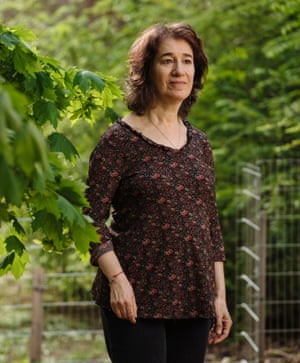
Ona at home: ‘A poetry workshop, I sat beside a man named Dan.’ Photograph: Gene Smirnov for the Observer
What did interest me that afternoon was the metaphor of the mirror, and the idea that men used us to build themselves up. I’d recently joined a feminist consciousness-raising group, and had begun insisting, sometimes petulantly, that I be referred to as a woman rather than a girl. When I marked Woolf’s words it was because they struck me as poetic and true. What I couldn’t yet see was that I had begun to use men similarly, not to reflect me at twice my natural size but as attractive enough. As OK.
This is where my college life wasn’t all disembodied intellect. I had also begun seeking validation through sex.
Here is another truth. I wasn’t at all beyond the prejudices expressed in Woolf’s forgotten passage. The young men I pursued had to be not just smart, creative and interesting, but handsome too. It went without saying that they were also able-bodied. Everyone I knew was able-bodied. There may have been a handful of other students with disabilities on campus, but I paid them no mind.
I chose men for the wrong reasons and, in turn, none of them chose me for anything more than an occasional intimate night. Then, when I was 25, I met Richard. He was athletic and handsome in the way of the popular boys who were completely out of my league in high school. The two of us had very little in common. Richard’s passions included skiing and mountain biking, and though I could never join him on either terrain, he was passionate about me too.
Richard was earnest, playful and affectionate. He was also hot-tempered and impossible to please. Nonetheless, I invited him to move into my apartment. Soon after, we got engaged. All the while, my friends looked on warily.
One friend told me she had always imagined that the man I’d wind up with would be someone she found amazing.
“Someone smart and really kind. The type of guy I’d love for myself, only I’d be so happy for you I wouldn’t be jealous.”
She watched me carefully and I realised that her comment had not just one subtext, but two. First, and most obvious, Richard, who was more conventional and less intellectual than my previous love interests, didn’t meet her expectations. Worse, it seemed she’d always believed that only someone amazing and really kind could possibly choose me. What hung in the air, unspoken between us, was the reason she thought it would take such a remarkable person to love me. I was defective. This made me cling to my handsome boyfriend all the more.
One weekend, while Richard was off mountain biking with friends, I decided to spend an afternoon in the city. After a movie and lunch at a cafe, I found myself following a strange woman down a winding street.
Is that what I look like? I wondered, carefully studying her from a distance. She’s pretty enough, but how much does her limp detract from that?
Over the following weeks and months, for the better part of a year, I kept an eye out for women with physical disabilities. When I found them, I trailed them. For a while, my curiosity remained on the surface. Could women who moved like me still be considered attractive? Did I find them so? But as I continued my stalkerish experiment, something shifted. I began to want to know about their lives.
The best way I knew to process this, as with most issues I grappled with, was through writing. Alone at my desk, I entered into a kind of dialogue with these strangers I was too reticent to approach in person. I did this by writing a poem in the voice of a nonverbal quadriplegic woman who was in the news at the time.
By now I had completed an MFA in creative writing and had found my place in a community of poets. One winter afternoon, I ran into an acquaintance who invited me to take part in a poetry reading and panel discussion for Women’s History Month. Each participant would be from a different cultural background, she explained. She’d already lined up an African American poet, a Latina poet, and she wanted me there to represent disability. My initial response was to take a step back when she said this. But then I felt a stirring of interest.
“I’ll be there,” I heard myself say.
I had the persona poem, and one about my mother helping me on with my nightbrace, and a third, titled What the Mirror Knows, that used my partial disability as a symbol for other ways I felt divided. At the reading, I surrounded these pieces with poems that made no mention of disability and that, to my mind, proved I led a perfectly normal and interesting life.
The panel discussion ended with questions and comments from the audience. There was one woman, seated a few rows back, whose insights caught my attention. She referred to writers I loved, and made connections that surprised and intrigued me. Afterwards, as I was gathering my things, I looked up to find her waiting to talk to me.
“I really liked your poems.”
“Thanks. I liked hearing what you had to say.”
We smiled shyly at each other. “Well,” she said, “I should probably use the bathroom before I head home.”
It wasn’t until the woman, who had introduced herself to me as Hope, started to walk away that I noticed her palsied gait. What could I do but follow her into the restroom?
Cerebral palsy is caused by damage, most often at birth, to a part of the brain that controls motor skills. There are various forms, and it affects people to widely differing degrees. Many don’t have enough balance to walk or need crutches to do so. Some have uncontrollable tremors. Some are intellectually disabled, while others are assumed to be because their facial muscles are affected and their speech is unclear.
Hope and I both have relatively mild cases and forms of the disability that affect only half our bodies. She has diplegia, which means the palsy is just in her legs. I have hemiplegia, which means the split is vertical. The muscles of my right limbs are tight and underdeveloped, and the fingers of that hand lack the dexterity, tactile sensitivity and fine motor skills of those on the left.
“It’s lucky she’s left-handed,” a doctor once told my parents during a consultation, “since she’ll always have to depend on that side.” I was nine at the time, old enough to resent being spoken about in the third person, and also to see the flaw in his logic. Maybe I was born left-handed, maybe not. The body learns to compensate, just like the mind.
Years later, I read an article suggesting that right hemiplegics are likely to be more creative and less practical than our counterparts whose disability is manifested on the left. The hypothesis is based on left /right brain differences. Left hemiplegics have undamaged left hemispheres, which is where pragmatism lives. Meanwhile, we right hemiplegics need to rely on our intact arty and imaginative right hemispheres.
The theory appealed to me. It fitted me so well. But then, just as I understood at nine years old, when it comes to cause and effect it’s hard to assess the true order. Certainly, my cerebral palsy and my drifty, daydreaming ways are connected. But to what extent is this due to the physical brain as opposed to the simple desire to escape the confines of a limited and disappointing body by imagining it away?
Hope and I spent several hours in a coffee shop that late afternoon, commiserating about what it felt like for each of us to be the one kid on the block who couldn’t run, climb fences, or ride a bike without training wheels. I learned I wasn’t the only one who coped by making excuses, hiding behind books, and living too much in my head. This was the first time either of us had ever spoken about these experiences. It was also the first time that I could remember when I wasn’t expending effort and energy to pretend my cerebral palsy didn’t exist.
While Hope took the fuel of our connection and almost immediately got involved in disability activism, I went home to Richard and my belief that his love for me meant that my cerebral palsy was, as my mother had assured me all those years ago, nothing, hardly noticeable.
A few months later, Richard and I married. With Hope now in my life, I had a growing consciousness about disability that came close to acceptance, but it was a place I visited, not yet one where I lived. More real to me was my marriage licence, which I saw as a kind of passport. It proved that where I really belonged was in the enviable world of the unscathed.
Something I had wanted since I was a child trying to coax my friends away from their games of hopscotch and tag to play house with me was to one day be a mother. Six years into our marriage, Richard and I agreed the time was right.
Through my pregnancy, my midwife never once mentioned my cerebral palsy, so neither did I. She did suggest a number of tests to rule out potential birth defects. Always I declined, feeling vaguely insulted, though I couldn’t have said why.
The daily and very physical tasks of caring for a baby forced me to recognise my disability for what it actually was
Our son Ethan was perfect: seven-and-a-half pounds, 14 inches, with active limbs, the right amount of digits, and a hearty cry. For the first hours after his birth, Richard and I sat together in the hospital room and stared at him in wonder. Eventually, a nurse came in to help me with breastfeeding.
“You need to lift your elbow so his head sits a little higher. Not working? How about we try the other side? Can you shift him so he’s in a better position? Let me show you something called the football hold…”
Nothing we tried worked so she brought in another nurse and then a third. They piled cushions around us until I could finally hold Ethan at the right angle and height.
“There we go,” the nurses said once he began to suckle.
“Problem solved,” Richard put in.
This tiny new person nuzzling at my breast depended on me. Yet, somehow, as I’d drifted through my pregnancy, daydreaming as usual, it had never occurred to me that I wouldn’t be able to meet his needs. Now, as I touched his cheek with the one hand that could really feel him, I understood that I didn’t have the balance or coordination to be this fragile, trusting person’s mom. I may have learned early in life to cover for being unable to run, skate or climb fences, but there would be no covering for being unable to safely bathe a newborn, carry him on stairs, or walk any distance while he flailed in my arms.
From that moment on, the daily and very physical tasks of caring for a baby forced me to recognise my disability for what it actually was. A set of very real and specific limitations I had to either work with or around. There were constant puzzles to solve, along the lines of, I’ve arrived home with a baby and a bag of groceries in his carriage and now I find that the one elevator in our apartment building has broken down. What do I do? Often the only answer was to ask for help from a neighbour. The first few times I did so, I stammered and felt myself flush. Then one day I simply stopped feeling apologetic. So, I had a disability. It was what it was.
Meanwhile, Ethan had begun reaching his perfect pudgy little arms towards me the moment we were together in a room. His absolute acceptance, despite my funny walk and clumsy touch, struck me as both lovely and familiar. It reminded me of my three-year-old self, noticing my brace in a photo without judgment.
It’s tempting to end the story here with the happy ending of a renewed self-acceptance. I would, except it gets even better.
It’s neither a surprise nor a tragedy that my marriage to Richard ended when Ethan was still small. Richard remains active in Ethan’s life and the divorce proved to be the best choice for us all.
One holiday weekend, when Ethan was eight, he stayed at Richard’s while I went to a writers’ retreat. There, in a poetry workshop, I sat beside a man named Dan, who had a soft-spoken gentle manner and, I could tell from his responses to poems, an incisive mind. When he brought out his own poem to be critiqued, I liked him even more. His piece had rhythm, wit and heart. This was definitely someone I wanted to know.
I watched him read and take notes by tapping on a braille laptop, his guide dog sprawled at his feet. After the workshop ended we stayed in our seats an extra few minutes talking, then he slipped his hand into the crook of my elbow, and we strolled together to the next event. I wondered if he noticed the lilt in my walk, and actually hoped he did. I wanted Dan to know that, along with poetry, disability was something we shared.
A week later, Dan called me and we stayed on the phone for four hours. In many ways, it was like my first conversation with Hope in the coffee shop. We were so happy to share our stories with each other, and while, in this case, the details of our disabilities bore no resemblance, when I talked about the long and circuitous road I took to making peace with mine, he let me know he’d been there too.
Still, I thought about how, as a young woman, I’d considered my disability a cosmetic flaw, akin to having a bad complexion or being a bit overweight. My concern had been whether people noticed. Now, it occurred to me what an indulgence that was. Born blind, Dan never had the luxury to pretend.
When we met, Dan and I lived a hundred miles apart. This meant we only got to be together on weekends. The rest of the week, we talked on the phone, building our relationship on a foundation of ideas and conversation. From the start, I was captivated by how smart he was, and by how intently he listened. Of course Dan listens well. Hearing is the sense he relies on the most. But I’d never met a man who did so with such presence and interest, and somehow I knew that this had more to do with who he was and what he valued than with the fact that he was blind.
Long before Dan and I got to know each other, he’d begun to write beautifully and candidly about his life as a blind man. He also had a community of friends who were writers and artists with disabilities. I wanted in, and they embraced me without hesitation. Soon, I began to seriously take on disability as a subject in my work. It felt scary at first, a little like pulling my childhood brace out of the closet and putting it on display. But I had spent more than enough time hiding and pretending. I wrote as truthfully as I could about how it felt to live in my particular body, which allowed me to see how universal my experiences actually were.
Dan and I were married on a bright, breezy day in June. Hope slept on our couch on the nights bracketing our wedding day. Ethan stood with us at the altar, holding my palsied hand.
We have been together for 12 years now. The work we do includes disability awareness presentations, literary readings and panel discussions about disability poetics. During one such event at a large poetry festival, a member of the audience, a man with a visibly awkward gait, took the microphone during the Q&A portion and asked in a shaky voice, “How did you learn to like yourselves?”
There were four of us up on the stage and for a long moment we were silent, touched by the vulnerability in the question. I thought of Hope who’d approached me after hearing my first tentative poems about disability. I thought of Dan and our community of disabled friends, including those with us up on that stage. It struck me that, in some way, we were each a pleasing and accurate mirror for the others.
“Do you like us?” I asked.
The man nodded.
“Well, that’s a start.”
Ona Gritz is the author, most recently, of On the Whole: A Story of Mothering and Disability (Shebooks, 2014) and the poetry collection Geode, which was a finalist for the 2013 Main Street Rag poetry book award. Her essay, It’s Time, which appears in the Rumpus, was named a Notable Essay in Best American Essays, 2016
Imagine this scenario: a patient arrives at hospital for an appointment or an emergency, or is admitted for treatment and the clinical team can see their medical record in its entirety, wherever and whenever they need to.
At Cambridge University hospitals NHS foundation trust, that is what we set out to achieve when, seven years ago, we decided to invest in a sustainable digital future for our hospitals. Rather than relying on paper-based processes and simply replacing outdated technology as it became obsolete, we wanted to transform the way we care for our patients.
In 2013 we began a 10-year eHospital digital programme, to create a fully integrated electronic patient record (EPR) system, andset in motion a modernisation of our networking and computing infrastructure. More than 100 colleagues from various clinical areas were seconded to the eHospital team, so our EPR was built by our staff, for our staff.
In October 2014 our EPR went live across both hospitals in our trust: Addenbrooke’s and the Rosie. It spans all clinical areas – both inpatient and outpatient – including A&E, critical care, clinics, wards, surgery, pharmacy, laboratory and radiology services.
It was a big undertaking. More than 175,000 hours of training were delivered to about 12,000 staff in nine weeks as we prepared to make the system live. Around 5,500 old computers were replaced with 6,750 new ones, and we connected another 500 laptops, 395 workstations on wheels and 420 handheld devices, such as iPods with barcode wristband scanners. We also installed 1,350 wifi access points across all clinical areas.
For some of our staff the transition from paper to digital was not simple, even though they had access to the same information as before, just presented in a different way. Having “super users” – hospital staff who volunteered to have extra training so they could help others – proved invaluable.
The EPR has 3,200 concurrent users and every single one looks at the most up-to-date version of patient records
Today our EPR is vital to better patient care. It has helped us improve quality and safety, reduce duplication and eliminate unnecessary delays. Inpatients do not have to stay in hospital for longer than necessary as the time taken to prepare discharge medications has halved. Every inpatient has a barcoded wristband, which links directly to the EPR, and allergy-related prescribing alerts in the system have reduced adverse medication reactions, saving around 2,500 inpatient bed days per year.
Outpatients now only come in to hospital if it’s necessary as clinicians can review their patients’ notes and x-rays virtually. In orthopaedics this has freed up 4,500 appointments a year. Patients attending the surgical pre-assessment clinic complete their initial documentation on tablets, meaning this department now sees approximately 20% more patients than before.
Integrated handheld and mobile devices enable clinicians to document information in the EPR in real time at a patient’s bedside. This has released the equivalent of 120 nursing posts, allowing staff to spend more quality time with patients.
We typically have 3,200 concurrent users of the EPR at peak times and every single person is looking at the most up-to-date version of their patient’s record. Overall, we have reduced the use of paper records by 99%.
Moving forward, we are introducing a patient portal, MyChart, which will give patients secure access to parts of their medical record, so they can be more in control of their health information. The future of electronic healthcare is coming with the forthcoming launch of Care Everywhere and EpicCare Link, which will allow us to share key patient information electronically with other hospitals and primary care services.
As one of the UK’s highest rated trusts for the effective use of technology in providing high-quality patient care, not only will we continue to focus on using technology to deliver further improvements for our patients, but also as a global digital exemplar hospital we are committed to sharing our learning with others and helping the NHS embrace its digital future.
Dr Afzal Chaudhry, chief medical information officer at Cambridge University hospitals NHS foundation trust, will be speaking at eHealth Week on 3-4 May. The Guardian Healthcare Professionals Network is media partner for the event.
Join the Healthcare Professionals Network to read more pieces like this. And follow us on Twitter (@GdnHealthcare) to keep up with the latest healthcare news and views.
What was the number one reason I didn’t make my health a priority for more than 15 years?
Can you guess?
You got it: time.
It may be different for you, but for the majority of my patients (and in the past, for me), time is at the top of the list of reasons why they are struggling.
Every day I balanced work, home, friends and a seemingly endless stream of errands and to-dos. I wore too many hats. To be honest, I was once a workaholic; I used to work up to 14–16 hrs. a day. There was NO time for exercise or cooking, let alone some relaxation time. I used to think that people who had time for that were just, simply put, “lazy.” The hustle was real and I love it. It made me feel important and worthy.
But then one day, without warning, I ended up in the hospital and was told (by a cute young doctor …) that I needed to take prescription medications; otherwise, my condition would just get worse. That’s when it hit me like a ton of bricks: I was slowly but surely destroying my health.
It’s not like I never thought of it. Let’s face it, I’m smart a woman. I knew that every time I stopped by McDonald’s drive-thru on my way home after work, it wasn’t the best choice for my health. But I’d always tell myself, “Ah, what the heck! Nothing bad has happened to me yet so I will figure this out later.”
Life is a Series of Choices
I had a choice to make: I could either continue to go down this path of self-destruction and just take prescription pills so I could go at that same pace, or I become a healthier person. I mean let’s face it. It wasn’t a secret and I could hide: I was overweight.
But here’s the real question that you’re likely asking yourself right now: Do I have the time to devote to becoming and staying healthy? If your answer is “no,” think again, because it’s not a question of having the time; it’s a question of making it. This one single realization could be the key to achieving the weight you want, and the feeling of energy and self-confidence you crave.
More Time for Health: 5 Ways to Make It Happen Now!
Try these tips to make more time for your fitness, nutrition, and emotional health and make your health a priority.
1) Change your perspective from “I have no time” to “There is time to be found.”
When I got back to the office after my trip to the hospital, I looked around me and I kept seeing colleagues who looked healthy. They seemed to be able to make time to go to the gym and bring their lunches to work. It was obvious that they had a positive outlook on life. When I asked them how they were able to do what they did, I found out that they all had one thing in common: They didn’t think they had any other option. It was part of who they were. Their perspective was different than mine.
I shifted my perspective from “I have no time” to “There is time to be found.” In most days, if not all, there are underused pockets of time, which you can spend on doing something that can help you become healthier. We all have a choice on how we view things.
Changing your perspective is like changing the window through which you view the world. When you change how you view the world, you change how you feel about it, and life choices become easier.
2) Get your planner out and get creative
Find the time. For me, what seemed to be a lack of time was actually a failure to prioritize. Start by sitting down with your planner. If you don’t use one, get out a notepad and sketch out what every day during the week looks like, including what time you get up, what time you go to sleep, and everything in between.
Then dust off the same problem-solving skills you use at work or with the kids and look for places where you might trade one activity for another. When you have intentions, the universe collaborates with you to make them possible
If you watch 60 minutes of TV each night, can you cut down your TV time to 30 minutes so that you can use the extra time to exercise or put together a healthy meal for tomorrow’s lunch? Perhaps you can walk on the treadmill while you watch. Maybe your kids can take the bus to school a couple of days a week or carpool to get to sports games so you can free up your time to do chores and go to bed early. Where there’s a will, there’s a way.
For me, I found pockets of extra time during the evening. I used to just crash on the couch from exhaustion every night. So I made a commitment to exercise at the end of each day and gave myself a month to see if it would help me. Well, guess what? Exercise, combined with healthier eating habits, gave me more energy, not only throughout the day but also at night. Since then, I would exercise for 45 minutes, 5 days a week. I also spent 15 minutes each night on packing my lunch for work.
3) Delegate
Perfectionism will kill you. There’s no doubt about that.
I used to be a perfectionist. At first, I refused to admit it. As matter of fact, I thought of myself as not being perfect enough. I mean having high standards is what pushed me to create the life that I have now. Nothing wrong with that, right?
The problem with having high standards is that you’re likely to not delegate. You tend to take on everything, I mean everything and do everything all by yourself. We think that no one besides ourselves can be trusted to get it done right, which is why we take on too much and have suffered from the “I don’t have time syndrome.” Doesn’t it sound familiar?
However, when I realized that I was making a mistake, I started handing over responsibilities to people around me. I invested time in training others on how to do important tasks and then I hold them accountable. People always strive to do their best, especially when we trust them with something important to us, including children. You might be frustrated if your partner doesn’t fold the laundry exactly the way you think it should be done. But remember: The trade-off is a valuable 10 or 20 minutes of time you can devote to yourself
4) Learn to say no
Do you feel resentment towards certain commitments in your life? I had one client who felt like she “should” be on the board of this nonprofit organization. But she was dreading the meetings and was always exhausted from her job and the commute. She started to feel resentful of the commitment. When she resigned from the Board, she immediately felt as if a huge weight was lifted off her chest.
The key to creating more time is to start saying “no” to requests and obligations that you don’t want to fulfill. It’s kind of like cleaning out your closet. At first, you think everything is necessary. But once you begin getting rid of hangers from the dry cleaners and creating more space, you gain momentum. By the time you’re done, it feels great!
At first saying, no was very difficult for me…Honestly, I was afraid of not feeling needed. The aha moment for me was when I realized that the person who needed me the most was…ME. I needed to give to myself first.
5) Quit wearing “busy” like a badge of honor
“I’m a busy woman.”
“Sorry, I’m booked till next week. Two weeks, actually.”
I used to say these things with pride. I wore my busyness as a badge of honor. My booked schedule was a proof of my value, my worth. But at the end of the day, I wasn’t happy, which led to me not being healthy.
We are part of a culture that increasingly values preoccupation and over-commitment. “Crazy busy” has almost become a statement of validation, reinforcing that I am significant and that what I am doing is important. That’s was me. But this addiction to being busy, as well as my drivenness, came at a steep cost: my health.
The first thing I did was to be aware whenever I said, “I’m so busy.” And whenever I caught myself doing so, I would reframe the situation in my own head. I needed to regain a sense of perspective and control over my own life. I started journaling 3 to 4 times a week in the morning. I did have some resistance initially, but this habit has turned out to be a game changer in keeping me from succumbing to “the rising tide of demands, details, and deadlines.”
The discipline of recording your thoughts will help you gain greater focus, unravel thorny problems, process negative emotions, and maintain a balanced perspective on my work and life.
Dieting is Not About The Food
For me and 90% of the people who completed my programs, the biggest challenge wasn’t about the food at all. It was changing our mindset. I’m guessing that it will be your biggest challenge, too.
It’s all about what is going on inside your head that influences the choices you make. What you have done thus far has gotten you to where you are now. If you want different results, it’s time to change your approach.
I’m a living proof that the five principles that you’ve just read really work. I have applied them in my own life. I changed my thoughts and this led to me making more time for myself. And gradually, I was able to change my lifestyle. In the process, I lost 100 lbs and achieved optimal health. I’ve never felt this good before!
I invite you to change your mindset and apply the five principles that you just read about. If you are consistent with your efforts, you will soon see positive changes and move significantly closer to your health goals.
Why isn’t Easter the same date each year? Unlike Christmas, it relies on different religious calenders and astronomy tricks, in particular the Spring Equinox and the full moon, meaning it is complex to co-ordinate. The most we achieve are close matches: a lunar month is just over four weeks of earth days; a solar year is near to 12 lunar months. But if you make that rule absolute, things gradually get out of sync.
Our own bodies share similar issues when it comes to circadian rhythms. Although individual cells isolated in a dish display a roughly 24-hour cycle, they need to be synchronised for a whole organism to work effectively. In studies where respondents ‘free-run’, ie where they are shielded from time cues – light, sound or action – the internal body clock shifts to a cycle of a little more than 24 hours, gradually losing sync with the day.
There are pathways to transmit light from the retina to the suprachiasmatic nucleus, a tiny bit of brain above the crossing of the optic nerves: the central timekeeper. Complex feedback mechanisms keep the whole thing running. For religious dates and biology, controlling cycles is a tricky business.
Dr Daniel Glaser is director of Science Gallery at King’s College London
General practice is in a state of crisis. Despite the promises and the optimism of proposed plans to reform primary care over the next five years, the reality on the ground offers little comfort.
The GP Forward View (GPFV) published 12 months ago promised us 5,000 more GPs by 2020. So one year on, where do things stand? Yes, there was a rise in GP trainee recruitment in 2016 (167 more trainees than in 2015), but overall, GP numbers are falling. According to the latest NHS England figures, 92 practices closed in 2016, up 114% on GP surgery closures in 2014. While 34 merged with other practices, the remainder shut completely. And the number of GPs fell by more than 400 between October and December 2016 alone.
While the lure of jobs abroad, early retirement and locum jobs explain some of these figures, there is a growing crisis in retention. In the south–west, a survey of more than 2,000 GPs, published today, has found that around two in five GPs intend to quit within the next five years. More than half report low morale.
Poor retention is also both a cause and effect of staff shortages and escalating workload (with 12- to 14-hour days). A recent British Medical Association poll showed that 84% of GPs find their workload unmanageable. Reduced take-home pay, particularly for partners as practice costs increase, is also a factor, as is red tape. There is more paperwork than ever before, as work is shifting from secondary to primary care. Resources are stretched and rationing more widespread. I see a greater influx of patients, a faster turnaround from earlier hospital discharges, more limited access to outpatient referrals and longer waits for elective surgery. A significant amount of work also goes into preparing for Care Quality Commission visits, with the bulk of the responsibility on the shoulders of practice managers and partners. And where the government has given primary care more funding on the one hand, it has taken away with the other by cutting investment in other areas or linking it to extending access or seven-day services.
The effect on patients of this shortage of GPs is stark. The scale of practice closures meant that 265,000 patients had to register with a new surgery last year and now often face travelling further to see a doctor. Yet the government is still keen to develop super-practices of 30-50,000 patients, despite GPs and patients not being in favour of these models that reduce continuity of care and autonomy. It feels like we are being pushed towards privatisation and a salaried GP model, stripped of the sense of ownership for our practices and responsibility that we feel for our staff, premises and patients.
As one of the antidotes to the retention crisis, the practitioner health programme (PHP), commissioned by the government for GPs, was rolled out earlier this year and in only four weeks it saw the number of GPs it was commissioned to see for the whole year. The PHP has cited stress, burnout and post-traumatic stress disorder as some of the commonest problems faced by GPs, often from “practice meltdown”.
One year on from the GPFV we have seen little change when it comes to improving the working lives of GPs, who may be independent contractors but nevertheless work for the NHS and provide a crucial and cost-effective service.
Retention schemes to keep over-55s in work by allowing them to work more flexibly, or giving “golden hellos” to trainees to work in under-doctored areas are all a drop in the ocean. The PHP is certainly welcome and well overdue. But it would also make sense to increase core funding of general practice to reflect the explosion in workload. This will improve retention and recruitment. As things stand, it seems a herculean task for the government to rescue something it has little understanding of or empathy with. It may be time to go back to the drawing board.
Talk to a woman about her period and she will probably give you an example of the time her cycle aligned with a friend, partner, colleague or family member. Many of us have noticed that the closer we get to another woman the more we seem to get crampy, grumpy, tired, bloated and spotty at the same time. It’s as if our uteruses, in a monthly show of solidarity, are saying hey, why not go with the flow? Let’s do this painful, stigmatised, and bloody expensive thing together, and take advantage of the three-for-two tampon offers in the process.
However, a new scientific study – thought to be the largest of its kind – has found data showing women’s periods do not synchronise when they live together after all. The study – carried out by period tracking and fertility app Clue in partnership with the University of Oxford – received 1500 responses, which were narrowed down to 360 pairs of women. Analysing three consecutive cycles in each pair, the research found the vast majority – 273 pairs – had a greater difference in period start dates at the end of the study than at the beginning. In other words, menstrual syncing is a myth up there with periods being tied to the waxing and waning of the moon. Not only that, women’s menstrual cycles are more likely to diverge than come together over time.
“It’s very unlikely that cycle syncing is a real phenomenon,” says Clue’s data scientist Marija Vlajic. “Menstrual syncing amongst the sample we had did not exist. We’ve also done some statistical tests and found that the difference in cycles actually grows. This doesn’t mean that pairs go out of sync – it means they were never in sync in the first place. It’s the nature of two mathematical series that keep repeating: the series will diverge as the numbers grow.”
This has been my experience. I have been with my female partner for 13 years, living together for 11 years. In that time, our periods have never synced for more than a month or two, because our cycles are different lengths.
“Exactly,” Vlajic says. “So there will be a time every six months, say, when your periods sync but that doesn’t mean the difference is getting smaller.” Has Vlajic ever experienced her period syncing with another woman? “My background is scientific,” she notes. “So when I say to my friends that I have my period and they have theirs too I don’t conclude that we are syncing. I just think it’s information bias; our brains looking for patterns.”
Still, the belief in menstrual synchrony persists, with a study published in 1999 revealing that 80% of women believed in the phenomenon and 70% saying they enjoyed it. The editor who commissioned this piece told me that she syncs with her sister whenever they spend time together and gets her period at the same time as her closest colleague. The idea has been around for centuries, though because menstrual health has long been overlooked by the scientific research community it was not until 1971 that it was first documented in a study.
In a Harvard research paper titled Menstrual Synchrony and Suppression, psychologist Martha McClintock tracked 135 female college students living in the same dorm and found “a significant increase in synchronisation of onset dates”. She concluded: “the evidence for synchronicity is quite strong, indicating that in humans there is some interpersonal physiological process which affects the menstrual cycle.”
The idea that pheromones enable women to become sexually receptive at the same time has been researched in various groups as well as in rats, baboons and chimpanzees. Themain evolutionary explanation is that it permits female species to avoid being monopolised by a single dominant male. But McClintock’s paper has been discredited on methodological grounds and a whole host of other studies, like this new one, continue to prove that menstrual synchrony is a myth.
So why won’t we let this one go? And how does Vlajic explain all the anecdotal evidence of our periods synchronising? “I like the idea myself of this dominant super uterus in a group of women that makes everyone adjust their cycles,” she admits. “I can see how it gives you a special connection with a woman to go through that at the same time. It feeds into a feeling of connection, support, and sisterhood. Even though we do it every month, t Periods are personal and the thought of sharing with someone makes the idea powerful. That’s why we continue to look for patterns even when they don’t exist.”
It is the end of an afternoon in theatre and I have extracted more than 100 teeth from my operating list of eight patients, the youngest a two-year-old who needed all 20 baby teeth removing because they were so decayed. I watch in silence as a child younger than my own is transferred from the operating table and I wonder how we reached this point as a society where I don’t believe we truly value oral health, nor realise the implications of failing to do so.
Nearly 20 years after observing my first general anaesthetic as a student it doesn’t get any easier. I regularly see parents overcome by guilt and emotion as they watch their child being put to sleep, or recovering dazed and confused in the recovery suite. Sometimes after a busy afternoon I sit in the theatre and wonder if there is more I can do, sometimes I have nothing left to give.
Responsibility for oral health promotion has been devolved to cash-strapped local authorities
As an NHS consultant in paediatric dentistry, it sadly comes as no surprise to me that removal of decayed teeth remains the most common reason for a child aged five to nine years to be admitted to a hospital in England. In these straitened times, it seems so wrong that every year we spend around £35m on operations to treat a disease that is almost always preventable.
The frustration is that the solutions are already out there. Ten years ago, the Scottish government agreed to invest in a programme of oral health prevention called Childsmile. Now every child in Scotland has access to free daily supervised toothbrushing in nursery and free dental packs to support toothbrushing at home. Dental registration is encouraged and those communities and individuals who are higher risk have more support. The result? Scotland is reducing the millions of pounds it spends on general anaesthetics and turning around the oral health of its children, for the princely sum of £17 per child per year.
Wales has a similar Designed to Smile programme but in England, responsibility for oral health promotion has been devolved to cash-strapped local authorities. This means that it is a postcode lottery with some excellent programmes, such as Teeth Team in Hull, while in other areas existing services are being decommissioned.
England needs urgent investment in oral health prevention. It is actually more cost effective to prevent, rather than treat, dental disease but more importantly we could be preventing tens of thousands of young children, and their families, from potentially experiencing pain, swelling and sleepless nights and time away from school or work.
Every child has a right to good oral health yet still we see one in eight three-year-old children with obvious signs of decay. We need a more radical approach to reduce the persistent inequalities in oral health, which are immoral in this day and age. We need more compassion, an accelerated programme of product reformation so that the sugar content is reduced, and a war on marketing of high sugar products aimed at children.
Two years ago after a particularly frustrating consultation with a parent whose child’s diet was limited to Ribena and biscuits, I decided to begin writing a blog as a way of delivering practical information. I have reached many more families than I would in my day job, but I still feel as though I am wading in a sea of untreated decay. Education is important but it forms only part of the solution. It is too simplistic, and frankly unhelpful, to apportion all blame to the parents. Yes, as parents we have responsibilities and a vital role to play – but we could all be more proactive when it comes to children’s oral health.
I am delighted at the growing number of organisations that are now beginning to collaborate with myself and colleagues via the British Society of Paediatric Dentistry. Health visitors can and are encouraging a dental check before a baby’s first birthday; sports and education settings can lead by example, adopting low-sugar menus and refusing to place sugary drinks in their vending machines; and communities should campaign for water fluoridation. Above all, we need strong, visible leadership by local and national government that says, “This is not acceptable and we are going to do something about it”. Children’s oral health should be everyone’s business.
If you would like to write a blogpost for Views from the NHS frontline, read our guidelines and get in touch by emailing sarah.johnson@theguardian.com.
Join the Healthcare Professionals Network to read more pieces like this. And follow us on Twitter (@GdnHealthcare) to keep up with the latest healthcare news and views.
Beset upon by pink fluff on all sides, like awaking to find yourself trapped in Barbara Cartland’s musty closet, we’re once more in the midst of Race for Life fundraising season. It’s an important and worthy cause, and yet many hearts (soft, kind hearts) can’t help but sink at the pinkification. “I’ll donate later – I promise” is hesitantly mumbled to beaming participants, and donations are quietly given to the main Cancer Research UK branch instead.
Does avoiding the old-fashioned-gender-cliches-for-charity’s-sake make you a monster? Or should charities receive the same criticism other publicity campaigns get when they use tired stereotyping?
Race for Life isn’t Oven Pride, obviously – it works to save lives, helping those impacted by breast cancer and building a community of support. We know this, we agree with the work. But not always so much with the gender-segregation (men are still banned from running in the races alongside women), and its core brand colour that pulses (however unfairly) with negative undertones, highlighted by such campaigns as Think Before You Pink and Pinkstinks – and the documentary Pink Ribbons, Inc.
Working to balance out Race for Life’s saccharine feather boa-and-cupcake prissiness with some grit are today’s grime-caked Pretty Muddy events, aggressive taglines such as “Hell hath no fury like a woman in pink” and adverts with Braveheart-like line-ups of women ready to run. But can there be any escaping the pink central to it all, and its associations?
After all, the rosy breast cancer awareness ribbons used by organisations such as Race for Life only came about after Estée Lauder turned originator Charlotte Haley’s peachy-orange strips to pink back in the 1990s, after researchers found the colour to be the most “non-threatening”. Ad copy can be packed to the hilt with wrath, dirt, and ferocity, but if its core colour was chosen for its non-threatening impact, then any lately adopted roughness comes across as a weak cover for still-fluffy and asinine insides.
Race for Life’s cutesy and sometimes infantile branding (Real Women Wear Mud, apparently) has a gender problem at its heart. And it’s not necessary. Just because a charity is fundraising for a gender-specific disorder or disease, it doesn’t follow that its efforts should be based around outdated gender cliches to gain support. That belongs to another time; not today, not now. In any case, breast cancer doesn’t just affect women: it’s rare, but men can have the disease too.
A counterpoint to Race for Life’s downsides, if you’re looking for some male-focused charity stereotyping, is the Campaign Against Living Miserably’s (Calm) Mandictionary initiative. “Mandictionary” – sounds just terrible, doesn’t it? Down there with the passive-aggressive phrase “man flu”: it’s that low. Bus stop posters for the campaign feature words such as Mantip (“Disposal of a drink when you’re struggling to keep up with your mates”) and Manbaggage (“A puppy [...] used by a bachelor to heighten ‘cute levels’ in parks”) – so far, so much forced machismo bullshit. But then there’s Imangination (“The capacity to believe in multiple definitions of masculinity”) and Mandown (“One of the 12 men who take their life every day in this country”).
Calm are doing something slightly more subtle – aiming to dismantle the stereotypes that men are pressured to conform to by parodying some of the most trite. Many examples are contributed via Twitter and Facebook by men who are hurt by such cliches. It’s an unexpected, clever way to highlight the harm in gender essentialism.
So how do we get more of these different approaches and voices into advertising and awareness campaigns? The IPA’s diversity quota for UK advertising, marketing and communication agencies looking to hire and promote could be one way. Before three years is up, the industry must have 40% women in senior roles and 15% of its senior people from non-white backgrounds. Prescriptive perhaps, but needed in an industry that isn’t moving quickly enough on its own.
Real charity campaigns – and successful marketing/advertising campaigns – don’t make potential contributors feel resistant and uncomfortable about engaging with them. The industry that puts them together needs new voices that we can relate and respond to. Ultimately that’s the best way to make all of us – whatever our gender or race – dip into our pockets.
Anonymous Last night I had a dream about my eldest son who’s just turned 11. Because of my mental illness, I have not been able to speak to or see my three boys for eight months now. In the dream I’m hangin’ with my eldest, shooting the breeze as we’ve done many a time, but this time I notice a difference; his voice has broken, and with this realisation my heart broke, too.
This dream is analogous of all those golden moments of childhood I have missed in their lives, that can never be relived, moments that seem even more precious when it comes to my eldest, as he rapidly approaches adolescence. The dream also feels analogous of everything I’ve lost as a result of mental illness; my marriage, career, liberty (sectioned twice), self-respect and societal approval.
What really frightens me about my mental illness is the way it suddenly grabs me and leads me to do things that I, when feeling stable, just would never want to do. Like right now I love my boys and mum so much I cannot believe I’d want to never see them again and devastate them through taking my own life. Yet out of the corner of my eye, I can see the omnipresent scar on my left wrist that is a constant reminder of how my mental health can construct a vast distance between me and my values.
Anonymous, 21 I have bipolar disorder, a highly stigmatised diagnosis. One of the hardest things to deal with is knowing you’re hurting people around you. After taking an overdose, lying in A&E with someone who loves you and feeling the guilt and horror of what you’ve done. They’re scared that this time you might die, but the urge was so strong you couldn’t stop yourself from doing it. Even when you know you are loved, you still wish to die. I have an illness. I wrote this poem in art therapy.
Today you are possible of great things,
Things of beauty, of purpose and of wonder.
Your voice is of importance, your body is of splendour.
Today you are tasked with only being fair to yourself and your soul, and to be fair to yourself and your soul is to be kind.
Kindness is all that you deserve.
Today you are you, and that is a magical thing, no one else will ever be you.
You are strong, you are mesmerising, you are intelligent, you are divine.
Today you are loved, as you should be, and as you always will be.
Anonymous Go me: a poem about mental health, from a mother’s perspective
I am the world’s greatest mum
My teenage daughter is perfect
Good grades, no shouting, no drinking, no boys, no worries
I’m expert at giving lifts, coordinating activities, supporting vegetarianism, saying no to piercings, organising cultural excursions and understanding UCAS points
I’ve got this covered. Go me!
I am the world’s most understanding mum
I can support this exam stress
Distant, withdrawn, eating less, sleeping more, staying in
I am an expert at finding French tutors, arranging extra physics, breathing exercises, pep talks and staying positive
One of life’s challenges. Go me!
I am the world’s most bewildered mum
I don’t know why this is happening
School dropout, counselling, anger, a handful of pills, some minor cuts
I am expert at managing panic attacks, investigating colleges, negotiating the NHS and weird piercings
But I’m up for this. Go me!
I am the world’s most exhausted mum
I love her to death
Major overdose, psychiatrist, cardiac ward, cutting, minor overdose, more cutting
I am expert at bandaging cuts, hiding razor blades, 999 calls, police statements, social services, riding in ambulances, fighting for support, staying up all night, dispensing pills
But we’re still here and stronger. So go us
Helen, Manchester, 35 Fourteen years ago, I found my flatmate (and close friend) almost unconscious, with an empty bottle of pills next to her bed. I got her to the hospital. I stayed all night, until she was released in the morning. It was horrible. What came next was worse. At the hospital I asked the doctor what I should do the next day. He drew a blank. My other flatmate and I had no idea how to react. We were angry, we blamed her, we thought she was selfish. We treated her like a stranger. I went to my GP, who suggested we focus on ourselves because finals were coming up. Within a week, we just left her – went to our respective homes to study, claiming that we needed peace and quiet away from university.
I’ve never forgiven myself for that response, or forgotten how awful it was when she quietly confronted me about lying to her. In the end we both apologised, cried a lot, and made peace. It took me a few years, though, to fully accept that she wasn’t selfish or to blame. I hope that today’s 21-year-olds already know that, and that their doctors are giving better advice. By removing the stigma around mental health, and by educating people in how to support their friends and family, perhaps we can prevent other people being judged and abandoned.
Anonymous, early 40s
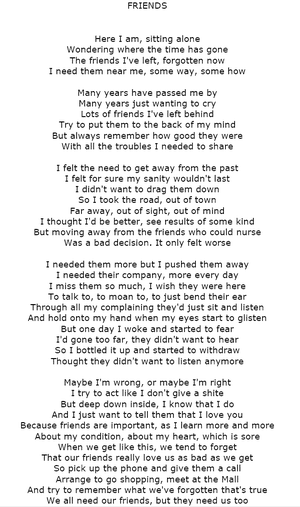
A poem dedicated to old friends, hopefully to return.
In the UK, the Samaritans can be contacted on 116 123. In the US, the National Suicide Prevention Hotline is 1-800-273-8255. In Australia, the crisis support service Lifeline is on 13 11 14.
Twice a week we publish problems that will feature in a forthcoming Dear Jeremy advice column in the Saturday Guardian so that readers can offer their own advice and suggestions. We then print the best of your comments alongside Jeremy’s own insights.
I’m about to start a new job, my first with any prospect of security after several years of juggling part-time, short-term contracts, and I’m keen to make a good impression.
However, my previous work pattern and some of the stresses involved have taken their toll and I’ve been struggling with depression for a while. I have just been offered a few months of therapy on the NHS, starting in the next couple of weeks.
The catch is, to take this up I would need to take some time out of my working day. As a certain amount of my work is fairly independent of my colleagues’ input, making up the hours won’t be a problem. I’ve already worked out a few strategies to do this, depending on what would best fit with my new employer’s work pattern.
My worry is that I don’t know how to broach the subject – starting a new job by declaring any health issues is difficult enough, but I fear they may see those involving mental health as a stigma and this makes this worse.
How can I best approach this? I don’t feel I can let the opportunity for treatment go. I’ve done the sums and there’s just no way I can afford to get this privately, now or in the foreseeable future, but I also need this job.
Do you need advice on a work issue? For Jeremy’s and readers’ help, send a brief email to dear.jeremy@theguardian.com. Please note that he is unable to answer questions of a legal nature or to reply personally.
The ambulance pulled in but unusually the crew came into the hospital alone. They informed us that a high risk mental health patient was on their way to the department, and was being accompanied by the police. This set alarm bells in my head.
I qualified as a staff nurse a few years previously. We received no mental health training, but we do look after people in real crisis. In my experience patients with severe mental health problems do not usually want to be in A&E.
I have been spat at, verbally abused and threatened. Though this was normally due to drugs, alcohol and fear, it wears you down. The environment is busy, loud and fast and even with my lack of mental health training, I know this is not conducive to calm.
When I started working in A&E I was in my early 20s and had a very naïve view of the world. A&E taught me that some people have very hard lives, they’ve experienced things no one ever should and it’s taught me everyone has a story, even if they hide it.
The police arrived and when they stepped aside I saw this child-like figure; she had closed body language, her hair was strewn across her face, and mascara ran down her cheeks. She was terrified. She sat down and stared at the floor while the ambulance crew and police handed over.
Knowing what to say is hard. You want to take the pain away but mental torture isn’t cured by painkillers.
She was in her late teens. She was having hallucinations and suicidal thoughts. Her parents had phoned the police because they were scared of her behaviour. She was screaming and shouting. She had arrived without any family. I remember a wave of sadness washing over me as I listened. How had this young, beautiful girl got to this point? How had she got to point of thinking she would be better off dead?
The patient was still visibly agitated but was no longer shouting. The crew and police left, telling us to phone if we needed them. I sat next to her, but she remained closed.
Knowing what to say in this situation is hard. You want to take the pain away but mental torture isn’t cured by painkillers. She didn’t reply to anything I said until I realised that if I was in her situation, I would want to know I was safe. I put my arm on her shoulder and told her she was safe. She fell into my chest sobbing. She stayed there for what felt like hours, holding me so tight as her make-up ran down my uniform.
I was grateful the department wasn’t overflowing that day. My manager looked over to me and mouthed: “Stay with her.” The patient told me how her parents didn’t care, how she hated herself and just wanted to be normal. I just listened, not saying anything. I thought that her parents probably did care, but just didn’t know how to help. Many people’s fear is expressed as frustration.
As her sobbing stopped the exhaustion set in. She was assessed by our psychiatric team and only then did I see how much she needed help. She thought doctors were trying to kill her. Sorrow filled me, knowing her mind was causing her to have these terrible thoughts.
The patient was sectioned. I went home and cried because I couldn’t make her better. She was only a few years younger than me and I could understand what was happening to her. This was not the first or the last time I would cry about a patient.
Weeks later, I arrived at work to find a letter addressed to me. The letter thanked me and told me that if all nurses were like me, everyone would be sane. I welled up reading it. It was my first note from a patient and I treasure it to this day.
I have never forgotten this young woman or how she changed my perception of mental health patients. She taught me so much. Most importantly that spending enough time with someone at the right moment can achieve so much. This situation taught me to take my time whenever I can, and to fight for safe staffing. This story could have been so different if the department was busy.
Years later, when I saw the patient in the local media advocating for mental health patients, I was amazed. For the first time, I felt hope and joy when seeing her; hope for her and for the NHS, joy that she had recovered so well, and that maybe I touched her life in a similar way to how she touched mine.
If you would like to contribute to our Blood, sweat and tears series about memorable moments in a healthcare career, read our guidelines and get in touch by emailing sarah.johnson@theguardian.com.
Join the Healthcare Professionals Network to read more pieces like this. And follow us on Twitter (@GdnHealthcare) to keep up with the latest healthcare news and views.