Infertile mice have given birth to healthy pups after having their fertility restored with ovary implants made with a 3D printer.
Researchers created the synthetic ovaries by printing porous scaffolds from a gelatin ink and filling them with follicles, the tiny, fluid-holding sacs that contain immature egg cells.
In tests on mice that had one ovary surgically removed, scientists found that the implants hooked up to the blood supply within a week and went on to release eggs naturally through the pores built into the gelatin structures.
The work marks a step towards making artificial ovaries for young women whose reproductive systems have been damaged by cancer treatments, leaving them infertile or with hormone imbalances that require them to take regular hormone-boosting drugs.
“Our hope is that one day this ovarian bioprosthesis is really the ovary of the future,” said Teresa Woodruff at Northwestern University in Chicago. “The goal of the project is to be able to restore fertility and endocrine health to young cancer patients who have been sterilised by their cancer treatment.”
[embedded content]
Of seven mice that mated after receiving the artificial ovaries, three gave birth to pups that had developed from eggs released by the implants. The mice fed normally on their mother’s milk and went on to have healthy litters of their own later in life.
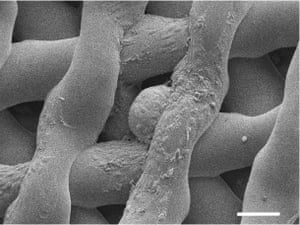
Writing in the journal Nature Communications, the scientists describe how they printed layered lattices of gelatin strips to make the ovary implants. The sizes and positions of the holes in the structures were carefully controlled to hold dozens of follicles and allow blood vessels to connect to the implants. Mature eggs were then released from the implants as happens in normal ovulation.
Chemotherapy and high doses of radiation used in cancer treatment can destroy some or all of a woman’s eggs, putting them at risk of infertility and an early menopause. And while doctors have had some success in restoring women’s fertility from frozen ovarian tissue, an implant could potentially help those who do not bank healthy tissue when they are children.
Monica Laronda, a co-author on the study, said that an ovary implant could also help cancer survivors whose eggs are so damaged that they need hormone replacement therapy to trigger puberty. “We’re thinking big picture, meaning every stage of the girl’s life, so puberty through adulthood to a natural menopause,” she said.
A microscopic image of an immature mouse egg, surrounded by supportive cells, after it has been housed in a bioprosthetic ovary scaffold for six days. Photograph: Northwestern University
Scientists have made artificial ovaries for mice before, but the latest research is believed to be the first time that researchers have used 3D printing to manufacture them. It is not clear if the same approach will work in people because human follicles are much larger and grow rapidly until they are visible to the naked eye.
Other animal experiments performed nearly a decade ago hinted that women who had ovarian tissue transplants later in life might enjoy broader benefits from the procedure than restored fertility. In 2010, scientists at Kato Ladies Clinic in Tokyo found that ovarian transplants extended the lives of old mice, and led older females, who were normally inactive, to seek out mates and have babies. The researchers conceded that far more work was needed to assess the effects in women.
Advances in 3D printing have already transformed some areas of medicine by allowing the doctors to make bespoke body parts that can be directly implanted into patients. Last year, South Korean surgeons printed a titanium heel bone for a man who had a tumour removed from his foot.
Meanwhile, researchers in North Carolina announced that they had made ears, jawbones and skeletal muscles by 3D printing structures laced with living cells. Other groups have printed vascular networks that will be vital for creating large synthetic organs in the lab.
Hello, how are you today? If you’ve got a uterus, maybe the answer is “not so great” – especially if you’ve heard reports about Donald Trump’s latest appointee. The woman tipped for a key family planning role, Teresa Manning, has previously worked with an anti-abortion group as well as an anti-LGBT rights lobbying group.
If Manning is appointed as deputy assistant secretary for population affairs at the Department of Health and Human Services, she would have oversight of the federal program that provides contraceptive services to low-income and uninsured women and men.
Manning, who is a law professor, has said “family planning is something that occurs between a husband and a wife and God, and it doesn’t really involve the federal government”. I won’t be fact-checking that statement (because it’s tricky to prove who does and who does not have a direct line to chat to God), but rather Manning’s claim that contraception doesn’t work well.
Here’s Manning’s statement in full which she gave in full during a radio interview:
Its efficacy is very low, especially when you consider over years – which, a lot of contraception health advocates want to start women in their adolescent years, when they’re extremely fertile, incidentally, and continue for 10, 20, 30 years. The prospect that contraception would always prevent the conception of a child is preposterous.
Let’s fact-check this.
Step 1: Do an internet search for “contraception efficacy rates”. You’ll very quickly land at this summary published by the Centers for Disease Control and Prevention (CDC). It shows that the effectiveness of contraception varies depending on which method is being used.
They range from spermicide (which is the least effective, with about 28 out of every 100 women who use it becoming pregnant on average within the first year of typical use) to the hormonal implant (which is the most effective, with one out of every 200 women becoming pregnant in the first year of typical use).
Step 2: Check the reliability of your source. While Wikipedia is certainly not the most accurate site on the internet, the thousands of editors who regularly work there can be more inclined to dig up criticism than the standard “about” page on a website.
The Wikipedia page on the CDC offers few leads about a corrupt, biased organization – rather, the CDC is simply described as a federal agency whose “main goal is to protect public health and safety through the control and prevention of disease, injury, and disability in the US and internationally”. The organization doesn’t seem to have an interest in overstating the effectiveness of contraception.
Step 3: Understand the terms used. The CDC talks about “typical use” and that seems kind of important, so I repeat the same internet search but this time with those two words added in there.
I land at this New York Times page, which has been built using data compiled by James Trussell from the Office of Population Research at Princeton University and also the Brookings Institution. Here’s how they define typical use:
“This is the norm, reflecting the effectiveness of each method for the average couple who do not always use it correctly or consistently.”
That makes sense. It is part of the reason why methods that require planning (eg “Babe, do you have the spermicide?”) or some other action before or during sex (“Don’t worry, I’ll pull out in time”) are much less effective than those that don’t (hormonal implants, intra-uterine devices and sterilization require much less upkeep).
Perfect use, by the way, is defined as:
“A measure of the technical effectiveness of each method, but only when used exactly as specified and consistently followed. Few couples, if any, achieve flawless contraceptive use, especially over long time periods.”
If 100 women were to use the pull-out or withdrawal method “perfectly”, 34 of them would wind up pregnant within 10 years (yep, that’s the 10-year use period Manning mentioned). But even with perfect use, there’s still a significant gap between different contraceptive methods. If those same women were to use a hormonal implant, chances are only one would be pregnant at the end of 10 years.
By appointing Manning, an opponent of Planned Parenthood, Trump takes another step towards his goal: defunding it. As a result, the availability of contraception such as the hormonal implant will be curtailed.
Step 4: Find a sexually active woman and listen to what she has to say. Ask her whether she wants to have the freedom to choose.
Would you like to see something fact-checked? Send me your questions! mona.chalabi@theguardian.com / @MonaChalabi
A male contraceptive gel has been found to work reliably in a trial in primates, bringing the prospect of an alternative form of birth control for humans closer.
The product, called Vasalgel, is designed to be a reversible and less invasive form of vasectomy and in the latest study was 100% effective at preventing conception. A blob of the gel is injected into the sperm-carrying tube, known as the vas deferens, and acts as a long-lasting barrier.
Previous tests in smaller animals showed the procedure could be easily reversed by breaking up the gel using ultrasound.
Catherine VandeVoort, of the California National Primate Research Centre and the study’s lead author, said: “Men’s options for contraception have not changed much in decades. There’s vasectomy, which is poorly reversible, and condoms. If they knew they could get a reliable contraceptive that could also be reversed I think it would be appealing to them.”
The Parsemus Foundation, a non-profit organisation that funded the work, said it plans to start a human trial as soon as funding is secured, based on the promising monkey results.
“One of the great things about the monkey model is that the male reproductive tract is very similar to humans and they have even more sperm than humans do,” said VandeVoort. “Chances are, it’s going to be effective in humans.”
How Vasalgel male contraceptive works
After decades of minimal progress on male contraceptives, a range of different approaches now appear to be showing promise. A World Health Organisation investigation, published last year, found that a male hormonal contraceptive jab was as effective as the female pill. However, scientists are still working to overcome unwanted side-effects including depression, acne and soaring libido that are linked to hormone-altering gels, pills and injections.
By contrast, the Vasalgel procedure does not interfere with sperm production and hormone levels in the body remain unchanged, meaning such side-effects are not an issue. As with a vasectomy, sperm continues to be produced in the testes, but rather than being ejaculated, it dissolves and is naturally absorbed by the body.
Unlike vasectomy though, in which the tube is snipped and the two ends cauterised, the Vasalgel procedure should be reversible, potentially making it an attractive option for a wider range of men.
“They wouldn’t have to worry about it on a day-to-day basis,” said VandeVoort. “This would be more akin to an IUD [the coil] in women.”
In the study, published in the journal Basic and Clinical Andrology, 16 male rhesus monkeys were given injections of the gel and then returned to their group, which included between three and nine breeding females.
The monkeys were monitored for at least one breeding season and about half the monkeys lived alongside females for two years, during which time there were no conceptions and side-effects, such as inflammation, were minimal.
Angela Colagross-Schouten, lead veterinarian on the project, said: “We were impressed that this alternative worked in every single monkey, even though this was our first time trying it.”
The same team are now hoping to confirm that the procedure is fully reversible in monkeys.
On Wednesday morning, gynecologist Deborah Ottenheimer went to work determined not to talk about the election. “I never do that,” she says. “You just never know where people are at.” But as her doors opened, she quickly realised she wouldn’t have a choice. “Every single patient that walked in burst into tears,” she says. “Women and girls were sobbing. Just sobbing. Everybody was wrecked.”
Ottenheimer’s New York City clinic treated nearly 40 patients the day after Donald Trump was elected, and the only thing more unusual than their tears was that so many of them had the same question: “Should I get an IUD?”
Feminists, queer and transgender activists gather to protest against Donald Trump. Photograph: Pacific Press/LightRocket via Getty Images
This tiny T-shaped plastic-and-copper coil, designed to stop an egg and sperm from surviving in the womb, has become an unlikely weapon on the frontline of women’s rights. “These are not people who were thinking about it already – or were unhappy with their current method,” Ottenheimer says. “These people were afraid.”
In fear of what a Trump presidency might mean for reproductive rights, thousands of women have taken to social media to urge each other to seek out access to IUDs, a form of birth control that can last anywhere from three to 12 years. Trump has promised to defund Planned Parenthood, the reproductive health organisation that provides contraception to many women around the US, and dismantle the Affordable Care Act, which guarantees access to contraception. Depending on the brand, an IUD inserted before Trump’s inauguration guarantees that a woman is protected from unwanted pregnancy for the duration of his presidency and beyond. “It’s a ‘fuck you’ to this president to get birth control that will outlast him,” said Margot Judge, a 25-year-old from New York who is considering getting an IUD this week.
Since the election, Ottenheimer says she has continued to be overwhelmed with requests about the device, and she is not alone. Planned Parenthood has reported a spike in inquiries while Google reported a “massive peak” in searches for “IUD” this week. And while this step towards self-protection is a measure of reassurance, plenty of women remain deeply uncertain about what the future holds.
Planned Parenthood supporters rally for reproductive healthcare. Photograph: Nick Ut/AP
“For me, my motivation is fear,” says Jennifer, 35, from Maryland. “For the past eight years, we’ve seen expanded healthcare and more acknowledgement of reproductive rights – but I remember how tense things were under George Bush. So, for me, there’s a sense that I need to protect myself because I don’t think lawmakers will.”
Jennifer has thought about getting an IUD before, but feels urged to get one now. She says that the panic she has noticed among women after the election has left her feeling unsettled about making a decision. “I don’t like the feeling of being painted into a corner. I feel like I am being rushed, like I’m having to make a decision right now that I would like to be more thoughtful about.”
Even without the threat of a pussy-grabbing president, IUDs make a lot of women anxious. They are the third most popular form of contraception in the US – and the most effective form of reversible contraception available – but it requires a medical procedure, and tales of perforated uteruses, heavy bleeding and painful cramps have long sent women running to the pill instead.
A mass rally on the fourth day after the election. Photograph: Pacific Press/LightRocket via Getty Images
However, gynaecologists insist complications are rare. Ottenheimer says that, while there are other forms of long-term birth control such as the implant (inserted in the arm, lasting up to 3 years), IUDs are a “really good option” for most women. Clare Lyons, a registered nurse who urged women to get an IUD on the night of the election, says that IUDs are “incredibly safe” and that women should get informed about whether it might be a good option for them. “Ultimately, my message is to make an appointment with a provider; figure out what is best for you.”
Ayelet Bitton, a 25-year-old software engineer from San Francisco, has read a few horror stories about IUDs, which have always held her back from getting one. But now she is re-evaluating. “I used to say I didn’t want to deal with getting it inserted, or the fear that it might be dislodged. But now I want to reconsider all of that,” she says. “Because the stress of something going wrong with my IUD is a lot less than the stress I’ll have if this other stuff happens.”
Hannah Weinberger is also reconsidering the downsides. The 26-year-old from Amaeus, Pennsylvania, is an avid cyclist. She was once put off having the procedure to avoid physical side-effects that could stop her from cycling. But now that has changed. “My strong feelings about being able to take control of my body mean that temporary discomfort doesn’t [matter] very much to me any more.”
Most women cite two reasons for wanting to get an IUD: wanting to take advantage of their current right to free contraception, and uncertainty about rising costs of contraception in the future. But there’s another reason, too.
A #GOPHandsOffMe protest outside Trump Tower. Photograph: Pacific Press/LightRocket via Getty Images
“Contraception is a feminist issue,” Weinberger says. “Getting an IUD means I have a tool in my body that the government can’t touch. Making my own choice about what my body can and cannot do in the face of an administration that wants to change that is a political act.”
And let’s be clear, this administration does very much want to change that. Although Trump has flip-flopped on abortion and has seemingly softened his perspective on Obamacare, Mike Pence, his beady-eyed running mate, has been vehemently opposed to reproductive rights throughout his political career. He signed a whopping eight anti-abortion bills into law in fewer than four years as governor of Indiana, including one that mandated women hold funerals for their aborted foetuses and allowed hospitals to deny abortions to women even if they would die without care.
So, while an IUD is a form of armour that women can use to shield themselves against Pence and Trump’s crusade to control their bodies, there’s still reason for women to be anxious about their future in Trumpland.
“Even if I decide to get an IUD today,” Jennifer says, “how do I know that in a few years I’ll be able to see someone to get it taken out?”
Paula D’Amore was never expecting to give birth in the backseat of her Jeep. A few hours after she felt a contraction on 7 April, she loaded into the car and her husband started driving to the hospital, only to feel a burning sensation as the car pulled into its driveway.
“Never in a million years wouldI havethought this would happen,” D’Amore said.
Her husband ran into the hospital to tell the staff his wife was in labor. As he came back and opened the door, the baby began crowning and he was forced to deliver the head. Moments later, a few nurses joined at the car and a midwife helped complete the delivery of her newborn daughter, Danielle.
Only after giving birth in her car was she taken to a recovery room because all the labor rooms at the Boca Raton regional hospital were full.
Given that she gave birth in her car, D’Amore was shocked to receive a hospital bill that charged her more than $ 7,400 for a delivery room. She is also disputing an additional $ 4,000 bill for a time her daughter spent in the neonatal intensive care unit.
“I laughed,” she said when she got the bill. “You gotta be kidding right? How do you charge for something that you didn’t do?”
D’Amore and her husband switched to a $ 5,000 high deductible insurance package that she had saved up for in preparation for the pregnancy, so her expenses will be capped at $ 5,000 and she has not disputed payment for other services, including the midwife. But she refuses to accept the hospital room charges given that she gave birth in the car.
“I cannot swallow seeing that they have the audacity to charge $ 7,000,” D’Amore said.
Labor and delivery are among the most expensive healthcare costs in the US. According to a 2013 study by Truven Health Analytics, the cost of childbirth in the US has tripled since 1996. Truven also found the average price of pregnancy and newborn care for a baby was approximately $ 30,000 for vaginal delivery, and $ 50,000 for a C-section. Delivery costs alone are an average of $ 10,000 and over more than $ 15,000 for a vaginal or C-section respectively, according to the International Federation of Health Plans (IFHP).
After working with counsel provided by her husband’s employer, she took her grievances to the hospital who said they found nothing wrong with the charges after two reviews.
“Boca Raton Regional Hospital has reviewed the matter, understands the concerns of this patient, and has previously attempted to resolve the outstanding balance concerns with the patient,” Thomas Chakurda, vice-president of marketing at Boca Raton regional hospital, said in a statement. “The hospital appropriately bills for the medical services and care it provides and has determined that the level of care provided and billing were appropriate in this instance. We take all of Mrs D’Amore’s concerns seriously and are willing to review them further.”
Of the Australian women who give birth, 23% are over 35 but these older mothers account for 40% of maternal deaths across the country, a study has revealed.
Australia has the second highest rate of births to older women among 14 developed countries – behind only Spain, where 35% are above that age – and the highest rate of caesarean section births, a study in the Lancet says.
Just over 32% of Australian women have a caesarean section, it says.
The report noted that while hospitals were well set up to cater for high-risk women, they were not always ideal for low-risk mothers-to-be who were subjected to more interventions, such as caesarean sections and inductions of labour, than was necessary for most.
As a result, maternity care costs can escalate and some mothers and newborns can face complications.
“Cost increases over time are largely attributed to use of interventions,” the report said.
The study showed Australia was one of the most expensive countries in the world for women to give birth, ranking behind only the US.
The cost of a caesarean section is estimated at A$ 14,000 in Australia, compared with more than A$ 20,000 in the US, figures compiled by the Lancet show.
A vaginal birth in Australia costs A$ 9,000, while in the US it is almost A$ 14,000.
The report said that while high-income countries including Australia had taken many steps to reduce maternal and neonatal mortality rates, the cost of maternity care could be high and medical liability costs “enormous”.
“Although mortality is generally low, the picture is far from perfect,” the Lancet’s latest Maternal Health series, released on Friday, said.
“In some settings, fear prevails among subsets of women and providers, driving increased and inappropriate intervention.”
Most women in high-income countries deliver their babies in hospital, regardless of whether they have low or high-risk pregnancies, the report said.
Two per cent of Australian mothers have their babies in a birth centre, and less than 1% give birth at home.
The study also highlighted that pregnant Canadian and Australian Indigenous women had high rates of gestational diabetes and pre-existing diabetes, and that Torres Strait Islander women had an incidence of diabetes of three to six times the national average.
Under my hands were the hands of a midwife with years of experience, and under hers the head of a baby about to be born.
I had never met the woman lying in the bed in the delivery room before, but she gave me the opportunity as a student nurse to experience childbirth with her.
I was in my mid-twenties and had worked in hospital administration for a number of years. At this point I had completed the first year of my general nurse training: modules in care of elderly people, acute medical and surgical, and time in the operating theatre.
It should have been nerve-racking but I knew my hands would be shadowing the midwife’s, and fear turned to astonishment. I could sense through her hands the movement of the advancing baby. The midwife enabled this progress using just the right amount of guiding control. I had no fear, only anticipation.
The labour was at an advanced stage – a small tuft of dark hair was visible. There was no time to discuss anything other than that this was her second pregnancy and her labour had been quick.
The birth seemed more of a spiritual experience than anything I expected. The midwife gently encouraged the woman, with no sense of urgency but calmly and knowledgeably. You only heard a slight change in her tone and saw a hint of a nod to the labouring mother when effort was required.
The midwife cradled the head of the child as he was born, while I stood at her side. It was a defining moment for me to feel the baby part from his mother and take that first gasp. It was as if I had delivered him myself, a moment forever etched in my heart and mind. Nothing else I could do would match the privilege of helping bring another human being into the world.
It would be a number of years after this experience before I would deliver a baby by myself. I’ve never forgotten how much this gentle birth helped influence my career path. That experience in a small rural midwifery-led unit was when I decided to become a midwife. The first day there sealed my future, and not only because I witnessed the birth of a baby. It was because the delivering midwife asked me to step forward. I had no idea what she was going to ask me to do. Having done my theatre experience I knew how to scrub up at least and that was all she asked of me. She was a natural mentor.
Once the baby was born I was allowed to hand the infant to his mother. We were left in awe in the hushed silence of the room. She gently felt him all over counting along with the midwifery sister the tiny toes and fingers. It was as if nothing else in the world existed other than mother and child. The mother cradled her son in her arms as he took his first feed from her. It was a scene of completeness and contentment.
The usual depiction of a baby crying out was not so. The mother murmuring sweet words to her newborn son were calming and no one wanted to break the sense of wonder.
Such hands-on experience changed my world as much as it did that mother’s. Some 30 years on, she is likely to be a grandmother and that baby, a parent himself. To have been a part of that is profound.
I went on to become a midwife in more clinical, acute hospital settings in bustling towns and larger cities. Yet I endeavoured to keep that gentle birth at the forefront of my practice. For in all we do, in our administering to the sick or healthy, there is no greater honour than stepping into another’s life.
If you would like to contribute to our Blood, sweat and tears series which is about memorable moments in a healthcare career, please read our guidelines and get in touch by emailing sarah.johnson@theguardian.com.
Join the Healthcare Professionals Network to read more pieces like this. And follow us on Twitter (@GdnHealthcare) to keep up with the latest healthcare news and views.
A baby was born, took one breath, then left the world again. No amount of the midwife pumping his legs up to his ribcage and back, or poking a finger hard and fast at his chest, would bring him back.
His 17-year-old mother lay in pain on the delivery table as her son was wrapped up in a yellow cloth. There was no time even for her to hold him, as another woman was about to give birth. The midwives quickly changed their bloodied robes and gloves. Because there was no other table, the second woman gave birth lying on the floor.
This time, the baby yelled as soon as she came out. She was healthy. While the midwives moved on to the next urgent case, their small delivery room filling up, she spent her first few minutes screaming on the concrete slab.
Welcome to life in Guinea, baby Katherine.
The situation for newborn babies and their mothers in this west African country is dire. Of every 1,000 babies born in Guinea, 123 die before their fifth birthday. For every 100,000 live births, 724 women die. Guinea has the world’s second-highest rate of female genital mutilation (FGM), after Somalia – 97% of women between 15 and 49 have been cut. Women who have had FGM are twice as likely to haemorrhage during childbirth, and haemorrhage is the leading cause of mothers dying in Africa.
Medicine is in short supply, and health workers’ salaries rely on selling enough of it. This leads to staff shortages; most health centres have one or two health workers when they should have eight.
The Ebola outbreak, which killed more than 2,500 people in Guinea, revealed how little access to medical care rural Guineans had. The health situation has improved slightly post-Ebola, but without donor money, the system would grind to a halt.
“The needs are identified, but the money is just not coming from the government,” says Guy Yogo, Unicef’s deputy representative in Guinea. After Ebola, the government increased its contribution to health from 2.66% to 4.66% of GDP, and has committed to 7% for next year. According to Yogo, however: “The minimum is 11-15% if you really want to have an impact.”
Katherine is one of nearly 5,000 babies officially born each year at Doko health centre in the Kankan region of north-eastern Guinea, but about 2,000 more are born to unregistered mothers who come to the area to search for gold in artisanal mines.
Births take place in one small room, with its single delivery table presided over by two midwives.
“Lots of women come, and there’s nowhere to put them all. They often have their babies on the floor. Better there than next to sick people – at least it’s clean,” says Bernadette Mansaré, a midwife.
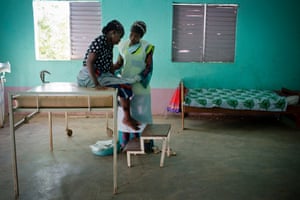
Sayon Keita, who is pregnant with her seventh child, is examined by a midwife at a health post near Doko, Siguiri
When there is a moment between deliveries, she lectures the dozen pregnant women waiting outside on the importance of coming in for checkups.
Doko’s midwives have not had any training in 20 years. If they had, they might have known how to give the baby who died mouth to mouth resuscitation or proper compressions. Thousands of babies die from preventable causes each year.
One of the things that the response to Ebola brought was medical supplies, the like of which had not been seen in a generation.
Kondiadou health centre is near Kissidougou, one of the towns to which the UN started regular flights during Ebola. Before, reaching south-east Guinea from the capital involved a bumpy car journey lasting several days. Now, because of the flights, it is easier to get supplies and staff in, although the UN is expected to cancel the flight as soon as the threat of Ebola is completely over.
“It’s the first time we’ve got equipment like this since the centre was built in 1990,” says Therese Soropogui, a community health worker at Kondiadou, as she pulls out standard latex gloves and yellow washing-up ones and explains the difference.
Why do women still die in childbirth?
A small camping stove, some sterilising kit, bandages and a few hundred pairs of gloves have been donated by the Spanish government and Unicef. And a red plastic bucket. It does not take much to save lives in remote Guinea.
“Before, we burned tools in the fire, and that took too long,” Soropogui says. “And if you had two women giving birth at the same time, you had to use our one set of tools for both women, one after the other. That was very difficult. Now we have three or four sets of tools and, at the end, you can sterilise them.”
Not all of the equipment seems to have been used, however, showing up what many see as an endemic problem with the UN’s approach.
“They give out supplies like sweets,” says Yolande Hyjazi, the country director of Jhpiego, an international health organisation. “The UN system is: what the government asks for, they buy, and that’s it. We’ve seen a lot of vacuum extraction equipment, but if you ask the staff about it they say: ‘I don’t know [what it is], the UNFPA [UN population fund] sent it.’ They give equipment without training.”
Even when staff do know how to use it, obstetric equipment does not solve a problem many women have – getting to a clinic.
Harriet Somadouno, a 20-year-old farmer in her third trimester, walked 17km to Kondiadou for a checkup, carrying 10kg of peanuts on her head to sell at the market en route.
“I walked with my friends, but I carried the peanuts myself,” she says. “It took me six hours. I’m going home tonight but I think it’ll be a quicker journey as I sold all the peanuts – perhaps four hours.”
Somadouno, exhausted after her walk, barely seemed to take in the information given by the nurse.
One scheme to help women involves what looks like a giant old-fashioned pram, which is attached as a sidecar to a motorbike. Spain has given 15 of them to health centres in Guinea.
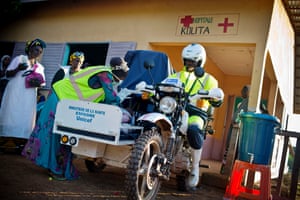
Mamady Berete doubles up as Doko health centre’s broken bones specialist and the moto-ambulance driver. Dressed in high-vis from head to toe, he bumps up and down bush tracks and through enormous puddles, picking up pregnant women, strapping them in his sidecar and taking them to Doko.
The giant pram turns heads, but brings fresh problems, such as how to pay for petrol or maintenance.
“We have someone here who can fix it but, if a tyre breaks, we have to send to Conakry for a new one. It’s a bit difficult,” Berete says.
On his trips to the villages, Berete spreads the word about the health centre and encourages more people to use it.
Mamady Berete heads off to collect a pregnant woman from a remote outpost and bring her to the Doko health centre
Trust in Guinea’s health system was in short supply during Ebola, when clinics closed their doors, doctors and nurses died, and infected people seemed to disappear into hospitals never to return.
“People were afraid of our health centre – they said if you came here you’d catch Ebola. So people avoided coming,” says Berete. Because nobody came, salaries could not be paid, so the clinic had to shut, leading to even less trust in the service.
According to Yogo, the lack of working health systems meant the death toll from “collateral” diseases and health complications outpaced that of Ebola.
“More people died from malaria, diarrhoea and in childbirth than of Ebola,” he says. “The country did not have enough ambulances. They were all used for Ebola patients – nobody else.”
Now, people are trying to take advantage of the supplies and attention that Ebola brought, and keep people coming through the doors so staff can afford to keep those doors open.
Berete and his colleagues are succeeding: several health centres, including Doko, are recording pregnant women coming in greater numbers than before Ebola.
Somadouno, who left school aged nine and had her first child at 16, plans to repeat her gruelling 17km journey to give birth.
“I gave birth to my first child here and, because it went well, I’m coming back for this one,” she says. “My mother-in-law will come with me, but we’ll be on foot then too. My plan is to try to catch it early.”
Magda, a 29-year-old software developer, regularly fends off questions about when she will have her first child. Coming from a close-knit family and having been with her boyfriend for a decade, the topic is brought up regularly. But Magda grimaces in response, only to be told: “Don’t leave it too late.”
For Magda, the question of when she wants to have a child is complex. There is a serious history of depression and psychosis in her family on both sides. In fact, her mother was sectioned for a long time after giving birth to her.
“I’m not just concerned about passing on mental health problems to any child I might have, I also have serious concerns about the risk to my own wellbeing from having a baby,” she says.
She also worries about the kind of treatment she might receive if she were to have problems. “I’m acutely aware of how awful the mental health support can be in the NHS. I have witnessed failing after failing in the care of my mother. If I speak to a GP about my concerns, will they care and offer advice? If I did decide to have a baby, would they make sure I’m looked after through pregnancy and beyond?”
This is just one of the individual stories sent to the Guardian as part of a project inviting people to discuss the often taboo topic of mental health and pregnancy.
Between 10 and 20% of women in the UK develop a mental illness during pregnancy or within the first year after having a baby. This costs the NHS around £8bn for each annual birth cohort. Conditions range from postnatal depression to obsessive compulsive disorder and psychosis.
It’s not just women either: one in eight first-time fathers suffer from depression while their partner is pregnant, according to a survey by scientists at McGill University in Canada.
Despite this, new NHS England figures show less than 15% of areas currently provide recommended services for mothers with mental health issues, and more than 40% provide no service at all. In almost half of the UK, pregnant women and new mothers do not have access to specialist perinatal mental health services – with even less specific support in place for men.
It’s an issue the government has pledged to address, with £365m allocated for specialist perinatal mental health services over the next five years, the the first tranche of which has just been made available.
So, why is help desperately needed and what sort of experiences do people have? Here are our readers’ stories.
The decision to have a child
For some, like Magda, the challenge begins before pregnancy – many women and men experiencing mental health problems worry about their children developing similar conditions. They also worry about how their condition could affect their ability to be a parent.
A lot of times my days are coping minute to minute. I don’t know if that puts me in a good position to raise a child
Daniel Stusiak, 37, from Aberdeen, South Dakota,has type-two bipolar disorder. In the audio recording above, he explains how his mental health problems influenced his decision not to have children.
When it comes to having children I have two thoughts. One, genetically I don’t like the idea of gambling and seeing whether I pass it on… Second, should that child not have to deal with that, they will have to deal with me as their father and a lot of times my days are coping minute to minute. I don’t know if that puts me in a good position to raise a child in the best way.
The medication question
A lot of women also have to weigh up whether or not they are prepared to come off their medication to have a child. While some drugs are considered relatively safe the evidence is not conclusive, and some have been linked to health problems in babies.
But those who come off any medication are at risk of getting ill again: for example, seven out of every 10 women who stop antidepressants in early pregnancy become unwell again.
Harriet, 32, Stoke-on-Trent
Giving birth was much more painful and difficult than I ever imagined it would be
I have been told that I may need medication for life to treat my anxiety and depression. When I decided to have a baby, my main fear was that the drugs would be dangerous and I’d have to come off them. I was scared of falling ill, which had happened when I came off medication before – when I was at my worst I had extreme panic attacks about 10 times a day.
My dad, who is a doctor, assured me that citalopram is generally considered OK during pregnancy. But babies born to depressed mothers can have worse growth and general health.
I talked to my husband and I decided it was safer for me to stay on the drugs. However, I still found the pregnancy very stressful. I worried constantly about miscarrying. I was offered a reassurance scan but it made me more stressed because they noticed a slight abnormality in the baby’s brain. It turned out to be nothing, but I completely broke down. I could not function for weeks and struggled with the rest of the pregnancy.
Since the birth my mental health has improved. I love being a mum and my daughter makes me very happy. Giving birth was much more painful and difficult than I ever imagined it would be. Afterwards, you wake up to a life and a body that you don’t recognise. It’s not great for your self-esteem. I put on a huge amount of weight but the pain was definitely worth it.”
Mandy, 36, north-west England
I have borderline personality disorder and a social anxiety disorder. I stopped taking my medication (Escitalopram) when I was pregnant because I was worried about the health of my baby. Some doctors thought it was better I stay on the drug, while others disagreed, and because of this varying advice I stopped. However, coming off it caused me a lot of problems. I started self-harming, for example, and worried about everything. I ended up hiding in my house, which meant I couldn’t go back to work. With borderline personality disorder I can go very quickly from being level-headed to mentally unstable. Being pregnant made it harder to cope with this. I didn’t feel like my body was my own. I couldn’t harm myself physically to rid my mind of distressing thoughts.
I was referred to a mental health assessment team and put back on medication on a low dosage. I had one visit with the assessment team but found the nurse dismissive and unhelpful. They didn’t realise I’d had past mental health problems and were treating me as if I had just turned up with thoughts of harming myself. Once I explained to them that I presented before pregnancy I hoped they’d adjust their attitude towards me, perhaps offer more contact, but they didn’t.
I coped throughout the pregnancy mainly thanks to my husband and my GP, who I could talk more openly with, but I wish there had been more support from the assessment team.
Hannah from Yorkshire experienced anxiety before pregnancy, but chose to come off medication to treat this in order to have a child. Listen to her story below.
Antenatal
Postnatal depression is often reported on, but less attention is given to mental health issues during pregnancy. While it’s normal for women to experience “baby blues” as a result of hormonal changes, for a large number this is much more extreme. In fact, it is estimated that 7% to 20% percent of pregnant women are affected by what is known as antenatal depression, which if untreated can lead to postnatal depression after the birth.
Women and men can also experience a great deal of anxiety during pregnancy – it is thought that more than one in 10 women struggle with symptoms of anxiety while carrying a child.
I started to have horrible thoughts about my baby – thinking I had made a terrible mistake and wanted to get rid of it
Ariana, 25, London
I have never experienced mental health issues other than while I was pregnant. When I was around eight weeks, I started to feel upset. The baby hadn’t been planned, but I was ecstatic at first. However, depression soon took over. As the weeks went on it got worse – I hated people talking about the pregnancy and wanted to pretend it wasn’t happening. I started to have horrible thoughts about my baby – thinking I had made a terrible mistake and wanted to get rid of it. Bizarrely, I also decided that when the baby was born, I would swap it with another child in the hospital, and at least then they wouldn’t be my responsibility any more.
Fortunately by the time I was heavily pregnant, I didn’t feel negatively any more. I only felt sad that this thinking had ruined my early pregnancy for me. I now have a huge amount of sympathy for anyone who experiences depression.
After having my son, I stayed up all night on the maternity ward just watching him. I remember thinking he was the best thing that had ever happened to me, and I still do now. He is three years old.
Postnatal depression is widely recognised, but there is less said about depression during pregnancy. I might have sought help if people talked about it more.
Leila experienced anxiety and depression during her pregnancy, having never had mental health problems before. You can hear about her experience in this recording.
I finally admitted to myself that I was seriously ill after weeks of considering throwing myself under the train
I finally admitted to myself that I was seriously ill after weeks of considering throwing myself under the train on my way to work, followed by weeks of not being able to get out of bed. I lacked the motivation to do anything: get dressed, wash my hair, let alone make any preparation for a new baby. There is a hormonal trigger to perinatal depression and the more the pregnancy progresses the greater the influence of hormones.
Miscarriages
There are no official government statistics held on women who miscarry (they are only collated for women admitted to hospital), but the pregnancy charity Tommy’s says around one in every four women with a BMI of over 30 will miscarry a child.
The effects of this last longer than you might imagine: a study in 2011 found that the depression and anxiety experienced by many women after a miscarriage can continue for years, even after the birth of a healthy child. Men are also affected, although perhaps differently. One British study of 323 men found that although they displayed less “active grief” than their female partners, they were more vulnerable to feelings of despair and difficulty in coping eight weeks following the loss.
Matt Allen, 38, from Brighton, shares his story of how miscarriage affected his mental health below.
Looking back on it it would have been better for me to have someone to talk to [after the miscarriage] and maybe drop the stigma that men have to be strong and carry everyone around them, because something like losing a child does affect us just as much emotionally.
Kaye, Manchester
I’m pregnant for the second time. My husband and I lost our first child when I had a miscarriage in my first trimester. It’s not something you get over. People around you think that it’s all about getting pregnant, but the waiting for the arrival of a healthy baby now is worse than any treatment. I suffer from crippling anxiety – crying at random times, waking up from nightmares. I can’t talk about being pregnant and am still trying to hide it at almost 20 weeks.
I wish that I could be offered some counselling. My partner and I received no support whatsoever from the NHS after the D&C [a surgical procedure often performed after a first-trimester miscarriage]. Only now, from reading the Miscarriage Association’s literature am I beginning to understand that the anxiety we are going through is common.
A viability scan should also be offered on the NHS at seven to eight weeks as a standard. This can really help to reassure new parents. I do think the NHS should have different support in place for people where this is a Pal (pregnancy after loss), and that includes silent miscarriages. Friends from abroad are often shocked at how few scans we get in the UK and that the chance to hear the baby’s heartbeat at midwife appointments isn’t standardised across the country.
Postnatal
Postnatal depression is an illness that affects between 10 to 15 in every 100 women having a baby. It can start within one or two months of giving birth. It’s also something that hits men too: studies predict about one dad in 10 has postnatal depression. Traditionally, the mother’s mental health gets more attention, but recognition of the dad’s mental health is increasing.
Alice, Midlands
I had my daughter a few years ago and read all the information I could get my hands on. After a difficult birth I eventually delivered my baby. I was exhausted (it took 48 hours in total) and shell-shocked. We stayed in hospital for a few days while trying to get my daughter to breastfeed. I was struggling so much with this that I refused to have any visitors as I didn’t want anyone to think I couldn’t cope. In the end I gave up so that we could all just go home. Luckily bottle feeding didn’t affect bonding with my baby.
However, my partner didn’t cope well at all. From seeing me in so much pain and out of control, he tried to take on far too much so that I could recover. His mental health spiralled as a result to the point where he couldn’t look at our baby. He couldn’t handle her crying and one day I found him crouched in a corner rocking. I got him to see a counsellor and the doctor advised that he would recover better if he moved out for a while. He went to live with his parents and we would visit, but he couldn’t cope with the guilt of leaving us.
Eventually we got through it and he was able to move back home with us. Unfortunately we didn’t make it as a couple; the strain was too much. Looking back I wish we’d have had more support in trying to deal with his depression but even though this was a few years ago, there was very little awareness about male postnatal depression and a lot of shame attached to it. I wish I could have helped more.
Emma, Manchester
I’d already had a baby and enjoyed being a mum, so when I fell pregnant again I never expected to experience postnatal depression.It was four months before I plucked up the courage to go and see the doctor. I kept telling myself to keep going, and that I could be a perfect mum like the ones you see plastered all over social media. Now I realise that it’s not real. To me, during the dark days that perfect picture wasn’t my life but boy did I try to achieve it. I was really struggling and I told no one. Admitting weakness was like putting my hand up and saying: “Look at me, the bad mum over here.”
The day I told my sister and my mum I was at my wits’ end. I cried the whole time. I paced the length of my house for half an hour before I finally made the call to my family. After that I went to the doctor. I thought he was going to laugh and tell me to just get on with it like every other mum, but he didn’t. He told me that this would be the last time I would feel this way and that every day, from today, I would start to feel better. Most importantly he made me realise for the first time in four months that I wasn’t a failing mother-of-two. I’d managed to keep my head above water through one of the most challenging times of my life.
We discussed options and I agreed that I would take tablets for depression and anxiety – it was time to give my body a little helping hand. He made me see some things are out of my control and postnatal depression can happen to anyone.
Psychosis
One of the most severe forms of illness seen in psychiatry are postpartum psychoses. In rare but tragic cases it can lead to women taking their own lives.It’s thought that postpartum psychosis affects women in every 1-2 of 1,000 births. It’s more likely to affect women who have had it before (or have a relative who has) or have a serious mental health condition, such as bipolar disorder or schizophrenia.
Lisa Abramson, who suffered from postpartum depression after the birth of her daughter
Lisa Abramson, from San Francisco, experienced severe mental health difficulties after giving birth to her first child. She talks about postnatal psychosis in the audio recording below.
Leila, interviewed above, also experienced psychosis after pregnancy – as well as antenatal depression and anxiety. She talks about this below.
I completely lost touch with reality and was convinced my phone was communicating with me in code
I started to get hyper-manic and the effect that had, in terms of behaviour, meant that I would be wide awake all night. My mind would be racing and I was really driven to do things, for example I would reorganise the kitchen cupboard at 3am to 4am in the morning. I also wrote lists compulsively and used hand gestures, which I don’t normally do … then after that I became psychotic. I completely lost touch with reality and was convinced my phone was communicating with me in code. I thought it might be my father who had died three years previously. I thought I would just will with my mind ordering a pizza and it would be delivered to the door.
Post-traumatic stress disorder
Research is limited but estimates of post-traumatic stress disorder (PTSD) after delivery tend to be around 1-2% in high-income countries. One study in Sweden put the rate of postnatal PTSD at 2% in the first year after birth. While some women experience it after a particularly traumatic birth (with medical difficulties), others have PTSD from the birth process itself.
A spokesperson for the Birth Trauma Association said: “The help on offer for women is very patchy and generally poor. Individual health visitors and midwives may help but waiting lists are long – up to a year – and almost no one gets on a list for cognitive behaviour therapy or other treatment unless they have been symptomatic for at least 12 weeks.”
Bill, Staffordshire
My wife and I experienced the stillbirth of our first child, Andrew. It was very sudden, my wife noticed a lack of movement and we went to hospital. We saw a classic scan, but this time with no heartbeat. I carry the image with me to this day. The following days and weeks were traumatic. We were told that the chances of a future successful pregnancy were higher if my wife delivered Andrew naturally, so labour was induced gently. We then went to a dedicated maternity suite (where we were handled with exceptional care and attention by all staff). The delivery was normal, except that Andrew was not alive.
Following the stillbirth, I experienced post-traumatic stress disorder for which I have since received cognitive behavioural therapy. I had flash-backs of the traumatic delivery and the events immediately before and after, including my son’s funeral. I also suffered from an intense anxiety as we went through four more pregnancies – two ended in miscarriage and two ended inthe births of two wonderful boys. We constantly wondered about miscarriage, stillbirth and the chances of a good outcome. The mental health problems affected my work – I was constantly on high alert.
On the whole the NHS was marvellous. Their care when we lost Andrew was excellent in the circumstances. My wife got support during the pregnancies and for the way in which the stillbirth affected her. However, there was less attention on the father. I was not prepared mentally for the immense impact that this would have on me.
On the whole the NHS was marvellous. Their care when we lost Andrew was excellent in the circumstances
Emma, Midlands
I had a traumatic first birth and my baby was in neonatal care, which left me struggling with what I know now to be PTSD and perinatal anxiety. I didn’t understand what was happening, so tried to carry on as normal. I became pregnant again 14 months later by accident and really suffered. I believed I would die, writing letters to all my family and counting down the days until I would leave this world. I had awful anxiety, flashbacks and was terrified all the time. I didn’t trust healthcare professionals, hated going to the hospital for appointments and didn’t know who I could approach for help. I became a shell, empty and full of fear.
I wish that my traumatic birth had been acknowledged and that I had been asked how I was coping in my next pregnancy. I wish that there had been counselling, more information around having a difficult birth. I wish I’d just been asked how I was, not physically but mentally. I wish there had been continuity of care so that I had someone I trusted care for me. It took me 15 years to get a correct diagnosis after the second birth and even then there was no specialist treatment support available.
Obsessive compulsive disorder
It’s thought to affect 2-4% of all new mothers, but – until recently – has received relatively little research attention. Some women develop obsessive compulsive disorder (OCD) for the first time either during pregnancy or shortly afterwards, while others find it makes a pre-exisitng condition worse. This is partly down to the fact that pregnancy is a time of increased stress, with most women becoming concerned about protecting their baby. It is a time of major physical change, which can cause difficulties.
It’s not just down to hormones, however, and some fathers also experience postnatal OCD because of their feeling of responsibility to protect their new baby.
May, Birmingham
I was diagnosed with OCD following the birth of my first child. I was experiencing intrusive thoughts about my son coming to harm (and that I might actually be the one to harm him). I have suffered from recurrent depressive episodes throughout my life.This and the severe anxiety I was experiencing led me to spend a lot of my maternity leave sitting at home, waiting for something terrible to happen.
My midwife noticed during my pregnancy that I was feeling anxious and referred me to a mental health clinic at the local women’s hospital. I continued to attend there after my pregnancy and, as things spiralled out of control, I was prescribed antidepressants and given a place in a group therapy session. I was admitted to hospital – in a dedicated mother and baby unit – for two months as things failed to improve.
The care I received was wonderful – I cannot fault it at all. I had never imagined that I might be suffering from OCD, and once I had my diagnosis and began cognitive behavioural therapy, the depressive episodes in the past began to make sense. I was treated with utter respect and kindness both as an outpatient and an inpatient, and have since been able to return to work. I feel very lucky that I had access to this service, and that it was so close to home. I know that this isn’t the case for most women.
•Some names have been changed.
• In the UK, the Samaritans can be contacted on 116 123. In the US, the National Suicide Prevention Hotline is 1-800-273-8255. In Australia, the crisis support service Lifeline is on 13 11 14. Hotlines in other countries can be found here