Wade etiketine sahip kayıtlar gösteriliyor. Tüm kayıtları göster

12 Mart 2017 Pazar

Sarah Weddington, Roe v Wade attorney, on Trump’s threat to abortion rights

Sarah Weddington is the lawyer who, aged just 26, represented “Jane Roe” in the landmark case Roe v Wade, which in 1973 effectively legalised abortion in the US. The daughter of a Methodist minister, she was born in 1945 in Abilene, Texas. Having graduated with a degree in English from McMurry University, she enrolled at the University of Texas Law School in 1964, one of 40 women among a student body of 1,600. “I thought I would be teaching eighth graders to love Beowulf,” she recalls. “But that wasn’t working out so well, so I decided to go to law school instead. In this, I was encouraged by the dean of my college, who told me that it would be far too tough for a woman. ‘As sure as dammit I am going,’ I thought.”


After graduating, she joined a group of students who were seeking to challenge anti-abortion laws, agreeing to file a suit against the state of Texas on their behalf. Soon after, 21-year-old Norma McCorvey was referred to Weddington and her colleague Linda Coffee, now actively looking for pregnant women who were seeking abortions. McCorvey became the plaintiff “Jane Roe”, though by the time the supreme court issued its ruling, her baby had long since been born and given up for adoption. McCorvey later became an evangelical Christian and vocal anti-abortion campaigner, and claimed to have been the “victim” of the Roe v Wade lawyers. She died last month aged 69.


I was very nervous. It was like going down a street with no street lights. But there was no other way to go


Weddington remains the youngest person ever to have argued a successful case at the supreme court. In 1973, she was elected to the Texas House of Representatives, where she served for three terms. In 1973, she became the first female General Counsel at the US Department of Agriculture. From 1978 until 1981, she served as assistant to President Carter, directing his administration’s work on women’s issues. She now runs the Weddington Center, Austin, whose work focuses on women and leadership. She recently told NBC news that the election of Donald Trump may pose the biggest threat yet to abortion rights in the US.


Where were you on election night? Did you sense that Trump was going to win?
Austin is one of the more liberal towns in Texas, though the state itself is barely liberal. Most people I know strongly expected Hillary to win. But I’d been on a panel a few weeks before where a man had said: “You liberals think Hillary is going to win. Well, let me tell you, there are a lot of people out here who are voting with our finger – the middle finger.” So I knew there was… resistance. There were a lot of parties on the night, but I had enough concerns to be afraid that going to one might turn out to be too depressing. So I came here to my office, and watched it on the New York Times website.


What’s your impression of the president so far?
I thought he would be terrible, and he has proven me correct. In Texas, we have a lot of people from Mexico and El Salvador, and a lot of them are worried family members will be deported.


What do you make of the growing fear that under this administration Planned Parenthood [a 100-year-old nonprofit organisation that is the largest single provider of reproductive health services, including abortion, in the US] will lose its federal funding?
The federal government has never given money to Planned Parenthood for abortion. It gives money to it for the provision of contraception and well woman care: for the treatment of venereal disease, mammograms, and so on. The anti-abortionists recognise that the money is not used for abortion, but they want it cut off anyway. It is a real threat. But Planned Parenthood may ultimately benefit from what Trump is doing and saying. Last week, I was in Houston for a Planned Parenthood event. Usually, there would be about 1,000 people in the audience. This time, we had 2,500. People are very worried, and they are giving more generously.
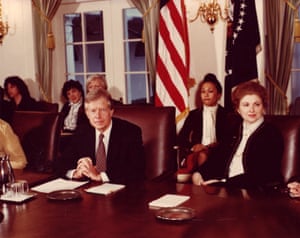


Sarah Weddington with president Jimmy Carter. She served as his assistant from 1978 to 1981.


Sarah Weddington with president Jimmy Carter. She served as his assistant from 1978 to 1981. Photograph: Courtesy Sarah Weddington

What about abortion? Is it possible it could become illegal again in the US?
Trump has always said that he would try to appoint people who were strongly against abortion to the supreme court. But Neil Gorsuch [a conservative judge, and Trump’s nomination to the supreme court] has never said that much about abortion. States can’t make abortion illegal. But some have been passing laws that make it much less available, for instance by saying that no abortion can be done except in a facility that meets the requirements for emergency care. In other words, they make the cost of abortion much higher. A lot of women are already crossing state lines, and in that sense, a lot of what is happening is just like it was before Roe v Wade was decided. You’ve got one vacancy now on the supreme court. But Ruth Bader Ginsburg, who is helping to keep abortion available, is 83, and there are a couple of older male judges too. If Gorsuch’s nomination is approved, will abortion be illegal the next day? No. One new judge won’t necessarily make much difference. But two or three might.


How did you feel on hearing that Norma McCorvey had died?
Well, I was sad. I appreciate that she was once concerned with overturning the law on abortion. But on the back of being Jane Roe, she ended up going on all these pro-choice tours. I learned to be very careful about believing what she said.


You worked somewhat against the odds on the case in which she became involved.
That’s right. There was a building across the street from the University of Texas and a lot of student organisations had cubby holes there, with desks rescued from the garbage. In one little nook, women and some men were trying to work on women’s issues. One thing that was upsetting was that the university health centre did not give out information about, or prescriptions for, anything relating to contraception. A couple of these women had gone to New York and got a copy of Our Bodies Ourselves [a landmark book of 1971 that dealt plainly and openly with women’s health and sexuality] – I still have this mental image of them in a closet with a flashlight reading this book – and they began to give the relevant information out to women. As they did, women would sometimes say: “I’m already pregnant. Where can I get an abortion?” So they started going to places where abortion was available, and they’d write up that information, too. Sometimes, for instance, they’d write: “This person does not seem very skilled: never send anyone here.” A lot of women were going to Mexico. Abortion was illegal there, too, but it was close to Texas, and sometimes women ended up in the wrong hands because people there wanted to make money out of the situation.


The upshot of all this was that the women students were getting worried the police might arrest them for being accomplices to abortion. We were sitting at the snack bar in the law school one day and one of them, Judy Smith, said: “We need to get a lawsuit filed and try to overturn the Texas law. Would you be willing to do it?” I told her she would be better off with someone with more legal experience. I’d only done uncontested divorces, wills, one adoption for my uncle; I had no experience at all in federal court. “How much would you charge?” she asked. When I admitted I would do it for free, she said: “OK, you are our lawyer.”
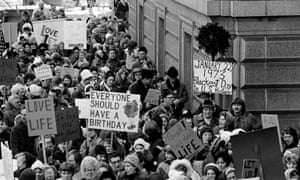


Protest marchers form a ‘ring of life’ around the Minnesota Capitol building protesting the US supreme court’s Roe v. Wade decision, 22 January 1973.


Protest marchers form a ‘ring of life’ around the Minnesota Capitol building protesting the US supreme court’s Roe v. Wade decision, 22 January 1973. Photograph: AP

Were you nervous?
I was very nervous. It was like going down a street with no street lights. But there was no other way to go, and I didn’t have any preconceived notions that I would not win. In 1965, there was a case, Griswold v Connecticut, involving doctors and the supply by doctors of contraceptive devices to a married couple. [Connecticut was then one of two states where contraception was effectively illegal, even if the law was rarely enforced.] Yes, neanderthal. That case was won in the US supreme court, and in its ruling, the court had talked about the right of privacy under the constitution. It was, the court said, for the married couple to decide whether or not to use contraception. So there was a precedent. But I certainly was not confident.


You won in the federal court, but the case still went to the supreme court. Why?
In Dallas, the court ruled there was a right of privacy, that abortion should be legal. Henry Wade, the district attorney, then unwittingly helped us. At a press conference, he said: “I don’t care what any court says; I am going to continue to prosecute doctors who carry out abortion.” There was a procedural rule that said if local elected officials continue to prosecute after a federal court had declared a law unconstitutional, there would be a right to appeal to the supreme court.


Did you have any hint at all as you addressed the supreme court that you might win?
No, it was impossible to read the justices’ faces. The attorney on the other side started by saying something inappropriate about arguing a case against a beautiful woman. He thought the judges would snicker. But their faces didn’t change a bit.


It was a while before the verdict was released, wasn’t it?
I had to argue it twice in the supreme court – in 1971, and again in 1972. On 22 January 1973, I was at the Texas legislature when the phone rang. It was a reporter from the New York Times. “Does Miss Weddington have a comment today about Roe v Wade?” my assistant was asked. “Why?” she said. “Should she?” It was beginning to be very exciting. Then we got a telegram from the supreme court saying that I had won seven to two and that they were going to airmail a copy of the ruling. Nowadays, of course, you’d just go online. I was ecstatic, and more than 44 years later we’re still talking about it.


When you published your book A Question of Choice in 1992, you decided to reveal that in 1967 you’d had an abortion yourself, while you were still a law student. Why did you wait so long to reveal this?
Just before the anaesthesia hit, I thought: I hope no one ever knows about this. For a lot of years, that was exactly the way I felt. Now there’s a major push to encourage women to tell their stories so people will realise that it is not a shameful thing. One out of every five women will have an abortion. I was lucky because the man I was planning to marry [Ron Weddington; they divorced in 1974] was with me. He drove me to Mexico. We had gotten information from a woman he knew about where to go, and luckily I was working three jobs so I had the money to pay. It was anxiety-inducing. You’re going across the border to see someone you don’t know. But it turned out that my doctor was very good. I wish I had his name, so I could thank him.


Are you still able to get in touch with the young woman you once were, or does she feel very far away?
Well, my hair is white now, so in one way, I don’t see myself as her at all, even if, whatever else I do in my life, the headline on my obituary is always going to be: “Roe v Wade attorney dies.” But in terms of my emotions, yes: I think most women of my generation can recall our feelings about the fight. It’s like young love. You may not feel exactly the same, but you remember it.


Sarah Weddington, Roe v Wade attorney, on Trump’s threat to abortion rights

9 Mart 2017 Perşembe

Roe v Wade: Suffragette producers to make film about abortion ruling

The producers of Suffragette are to make a film telling the story of Roe v Wade, the landmark 1973 ruling that gave every woman in the US the right to have an abortion.


According to Deadline, Alison Owen and Debra Hayward’s Monumental Pictures is set to produce the film, which will be written by the Bafta-winning screenwriter Jennifer Majka.


The story will centre on Sarah Weddington, the lawyer who represented “Jane Roe” (real name Norma McCorvey), the pregnant woman who challenged a Texan law that restricted her access to abortion. The case ultimately reached the US supreme court, whose ruling paved the way for universal women’s rights across the country. McCorvey, who died last month, claimed she had been misled by her lawyers and became a fierce opponent of abortion rights in the years following the ruling.


Owen, whose credits include Elizabeth, Shaun of the Dead and The Other Boleyn Girl, produced Suffragette in 2015. Majka co-wrote The Bigger Picture, which won the Bafta for best short animation in 2015 and was nominated for best animated film at the 2015 Academy Awards in the same year.


“Women’s reproductive freedom is just as contested now as it was before this case, and this is a story that everyone should know,” Owen said.


The announcement comes at a time when abortion rights are under concerted assault by legislators in the US following the election of Donald Trump. Last month the House of Representatives voted to permit states to withhold funds from affiliates of Planned Parenthood and other healthcare providers that offer abortions.


Weddington herself has warned that abortion rights may be under threat. “I think everyone who cares about the Roe v Wade issue and other reproductive rights is very concerned about what will happen,” she told NBC News earlier this year.


Roe v Wade: Suffragette producers to make film about abortion ruling

25 Şubat 2017 Cumartesi

Could Roe v Wade be overturned and abortion outlawed in the US?

Who was Norma McCorvey?
Norma McCorvey is the real name of the woman known as “Jane Roe” in the landmark US supreme court case on abortion rights, Roe v Wade. The 1973 case established a right for US women to have abortions. McCorvey became the plaintiff after she met with two lawyers looking for a test case to challenge Texas’s abortion ban. That was in 1970. At the time, McCorvey was pregnant, unwed, unemployed and unable to obtain an abortion legally or otherwise.


McCorvey never had an abortion. Her case, which proceeded largely without her involvement, took too long to resolve, and she gave birth to a child that she placed for adoption. Several years after the ruling, she publicly revealed her identity and became involved in the pro-abortion rights movement. But after a conversion to Christianity, she became an anti-abortion rights activist. Before she died last week, McCorvey had said that it was her wish to see Roe v Wade overturned in her lifetime.


Is Roe v Wade actually in danger?
It depends on what you mean. Many legal experts are sceptical that the US supreme court would overturn it any time soon. For starters, it’s difficult to bring a case before the supreme court that would threaten the ruling, because those cases almost always founder in a lower court. And even if Donald Trump’s supreme court nominee opposes abortion rights, the current makeup of the court is such that there aren’t enough votes to overturn Roe.


An alternative strategy is to poke so many holes in Roe that its protections for abortion rights become weakened. At this, anti-abortion activists have been very successful. Since Roe, some states have enacted laws requiring women seeking an abortion to attend anti-abortion counselling or to wait 24 hours or more for the procedure, laws extensively regulating abortion after 20 weeks, and laws blocking public funding for abortion. And they have picked up speed in recent years. Since 2010, lawmakers have placed 338 new restrictions on abortion.


Will states continue to pass new anti-abortion laws?
Many states are controlled by Republicans who oppose abortion rights, so they will certainly try. You might have heard about a proposal in the state of Oklahoma calling for women to require permission for an abortion from the man who impregnated her. One legislator justified the bill by saying pregnant women’s bodies are not their own because they’re “hosts”. It’s outrageous, but not a huge threat to abortion rights – the jurisprudence is pretty clear that you can’t require an adult woman to get permission before having an abortion.


What does threaten abortion rights are laws that chip away at Roe v Wade. Several states are attempting to ban a common method of second-trimester abortion on the basis that it’s cruel to the foetus. There are efforts to regulate how abortion clinics dispose of medical waste, which the clinics say are just attempts to shut them down with unnecessary rules and expenses. There is also a push to give women scientifically untrue information that it is possible to “reverse” an abortion performed with medication.


Have all these laws really made it harder to get an abortion?
It’s hard to say. There is evidence that shutting down clinics can cause a drop in the abortion rate. In Texas, after a 2013 clinic regulation forced about 20 clinics to close, there was a 50% drop in abortions in areas where the distance to the nearest clinics suddenly increased by more than 100 miles. Last June, the US supreme court ruled that the regulation had no medical justification and was unconstitutional. But in many places, the damage had already been done.


Making it harder for women to pay for abortions also seems to have an impact. Since 1976, when Congress blocked Medicaid – insurance for those on low-income – from paying for abortions, more than a million women have been blocked from access. A new tactic is to try to ban abortion coverage in state insurance marketplaces. Congress is exploring ways to replicate those restrictions nationally.


Then there are laws that place extra restrictions on abortion – a waiting period, or a counselling requirement, or a ban on abortion after a certain number of weeks. The research isn’t definitive, but people who study abortion restrictions are pretty sure that these kinds of laws don’t prevent women from having abortions – they just make it more time-consuming and expensive. The exception may be bans on abortion after a certain week of pregnancy, which studies show can force women to carry a pregnancy to term.


What could change under Trump?
Republicans in Congress have plans to pass a national ban on abortion after 20 weeks, to make it harder for a future Congress to restore public funding for abortion, and to curtail insurance coverage for abortion. It’s not clear if they will overcome opposition in the Senate, where Democrats retain enough votes to filibuster legislation.


But many public health advocates fear that the Trump administration will scale back the availability of contraception – which seems to have helped bring the US abortion rate to historic lows. Obamacare requires insurance companies to cover contraception with no copay, and the share of privately insured women who were able to obtain contraception at no extra cost quadrupled. Trump and Congress intend to repeal Obamacare – and so far, none of the replacement models have the same coverage requirements. At the same time, Republicans are attempting to strip public funding from Planned Parenthood, a move that health experts warn could blow a hole in the family-planning public safety net.


Could Roe v Wade be overturned and abortion outlawed in the US?

20 Şubat 2017 Pazartesi

Roe v Wade: plaintiff"s death highlights weakening of abortion rights in US

In 1998, Norma McCorvey, the “Jane Roe” in the Roe v Wade supreme court decision, testified before a group of senators about the case fought in her name 25 years earlier. “I am dedicated,” she said, “to spending the rest of my life undoing the law that bears my name.”


McCorvey did become an activist against abortion rights, although she wouldn’t live to see Roe, which in 1973 established a right to abortion, overturned. She died on Saturday in Katy, Texas, at the age of 69.


Knowing the end was near, McCorvey gave her friends and fellow activists a mission the day before she died, according to her friend Janet Morana. “She wanted to tell everyone to continue the fight,” said Janet Morana, executive director of Priests for Life.


But while McCorvey died in a country still shaped by the case that bears her pseudonym, the practical realities of abortion access may more closely resemble the country of her youth than she imagined.


Anti-abortion activists began to chip away at Roe v Wade almost as soon as the supreme court handed the decision down. In 1976, Congress began prohibiting poor women from using Medicaid to cover abortions. Conservative state lawmakers have unleashed a tidal wave of abortion restrictions, such as an Ohio law signed in December, that make the procedure more difficult to obtain. The most effective of these laws forced abortion clinics to close down. Since 2011, abortion clinics have closed at a record pace of more than 30 clinics per year.


McCorvey wasn’t a soldier in the early battles. In the 1980s, she revealed her identity publicly and spent time volunteering in a Dallas abortion clinic and taking part in abortion rights rallies. It wasn’t until 1995, when she converted to evangelical Christianity – later, to Catholicism – that she began to join activists who wanted abortion to be abolished.


For the most part, she was active with religious groups and ordinary people who wanted to see abortion outlawed as quickly as possible. Occasionally, she lent her name to legal efforts that challenged Roe head-on. In 1997, she wrote a friend-of-the-court brief in a long-shot case claiming Roe had led to untold numbers of coerced abortions, and must be overturned.


The most successful contingent of the anti-abortion movement had long since left those tactics behind. In 1984, at a conference sponsored by Americans United for Life, a participant proposed what would become the movement’s most powerful weapon against Roe: laws that allowed the courts to chisel away at its doctrine.


It is a strategy that has proved highly effective. Activists have sufficiently narrowed Roe so that states can require women seeking an abortion to attend anti-abortion counseling; require minors seeking an abortion to receive the permission of one or both parents; require women to wait 24 hours or more before receiving an abortion; extensively regulate abortion after 20 weeks; and block public funding for abortion.


All the while, fewer women have found they needed abortions. This year, US researchers announced that the proportion of pregnancies that ended in abortion had reached its lowest point since the supreme court decided Roe v Wade. The decline was largely due not to new abortion restrictions, they believed – with the exception of unconstitutional laws that forced clinics to close – but to more effective and widely available methods of contraception.


Anti-abortion activists have credited the low abortion rate to the triumph of their tactics and rhetoric, and have largely hailed the Republican takeover of Congress and the White House. The party has historically aided their fight against abortion rights, and its leaders have announced plans to gut widespread access to contraception and place new restrictions on abortion.


All of this, of course, is achieved with an eye toward overturning Roe v Wade. Donald Trump, in his election-season efforts to win the support of anti-abortion groups, promised to appoint judges to the supreme court who would be open to overturning the decision. Many legal experts are skeptical, however, given the amount of precedent that now exists to protect abortion rights, that overturning Roe v Wade is even possible.


With this in mind, anti-abortion campaigners have noted the difference between overturning Roe v Wade and making it as though Roe v Wade had never happened. Activist groups and conservative lawmakers have shown that they can achieve one without the other.


Twenty-one states have laws allowing a parent to all but prevent minors from having abortions. The ban on using Medicaid to cover abortion has foreclosed the option of abortion to at least 1 million women. The closure of half of Texas’ abortion clinics, under a law that was later ruled unconstitutional, caused a 50% drop in abortions in areas where the distance to the nearest clinics suddenly increased by more than 100 miles.


Owing to a record number of clinic closures, thousands of women each year travel great distances for abortions and even cross state lines. An unknown number of women have attempted to perform their own abortions, including some who have tried to do so with sharp objects. The difficulties begin to recall a time before abortion was legal in all 50 states.


Two years ago, one abortion provider reflected on the changes, saying: “Sometimes, I feel like I’ve gone back 40-some years.”


Roe v Wade: plaintiff"s death highlights weakening of abortion rights in US

18 Şubat 2017 Cumartesi

Norma McCorvey, "Roe" in Roe v Wade case legalizing abortion, dies aged 69

Norma McCorvey, who was just 22 years old when she became better known as Jane Roe in the landmark 1973 supreme court case Roe v Wade, has died aged 69 in her home state of Texas.


Her death was confirmed by journalist Joshua Prager, who was working on a book about McCorvey and was with her and her family when she died. He told the Associated Press that she died of heart failure at an assisted living center in Katy, Texas.


Pregnant and unmarried in 1969, McCorvey sought to terminate a pregnancy that year, setting off a long struggle through the courts that culminated in a legal ruling that would become, and remains, a touchstone for a bitter culture war over reproductive rights.


When McCorvey brought the action, under the pseudonym Jane Roe in 1970, she was simply looking for the right to end a pregnancy she did not wish to bring to term. Three years later, the supreme court handed down its historic 7-to-2 ruling, establishing the constitutional right to terminate a pregnancy. By the time the ruling was delivered, McCorvey’s baby was 2 ½ years old and had been given up for adoption. She later claimed that she was misled by her lawyers who, she said, used her as a “patsy” to bring about abortion rights.


McCorvey later became a figure­head for both sides of the issue. Initially, she was celebrated by pro-choice campaigners and reviled by anti-abortion activists, and campaigned in the 1980s in support of abortion clinics.


But McCorvey abruptly converted to evangelical Christianity and was baptized in a swimming pool, in front of network TV cameras, by the minister who headed the group Operation Rescue. McCorvey became a fierce opponent of abortion rights, and remained so through her conversion to Catholicism. .


“I’m 100% pro-life,” she told the Associated Press in 1998. “I don’t believe in abortion even in an extreme situation. If the woman is impregnated by a rapist, it’s still a child. You’re not to act as your own God.”


She described herself as the victim of her lawyers, who she claimed used her case to win a larger abortion rights cause. “She felt used by Sarah Weddington [her attorney] and she felt a sense of responsibility that her signature led to the slaughter of millions of children,” said Janet Morana, the executive director of Priests for Life and a longtime friend of McCorvey’s.


Norma McCorvey later became a fierce opponent of abortion rights.


Norma McCorvey later became a fierce opponent of abortion rights. Photograph: Manuel Balce Ceneta/AP

McCorvey was involved in a handful of legal challenges to Roe over the years, but the bulk of her activism was with religious groups opposed to Roe.


“Norma found out about Roe v Wade passing by opening her door one morning and seeing the newspaper,” Morana said.“Norma never had an abortion. She gave birth to the Roe baby.”


After her conversion, Morana said, “she used to say, ‘I am Roe no more.’ That was very important to her, that people would understand that she was no longer Roe. She, just yesterday, when I talked to her, she wanted to tell everyone to continue the fight. I take that as a personal mission.”


In 2009, McCorvey was twice arrested for protesting: on one occasion a speech by Barack Obama, and on a second the supreme court nomination hearing of Sonia Sotomayor. McCorvey stopped speaking publicly over the past three years, and in the past year or two her declining health prevented her from attending anti-abortion events.


But her life was never truly settled. She wrote in her autobiography, I Am Roe that, she was a victim of abuse in her childhood in Louisiana and Texas, that she stole money at the age of 10 from a gas station, and that she later struggled with drug and alcohol abuse. Early in her life, she’d been enrolled in a Catholic boarding school and at a reform school for delinquents, and she worked, variously, as a bartender, a maid and a house painter. Her mother told her biographer, Prager, that she’d beaten her daughter over her “wild” behavior.


“She loved life. She loved people. She wanted to make a Texan out of me,” Morana said. “She took me shopping for cowboy boots and hats.”


“I don’t require that much in my life,” McCorvey told the New York Times in 1994. “I just never had the privilege to go into an abortion clinic, lay down and have an abortion. That’s the only thing I never had.”


The Associated Press contributed reporting


Norma McCorvey, "Roe" in Roe v Wade case legalizing abortion, dies aged 69

17 Ocak 2017 Salı

US abortion rate is lowest since Roe v Wade – but contraception access may go

The rate of abortion in the US reached a lower level in 2014 than in any other year since the procedure first became legal, a study has found, a decline that appears to be due to the widespread use of contraception producing a drop in unintended pregnancies.


Nineteen percent of pregnancies ended in abortion in 2014 – the lowest abortion rate since the supreme court handed down Roe vs Wade in 1973, legalizing the procedure – and the number of abortions between 2011 and 2014 also fell, by 12%.


But the researchers found strong indications to link the decline in the abortion rate to the wider availability of highly effective contraception – which could be imperiled by efforts to repeal Obamacare by the incoming Republican administration.


The study appears in the latest issue of Guttmacher Institute’s scholarly journal, Perspectives on Sexual and Reproductive Health, and was conducted by two of the institute’s researchers, Rachel K Jones and Jenna Jerman.


The researchers made an estimate of the number of abortions by surveying local health department data and abortion clinics, which may be hampered by clinics that did not respond. Guttmacher is a think tank that supports access to reproductive care, but its data is widely trusted by supporters and opponents of abortion rights alike.


The decline in the abortion rate was greatest in the midwest, south and north east. Abortion is still a common procedure – in 2014, Jones and Jerman estimate, US women had 926,200 abortions – but there were nevertheless shifts in how abortions were performed. The number performed with medication, which is only effective early in a pregnancy, rose 7% to account for 31% of abortions outside a hospital setting.


There are competing theories to explain the decline in the abortion rate. The drop coincided with the enactment of the Affordable Care Act (ACA), which made more effective methods of contraception, such as IUDs, available to millions more women for no copay. But the decline also aligned with a historic spike in new, state-level abortion restrictions.


Some data – such as trends in contraception usage – that could help determine the reasons for the decline are not yet available for 2014. Still, the researchers predicted that the drop in the abortion rate had less to do with new restrictions than with changes in contraception usage and a reduction in unintended pregnancies.


One clue is that more than 60% of the decline in the abortion rate took place in states that had not enacted new hurdles to getting the procedure.


If the drop is due to contraception, it would have alarming implications for Republicans’ breakneck campaign to repeal the ACA. The law says that most health insurance plans must cover a broad range of contraceptive drugs and devices at no copay – the so-called contraception mandate. Public health advocates have credited this provision with an explosion in women’s access to more affordable and more effective birth control.


Between the fall of 2012 and spring 2014, a separate Guttmacher study found, the share of privately insured women who had no copay for contraception quadrupled. By 2015, the federal Department of Health and Human Services (HHS) found, 55.6 million US women had access to FDA-approved methods of contraception without a copay.


Vice president-elect Mike Pence has proposed a rule allowing business owners to refuse to cover contraception if doing so violates religious beliefs.


Vice president-elect Mike Pence has proposed a rule allowing business owners to refuse to cover contraception if doing so violates religious beliefs. Photograph: Evan Vucci/AP

If Republicans were to repeal Obamacare, it is not clear that their replacement would contain a similar provision. Tom Price, Trump’s nominee to lead the HHS, has put forth several proposals for an Obamacare replacement that do not contain a contraception mandate.


Separately, vice president-elect Mike Pence has proposed issuing a rule, through the HHS, that would allow business owners to refuse to cover contraception if doing so violates religious beliefs.


“Their agenda … could stop or reverse progress in empowering women to meet their childbearing goals, including by avoiding unintended pregnancy,” Joerg Dreweke, of Guttmacher, wrote in a policy brief accompanying the new study.


“There is strong evidence from recent abortion declines that supporting women’s decision-making across the spectrum of reproductive healthcare is very much compatible with reducing abortion incidence.”


The Guttmacher researchers found less evidence to link the decline in abortions or to new abortion restrictions. About 38% of the decline in the number of abortions was observed in 22 states that had enacted new restrictions significant enough to potentially impact women’s access to abortion.


These included laws that imposed extra counseling for an abortion. But only eight of those 22 states had abortion declines that outranked the national average, and four states – Arkansas, Michigan, Mississippi and North Carolina – actually saw an increase in their abortion rates.


There was, however, one type of abortion restriction that seemed to cause a decline in the abortion rate. These were laws that placed medically unnecessary regulations on abortion clinics in order to shut them down.


The number of abortion clinics fell by 6% between 2011 and 2014, and the loss of access appeared to be linked with a decrease in abortions – although it could not account for the entire declines observed in those states. In June 2016, the supreme court ruled these kinds of laws to be unconstitutional.


The decline in the abortion rate from 2011 to 2014 continues a long downward trend. The US also saw its abortion rate drop between 2008 and 2011, driven, according to Guttmacher, by a steep decline in unintended pregnancies, probably explained by improvements in the use of contraception. As the abortion rate fell, the birth rate did not rise commensurately.


In particular, the rise of the use of highly effective, long-acting, reversible contraception, such as IUDs, might account for the drop in abortions.


US abortion rate is lowest since Roe v Wade – but contraception access may go

9 Aralık 2016 Cuma

Ohio "heartbeat" abortion bill could be test case for overturning Roe v Wade

The Ohio state legislature threw down the gauntlet this week to the supreme court, passing a new anti-abortion “heartbeat” bill that would ban terminations from as early as six weeks, the most severe restrictions in the country.


Ohio politicians say they were motivated to push through the bill by Trump’s win, believing they might find a more friendly US supreme court that would uphold the law.


If passed by Governor John Kasich, the bill could serve as a test case for the limits of constitutional protections of abortion, and even for overturning the landmark decision Roe v Wade, which enshrines a woman’s right to choose abortion until the fetus is “viable” (between 24 and 28 weeks gestation). But activists on both sides of the issue doubt that strategy is likely to succeed, and say it could do more to harm the legal movement than help it.


The bill passed by the Ohio state legislature Tuesday night stops just short of banning abortion from the time a fetus’s heartbeat is detectable, which is usually around six weeks. The new law states that if a doctor terminates a pregnancy without listening for a heartbeat or when a heartbeat is audible, then the physician would be committing a fifth-degree felony and facing up to a year in jail, disciplinary action and civil lawsuits.


Many women do not even realize they are pregnant at this early stage.


“If this law would take effect, it really is a flat out abortion ban,” said Amanda Allen, senior state legislative counsel at the Center for Reproductive Rights.


Many other states have also tried to get “heartbeat bills” through in the past. North Dakota and Arkansas state legislature passed similar laws in March 2013, however the eighth circuit appellate court ruled them unconstitutional in 2015 and the laws were never enacted.


Ohio lawmakers have considered their own bill in the past. But lawmakers said that Trump’s election and a free seat on the supreme court gave them new impetus for the bill and make it more likely that the bill would be upheld in the courts.


“A new president, new supreme court appointees change the dynamic, and there was consensus in our caucus to move forward,” Senate president Keith Faber.


But despite lawmakers’ views, many anti-abortion activists in the state are not celebrating the move.


Mike Gonidakis from Ohio Right to Life, an anti-abortion lobby group, says his group is officially “neutral” on the bill because he fears the law would be struck down, after an expensive and lengthy court battle. He believes the six-week ban would be so dramatic that even the supreme court would vote 5-4 to strike it down, even if another conservative justice were confirmed to replace the vacancy on the court.


“You have to be patient and strategic with the courts,” said Gonidakis.


“That doesn’t even take into account millions of dollars Ohio would be forced to pay the lawyers for Planned Parenthood and the ACLU,” he added.


Gonidakis thinks it may even strengthen Roe v Wade.


“We will be inviting nothing more than damage and danger to all we’ve accomplished for the past 40 years,” said Gonidakis.


And while some are worried that the law sets up a test case that might become a referendum on the supreme court’s Roe v Wade president, Ohio’s arm of the American Civil Liberties Union says it’s ready to declare a legal challenge if the bill becomes law. Allen says she’s not too worried the legal challenge would have an adverse effect at the high court, since another court has already judged the North Dakota and Arkansas laws unconstitutional.


“These types of bans are completely unconstitutional and have very little chance of standing up in court,” said Allen, noting that Roe v Wade has been settled law for over 40 years.


Ohio has tightened abortion restrictions in recent years, and this legislation was tacked on to an unrelated bill last minute in Ohio this week.


This was the third time Ohio attempted to pass it, after it failed in 2012 and 2014.


On Thursday, the Ohio state legislature passed another anti-abortion bill, which would ban abortion from 20 weeks. Currently 18 states have enacted some form of 20-week abortion ban, and Allen noted that lawmakers may be pushing the “heartbeat” bill as a red herring while the other, also controversial measure flies under the radar.


“That could certainly be part of the strategy,” noted Allen. “Both bans are prohibitions on abortion prior to viability and the US Supreme Court has been very clear that states may not do that.”


Kasich, who ran as a moderate during the Republican primaries but has signed several restrictions on abortion into law in the last few years, will have to decide whether to sign one or both bills into law, veto them, or ignore them, in which case they would automatically be enacted into law within a few weeks.


Ohio "heartbeat" abortion bill could be test case for overturning Roe v Wade