tell etiketine sahip kayıtlar gösteriliyor. Tüm kayıtları göster

12 Mayıs 2017 Cuma

Doctors owe it to patients to tell the truth: the NHS is in terminal decline | Rachel Clarke

Like church and state, medicine and politics are traditionally seen as a queasy mix. The last thing you want in your flimsy hospital gown is some zealot with a stethoscope trying to sway your vote. Doctors, at the bedside, should clearly stick to doctoring. But – in a world of ever more outlandishly spun health statistics – where, outside of clinical encounters, do the limits of doctors’ duty to act in our patients’ best interests lie?


I made the sobering discovery, in my first few weeks as a doctor, that serving patients in the modern NHS was at least as much to do with advocacy as medicine. It has to be, in a system that’s stretched beyond breaking point. With resources so scarce, speaking out counts.


Once, I actually stalked a professor, in sheer desperation to provide an inpatient with decent care. He did a double take at the steely-eyed junior doctor, sat perched outside his clinic, fired up to plead her patient’s case. With everyone run ragged, overwhelmed by patients, no one had believed me or cared enough to act when I’d insisted my patient was suffering from a rare diagnosis, adult-onset Stills disease, that had left her heart swamped in fluid, her temperature soaring, her circulation so fragile it might need intensive care. “Please,” I begged. “Just see her for yourself.” As the pre-eminent professor of rheumatology in my hospital, he was the one man I knew who might act. And he did. He confirmed the diagnosis and whisked my patient off to his specialist care, possibly saving her life.


When almost every statistic about today’s NHS depicts a system quietly imploding around us, advocacy writ large has never mattered more. Doctors, like nurses, bear daily witness to the facts behind the spin. Our testimony is a vital corrective to a government hell-bent on airbrushing away the truth about today’s underfunded NHS. We look the patients in the eye as they languish on trolleys in hospital corridors. We apologise, shamefaced, to the families whose loved ones are stranded in hospital, because no social care exists to support their safe discharge home. We turn away the elderly who sob in A&E because the pain in their hip is beyond endurance, yet who haven’t even made it on to a waiting list for surgery. If we turned a blind eye and kept our heads down, would Hippocrates nod his assent?


Having to break bad news to a patient is never easy. But unflinching conversations are a cornerstone of good medicine


The state of the NHS in 2017 demands that doctors speak out about the human cost of underfunding since it clear our political leaders will not. Only this week, Theresa May made an election manifesto commitment of 10,000 more staff in mental health. Unfunded, needless to say, but also – more audaciously – a promise made on the back of the 6,700 mental health staff already culled since the Conservatives came to power in 2010. It’s this kind of political doublespeak that compels doctors to challenge loudly the government line that – despite the most brutal funding squeeze in NHS history – everything is going swimmingly.


In microcosm, we already know what happens when cost-cutting is prioritised above patient care. The scandal of Mid Staffs – a stain upon the history of the NHS, in which patients in their thousands were subjected to inhumane care – arose when one hospital trust strove to slash costs by millions. Yet currently, the government is enforcing £22bn of “efficiency savings” across the NHS, while insisting excellence of care can somehow continue.


Doctors should call out this claptrap for what it is. We are, after all – perhaps more than anyone – trusted to tell unpalatable truths. In this case, the hard medicine is more taxes. A world-class health service requires world-class funding. Either we provide the budget to fit the health care we want, or we cut the NHS to fit the amount we’re willing to spend on health. With a government too cowardly to confront this simple truth out loud, doctors should force an honest debate.


Yet – with a few notable exceptions (Taj Hassan and Neena Modi, for example, the presidents of the Royal Colleges of Emergency Medicine and of Paediatrics and Child Health respectively), the medical establishment is loath to rock the boat. Where is the joint statement from the Royal Colleges, for instance, urging increased taxation to bring our NHS and social care spend to at least the levels of Germany and France? Where are the hospital medical directors brave enough to speak out in public against the ever more fanciful diktats from on high to keep on delivering as their funding dries up?


Having to break bad news to a patient is never easy. But unflinching conversations are a cornerstone of good medicine. Nationally, doctors should be telling it like it is: without more money, our NHS is in relentless, terminal, and wholly avoidable decline.


Doctors owe it to patients to tell the truth: the NHS is in terminal decline | Rachel Clarke

6 Mayıs 2017 Cumartesi

Are you a long-term user of antidepressants? Tell us about your experiences

In the past decade there has been a doubling in the number of prescriptions written for selective serotonin reuptake inhibitors (SRRIs) – the most common antidepressant. NHS research shows there are now more than 70m prescriptions dispensed in the UK in a year, the “greatest rise” of any drug in the last year.


But while the short-term side effects of taking this medication are well-known, there has been less exploration into the longer-term impact of them. In an article for Guardian Weekend magazine, Aida Edemariam spoke to people who had been taking the drugs for many years. She found that many SSRI users report blunted emotions and an impact on sexual function, with the effect lasting long after people have stopped taking pills.


Those attempting to come off these drugs also face withdrawal symptoms. This can include feeling heightened anxiety or depression, with some going back onto the drugs believing their mental health problems have returned.


That is not to say that these drugs are not helpful. They can prove life-saving in terms of helping them cope and live with mental health problems. The Guardian’s Simon Hattenstone said: “If Prozac was no longer working for me, would I stop taking it? Probably. Would I stop taking antidepressants full stop? I doubt it. I’d simply look for another super pill.”


Share your experiences


We want to hear from our readers about long-term antidepressant use. Have you been on medication for a long time and struggled to come off it? Do you want to? Do you feel these drugs are overprescribed? Should more be done to warn patients about long-term side effects before they take them? Or do you feel you would never have coped without them? Share your stories.


Are you a long-term user of antidepressants? Tell us about your experiences

24 Nisan 2017 Pazartesi

Public service workers: tell us what you want in party manifestos

In the run-up to June’s general election, almost every aspect of our public services and social policy feels at breaking point: we’re in the midst of an NHS crisis, a social care crisis, a housing crisis, a local government funding crisis and a civil service staffing crisis, not to mention a collapse in public trust for charities.


The election will be dominated by Brexit, but domestic policies are equally vital – and must not be swept under the rug. It will be up to all those professionals working for and with the public to make that case. So we’d like to know what you want to see in the party manifestoes as top election priorities.


This is not just a matter of grand statements or pledging more money. What do the main political parties need to say that shows they really understand the issues?


Share your thoughts


Whether you work in healthcare, social care, housing, local government, central government, or any other part of public service – including the private sector or the voluntary sector – we want to hear from you. Tell us what you think are the biggest problems in your sector at the moment and what each of the political parties should be offering.


You can do so by filling in our encrypted form below – anonymously if you wish. We will do our best to ensure your responses are kept secure and confidential. A selection of contributions will be featured in our reporting.


Public service workers: tell us what you want in party manifestos

7 Nisan 2017 Cuma

What I wish I could tell my boss: "I was broken, and you fixed me"

I was broken when I came to you. My life felt futile, my existence pointless. I had been crying for days. I was always tired and never hungry. My body weight was down by 15lbs. I’d been suffering anxiety attacks, both day and night, for several weeks. Muscles in my arms and legs were twitching uncontrollably. I’d been to the hospital’s emergency department twice with thoughts of suicide. I was trying to hide it, but I know I looked sick. I didn’t want to admit my mental illness to anyone, but I couldn’t go on hiding my depression. So I came to you.


My brain had turned against me, but you joined my side of the battle


Depression is like a magnet for negative thoughts, so I expected the worst. Fearful of stigma, I told you a softened version of what was happening to me. You saw right through me. You saw how serious it was. You listened, didn’t rush me, and were kinder than I could have expected. At that time nothing was capable of making me happy, but my meeting with you created a spark of hope. Hope that I would get through this, that others might understand.


My brain turned against me during my depression, but you instantly joined my side of the battle. You reassured me. You told me you had noticed something was wrong and had been wondering how to approach it with me. You said I was good at my job and that I was clearly unwell. You told me that I would get better, that I needed rest, and that you would do everything in your power to help that happen – which you did.


You immediately helped me take time off from work. Following your instruction, I went home after that very same meeting. You helped me navigate the work procedures for dropping to half-time work. You were prepared to accept full-time sick leave, but understood my reluctance of being home alone all day.


Half-days were more difficult for you to organise, yet you made it happen. You rallied my work team together and developed a plan for reducing my stress and workload. You treated my mental illness the same way you would have treated any other serious illness – with complete and total kindness.


You never rushed me to return to work. You encouraged me to take my time. You told me of the importance of being fully well to avoid relapse. You spoke to me with such kind understanding that every time I left your office I felt better.


You dealt with a lot of stuff. You and my work team made some stressful decisions without letting me know – without me having to feel any of the pressure. You all took on extra work so I could do less. You never complained about it and you never sought thanks for what you did.


Depression convinces the sufferer that they should deal with it all on their own. I’m glad that I didn’t. I credit a few people with getting me through my depression: my wife, my psychiatrist, and you. Thank you for helping to save my life. I will never forget the way you treated me. I will always remember your kindness.


I don’t know where your empathy comes from – personal experience, experiences of a family member or friend – or just having a kind heart. Wherever it comes from, I am glad that when I went through the worst experience of my life, I was working for you.


Thank you.


What I wish I could tell my boss: "I was broken, and you fixed me"

6 Mart 2017 Pazartesi

NHS staff: tell us about the impact of social care cuts | Sarah Marsh

The government’s austerity programme is squeezing funding to both social care and the NHS – leading to serious problems in both. The Care and Support Alliance this month has found almost 9 out of 10 GPs think reductions in social care are leading to extra pressures in their surgeries. Even more (93%) think that the lack of social care is leading to extra pressure on A&Es and contributing to increased delayed hospital discharges.


We’re looking for NHS staff who have been affected by the cuts for Frances Ryan’s Hardworking Britain column, which looks at the stories of individuals whose lives have been negatively impacted by government policy.


Share your experiences


Are you a GP seeing the impact of social care cuts? Or do you work in A&E and cannot discharge patients because there’s no support for them at home? Share your stories and views.


NHS staff: tell us about the impact of social care cuts | Sarah Marsh

3 Şubat 2017 Cuma

What I wish I could tell my boss: "My anxiety isn"t a weakness"

“How can you guarantee that this won’t happen again?” you asked. I was sat in a disciplinary meeting with the head of HR and you, my department manager. The meeting followed a three-day absence and was something I’d been dreading from the moment I’d called in sick.


My feet couldn’t stay still, I was swallowing bile every few minutes and I was having palpitations. I could barely concentrate on what was being said because I was trying not to hyperventilate. It took me a few moments to register the question, and when I did, I felt sick to my stomach.


You did not see my anxiety for what it was – an illness.


It may be a well-known cliche that large companies don’t care about the little people. But as someone who had only worked for local pubs and small businesses, I was naively confident that a well-known corporation would value the wellbeing of their staff. I assumed they would offer support and resources for mental health illnesses – considering as many as one in four people in the UK suffer from them each year.


As I sat there, all I could think while you were telling me off was: “You know nothing about anxiety disorders”.


Anxiety affects everyone in different ways. It can appear in the face of certain triggers or at completely random times – and its severity can vary wildly from episode to episode. Despite having been affected by mood disorders for years, I only realised I suffered from anxiety when a friend of mine suggested I seek help from my GP. This was after an episode where I had spent two hours hyperventilating and unable to move from the bathroom floor.


Describing my experiences to you and the head of HR gave me a dry mouth, as I could feel myself faltering under her stare and thinking: “She definitely thinks I’m exaggerating.” Though her tone of voice was sympathetic, she slid an unhelpful leaflet titled “stress at work” across the table and set up an appointment for me to talk to the occupational health therapist. They in turn suggested I speak to my GP, as I had done months before.


I don’t blame individuals for misunderstanding mental health. It carries a stigma with it, and because it often shows no physical symptoms it can be hard for others to understand. Anxiety isn’t simply getting worried about a presentation or feeling Sunday night blues – it’s a constant feeling of being on edge. It’s breaking down at a moment’s notice. It’s feeling a fist squeeze your chest until you feel like you’ll die from being unable to breathe.


Employers should have support systems in place for staff, so people like me don’t face disciplinary action. I understand that absence policies are in place to catch slackers, and to pinpoint recurring illness in staff who may need help. However the way you conducted the interview made it feel like I was being punished rather than helped. It felt like my personality and work ethic were being scrutinised.


What I wish I could say to my boss is: no, I can’t guarantee an attack won’t happen again, because the nature of my illness is unpredictable. I’m taking antidepressants and undergoing cognitive behavioural therapy so I can learn to get my anxiety attacks under control. They’ve been much more frequent in the past, and I know that if I wasn’t receiving medical help you’d have fired me by now.


These things don’t go away overnight, and I’d like to think that you support me trying my best to overcome my illness. Perhaps you could read up on anxiety, then you would know that it isn’t just me wanting to stay in bed all day, but rather that my mind has trapped me there – and you could work towards a better understanding of mental health.


What I wish I could tell my boss: "My anxiety isn"t a weakness"

11 Ocak 2017 Çarşamba

NHS "will fail" this winter without cash injection, doctors tell Theresa May

Hospital doctors have warned Theresa May that the NHS “will fail” this winter and patient care will suffer unless she provides an emergency cash injection.


The leaders of 33,000 doctors from 30 medical specialties urged the prime minister to recognise that hospitals are “paralysed by spiralling demand” and warned of an exodus of personnel quitting the already understaffed NHS.


In a letter to May, the Royal College of Physicians (RCP) and a host of senior doctors told her that the NHS is trying to tackle so many problems with such limited resources that it is in danger of not being able to do its job of caring for patients.


“The NHS is the embodiment of your view that ‘We have a responsibility to one another’. Without urgent investment, the NHS will fail to live up to this responsibility this winter,” they say. The signatories include Prof Jane Dacre, the college’s president, as well as experts in cardiology, geriatric medicine and acute medicine.


In a direct challenge to May’s repeated view that the government has given the NHS enough money, they claim that only an urgent bailout will stop the service – which experts say is under pressure like never before in its 69-year history – running into even more serious difficulties.


They welcome the pledges to train more doctors and increase the NHS’s budget by 2020. But they say: “Frontline staff and managers across health and social care are clear: investment levels are not sufficient to meet current or future patient needs. As a result, in spite of rapid advances in clinical care, services are often too paralysed by spiralling demand to transform and modernise. Promises of future investment will not address the very real challenges we face going into 2017: the time to invest is now.”


Money is so tight that “the quality of patient care is threatened by demands which the health service does not have the capacity or resource to meet”, they add.


Downing Street declined to respond to the letter, but May has told Simon Stevens, the chief executive of NHS England, that the service will not get any extra money and that he should concentrate on making major efficiency savings.


The Department of Health replied on May’s behalf, but did not respond to the RCP’s plea for an immediate cash boost or warning that the NHS could fall.


It said : “We know the NHS is facing increasing demand from an ageing population, but this makes building a safer healthcare system more urgent, not less.


“Since just last year, we have 3,100 more nurses and 1,600 more doctors. We’re also joining up health and social care for the first time and investing £10bn to fund the NHS’s own plan to transform services and relieve pressure on hospitals.”


The doctors’ letter comes as more than 20 MPs from all three main parties and two former health secretaries call on May to set up an NHS and care convention to work out how to fund the soaring costs of medical and social care in the long term, given the ageing population.


The initiative has come from the Liberal Democrat MP Norman Lamb, who was a health minister in the coalition government. Backers include Dr Sarah Wollaston, the highly respected Conservative who chairs the Commons health select committee; three other select committee chairs; the ex-Tory health minister Dr Dan Poulter; Alan Milburn, the health secretary under Tony Blair in 1999-2003; and Stephen Dorrell, his Tory predecessor in 1995-97.


In a further sign of the government’s difficulties over its handling of the NHS, A&E doctors made clear that they believe Jeremy Hunt’s plan to downgrade the duty on hospitals to treat 95% of A&E patients within four hours is misguided. They were responding to the health secretary telling MPs on Monday that the four-hour target should not apply to the 30% of people who seek help at an A&E unit despite being neither an urgent or emergency case.


Dr Taj Hassan, president of the Royal College of Emergency medicine, which represents A&E medics, said Hunt was right to say that emergency departments should be for genuine medical emergencies only.


“However, it is exactly those patients who present as emergencies that pose the greatest challenges as a substantial proportion of these spend long periods of time in the emergency department, waiting for a bed. Seeking to target patients with minor illness should not be the priority,” Hassan said.


In new evidence of the chaos engulfing many hospitals, nurses report that some patients are waiting up to 23 hours in hospital corridors across the UK because beds are in such short supply. Hospitals are under such pressure that nurses are being told to discharge even patients who are not fit to leave in order to free up beds, the Royal College of Nursing claimed.


“Nurses from Scotland to London report serious concerns over the quality of the care they can provide in what for many are the worst conditions they have ever experienced,” said Janet Davies, the RCN’s chief executive.


NHS "will fail" this winter without cash injection, doctors tell Theresa May

8 Ocak 2017 Pazar

Now, open wide. Then I can tell how rich you are | Barbara Ellen

A study published in the Journal of Oral Rehabilitation reports that more than 100,000 A&E visits a year are caused by tooth problems, with patients trying to avoid NHS dental charges by going to hospitals for free treatment, frequently at weekends.


This comes as no surprise. While it’s said that it will soon be possible to identify whether someone is rich or poor simply by how overweight they are, I’ve long thought that dentistry could turn out to be another poverty indicator, with many of the poorest unable to afford to maintain basic dental health.


In some areas of the country, NHS dentists are notoriously hard to find and oversubscribed, but it doesn’t end there. NHS dentistry is chronically underfunded, with patients forced to make up the shortfall for treatment costs, whatever their personal circumstances, while dentists who treat NHS patients complain that fixed fees don’t cover the time spent on complex issues.


British dental problems aren’t always about money; children are entitled to free care, but figures showed that two out of five hadn’t visited an NHS dentist in the past year. However, it does seem to be about money when so many adults are clogging up A&E departments or, as reported last year, turning to GPs, who are obviously ill-equipped to treat them.


Put bluntly, the poorest in British society are increasingly becoming too frightened to go to the dentist, not because of the treatment, but because of the cost. This is shameful. If these findings are anything to go by, Britain is well on the way to regaining its international reputation for notably bad dental health. Not all Britons, of course, just those who can’t afford basic care, with “basic” being the operative word.


At the risk of being accused of liberal hand-wringing, this feels very personal to me because, where dental treatment is concerned, I’ve been such a spoilt cow. When I was last with an NHS dentist, I was always able to afford upgraded treatment over the basic option, but it was obvious that for some people that “choice” was going to be as stark as the choice between extracting a tooth or – the more expensive option – trying to save it.


Then there’s cosmetic dentistry. I’m just coming towards the end of a lengthy period in adult braces, which has been quite an experience – I look as though I’m permanently vomiting a garden gate. Away from the comedy aspect, I’m painfully aware of how lucky I am. My orthodontic treatment, even with a finance plan, will have been way out of reach for many people. These are people who’d need the same treatment (which, without boring you with details, wasn’t purely cosmetic), but wouldn’t have been able to afford it or even been given the chance on the NHS.


Where teeth are concerned, what does “cosmetic” even mean anyway? Not everyone wants gleaming, whitened TOWIE choppers, but nor are teeth just for chewing. Teeth aren’t optional – teeth are crucial. And teeth are emotional. Not only is toothache vile, with teeth linked to general good health; people need teeth for everything from work and job interviews to personal confidence, relationships and every conceivable form of social interaction.


It’s not enough to say: “Well, look after them then.” Of course people should look after their teeth and most people, rich and poor, try their best. However, when things go wrong, it can’t be anything but a disgrace if people are so scared by dental costs that they end up sitting in casualty departments in the hope of free care.


This should be a source of national shame, as should be the growing realisation that it won’t be too long before a person’s social circumstances can be accurately assessed simply by them opening their mouth.


Who really needs a booze bracelet?


Where was this miraculous ‘stop boozing you idiot!’ device when the likes of me sorely needed it?


Where was this miraculous ‘stop boozing you idiot!’ device when the likes of me sorely needed it? Photograph: Philip Toscano/PA

Excitement is mounting as the world gets ever closer to a tracking device to tell you exactly how disgustingly sloshed you are. And that’s because, on realising how drunk we are, all of us are likely to say: “Good heavens, in that case, I must depart this fine hostelry to make my way homewards.” Because that’s how it always works, especially in Britain.


Milo Sensors, from California, has developed a product called Proof. It is “wearable technology” (or how about just admitting it’s a bracelet?), a bit like a Fitbit, and it monitors blood alcohol levels, alerting you to the point where you may start feeling the urge to sing, dance, cry or express your viewpoint more candidly than usual – a bit like being in a Question Time audience, only with more alcohol and less Brexit.


Where was this miraculous “stop boozing you idiot!” device when the likes of me sorely needed it? The angst we’d have avoided, the time we’d have saved, all those deathly mornings ringing around apologising for behaviour you couldn’t remember to people who’d rather not speak to you.


However, maybe the answer is that people like me didn’t need it. Or more precisely, we wouldn’t have heeded it. Instead of electronic devices, previous generations had these things called partners, family, friends and bar staff who told you when you’d had enough…and whoever bothered listening to them?


In which case, how many people are going to take any notice of an electronic bracelet nagging them about their alcohol levels?


I still like Proof as an idea, and I’d still like them to send me a free one, but it seems fated to be used by people who are more likely to be intoxicated by new technology than they are by alcohol.


It’s touching how much Robbie Williams likes his fans


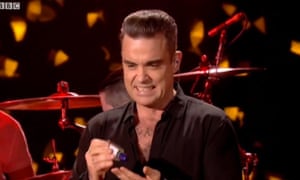
Coming clean: Robbie Williams using hand sanitiser.


Coming clean: Robbie Williams using hand sanitiser. Photograph: BBC

Robbie Williams has responded to the furore over the incident on New Year’s Eve, when, after shaking hands with members of the excited crowd, he was shown squirting sanitiser on to his mitts, his face plastered with the kind of grimace usually reserved for old footage of cow rectal examinations on All Creatures Great and Small.


Williams isn’t a complete PR dolt, so he’s now issued an amusing video of himself using hand sanitiser after he’s touched a family member.


Well played. However, it’s not quite enough to dispel the feeling that as much as celebrities such as Williams say they “love” their fans, it’s nowhere near as much as they love a nice relaxing bath in scalding hot Dettol after they’ve had anything to do with them.


The feeling that this “love” they feel for fans may be a tad selfish and needy, as in, wholly to do with wanting them to continue buying their stuff. And as much as they want to reach out to their public and touch hearts and lives, this doesn’t include any other kind of touching or the little bottle of Carex hand gel is coming out again.


Now, open wide. Then I can tell how rich you are | Barbara Ellen

6 Ocak 2017 Cuma

What I wish I could tell my boss: "You never defend me"

You never stick up for your junior members of staff. When another healthcare worker said recently: “I don’t see the point of pharmacists on the ward”, instead of defending us, you brought the complaint to us and lectured us about how we do our jobs. This is the role that you – a senior managing pharmacist – created, and recruited us for. So why don’t you defend us?


And I don’t just hear this from colleagues. Patients routinely tell me: “Oh you wouldn’t know what that tablet is for” and speak to me like I am an uneducated, inexperienced member of staff – oblivious to the fact I have a four-year degree. While others tell me they “don’t understand my job”.


People often assume that the pharmacist is simply there to pick the tablets off the shelf, count them out and hand them over. I get asked by patients’ relatives: “Why does it take three hours just to get the medications up?” I have to defend the job that I do on a daily basis, explaining that I have to make sure the medications are safe before I simply hand them over.


I wouldn’t expect the public to know exactly what a pharmacist does, but now it seems the healthcare colleagues I work with don’t understand the concept of my job either. I am left feeling unappreciated by everyone around me. Our senior pharmacists, managers and leaders do nothing to defend our positions or highlight the importance of our roles.


I continue to do what I do without recognition. Patients are often none-the-wiser about the corrections I’ve made to their prescribed medications. On a daily basis I find myself having to tell junior doctors how they have prescribed essential medicines incorrectly: Parkinson’s medications, cancer treatments, anti-hypertensives, anti-epileptics and anti-diabetics. The prescriptions quietly get changed without the patient or other healthcare professionals knowing.


A doctor prescribes a double dose of a toxic drug – I see the prescription and instantly instruct the doctor to amend it so that the patient is not given a potentially dangerous dose. A doctor documents a plan to start phosphate supplements yet accidentally prescribes potassium supplements – I tell them to change the prescription to avoid potential heart problems. In both instances the patient is unaware. When junior doctors went on strike, we were left with consultants who didn’t know how to use electronic prescribing systems. On whom did they rely? You guessed it: us. It would be nice if, instead of agreeing with colleagues who say they don’t understand my role, you explained to them the importance of what we do.


From a distance it might seem that I am doing nothing, sitting at the corner of the ward behind a screen staring at drug charts, prescriptions and blood results. But if it was not for me checking and cleaning up the mess of inaccurate prescribing by doctors who are too busy and tired to pay attention, then patients would not be treated safely. They would be given the wrong medication in hospitals, with potentially fatal consequences, and they would go home with the wrong prescriptions.


So next time someone questions the importance of our jobs and makes a demeaning remark asking what is the point of us “sitting around on the wards all day”, it would be nice if you stood up and highlighted just how essential our jobs are. I do not expect understanding, praise or recognition from patients and the public, but I do expect appreciation and respect from the other healthcare professionals that I work with – and even more so from you.


What I wish I could tell my boss: "You never defend me"

16 Aralık 2016 Cuma

What I want to tell my boss: ‘You"re ruled by money, not patient care’

You harass my team constantly while we’re trying to do our job. When I am with a patient, non-clinical staff call me every half hour asking for updates – and apply pressure for the crew to move on to other 999 calls.


What you say on the phone is overheard by patients, often the elderly and vulnerable, which makes them feel guilty about having an ambulance – and at times patients refuse to go to hospital even though they should, so the ambulance can be available for someone else.


You want us to work quicker and quicker, yet this means reporting accidents and safeguarding vulnerable patients can be missed. There’s never time – as the shifts often over-run and the exhausted crews go home without completing the necessary paperwork. Ambulances are also often denied the opportunity to restock drugs, potentially leaving other patients without the care they need.


There are no government targets for this though, so under your leadership the staff, who are caring by nature, become increasingly disillusioned and frustrated – up to the point they need to leave the profession for their own sanity.


The bullying doesn’t end there. There are staff employed by the NHS to pressurise crews at hospital to turn calls around quicker, whether they are in a position to do so or not – yet again chasing a government target.


You revel in having good figures and use all the tactics you can to get them. You chase any government or Department of Health targets, such as sickness rates and flu vaccination rates. You pressurise your management team to harass staff to have the influenza vaccination against their wishes, and instruct managers to sack people on long-term sick leave. This leads to dread, fear, and plummeting moral.


Recruitment and retention of paramedics is a constant, national problem. Pay is being reviewed at a national level, but it’s not just about pay: your management is part of the problem, which is not being addressed. The number of people currently leaving the profession shows this. No amount of money can persuade people to continue to be on the receiving end of unattainable targets and bullying.


There is a cumulative effect: you bully your directors, they bully the more junior managers, who bully the staff. So experienced paramedics leave and take years of practical knowledge and experience with them, to be replaced with inexperienced new staff on significantly less pay.


You pretend in public to focus on patient care and welfare, but then make cuts that leave parts of the community with a second-class service. Bigger is not necessarily better. When the government merged ambulance services, from county services to regional ones, standards went down the pan.


Money is the true deciding factor here, not best practice, so the best care won’t be rolled out on a regional basis. Is it any wonder so many people are leaving, to be replaced by less experienced but, most of all, cheaper, staff?


What I want to tell my boss: ‘You"re ruled by money, not patient care’

12 Aralık 2016 Pazartesi

Healthcare staff, tell us your experiences of working at Christmas

For many healthcare professionals, working over Christmas is a given. The thought of working at this time of year can be galling for many but, as Dr Jenny Hughes wrote, it can be the most uplifting time to work.


Teams of staff can pull together and bond over boxes of chocolates on the ward and canteen Christmas dinners. And the odd Christmas miracle may happen, be it the birth of a baby, saving someone’s life or even just being there to listen.


Are you a healthcare professional who has worked at Christmas? We want to hear about it. What have been your memorable moments? What’s the atmosphere like? How did you feel working over the festive season? Have you witnessed or been part of any Christmas miracles?


Please fill in the form below and tell us your experiences of working at Christmas. A selection of responses will be used in our reporting. You can remain anonymous if you wish.


Healthcare staff, tell us your experiences of working at Christmas

21 Kasım 2016 Pazartesi

Men and mental health: tell us your stories

Men are much less likely to get medical help for mental health problems than women, according to new figures.


A survey commissioned by the Mental Health Foundation found that not only are men far less likely than women to seek professional support, they are also less likely to disclose a mental health problem to friends and family.


But this can have serious implications: data from the Office of National Statistics shows suicide is the single biggest killer of men aged under 45 in the UK, with 76% of all suicides in 2014 being men.


In the past year a number of campaigns have been launched to encourage men to talk about their mental health problems. Documentaries by the rapper Professor Green, Stephen Fry and the Bafta-award-winning actor Adam Deacon have all helped to draw attention to the issue.


We want to hear from young men about their mental health. Have you experienced difficulties? What did it teach you? How can men be encouraged to talk more openly? Tell us your stories below.


Men and mental health: tell us your stories

16 Ekim 2016 Pazar

Should I tell my estranged mum I’m pregnant? | Mariella Frostrup

The dilemma I’ve always had a difficult relationship with my mother. She has mental health problems, few friends and feuds with family members. She was physically abusive and mentally controlling when I was young. When I was 16 she pushed me out of a car because I was 10 minutes late to meet her. If things break she won’t get them fixed. Her washing machine broke 15 years ago and she has been hand washing ever since, resulting in RSI.


I went to university, got therapy and “moved on”, although I had self-esteem issues and an eating disorder as a teen. In my 20s I tried to have a relationship with her, but my tolerance for her obsessive behaviour has lowered. I met my husband four years ago and she took an angry dislike to him – since then our relationship has deteriorated. It’s been more than a year since we’ve been in contact.


Now I’m pregnant and others expect me to make amends. I feel little compulsion to do this. Maybe it’s better to live without her to protect my child and myself.


Mariella replies This is so tricky. I’d love to say that life is short, we need to forgive and forget and family is ultimately all we have. But I don’t think that’s true. Often family can be the spring from which our troubles spill forth.


Having a baby doesn’t turn you into a perfect parent, or even a better-functioning human being. In many respects it can exacerbate character flaws that already exist. All the experiences you carry from childhood will heavily influence how you parent. There may be no such thing as a perfect parent, just as there is no such thing as a perfect human being, but some take their dysfunction to heights from which it is impossible to return.


You’ve had a pretty rough childhood and it’s no wonder you’ve tried to escape. I’m in admiration for the strength of character you’ve shown in getting to university, tackling your emotional residue and embracing a life seemingly not too much mired down in past problems. Another test of your resilience would be your ability to maintain an emotional distance while continuing to have a semblance of a relationship with your mother.


Drop her a card and leave it to her to reply. If it comes with emotional tripwires step away


Turning your back and severing contact is sometimes the only path, but it can also be the easiest. It offers a form of escape, but no resolution; it just means you don’t need to cope with behavioural problems and emotional triggers that are your mother’s legacy. It also means you’ll never really know what was at the root of her unhappiness, or come to understand what made her the person she has become. The latter is a potential key to confronting your own foibles and fairly apportioning blame. Curiosity is one reason to try to forge a new, less emotionally fraught connection and, interestingly, your baby may do the work for you.


Grandchildren often develop an entirely independent connection with grandparents, enjoying a harmony with the adults we found impossible to live with. Without responsibility for the young life in their orbit, but enhanced by the pleasure of seeing themselves reflected, love can swing both directions in a fairly unconditional way. Vicariously it can be a healing balm for raw sores.


The most important question is how robust you feel about your own mental health at the moment. Pregnant with your first child is no time to take on additional emotional challenges and if that is all a rekindled relationship with your mother has to offer I’d be inclined to make yourself the priority. Familiarity does not come with a right to continue bad patterns of behaviour down the decades. It’s possible that this period of estrangement has given your mother time to contemplate her relationship with her daughter; it’s also possible that she hasn’t given it a second thought.


I’d be tempted to drop her a simple, kind card, letting her know you are all well, that you are having a baby and that you miss her. Then leave it to her to respond, and if it comes fraught with emotional tripwires step away and consider your duty done. If, on the other hand, your olive branch elicits a reply that feels it’s carried on a conciliatory wind, tentatively step further towards her. Ultimately it’s all down to you. Parenting gives you no rights over your children. At a certain point your relationship with them will be defined not by guilt but by the good times. If that bonding base never existed, ranting and raving about duty, responsibility or devotion is just specious noise.


As in a romance, the quality of blood relationships depends on all parties. They need to be invested in and nurtured in order to flourish. You can’t torture a child for 20 years and then expect them to support you unconditionally in old age. There’s no debt due, but there’s much pleasure to be gleaned watching your child enjoy an independent relationship with their grandparent. I’d give her a chance just to see if she deserves it.


If you have a dilemma, send a brief email to mariella.frostrup@observer.co.uk. Follow her on Twitter @mariellaf1


Should I tell my estranged mum I’m pregnant? | Mariella Frostrup

14 Ekim 2016 Cuma

The pressure of perfection: five women tell their stories | Guardian readers and Sarah Marsh

Do you look at other people’s lives and compare them to your own? Does this make you question whether you are smart, fit or happy enough?


If so, then you may be a perfectionist. Writing for the Guardian earlier this year, clinical psychologist Linda Blair described a perfectionist as a person: “who strives for flawlessness, for a perfect creation, outcome or performance … They find it difficult to delegate, even if that means neglecting their health, relationships and wellbeing in pursuit of a ‘perfect’ outcome.”


According to some studies, this is something that largely affects women. A US survey in 2009 found that women are also more likely than men to experience feelings of inadequacy at home and at work, and a larger proportion felt they failed to meet their own high standards.


These insecurities are well-documented in the world of work: in 2011, the Institute of Leadership and Management found half of female managers, compared with fewer than a third of the male ones, reported self-doubt in their performance. An internal survey of women working at Hewlett-Packard also found women applied for a promotion only when they met 100% of the qualifications. Men applied when they met just 50%.


The desire to be perfect seems to influence thinking from a young age: research by Girlguiding UK found that a quarter of seven- to 10-year-old girls felt the need to be perfect.


Perfectionism can have serious implications: it’s been linked to anxiety and depression, and the health and happiness of young women is a growing concern. In fact a NHS study found 28.2% of 16- to 24-year-olds have a mental health condition, with one in four women aged 16 to 24 experiencing anxiety, depression, panic disorder, phobia or obsessive compulsive disorder.


We decided to explore this topic with our readers, asking for young women’s experiences and stories of perfectionism. We received 134 responses – with an average age of 25. For a lot of young women who contacted us, body image was a huge preoccupation and many said they felt undervalued unless they met society’s expectations of beauty. The pressure to be perfect also extended to the workplace, withmany respondents talking about feeling inadequate at their jobs or experiencing impostor syndrome. They also complained of feeling the pressure to have it all: juggling being a mother with career and other personal pressures.


Social media has a big role to play in influencing women’s outlook on this issue. Miranda, 18, from Cambridge summed this up: “I certainly feel the pressure to be perfect and it has got to the point where it’s damaging my health. Social media is the main culprit. I had to delete my Instagram account because it would actually make me cry. I am a mature person with a firm grip on reality, but I have so many peers whose lives seem so perfect and sociable that it left me feeling worthless and lonely.”


The impact of all this pressure on women’s mental health and wellbeing was notable, with many experiencing anxiety, eating disorders and depression. We approached five women to find out more. Here are their stories:


Chardine Taylor-Stone, 31, who works in the arts in London


Chardine Taylor-Stone


‘The pressure to be perfect feels heightened to me as a black woman.’ Photograph: Sarah Lee for the Guardian

As a child I felt pressure to be a certain kind of perfect, so I wanted to look pretty and nice while my male cousins were running riot, that sort of nonsense. I wanted to marry a man and get a job.Now I am an adult my aspirations have changed and I am a lot more confident about who I am. I’ve broken out of those narrow expectations, but I still feel a lot of pressure in terms of my career.


I am one of few black working-class womenin my industry,which is dominated by white men. Most of the black women I see in the arts are personal assistants;none of them are working in a position that gives them autonomy – although they usually end up running a lot of things anyway.


I definitely have impostor syndrome; that’s defined as self-doubt and a sense of intellectual fraudulence thatoverrides any feelings of success. I didn’t have this so much before, when I was working in call centres, but I feel it now in a predominantly upper-middle-class environment. It’s weird being the only person of colour or the only one with a certain accent – it makes you feel as though you shouldn’tbe there. I sometimes suffer so much anxiety about sending an email, worrying about whether I will phrase it correctly. It’s silly because I’ve done well and proven myself, I have my own flat and a good job, yet that doesn’t feel good enough.


The pressure to be perfect feels heightened to me as a black woman because my mum always told me I would have to work harder than a white person to get ahead. It is true but it’s a self-defeating aspiration.


Perfection, or what society deems perfect, is not attainable for everyone, but it feels even further away for a woman of colour. The image of perfection is a certain physical type: a skinny woman with blond hair etc. Those things are not even half attainable to you, and you sometimes feel you were born imperfect.


Salma Al-Hassan, 18, student at Warwick University, from Oxford


Salma Al-Hassan


‘I wish I could be more relaxed about how I look.’

I feel the need to look perfect all the time. I am not sure where this obsession comes from but social media definitely makes it worse.


I got Instagram when I was 14 and growing up with it has really affected me. I spend ages scrolling through the site and seeing images of women with perfect hair and makeup, thinking I should look like them – even though a lot of the time the pictures have been altered. I have always felt self-conscious about my hair because it wasn’t long and straight like the girls I saw online. I would see all my friends with their silky long hair, so easy to brush, and think: “I want that.” I got hair extensions to make my hair longer, which cost a lot but now I am trying to love my natural afro hair again. I want to embrace my natural curl.


Social media also brings the pressure of getting lots of likes; a lot of people post at “prime time”, which is about 5pm, when everyone is online. I know friends who will say: “If I don’t get 40 likes I am deleting the picture.” I’m not majorly worried about this, although I have deleted photos before, but afterwards thought: “That was stupid and I shouldn’t care what other people think.”


Another source of pressure for me, personally, comes from the fact that the media has become obsessed with a particular aesthetic for mixed-race and black women. We are only deemed attractive if we have tiny waists and large hips and lips. Over the past few months I have started to become very self-conscious about my lips, which are not as full and beautiful as other black women’s. I don’t have plans to get plastic surgery, but if I did get anything done it would be lip fillers because it just seems to be a fashion thing now – lot of celebrities get it done.


I wish I could be more relaxed about how I look: I am getting better gradually but I still always try to look good, and always put on makeup. While nowadays there is definitely a much more diverse idea of what beauty is, there are still stupid stereotypes which people are stuck in, myself included. There is still a long way to go for women to accept themselves for who they are.


Anna Robertshaw, 37, a yoga teacher from Tunbridge Wells


Anna Robertshaw


‘From the outside my life looked great, but inside I was struggling.’

My early 20s were a bit of a whirl. I got pregnant with my eldest at 23, which was wonderful; at the time I was still together with my husband,who was my childhood sweetheart. After our son was born we set up home in Tunbridge Wells and I quit my job to become a full-time mother. My husband had a wonderful and well-paid job and so we moved into a beautiful home, and it wasn’t long before my second son came along. Then, when he was five months old, I got pregnant with my third boy.


From the outside my life looked great, but inside I was struggling. I felt a lot of pressure to be a perfect mum, and this got worse when my boys started school. I couldn’t help but compare myself to other mothers, and to think their children were really polite and wellbehaved. I felt lost and had no confidence in my ability to raise my boys in a way that was right for me.


Depression and anxiety came on thick and fast. I was prescribed antidepressants, but I soon realised they were not for me. I remember sitting out in the garden, feeling so detached from my boys. It was like I was looking at them through a screen. I stopped medication and sought other means of help, eventually finding homeopathy and yoga.


My life took a different course after this, and I separated from my husband. Part of my recovery was letting things go, and starting to take charge of my life and think about what was right for me. For so long, I had fitted into everyone else’s idea of who I should be, and I was so afraid of breaking that image, but it was making me miserable.


With age comes wisdom and now I am happy with my new partner and my life in general. I am much less harsh on myself and have realised everything cannot be perfect all the time.


The biggest lesson for me, in terms of losing the urge to try to be perfect, was becoming a mum: it taught me that it’s not all about me, it’s all about them. Kids have their own views and sometimes speak more truth than grownups. They also taught me that I couldn’t possibly maintain a tidy, clean house all the time and neither could I maintain my body shape or appearance because of the effect being pregnant for years has had on them.


My advice to young people today would be to find a hobby or passion that brings you joy and don’t compare yourself to others. Sometimes it’s our biggest failures that teach us the most valuable lessons and letting things fall apart isn’t the end of the world – it’s a chance to rebuild it.


Lotta Sampson-Stone, 22, a student and single mother from Plymouth


Lotta Sampson-Stone


‘Being a mum, in particular, is a lot of pressure.’

I am quite critical of myself as a single parent. I am conscious of trying to portray myself online and to family as the perfect mother and now I am at university I also want to be a perfect student. It can be hard to juggle everything.


I moved to Plymouth from Lancashire for universitylast yearand have been desperate to make it work, but it’s hard. I worry that I’ve not spent enough time with my daughter and too much time in the library, or that I’ve spent too much time with her and not enough time socialising.


Being a mum, in particular, is a lot of pressure. On Facebook I see mothers saying: “I baked with my boy today and we made pasta necklaces.” When you’ve just plonked your kid in front of the telly it makes you think: “Should I be doing that?” But it’s hard to be a full-time student, single parent and do baking and arts and crafts activities as well.


I made a conscious decision only very recently to limit time spent on social media. I did not want it to impact on how I viewed my life with my daughter and what I could and could not provide for her. The best thing I can give her is a mum who’s totally happy and present in the here and now – she doesn’t care that her mum isn’t a size six or that the flat gets cluttered..


I hope my daughter won’t grow up as insecure as me. I hope she never negatively compares herself to others and that if she recognises differences she embraces them and does not feel they make her less of a mother, student, woman or human being.


Kate Goodrum, 18, a student at Cambridge University, from London


Kate Goodrum


‘One thing I have learned is that being perfect doesn’t always make you happy.’

Even as a girl I always had a perfectionist streak. While other children went out and got cheerfully muddy I would be held back by a fear of looking scruffy, and even in primary school I worried about not getting good grades.
So the drive for perfection was always there, but as I got older it took hold in a more negative way and led to an eating disorder. I became very critical of how I looked, to the point where my body mass index got really low and I was told by doctors that I wouldn’t be able to sit my GCSEs if my health didn’t improve.


This was so hard to take because I’ve always striven for perfection, academic as well as physical. In fact, it was the wake-up call I needed and I went for treatment. By the time my A-levels came around I’d put on weight and was much better physically, but there were still underlying issues and insecurities.


Eating disorders never really go away, and even four years later, although I’m much better, I still compare myself to others and feel bad about how I look, thinking I am too fat or not tall enough and I don’t have abs.


I have sort of come to terms with the fact that being a perfectionist is part of my personality. I’m never content with anything I have achieved. I got into Cambridge University last year and while I am excited about starting I am also worried about the workload. I hate not being the best at everything and I worry I will be the dumb one there as other people will be so clever and multi-talented. I am worried I won’t be able to keep up.


Despite this, all I’ve experienced has taught me to try to be less harsh on myself. One thing I have learned is that being perfect doesn’t always make you happy. You can have a great body and do well in exams but it doesn’t solve all your problems – even my response to getting into Cambridge has made me see that.


In my mind the perfect woman is successful, happy and not stressed. Someone with a good social life and lots of friends. I suppose someone who has everything really, but then the older I get the more I realise that this ideal probably doesn’t exist. Maybe it’s time we stopped striving for something else and started celebrating what we have now.


The pressure of perfection: five women tell their stories | Guardian readers and Sarah Marsh

3 Ekim 2016 Pazartesi

Can you tell how drunk you are?

Can you tell if you have had too much to drink? Do you count alcohol units, or try walking in a straight line? Turns out we base our judgment on the sobriety – or not – of those around us. Research from four Welsh city-centre pubs and clubs, published in the journal Biomed Central found that people were more likely to underestimate how much alcohol they had drunk when surrounded by others who were inebriated. Such company also made them feel more relaxed about the health risks of boozing.


The solution


So should you just stick around heavy drinkers and feel sober in comparison? No, says Professor Simon Moore of Cardiff University and lead author of the paper, because drinking excessively puts you at risk from violence, alcohol poisoning and inhaling your own vomit. The study involved breathalising 1,862 people who were on average 27 years of age, between 8pm and 3am on Friday and Saturday evenings. They asked a subset of 400 of them questions including: “How drunk are you right now?” and “If you drank as much as you have tonight every week, how likely is it that you will get cirrhosis of the liver in the next 15 years?” On average, people thought they were moderately drunk and moderately at risk. Their breath alcohol concentration was an average of 47.3mg of alcohol in 100ml of breath – the drink-driving limit is 35mg.


But what Moore found so interesting was that at the same level of breath-alcohol concentration, people who were surrounded by heavier drinkers ranked themselves as less intoxicated than those out with more modest boozers. “People don’t see an objective reality,” says Moore. “Their feelings of risk and intoxication are not based on the perceptions of the individuals themselves.” Moore, a public-health doctor, worries that being out late in city-centre pubs and clubs makes severe intoxication seem normal because everyone is in that state.


So, don’t compare how drunk you are with the state of your mates, as you will get it wrong. Pace yourself – intersperse alcohol with soft drinks, don’t go for premium lager with its heftier alcohol content, drink slowly, eat first and avoid spirits. Take a designated driver with you who, by remaining sober, will make you feel seriously drunk within a couple of hours. This study, by the way, should not just be of interest to students and those under 30 years of age: Moore points out that we are all constantly ranking ourselves against others, including on how happy and wealthy we are. Now have one more ranking system: how much more likely we are than others to get liver cirrhosis.


Can you tell how drunk you are?

26 Ağustos 2016 Cuma

How to Tell if Your Dentist is Holistic

It can be difficult to find just the right dentist for your family. Many of today’s dentists do use all of the latest technologies, but what if you are looking for a dentist who focuses more on holistic dentistry? Luckily, there are several dentists who are turning to holistic dentistry. If you are unsure of what to look for to be able to tell if a dentist is holistic, here are some tips.


1. No Amalgam Fillings


If a dentist is holistic, they do not use amalgam fillings. These fillings contain mercury, and can produce unhealthy vapors in the dental office. If you visit a dentist and they offer amalgam fillings, you can be pretty sure that they are not the least bit holistic, and it is time to find another dentist.


2. No Fluoride Treatments


A natural dentist will not ask you or your family members to get fluoride treatments. Fluoride can actually lower a child’s IQ, as well as cause white spots on the teeth and increase the risk of tooth and bone fracture. No holistic dentist will offer fluoride treatments.


3. No Crowns


Natural dentists try to avoid drilling as much as possible. If a cavity needs to be filled, the holistic dentist will take care to keep as much of the tooth as possible, and filling materials are non-toxic. For large cavities, inlays are often used. A holistic dentist will only place a crown if there are no other options available.


4. No Sealants


Because the materials used for sealants are made with Bisphenol, which can disrupt the hormones, holistic dentists do not use sealants, particularly on children. They will not use a BPA-free sealant either, because the chemicals used are just as bad for your health.


5. Very Few X-Rays


No decent dentist should do an x-ray on a child’s mouth until they are at least 13 years of age. A natural dentist will not x-ray children unless it is absolutely necessary, because of radiation exposure. If x-rays are recommended, make sure that your dentist uses digital x-rays, which are 50% lower in radiation than traditional x-rays.


6. Filling Materials are Tested


Before doing a filling for a patient, a natural dentist will do a blood test to make sure that they will be using the proper filling materials for that patient. Non-holistic dentists do not do this, and tend to use the same materials for all patients, regardless of what would be best for the individual patient.


7. Homeopathy is Used


For pain relief, a natural dentist will offer homeopathic remedies, including oral vitamin C, which helps to speed up the healing process. When holistic remedies are used, recovery time is faster, and there is much less discomfort. Also, there are little to no side-effects, which often occur with antibiotics and pain killers.


8. Infrared Devices for Healing


A non-holistic dentist will prescribe pain killers following dental surgery. A holistic dentist will offer a hand-held infrared device to take home, which is to be used for 20-30 minutes at a time, several times daily. This will help to speed up healing, and reduce pain and discomfort.


9. Wisdom Teeth Stay In


Unless you are having serious problems with your wisdom teeth, a natural dentist will find ways to preserve them rather than remove them. In many cases, extraction of the wisdom teeth is not necessary, and many people who have this surgery end up with something known as permanent paresthesia, which is basically a numbness of the lips, tongue, and cheek.


Resources:


How to Tell if Your Dentist is Holistic

25 Temmuz 2016 Pazartesi

What your “hooker” dentist won’t tell you

With all the information available but mostly dispensed regarding root canal treatments, a dentist friend of mine sent me a questionnaire/consent form that the majority of root canal practitioners never reveal.


The following paragraphs are listed separately on the form and each paragraph must have the patients acknowledgement otherwise the procedure will not be administered.


Perhaps this is why you will never see this form if it gets in the way of the Almighty Sign – $ $ $ .


Root canal treatment, also called endodontic treatment involves removing the nerve tissue (called pulp) located in the center of the tooth and its root or roots (called the root canal). Treatment involves creating an opening through the biting surface of the tooth to expose the remnants of the pulp, which then are removed. Medications may be used to sterilize the interior of the tooth to prevent further infection. Root canal treatment may relieve symptoms such as pain and discomfort.


Each empty root canal that can be located is filled. Occasionally, a post is also inserted into the canal to help restore the tooth. The opening in the tooth is closed with a temporary filling. At a later appointment, a crown may be placed. It is a separate dental procedure not included in this discussion.


Twisted, curved, accessory, or blocked canals may prevent removal of all inflamed or infected pulp. Since leaving any pulp in the root canal may cause your symptoms to continue or worsen, this might require an additional procedure called an apicoectomy. Through a small opening cut in the gums and surrounding bone, any infected tissue is removed and the root canal is sealed. An apicoectomy may also be required if your symptoms continue and the tooth does not heal.


Once the root canal treatment is completed, it is essential to return promptly to begin the next step in treatment. Because a temporary seal is designed to last only a short time, failing to return as directed to have the tooth sealed permanently with a crown or filling can lead to other problems such as deterioration of the seal, resulting in decay, infection, gum disease, fracture, and the possible premature loss of the tooth.


Root canal treatment is intended to allow you to keep your tooth for a longer time, which will help to maintain your natural bite and the healthy functioning of your jaws. This treatment has been recommended to relieve the symptoms of the diagnosis described above.


I understand that following treatment I may experience bleeding, pain, swelling, and discomfort for several days, which may be treated with antibiotics. I will immediately contact the office if conditions worsen or if I experience fever, chills, sweats, or numbness.


I understand that I may receive a local anesthetic and/or other medication. In rare instances patients have a reaction to the anesthetic, which may require emergency medical attention, or find that it reduces their ability to control swallowing. This increases the chance of swallowing foreign objects during treatment. Depending on the anesthesia and medications administered, I may need a designated driver to take me home. Rarely, temporary or permanent nerve injury can result from an injection.


I understand that all medications have the potential for accompanying risks, side effects, and drug interactions. Therefore, it is critical that I tell my dentist of all medications I am currently taking, which are: (refer back to office registration form).


I understand that holding my mouth open during treatment may temporarily leave my jaw feeling stiff and sore and may make it difficult for me to open wide for several days. However, this can occasionally be an indication of a further problem. I must notify your office if this or other concerns arise.


I understand that occasionally a root canal instrument may break off in a root canal that is twisted, curved, or blocked with calcium deposits. Depending on its location, the fragment may be retrieved or it may be necessary to seal it in the root canal (these instruments are made of sterile, non-toxic surgical stainless steel, so this usually causes no harm). It may also be necessary to necessary to perform an apicoectomy, as described above, to seal the root canal.


I understand that during treatment the root canal filling material may extrude out the root canal into the surrounding bone and tissue. Occasionally, an apicoectomy mat be necessary for retrieving the filling material and sealing the root canal.


I understand teeth that receive root canal treatment may be more prone to cracking and breaking over time, which may require removal and replacement with a bridge, partial denture or implant. In some cases, root canal treatment may not relieve all symptoms. The presence of gum disease (periodontal disease) can increase the chance of losing a tooth even though root canal treatment was successful.


I understand that root canal treatment may not relieve my symptoms and I may need my tooth extracted.


I understand that if I do not have root canal treatment, my discomfort may continue and I may face the risk of a serious, potentially life-threatening infection, abscesses in the teeth and bone surrounding my teeth and eventually, the loss of my tooth and/or adjacent teeth.


I understand that depending on my diagnosis, alternatives to root canal treatment may exist, which involve other disciplines in dentistry. Extracting my tooth is the most common alternative to root canal treatment. It may require replacing the extracted tooth with a removable or fixed bridge or an artificial tooth called an implant. I have asked my dentist about the alternative and associated expenses. My questions have been answered to my satisfaction regarding the procedures, their risks, benefits, and costs.


No guarantee or assurance has been given to me by anyone that the proposed treatment or surgery will cure or improve the condition(s) listed above.


I consent to the root canal treatment as described above by Dr. —–.


I refuse to give my consent for the proposed treatment as described above.


I have been informed of and accept the consequences if no treatment is administered.


I attest that I have discussed the risks, benefits, consequences, and alternatives with __________ (patient’s name) who has had the opportunity to ask questions, and I believe my patient understands what has been explained.


Here’s the short version:


Root canals cause the tooth to rot and emit toxins. While the tooth is intact the toxins proliferate the body. If one is lucky enough to have the showing tooth break, the toxins will have the opportunity to come out of the body. A root canal is a temporary fix, eventually leading to extraction and a partial bridge if need be. So, if a tooth needs root canal work, have it pulled and explore your options. That will eliminate needless toxins in your body.


Yeah, yeah, if the tooth can be saved for a while, why not? Do you really want toxic poison circulating throughout your body until you eventually go through the extraction process?


About implants:


Dental implants are metal screws, typically of titanium, that are surgically inserted into the jaw to act as an anchor for a replacement tooth (the crown). While titanium is often described as a metal that doesn’t react with tissues, there is evidence to suggest otherwise. The Bristol Wear Debris Team found that debris from joint replacements made from metals such as titanium, nickel, chrome and cobalt had worked their way into the liver, spleen, lymph nodes and bone marrow (J Bone Joint Surg, 1994; 76B: 701-12).


Dental implant surgery is very intrusive and, while surgical techniques for the procedure have improved the success rate, complications can arise. These include peri-implantitis, a bacterial inflammation that can lead to jawbone loss; nerve damage; hematoma (blood clot) in the floor of the mouth, causing possible airways obstruction; and sinusitis (Med Oral Patol Oral Cir Bucal, 2004; 9 [suppl]: 63-9; 69-74; Int J Oral Maxillofac Implants, 2004; 19: 731-4; Oral Surg Oral Med Oral Pathol Oral Radiol Endod, 2001; 92: 597-600; J Oral Maxillofac Surg, 1992; 50: 285-7).


The bottom line: find a holistic dentist opposed to fluoridation, implants and root canals. They are very rare but they are out there. Try a search for IABDM – International Academy of Biological Dentistry and Medicine and/or HAD – Holistic Dental Association.


Aloha!


To learn more about Hesh, listen to and read hundreds of health related radio shows and articles, and learn about how to stay healthy and reverse degenerative diseases through the use of organic sulfur crystals and other amazing superfoods, please visit www.healthtalkhawaii.com, or email me at heshgoldstein@gmail.com or call me at (808) 258-1177. Since going on the radio in 1981 these are the only products I began to sell because they work.
Oh yeah, going to www.asanediet.com will allow you to read various parts of my book – “A Sane Diet For An Insane World”, containing a wonderful comment by Mike Adams.
In Hawaii, the TV stations interview local authors about the books they write and the newspapers all do book reviews. Not one would touch “A Sane Diet For An Insane World”. Why? Because it goes against their advertising dollars.


What your “hooker” dentist won’t tell you