open etiketine sahip kayıtlar gösteriliyor. Tüm kayıtları göster

11 Mayıs 2017 Perşembe

We need to open up about mental health in the workplace | Sue Baker

Looking after the wellbeing of employees benefits everyone – no matter your role, seniority, and whether you have a mental health problem, or not.


Working with employers over the past six years means we have a good indication of what works to ensure a mentally healthy workplace. Those elements are incorporated into the Time to Change employer pledge, which gives organisations the opportunity to demonstrate their commitment to opening up the conversation about mental health. More than 500 organisations have made that commitment.


There are multiple things employers can do to create a more open working environment. Senior leaders have a pivotal role to play in leading by example – being open about their own mental health experiences sends the strong message that this isn’t a sign of weakness and doesn’t limit your ambition or aspiration. Employees at all levels talking honestly and openly about their experiences has contributed hugely to a cultural shift in how we think about the topic.


When employees feel their work is meaningful and they are valued and supported, they tend to have higher wellbeing levels. We often talk about a three-pronged approach that employers can adopt: promoting wellbeing for all staff; tackling the causes of work-related mental health problems; and supporting staff who are experiencing mental health problems.


We’ve made a conscious effort in recent years to target male-dominated workplaces, such as construction. Our research shows that men still don’t consider mental health relevant to them. Men try to be self-sufficient, keeping problems to themselves. But mental health problems don’t discriminate – they can affect anyone.


Many of the biggest UK construction firms have signed our pledge, and they tell us that for them it has been crucial to have people “on the ground” in the form of employee champions who challenge workplace stigma, normalise conversations about mental health and encourage those who need help to feel comfortable asking for it.


With the right support from those around them, people with mental health problems can recover and have equal opportunities in all areas of life – including work.


Sue Baker is director of Time to Change, the anti-stigma Movement run by charities Mind and Rethink Mental Illness.


We need to open up about mental health in the workplace | Sue Baker

20 Mart 2017 Pazartesi

Men need a drink to open up? What a dangerously self-fulfilling belief| Tom Usher

Let’s be honest with each other, lads – and by lads I mean everyone who is reading this article, regardless of gender but still being called a lad by me, because I’m setting up a question in the next sentence that is primarily aimed at a gender often referred to in the UK as “lads”. How many times do you hang out with your mates in a group when you’re not drinking?


Well there’s midweek five-a-side isn’t there, with all the seething heat of competition, thinly veiled ignominy of loss and anywhere between eight and 16 scything, ligament-jarring tackles a game that it brings. Or there’s just hanging out playing PlayStation, with all the seething heat of competition, thinly veiled ignominy of loss and so on and so forth.


But even after, or perhaps during those, there is booze. Booze is what Lynx Africa was to the prepubescent armpits of my past: extremely counterproductive, yet essential and unavoidable. Unless it’s an unusual occasion (unusual because “special” would invariably circle back to drinking), men don’t tend to hang out that much in groups unless there is some kind of alcohol involved. But don’t just take my sweeping generalisation for it, because recent research published in the Behaviour Research and Therapy journal came to the conclusion that there is “greater alcohol reward for male groups” and so ultimately “identifies a mechanism that may support heavy drinking in male drinking contexts”.


According to the review led by the University of Pittsburgh, women can – shockingly – just hang out with each other completely sober. They just get together, maybe talk and not be afraid of silence, maybe even not try to best each other or damage each other’s ankles, just simply hang out. Men, meanwhile, are sat clutching their first pints like torches in a labyrinth, their trembling, sober smiles ready to be shattered by the simplest of social expectations, quivering with fear over the unknown awkwardness that lingers like an icy crevasse at the end of every sentence.


Men are too scared to open up, basically. The traditional gender norms men follow don’t allow for open displays of genuine affection so, according to the study, they fall back on getting pissed because getting pissed can “dis-inhibit and decrease the extent to which behaviours conform to social norms”.


We seem to enjoy hearing about these kinds of studies because ultimately they confirm that the traditional gender norms of society are somehow innate – ignoring the possibility that of course this behaviour could be as a result of these societal expectations, not the origin of them. The norm that men are uncomfortable with public emotion and women aren’t is as old the hills, and studies like this seem to reassure people that things are as simple as they’d hoped.


But, as much as I do enjoy having to hold genuine sentiment under the surface of alcohol until its panicked thrashes have turned into slurred loved-up outbursts, I don’t think it’s the healthiest gender norm to subscribe to. Although women are more likely to suffer from depression than men, men are more than three times as likely to kill themselves, according to recent statistics. The fact is, a lot of this will be down to men’s refusal to talk about how they are really feeling, of repressing their inner monologue until it’s softened enough by alcohol to be let loose, at which point any distress in it will be easily painted over by the pretence that it was just the beer talking.


But more now than ever, people in the public sphere are discussing mental heath issues more openly. This, combined by the work that organisations like Calm are doing, mean it’s becoming less awkward for men to discuss how they feel, of being afraid to open up to their mates on a day-to-day basis. It may not result in men being as effusive as women, but it could be a step in the right direction.


Although it seems harmless and everyday, it surely isn’t the healthiest trait that men need to drink to open up at a time when suicide is the leading cause of death among men aged 20-49 in England and Wales, and when alcoholism itself can so quickly lead to its own downward spiral. It can be easy to fall back on tired gender norms when attempting to explain away such damning statistics, but the more we revert lazily to type, the harder it will be to bring about meaningful change. I guess that’s how long-held yet archaic views get changed, from starting simply and working up.


Men need a drink to open up? What a dangerously self-fulfilling belief| Tom Usher

5 Mart 2017 Pazar

‘Face-down restraint must end’: an open letter to Jeremy Hunt

Dear Jeremy Hunt


New figures released by Agenda, the alliance for women and girls at risk, have highlighted the routine use of physical and face-down restraint against women and girls in mental health settings. Although government guidance is clear that physical restraint should only be used as a last resort, this research shows that in many trusts it is widespread.


Given that more than half of women who have mental health problems have experienced abuse, restraint not only risks physical harm and can be frightening and humiliating, but being restrained, particularly face-down, can also re-traumatise those with a history of violence and abuse.


Mental health units are meant to be caring, therapeutic environments, for people feeling at their most vulnerable, not places where physical force is routine. That is why we believe face-down restraint must end and other forms of restraint should only be used as a last resort.


Instead, women and girls’ particular needs and experiences, including their histories of trauma, must be taken into account by mental health services and support given to tackle the underlying issues they face.


Katharine Sacks-Jones director, Agenda


Paul Farmer CEO, Mind


Mark Winstanley chief executive, Rethink Mental Illness


Sarah Hughes chief executive, Centre for Mental Health


Kathy Roberts chief executive, Mental Health Providers Forum


Liz Felton chief executive, Together for Mental Wellbeing


Professor Joy Duxbury chair, Restraint Reduction Network


Sarah Brennan chief executive, YoungMinds


‘Face-down restraint must end’: an open letter to Jeremy Hunt

8 Ocak 2017 Pazar

Now, open wide. Then I can tell how rich you are | Barbara Ellen

A study published in the Journal of Oral Rehabilitation reports that more than 100,000 A&E visits a year are caused by tooth problems, with patients trying to avoid NHS dental charges by going to hospitals for free treatment, frequently at weekends.


This comes as no surprise. While it’s said that it will soon be possible to identify whether someone is rich or poor simply by how overweight they are, I’ve long thought that dentistry could turn out to be another poverty indicator, with many of the poorest unable to afford to maintain basic dental health.


In some areas of the country, NHS dentists are notoriously hard to find and oversubscribed, but it doesn’t end there. NHS dentistry is chronically underfunded, with patients forced to make up the shortfall for treatment costs, whatever their personal circumstances, while dentists who treat NHS patients complain that fixed fees don’t cover the time spent on complex issues.


British dental problems aren’t always about money; children are entitled to free care, but figures showed that two out of five hadn’t visited an NHS dentist in the past year. However, it does seem to be about money when so many adults are clogging up A&E departments or, as reported last year, turning to GPs, who are obviously ill-equipped to treat them.


Put bluntly, the poorest in British society are increasingly becoming too frightened to go to the dentist, not because of the treatment, but because of the cost. This is shameful. If these findings are anything to go by, Britain is well on the way to regaining its international reputation for notably bad dental health. Not all Britons, of course, just those who can’t afford basic care, with “basic” being the operative word.


At the risk of being accused of liberal hand-wringing, this feels very personal to me because, where dental treatment is concerned, I’ve been such a spoilt cow. When I was last with an NHS dentist, I was always able to afford upgraded treatment over the basic option, but it was obvious that for some people that “choice” was going to be as stark as the choice between extracting a tooth or – the more expensive option – trying to save it.


Then there’s cosmetic dentistry. I’m just coming towards the end of a lengthy period in adult braces, which has been quite an experience – I look as though I’m permanently vomiting a garden gate. Away from the comedy aspect, I’m painfully aware of how lucky I am. My orthodontic treatment, even with a finance plan, will have been way out of reach for many people. These are people who’d need the same treatment (which, without boring you with details, wasn’t purely cosmetic), but wouldn’t have been able to afford it or even been given the chance on the NHS.


Where teeth are concerned, what does “cosmetic” even mean anyway? Not everyone wants gleaming, whitened TOWIE choppers, but nor are teeth just for chewing. Teeth aren’t optional – teeth are crucial. And teeth are emotional. Not only is toothache vile, with teeth linked to general good health; people need teeth for everything from work and job interviews to personal confidence, relationships and every conceivable form of social interaction.


It’s not enough to say: “Well, look after them then.” Of course people should look after their teeth and most people, rich and poor, try their best. However, when things go wrong, it can’t be anything but a disgrace if people are so scared by dental costs that they end up sitting in casualty departments in the hope of free care.


This should be a source of national shame, as should be the growing realisation that it won’t be too long before a person’s social circumstances can be accurately assessed simply by them opening their mouth.


Who really needs a booze bracelet?


Where was this miraculous ‘stop boozing you idiot!’ device when the likes of me sorely needed it?


Where was this miraculous ‘stop boozing you idiot!’ device when the likes of me sorely needed it? Photograph: Philip Toscano/PA

Excitement is mounting as the world gets ever closer to a tracking device to tell you exactly how disgustingly sloshed you are. And that’s because, on realising how drunk we are, all of us are likely to say: “Good heavens, in that case, I must depart this fine hostelry to make my way homewards.” Because that’s how it always works, especially in Britain.


Milo Sensors, from California, has developed a product called Proof. It is “wearable technology” (or how about just admitting it’s a bracelet?), a bit like a Fitbit, and it monitors blood alcohol levels, alerting you to the point where you may start feeling the urge to sing, dance, cry or express your viewpoint more candidly than usual – a bit like being in a Question Time audience, only with more alcohol and less Brexit.


Where was this miraculous “stop boozing you idiot!” device when the likes of me sorely needed it? The angst we’d have avoided, the time we’d have saved, all those deathly mornings ringing around apologising for behaviour you couldn’t remember to people who’d rather not speak to you.


However, maybe the answer is that people like me didn’t need it. Or more precisely, we wouldn’t have heeded it. Instead of electronic devices, previous generations had these things called partners, family, friends and bar staff who told you when you’d had enough…and whoever bothered listening to them?


In which case, how many people are going to take any notice of an electronic bracelet nagging them about their alcohol levels?


I still like Proof as an idea, and I’d still like them to send me a free one, but it seems fated to be used by people who are more likely to be intoxicated by new technology than they are by alcohol.


It’s touching how much Robbie Williams likes his fans


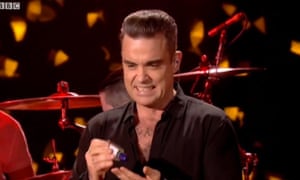
Coming clean: Robbie Williams using hand sanitiser.


Coming clean: Robbie Williams using hand sanitiser. Photograph: BBC

Robbie Williams has responded to the furore over the incident on New Year’s Eve, when, after shaking hands with members of the excited crowd, he was shown squirting sanitiser on to his mitts, his face plastered with the kind of grimace usually reserved for old footage of cow rectal examinations on All Creatures Great and Small.


Williams isn’t a complete PR dolt, so he’s now issued an amusing video of himself using hand sanitiser after he’s touched a family member.


Well played. However, it’s not quite enough to dispel the feeling that as much as celebrities such as Williams say they “love” their fans, it’s nowhere near as much as they love a nice relaxing bath in scalding hot Dettol after they’ve had anything to do with them.


The feeling that this “love” they feel for fans may be a tad selfish and needy, as in, wholly to do with wanting them to continue buying their stuff. And as much as they want to reach out to their public and touch hearts and lives, this doesn’t include any other kind of touching or the little bottle of Carex hand gel is coming out again.


Now, open wide. Then I can tell how rich you are | Barbara Ellen

15 Aralık 2016 Perşembe

Open Letter For Aging Adults From An Aging Adult

Aging And Your Body


You and I have probably never met.


I have worked in healthcare for over 30 years, many of them right here in southern Arizona. I have learned a few things that I want to share with you. Hopefully, you can relate to them.


As an older adult myself, and as a child who has cared for aging relatives, I have been frustrated both to see and to experience the limitations that becoming older brings. We tend to be more fragile, less resilient; things take more effort but we have less endurance. Simple, everyday tasks bring new challenges and risks we never considered 20 years ago.


One of the most bewildering things you may notice about becoming older is the difficulty you begin to experience when attempting tasks that used to take little, if any, effort. The distant possibility of no longer being able to live independently begins to look closer every day to you. You may find it hard to ask for help and consider that we are dependent on others after an entire life of being self-reliant. It can be disheartening, to say the least.


There are steps you can take (and some of you have taken these steps already) to stay more independent for longer. You can feel safer and more capable at home.  Rehabilitation and physical science has shown this to be true.


http://biomedgerontology.oxfordjournals.org/content/64A/1/61.short


Our physical therapists are uniquely qualified to help with the difficult business of getting older and more fragile. They have years of experience and they know how to work with you to improve your function.


Our bodies are complex organisms that rely on movement and circulation for strength and balance. If you aren’t using your muscles and joints, over time they become less flexible and more easily fatigued. If you have been injured or ill,  you may become discouraged and believe that physical activity is not possible for you.


It is. Physical therapists work with your personal limitations and consider carefully your injuries or illness.They will provide you with a program that can result in improved balance, more strength, and confidence in your ability to be more independent for longer.


physicaltherapytucson.com


You can take charge – no referral is required – and start today to work a program to improve how you feel.


Sincerely,


Amy


Open Letter For Aging Adults From An Aging Adult

25 Kasım 2016 Cuma

Kanye West"s travails help hip-hop open up on mental health

In the final shot of Kanye West’s video for his 2008 track Love Lockdown the rapper curls up into a foetal position in the middle of a bright white room, his head clutched desperately in his hands. It is a moment of vulnerability many might see as being at odds with the antagonistic, controversy-courting megastar, who declares himself a god, has snatched awards from the hands of Taylor Swift and makes dramatic outbursts on television chat shows.


Yet this week, as news broke of the singer’s hospitalisation in the psychiatric ward of UCLA, reportedly for stress and exhaustion following a week of erratic behaviour on stage and the subsequent cancellation of his tour, the pressures on hip-hop artists to conceal mental health vulnerabilities have come under almost unprecedented scrutiny.


West’s hospitalisation comes at a pivotal time for hip-hop’s complex relationship with mental health. Rather than distancing themselves from West’s possible mental health issues, fellow musicians such as Chance the Rapper, West’s recent collaborator, told the BBC he wanted to “extend a special prayer to my big brother Kanye West”.


Grammy-winning hip-hop producer 9th Wonder tweeted, “been knowing the brother upwards of 13 years. Mental health is a serious thing, no matter what. Stay strong Kanye West.”


9th Wonder (@9thwonder)

Been knowing the brother upwards of 13 years. Mental healing is a serious thing, no matter what. Stay strong Kanye West. ✊


Kanye West"s travails help hip-hop open up on mental health

17 Kasım 2016 Perşembe

Keeping footpaths open for ramblers | Letters

Rambling is a wonderful leisure pursuit that can be undertaken alone or as part of a group, making a significant contribution to participants’ health and wellbeing, while combating the epidemic of loneliness that is also currently attracting attention (Editorial, 15 November). But, in common with other preventive services, it is not easy to demonstrate cause and effect, so footpath maintenance is unlikely to figure highly on a council’s list of priorities.


Outsourcing has reached this area too. When I contacted a county council in the heart of England, providing photographs of more than 20 broken or inaccessible stiles on an 11-mile route, I was told that this was no longer their responsibility but they would pass on my concerns to the contractor.
Les Bright
Exeter and District Ramblers


Keeping footpaths accessible for ramblers is something the government is unlikely to help with and the local authorities cannot afford to.  In Hertfordshire shortly after the second world war local enthusiasts went out every weekend, our leader with wire cutters, and walked all the ancient footpaths so they remained officially public rights of way. Now may be the time for rambling clubs to do the same.
Gillian Mulley
Saffron Walden, Essex


Join the debate – email guardian.letters@theguardian.com


Read more Guardian letters – click here to visit gu.com/letters


Keeping footpaths open for ramblers | Letters

19 Eylül 2015 Cumartesi

Open Sesame: seven Collective Benefits Of This Strong Seeds

The sesame seed is obtained from a flowering plant native to Africa and Asia. The sesame plant is one of the oldest cultivated plants in the world and as effectively as currently being a popular seed. The electrical power of the sesame seed dates back thousands of many years in the past when it was utilized by the Egyptians as a medicine.


Nutrition Worth


Copper – 73.five%
Tryptophan – 37.five%
Manganese – 44.five%
Magnesium – 31.5%
Calcium – 35.one%
Phosphorus – 22.6%
Iron – 29.1%
Vitamin B1 – 18.6%
Selenium – 17.6%
Zinc – 18.6%
Calories (206) – eleven%


7 Collective Rewards Of This Remarkable Seeds


Sturdy bones
Sesame seeds are a fantastic supply of the two calcium and zinc, and each these minerals perform a key part in assisting to maintain strong, healthier bones. Consuming sesame seeds on a standard basis can assist avoid osteoporosis, creating sesame seeds a common element of the diet program of older people.


Lessen High Blood Stress
Sesame seeds incorporate sesamin and sesamolin, substances that is believed to stop higher blood stress and protect the liver against damage.


Cure Rheumatoid Arthritis
A mineral that is crucial for anti-inflammatory and antioxidant enzyme methods, copper is recognized for lowering ache and swelling related with arthritis. Moreover, this mineral assists supply power to blood vessels, bones, and joints.


Cure Anemia
Sesame seeds remedy anemia as an ounce of Sesame seeds can make up for about 23% of Iron and 25% of Magnesium every day requirement. It is found that black sesame seeds are deemed a lot more potent than the white ones for curing anemia.


Avoid Diabetes
Magnesium and other nutrients contribute to the management of diabetes. Numerous researches have proven that sesame seed oil assists in regulating blood sugar levels and hence managing diabetes.


Stop cancer
Anti-oxidant properties of sesame seeds and presence of nutrients like magnesium and iron, and several vitamins, they look to lessen the danger of specified cancers. It has anti-carcinogenic agent Phytate that has been proved to stop cancer.


Relieves Stress
1 ounce of Sesame seeds have about 28% and 25% of our daily necessity of Calcium and Magnesium respectively. They are important for far better nerve perform, reduction of mood swings and as mood enhancer.


Sources of write-up include:


http://wiki-fitness.com/sesame-seeds-overall health-positive aspects-and-nutrition-information/


http://www.healthcabins.com/sesame-seeds-well being-benefits.html


http://www.drwhitaker.com/the-overall health-advantages-of-sesame-seeds/


Open Sesame: seven Collective Benefits Of This Strong Seeds

20 Ağustos 2015 Perşembe

Walgreens To Open New Clinics Staffed, Owned By Hospital Partners

[unable to retrieve total-text material]


In a new twist on its retail health clinic model, Walgreens Boots Alliance (WBA) says it will open up to 25 new retail clinics in Oregon and Washington states that will be owned and operated by a Seattle-primarily based wellness technique. The collaboration calls for Walgreens&rsquo spouse, Providence Wellness &amp Services, a [...]


Walgreens To Open New Clinics Staffed, Owned By Hospital Partners

30 Temmuz 2014 Çarşamba

People"s Choice: In This Fall"s Open Enrollment More Health Care Via Private Exchanges

Walgreen Walgreen


By 2018 more people will use so-called private exchanges than similar ones created by the Affordable Care Act, according to a recent analysis by Accenture. 


Walgreen, Sears and Aon Aon Hewitt, among the earlier pioneers in this new approach, give employees a credit to buy insurance in an online marketplace.


Already an estimated 3 million Americans are getting insurance from their employers this way, which is triple the number of active employees that were buying from private exchanges a year ago, according to Accenture Accenture, which projects 40 million Americans will be buying on private exchanges in 2018. Employees get a credit or subsidy, and are sent to buy a plan on a private market place akin to Amazon.com Amazon.com or Orbitz in their respective industries.


Aon Hewitt, the largest manager of a private insurance exchange, says that the approach reduced growth in health insurance costs for its clients’ active employees to 5 percent, compared to 7 percent for most large employers.


So far, Walgreen has been the largest company to disclose participation by workers in its private exchange. The pharmacy giant says more than 220,000 workers and their dependents are getting coverage through the Walgreen proprietary “Live Well Benefits Store,” a marketplace that is an outsourced solution through Aon Hewitt Corporate Health Exchange.


Aon Hewitt, Mercer and Towers Watson (TW) are the leading consultancies pushing the exchange approach for both active employees and retirees with IBM (IBM), AT &T (T) and Time Warner moving their workers to retiree private exchanges. And the consultants are on the verge of having more competition as health insurance companies get into the act like Cigna (CI), Aetna (AET) and others.


“We continue to work to develop our own proprietary exchange called, the Aetna Marketplace, which we believe will offer an attractive alternative to existing multi-carrier exchanges and the current defined benefit model for health benefits,” Aetna chairman and chief executive officer Mark Bertolini told analysts and investors Tuesday on the company’s second-quarter earnings call.


Wondering how private exchanges or Obamacare exchanges will affect your health care? The Forbes eBook Inside Obamacare: The Fix For America’s Ailing Health Care System answers that question and more. Available now at Amazon and Apple.


People"s Choice: In This Fall"s Open Enrollment More Health Care Via Private Exchanges

11 Temmuz 2014 Cuma

Open thread: should a million more people get obesity surgery on NHS?


The Nationwide Institute of Health and Care Excellence (Nice) say that fat reduction surgery—which fees the NHS around £6,000 per operation—should be made broadly obtainable amid increasing ranges of weight problems and diabetes.


Existing NHS weight problems surgical treatment is supplied to people who are morbidly obese with a BMI of more than 40, or to people with a BMI over 35 if they have another issue, this kind of as diabetes.


One particular in four Britons is now classed as obese—should they be given excess weight loss surgery free on the NHS?


Can we afford to double the quantity of folks who qualify for gastric bands and stomach stapling? And is it proper to give cost-free care for individuals who are overweight even though NHS has rejected a series of daily life-extending cancer medication?


And must we spot better emphasis on other policies to tackle obesity—such as encouraging individuals to workout and limiting promoting for low cost, unhealthy meals?


Inform us your thoughts in the feedback beneath or tweet @TeleTweetures.


Open thread: should a million more people get obesity surgery on NHS?

4 Temmuz 2014 Cuma

"I want to see a a lot more open, listening and engaging culture in the NHS"

Mark Newbold

Mark Newbold became a chief executive after functioning for 20 years as a histopathologist.


Describe your function in one sentence: I run the Heart of England NHS basis believe in, which includes 3 hospitals and a selection of local community well being solutions in the Birmingham and Solihull places.


Why did you want to perform in healthcare? At school I loved human biology, and was attracted to medicine by the blend of applied science and vocation. I was a histopathologist for a lot more than twenty years right up until I became a hospital chief executive in 2007.


How do you want to see the sector change in the up coming five years? A shift from our best down, narrowly centered and target-primarily based culture to 1 that is much more open, listening and engaging, and with clinical outcomes, security and compassionate care as real priorities.


My proudest achievement at function was … currently being appointed to my current work 3 years ago.


The most challenging factor I’ve dealt with at perform is … the understanding that I am nevertheless finding out and could have carried out important things greater, earlier or quicker.


The greatest challenge facing the NHS is … the want to change from a reactive support to one that defaults to homecare rather than hospital, and prioritises the energetic servicing of well being in these with frailty and persistent conditions.


The people I operate with are … challenging-working, resourceful and completely committed.


I do what I do due to the fact … it is worthwhile and it challenges me, and I can make a big difference.


At times folks consider that I … am mad for giving up a secure healthcare profession to turn into a chief executive, but I think it is just a different way of using my knowledge and knowledge in the NHS.


At work I am always understanding that … however considerably I talk, it is in no way sufficient!


The 1 thing often on my mind at perform is … the degree of emergency pressure in our hospitals.


If I could go back 10 many years and meet my former self I would tell them … to consider much more job risks, and to adhere to my instincts about what is crucial to me.


If I could meet my long term self I would expect them to be … articles that I had done the really greatest task I could.


What is the best part of your job? Meeting employees that radiate pride in the services they are supplying to individuals.


What is the worst element of your task? Blockers, box-tickers and the unsupportive culture.


What makes you smile? Following the ideas and actions of my children as they increase into grownups.


What keeps you awake at night? I frequently believe about whether or not I am pushing hard and rapidly ample for the adjustments that are essential.


Dr Mark Newbold is chief executive of Heart of England NHS foundation believe in


Are you a member of our online community? Join the Healthcare Experts Network to receive standard emails and exclusive provides.


"I want to see a a lot more open, listening and engaging culture in the NHS"

18 Haziran 2014 Çarşamba

What medical jargon need to be banned? Open thread

Concerned woman doctor listening to patient

Doctors’ explanations of illnesses and remedies are as well often complicated. Photograph: Blend Photographs /Alamy


Health specialists are being urged to use clearer language to assist individuals to understand their illness.


A report by the Royal College of GPs (RCGP) tells medics to communicate a lot more gradually and use less jargon when speaking to sufferers since their explanations of illnesses and remedies are too typically perplexing.


It calls for the UK’s 250,000 medics to stay away from the use of phrases such as “chronic”, “palliative” and “hospice”, and warns that describing a diagnosis of cancer as “constructive” can be misinterpreted as great information.


Tell us which healthcare terms and phrases do you think need to be ditched and why.


What medical jargon need to be banned? Open thread

15 Haziran 2014 Pazar

French area hopes open day will cure medical doctor decline

French village, Lozère region

Medical interns from Montpellier visited the river gorges and limestone plateaux of Lozère. Photograph: Michael Busselle/Corbis


France’s least populated region has come up with an uncommon incentive to attract a future generation of physicians.


With the variety of GPs in France in steady decline, the south-eastern Lozère area played host this weekend to fifty five health care interns from Montpellier, showing off its gastronomic delights and landscapes of river gorges and high limestone plateaux.


Lozère, recognized for roquefort cheese, has a population density of only 15 people a square kilometre. Sixty per cent of medical doctors in the area are over fifty five, according to regional official Valérie Cogoluegnes, who advised Le Figaro that the division wants an additional 6 or 7 doctors to join the 58 who are currently practising. Right up until now, French rural locations have attempted to boost healthcare cover by offering economic rewards to physicians. In light of intensifying competitors, Lozère made a decision to increase its game.


The French medical association last week launched a thorough atlas on the distribution of health care providers nationally, which showed that the quantity of GPs dropped by six.5% in between 2007 and 2014. The variety of experts, nonetheless, enhanced by six.one% above the exact same period.


The Paris region has been the worst hit by the disappearing physicians, with a single in 5 leaving over the 7 years. Seine-Saint-Denis is the worst-served region with a single GP for every single one,500 residents.


But even although Lozère is struggling from a shortage of GPs, the health-related atlas showed that at least some therapy was at hand for its residents: the variety of psychiatrists has doubled in the past seven years.


French area hopes open day will cure medical doctor decline

4 Haziran 2014 Çarşamba

Is present day daily life also noisy? | Open thread

Congestion and an ambulance

Urban regions are specifically noisy, with the sound of site visitors and sirens. Photograph: Alamy


The noise expert Bernie Krause has mentioned the incessant sounds of contemporary life are generating people unhappy.


Speaking at the Cheltenham science festival, Krause explained that whilst we feel we have turn into accustomed to noise, it is truly creating us stressed, depressed and reliant on sleeping tablets and antidepressant prescription drugs. Urban regions are particularly noisy, and the sound from aeroplanes, traffic and police and ambulance sirens are all factors that could be contributing to anxiety and insomnia.


Do you deal with intrusive noise on a everyday basis? Does it contribute to your sleepless nights or sense of tension? Tell us how you deal with the sounds of modern day lifestyle, and if you deal with to block them out.


Is present day daily life also noisy? | Open thread

3 Mayıs 2014 Cumartesi

Sian Williams: "Sometimes it"s much better to open the box"

“Well, I’ve constantly wanted to review the workings of the mind, inasmuch as you can, and imagined I’d do an MSc to challenge myself.”


She says her interest in psychology constructed slowly, stemming from a expanding unease about numerous dimensions of the unequal connection between journalists and the topics whose lives are pillaged for broadcasts and print.


“I was in Liverpool in the Eighties – there had been a good deal of massive news stories going on which was why I needed to go there. But sometimes you’d be sent out on a street targeted traffic accident or to interview victims with no correctly knowing how to manage them. I did a great deal of interviews, aged 21, with folks who had been at Hillsborough and who were in a state of shock. Now I appear back and feel, ‘How did I handle people people? Were they even mindful I was there? These had been their stories, their lives.’”


She started critically to assess her personal direction at the end of 2009, the yr in which her youngest child, a daughter, was born and her mom died of bowel cancer. Then when BBC Breakfast transferred to Salford in 2012 she resigned from the programme and determined to use the time to embark on the course.


Williams with her research (MARTIN POPE)


We pause for a second to order. The menu is modern comfort meals: small plates, soups – there is lobster lasagne on the menu but we demur.


Williams set out some of her views on how journalism might be honed and improved in a latest and extremely lucid cover story for The Psychologist, the regular monthly magazine for members of the British Psychological Society.


In it, she discusses practice all around the coverage of mental well being stories and the fine line in between making it possible for people’s stories to be told and utilizing tactics to extract juicy particulars that may well not very be in the greatest interests of the vulnerable.


She’s appropriate, of course. The statistics say that one in 4 individuals will have a psychological health issue at some stage in their lives nevertheless these are nevertheless stigmatised and we haven’t identified the right language to speak about it openly and very easily. But how realistic is a much more considerate strategy in other regions? Is her editor – she has recently started an interview demonstrate for BBC Wales – going to consider she’s gone soft?


This draws a wicked laugh. “An interview with a politician is always going to be an interview with a politician. No.”


The piece also touches on her recent area of analysis, the difficult-to-manage emotions of people sent to cover the stories in catastrophe zones.


“You’re caught up,” she says now, speaking quickly. “You’ve got conflicting feelings. There is the adrenalin. You’re operating to consider to hold up, what’s taking place now? What are the most current casualty figures? How many individuals have pledged to the helpline? When’s the support coming by means of? Receiving all this, asking what was it like, what did you encounter, how several household members have you misplaced, where are you going to rest? But you are in a position in which you can request people questions, their lives have been changed forever.


“In Pakistan we were sleeping in a automobile and we did not have any foods. However, we had a auto to rest in, whereas most people had practically nothing. And afterwards you get to go house and they really don’t and I do not like that feeling.”


A single of the problems faced by information teams is the struggle to locate a way to approach what they have observed and heard when it is filtered through this sense of guilt. Williams says sharply, “It feels self-indulgent to acknowledge your own feelings in this kind of situations – it is self-indulgent,” but her own investigation is about the require to do specifically that, so it’s obviously a conflict she’s even now resolving.


She has also said that following covering stories, recollections were returning “uninvited”. What was returning?


“Images, folks. Smell. Smell goes straight to the limbic program and gets locked in there. Even if we attempt to control all these other bits. I can block out that picture, I really do not need to have to keep in mind that. By some means you can not shake smell.”


What smells came back? There is a extended silence ahead of she solutions.


“The smells that you would expect in a catastrophe spot. Which is just… what you’d anticipate. What you’d assume following five days of tsunami. Where there’s no sanitation and there is no care and aid is taking time to come by way of and dysentery is starting up and bodies haven’t been cleared away and you do not have foods. That type of issue.”


She is rapid to stage out that she has by no means experienced PTSD herself but investigation suggests war correspondents demonstrate comparable ranges of signs and symptoms to those who have been in energetic services. Not only is there little assistance but newsroom culture is all about coping, staying specialist, and moving on.


“And you don’t want to bring it home simply because of what benefit is that to folks who enjoy you? None. So you put it away and maintain the box very firmly closed. Whereas what I am learning now is at times it is much better to open the box and get stuff out and have a search at it and place it back.”


Our meals has arrived by now – there is a especially wonderful tiny plate of pickled watermelon and goat cheese, and I’ve ordered a springlike and uplifting glass of Framingham pinot noir from New Zealand (you can consider the girl off the wine page…). But we’re not producing much headway with it. There is as well a lot chat to consume or drink. Sian will not inform me what she has in people mysterious boxes, so I request about receiving to grips with the deeper demands of academic examine when you are used to daily deadlines.


“Slowing down was the most demanding thing. The lecturer would stand in front of me and I’d be like, appropriate, inform me everything about cognitive psychology and I’ll write it down, thank you really significantly, and then I’ll know it by the end of the day. But you want to consider time to analyse.”


Is she very impatient? Does she get cross with men and women who stroll slowly down the street? There is a lengthy laugh then a prolonged silence. I’m contemplating the answer’s yes but she’s worried that will sound undesirable.


“Do you meditate?” No. “I remember getting a CD years ago and sitting there, it was slow! I wanted to say to her, just get to the bit that I need to have to know. I desired to put it on quick forward!


“But individuals who do mindfulness programs usually appear calmer in the rest of their lives. One issue I’ve learnt is that the brain is plastic and there are real physical changes within it – a single review showed those who’d accomplished an eight-week mindfulness course had significantly less grey matter in their amygdala (a part of the brain thought to be connected with concern amounts), it wasn’t firing up so significantly, their anxiety amounts were diminished.”


So has she now signed up for meditation? “I did, but I had to cancel due to the fact I was also occupied.”


We speak a bit more about her course. She tells me about becoming wired up to a heart-charge keep track of and shown a video of a brain dissection. “You feel nicely, I can watch Casualty, my son’s undertaking medicine, how undesirable can it be? But – the guy had grey hair and you hear this large crack as they’re opening the skull – and I closed my eyes. Oh! You’re consuming your lunch! Sorry!”


And about her investigation task, “It’s particularly about one thing referred to as subsequent publish traumatic development which has been recorded in firefighters, emergency responders, social workers, therapists, carers. It is a strengthening of resilience and a modify inside oneself and your daily life that can happen as a consequence of PTSD. The hope is to locate one thing new, to include one particular small cog of data to what we know.”


We also chat about her mother, who had been an intensive-care nurse and ended up getting handled for cancer in the very same hospital in which she had worked for twenty many years and who was moved to a Macmillan hospice two days just before she died. “It was really quick and I slept there so I was with her when she died.”


There’s almost a teary second as she loses her composure for a second. “Don’t open that box,” she says quietly. “That’s 1 of the boxes.”


The photographer arrives and she’s straight back to fast-fire, competitive form. “Have you considered a PhD? Does not a small small bit of you want to be a medical doctor? Just a tiny bit? My son is instruction to be a medical doctor, and I thought it would be great if we could each be physicians at the same time! Then I realised he would be truly annoyed with me. So I am not going to do that.”


And dashing off to the college pickup, all the while talking about how she’s going to Feel Gradually, that is Believe Gradually,yes, definitely Feel S-L-O-W-L-Y, about what she does up coming.


Sian Williams: "Sometimes it"s much better to open the box"

2 Mayıs 2014 Cuma

Sian Williams: "Sometimes it truly is greater to open the box"

“Well, I’ve always wanted to study the workings of the mind, inasmuch as you can, and thought I’d do an MSc to challenge myself.”


She says her interest in psychology built gradually, stemming from a growing unease about many dimensions of the unequal relationship between journalists and the subjects whose lives are pillaged for broadcasts and print.


“I was in Liverpool in the Eighties – there were a lot of big news stories going on which was why I wanted to go there. But sometimes you’d be sent out on a road traffic accident or to interview victims without properly knowing how to handle them. I did a lot of interviews, aged 21, with people who had been at Hillsborough and who were in a state of shock. Now I look back and think, ‘How did I handle those people? Were they even aware I was there? These were their stories, their lives.’”


She began seriously to assess her own direction at the end of 2009, the year in which her youngest child, a daughter, was born and her mother died of bowel cancer. Then when BBC Breakfast transferred to Salford in 2012 she resigned from the programme and decided to use the time to embark on the course.


Williams with her research (MARTIN POPE)


We pause for a moment to order. The menu is contemporary comfort food: small plates, soups – there’s lobster lasagne on the menu but we demur.


Williams set out some of her views on how journalism might be honed and improved in a recent and very lucid cover story for The Psychologist, the monthly magazine for members of the British Psychological Society.


In it, she discusses practice around the coverage of mental health stories and the fine line between allowing people’s stories to be told and using tactics to extract juicy details that might not quite be in the best interests of the vulnerable.


She’s right, of course. The statistics say that one in four people will have a mental health problem at some point in their lives yet these are still stigmatised and we haven’t found the right language to talk about it openly and easily. But how realistic is a more considerate approach in other areas? Is her editor – she has recently started an interview show for BBC Wales – going to think she’s gone soft?


This draws a wicked laugh. “An interview with a politician is always going to be an interview with a politician. No.”


The piece also touches on her current area of research, the difficult-to-handle emotions of those sent to cover the stories in disaster zones.


“You’re caught up,” she says now, talking rapidly. “You’ve got conflicting emotions. There’s the adrenalin. You’re running to try to keep up, what’s happening now? What are the latest casualty figures? How many people have pledged to the helpline? When’s the aid coming through? Getting all this, asking what was it like, what did you experience, how many family members have you lost, where are you going to sleep? But you’re in a position where you can ask those questions, their lives have been changed forever.


“In Pakistan we were sleeping in a car and we didn’t have any food. However, we had a car to sleep in, whereas most people had nothing. And afterwards you get to go home and they don’t and I don’t like that feeling.”


One of the difficulties faced by news teams is the struggle to find a way to process what they have seen and heard when it is filtered through this sense of guilt. Williams says sharply, “It feels self-indulgent to acknowledge your own emotions in such circumstances – it is self-indulgent,” but her own research is about the need to do exactly that, so it’s clearly a conflict she’s still resolving.


She has also said that after covering stories, memories were returning “uninvited”. What was returning?


“Images, individuals. Smell. Smell goes straight to the limbic system and gets locked in there. Even if we try to manage all those other bits. I can block out that image, I don’t need to remember that. Somehow you can’t shake smell.”


What smells came back? There is a long silence before she answers.


“The smells that you would expect in a disaster area. Which is just… what you’d expect. What you’d expect after five days of tsunami. Where there’s no sanitation and there’s no care and aid is taking time to come through and dysentery is starting and bodies haven’t been cleared away and you don’t have food. That sort of thing.”


She is quick to point out that she has never experienced PTSD herself but research suggests war correspondents show similar levels of symptoms to those who have been in active service. Not only is there little support but newsroom culture is all about coping, staying professional, and moving on.


“And you don’t want to bring it home because of what benefit is that to people who love you? None. So you put it away and keep the box very firmly closed. Whereas what I am learning now is sometimes it’s better to open the box and take stuff out and have a look at it and put it back.”


Our food has arrived by now – there’s a particularly lovely small plate of pickled watermelon and goat cheese, and I’ve ordered a springlike and uplifting glass of Framingham pinot noir from New Zealand (you can take the girl off the wine page…). But we’re not making much headway with it. There’s too much chat to eat or drink. Sian won’t tell me what she has in those mysterious boxes, so I ask about getting to grips with the deeper demands of academic study when you’re used to daily deadlines.


“Slowing down was the most challenging thing. The lecturer would stand in front of me and I’d be like, right, tell me everything about cognitive psychology and I’ll write it down, thank you very much, and then I’ll know it by the end of the day. But you need to take time to analyse.”


Is she very impatient? Does she get cross with people who walk slowly down the street? There’s a long laugh then a long silence. I’m thinking the answer’s yes but she’s worried that will sound bad.


“Do you meditate?” No. “I remember buying a CD years ago and sitting there, it was slow! I wanted to say to her, just get to the bit that I need to know. I wanted to put it on fast forward!


“But people who do mindfulness courses always seem calmer in the rest of their lives. One thing I’ve learnt is that the brain is plastic and there are actual physical changes within it – one study showed those who’d done an eight-week mindfulness course had less grey matter in their amygdala (a part of the brain thought to be associated with fear levels), it wasn’t firing up so much, their stress levels were reduced.”


So has she now signed up for meditation? “I did, but I had to cancel because I was too busy.”


We talk a bit more about her course. She tells me about being wired up to a heart-rate monitor and shown a video of a brain dissection. “You think well, I can watch Casualty, my son’s doing medicine, how bad can it be? But – the guy had grey hair and you hear this big crack as they’re opening the skull – and I closed my eyes. Oh! You’re eating your lunch! Sorry!”


And about her research project, “It’s specifically about something called subsequent post traumatic growth which has been recorded in firefighters, emergency responders, social workers, therapists, carers. It’s a strengthening of resilience and a change within yourself and your life that can happen as a consequence of PTSD. The hope is to find something new, to add one tiny cog of information to what we know.”


We also chat about her mother, who had been an intensive-care nurse and ended up being treated for cancer in the same hospital in which she had worked for 20 years and who was moved to a Macmillan hospice two days before she died. “It was very fast and I slept there so I was with her when she died.”


There’s nearly a teary moment as she loses her composure for a second. “Don’t open that box,” she says quietly. “That’s one of the boxes.”


The photographer arrives and she’s straight back to quick-fire, competitive form. “Have you considered a PhD? Doesn’t a little tiny bit of you want to be a doctor? Just a tiny bit? My son is training to be a doctor, and I thought it would be great if we could both be doctors at the same time! Then I realised he would be really annoyed with me. So I am not going to do that.”


And dashing off to the school pickup, all the while talking about how she’s going to Think Slowly, that’s Think Slowly,yes, definitely Think S-L-O-W-L-Y, about what she does next.


Sian Williams: "Sometimes it truly is greater to open the box"

13 Nisan 2014 Pazar

GPs" surgeries to open all hours in £50m reforms

GP surgeries

The GP Access Fund will suggest that patients at one,147 practices across England will be capable to see their medical doctor outside standard working hrs. Photograph: Ferenczy Europress/FEB


Hundreds of thousands of sufferers will be ready to see their GPs in evenings and on weekends with £50m of government funding created offered to lengthen opening times, it is to be announced.


David Cameron, the prime minister, will say on Monday that far more than 7.5 million men and women will be supplied elevated entry to GP companies through extended opening times and new consultation methods making use of Skype, e mail and cellphone.


The £50m GP Accessibility Fund will indicate that sufferers at 1,147 GP practices across England will be ready to see their family members medical doctor outdoors standard working hours, like late-night and weekend appointments or use 1 of the modern consultation tools for convenience.


It was initially imagined that close to 500,000 folks would benefit from the modifications but due to substantial levels of interest it has been rolled out to cover more GP companies.


Cameron will also announce strategies to improve care services for the elderly.


About 800,000 folks above the age of 75 and those with a lot more severe wellness complaints will get tailored care, co-ordinated by just a single neighborhood GP.


The overall health minister, Norman Lamb, informed the Telegraph: “It truly is quite challenging for folks with hectic lives to get appointments with GPs so let’s just get smarter with the use of technologies.”


He said: “We have received to break away from this treadmill of the 10-minute appointment which drives GPs crazy and which leaves patients often annoyed.”


Lamb additional that as older men and women became far more tech-savvy the use of email and video chat for consultations would aid people who were also hectic to attend face-to-face consultations.


GPs" surgeries to open all hours in £50m reforms

12 Nisan 2014 Cumartesi

Ministers inform GPs to open all hours

The Government hopes that the bundle of measures will finish the “treadmill” of rigid 10-minute appointments and permit medical doctors to spend more time on sufferers who need the most aid.


People will also be ready to guide more handy appointments after office hours and at weekends. They could acquire faster suggestions by emailing their physicians, the Government hopes.


Networks of surgeries could offer you shared clinics in the evenings and at weekends, beneath the reforms.


The plans are intended to ease the pressure on hospital accident and emergency departments, which have been swamped by millions more sufferers in recent many years who do not know the place else to go when surgeries are closed.


A lot of GPs’ surgeries are open only from 9am to 5pm on weekdays, forcing operating patients to take time off to see a medical professional.


Millions of individuals wait a week or a lot more for an appointment with their GPs, NHS figures demonstrate.


Ministers want to restore “the ideal traditions of loved ones doctors”, especially to increase providers for elderly individuals. The Government has also set a target to increase the number of health care college students who go into general practice.


Norman Lamb, the Wellness Minister, informed The Telegraph it would be crucial for medical professionals to make far more use of new engineering alongside the new extended opening hours to supply sufferers with the service they need to have.


“It’s very challenging for people with hectic lives to get appointments with GPs so let’s just get smarter with the use of engineering,” he said.


“In every single other element of our lives we are making use of engineering to talk. We have acquired to get into this in a large way in overall health and care.


“It has transformed the efficiency of numerous other industries and sectors and I consider it can do the exact same and offer more responsive care for occupied folks.” Developments in mobile technology have “enormous” likely to help maintain elderly patients and those with long-phrase situations residing independently, he said.


A new wave of health “apps” is currently being designed to allow individuals to keep track of their conditions on smartphones and feed data back to physicians.


“There are enormous possibilities right here to give better care and assistance but also to reduce out price in a rather bureaucratic system,” Mr Lamb mentioned.


“If we have acquired something that we just want checked out, we don’t want to take time off function or go through the nightmare of striving to get an appointment that fits our doing work lives. We just want to be capable to e-mail our GP to get a rapid answer.”


Ministers have modelled some of the strategies on an progressive doctors’ centre in Seattle, America. The not-for-profit Group Overall health healthcare centre permits many patients to make contact with medical professionals for advice above secure email.


The outcomes have been striking, Mr Lamb mentioned.


“What they discovered is that by undertaking a considerable quantity of consultations by secure e-mail they freed up GPs’ time to concentrate on these older men and women who want a lot more than the 10-minute consultation.


“The fascinating point they say is that it has improved GPs’ effectively-currently being, it supplies a lot much better care and it’s a lot far more practical for very hectic folks who really don’t want to have to go to a face-to-encounter appointment if they really don’t think it’s essential.”


Numerous individuals in England who do make time to check out a medical professional then locate that they are limited to a fixed 10-minute slot, which may possibly not be enough, Mr Lamb stated.


“We have got to break away from this treadmill of the 10-minute appointment which drives GPs crazy and which leaves individuals usually frustrated,” he mentioned.


“I had an appointment final yr and I had three or four items I desired to raise. We received to the third problem and I was advised the time had run out. I couldn’t raise the fourth problem. Typically, psychologically, it is probably the last concern that is the actually essential 1, but my time had run out.”


Mr Lamb mentioned more older men and women had been getting to be “IT-savvy” and would be capable to benefit from the program to make greater use of technology.


“The infant boom generation as they get older, their daily life will revolve around the iPad,” he predicted. “Then there is the possible for Skype so you can speak to an individual, or e mail. This will turn out to be much more and a lot more relevant to older folks as properly as young active folks.”


David Cameron initial announced programs to lengthen surgical treatment opening hours at last October’s Conservative Celebration conference. Below alterations to GPs’ contracts, which came into force this month, all individuals older than 75 will have a medical doctor accountable for their care.


Medics have warned that A&ampE departments have been inundated by men and women with minor ailments at weekends due to the fact out-of-hours health providers are inadequate. Four million more patients visited A&ampE last 12 months than in 2004.


Caroline Abrahams, from the elderly people’s charity Age United kingdom, explained: “These new measures mark an essential and very welcome stage towards equipping the NHS to care much better for some of its most vulnerable end users.”


Dr Chaand Nagpaul, Chair of the British Healthcare Association’s General Practitioner Committee, mentioned the projects funded by the £50 million scheme must be “independently evaluated” and warned that a lack of income could undermine lasting reform.


“Provided that this funding is only for one 12 months, there is no assurance of these modifications becoming cost-effective in potential many years,” he stated.


“If we are to meet the rising patient demand from an ageing population, all GP surgeries nationally want to be much far better resourced.”


Ministers inform GPs to open all hours

31 Mart 2014 Pazartesi

Superstar Chef Ferran Adria To Open Cooking Lab And Museum On Web site Of El Bulli

Superstar chef Ferran Adria, of El Bulli fame, mentioned programs for new projects he is at the moment developing on a latest trip to New York, like a seven,000-square-meter cooking lab and museum focused to the historical past and concept of cuisine, and a culinary wiki, Bullipedia.     The El Bulli Basis, which will be found on the internet site of his former restaurant in the Mediterranean town of Roses, north of Barcelona–will be the residence of elBulli DNA, a team of thirty to forty of what Adria referred to as “the most creative chefs in the globe, of any age,” who will invest eight months in dialogue with “people in other disciplines.  They will compare and share the innovative processes of other disciplines.  Every thing they generate will be put on an on the web stream, and they will perform on joint tasks with new technologies,” he explained in a speak at the 92nd Street Y.


The basis also will contain elBulli 1846 (after the variety of dishes created at his restaurant and the year the legendary French chef Auguste Escoffier was born), an exhibition he explained would “study the background of cooking, the culinary genome and the genome of the imaginative procedure.”


And Adria is making Bullipedia, which he described as “an Net device at a skilled level” featuring the “taxonomy of the discipline, botany and the species,” something he explained no 1 had ever attempted just before.  Bullipedia is slated to go on the internet this fall.


The basis will offer you site visitors meals cost-free one month each and every year Adria mentioned diners would be selected by on the web lottery.


Helping Adria with these tasks are researchers from the MIT Media Lab in Cambridge, Mass.


Speaking about his career—he closed the three-Michelin-starred El Bulli on July 30, 2011 following functioning there for almost 30 years—Adria explained that when he started operating, he invested six months as a dishwasher.  “If you really don’t have clean plates, you can not eat,” he mentioned.


He also named his brother, chef Albert Adria, “one of the most innovative chefs now in the globe.”  His brother’s four dining establishments in Barcelona—41Degree Experience, Tickets, Pakta and Bodega 1900– show that “you can have a great restaurant, be pleased, make cash, with out getting three Michelin stars,” Adria said.


Superstar Chef Ferran Adria To Open Cooking Lab And Museum On Web site Of El Bulli