dust etiketine sahip kayıtlar gösteriliyor. Tüm kayıtları göster

15 Şubat 2017 Çarşamba

Delhi"s deadly dust: how construction sites are choking the city

Far out on Delhi’s southern and eastern fringes the rows of high-rises suddenly turn skeletal. The population of the Indian capital, already the second largest in the world, is forecast to grow by 9 million in the next 15 years; and despite a recent lull in new projects, areas such as Noida are a universe of worksites, cranes and workers.


The empty towers stretch as far as can be seen – which is only about 300 metres. Like much of Delhi on most winter mornings, Noida is blanketed in thick smog and a heavy dust that cakes windows and clogs throats.


A comprehensive 2016 study of what is to blame for Delhi’s poor air identified some obvious sources,such as car emissions, the city’s coal-fired power stations and rubbish fires both small and literally mountainous. But it also highlighted more unlikely culprits.


Dust kicked up by cars along Delhi’s vast and growing road network contributes between a third and 56% of the most harmful pollutants in the city’s atmosphere.


The city’s construction sites, and the production of the raw materials that feed them – such as bricks and concrete – are also an outsized contributor to the foul air that some lung specialists warn is making Delhi hazardous, particularly for children and the elderly.


In a country largely under construction – by some rough projections, around 70% of the buildings that will exist in India’s cities by 2030 are yet to be built – controlling the dust produced by roads and worksites is an important, but largely neglected, part of clearing Delhi’s air, according to environmental groups.


Landlocked by treeless plains and deserts, Delhi is inherently dusty. “It’s one of the reasons we can’t have air quality standards as strict or high as the US,” says Sarath Guttikunda, the founder of UrbanEmissions, an air pollution research group. “Our annual standard for PM2.5 pollutants is 40 units, but the World Health Organization’s guideline is 10.”
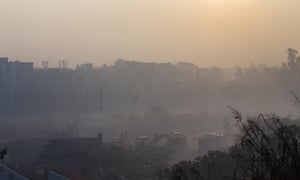


Construction equipment sits idle at a site shrouded in smog in New Delhi, India


Construction and demolition are the third-largest contributor of coarse pollutants. Photograph: Bloomberg/Getty Images

But poor building standards and antiquated practices, multiplied across thousands of worksites, make construction and demolition the third-largest contributor of coarse pollutants – strongly linked in a 2015 study to heart disease.


At one building site in Chittaranjan Park, an affluent south Delhi neighbourhood, half-covered piles of rubble spill out on to the pavement. No fences have been erected to keep the wind from whipping dust out into the street. Enormous mounds of dirt left in empty lots, or simply dumped at the roadside, are also a common sight.


“The Indian construction contractor is trying to maximise his margins,” says Polash Mukherjee, a researcher with the Delhi-based Centre for Science and Environment. “If he’s constructing his house, he’s not required to go to a facility by law and dispose of the waste. Unless he’s forced by government to cover his trucks when he transport raw materials, he won’t do it.”


Builders aren’t just cutting corners: Delhi simply lacks the capacity to safely process the amount of construction waste it produces. A senior environmental engineer at the Delhi Pollution Control Committee told the Guardian current facilities allow for about 1,000 tonnes of waste to be processed per day, but the city produces an estimated 3,600 tonnes.


Run-of-the-mill construction activities take a hefty toll. The process of mixing concrete alone, for example, is estimated to contribute 10% of the coarse pollutants in Delhi’s air, according to an Indian Institute of Technology Kanpur study. Less polluting methods of producing concrete exist, but cost money. “Here it’s often mixed in a pit by manual labour,” says Mukherjee. “It’s cheaper that way, because there’s such a surplus of labour.”
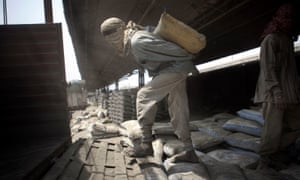


Laborers load cement bags manually onto transport carriers at the Shakur Basti station in New Delhi, India.


Concrete is ‘often mixed in a pit by manual labour. It’s cheaper that way.’ Photograph: Bloomberg/Getty Images

A 2015 study of 19 large Delhi construction sites found the air quality around all of them exceeded safe limits by at least three times, with workers on these sites, mostly daily wage labourers, bearing the brunt. Almost none wear pollution masks, while a handful tie handkerchiefs across their faces to guard against the dust.


Naresh Sharma, a cook on a site in Greater Noida, said workers were sometimes issued pieces of jaggery, a concoction of sugarcane and date palm believed to clear the throat and lungs. “It clears your throat from phlegm, but I don’t think it prevents damage,” says Sai Kiran Chaudhari, a leading pulmonologist at the Delhi Heart and Lung Hospital.


Two years ago, India’s environment court issued extensive regulations to clean up the city’s construction industry, mandating 50,000 rupee (£595) fines for builders who failed to cover their sites in tarpaulin, put up barriers, or sprinkle building materials with water before they were stored or transported. But Mukherjee says construction in Delhi is administered according to complex rules by numerous authorities, and in any case, “enforcement is very, very lax”.


Delhi itself has strong regulations, he adds, “but the biggest projects, the metros, hospitals or malls, are usually in suburbs outside the city, in Gurgaon or Noida, where those rules don’t apply”.


Even when clear orders are issued, they are routinely flouted. Brick production has been banned in Delhi for environmental reasons, but flourishes in nearby towns such as Dadri, in Uttar Pradesh state.
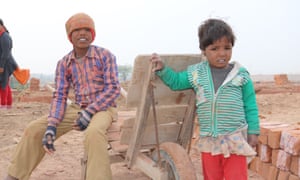


Children at brick factory Delhi


Children working at a brick production site on the outskirts of Delhi. Photograph: Michael Safi

At RR Brickfields, one of the 18 kilns that dot the dry fields around the town, workers including children were collecting finished bricks from a furnace cut deep into the earth. Thick smoke billows from a chimney stack for almost the entire six months each year that the kiln operates. Studies have suggested India’s brick industry could contribute nearly 10% of India’s emissions of black carbon, a major contributor to climate change.


Since early 2016, brick kiln owners have been required to gain environmental clearance before firing their ovens. “But in some areas, people bribe officials. Sometimes they produce bricks secretly,” said the owner of the kiln.


He said he was still in the process of applying for a clearance and, despite the apparent signs of industry, insisted his kiln was not one of those operating.


Then there is the largest year-round contributor to the city’s air crisis: the dust thrown up by the more than 9 million cars that grind along Delhi’s poorly maintained, sometimes unpaved 33,000km road network. Dust has always been factor of Delhi life, but the particles released by traffic are particularly toxic, Mukherjee says.


“It mixes up with the vehicular emissions, the industrial pollution,” he says. Harmful pollutants bind to the dust and settle in the air, when they might otherwise be dispersed by winds.


Building more pavements would make “a big difference”, he says. So would planting vegetation along dividers and road shoulders. “Those bushes would get covered in dust, but it would prevent the dust from blowing further down the road,” Mukherjee adds.


A significant proportion of Delhi’s pollution blows in from across the region, including from crop burning in Punjab and Haryana. There is growing awareness that Delhi’s air problem is really a regional one. Modelling produced for the Guardian by Greenpeace shows that air pollution increases the risk of heart disease for Delhi residents, and the risk of lung cancer by 62%. But the air in Amritsar, the Punjab capital, poses its residents a similar risk. The rates in Allahabad, in Uttar Pradesh, are even higher.


But lasting change will also involve tackling Delhi’s local pollution sources, Mukherjee says. “We know the solutions. We’ve known them for 30 years,” he says. “Implementation is the bane in India.”


Lung specialists such as Chaudhari are beginning to recommend to some older patients and those with chronic conditions to leave the city. “At one stage you have to think Delhi is not the place to live, you should look for a better option,” he says.


He says he aims to leave the city before the age of 50. “I’m serious,” he says. “Next time someone tries to trace me, I might be gone.”


Guardian Cities is dedicating a week to exploring one of the worst preventable causes of death around the world: air pollution. Explore our coverage here and follow Guardian Cities on Twitter and Facebook to join the discussion


Delhi"s deadly dust: how construction sites are choking the city

14 Eylül 2016 Çarşamba

Toxic chemicals in household dust linked to cancer and infertility

[unable to retrieve full-text content]


Scientists find scores of harmful chemicals in indoor dust including phthalates linked to developmental problems in babies


Household dust harbours a cocktail of toxic chemicals that have been linked to an increased risk of a range of health hazards, from cancer to problems with fertility, researchers in the US have found.


The chemicals are shed from a host of common products, from flooring to electrical goods as well as beauty and cleaning products.


Related: Seven deadly poisons – and a law that won’t protect you fast enough


Related: Research lags on the health risks of women’s exposure to chemicals


Related: Toxic chemicals in outdoor products of leading brands, Greenpeace study finds


Continue reading…


Toxic chemicals in household dust linked to cancer and infertility

12 Haziran 2014 Perşembe

Exposing infants to dust mites "may minimize asthma risk"

“As a consequence, we believe there is a powerful likelihood this could now lead to the prevention of asthma, eczema and other allergic conditions.”


As many as 1 in four men and women in the Uk are affected by an allergic ailment and, as allergic reactions commence early in life, youngsters bear the brunt of the conditions.


In the Uk, dust mites are the most prevalent allergy-triggering substance, inducing reactions in a high proportion of youngsters with asthma.


Prof Arshad, who is chairman of allergy and clinical immunology at the University of Southampton, stated prior scientific studies carried out by his group showed that about a quarter of all higher-risk kids have proof of an allergy at 18 months and they had been at substantial chance of building asthma later on in lifestyle.


The findings, presented on Wednesday at the European Academy of Allergy and Clinical Immunology Congress in Copenhagen, showed final results in the placebo group have been as expected- 25.5 per cent created allergy to dust mites or other allergens – but the dust mite extract intervention group saw that occur in only 9.4 per cent.


Professor Graham Roberts, a advisor in paediatric allergy and respiratory medication, additional: “Reduction in allergies at an early age need to lead to a reduction in the development of asthma later on in childhood.


“We nevertheless want to show that asthma can be prevented but, obtaining lowered reactivity to this allergen, there is a higher likelihood we won’t see asthma develop in these young children.”


The kids in the review will now be followed and checked at the ages of 3 and 5 to examine the prolonged-term results of the remedy.


Exposing infants to dust mites "may minimize asthma risk"

23 Nisan 2014 Çarşamba

Obama administration tightens coal dust rules to lessen black lung situations

The Obama administration stated Wednesday it is cutting the amount of coal dust permitted in coal mines in an energy to help lessen black lung condition.


“Nowadays we advance a really simple principle: you shouldn’t have to sacrifice your lifestyle for your livelihood,” Labor Secretary Thomas E Perez said. “But which is been the fate of a lot more than 76,000 miners who have died at least in part because of black lung since 1968.”


Perez was one particular of many best government officials to announce the lengthy-awaited final rule Wednesday at an event in Morgantown, West Virginia.


Black lung is an irreversible and potentially deadly ailment caused by publicity to coal dust, the place the dust particles accumulate in the lungs.


The rule by the Labor Department’s Mine Security and Overall health Administration lowers the overall dust regular from 2. to 1.5 milligrams per cubic meter of air. For certain mine entries and miners with black lung condition, the normal is cut in half, from 1. to .5. The rule also increases the frequency of dust sampling, and calls for coal operators to take instant action when dust levels are higher. In addition, coal mine operators will be required to use new technology to supply true-time dust levels. The needs will be phased in in excess of two years.


“It is a significant occurring in the coal fields,” Joseph A Major, assistant secretary of labor for mine security and health, explained in an interview just before Wednesday’s event. “And it truly is 1 whose time has genuinely come.”


Principal, who worked as a coal miner in Pennsylvania and West Virginia for about eight many years beginning when he was 18, mentioned he manufactured a “personalized commitment” to assisting to eradicate black lung illness.


“I personally know miners who have had the ailment and died from the disease – the very same as other folks who grew up in coal mining communities,” Major mentioned.


The administration 1st proposed the rule back in 2010, when it said it would fight a resurgence of black lung ailment. The Mine Security and Wellness Administration held 7 public hearings, extended the comment time period three times, and received all around two,000 pages of feedback. It took 3 ½ years for the rule to be finalized.


“We possibly all would have liked to move faster, but you’ve received to be cautious when you are getting to regulatory processes like this,” Primary explained. “Acquiring it appropriate was extremely crucial.”


Major and John Howard, the director of the Nationwide Institute for Occupational Safety and Overall health, joined Perez at the event in West Virginia.


Hal Quinn, president and CEO of the National Mining Association, a trade association, known as the rule “a lost possibility to supply much better protection for these who need it and more job protection for all our coal miners.”


The Mine Safety and Health Administration, Quinn stated in a statement, “declined to embrace constructive suggestions and confirmed remedies to reduce miner’s publicity to respirable coal dust.” Those incorporate the use of proven private protection technologies rotating miners to decrease their publicity to coal dust and requiring miners to participate in X-ray surveillance plans to encourage timely medical intervention, Quinn said.


But Senator Jay Rockefeller, a West Virginia Democrat, stated Wednesday marked a “really historic day” for coalminers.


“While this is a large stage forward, it is by no implies the finish of our fight to eradicate this scourge of coalminers,” he mentioned, referring to black lung condition.


The United Mine Workers of America had no quick comment on the rule.


Obama administration tightens coal dust rules to lessen black lung situations

2 Nisan 2014 Çarşamba

Saharan dust: suggestions for these at threat


Individuals struggling the effects of high levels of pollution – like sore eyes, coughs and sore throats – must lower down the quantity of action they get outside, professionals have warned.


Children, the elderly, individuals with asthma and individuals with lung problems this kind of as bronchitis or emphysema are particularly vulnerable.


Dr Rossa Brugha of Queen Mary University of London says that it is effectively-recognized that right after a bout of pollution, there is a rise in the number of people going to their GP’s or to A&ampE with breathing troubles, heart attacks and strokes.


Therefore arranging ahead can be key to minimising the results of pollution on the physique by going on the web to government site DEFRA and downloading apps that check smog amounts.


“If you can decrease the levels of actually substantial pollution that individuals are exposed to, even just for quick times for the duration of the day, you can make a really massive big difference to your complete publicity,” he said.


Meanwhile, in the final week, Dr Pezhman Fard says that he is noticed more individuals who are struggling from breathing troubles than is typical this time of yr.


Source ITN


Saharan dust: suggestions for these at threat

25 Mart 2014 Salı

Sahel meningitis outbreaks linked to wind and dust ranges, declare scientists

Sahel

A donkey throws up dust in Chad’s Mao area. Research suggests wind and dust levels can be employed to predict meningitis. Photograph: Rebecca Blackwell/AP


Scientists could soon be in a position to forecast ailment outbreaks in sub-Saharan African’s “meningitis belt” using climate information. The forecasts could be used to strategy early vaccination drives aimed at preventing or limiting casualties.


In the “meningitis belt” of sub-Saharan Africa, which stretches across the Sahel from Senegal to Ethiopia, major epidemics of lethal meningitis are schedule. A devastating 1996-97 outbreak killed about 25,000 individuals.


An powerful new vaccine has driven a decrease in meningitis, but the common method in the area has been to carry out vaccination drives and antibiotic therapy of the condition in districts previously struggling outbreaks. In some cases, assist arrives as well late to make a substantial influence, overall health officials say.


In the close to future, although, scientists may well be ready to use climate factors this kind of as wind and dust circumstances to forecast these epidemics and develop earlier vaccination methods to prevent or limit casualties.


New research carried out in Niger by the Nasa Goddard Institute for Room Research and Columbia University’s Global Study Institute for Climate and Society found that measured amounts of wind and dust can be utilised to predict some of the yearly variability in meningitis outbreaks, at both nationwide and district levels.


“We’ve recognized that the disease is associated to climate and environmental problems for a extended time, due to the fact it really is quite seasonal,” explained Carlos Pérez García-Pando, one of the report’s lead authors.


The challenge, he said, was to figure out which climate factors have been essential in buy to greater equip public wellness selection-makers to act.


“The idea was to try to use designs and observations from satellites and all kinds of data on possible (climate-connected) parameters that might be affecting the ailment, and consider to use that data to provide advance warning,” Pérez said.


What the group of researchers found was a notably shut correlation in between wind and dust levels and meningitis outbreaks.


Madeleine Thomson, another researcher concerned in the task, named the strength of the romantic relationship astonishing.


“A lot of professionals have known for a prolonged time that setting is crucial, but not how important,” she stated.


The analysis on meningitis follows equivalent perform with malaria, connecting climate aspects to the mosquito-borne condition.


Thomson explained that the distinctions in between the two illnesses produced them effectively-suited for comparative scientific studies.


“We had some experience working on malaria, and chose to function on meningitis, because it truly is an essential ailment, specifically for the Sahel area in Africa, and it is a dry season condition, as an alternative of a moist season ailment … So it permitted us to investigate some of the issues of dealing with a diverse sort of the condition, but again with environmental and climate elements.”


“What we have realized is that yes, this strategy can be utilized to climate sensitive illnesses, writ huge,” she said.


The researchers stated their operate was made to assist wellness officials make successful decisions about meningitis vaccination campaigns. “We have been collaborating extremely closely with decision makers,” extra Pérez.


The following actions are to increase the investigation outdoors of Niger and build models for other elements of the affected area, he explained.


“What we’ve developed is a valuable tool that can assist selection makers to think, organise, distribute medicine, and make their choices much more in advance,” Pérez said.


Sahel meningitis outbreaks linked to wind and dust ranges, declare scientists