curb etiketine sahip kayıtlar gösteriliyor. Tüm kayıtları göster

8 Ocak 2017 Pazar

Will new FDA rules curb antibiotic use in farm animals?

New federal rules went into effect last week that ban the use of antibiotics to help livestock gain weight, a practice that leads to antibiotic-resistant bacteria that pose health threats to humans. Meat producers will also need a veterinary prescription to use these drugs for other purposes such as treating or preventing disease.


The new rules by the Food and Drug Administration (FDA) represent a broad attempt to limit antibiotic use in farm animals, not just banning a class of antibiotic for a type of livestock. Historically, antibiotics are given regularly to chicken, cattle, pigs and other animals not only to treat diseases but also to prevent them and to make the animals grow faster and bigger. But most of the antibiotics given to them are also used to treat humans and referred to as “medically important”.


The widespread use of antibiotics in both animals (and humans) has contributed to the rise of so-called superbugs, bacteria that have grown resistant to antibiotics. Drug-resistant infections currently kill an estimated 700,000 people worldwide each year, a number that could increase to 10 million by 2050 if the drug resistance trend continues, according to a report commissioned by the UK government. In the US, at least 2 million people get sick from drug-resistant bacteria each year, and roughly 23,000 die annually, said the Centers for Disease Control and Prevention (CDC).


Critics contend the FDA’s new rules are weak. The National Resources Defense council, for example, says the rules would still let farmers use antibiotics for disease prevention, an allowance that continues to sanction the prolonged use of the drugs.


Below are some charts that show why the widespread use of antibiotics threatens public health.


More meat in the future
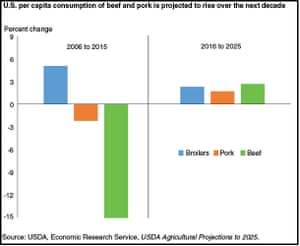


US per capita meat consumption projection

Illustration: USDA

Americans’ meat diet has changed. In the past decade, we’ve eaten less beef and pork, but more chicken. But the government is projecting an increase for all three types of meat as their prices fall, a result of a growing demand for them domestically and overseas and falling cost to feed the animals. Beef consumption is forecast to grow 11.7% and pork 10.3% from 2016 to 2025.


The term “broilers” in the chart refers to young chickens (as opposed to, say, hens raised primarily for eggs), which make up the bulk of chickens eaten.


Tracing antibiotic-resistant bacteria
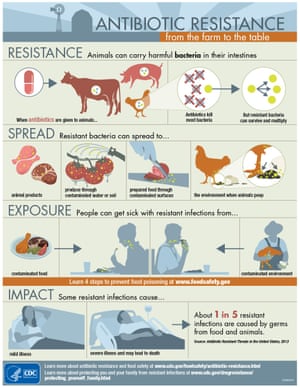


Antibiotic resistance from farm to table CDC


Illustration: CDC

When bacteria that dwell in farm animals develop resistance to drugs, they are more likely to reach humans. Some of the paths for the bugs take to get to their human hosts include handling and eating raw or undercooked and contaminated meat, drinking or swimming in water contaminated with animal feces and taking care of animals.


The sales boost
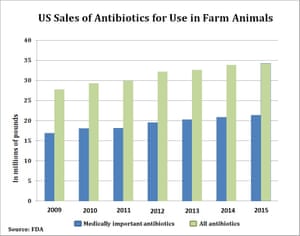


Antibiotic sales for farm animals


Illustration: Ucilia Wang/The Guardian

For more than a decade, the meat industry has faced mounting pressure from consumers and health groups to phase out the routine use of antibiotics in raising animals. The industry had to stop using certain antibiotics because the practice contributed to drug-resistant bacteria and caused a rise in food-born illnesses. Yet sales of medically important antibiotics to raise livestock, such as penicillins, tetracyclines and macrolides, have grown 26% from 2009 to 2015, according to the FDA.


As much as 70% of antibiotics developed to treat humans are sold for use in feed and water for farm animals.


Detoxing Chicken
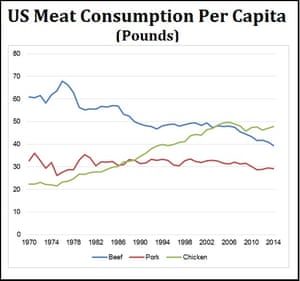


Meat consumption per capita

Illustration: USDA

Americans are eating more chicken than before, partly because it’s cheaper than beef or pork, as well as the belief that white meat is healthier than red meat. Chicken farmers have been ahead of other meat producers in reducing the use of antibiotics.


The FDA also has banned the use of certain antibiotics – sarafloxacin and enrofloxacin – in chicken because their use led to a type of drug-resistant bacteria called Campylobacter, which shows up in food poisoning cases in humans and causes diarrhea, stomach pain and fever. The bacteria developed resistance to ciprofloxacin, which belongs to the same class of antibiotics as the banned versions for chicken. Bacterial resistance to ciprofloxacin has persisted, however, mainly because many people contract the infection while traveling overseas, said the CDC.


How fast food chains respond
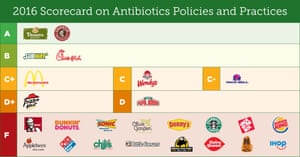


Restaurant antibiotic policy scorecard


Illustration: Natural Resources Defense Council

In response to the changing FDA rules and pressure from consumer advocates, fast food restaurants such as McDonald’s, Subway and Chick-fil-A in recent years have pledged to use meat raised with minimal or no antibiotics. Several consumer groups, including Center for Food Safety and Consumer Union, issued a report in September that graded big chain restaurants on their antibiotics policies. The scorecard, shown above, gave a failing grade to well-known brands such as KFC and Dunkin’ Donuts.


Consumer food and safety groups sent a petition earlier this month to 16 fast food restaurants, including KFC, Burger King and Jack in the Box, demanding that they stop using these drugs in their meat products.


Will new FDA rules curb antibiotic use in farm animals?

21 Ağustos 2016 Pazar

Failure to curb junk food ads ‘will hinder parents’ in fight against obesity

A failure to limit the way the junk food industry promotes itself to young people will make life far harder for parents trying to give children a nutritious diet, according to the royal society set up to improve public health.


Related: Theresa May’s climbdown on obesity is her first big mistake | Jackie Ashley


Experts in child health had hoped that the government’s long-awaited plan for fighting childhood obesity would include a comprehensive commitment to rein in the power of the food industry to advertise its more unhealthy products to children.


But, while the Department of Health is understood to have been supportive of the commitment, it was omitted from the plan unveiled last week during the summer recess following intervention by No 10. The decision dismayed many in the public health sector.


The watered-down plan, nine months in the making, was seen as a major victory for the fast food and fizzy drinks industries which have lobbied vigorously against measures that would stop them advertising at key times. Originally due to be unveiled by David Cameron, the revised plan under Theresa May’s new government has been savaged by TV chef Jamie Oliver and health bodies for not going nearly far enough.


Public Health England had produced a large body of evidence that suggested tackling the way the food and drinks companies target children was vital if the plan was to have an impact. But the government’s decision to ignore the evidence represents a huge missed opportunity, according to Shirley Cramer, chief executive of the Royal Society for Public Health (RSPH), which conducted interviews with children and their parents on what needed to be done.


“Everybody was advocating very hard for a ban on advertising junk food before the watershed and for family-based programmes like The X Factor,” Cramer said. “We’ve done quite a lot of research talking to young people who tell us that this – the stuff they see online, on bus tickets on posters near their school – makes an enormous difference. People are worried about the promotions, about the advertising. It’s all about pester power – 75% of parents we spoke to said their kids had seen an ad and they’d give in after half an hour of pestering.”


Cramer described the government plan as a good one but with “some big bits missing”. Only if a range of relevant government departments were to commit to preventative measures could the mounting problem of childhood obesity be adequately tackled, she suggested.


“If you look at teen pregnancies, that was a committed, longstanding strategy that went on for 10 years and now we’ve got the outcomes that are much better than predicted. If you really mean to do something about childhood obesity you can, but you need to get all these things working at the same time.”


The failure to constrain the advertising power of the fast food industry would make the job of councils trying to fight obesity all the more difficult, Cramer said. “For a local authority trying to take action against child obesity it doesn’t make their life easier. Junk food will still be advertised everywhere. It means the fight against childhood obesity will be much harder.”


She also echoed concerns expressed by some supermarket chains that voluntary plans to reduce sugar amounts in food would fail. “If you make it mandatory then, in a competitive sense, everyone knows where they stand. If it’s voluntary then the companies who do something will feel, ‘well the other guys aren’t doing it’. It needs to be a level playing field. We’ve got to do what we did with salt. The evidence is clear: most kids who are overweight or obese get their calories from sugar-sweetened beverages.”


Nearly 10% of all four- to five-year-olds and almost 20% of 10- to 11-year-olds are obese ,according to official figures. Obesity-related health issues now cost the NHS almost £5bn a year. The RSPH reports that half of all adults are predicted to be obese by 2050, more than doubling NHS costs to £10bn a year and with wider economic costs to the nation of almost £50bn.


“If we can reduce the number of children who are obese and therefore the number of adults who are obese we will not only be saving lives but saving the NHS money,” Cramer said.


Failure to curb junk food ads ‘will hinder parents’ in fight against obesity

17 Ağustos 2015 Pazartesi

Obama Continues Efforts To Curb Skyrocketing Heroin-Associated Deaths

[unable to retrieve complete-text material]


The Obama administration unveiled a new program that aims to tackle the country’s expanding heroin issue by diminishing heroin trafficking and growing help prevention efforts. In accordance to the Centers for Condition Control and Prevention (CDC), heroin use has much more than doubled amongst youthful adults in between the ages of 18-25 in the [...]


Obama Continues Efforts To Curb Skyrocketing Heroin-Associated Deaths

22 Haziran 2014 Pazar

"Sugar tax" essential to curb childhood weight problems, say professionals

Sugar

Action on Sugar stated: ‘Obesity in kids prospects to the premature growth of cardiovascular disease, stroke, heart attacks and heart failure.’ Photograph: Nick Ansell/PA


A campaign group has known as on the government to introduce a “sugar tax” to discourage consumption of sweetened soft drinks.


Action on Sugar explained it had created a seven-level strategy to curb childhood obesity following a request for its views from the well being secretary, Jeremy Hunt.


The measures consist of bringing in a sugar tax, limiting the availability of ultra-processed foods and sweetened soft drinks, and banning “junk food sports sponsorships”.


The group’s chairman, Professor Graham MacGregor, said: “Obesity in youngsters leads to the premature growth of cardiovascular condition, stroke, heart attacks and heart failure, which are the commonest trigger of death and disability in the United kingdom.


“Weight problems predisposes to type two diabetes, which additional increases the chance of cardiovascular ailment and also, importantly, it can lead to serious complications, ie the commonest lead to of blindness, renal dialysis and amputation of the reduced limbs.


“These problems are really expensive to control, and will cripple the NHS if the boost in weight problems and kind 2 diabetes is not stopped right away.


“Obesity is preventable if the foods environment is modified, however the existing policies are not doing work. The Uk demands the implementation of this coherent method, starting by setting incremental sugar reduction targets for soft drinks this summertime. No delays, no excuses.”


Dr Aseem Malhotra, cardiologist and science director of Action on Sugar, explained: “It is truly very shameful that the foods industry continues to devote billions in junk meals advertising focusing on youngsters, the most vulnerable members of society. They even manage to associate sugary merchandise with sport.


“Bodily activity has a multitude of positive aspects but a kid carrying out an hour of PE each and every day would be placing all to waste if they ended up gorging on a burger and chips and a packet of crisps washed down with a sugary drink. One has to run half a marathon to burn up off people calories. It is time to bust the myth of physical activity and obesity and dissociate junk foods and sport.”


The 7 measures known as for are:


• Lessen extra sugars by 40% by 2020 by reformulating food.


• Cease all forms of targeted advertising of ultra-processed, unhealthy food items and drinks to youngsters.


• Dissociate physical exercise with obesity by way of banning junk meals sports activities sponsorships.


• Minimize fat in ultra-processed food items, particularly saturated fat – 15% reduction by 2020.


• Limit the availability of ultra-processed food items and sweetened soft drinks as effectively as lowering portion dimension.


• Incentivise more healthy food and discourage drinking of soft drinks by introducing a sugar tax.


• Remove accountability for nutrition from the Department of Overall health and return it to an independent agency.


Action on Sugar – a group of specialists concerned with sugar and its effects on overall health – is doing work to attain a consensus with the meals market and government more than the dangerous results of a large sugar diet regime, and bring about a reduction in the quantity of sugar in processed foods.


A Division of Health spokesman said: “We know some folks consume as well numerous calories including sugar. Childhood weight problems is at its lowest because 1998 but much more need to be completed.


“Next week we will get skilled scientific tips on sugar which will help form potential contemplating. We will take into account these recommendations as element of this.”


"Sugar tax" essential to curb childhood weight problems, say professionals

16 Mayıs 2014 Cuma

Want to curb binge consuming? Finish the emphasis on laws and search at culture | Sadhbh Walshe

The summer just before I went to university in Dublin, I was in a state of large anxiety – not about the prospect of leaving house or the coming course perform so much as my capability to drink alcohol in any amount. To my young mind, becoming ready to drink a whole lot was as important a portion of college daily life as getting able to compose a very good paper. So I put in a good deal of work – to consuming – until I was in a position to knock back pints with the very best of my new classmates.


This type of blind obligation to binge drink is specifically the type of probably unsafe boozing that is led to a surge of new warnings from health specialists. According to a report launched this week by the Planet Overall health Organization (WHO), entirely 16% of drinkers around the world engage in hefty episodic (or binge) consuming – the most hazardous form.


WHO is urging governments to take aggressive methods to tackle the issue by raising taxes on alcohol product sales, raising minimal drinking ages, regulating income and so on. But if rules alone were enough to lessen binge consuming, then countries with stricter rules would have better drinking habits. Except that is not constantly the case.


As Western nations go, the United States is reasonably puritanical about boozing – the legal drinking age is 21, liquor taxes are higher, product sales are regulated and public drinking is a no-no in most places. Nevertheless binge drinking is a common sport in the US, even amongst teens. The WHO report says 24.5% of American drinkers engage in bouts of heavy episodic drinking.


In spite of early pub closing instances and large taxes on alcohol sales, Britain’s binge drinking rate is even worse, at 33.four%. In Ireland, the place the laws are even stricter than in the Uk, I am embarrassed to say that a whopping 48.two% of drinkers binge.


Then we have the virtuous Italians, who love their vino, their apertivos and their digestivos but report a heavy episodic consuming rate of just 6.2%. In contrast to the US, Britain and Ireland, alcohol is super-inexpensive in Italy and, till last year, the legal consuming age was just 16. Obviously the Italian model is the 1 to emulate – but it really is the country’s drinking culture and not its consuming laws that make the model function.


Malcolm Gladwell examined the influence of culture on the way men and women drink in a 2010 New Yorker piece. In it, he referenced the operate of Yale researchers from the 1950s who looked into drinking routines of first- and 2nd-generation Irish and Italian immigrants in New Haven, Connecticut, exactly where the university is based mostly. Each communities liked to drink, but it is not difficult to guess which group suffered the a lot more damaging consequences from performing so. The Yale clinic admitted one,200 alcoholics from the community into its clinic – the bulk of whom had been Irish. Only a fraction were Italian. As Gladwell wrote:


Right here had been two groups who practiced the very same religion, who have been topic to the exact same laws and constraints, and who, it appeared affordable to suppose, ought to have the very same assortment inside their local community of individuals genetically predisposed to alcoholism. Yet the heavy drinking Italians had nothing at all of the issues of their Irish counterparts.


Obviously the drinking laws of their adopted land had less influence on these immigrants than the cultural influences they brought with them from their residence countries. The Italians had absorbed the strong cultural message that consuming was something you did in moderation, with meals, although the Irish immigrants had absorbed the identical mistaken cultural message I heard at the age of 17: you drink to get drunk.


I’m not suggesting that laws perform no part in regulating behavior it really is just that, by themselves, they will not do practically enough. The predicament with American university college students is a situation in level. Scientific studies have proven that a higher minimum-age drinking law has helped to prevent alcohol-relevant deaths in this demographic – and that is not nothing. But drinking (and binge drinking) is nonetheless so common among underage students that universities may well as properly hand out fake-ID cards along with their prospectuses to conserve the children time. The powerful cultural message that drinking to excess is a standard rite of passage, I feel, has a lot more bearing on pupil conduct than any rules imposed by the government. So, if we genuinely want to see a reduction in binge drinking, the message demands to modify along with the law and its enforcement.


It is possible to do greater on the two fronts – and Ireland could truly be leading the way. Despite individuals embarrassingly higher binge consuming statistics, alcohol consumption in my house country has actually decreased by almost twenty% more than the last decade. Some of this decline can be attributed to the 2007 Intoxicating Liquor Act, which launched random breathalyzer tests for drivers and limited hours for liquor revenue, but cultural factors could have played an even bigger role.


Schooling campaigns like DrinkAware.ie have been credited with shifting perceptions about alcohol use and promoting responsible drinking – and, far more importantly, most pubs in Ireland now serve foods as properly as drink. This might not seem like a big deal to outsiders, but it has been a large shift in Irish daily life. The regional pub has always been an critical social center, except now, rather of knocking back drinks at the bar, Irish men and women can get pleasure from consuming and consuming – just like the Italians.


Certainly, the sooner we all commence consuming like Italians, the far better. I frequently believe that if I had not grown up in a nation in which hefty consuming was so culturally acceptable and even glamorized, I would not have felt such intense pressure as an underage teen to commence knocking back booze that I didn’t even like the taste. The good news is for me, I apparently don’t possess the alcoholic gene and ultimately realized to get pleasure from my wine and drink like a regular particular person. But with three.3m alcohol associated deaths in 2012 alone, obviously many men and women are not so fortunate.


We owe it to these millions to get into account the tremendous cultural pressures that can lead people to drink to excess– as an alternative of just moralizing about their conduct and imposing tighter sanctions and laws. These measures surely have their place, but except if the everyday life forces that influence people’s drinking habits are confronted, this dilemma is in no way going away.


Want to curb binge consuming? Finish the emphasis on laws and search at culture | Sadhbh Walshe

26 Nisan 2014 Cumartesi

Insurers Including Merchandise On Obamacare Exchanges May Curb Charges

Information that more than eight million Americans signed up for personal wellness rewards below the Cost-effective Care Act is drawing well being insurance coverage businesses to much more markets in 2015 and could suggest greater costs and choices for buyers, analysts say.


Currently, the nation’s greatest wellness insurance coverage firm, UnitedHealth Group UnitedHealth Group (UNH), final week mentioned it is seeking to expand up coming yr. Meanwhile, other wellness plans which includes Aetna Aetna (AET), Humana Humana (HUM), Wellpoint (WLP) and Blue Cross and Blue Shield programs are evaluating their markets and costs for 2015.


“We had a extremely modest footprint in 2014 and as we’ve mentioned and even now believe, we do have a bias to enhance that participation in 2015,” Gail Boudreaux, executive vice president and CEO of UnitedHealth’s United Healthcare subsidiary, informed analysts on the company’s quarterly earnings call last week.


Even though UnitedHealth isn’t saying exactly where it will increase, wellness rewards analysts say improved insurance coverage firm participation on the exchanges is excellent information for client options and well being prepare pricing.


Aetna CEO Mark Bertolini earlier this week told Wall Street analysts and investors on the company’s 1st-quarter earnings call that the business is evaluating rates for 2015 for the 17 states the place it offers merchandise on public exchanges. Markets with increased numbers of overall health program members tend to have decrease rates but something nonetheless has to be accredited by state or federal regulators.


But benefits analysts say marketing rewards on an exchange is beginning to improve competition and reduce charges.


“The all round goal of a overall health exchange is to develop a aggressive marketplace that provides shoppers a variety of high quality overall health ideas to meet their person requirements,” stated Cary Grace, CEO of Aon Exchange Answers, a personal exchange provided to employers by positive aspects consulting company Aon Hewitt (AON). “Adding new carriers that comprehend the regional competitive environment and the buying preferences of the buyers in that regional market will aid to boost this final result.”


Pondering how Obamacare will influence your overall health care? The Forbes eBook Inside Obamacare: The Repair For America’s Ailing Well being Care Technique answers that question and far more. Obtainable now  at Amazon and Apple. 


Insurers Including Merchandise On Obamacare Exchanges May Curb Charges

25 Mart 2014 Salı

MPs: action must be taken to curb rise in liver illness

The government must handle the “catastrophic consequences” of ignoring the burden of liver condition, MPs have mentioned.


An inquiry report from the all-get together parliamentary hepatology group (APPHG) accused NHS England of ditching programs to produce a technique for tackling liver ailment, which kills nearly eleven,000 people a 12 months.


The British Liver Believe in has predicted that spend on combating liver disease will attain £1bn a 12 months inside of the next decade.


The report stated the government, the NHS and Public Health England must take action to curb the tide of rising liver illness.


Recommendations consist of a minimal 50p unit cost for alcohol and the co-ordination of a national method to stopping ailment as effectively as guaranteeing much better care and early diagnosis.


Action is also necessary on weight problems and getting rid of hepatitis C inside the next 15 years, the APPHG explained.


Liver disease is the fifth biggest – and quickest-growing – killer in the United kingdom but a lack of apparent signs signifies it can be diagnosed at a late stage.


Figures display that a third of men and women in the United kingdom with liver condition have weight problems-related non-alcoholic fatty liver disease.


Alcoholic liver condition is also accountable for about 66% of all alcohol-associated deaths.


Meanwhile, an estimated 216,000 men and women in the United kingdom are infected with hepatitis C which can also cause liver condition.


Public well being minister Jane Ellison announced in December that NHS England had no strategies to publish a national liver ailment outcomes approach, which the APPHG said had been 3 many years in the drafting.


Tory MP, David Amess, who chairs the APPHG, explained: “The launch of today’s inquiry report is a wake-up call for the nation.


“Liver condition is the only one of the UK’s leading five causes of death where death costs proceed to rise and there is no national approach to tackle this. Except if urgent and co-ordinated action is taken now, in much less than a generation, liver disease has the possible to be the UK’s greatest killer.


“As most liver ailment can be prevented, this is a tragic waste of life.”


Andrew Langford, chief executive of the British Liver Trust, explained: “Liver disease is a nationwide scandal and much more must be accomplished to avert, diagnose and treat the situation.


“We can’t sit by and allow so much needless struggling and death. Liver ailment destroys lives and puts a important fiscal burden on society. We want decisive action now.”


Charles Gore, chief executive of the Hepatitis C Trust, stated: “There is so considerably more that could be accomplished to avoid the escalating death toll from liver illness.


“For example, only three% of hepatitis C individuals acquire probably daily life-conserving treatment every 12 months. With the new therapies we could properly get rid of the virus in the Uk inside of a generation. The government, Public Well being England and all elements of the NHS urgently wants to prioritise action on the causes of liver condition.”


MPs: action must be taken to curb rise in liver illness

9 Ocak 2014 Perşembe

Five techniques to curb your web use and get your lifestyle back | Rhiannon Lucy Cosslett

It wasn’t until I started working that my internet use started to spiral out of control.

‘It wasn’t right up until I started out doing work that my world wide web use commenced to spiral out of control.’ Photograph: Piotr Pawinski/Alamy


A study has unveiled that people who are effective in their careers are more likely to be engaging in compulsive net use, and are at rising risk of anxiety, depression and isolation as they obsessively log in in out-of-workplace hrs.


The results came as a shock to the researchers, who assumed it would be younger folks and the unemployed who have been most at threat from internet addiction. As a teenager, I would remain up chatting on msn or updating my teenopendiary with terrible poetry and homemade gifs until finally the early hours, although when I was on the dole I would be consistently refreshing my inbox in the hope that someone, anyone, would throw me a bone.


It wasn’t, however, right up until I started functioning that my internet use began to spiral out of control. The phrase “come to bed” will be acquainted to net addicts all over the place, whether or not employed or not, but the want to be consistently plugged into the information took my addiction to an additional degree, and I only just look to have got a hold on it (however my darling boyfriend may possibly disagree). Here are my 5 leading guidelines to sustain a healthy on the web daily life. I am now in recovery. Maybe quickly you will be also.


one. Schedule your internet time


It sounds deeply dull, I know, but except if I’m on a quite critical deadline, I now force myself to switch off at five.45pm, which is when my companion will get in from work. Generating positive there is a clear division among work time and residence time, I realised, is the only way I would be capable to maintain our relationship. If the only time your loved ones see your gorgeous encounter is when it truly is basked in the glow of a screen, this might be 1 to consider.


two. Accept that not every single e-mail can be answered


A simple tip, but a revelation to me. Backed-up emails can be a terrifying prospect, but as soon as you accept that it truly is extremely hard to dwell a wholesome daily life at the identical time as answering every single and every a single, a surprising volume of time frees up. As a seasoned procrastinator, I’ve produced a minor e-mail label referred to as “to reply”, for those messages which demand eventual action on my part. Stated action may be slow, but it acts as a reassuring comfort blanket.


3. Disable unnecessary notifications


The first thing I did when striving to minimize down on my web use was to make confident it was unable to encroach on my day-to-day existence in the genuine planet via the medium of iPhone notifications. In other phrases, I ended the approach by which Facebook updates, tweets and emails would come right to my mobile. This was partly to avoid tweets accusing me of being a rubbish feminist/crap journalist/appalling human from harshing my buzz when I was possessing cocktails, but it can also be employed for operate functions. Anyone who needs to contact you urgently, for specialist causes, will almost certainly have your mobile phone quantity anyway. The same goes for pals and relations.


4. Go for a walk


A piece of tips from my mom, in the kind of “make certain that you get out of the property each day”, but it can also apply to individuals in a work atmosphere, or individuals who are embroiled in a especially vehement political debate in the comment section. If you are ready to, obtaining a bit of fresh air helps you realise that the outdoors globe even now exists prior to you return to your pursuits with a renewed vigour (or, in the case of on-line arguments, 10 much more rebuttals that you believed of on the way to Budgens). If you can not get away, get a nap subsequent to the radiators in the staff space, disappear to the loos for a time longer than is polite, or have a cup of tea.


5. Don’t forget: it really is only the web


It really does not matter that a lot. It sounds cheesy, but spending time with folks who care about you and make you howl with laughter is the best antidote to web addiction. It truly is hard to consider items like social media significantly when friends are texting you going “lol at your twitter storm – pub?” Logging in slips even more down your priority checklist as you realise that your absence does not imply the planet will quit turning. I just lately took a month-long hiatus from blogging and Twitter, and when I returned, all was much the identical. It was that, or smash up the router – and it worked.


Five techniques to curb your web use and get your lifestyle back | Rhiannon Lucy Cosslett