tribunal etiketine sahip kayıtlar gösteriliyor. Tüm kayıtları göster

27 Mart 2017 Pazartesi

Doctor was "dishonest" in screening nurse who had Ebola, tribunal finds

A doctor acted dishonestly when she lied to investigators about the dangerously high temperature of a nurse who went on to develop Ebola, a tribunal has found.


Dr Hannah Ryan, who had been working in Sierra Leone during the west Africa Ebola outbreak of 2014, was one of the medics who assessed Pauline Cafferkey following the Scottish nurse’s return to the UK in December 2014.


Ryan did not raise the alarm when a colleague wrote down Cafferkey’s temperature as 1C lower than it actually was during a “chaotic” screening process at Heathrow airport on 28 December 2014, a medical practitioners tribunal found on Monday.


A raised temperature can be the first sign of Ebola, which can kill within five days. Cafferkey, who twice nearly died from the virus, went on to develop one of the worst cases on record for people treated in the west.


During screening at Heathrow, Cafferkey insisted she was feeling fine and was eventually allowed to catch her connecting flight to Glasgow. The following day, she developed further Ebola symptoms and was admitted to hospital for urgent treatment.


The tribunal found that Ryan had acted in a “misleading” manner when she agreed that the form recording the lower, wrong temperature be submitted to screening staff from Public Health England (PHE) at the airport.


But Ryan, who had only just graduated from medical school, did not intend to conceal Cafferkey’s real temperature at the airport, knowing it to be at least 38.2C – higher than the 37.5 considered normal – the panel found.


However, the tribunal decided that the doctor had later been “dishonest” when she concealed her role in taking Cafferkey’s temperature during a conversation with Dr Nick Gent on 2 January 2015. Gent, deputy head of the emergency response department at PHE, had phoned her during PHE’s investigation into when Cafferkey’s symptoms first emerged.


Ryan did not tell him she had taken Cafferkey’s temperature and told him words to the effect that the nurse’s temperature was “normal”, the panel found.


The tribunal heard that Ryan and Cafferkey were one group among many British medics who put their own lives at risk by volunteering their medical skills and going to west Africa to help fight the outbreak.


Deployed on 22 November 2014, they were based at an 80-bed treatment centre in Kerry Town, a village in Sierra Leone, working “tirelessly in dangerous and highly pressurised conditions” during which they “formed a strong bond of friendship”, according to Fraser Coxhill, representing the General Medical Council.


The medical practitioners tribunal, which is independent of the GMC, will decide later this week whether Ryan’s fitness to practice as a doctor was impaired due to her actions and whether to impose sanctions.


Doctor was "dishonest" in screening nurse who had Ebola, tribunal finds

24 Kasım 2016 Perşembe

Ebola nurse Donna Wood had unblemished record, tribunal hears

The nurse who was found to have concealed her colleague Pauline Cafferkey’s raised temperature before she tested positive for Ebola risked her life for others in Sierra Leone and has an otherwise unblemished record, a tribunal has heard.


Donna Wood’s lawyer told an independent panel at the Nursing and Midwifery Council that he accepted their findings but said her actions amounted to a brief “lapse of judgment” by a professional who had given almost 30 years of “distinguished” service to the NHS.


Ben Rich was speaking the day after Wood had been found guilty of misconduct following allegations that she knew Cafferkey had a high temperature and that she failed to escalate this during the screening process at Heathrow airport when they returned from six weeks volunteering in Sierra Leone in December 2014.


Before the panel retired to consider whether her misconduct amounted to an impairment in the nurse’s current fitness to practice, Rich told them: “On your findings it would be incorrect to find that any of those professionals, Donna Wood included, really thought that Pauline Cafferkey had Ebola.”


He told the panel that several witnesses including the lead clinician on the screening team, Deepti Kumar, had said that Cafferkey did not seem unwell on the day.


“Had there been the slightest suspicion that actually Pauline Cafferekey was ill, you know that witnesses you found to be honest, thought that Pauline Cafferkey seemed completely well,” Rich said.


Cafferkey initially passed the screening process after her temperature was found to be over 38C but was recorded on a form as normal. When she returned to the screening room her temperature was taken three more times and found to be normal.


Cafferkey had told the manager of the screening process, David Carruthers, a former Metropolitan police officer, that she had taken paracetamol about an hour before, which could have masked her real temperature.


But Carruthers, who had no clinical training, did not understand the significance of this and failed to pass the information on to Kumar, who was assessing Cafferkey in the second screening.


Rich pointed out that Kumar was among several witnesses who had nonetheless said that Cafferkey appeared well despite her temperature.


He told the panel on Thursday that the findings amounted to a “momentary lapse of judgment in a nurse who has an otherwise distinguished record of service to the NHS, to the public, a distinguished period of service to Ebola patients before this during which time she risked her own life for the benefit of others”.


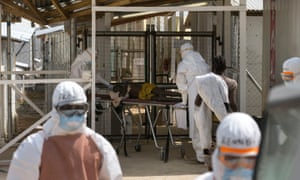
An Ebola treatment centre outside Freetown, Sierra Leone, in December 2014.


An Ebola treatment centre outside Freetown, Sierra Leone, in December 2014. Photograph: Baz Ratner/Reuters

Wood was brought before the NMC on three misconduct charges, including recording Cafferkey’s temperature reading dishonestly in order to hide it from public health officials.


It transpired during the hearing that the group had decided to take their own temperatures because the screening team were not equipped to do so. They had run out of screening forms and only had four screening cubicles for about 50 people.


On Wednesdsay the NMC found that she had not recorded an incorrect temperature as alleged but found that she had suggested that Cafferkey’s temperature be recorded lower so that the volunteer group could leave the “uncomfortable” and “chaotic” area more quickly.


Wood is facing a professional sanction, which could involve being struck off or a suspension.


Aja Hall, the case presenter for the NMC, told the panel the case was “particularly serious” as “Pauline Cafferkey was in the starting stages of Ebola and in an extremely busy and public place”.


She said it was “well established” that a high temperature was the “first sign that there may be infection which is why so much significance was placed on the taking of temperature, both in Sierra Leone but more crucially through the screening process at Heathrow airport”.


The panel is expected to to conclude its deliberations on Friday.


Ebola nurse Donna Wood had unblemished record, tribunal hears

14 Kasım 2016 Pazartesi

Nurse faces tribunal over Pauline Cafferkey temperature reading

A nurse who was lauded by the government as one of Britain’s heroes of the Ebola epidemic is facing a disciplinary tribunal, accused of concealing the high temperature of her colleague Pauline Cafferkey, who developed Ebola on her return from Sierra Leone.


Senior sister Donna Wood was the face of the volunteers in Medics Behind the Mask, an online feature made by the Department for International Development. She and Cafferkey were among the first 70 volunteers to leave the UK and spend Christmas 2014 in the Ebola treatment units of Sierra Leone, and were publicly thanked by Justine Greening, the then international development minister.


But Wood’s career could end over events at Heathrow airport when the volunteers flew home on 28 December 2014. All the returnees had to be screened to ensure they did not have a high temperature that might be the first sign of Ebola fever. Chaotic conditions and long delays were described in the screening unit, with too few staff to process the exhausted volunteer nurses and doctors, so they took each other’s temperatures.


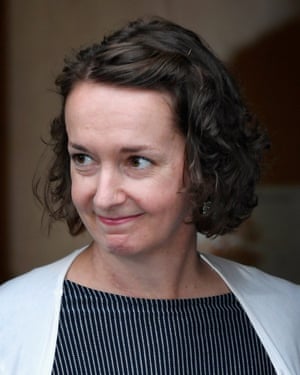
Pauline Cafferkey after being cleared of misconduct charges.


Pauline Cafferkey after being cleared of misconduct charges. Photograph: Jeff J Mitchell/Getty Images

When Cafferkey’s temperature was found to be high, Wood is alleged to have recorded it on the form as normal, saying they would then “get out of here and sort it out”. They were then allowed to leave the screening area.


Cafferkey later told another volunteer she had a high temperature and returned to the screening area, but she had taken paracetamol and her temperature was found to be within the normal range, so she was cleared to fly to Scotland, where she was taken ill.


Cafferkey was accused by the Nursing and Midwifery Council of misconduct, but was cleared on the grounds that she had already become too ill to understand the implications of her actions.


After she became ill the RAF flew her to a special isolation unit at the Royal Free hospital in London. Cafferkey came close to death but recovered. She then nearly died again when she later developed meningitis as a result of the Ebola virus.


Before travelling to Sierra Leone, Wood was a senior sister at Haywood hospital in Burslem, near Stoke on Trent, and had been nursing for 29 years.


“I’ve always been a caring person – that’s what my mother said. So it always felt like nursing was my vocation. It always will be,” she is quoted as saying on the DfID website.


“I’d been following the stories on the news and I felt I had to do this straight away. I could use the skills I’ve got to make a difference and join a team to help bring the disease under control … You don’t think of it as being heroic. It’s just what we do.”


The misconduct hearing is scheduled to last for eight days.


Nurse faces tribunal over Pauline Cafferkey temperature reading

11 Ağustos 2016 Perşembe

Tribunal rules Yorkshire Ripper can be sent to mainstream prison

[unable to retrieve full-text content]


Peter Sutcliffe, now known as Peter Coonan, may be released from Broadmoor after mental illness judged to be under control


The Yorkshire Ripper, Peter Sutcliffe, who murdered 13 women during the 1970s, may be released from Broadmoor, the secure psychiatric hospital, and sent to a mainstream prison after a tribunal concluded his mental illness was under control.


Sutcliffe was given 20 life sentences when he was convicted in 1981 but in 1984 was diagnosed with paranoid schizophrenia and transferred to Broadmoor.


Related: Police review claims of unsolved Yorkshire Ripper attacks


Continue reading…


Tribunal rules Yorkshire Ripper can be sent to mainstream prison

3 Haziran 2014 Salı

Best surgeon sacked right after allegedly harassing two female trainee medical professionals, tribunal hears

“I feel the claimant had sought to engage in inappropriate conversations of a personalized nature with (the medical doctors) and had tried to persuade them to meet privately with him. In addition, he had, I believed, told them each to maintain these matters amongst them secret,” Dr Thomson said.


She added: “Worst of all, the claimant had sought to influence the junior physicians by implying that their careers may be affected if they did not comply with his requests to meet, or would be enhanced if they complied with the requests to meet outside of function hours and at his residence.


“As junior doctors, they have been in a vulnerable position in relation to the claimant and their careers would have been hard won and very dear to them. To try to exploit this was wholly wrong.”


Dr Thomson stated the ladies, who are not able to be named, “felt intimidated by the advances created by the claimant”, and that his conduct had been “unwanted and had triggered them anxiousness and distress”.


One of the females alleged the unmarried surgeon touched her inappropriately on the leg in a failed sexual advance in his office, whilst the other explained he sent her “persistent” text messages asking her to come over to his house soon after perform.


Dr Thomson said: “The two medical doctors explained how the claimant’s position and influence with the Yearly Assessment of Competence Progression approach had been referred to on numerous occasions and that they had understood that their ARCP would endure if they did not agree to devote social time with the claimant.”


The ARCP is a formal assessment used to determine how well a trainee doctor is progressing in their coaching, the tribunal heard.


Dr Thomson stated the accused advisor had referred to as one particular of the ladies “a liar” and claimed the two had colluded to destroy his profession when he was hauled just before the disciplinary hearing.


“In essence, the claimant denied he had behaved in the way alleged by (the physicians) and he said the incidents they described had basically not happened,” explained Dr Thomson, director of children and women’s services at the hospital Believe in.


She continued: “I in the end concluded that each (doctors) were credible witnesses. I discovered no evidence to substantiate the claimant’s argument that the junior physicians had colluded with every single other.


“I believed (the doctors) and I believed the claimant had behaved in the way they described. I identified the claimant’s perform, aside from getting intimidating and upsetting, amounted to sexual harassment.”


The advisor was located guilty of gross misconduct and sacked with instant impact in December 2012.


Now, he is suing the NHS Believe in for unfair dismissal, breach of contract, racial discrimination, sexual discrimination, and loss of wages at Reading through Tribunal Centre, Studying, Berkshire.


The advisor claims the allegations were fabricated as portion of a cynical move by the Trust managers to force him out of his occupation amid budget cuts.


Nonetheless, Dr Thomson mentioned she was unaware of the planned restructuring of his department at the time she sacked him, and pointed out that his dismissal induced “quick-phrase troubles” at the hospital in which he worked.


The 3-week tribunal continues ahead of Employment Judge Andrew Gumbiti-Zimuto. The tribunal manufactured an buy precluding the naming of the claimant or anything at all which may possibly identify him for the length of the proceedings.


Best surgeon sacked right after allegedly harassing two female trainee medical professionals, tribunal hears

17 Nisan 2014 Perşembe

Whistleblowing heart medical doctor who aired hospital security fears wins tribunal situation

Cardiac surgeons replace a heart valve.

Surgeons change a heart valve. Mattu raised issues such as patients’ beds being squeezed too shut collectively after operations. Photograph: Sean Smith/Guardian


A whistleblowing heart medical doctor who sounded the alarm about poor care and patient deaths at his own hospital has won a main legal victory towards his NHS employers, whose attempts to pursue in the end unsubstantiated allegations against him expense £6m of public money.


An employment tribunal has ruled that Dr Raj Mattu was unfairly dismissed by the Walsgrave hospital in Coventry, and suffered a series of “detriments” soon after he spoke out about what he saw as hazardous circumstances, which includes as well numerous patients’ beds becoming squeezed together to support alleviate overcrowding.


Mattu was sacked by University Hospitals Coventry and Warwickshire NHS Trust in 2010, nine years soon after he first aired his considerations publicly about what he stated was dangerous submit-operative care. He highlighted a series of worries about patient security, including the situations of two patients who died in crowded bays.


He voiced alarm at the hospital’s “5-in-4″ policy, beneath which – to save funds – an extra fifth bed was positioned in a bay meant for only four individuals. The Commission for Health Improvement, the then NHS watchdog, condemned the practice and criticised the hospital, which it said had a much larger death fee than must have been anticipated.


An employment tribunal sitting in Birmingham below Judge Hughes ruled this week that 54-yr-outdated Mattu had been unfairly dismissed and would receive compensation, which will be decided later on.


It described him as blameless, saying: “The claimant did not result in or contribute to his dismissal.”


The believe in ran up in excess of £6m in legal charges in its long quest against Mattu, which he mentioned was a campaign of vilification designed to discredit him for no purpose. The General Medical Council determined not to proceed to an inquiry following hunting into far more than 200 allegations the believe in created towards him.


It also employed private detectives to investigate the cardiologist and a public relations agency to manage media curiosity in the lengthy-running situation, which noticed Mattu obtain important assistance from his healthcare colleagues.


Mattu had been “vilified, bullied and harassed out of a work he loved”, the doctor’s lawyer claimed. “This has been a David v Goliath legal battle, which I am delighted to have won for my consumer,” explained his solicitor, Stephen Moore.


“The tribunal’s findings – that Dr Mattu was a whistleblower and was unfairly dismissed – entirely vindicate him. Dr Mattu was a amazing cardiologist and it was tragic that his pursuit of safety and the highest requirements in care led to him currently being vilified, bullied and harassed out of a work he loved.” Moore extra.


“This case has brought to light the appalling way whistleblowers are still being treated and raises critical and wider concerns that need to be addressed.”


In a statement, the trust stated it was “disappointed by the employment tribunal’s decision that the dismissal of Dr Mattu was unfair, provided that the procedure followed by the trust was reviewed by the court of appeal in March 2012, when it located in the Trust’s favour”.


It extra: “We are pleased that they have firmly rejected his main declare that his dismissal in 2010 was in any way linked to whistleblowing about patient care.


“As a believe in, we will continue to help all our personnel to increase problems of concern in our work to give continuous improvement in our solutions to patients.”


In his inaugural speech as the new chief executive of NHS England earlier this month, Simon Stevens stated that, while each and every whistleblower would not always be right, “the reality is, patients’ lives are saved when courageous people speak up – openly and truthfully – and when every single of us requires private accountability for putting items correct.”


Whistleblowing heart medical doctor who aired hospital security fears wins tribunal situation