3Dprinted etiketine sahip kayıtlar gösteriliyor. Tüm kayıtları göster

16 Mayıs 2017 Salı

3D-printed ovaries allow infertile mice to give birth

Infertile mice have given birth to healthy pups after having their fertility restored with ovary implants made with a 3D printer.


Researchers created the synthetic ovaries by printing porous scaffolds from a gelatin ink and filling them with follicles, the tiny, fluid-holding sacs that contain immature egg cells.


In tests on mice that had one ovary surgically removed, scientists found that the implants hooked up to the blood supply within a week and went on to release eggs naturally through the pores built into the gelatin structures.


The work marks a step towards making artificial ovaries for young women whose reproductive systems have been damaged by cancer treatments, leaving them infertile or with hormone imbalances that require them to take regular hormone-boosting drugs.


“Our hope is that one day this ovarian bioprosthesis is really the ovary of the future,” said Teresa Woodruff at Northwestern University in Chicago. “The goal of the project is to be able to restore fertility and endocrine health to young cancer patients who have been sterilised by their cancer treatment.”


[embedded content]

Of seven mice that mated after receiving the artificial ovaries, three gave birth to pups that had developed from eggs released by the implants. The mice fed normally on their mother’s milk and went on to have healthy litters of their own later in life.


Writing in the journal Nature Communications, the scientists describe how they printed layered lattices of gelatin strips to make the ovary implants. The sizes and positions of the holes in the structures were carefully controlled to hold dozens of follicles and allow blood vessels to connect to the implants. Mature eggs were then released from the implants as happens in normal ovulation.


Chemotherapy and high doses of radiation used in cancer treatment can destroy some or all of a woman’s eggs, putting them at risk of infertility and an early menopause. And while doctors have had some success in restoring women’s fertility from frozen ovarian tissue, an implant could potentially help those who do not bank healthy tissue when they are children.


Monica Laronda, a co-author on the study, said that an ovary implant could also help cancer survivors whose eggs are so damaged that they need hormone replacement therapy to trigger puberty. “We’re thinking big picture, meaning every stage of the girl’s life, so puberty through adulthood to a natural menopause,” she said.
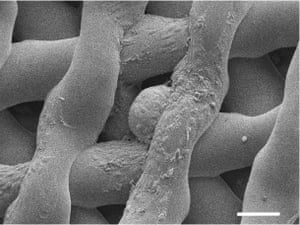


A microscopic image of an immature mouse egg, surrounded by supportive cells, after it has been housed in a bioprosthetic ovary scaffold for six days.

A microscopic image of an immature mouse egg, surrounded by supportive cells, after it has been housed in a bioprosthetic ovary scaffold for six days. Photograph: Northwestern University

Scientists have made artificial ovaries for mice before, but the latest research is believed to be the first time that researchers have used 3D printing to manufacture them. It is not clear if the same approach will work in people because human follicles are much larger and grow rapidly until they are visible to the naked eye.


Other animal experiments performed nearly a decade ago hinted that women who had ovarian tissue transplants later in life might enjoy broader benefits from the procedure than restored fertility. In 2010, scientists at Kato Ladies Clinic in Tokyo found that ovarian transplants extended the lives of old mice, and led older females, who were normally inactive, to seek out mates and have babies. The researchers conceded that far more work was needed to assess the effects in women.


Advances in 3D printing have already transformed some areas of medicine by allowing the doctors to make bespoke body parts that can be directly implanted into patients. Last year, South Korean surgeons printed a titanium heel bone for a man who had a tumour removed from his foot.


Meanwhile, researchers in North Carolina announced that they had made ears, jawbones and skeletal muscles by 3D printing structures laced with living cells. Other groups have printed vascular networks that will be vital for creating large synthetic organs in the lab.


3D-printed ovaries allow infertile mice to give birth

21 Ağustos 2015 Cuma

Welcome to the complicated world of 3D-printed drugs

The prospect of tailor-made drugs that are customised to your individual wants has moved a phase closer with the latest announcement of the first 3D-printed (3DP) drug to achieve approval from the US meals and drug administration (FDA).


Relevant: Smile! Meet the 3D printer churning out teeth, nerves and gums for dentists


A visit to the pharmacy may soon involve currently being questioned on your bodyweight, or possessing your percentage of entire body unwanted fat measured so that the medicine can be printed to match your dimension. Younger young children, typically resistant to taking medicine, might be ready to choose the colour, form and layout of a tablet that could be developed to dissolve effortlessly. Imagine antibiotics that search like Peppa Pig or superhero characters.


But as entry to the engineering expands, what are the potential downsides? Will 3DP be risk-free? Could it lead to a proliferation of illegal drugs and how will regulation adapt?


Personalised medication


The vision behind 3DP is that medication will be customised to individuals in approaches that make it safer and far more effective. The dimension, dose, appearance and price of delivery of a drug can be developed to suit an individual. FDA accredited Spritam, for illustration, uses 3DP technology to generate a a lot more porous pill that is simpler to swallow.


“Now that this approval has gone via, a lot more medicines are most likely to come to marketplace,” says Dr Stephen Hilton, of University School London (UCL) School of Pharmacy. The possibilities are that higher street pharmacists will be able to tailor and print out customised drugs inside the subsequent decade.


The choices seem endless. For illustration, some sufferers have to have their stomach removed as component of their treatment method for stomach cancer. Medication could be created to be absorbed from the intestine rather than from the stomach for these folks. The opportunities to fit the drug to the patient will boost as people get their own gene profile.


Obese patients could swallow parts that assemble in the stomach to produce a structure that requires up a great deal of area as an substitute to a gastric band. Yet another thought could link the release of a drug that kills cancer cells with blood ranges of a tumour marker. As the cancer grows, blood amounts of the tumour marker rise and this would set off release of the drug into the cancer.


Lee Cronin, professor of chemistry at Glasgow University, says that current technological innovation enables prepared-produced medication to be adapted and made by 3DP. “Like taking a strong bar of chocolate and including air bubbles to make an Aero,” he says. The 3DP acts as a proxy robot, mixing person constituents like an automated cocktail maker, he explains.


But the actual challenge is to digitise the chemistry so you have a blueprint for molecules and can construct medication from scratch. The blueprint could be encrypted to make certain that medication are only created according to a validated blueprint and, the hope is, counterfeit medication would turn into a point of the past.


In a TED speak, Cronin explained how it could be completed. “It requires application, it requires hardware and it calls for chemical inks. And so the really awesome bit is the thought that we want to have a universal set of inks that we place out with the printer and you download the blueprint, the natural chemistry for that molecule, and you make it in the gadget. And so you can make your molecule in the printer employing this computer software.”


If Cronin’s vision turns into a actuality, the blueprints could be downloaded for a modest charge. The medication themselves could be produced in nearby pharmacies, which are probably to see their position change radically above the up coming five many years.


Alternatively of storing packets of tablets, pharmacists will have reels of filaments of the base solution (our prescribed drug) and will customise the dose and shape of tablet to our person needs. There would be an onus on the pharmacists to verify the customised pills, just as they do now, says Hilton.


Pharmaceutical organizations must not shed out substantially as pharmacists will even now have to acquire the base goods and sell only patented formulations of medication. But Cronin predicts that if 3DP requires off as predicted, they will have to undergo “an unprecedented time period of innovation” to adapt to the new challenges.


The implications


As with any new engineering, it can be a race against time to anticipate and deal with the downsides.


Critics, such as the journalist Mike Energy, have raised worries about the likely for blueprints to be mislabelled, filed below the wrong description or to have a greater strength than advertised.


In accordance to Hilton, any errors are very likely to be due to human error (this kind of as putting the wrong spool of base materials into the printer) but the final product will have to pass a validation check out – which compares the chemical formulation of the tablet to a standard – as they do now. There’s a four-five% failure fee in regular manufacturing, says Hilton and he thinks this is unlikely to alter when 3DP technology is employed.


There is also concern about blueprint hacking. For his element, Cronin accepts that encrypted codes can be hacked but says that the 3DP will have an inbuilt validation technique to permit medicines to be checked towards identified specifications.


Relevant: How 3D printing is set to shake up manufacturing provide chains


And for individuals who envisage crowds of partygoers waiting for sheets of ecstasy to come off the printer, this may not be routed in actuality. The scope for manufacturing illegal medication presently exists and employing a 3DP to customise drugs will not support the illegal drug trade.


1 major issue is how to regulate this brave new planet. David Hodgson, companion in Deloitte’s healthcare and existence sciences team, says that the new technology poses numerous concerns that have nevertheless to be resolved: “The present international, regional and local regulatory atmosphere is incapable of accommodating the ambiguity of a 3D printing method. The query is are we regulating the printer as a health-related gadget, the substances, or the individual or organisation carrying out the printing as the manufacturer and distributor?” In other phrases, where will the liability lie when a drug brings about an adverse response?


The worldwide nature of the technology also poses problems, in accordance to Hodgson. How would drug organizations make sure that the right packaging and consumer instructions had been accessible? And is printing of a drug in a country the place it is not authorized by the regulators acceptable?


The complexity of these problems indicates “it may consider time to embrace 3D printing as a technologies,” Hodgson predicts.


The long term


3DP engineering is presently up and working in many locations. It enables orthopaedic surgeons to print artificial bone, making use of scans to mould surgical supplies into precisely the needed dimension and shaped piece to change broken or missing bone. They’ve designed skull implants for men and women with head trauma and titanium heels to exchange a bone eroded by cancer.


But these customised surgical implants and grafts, like the new drug Spritam, are fairly crude adaptations of existing supplies. The actually interesting innovation is however to come: the capacity to generate bespoke materials. Let’s hope regulation can keep up.


Welcome to the complicated world of 3D-printed drugs