At least 94 patients with mental health issues died after South African authorities moved themfrom hospitals to unlicensed health facilities that were likened to concentration camps, a government investigation has revealed.
Many of the deaths were due to pneumonia, dehydration and diarrhoea as the patients were hurriedly moved to 27 “poorly prepared” facilities in an apparent cost-cutting measure that showed evidence of neglect.
The health ombudsman report, which has sparked uproar, detailed how some patients were collected from the Life Esidimeni hospital in Gauteng province last year using open pickup trucks.
As the scandal broke, the provincial health minister, Qedani Mahlangu, resigned over the findings, which directly implicated her in the move.
According to the report, which was reportedly compiled after 80 hours of listening to family members and inspectors during the investigation – relatives were left in the dark over where the patients were, in unheated centres that some witnesses said were like concentration camps.
The centres also failed to provide seriously ill patients with enough food and water, leaving them severely malnourished, underweight and in some cases dying from dehydration.
Gauteng’s provincial health department had terminated its longstanding contract with the Life Esidimeni hospital and moved more than 1,300 patients to an “unstructured, unpredictable, substandard caring environment”, the report said.
“One person has died from a mental health-related illness. None of the 93 [others] have died from a mental illness,” the health ombudsman, Malegapuru Makgoba, told local media as the report was released.
“The Gauteng health department took patients from a licensed institution and handed them over to unlicensed facilities.”
Makgoba said the death toll was likely to rise as investigations continued into the scandal.
The report pointed towards the neglect that led to the deaths being caused by profit-seeking. The 27 healthcare centres “were mysteriously and poorly selected” and were “unable to distinguish between the highly specialised non-stop professional care requirements … and a business opportunity”, it said.
Gauteng’s premier David Makhura vowed to hold accountable all the responsible officials.
The opposition Democratic Alliance party expressed outrage over the findings, and accused the government of lying about the death toll when reports of the tragedy began to emerge.
“Criminal charges should also be laid against all implicated parties,” said the party’s provincial shadow health minister.
Nigeria is racing to contain a polio outbreak in its north-east state of Borno, amid fears the virus could spread to neighbouring countries and set back global efforts towards eradication.
This week, the UN children’s fund, Unicef, launched an emergency vaccination drive in 18 states in northern Nigeria and neighbouring Chad, Niger, Cameroon and Central African Republic, to immunise more than 41 million children.
Nearly 39,000 health workers will be deployed across the Lake Chad basin, where ongoing conflict with the insurgent group Boko Haram has forced 2.6 million people to flee their homes (pdf), leading to fears the virus could spread across borders.
The four-day campaign will be the third of five vaccination drives to contain the wild strain of the polio virus. Two further campaigns are scheduled for November and December in neighbouring countries.
Global efforts to eradicate polio suffered a setback in August when, after two years free of transmission, two cases of polio were detected in Borno state, followed by another in September. Nigeria is the last country in Africa and one of only three in the world where polio remains. Afghanistan and Pakistan are the other two.
A country cannot be declared polio-free until three years have passed with no new cases. Earlier this year, the World Health Organisation said it believed transmission of the virus could be stopped within 12 months.
Doune Porter, Unicef Nigeria’s chief of communication, said: “We have to respond, and we are indeed responding, with a massive show of force to make sure that it does not get out of control. We can’t afford to have polio come back to the area, to Nigeria or Africa.”
Although the polio vaccine is relatively simple to administer, large parts of Borno state have, for some years, been inaccessible to humanitarian organisations due to the Boko Haram insurgency. This has meant large numbers of children have never been immunised against life-threatening diseases.
This drive, which will involve door-to-door visits from health workers, will include 750,000 people in territory taken back by Nigerian government forces earlier this year. However, large areas of north-east Nigeria still cannot be reached with any kind of humanitarian assistance.
Porter said immunisations were crucial in keeping the re-emergence of polio in Nigeria under control, saying the new cases earlier this year were a “huge disappointment”.
“We need to start the clock again and of course there is the question of accessing more children with immunisation. However, it’s important to remember that it’s not going back to having huge numbers of polio cases. It doesn’t undo the great progress that has been made. It’s important to remember we’ve come a long way.”
The vaccination teams will also conduct malnutrition screenings among children under five. According to Unicef, 400,000 children in the three Nigerian states worst affected by the conflict will suffer from severe acute malnutrition this year.
On the outskirts of a sprawling low compound stands a sun-bleached, hand-painted billboard. It welcomes visitors to the village and proclaims: “Esther is here … First lady to travel over sea.”
Esther Mahlangu is indeed here. She is sitting, legs outstretched, on a reed mat lain across a mud floor, painting careful black lines on a rough piece of paper with her chicken-feather paintbrush, inside an open-sided thatched-roof hut. This is the classroom where she teaches young girls, just as her mother and grandmother taught her “long, long ago”, she says.
This culture must not die. Our young people are vandalising our traditions. This is why I try to motivate them
At 82 years old, Mahlangu is not only an artist and teacher, but one of the last skilled custodians of the traditions of the Ndebele people. Her painting uses the pigments of her surroundings: the black comes from the mud in the river; the grey from a tree leaf pounded into paste; and there are five colours to be extracted from the African soil nearby. Shop-bought paints also fill giant well-used pots. She is especially fond of an azure, which can be seen in her wild geometric patterns that adorn every cow dung-plastered surface of the surrounding huts, walls and houses.
One of the most famous artists in South Africa, Mahlangu is a living tourist attraction, although visitors are few and far between in this far-flung village, two hours’ drive from the nearest city. And she is indisputably the most honoured gogo – Zulu for grandmother – of the Ndebele who remain in the Mpumalanga homelands.
The tribe’s numbers have dwindled as young people have departed to look for work in the big South African cities. The scourges of poverty, malaria, Aids and TB have also taken their toll. Mahlangu herself, a widow, has outlived all three of her sons and three of her grandchildren. However, she sees the real risk as the extinction of her tribe’s traditions, and it is that which has driven this little old lady to travel the world pushing Ndebele art internationally, in the hope of making the next generation at home also see its worth.
“This culture must not die,” she said. “Our young people don’t wear the clothes or respect their forefathers, the girls have hair extensions and wear western clothes. This does not make me feel comfortable. They are vandalising our traditions. This is why I talk to them, try to motivate them with my travels and teach them too about Aids.”
Along with art, the battle against Aids is Mahlangu’s passion now and the two obsessions have led her into an extraordinary collaboration. As part of a campaign promoted by John Legend, she has just created a classic Ndebele design for a special-edition bottle of Belvedere vodka (Red). Half of the profits will be donated to the Global Fund to be used in tackling HIV/Aids, malaria and TB.
Red’s strategy of partnering with big-name, luxury and designer brands to produce a bespoke product, sales of which generate donations to the fund, has been criticised for being too consumerist. It was set up by Bono’s One charity, but is run separately.
Charles Gibb, president of Belvedere vodka, is happy to acknowledge the PR benefits for his brand, but is also proud of his relationship with the most famous artist of the Ndebele people, whom he calls “a very special woman”.
“For celebrities and artists, it’s as important to do something as much as it is for anyone else,” said Gibb. “And most of them have something they care about. So everyone is tapping into something and at the end of the day it’s people relying on the Global Fund who benefit.”
It’s an unlikely alignment. A little great-grandmother from a yellow-dusted African village and a Polish luxury spirit drunk in some of the world’s more upmarket bars and hedonistic nightclubs. Mahlangu doesn’t drink alcohol and she certainly doesn’t drink vodka.
“I am very proud of her,” says her son, William. “She is our queen, queen of Ndebele, and our happy mascot.”
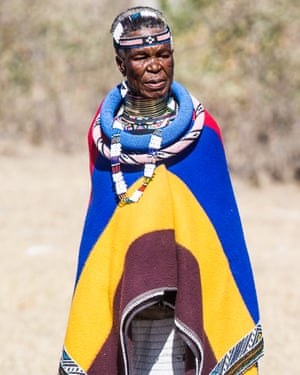
Mahlangu perches cheerfully on the chair, feet dangling, enjoying the role of dignitary. A tiny woman, her body is from the top of her head to her sandalled feet swamped by strips of beadwork, tapering metal and coloured bands. A heavy wool blanket in bright stripes of primary colours completes her plumage.
In 1986, when she was “discovered” by a passing French art dealer, Aids was still unknown. It is still a taboo subject and Mahlangu will touch only briefly on it but is passionate about educating young people on prevention.
‘I love to travel, but I love most to come home’: Esther Mahlangu Photograph: Jonx Pillemer/(RED)
In Weltevreden clinic, the local health centre, there are signs already of prevention. They have not seen a baby born with HIV since 2008. “It’s very different now, less people are dying,” said Sister Bathabile, who runs the clinic for a population of 9,500, of whom almost one in 10 are HIV positive. “It’s 15km to the hospital and our clinic is very, very small, too small,” she said, indicating the packed waiting room and queue of patients outside on the grass. “The doctor comes once a week, so it’s not ideal, but we never have a shortage of medicines at least. It is very rare for us to not have antiretrovirals.”
But charities stress that the real danger in South Africa is in slipping backwards. While the government and the Global Fund are supporting HIV/Aids work, the epidemic can be controlled, but eradicating it is still a pipe dream. Mahlangu still hopes it will happen in her lifetime. In October she will be in London for the opening of the British Museum’s exhibition of South African art, which will run from 27 October to 26 February. The only thing that fazes Mahlangu about such a long trip is airport security. Not because of the large bag of mealie meal she insists on carrying with her to combat her fear of being stuck with foreign food, but because of the metal detectors.
“They are always trying to make me take off my wedding bands,” she said, showing the rows and rows of brass rings on her wrists and ankles that are carefully tapered to accentuate the limbs. Given to her on her wedding day by her husband, her neck rings came on the same day from her parents.
“I say no, I cannot, these are from my husband. And oh they get very upset. Maybe they want me to sit on the X-ray machine.” She goes off in gales of laughter.
“No, I love to travel, but I love most to come home again. It makes me happy if people like Ndebele art.” And now, by buying it, people can contribute to battling the scourge that has blighted her homeland’s recent history.
The limited edition Red bottle, designed by Esther Mahlangu, is available from September. For every bottle bought, Belvedere will donate 50% of the profits to the Global Fund, the leading financier supporting HIV/Aids prevention in Africa.
African biomedical scientists encounter crucial issues – bad instruction, poorer infrastructure and scarce sources.
Associated: Larger Schooling in Africa: Our continent needs science, not support
This indicates most research is by way of epidemiological research or employing laboratory rats. Neither methodology deal with the cellular and molecular underlying physiological processes or diseases, or teach junior scientists how to carry out hypothesis-driven science.
As a outcome, the African study agenda is mostly set by properly-meant funders residing far away from the African actuality. Local researchers are most typically ignored, sometimes employed as a token in “collaborative” grants. People on ground have tiny to no decision-producing electrical power and the biggest element of the resources return to the west exactly where they originated.
We believe the Drosophila melanogaster (fruit flies) can empower the scientists of Africa to pursue their research interests. Drosophila transformed the scientific scene in Spain decades in the past, when limited assets referred to as for an affordable laboratory model.
A Drosophila researcher in Kampala. Photograph: Marta Vicente Crespo
Three Spanish researchers founded DrosAfrica to train a local community of researchers to use fruit flies to investigate biomedical concerns. This species of fly has been instrumental for developmental biology, genetics and biomedical analysis. The flies have played a role in identifying genes that relate to the immune program, cancer, Alzheimer’s and Parkinson’s illnesses and are an invaluable instrument in educating analysis, the scientific method and crucial contemplating.
In 2012, I moved to Uganda to set up a investigation lab at Kampala International University (KIU). Resources are scarce and recruiting competent staff is mission impossible. The lab is dusty and energy is erratic. Back then, very handful of knew of the existence of Drosophila, but now we have Nigerians, Kenyans and Ugandans discussing with this Spaniard how to check the prolonged-phrase effects of repeated publicity to some drugs utilizing flies.
In two workshops we have educated 27 individuals (17 Nigerians, three Kenyans, and four Ugandans). Our alumni are employing flies for their PhD tasks and leading budding investigation groups in Uganda and Nigeria. We have also established make contact with with other institutions and in 2016 we will run workshops at universities in Kenya and Nigeria.
Funders want the remedy for malaria but overlook to build capacity to allow African scientists to compete
Raising money for creating capability is a challenge. Funders want clean water for all, or the remedy for malaria, but neglect to create the capacity that will allow African scientists to compete for analysis money to fix Africa’s overall health problems. The couple of agencies that fund workshops give little amounts to partially cover bills. If we really do not cover travelling costs for participants, we will be constrained to the regional audience. Luckily, Kampala university has attracted an worldwide faculty to work with and our original efforts can broaden with the return residence of our alumni.
Two many years soon after the 1st workshop we have an established graduates who have accomplished large high quality study with their very own hands with out leaving the continent, and our alumni are instruction others. We want to do more workshops. We want to establish fly rooms all in excess of sub-Saharan Africa. The sources necessary to start off up a fly lab are small, but possible positive aspects are huge: deep information and profound discoveries. We consider that Drosophila can lead the consider-off of African biomedical study.
Marta Vicente-Crespo is a co-founder of DrosAfrica and director of the Institute of Biomedical Analysis at Kampala Worldwide University.
We are running a particular concentrate on the development of increased training in Africa. Do you have knowledge of the sector, or an informed stage of view on this subject? Speak to us on globaldevpros@theguardian.com with “higher training in Africa” in the subject line.
Join our community of development professionals and humanitarians. Follow@GuardianGDP on Twitter.
They come in ones and twos, sometimes a lot more. Some of the individuals have fresh bullet holes or machete wounds other people have wounds that have been neglected for days due to the fact of an inability to attain the hospital. Some are innocents caught in the crossfire, some the very ones who shoot.
And as is most typically the situation in civil conflicts, the majority of patients are not the ones immediately wounded but individuals who suffer the consequences of the disruptions of an previously-feeble health technique: intestinal perforations from typhoid fever pregnancies challenging by arrested labour significant skin and muscle infections that have spilled more than into the bloodstream, foremost to septic shock.
The Bangui General Hospital is a single of three primary hospitals working in the Central African Republic’s capital, with its population of some 1 million folks. Built in the 1960s by the Moroccan government, the big complex sits a few miles in one route from the relative peace of the Oubangui river, and in the other course from the chaos of Bangui’s violence-torn PK5 and PK12 neighbourhoods.
It is from the latter two locations that practically all of Bangui’s Muslim citizens have fled or been evacuated in the past few months as sectarian violence amongst Muslims and Christians threatens to tear the nation apart. Most have continued on to the north-west of the nation, or to neighbouring Chad or Cameroon.
I am part of a skeleton staff of expatriate physicians, nurses and support staff from Médecins Sans Frontières that functions with Central African physicians and nurses to give emergency space and surgical care at the hospital, although other teams focus on outreach in refugee camps and mobile clinics across the nation. From the hospital’s rooftop we peer across the city.
A flock of birds floats languidly across the sky, the crimson glow of the sun setting behind the unlit spotlight towers of the main soccer stadium. The peaceful scene belies the spasmodic chaos below. At evening we hear scattered gunfire and grenade explosions in the distance and wonder how a lot of patients will come, and when.
Muslim in the P12 district of Bangui put together to flee the violence. Photograph: Eric Feferberg/AFP/Getty Pictures
A 23 yr-previous lady arrives one particular early morning, her body riddled with bullet holes. Numerous slugs have blasted via her limbs, shattering bones. Despite our ideal efforts, her gaping chest wounds portend a death that can’t be averted by restricted surgical capacity. I wonder – no more here than back house in the US – what prospects people to violence. The human physique is not meant to be torn apart by bullets.
Spasms of violence grip this country, whilst in the background regular societal structures unravel. Thirteen percent of the population is internally displaced, schoolrooms are usually empty and crops go unplanted.
A yr in the past, the overt violence in the capital was possibly worse aid workers who have been here described dead bodies lining the streets on the way to the hospital and extrajudicial killings happening everyday across the city, some even outdoors the paediatric ward down the street.
And what now? Regardless of the presence of some two,000 French troops and 6,000 members of an African Union-led peacekeeping force, the Central African Republic appears to teeter on the brink.
The UN just lately approved the deployment of 12,000 extra troops and police to support maintain buy, but they are not due to arrive right up until September. Meanwhile, the disorder in this former French colony continues.
While the war-wounded might be the most visible victims, the true and lasting tragedy could lay in the consequences of worsening malnutrition, estimated to impact in excess of two million citizens, many of them young children. A society broken at the centre is fraying ever much more at the edges.
A rebel fighter in the Central African Republic smokes during a patrol, near to the border with the DRC. Photograph: Goran Tomasevic/Reuters
From the northern village of Boguila, near to the Chadian border, information of the slaying of 16 civilians, like three Médecins Sans Frontières nationwide staff, chills our hearts and rattles nerves.
Unprovoked, and taking place throughout an armed robbery at a well being outpost clearly marked as a Médecins Sans Frontières facility, the killings have sparked a debate within the organisation, utilized as it is to working in challenging situations. Médecins Sans Frontières made a decision to decrease its pursuits during Central African Republic in protest for a quick time, though the function at the hospital continues unabated.
Final week, a 35-12 months-previous female in her 10th pregnancy arrives in the emergency room in shock, barely coherent. The shape of her swollen abdomen suggests a ruptured uterus and she is rushed to the operating space. The eight-month-old foetus has perished and the mother’s life hangs by a thread as we perform an emergency hysterectomy.
Uterine rupture occurs up to ten occasions more frequently in least-produced nations than it does in the most-developed nations. It can be a last blow right after the domino result of having several pregnancies, limited pre-natal care and obstructed labour with impaired entry to well being care services. Up to 90% of girls with uterine rupture die, as will this patient in a couple of hours.
There is too little that we can do, also late. The patient’s mom waits outside and receives the news, translated from French to Sango and back, with an unmoving face. A short while later on, as daylight breaks and the sounds of roosters and the waking hospital fills the grounds, I observe as she carries away the wrapped physique of her unborn grandson. She disappears behind a cement column painted a rusty red, bare feet padding along the floor. It ought not finish like this…and nevertheless it does.
David Rothstein is a paediatric surgeon at the Lady and Children’s Hospital of Buffalo. He started operating with Médecins Sans Frontières in 2007 in northern Sri Lanka and has made month-extended journeys for MSF each 12 months because, working in Chad, Nigeria, Democratic Republic of Congo and the Central African Republic
On Christmas Eve 2010 my outlook on daily life changed significantly when I was diagnosed with multi drug-resistant tuberculosis (MD-R TB).
I was admitted to hospital, isolated and started on 7 diverse very toxic drugs. I in no way realised the troubles drug-resistant TB patients face when they have to comply with therapy. I in no way recognized the terrible side results of the medicines, such as irreversible side results like hearing reduction, that I however experienced. I couldn’t work as a physician anymore and with my hearing broken, I wondered if I would ever be in a position to choose up my stethoscope yet again.
I was incredibly lucky in gaining compassionate accessibility to the first new TB drug in in excess of 40 years. I managed to maintain the rest of my hearing and comprehensive treatment method right after 18 months. I was then capable to start off operating yet again as a medical doctor, but at this time I also began to dedicate time to TB advocacy. I co-founded an advocacy group referred to as TB Proof and grew to become a vocal advocate for others suffering from TB.
At the end of 2012 a prominent TB researcher heard my story and imagined it would be worth telling at the yearly International TB Conference. I did not have funding to go on the journey, even so thankfully the advocacy organisation Therapy Action Group made the decision to sponsor my trip. That presentation changed my daily life. I met international leaders in the discipline of TB and was invited to share my story on international platforms.
Back house in South Africa I also became mindful of the incredible threat healthcare employees face operating in our hospitals on a daily basis. Collectively with other occupational TB survivors and TB activist medical students we commenced an advocacy group with the aim to TB Proof our wellness care employees (similar to bulletproof vests for policeman). Our perform rapidly grew we commenced getting invitations to share these sessions with hospital and clinic staff all above the Cape Town area.
We saw that our TB Evidence sessions began to alter people’s attitudes and behaviours in direction of TB. Sharing our very own stories broke down the stigma, and encouraged an ever-rising quantity of wellness care workers and students to share their very own experiences of TB. This was exceptionally inspiring, and a vital 1st stage in acknowledging the extent of the problem and offering necessary care and help for TB sufferers.
It is critical to remember that TB is a social illness, preying on the disadvantaged and the marginalised. Till we deal with inequality, poverty and discrimination we will not achieve TB elimination, so these continue to be broader focal factors for our nation.
My biggest hope for South Africa is that we can get rid of our greatest enemy, the biggest killer in our country, and certainly in the background of mankind, mycobacterium tuberculosis.
Go through much more like this:
• 6 months following the death of Mandela: spotlight on South Africa’s rising stars
• South African stories: ‘I hope a lot more youthful changemakers rise up’
• South African stories: ‘I hope to one particular day see a unified nation’
Join the local community of worldwide improvement specialists and professionals. Turn out to be a GDPN member to get much more stories like this direct to your inbox.
Krishnan Guru-Murthy with Abdurahmane, 4, in Senegal’s only children’s cancer unit. Photograph: Channel four
Matar Syllah was crying in his hospital bed. The cancer in his liver had spread and the tumours were bulging from his abdomen. “At times the ache is so negative I fall above and faint,” the 25-year-old said. “I really feel it in my stomach and back. It comes and goes.”
The young doctor, Mohammed Oneefade, looked guilty as I asked what painkillers Syllah was on. “Paracetamol,” he replied. “When it gets worse we can give tramadol as well. But there is practically nothing else here. No morphine.”
The medical doctors in Senegal’s second city of Touba have prolonged considering that given up attempting to prescribe the drug that stops the discomfort of cancer. There are not any morphine tablets in the city. The only location it can occasionally be identified is in the capital, Dakar, four hours away – but government regulations stop them from creating prescriptions for it anyway. They don’t have the correct sort of prescription pad. Like several cancer individuals Syllah was becoming sent property the following day.
Hyperlink to video: Cancer individuals in Senegal denied morphine remedy
There are more men and women dying of cancer in Senegal than of malaria, tuberculosis and Aids combined. Programmes tackling infectious ailments have been powerful and with longer life expectancy and more western lifestyles cancer prices are climbing. But the country is failing to give palliative care to the huge vast majority of men and women who require it and as a consequence cancer patients in a relatively prosperous component of west Africa are dying in soreness that could effortlessly be stopped.
The doctors at Aristide Le Dantec hospital in Dakar do have the correct prescription pads, but the pharmacy often runs out of morphine. Individuals in the ultimate phases of cancer can locate their provide suddenly runs out. From medicated calm they are plunged into excruciating soreness without explanation or apology. Aminata Diob’s morphine had run out many days in the past. With a neck and encounter horrifically swollen by non-Hodgkin lymphoma she was in as well significantly pain to speak. The only relief she was acquiring that day was paracetamol. Her mother Coumba Awa cradled the youthful girl in her arms. “She was going to get married. She is significantly a lot more gorgeous than me,” she explained. “Her soreness has turn into extremely undesirable in the last number of days.” Awa was struggling to pay the hospital expenses and pondering what the stage of it was if they could not make Diob greater.
Matar Syllah with his doctor Mohammed Oneefade. Photograph: Channel 4
A quick walk across the hospital compound is Senegal’s only children’s cancer unit, run by Prof Claude Moreira. “Twice in the last yr we have run out of morphine syrup for the children. We do what we can to give them other medication but it is really terrible.” His colleague Sokhna Ndiaye, the unit’s American-educated psychotherapist, explained: “Sometimes in the unconscious thoughts young children create a correlation among the volume of discomfort they are experiencing and the gravity of their pathology. As a result when there is no ache medicine the kid may possibly be contemplating: ‘This is the end of existence.’” As I momentarily imagined of my own children and cried, Ndiaye explained: “We are totally distressed. It truly is extremely agonising for us. We consider it personally.”
The young children appeared aware of their extraordinary luck in acquiring into the unit. The majority of young children with cancer in Senegal get little or no treatment. The group introduced me to Abdurahmane, 4, who right after three months in hospital possessing chemotherapy and other treatment was being sent residence. Desperate to perform with outsiders supplying a bit of focus, he commandeered my iPhone and played the video games my young children perform on it. We played football in the ward, which did not go down also nicely with the other individuals. His mom Bambi explained how good he was at asking for morphine when he essential it but she could barely speak about what took place the final time it ran out.
Coumba Awa with her daughter Aminata Diob. Photograph: Channel four
Senegal has the second biggest economic system in west Africa and morphine is not expensive. It expenses the same or less than weaker painkillers. In any situation adult sufferers have to pay for all their health care supplies from paracetamol to chemotherapy drugs. But a bizarre vicious circle has prevented most individuals who need it from receiving morphine for decades. Because it is an internationally managed substance, nationwide governments need to estimate and buy the sum they want for the 12 months. Senegal bases its buy on what medical professionals demand. But medical doctors never prescribe it partly because they know it is not offered in most pharmacies and partly out of ignorance and worry that morphine will lead to addiction. As a end result there is no evidence of enhanced demand and despite there being an estimated 70,000 people and increasing who want it every year the authorities hold only ordering sufficient to deal with among two and 3 hundred patients.
The shortages also mean sufferers do not get morphine even when it is available. A pay a visit to to the Dantec hospital pharmacy revealed a new consignment of morphine tablets had arrived the earlier week. There was no purpose for patients like Diob, the female with non-Hodgkin lymphoma, to be nonetheless be in soreness. I went to inquire her medical doctor why they had not issued a new prescription but she had no thought the medicine had arrived. Even worse, when I went to the ward to inform Diob and her mom that they should demand more morphine they had currently left the hospital in despair. There was no level, apparently, in paying out the hospital costs if they could not end the ache.
Prof Claude Moreira, 2nd from left, with his team. Photograph: Channel 4
A report by Human Rights View last yr argued that the circumstance amounted to cruel and inhumane remedy. It demanded urgent action by the Senegalese government to change the ordering approach, train staff and make morphine widely available. But there remains an obvious lack of political will. Repeated attempts to interview the overall health minister, Awa Marie Coll-Seck, had been rejected, and when approached at a well being conference on infectious ailments she refused to reply questions, demanding to know if Channel 4 would deal with a British health minister the exact same way. The head of the National Pharmacy, the body that administers morphine supply in Senegal, Annette Seck Ndiaye, blamed medical doctors for failing to inquire for much more: “The use of morphine need to be justified, in a nation. And this details can only be provided by the individuals who prescribe the morphine. We are obliged to adhere to the guidelines that apply in Senegal.”
Senegal’s experience is becoming repeated across Africa and the rest of the establishing planet. The World Well being Organisation estimates that 80% of the planet faces shortages of morphine and the huge bulk of the international provide is consumed by just 6 nations. As Africa develops the crisis will intensify as cancer prices and populations develop.
Krishnan Guru-Murthy with an ampule of morphine. Photograph: Channel four
Earlier this week the two Syllah and Diob died. Abdurahmane has been readmitted to the children’s cancer unit in Dakar. Despite the original achievement of his chemotherapy the cancer has spread. He has a supply of morphine for now but it is insecure and could run out at any time.
• Krishnan Guru-Murthy’s Unreported World – Africa’s Drugs Scandal is on Channel 4 on Friday thirty May possibly at 7.30pm or can be viewed on the internet at 4OD.
Waste and sources in the United kingdom has now evolved into a mature business – employing 1000′s, turning in excess of billions of pounds, encompassing several disciplines and recognised as a vital element of a potential circular economy. But what was it like forty or so many years ago when recycling and reuse was something promoted by a few lone voices against a bulk that noticed nothing incorrect with landfilling most of our waste, in which littering was much more acceptable?
I have lately returned from a journey to the west African states of the Gambia where I spent some time with Isatou Ceesay, founder of a revolutionary neighborhood recycling undertaking, the Njau Recycling and Cash flow Generation Group (NRIGG). And, as in the Uk in the 1970s and 1980s, it is neighborhood-based groups top the way. Few components of the nation receive a municipal waste assortment service, let alone a recycling services, so it is up to communities to treatment this.
Considering that 1997 Ceesay has been doing work with communities across the small west African state to address not only the environmental influence of unregulated waste disposal but also to offer cash flow to what now amounts to above one hundred females. NRIGG is primarily based in four separate communities across the nation – the members collect the materials themselves and transport it by hand to their centre, which is typically just somebody’s compound. Ceesay has hit that elusive sweet spot, offering jobs and livelihoods but also enhancing the surroundings.
Her mom thinks she’s mad. Why must she want to commit her life dealing with other people’s rubbish? But she sees what these around her couldn’t – that the population was surrounded by ever growing mountains of waste, with a pressing require for much better management of the domestic waste which is both dumped in unregulated landfill or, worse, burnt compounds.
Waste heaped up close to a bus-end in west Africa. Photograph: Ahmed Jallanzo/EPA
The affect of unregulated waste is manifold and properly understood – from the disease connected with the blocking of drains by the ubiquitous plastic bags provided out freely with even the smallest obtain, to the result on air high quality of uncontrolled burning of waste (again, largely plastic), as effectively as the impacts of landfill gasoline from uncontrolled landfills. And this is prior to you even consider into account the visual impacts of uncontrolled littering is considered – important to a country like the Gambia where tourism accounts for around a fifth of GDP.
Ceesay’s concern is primarily for people that deal with their very own waste, and she aims to assist them to do it far better. Her crucial aim is to cease the burning very first and foremost, top with a message of waste prevention, especially focusing on plastic, followed by promotion of reuse and implementation of recycling schemes.
The uncontrolled burning of plastic must be regarded as one particular of the wonderful environmental well being hazards of our time. It is connected with a variety of really harmful pollutants, from carbon monoxide, which affects mental perform, to dioxins and furans that result in cancer and affect immune and reproductive technique and are persistent in the surroundings. It is also connected with contaminants and other volatile organic compounds that result in cancer and respiratory sickness, to asthma. In brief, it’s a public well being nightmare.
Meanwhile a lot of of the municipal companies taken for granted in the Uk (including simple waste disposal) simply do not exist in the Gambia. Outdoors of a handful of urban locations, it is entirely down to communities to deal and control with their very own waste. This is a frequent story across the creating planet, with about three billion individuals residing with out any formal waste management system. The influence on wellness, environment and high quality of existence stays unmeasured.
But what does a single do in a nation the place there is very minor waste disposal infrastructure, allow alone recycling infrastructure? Nicely, you develop your very own. And in their four communities, NRIGG have produced total lifestyle cycles for a selection of typical supplies. They have devised their personal separation program, with organics, paper, plastic, metals and glass and produced, in which it can, its very own end markets.
Property composting training is given to people communities where schemes are set up, answering a demand for low cost, substantial good quality organic fertiliser. There are some existing markets for metals and these are separated and offered to traders. Not only for metals, Ceesay has had to come up with ways of turning the resources from waste into wealth. Plastics are separated and stored to be up-cycled into every thing from robust, lengthy life bags, mats, purses. Rubber is turned into necklaces. Previous cassette and video tapes are even woven into purses. This is combined with other non-waste actions, which includes honey manufacturing, production of waxes, lotions and batiks. Even however these are non-waste connected, they help the girls who can then proceed to provide and control the recycling schemes.
Earrings manufactured from recycled waste. Photograph: Mike Webster
These are also combined with a range of other schemes that support the women strategy their incomes during the yr, save for the 3-month “hungry gap” at the finish of the yr, when family farms aren’t producing, and develop their organization capabilities. This is vital, simply because as several neighborhood recycling schemes at house as effectively as abroad have proven, sustaining these schemes is possibly the hardest component.
But issues remain. If the scheme could increase to this kind of a point the place containers of materials could be bulked and passed on to the international market place, new and more material streams could be developed. Somewhat strangely it seemed to me, the main dilemma waste stream faced by NRIGG was how to deal with glass. In the Uk, glass has usually been considered possibly the best of all supplies to collect, but with no regional end markets and a lack of scale to entry international markets, it is a problem in the Gambia. This perhaps points to the need for little- to medium-scale technologies that can reprocess such resources. Could this be a gap in the marketplace?
The other challenge is that of a comprehension gap by individuals who could otherwise support. The Gambian authorities look disinterested in delivering companies outdoors a handful of tourist regions, with a focus on clearing materials and dumping it in poorly regulated landfill, unaware of the massive financial and employment positive aspects associated with greater recycling (probably comparable to the present Uk administration?). In a country in which the 2013 per capita GDP was $ 512 (£303), the economics of labour intensive sorting and reprocessing are certainly a lot more favourable?
And this is a scheme whose time has come. The require for far better waste management is pressing, as urban populations expand, incomes enhance and waste arisings develop, modify, grow to be harder to deal with and current a higher wellness risk. There are also jobs in it.
But the pioneering factor is the two the opportunity but also the challenge – as soon as Ceesay has convinced her mother, she nonetheless has to persuade an indifferent government and public. But it is an fascinating time – this is the commence of anything that can only increase.
Mike Webster is operations manager at London Local community Assets Network, and has worked in the resource and recycling sector for two decades.
Interested in obtaining out a lot more about how you can reside greater? Get a look at this month’s Live Better Challenge here.
The Reside Far better Challenge is funded by Unilever its target is sustainable residing. All material is editorially independent except for pieces labelled advertisement characteristic. Uncover out a lot more right here.
He explained: “Our society has typically left too numerous folks who are the duty of the public companies on their very own in later daily life, even though they have household alive and other folks you would have imagined would care.
“We have gone by way of a time period in which the sense of a wider family responsibility has been considerably less important than it has in the past.
“I consider we need to understand greater the lessons of several other cultures and communities, of which the Asian and African communities are obvious.
“They understand the obligation to look soon after your household to the finish.
“If we had a society in which we collectively get responsibility for our families I consider we would see fewer folks dependent on the state.”
The 2011 census located that there have been 624,000 people over 85 in England and Wales residing on their personal, three-quarters of whom had been ladies.
Surveys have pointed to greater willingness for a return to Victorian-type multi-generational households, notably for the duration of the economic downturn. But in practice they account for just above one per cent of all households.
An official estimate in 2011 concluded there have been only 295,000 multi-generational households in the United kingdom and it is unclear how a lot of had been formed to give care as opposed to younger family members being unable to afford to reside on their personal.
Mr Hughes said it would get “sacrifice” but explained it was eventually a “much more civilised way to proceed”.
“There are a lot of households, some of which are from far more recent immigrant cultures, who are very great at comprehending the wider family members obligation,” he said. “We need to appear to our neighbours who typically, even if they are not nicely off, deal with to share family members obligation which implies not forcing them into care properties. It can be carried out. We must not consign any personal to be neglected by the family and frequently have a considerably significantly less happy ending than they would otherwise have.”
Mr Hughes was speaking ahead of an overhauling of the divorce law, to encourage out-of-court mediation, which he stated would also support foster a sense of “wider loved ones responsibility”.
From Tuesday couples who apply to a court to resolve disputes more than house or youngsters will be refused unless of course they have already met a mediator.
Denise Burke of the think tank United for All Ages, which has studied multi-generational households, said: “It is extremely laudable and anything that we would quite significantly like to see but it is extremely challenging to evaluate us with other cultures.
“Certainly in this country, typically the extended loved ones is totally spread about in excess of time and households no longer reside within the very same neighborhood,” she added.
“The world is shifting and, even though it is an perfect, it is not for numerous families actually doable.”
A little one becoming vaccinated against meningitis in Niger. The trial targeted 155,000 individuals across 150 villages in rural Benin. Photograph: AFP/Getty
The initial immunisation campaign in Africa making use of a vaccine that does not have to be stored in fridges and iceboxes has been productive and considerably cut charges, in accordance to scientists.
MenAfriVac is authorised for use at temperatures not exceeding 40C and can be stored out of the fridge for up to four days. The vaccine towards meningitis A was uncommon in getting made specifically for the African meningitis belt, the place yearly epidemics employed to kill 1000′s, but professionals say it would be possible to permit other vaccines to be utilized outdoors of cold-chain situations. Vaccines towards yellow fever and cholera are among those that could potentially be stored and utilized securely at increased temperatures, enabling many a lot more men and women to be reached in remote regions and the price of immunisation campaigns to come down.
In the journal Vaccine, medical doctors report the achievement of a trial in Benin of MenAfriVac at controlled temperatures under 40C, rather than the 2C-8C that is normal for vaccines. Component of the population was given the vaccine from the regular cold chain – stored in fridges, moved about the country in refrigerated vehicles and taken into the field in great boxes containing icepacks. The rest had been provided MenAfriVac that had been out of the fridge for up to 4 days. Neither group had a situation of meningitis A, and the vaccine remained viable at temperatures as large as 39C.
MenAfriVac was created by the World Wellness Organisation (WHO) and Path, a non-profit international wellness group. The vaccine is manufactured by the Serum Institute of India and it was the Indian regulatory authorities who gave approval for its use outside of cold situations. The query is whether or not companies of other vaccines that are also used in affluent nations, in which electricity and refrigeration are not a issue, will seek out equivalent approval.
A paper published in the WHO’s Bulletin demonstrated that not having to refrigerate MenAfriVac would have lower the fees of immunisation in Chad by 50%. “The remarkable coverage we noticed in Benin when MenAfriVac was utilized outside of the cold chain paves the way for potential campaigns in other regions with demanding geography, like countries exactly where the vaccine will be administered later on this yr to rural populations living in the desert,” stated Dr Marie-Pierre Préziosi, director of the Meningitis Vaccine Venture, the collaboration amongst WHO and Path that drove the advancement of MenAfriVac.
The trial targeted the rural Benin district of Banikoara, vaccinating 155,000 people across 150 villages. Only nine vaccine vials had been discarded since they had been at typical temperatures for a lot more than four days. None had to be discarded since of getting been exposed to temperatures of 40C or far more – a particular heat-sensitive sticker modified colour as a warning if that occurred.
Much more than 150 million individuals in the African meningitis belt have been vaccinated with MenAfriVac considering that it was launched in 2010. No situation of meningitis A has been recognized in those vaccinated.
Patents on new medicines may possibly be bypassed in South Africa if adjustments to intellectual home law go ahead. Photograph: Krista Kennell/ZUMA/Corbis
Drug firms in South Africa have been accused of preparing a covert, properly-funded campaign to delay the introduction of laws that threaten their earnings. Leaked paperwork demonstrate that pharmaceutical firms planned a $ 450,000 campaign, involving a high-profile consultancy primarily based in Washington, DC, against modifications to intellectual house laws that would allow their patents on new medicines to be bypassed in the interests of public health. This would permit the manufacture of less costly copies of their medicines.
Campaigners accused the global drug giants of trying to derail existence-saving legislation. The trade entire body IPASA (Modern Pharmaceutical Industry Association South Africa), which was coordinating the campaign, explained on Thursday the programs have been no longer going ahead – though it was legitimate for drug organizations to advertise their views in this way.
One particular of the leaked paperwork is an e-mail dated 10 January from a member of IPASA’s executive to representatives of most of the large-name drug businesses operating in South Africa. As agreed in December, it says, “we have moved ahead in identifying a large-calibre consultancy group to work with us”, naming Washington-based mostly Public Affairs Engagement (PAE).
The second document is the proposed PAE approach, involving the creation of an alliance of businesspeople and academics, the placement of prominent editorials in newspapers, and a bid to “distract” access to medicine campaigners “from their personal aggressive campaign”.
The document later names Médecins Sans Frontières (MSF) and the Therapy Action Campaign (TAC), calling them a “coalition that was formed to pressure the government into making [the draft IP policy] in the initial location”.
The stakes are high, says the document. “South Africa is now ground zero for the debate on the value of robust IP protection. If the battle is misplaced right here, the results will resonate. Clearly MSF and related NGOs understand that … With no a vigorous campaign, opponents of strong IP will prevail – not just in South Africa but eventually in much of the rest of the developing world.”
Campaigners mentioned they had been shocked. “What is surprising to us is that it is done so subversively,” stated Julia Hill of MSF. “We have really made an effort to be really transparent. It is disappointing that this is currently being carried out in secret and that this kind of an extraordinary volume of funds is getting spent to interfere with the democratic method.”
Lotti Rutter, a senior researcher at TAC, stated: “We have received substantial concerns in excess of what seems to be fairly a covert and well-funded atempt from foreign sector to delay an essential law reform method happening here in South Africa.”
Val Beaumont of IPASA said the discussions had taken spot but the PAE proposal had not been accepted. “It is a really, quite essential situation to us and it will be to any of the knowledge-primarily based organisations,” she stated. “There was a large concern that it would be rushed.” It was Ok for an organisation to have a PR company to support place across its views, she said.