tried etiketine sahip kayıtlar gösteriliyor. Tüm kayıtları göster

21 Nisan 2017 Cuma

NHS and medical watchdog tried to suppress scandal over vaginal mesh implants

NHS bosses and the watchdog that oversees medical devices tried to limit public exposure of the scandal over vaginal mesh implants that have harmed hundreds of women.


Minutes of a meeting held in October 2016 show that NHS England and the Medicines and Healthcare Products Regulatory Agency agreed to “avoid media attention” over the implants, despite the fact they were seeking to encourage patients to report any complications.


The document, obtained by the Press Association, records an agreement to “take the press element out” of the “yellow card” campaign to record adverse reactions experienced by vaginal mesh patients, suggesting that it could be folded into a wider effort, “of which mesh is one element, to avoid media attention on mesh”.


The apparent cooperation between NHS England and the MHRA to minimise media focus on the debilitating problems increasingly associated with the implants appears to breach the NHS’s duty – reiterated regularly by health secretary Jeremy Hunt – to be open and transparent over patient safety failings.


NHS England and the Department of Health both refused to comment on the minutes of the meeting.


One possible reason for the NHS to want to limit exposure of the issuecould be to reduce the number of potential lawsuits faced by the health service.


More than 800 women are suing the NHS and the manufacturers of vaginal mesh implants after suffering serious complications, it emerged this week. Some women reported that implants had cut into their vaginas, with one woman saying she was left in so much pain that she considered suicide. Others have been left unable to walk or have sex, according to the BBC.


Vaginal mesh implants are used to treat incontinence after childbirth or pelvic organ prolapse, where the womb or bladder bulge against the walls of the vagina. Between 2006 and 2016, more than 11,000 women in England were given the implants to treat prolapse or incontinence, NHS data shows.


Around 11%-12% of users have reported problems, while lawsuits in the US have already seen around $ 2bn (£1.5bn) paid to affected women.


Campaigners say that hundreds more women have come forward after learning of the group planning to sue.


Kath Sansom, who runs the campaigning website and Facebook group Sling the Mesh, says the number of women contacting her has risen from a few people a day to more than 200 in the past 24 hours.


“It’s always the same story,” she said. “There are so many women who were told it was just them, that they were a one-off. They can’t believe there are others out there. So many people are told it’s back pain, endometriosis, gall bladder pain, scar tissue. And so many of them accept it, you trust medical professionals.”


Data from the MHRA, which has been looking at the issue since 2011 following complaints from women, shows more than 1,000 adverse incidents have been reported in the past five years.


Despite the problems that have emerged the MHRA insists that the best current evidence supports the continued use of the implants to resolve health conditions that could themselves cause serious distress to patients.


A report into the issue from a working party led by NHS England admits there is a huge lack of data on complications from the devices. Published studies on mesh implants do “not tell the whole story” and there are gaps in NHS knowledge about their safety, it added.


NHS and medical watchdog tried to suppress scandal over vaginal mesh implants

27 Mart 2017 Pazartesi

Trump tried to burn down Obamacare. He set his hair on fire instead | Ross Barkan

Burning Obamacare to the ground was always a House Republican obsession that Trump, in the heat of the campaign, took up to spite the president while tossing a little red meat to Republicans. “Repeal and replace” is alliterative, after all: it sounds nice enough on an arena stage. It’s just hard to pull off in the real world, as Donald Trump found out on Friday.


Blessed with total control of government, Republicans can only think of how best to burn the house down – and they’re not even doing a good job at that. The House speaker, Paul Ryan, unjustly heralded as a policy wonk, tried to rush his healthcare bill to the floor for a vote on Thursday, only to find the moderates and extremists in his party rebelling. On Friday, Donald Trump was forced to pull the bill, due to lack of support from his own party.


It was a humiliating defeat, which he tried to blame – unbelievably – on the Democrats.


Paul Ryan on failed healthcare bill: ‘This is a disappointing day’

Ryan’s Trumpcare was a horrendous concoction and should disabuse fawning congressional reporters of the notion that the speaker is a man of deep intellect and self-reflection. Had the bill not fallen flat on its face this Friday, it would have had little chance of passing the Senate.


What remains is the fact that Donald Trump couldn’t close the deal. He is hoping everyone blames Ryan, and Trump is lucky that his supporters might do just that. The diehards, inhabiting his post-factual universe, will simply write Ryan off as a loser – they hated him anyway – and hail their king for the bounties he’s still promising.


But healthcare will ultimately be Donald Trump’s problem. That’s how our politics work. So far, the president has been more fatuous than fascistic, though he belatedly realized what an albatross the bill had become. His negotiating powers, whatever they ever were, failed.


Were Trump the deal-making genius his ego tricked himself into believing he was, he would never have taken up this healthcare venture. A recent Quinnipiac University poll found that only 17% of Americans approved of Trumpcare. Trump’s poorest and least educated supporters had much to lose and nothing to gain from the legislation.


That’s why demolishing Obamacare never made sense. After all, Trump, via Steve Bannon, promised economic nationalism, a robust spending plan for those who he believed deserved it most: the white and native born. Trump wasn’t going to lose any votes by focusing on immigration and infrastructure spending at the expense of Obamacare, which rank-and-file conservatives resent less now that Obama himself has been removed from the equation.


President ‘pulled out every stop’ to pass healthcare bill, Spicer says

Far from upholding the most basic protections for the working-class, the Trump administration has, instead, evolved into one of the most rightwing in recent memory. It is stocked with the kind of appointees (Mick Mulvaney, Tom Price) who could have been plucked from Congress by Presidents Ted Cruz or Marco Rubio.


This is the difference between Trump and someone like the French presidential candidate Marine Le Pen, the Front National leader who identifies closely with the billionaire. Le Pen’s fiscal platform is unapologetically leftist, rejecting the austerity measures embraced by Europe’s financial class.


Trump rages with all the hate of Le Pen and none of the savvy. Blaming Ryan for Trumpcare’s failure will not absolve him of trying to do a very stupid thing. If he chooses to weaken healthcare in other ways – to somehow prove Obama left the country with a self-destructing system – he’ll still be the president when premiums skyrocket as insurers struggle to adapt to this instability.


In 2018, 2019, and 2020, screaming Obama’s name won’t matter anymore. The country will just know President Trump and the damage being done.


Trump tried to burn down Obamacare. He set his hair on fire instead | Ross Barkan

15 Mart 2017 Çarşamba

Makers of thalidomide to be tried - archive, 1967

Bonn, March 14
After an investigation lasting five years, the Public Prosecutor at Aachen has brought charges against the manufacturers of the drug thalidomide which is blamed for causing at least 5,000 babies to be born malformed and nervous disorders in 5,000 adults.


The case against the managing director and eight other executives of the pharmaceutical firm, Grünenthal, of Stolberg, near Aachen, is expected to begin in about a year’s time and to last for a year. The charge sheet includes allegations of manslaughter, grievous bodily harm, and infringement of the West German pharmaceutical laws.


Dr Gierlich, the prosecutor, said today that about a thousand of the cases of malformation or nervous disorder were abroad, most of them in Sweden and Britain.


20M a month
Thalidomide first went on sale in 1957 and 20 million tablets a month were sold until it was withdrawn by the firm in November, 1961. In several countries, including Britain, it was manufactured under licence.


A spokesman for the firm said no comment would be made until the charges had been studied.


Thalidomide court case this year?
A test damages claim, begun in the English courts five years ago by the father of a handicapped thalidomide child, may be heard in the autumn or very early next year. The Lord Chancellor, Lord Gardiner, said this in a letter to Mr Alfred Morris, Labour MP for Wythenshawe, who asked him to inquire into the progress of the case.


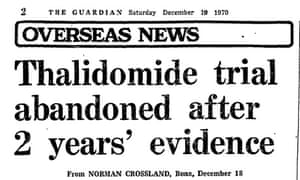
In 1970, the trial in Germany was discontinued under a compromise settlement that gave some compensation for those who claimed to be victims of the drug.


The Guardian, 19 December 1970.

The Guardian, 19 December 1970.

Makers of thalidomide to be tried - archive, 1967

10 Ekim 2016 Pazartesi

My ‘insane’ Uncle Ed tried to kill Queen Victoria – he was treated with kindness | Penny Pepper

A young Queen Victoria rides out of the palace with her dashing husband. It’s June, and she is happy as the open carriage moves down Constitution Hill. Waiting on a grassy verge is a young man. Scarcely that – he’s a boy, just 18, with dark eyes and a baby face, short of stature and wearing a high top hat, as was fashionable in 1840. As the Queen draws closer he raises two pistols, determined to fire on the pregnant Victoria.


The young man is Edward Oxford, and he’s about to fulfil his dream of becoming notorious. Edward: my great, great, great uncle, who I fondly call Uncle Ed.


As ITV’s Victoria came to the season finale, I was relieved his story played out relatively true to what is known. Edward is described as “one of Cumberland’s creature’s”, part of the supposed Hanoverian plot against Victoria. But it is quickly revealed he is as a “half-witted pot boy from south of the river”, and that “the would-be assassin is completely insane”. Victoria wanted to hang him high, naturally.


Since unearthing this skeleton in my family closet, I feel a deep protectiveness – and relief that Edward’s attempted regicide came at a time when “lunatics” and the “criminally insane” were beginning to be treated more humanely.


Indicted for treason, he stood trial at the Old Bailey on 6 July 1840. If found guilty, he would hang, and his defence rested heavily on the ideas of being “innocent by reason of insanity”. The Old Bailey records of the trial are as full of intrigue and early Victorian melodrama as one could wish for, including the reading out of his notebooks, which exposed Uncle Ed’s pseudo-military fantasy society, Young England.


Reading through the statements and the endless legal ramblings, I find nuggets that allow me to unravel a sense of young Uncle Ed’s wayward personality. I follow a repeating echo, as I realise the case for his defence depends on making sure that he is insane. The records swiftly become a sensational feast of detail, especially where Edward’s father and grandfather are concerned. Both were known alcoholics. His grandad, John Oxford, described in one press report as a “black sailor of obscure origin”, died in Greenwich Naval hospital. At various times he believed he was the pope and other times St Peter.


Part of the Bedlam Exhibition held at the Wellcome Collection 2016.


Part of the Bedlam Exhibition held at the Wellcome Collection 2016. Photograph: Thomas SG Farnetti/Wellcome/Courtesy The Vacuum Cleaner and Hannah Hull

Edward’s father, George Oxford, is described as a “mulatto” and “the Tawny Beau” in press coverage. A keen indulger in laudanum, he was given to odd and violent outbursts, most often inflicted on his long-suffering wife, Edward’s mother, Hannah. There was also the time he brought the horse into the parlour for dinner …


It’s hard to know now if Edward shared this family “madness”, assuming you share the still-controversial belief in inherited mental ill-health. Endless witnesses reported his strange behaviour and mood swings. But Edward’s family and friends would have known that any exaggeration could only strengthen his claim to innocence.


Uncle Ed was found “innocent by reason of insanity”, suffering “a lesion of the will”. He was sentenced to be detained indefinitely at Bethlem Royal hospital – better known as Bedlam – in its latest home in Southwark. This was a time when pressure was growing for the proper care for the mentally ill, with supporters committed to the genuine idea of asylum and a removal of those individuals from prisons and the workhouse. This began with the County Asylums Act 1808.


Those with mental health issues are demonised, despised and disbelieved. They are too expensive for the welfare state


Edward flourished in this environment, and responded to regimes aiming for genuine care of the patient – “patient” at last replacing the earlier terms “lunatic”, “imbecile” and plain “inmate” – through the Lunacy Act of 1845. Edward’s frustrated intellect grasped all opportunities – he became a model patient, learning several languages fluently, finding skills as a painter, and becoming an unbeatable chess player. He thrived in that environment, when – as Mike Jay, co-curator of the Wellcome exhibition, Bedlam: The Asylum and Beyond – says in his recent Guardian piece: “The asylum became an emblem of social progress: a therapeutic community in which patients were to be treated with kindness.”


It’s tragic that there is very little sense of true asylum, of sanctuary, within today’s mental healthcare system. In the 20th century, care in the community made much of individuals’ rights to be looked after in their own homes (which, conveniently in the Thatcher era, was likely to be cheaper). Yet many within the mental health system – myself included – feel that the baby might have been thrown out with the bathwater. These days, those with mental health issues are demonised, despised and disbelieved. They are too expensive for the welfare state.


John O’Donoghue, author of the award-winning memoir Sectioned, is a veteran patient of the remnants of those old hospitals. As he says: “The closure of the old Victorian asylums has yielded mixed results … Yes, they could be places of neglect and abuse, patients left to rot … but they also afforded sanctuary, the kind of open-ended humane treatment modern practice seems to have great difficulty in providing.”


Since my own teenage years I’ve experienced ongoing mental distress, uneasily wearing many labels given and changed. Clinical depression. Anxiety disorder. Manic depression. Emotionally unstable disorder. When I read the details of Uncle Ed in all the literature, I wonder what his label would be now. Would it help him any more than “lesion of the will”? That he was troubled, unhappy and in emotional pain is clear, and yes, I sat tight-lipped ready in his defence as this final episode of Victoria unfolded. But this is a royal soap opera. Edward is the pot boy working-class “lunatic”.


One day I’ll tell his story. Bring him fully to life, track our shared heritage from the mysterious black sailor and take him wholly back into the family embrace – and celebrate his happy ending in Australia.


My ‘insane’ Uncle Ed tried to kill Queen Victoria – he was treated with kindness | Penny Pepper

28 Eylül 2016 Çarşamba

Sweet Turmeric Cream, Have You Ever Tried?

Turmeric is healthy, and there are many ways to consume it:


While have you ever tried to use this super spice in a sweet dish? It actually works well and you will also get its amazing nutritional benefits.


Recipe For Sweet Turmeric Cream


Ingredients:


  • 3-4 tablespoons of turmeric

  • 1 teaspoon of cinnamon

  • 12 oz of full-fat coconut milk

  • 1-2 droppers of Liquid Stevia

Directions:


Put the coconut milk into a big bowl and then add the other ingredients.


Mix the mixture well until turmeric and cinnamon are well mixed into the cream. Serve it with your cookies or berries.


Turmeric: A Natural Healing Food That Better Than Drugs For Many Health Issues


Turmeric contains curcumin, a natural anti-inflammatory compound. Studies found that the anti-inflammatory properties of curcumin even can match the effectiveness of some anti-inflammatory drugs, makes turmeric as a widely used remedy for many diseases that caused by chronic inflammation.


A research at UCLA found that curcumin may block an enzyme that promotes the growth of head and neck cancer.


The University of Maryland’s Medical Center found turmeric has powerful antioxidant effects, which help fight the cancer-causing free radicals and also preventing the damages they may cause.


Turmeric lowers the risk of brain diseases by improving brain function. Curcumin has been proven to boost the levels of BDNF, a brain hormone that increases the growth of new neurons.


Turmeric has beneficial effects on preventing heart disease as curcumin helps prevent the buildup of plaque, thus lowering the risk of heart attacks and strokes.


Studies also suggested to consume turmeric daily as it helps cut down the rate of developing diabetes for people with prediabetes.


Study states that turmeric works as well as ibuprofen when comes to relieve osteoarthritis pain.


Another research showed that curcumin is effective as prozac in relieving the symptoms of depression.


Sources: mnn.com, umm.edu, webmd.com, ncbi.nlm.nih.gov, ncbi.nlm.nih.gov


Get The Best Of Natural Living Ideas At Seekingfit.com


Sweet Turmeric Cream, Have You Ever Tried?

16 Ekim 2015 Cuma

Tried & Tested- Juices That Reverse Kind two Diabetes Naturally

Diabetes is a disease that triggers blood glucose (sugar) ranges to rise higher than normal. This is also known as hyperglycemia. Type 2 diabetes is the most widespread type of diabetes.


When you have variety 2 diabetes, your fat, liver, and muscle cells do not reply appropriately to insulin. This is named insulin resistance. As a outcome, blood sugar does not get into these cells to be stored for vitality.


Diabetes has grown very quick and latest statistics uncovered by the US Centers for Condition Management state that 25.eight million Americans have diabetes. Also, analysis from the ADA exhibits that 79 million Americans have pre-diabetes, which is 25% of the US population!


The value of diabetes to our nation is a staggering $ 245 billion dollars a yr as of 2012. That’s $ 176 billion in direct medical fees and yet another $ 69 billion reduction in productivity.


Is type two diabetes curable?


In folks with sort two diabetes, glucose builds up in the blood. But with good management, your blood glucose amounts may possibly go down to standard again. But this does not suggest you are cured. Instead, a blood glucose level in your target selection demonstrates that your treatment prepare is working and that you are taking care of your diabetes.


Symptoms of type 2 diabetes


Bladder, kidney, skin
Fatigue
Hunger
Elevated thirst
Enhanced urination
Blurred vision
Erectile dysfunction
Ache


These Following recipes will help to reverse your Type two diabetes


Brussel Sprouts and String Bean Juice


Components:
10-12 Brussels sprouts
2 cup string beans
one cucumber (optional)
one peeled lemon


Instructions:
Juice the Brussels sprouts, then, the string beans, then the lemon.
When completely blended, stir.


Pineapple-Strawberry Green Smoothie


Ingredients:


1 and 1/2 cups kale
1/two cup parsley
two cups fresh pineapple
1 cups total strawberries
1 medium banana, peeled
1 Tbsp Hemp seeds


Instructions:


Blast all the substances in a Nutri Bullet and appreciate!


Spinach, Celery and Parsley Juice


Components:
2 Handfuls of spinach
1 stalk celery
one Handful of parsley
three carrots
one/2 green apple


Instructions:
Juice two carrots first, then, the spinach, parsley, the celery, and the last two carrots.


Sources:


http://www.rebootwithjoe.com/rebooting-and-juicing-with-diabetes


http://www.diabetes.org.nz/about_diabetes/kind_two_diabetes


http://www.healthful-vegetable-gardening.com/juicingfordiabetics.html


http://www.nairaland.com/1572320/diabetic-diet program-how-lemon-lemon


Also go through:


Tried & Tested- Juices That Reverse Kind two Diabetes Naturally

8 Temmuz 2014 Salı

How Flu Tried To Steal The Globe Cup"s Thunder

At 4PM ET, the German soccer staff will encounter Brazil in The Globe Cup semi-finals. The Germans might not have made it.  Just a handful of days ago, the staff could have been stopped, not by their opponent France, but by a virus that triggered seven of the team’s gamers to come down with flu-like signs.


After almost a century of investigation, far more than a half-century of producing seasonal vaccines, and a decade of vital U.S. Government involvement via the Biomedical Advanced Research and Development Authority (BARDA) partnering, we are still studying how flu evolves and what the long term of vaccines and anti-viral medicines might seem like.


That was until finally Dr. Yoshiro Kawaoka, a name not effectively known outside the flu investigation neighborhood, grabbed headlines. He manufactured a presentation about his analysis, revealing that he was capable to manipulate the genetic code of the killer Swine Flu in his laboratories to make it even far more lethal.  Now several in the media have vilified him as a present day day Dr. Frankenstein, who engineered a zombie flu strain that could possibly destroy up to a billion folks if it escapes. And the villagers (on social media at least) are restless.


German National Soccer Team Training, Euro 2012


Dr. Kawaoka’s lab at the University of Wisconsin’s Influenza Investigation Institute (IRI) has been securely conducting critical influenza research because it opened in 2008.  Dr. Kawaoka, a professor of pathobiological sciences and an professional on influenza, has been one of IRI’s most prolific scientists.  In addition to explaining how he produced the capacity to alter influenza viruses, he also reported that recent viruses have all the components required to recreate the deadly 1918 influenza virus, which was accountable for killing as several as 50 million folks worldwide.


Many articles or blog posts about Dr. Kawaoka’s perform created a wonderful deal of misunderstanding.  The truth is that Dr. Kawaoka’s perform supplies a much better knowing of how viruses alter over time so their evolution can be anticipated, enabling vaccines to grow to be offered more quickly and greater anti-viral medication to be created.


The most successful way to deal with influenza right now is through a targeted vaccine that prevents men and women from catching a certain strain of flu.  Every year, as the flu virus evolves and adjustments, the earlier year’s seasonal flu vaccine becomes ineffective.  At times a novel strain for which there is no vaccine appears.  Producers like Novartis Novartis AG (NVS), GlaxoSmithKline GlaxoSmithKline plc (GSK) and Sanofi Sanofi (SNY) make adequate targeted flu vaccines each and every year to meet most of the world’s yearly require for seasonal flu.  With assistance from the U.S. government, the vaccine industry has manufactured great progress in early identification of novel influenza viruses and accelerated manufacturing of vaccines to counter them.


Flu Vaccine


For people people who did not have access to a vaccine or came down with the flu anyway, drugs like Relenza (zanamivir) from GlaxoSmithKline plc and Tamiflu (osaltimivir), designed by Gilead Sciences Gilead Sciences Inc. with exclusive rights licensed to Roche Holding Roche Holding AG (RHHBY), are accessible.  Our government stockpiles the two of these drugs for distribution in the occasion of a key influenza emergency.


As great as our current defenses may possibly be, our present flu-fighting equipment have shortcomings. Vaccines consider months to generate and distribute once a unique influenza virus is recognized.  Anti-virals are only successful early in the program of flu and the flu virus sooner or later develops resistance to the drugs, rendering them ineffective.


But what if we could take just one particular vaccine and be protected for decades from any strain that emerges?  Dr. Kawaoka is 1 of many researchers seeking a universal vaccine – 1 vaccine that will immunize a population from all flu variations for many years to come.  His investigation is being carried out with funding from the Nationwide Institute of Allergy and Infectious Condition (NIAID).  The goal of this government/academic partnership is to uncover why some viruses are hugely lethal to humans and to model how people reply to these viral pathogens. To achieve this greater understanding of how viruses evolve, Dr. Kawaoka is stitching with each other gene-creating proteins to develop new viruses.


Every single year as billions of animals all around the globe contract and spread viruses, the likelihood of a pandemic influenza emerging through evolution increases. Dr. Kawaoka’s research is extremely essential, as it continues to unfold info that could lead to a vaccine method that will be ready to anticipate and avoid the threat of an influenza virus.


Considerably has been overstated about Dr. Kawaoka’s study which includes the ease his work can be replicated. Some news posts and commenting scientists would have you believe Dr. Kawaoka’s experiments could be re-produced in a substantial college lab. But Dr. Kawaoka’s research isn’t the stuff of science fairs. It is highly complicated science that needs accessibility to delicate equipment and industrial-grade strains of multiple influenza genomes. The project demands extraordinary clinical skill and scientific skills, not effortlessly replicated by laymen or rogue operators. It is assumed, nonetheless, that similar operate is being conducted in the highly secure labs of other produced nations, and we have to never overlook that the evolution of influenza is ongoing as its parts morph into continually altering kinds in the world’s greatest open and uncontrolled lab — planet earth itself.


How Flu Tried To Steal The Globe Cup"s Thunder

16 Şubat 2014 Pazar

John Yudkin: the man who tried to warn us about sugar

Lustig is 1 of a growing quantity of scientists who never just think sugar helps make you unwanted fat and rots teeth. They are convinced it really is the lead to of several persistent and quite widespread illnesses, such as heart disease, cancer, Alzheimer’s and diabetes. It truly is also addictive, since it interferes with our appetites and generates an irresistible urge to eat.


This year, Lustig’s message has gone mainstream a lot of of the New Year diet regime books centered not on body fat or carbohydrates, but on cutting out sugar and the daily meals (soups, fruit juices, bread) that contain high amounts of sucrose. The anti-sugar camp is not celebrating but, nonetheless. They know what took place to Yudkin and what a ruthless and unscrupulous adversary the sugar business proved to be.


The tale starts in the Sixties. That decade, nutritionists in university laboratories all in excess of America and Western Europe were scrabbling to perform out the motives for an alarming rise in heart illness ranges. By 1970, there had been 520 deaths per a hundred,000 per year in England and Wales brought on by coronary heart ailment and 700 per one hundred,000 in America. Soon after a although, a consensus emerged: the culprit was the large level of excess fat in our diet plans.


A single scientist in specific grabbed the headlines: a nutritionist from the University of Minnesota referred to as Ancel Keys. Keys, well-known for inventing the K-ration – twelve,000 calories packed in a tiny box for use by troops throughout the Second Planet War – declared fat to be public enemy amount a single and advisable that anyone who was anxious about heart condition must switch to a low-excess fat “Mediterranean” diet plan.


Instead of treating the findings as a risk, the foods business spied an chance. Marketplace study showed there was a wonderful deal of public enthusiasm for “healthful” products and reduced-body fat food items would prove extremely well-known. By the start off of the Seventies, supermarket shelves have been awash with low-fat yogurts, spreads, and even desserts and biscuits.


But, amid this new craze, one particular voice stood out in opposition. John Yudkin, founder of the nutrition department at the University of London’s Queen Elizabeth University, had been carrying out his own experiments and, alternatively of laying the blame at the door of body fat, he claimed there was a significantly clearer correlation among the rise in heart ailment and a rise in the consumption of sugar. Rodents, chickens, rabbits, pigs and students fed sugar and carbohydrates, he stated, invariably showed raised blood amounts of triglycerides (a technical term for body fat), which was then, as now, considered a chance factor for heart illness. Sugar also raised insulin levels, linking it directly to type two diabetes.


When he outlined these final results in Pure, White and Deadly, in 1972, he questioned no matter whether there was any causal link at all in between excess fat and heart disease. Soon after all, he said, we had been consuming substances like butter for centuries, although sugar, had, up till the 1850s, been anything of a unusual treat for most individuals. “If only a modest fraction of what we know about the effects of sugar had been to be uncovered in relation to any other material employed as a foods additive,” he wrote, “that material would promptly be banned.”


Prof John Yudkin and his controversial book


This was not what the meals market wanted to hear. When devising their lower-fat goods, manufacturers had essential a excess fat substitute to stop the meals tasting like cardboard, and they had plumped for sugar. The new “healthful” meals have been lower-unwanted fat but had sugar by the spoonful and Yudkin’s findings threatened to disrupt a extremely rewarding enterprise.


As a end result, says Lustig, there was a concerted campaign by the food sector and a number of scientists to discredit Yudkin’s perform. The most vocal critic was Ancel Keys.


Keys loathed Yudkin and, even prior to Pure, White and Deadly appeared, he published an post, describing Yudkin’s evidence as “flimsy certainly”.


“Yudkin often maintained his equanimity, but Keys was a actual a——-, who stooped to name-calling and character assassination,” says Lustig, speaking from New York, the place he’s just recorded but yet another tv interview.


The British Sugar Bureau put out a press release dismissing Yudkin’s claims as “emotional assertions” and the World Sugar Study Organisation described his guide as “science fiction”. When Yudkin sued, it printed a mealy-mouthed retraction, concluding: “Professor Yudkin recognises that we do not agree with [his] views and accepts that we are entitled to express our disagreement.”


Yudkin was “uninvited” to worldwide conferences. Others he organised had been cancelled at the last minute, right after pressure from sponsors, which includes, on 1 occasion, Coca-Cola. When he did contribute, papers he gave attacking sugar have been omitted from publications. The British Nutrition Basis, one particular of whose sponsors was Tate &amp Lyle, by no means invited any individual from Yudkin’s internationally acclaimed department to sit on its committees. Even Queen Elizabeth School reneged on a promise to let the professor to use its study facilities when he retired in 1970 (to create Pure, White and Deadly). Only soon after a letter from Yudkin’s solicitor was he presented a modest space in a separate constructing.


“Can you wonder that a single occasionally gets to be very despondent about whether it is worthwhile trying to do scientific study in matters of wellness?” he wrote. “The outcomes may be of fantastic relevance in assisting folks to stay away from illness, but you then find they are becoming misled by propaganda developed to assistance business interests in a way you believed only existed in undesirable B films.”


And this “propaganda” did not just influence Yudkin. By the finish of the Seventies, he had been so discredited that few scientists dared publish anything adverse about sugar for dread of currently being similarly attacked. As a consequence, the minimal-body fat market, with its items laden with sugar, boomed.


Yudkin’s detractors had 1 trump card: his evidence typically relied on observations, rather than on explanations, of growing obesity, heart illness and diabetes costs. “He could tell you these issues have been happening but not why, or at least not in a scientifically acceptable way,” says David Gillespie, writer of the bestselling Sweet Poison. “3 or 4 of the hormones that would clarify his theories had not been identified.”


“Yudkin knew a great deal far more information was essential to support his theories, but what’s important about his guide is its historical significance,” says Lustig. “It aids us understand how a concept can be bastardised by dark forces of sector.”


Robert Lustig is credited with starting up the contemporary anti-sugar motion


From the Eighties onwards, numerous discoveries gave new credence to Yudkin’s theories. Researchers identified fructose, a single of the two major carbohydrates in refined sugar, is mainly metabolised by the liver whilst glucose (discovered in starchy food like bread and potatoes) is metabolised by all cells. This signifies consuming excessive fructose puts additional strain on the liver, which then converts fructose to excess fat. This induces a situation known as insulin resistance, or metabolic syndrome, which medical professionals now normally acknowledge to be the major threat element for heart disease, diabetes and BBC obesity, as effectively as a feasible factor for numerous cancers. Yudkin’s son, Michael, a former professor of biochemistry at Oxford, says his father was in no way bitter about the way he was treated, but, “he was harm personally”.


“Far more than that,” says Michael, “he was such an enthusiast of public health, it saddened him to see damage being carried out to us all, since of vested interests in the food business.”


1 of the problems with the anti-sugar message – then and now – is how depressing it is. The substance is so a lot component of our culture, that to be advised acquiring kids an ice cream may possibly be tantamount to poisoning them, is most unwelcome. But Yudkin, who grew up in dire poverty in east London and went on to win a scholarship to Cambridge, was no killjoy. “He did not ban sugar from his home, and definitely did not deprive his grandchildren of ice cream or cake,” recalls his granddaughter, Ruth, a psychotherapist. “He was hugely exciting-loving and would in no way have wanted to be deprived of a pleasure, partly, possibly, simply because he grew up in poverty and had worked so challenging to escape that level of deprivation.”


“My father surely was not fanatical,” adds Michael. “If he was invited to tea and presented cake, he’d accept it. But at property, it really is straightforward to say no to sugar in your tea. He believed if you educated the public to avoid sugar, they’d realize that.”


Thanks to Lustig and the rehabilitation of Yudkin’s reputation, Penguin republished Pure, White and Deadly 18 months ago. Obesity charges in the UKare now ten instances what they had been when it was 1st published and the volume of sugar we eat has elevated 31.five per cent given that 1990 (thanks to all the “invisible” sugar in every thing from processed foods and orange juice to coleslaw and yogurt). The quantity of diabetics in the world has virtually trebled. The numbers dying of heart ailment has decreased, thanks to improved medication, but the number residing with the illness is increasing steadily.


As a result, the World Wellness Organisation is set to suggest a minimize in the volume of sugar in our diet plans from 22 teaspoons per day to nearly half that. But its director-standard, Margaret Chan, has warned that, even though it may be on the back foot at last, the sugar market stays a formidable adversary, determined to safeguard its marketplace position. Lately, United kingdom food campaigners have complained that they’re currently being shunned by ministers who are a lot more than willing to get meetings with representatives from the foods sector. “It is not just Large Tobacco any much more,” Chan explained final year. “Public wellness have to also contend with Huge Foods, Big Soda and Huge Alcohol. All of these industries fear regulation and shield themselves by utilizing the same techniques. They consist of front groups, lobbies, promises of self-regulation, lawsuits and industry-funded research that confuses the proof and keeps the public in doubt.”


Dr Julian Cooper, head of research at AB Sugar, insists the boost in the incidence of obesity in Britain is a outcome of, “a range of complicated aspects”. “Reviews of the physique of scientific proof by expert committees have concluded that consuming sugar as element of a balanced diet program does not induce way of life diseases such as diabetes and heart illness,” he says.


If you look up Robert Lustig on Wikipedia, almost two-thirds of the scientific studies cited there to repudiate Lustig’s views had been funded by Coca-Cola. But Gillespie believes the message is getting through. “A lot more individuals are staying away from sugar, and when this transpires organizations modify what they’re selling,” he says. It’s just a shame, he adds, that a warning that could have been taken on board forty many years in the past went unheeded: “Science took a disastrous detour in ignoring Yudkin. It was to the detriment of the health of millions.”


John Yudkin: the man who tried to warn us about sugar