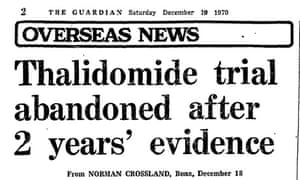
Bonn, March 14 After an investigation lasting five years, the Public Prosecutor at Aachen has brought charges against the manufacturers of the drug thalidomide which is blamed for causing at least 5,000 babies to be born malformed and nervous disorders in 5,000 adults.
The case against the managing director and eight other executives of the pharmaceutical firm, Grünenthal, of Stolberg, near Aachen, is expected to begin in about a year’s time and to last for a year. The charge sheet includes allegations of manslaughter, grievous bodily harm, and infringement of the West German pharmaceutical laws.
Dr Gierlich, the prosecutor, said today that about a thousand of the cases of malformation or nervous disorder were abroad, most of them in Sweden and Britain.
20M a month Thalidomide first went on sale in 1957 and 20 million tablets a month were sold until it was withdrawn by the firm in November, 1961. In several countries, including Britain, it was manufactured under licence.
A spokesman for the firm said no comment would be made until the charges had been studied.
Thalidomide court case this year? A test damages claim, begun in the English courts five years ago by the father of a handicapped thalidomide child, may be heard in the autumn or very early next year. The Lord Chancellor, Lord Gardiner, said this in a letter to Mr Alfred Morris, Labour MP for Wythenshawe, who asked him to inquire into the progress of the case.
In 1970, the trial in Germany was discontinued under a compromise settlement that gave some compensation for those who claimed to be victims of the drug.
The Government is today launching a major recruiting drive for nurses, to combat what is now officially recognised as a grave national shortage.
At the same time, an independent committee is being set up to look at the future role and training of the nurse, so that her scarce skills can be used to best advantage.
Mr Crossman’s announcement of these plans in the Commons yesterday came a fortnight after nurses had won pay increases of up to 20 per cent but, as he said, wages are not the only problem.
He has already tackled regional hospital boards on two more of the outstanding grievances: they are being asked to ensure that their senior nursing staff have a clear part in management, and told that it is essential for nurses to be relieved of the domestic chores which now take up so much of their time.
Boards have also been firmly told that although there is to be no extra money, they must not use lack of funds as an excuse for not recruiting. Cutting down on nursing staff, Mr Crossman said earlier yesterday, was not an economy that the National Health Service could afford.
The recruiting campaign, whatever Mr Crossman’s plans for improving the nurses’ conditions, still relies heavily on the traditional vocational pull: “You’re someone special when you’re a nurse,” the advertisements will say, but at least they can add: “And now you’ll be better off too!”
The campaign will cost £250,000 over the next year and the Department is not sure what it is aiming at. It has set no target for its recruitment because it actually has no figures on the gap between need and the present situation and therefore assumes that recruitment can be unlimited.
The last time the Department spent a lot of money on this sort of programme, it had something like 200,000 inquiries but has no idea how many of these turned into signed contracts. This campaign will at least have a follow-up element.
The shortage of nurses at least is incontestable in many parts of the country. Even London teaching hospitals now have to rely heavily on agencies to get staff, and intake has been dropping. The national wastage from training schemes is around 35 per cent of all who start a course.
Cheap labour The chaos of the present system of treating young nurses as an uneasy cross between student, apprentice, and cheap labour is one of the problems that the new committee will be looking at.
It will be chaired by Professor Asa Briggs, Vice-Chancellor of Sussex University and a historian. He said yesterday that he hoped the inquiry would take about 18 months, and he was anxious to tap current feelings among nurses rather than rely on published reports.
He wants to look at the education of nurses in relation to the whole development of educational patterns, as well as trying to rationalise manpower for a future where hospital and community work will be much more closely linked.
Cigarette firms may be considering sponsoring snooker tournaments abroad to get round the BBC’s new advertising curbs, it emerged yesterday. They could pull out of Britain because the restrictions would cut the air time given to their brand colours, sources said.
The BBC is tied by the advertising rules of the countries in which events are filmed. This weekend’s Mexican Grand Prix, for example, will be screened complete with advertisements for Marlborough and John Player cigarettes on sponsored cars.
Tobacco firms may switch sponsored snooker tournaments to countries with little or no advertising restrictions. Brazil is considered a tempting venue.
The BBC has told snooker’s governing body, the World Professional Billiards and Snooker Association (WPBSA), that the sponsor’s brand colours must not be reproduced in the playing area; signs bearing the sponsor’s name must not be cited behind players’ seats and health warnings must be legible – if they are not the BBC retains its right to put a warning caption on the screen.
Mr Bill Cotton, BBC’s managing director, has said he is concerned that air time is being used to sell cigarettes. This follows a Health Education Council complaint that sports sponsorship was giving the tobacco industry the equivalent of 500 30-second TV advertisements a year.
The curbs will come into force at the £275,000 Rothman’s Grand Prix snooker tournament later this month. The firm had just spent £2,000 on building a set in its brand colour, Rothman’s blue, when it was told of the new curbs.
Rothman’s three-year sponsorship agreement with the WPBSA runs out next month, and renewal is in question. ‘We won’t be taking any decision until we sit down in November and judge from market research the effectiveness of sponsorship,’ said Mr Roach.
Three Things to Seem for in a Vendor Neutral Archive
Medication calls for freedom, flexibility and sophistication to supply the highest common of patient care. The traditional, proprietary Picture Archiving and Communications Method (PACS) has become an antiquated format that does not have the capability to respond to the most current requirements of well being care information management. Right here are three (3) ideas for clinics in considering a vendor neutral archive (VNA).
Versatility in Caring for Sufferers
In 1982, the idea of PACS was mentioned at an crucial radiologist meeting. Cardiovascular Radiologist Doctor Andre Duerinckx is one particular of the very first who utilized the phrase to refer to a medical technologies enabling storage of important digital paperwork, images and pictures. The goal of this radiology data system is to offer the most up-to-date, genuine-time, sophisticated entry to vital medical data.
In the 2012 October – December concern of the Indian Journal of Radiology and Imaging, Tapesh Kumar Agarwal and Sanjeev discussed the benefits of a vendor neutral archive versus a conventional proprietary PACS. Just as present day tv technologies has innovative from vacuum tubes to plasma screens, radiology picture storage need to also advance to the subsequent degree. Three factors you ought to look for in your vendor neutral archive are 1. Open Supply Information Format, two. Scalability and 3. Remote Entry.
one. Steer clear of Proprietary Data Format
It is important to don’t forget that your clinic’s medical photographs need to nevertheless belong to your healthcare clinic. When a PACS employs a proprietary information format, they might claim that they have modified or extra worth to the photograph, therefore generating a legal claim thereto. The greatest way to deal with this is to operate with a vendor neutral archive making use of typical data formats.
Clinicians may possibly differ on whether they want to use a JPG, PDF, GIF or other information format, but realistically some formats are a lot more generally accepted. If 1 clinic demands to share data with another clinic, why not use the most universally accepted data formats? A proprietary information, computer software or database method may possibly make your data tough to retrieve.
Unfortunately, companies go out of company or may face a company interruption. If your information is caught in their proprietary format, then it will be hard to modify or translate. Discover a VNA with a typical information format to make your job less difficult.
2. Emphasize Scalability with Archive
A single of the principal reasons for outsourcing your pictures is due to information storage size limitations. In the contemporary realm of computing, the Cloud Computing data center offer you even better, a lot more reasonably priced solutions than some classic PACS. You can sign a cloud service contract discussing all of your demands for storage, availability and safety.
As your clinic grows, it can update its cloud services contract adding or subtracting features. Securing information scalability is definitely necessary in the present day planet of the Internet. Multimedia movies get up a great deal of area and cloud storage can be accessible remotely utilizing mobile units.
three. Make Information Available Remotely
And that is a very good segue to the final issue: real-time accessibility anyplace is a necessity in the contemporary clinical atmosphere. A physician with a smart telephone should be capable to accessibility your information, photographs and reviews remotely. Sometimes, a diagnosis could literally be the variation in between lifestyle and death.
Some modern clinics are becoming forced to improve their internet sites to supply much more mobile connections. Your VNA must also be ready to manage remote, real-time data requests to supply the ideal, most urgent patient care. The VNA ought to be a lot more compatible with the open supply format of the Globe Wide Web. Technological interoperability is key.
In the 1980s, the PACS took the first phase in the direction of generating much more reasonably priced image storage systems for the health-related area. Decades later on, the subsequent organic phase is obtaining a VNA with the versatility to control all of your clinical data requirements. Faster, scalable, true-time VNA information entry optimizes your patient care.
At the height of the Cold War, a group of health-related specialists swapped stethoscopes for placards in a bid to highlight the risk posed by nuclear weapons.
The Medact archive has just been catalogued at the Wellcome Library, and tells the story of a group of physicians, nurses and other professional health care practitioners, who joined collectively to protest against nuclear weapons, making use of their healthcare knowledge to argue that the bomb was the best threat to human well being and survival.
They were drawn to activism via a sense of specialist responsibility, and I have picked a handful of hidden gems from the assortment which I feel best capture the spirit of this courageous group.
This is the Enemy poster. Photograph: /Medact/Wellcome Library, London
This poster exhibits how Medact– or the Health care Campaign Against Nuclear Weapons (MCANW) as it was then identified –tried to strip the nuclear situation of East versus West dogma, campaigning as an alternative from a place of healthcare authority.
It also provides a nod to the origins of the Worldwide Doctors for the Prevention of Nuclear War (IPPNW), an umbrella organisation born out of an unlikely alliance among two cardiologists from either side of the Iron Curtain: Bernard Lown from USA and the Russian Evgeni Chazov.
Leaflet satirizing government suggestions on nuclear war. Photograph: /Medact/Wellcome Library, London
This leaflet responds to a 1985 government circular outlining programs for the NHS and the treatment method of casualties in case of war. The advice was heavily criticised by several physicians for offering unrealistic expectations of how the healthcare profession would cope with an assault.
It charts the tongue-in-cheek, but deeply serious, response of one doctor to the total inadequacy of civil defence preparing. It reveals specialist anger at the reassuring tone of the now-infamous Property Office public information video, Safeguard and Survive (accessible below).
BMA Board of Science and Education, “Choice of casualties for treatment after nuclear attack” (1988). Photograph: /Medact/Wellcome Library, London
Spurred on by the lack of concrete evidence about the health-related impact of a nuclear attack, the British Health-related Association’s Science and Training Board launched its very own inquiry in 1981, seeking at the health-related effect of nuclear weapons and assessing whether civil defence could ever be satisfactory.
The BMA’s initial report fully contradicted the claims created in Defend and Survive. It identified that the results of a single megaton explosion more than the United kingdom would lead to casualties which would overwhelm the NHS.
The BMA published two additional reviews in excess of the program of the 1980s, which nonetheless make for chilling reading through. Supplying a stark and devastating evaluation of what daily life after a nuclear explosion would be like, they also highlighting the ethical dilemmas about the treatment of nuclear casualties, including the not possible question of choosing who would be permitted to live and who would be left to die.
The BMA reports have been a wake-up contact. They have been crucial evidence for the anti-nuclear campaign, and supplied a potent counter-argument to the Government’s civil defence programme.
Coventry and Warwickshire Medical Campaign Against Nuclear Weapons, Arms or Overall health? The Effect of the Arms Race on Health (1986). Photograph: /Medact/Wellcome Library, London
One argument deployed in defence of nuclear weapons was that their manufacture stored people in jobs.
The Health care Campaign’s Arms Conversion special panel attempted to counter this declare, focusing on how the capabilities and companies utilised for military industries could be converted for peaceful functions.
The Arms Conversion Panel, along with the Coventry Alternative Employment Research (CARE), argued that extremely skilled defence contractors could simply be retrained. They known as for military business to be redeployed toward socially beneficial manufacturing, like the building of health-related devices and disability aids.
This publication demonstrates how the Healthcare Campaign adopted financial, as properly as emotive arguments, addressing fears of unemployment and challenging the standing quo.
Aberdeen Health care Campaign Towards Nuclear Weapons. 1980s. Photograph: /Medact/Wellcome Library, London
There is a excellent collection of images in the Medact archive, some of which have lately been digitised and will soon be freely available on Wellcome Pictures.
These photos demonstrate the human side of the Campaign, capturing the environment of protests, meetings and rallies. Tucked away in these files are a couple of pictures of the Campaign’s exhibitions and displays. As an archivist, it is uncommon to get a sense of the layout of exhibitions or how men and women responded at the time.
These photographs give us a sense of just that, helping us to recognize how Medact used campaigns and exhibitions to engage the public. My favourite pictures are individuals aboard the group’s legendary Medical Campaign buses.
Medact is nonetheless lively these days, and campaigns for global wellness on issues relevant to conflict, poverty and the environment. If you want to locate out much more about the work of this fascinating organisation, the archive is now accessible for analysis at the Wellcome Library, and searchable on our online catalogue.
Elena Carter is a venture archivist at the Wellcome Library. More than the previous 6 months, she has been cataloguing the Medact archive.
A important principal on which the NHS was created in 1948 was that companies would be cost-free at the stage of use. Photograph: SSPL/Getty Pictures
The management consultants who helped to layout the new structure of the Nationwide Overall health Services in 1974 say that the scheme has failed and should be scrapped.
They also propose scrapping the tradition of a totally free well being service and introducing £20 a week “hotel” fees for hospital stays, a £5 bill for every visit to a hospital casualty division and a £2 fee for each and every go to to a GP. The partners of the McKinsey management consultancy also advocate, in their proof to the Royal Commission on the NHS, scrapping two of the current tiers of administration, getting rid of most managerial obligation from the Division of Well being and Social Protection and creating an NHS commission to run the services.
The McKinsey evidence, which has but to be formally published, condemns the new NHS construction of location and regional health authorities for major to a “proliferation of paper” and a “substantial bureaucratic dilemma.”
The total NHS is in crisis, with troubles of morale, staff grievances, soaring costs, a dissatisfied public, small extended-phrase planning and so on, the McKinsey evidence says.
The McKinsey argument is a mixture of controversy and consensus. A lot of of these offering evidence to the Royal Commission are confidently expected to attack the 1974 construction of “tiers of authority.” The Society of Civil and Public Servants, representing individuals DHSS administrators who have oversight of the NHS, announced yesterday that they desired the regional well being authorities to be abolished.
The Labour Get together in opposition attacked the 1974 reorganisation scheme, and the two Labour Secretaries, Mrs Barbara Castle and Mr David Ennals, have made it plain that they are less than enthusiastic about it – but that it would be even much more unsafe to tinker yet again with a technique that is still recovering from its final overhaul.
The opposition social services spokesman, Mr Patrick Jenkins, said last night that the 1974 structure had turned out to be “somewhat a lot more cumbersome” than Sir Keith Joseph had envisaged, and surely far more than McKinsey had suggested.
The McKinsey proposals on charging for wellness amenities are very likely to be the most controversial. The British Health-related Association is thought to be nearly particular to suggest “hotel” expenses for hospital stays, but it has set its encounter against separate charges for each and every consultation of a GP. The McKinsey suggestion of an NHS commission also has its echoes amongst some aspects in the BMA, who have named for a BBC-variety public overall health corporation to “take politics out of medicine.” The BMA’s ultimate view will not be known until right after a special BMA meeting in March.
A patient goes under the knife at University School Hospital Health-related School, London, 1898. Photograph: Science & Society Image Librar/Getty Pictures
Dr. Bigelow, of Boston, some number of weeks since sent to this nation an account of surgical operations having been performed on sufferers, while they have been in a state of insensibility from the inhalation of the vapour of sulphuric ether. This account describes the procedure and its effects:—
“A boy of sixteen was seated in the chair. The first handful of inhalations occasioned a quick cough at the finish of eight minutes the head fell back and the arms dropped, but owing to some resistance in opening the mouth, the tooth could not be reached just before he awoke. He yet again inhaled and slept three minutes, during which time the tooth was extracted. On coming to he explained he had had ‘a first-rate dream – extremely quiet – and had dreamed of Napoleon had not the slightest consciousness of pain’ and he left the chair feeling no uneasiness of any kind, and evidently in a substantial state of admiration.
“A youthful guy was made to inhale the vapour while an operation was carried out on the tissues close to the eye. Soon after a excellent deal of coughing, the patient succeeded in inhaling the vapour, and fell asleep. During the succeeding two minutes, the very first incision was produced, and the patient awoke, but unconscious of discomfort. Desirous to be yet again inebriated, the tube was placed in his mouth, and retained there about 25 minutes, the patient being apparently half affected, but, as he subsequently stated, unconscious.
“35 minutes had elapsed, when I located the pulse all of a sudden diminishing in force. The respiration was slow, the hands cold, and the patient insensible. Interest was now directed to the return of respiration and circulation. Cold effusions, as directed for poisoning with alcohol, were utilized to the head, the ears were syringed, and ammonia presented to the nostrils and administered internally. It was only soon after getting compelled to walk throughout half an hour that the patient was in a position to lift his head.”
In a letter to the Morning Chronicle Dr. Boott, of Bedford Square, says that the inhalation has been tried in London with the most excellent accomplishment in the extraction of teeth and that two surgical operations have been performed by Mr. Liston, with no the patients possessing been in the least aware of what had been carried out.
Dr. Forbes, the editor of the British and Foreign Health-related Review, says:—
“Yesterday we had the fulfillment of seeing this new mode of cheating discomfort place in practice by a master of chiurgery on our personal side of the Atlantic. In the theatre of University College Hospital, Mr. Liston amputated the thigh of a guy previously narcotised by inhalation of the ether vapour. Shortly after becoming positioned on the working table, the patient started to inhale, and grew to become apparently insensible in the course of two or three minutes. The operation was then commenced, and the limb was eliminated in what seemed to us a marvellously quick room of time – undoubtedly much less than a minute the patient remaining completely still and motionless.
“Even though the vessels were becoming secured, on being spoken to he roused partially up (even now displaying no indications of discomfort) and answered concerns place to him, in a slow, drowsy method. He declared to us that at no portion of the operation had he felt discomfort, though he appeared to be partially aware he had heard some words, and felt that some thing was becoming accomplished to his limb. He was not conscious till advised that the limb was off, and, when he knew it, expressed wonderful gratification at obtaining been saved from pain.”