Ross etiketine sahip kayıtlar gösteriliyor. Tüm kayıtları göster

27 Mart 2017 Pazartesi

Trump tried to burn down Obamacare. He set his hair on fire instead | Ross Barkan

Burning Obamacare to the ground was always a House Republican obsession that Trump, in the heat of the campaign, took up to spite the president while tossing a little red meat to Republicans. “Repeal and replace” is alliterative, after all: it sounds nice enough on an arena stage. It’s just hard to pull off in the real world, as Donald Trump found out on Friday.


Blessed with total control of government, Republicans can only think of how best to burn the house down – and they’re not even doing a good job at that. The House speaker, Paul Ryan, unjustly heralded as a policy wonk, tried to rush his healthcare bill to the floor for a vote on Thursday, only to find the moderates and extremists in his party rebelling. On Friday, Donald Trump was forced to pull the bill, due to lack of support from his own party.


It was a humiliating defeat, which he tried to blame – unbelievably – on the Democrats.


Paul Ryan on failed healthcare bill: ‘This is a disappointing day’

Ryan’s Trumpcare was a horrendous concoction and should disabuse fawning congressional reporters of the notion that the speaker is a man of deep intellect and self-reflection. Had the bill not fallen flat on its face this Friday, it would have had little chance of passing the Senate.


What remains is the fact that Donald Trump couldn’t close the deal. He is hoping everyone blames Ryan, and Trump is lucky that his supporters might do just that. The diehards, inhabiting his post-factual universe, will simply write Ryan off as a loser – they hated him anyway – and hail their king for the bounties he’s still promising.


But healthcare will ultimately be Donald Trump’s problem. That’s how our politics work. So far, the president has been more fatuous than fascistic, though he belatedly realized what an albatross the bill had become. His negotiating powers, whatever they ever were, failed.


Were Trump the deal-making genius his ego tricked himself into believing he was, he would never have taken up this healthcare venture. A recent Quinnipiac University poll found that only 17% of Americans approved of Trumpcare. Trump’s poorest and least educated supporters had much to lose and nothing to gain from the legislation.


That’s why demolishing Obamacare never made sense. After all, Trump, via Steve Bannon, promised economic nationalism, a robust spending plan for those who he believed deserved it most: the white and native born. Trump wasn’t going to lose any votes by focusing on immigration and infrastructure spending at the expense of Obamacare, which rank-and-file conservatives resent less now that Obama himself has been removed from the equation.


President ‘pulled out every stop’ to pass healthcare bill, Spicer says

Far from upholding the most basic protections for the working-class, the Trump administration has, instead, evolved into one of the most rightwing in recent memory. It is stocked with the kind of appointees (Mick Mulvaney, Tom Price) who could have been plucked from Congress by Presidents Ted Cruz or Marco Rubio.


This is the difference between Trump and someone like the French presidential candidate Marine Le Pen, the Front National leader who identifies closely with the billionaire. Le Pen’s fiscal platform is unapologetically leftist, rejecting the austerity measures embraced by Europe’s financial class.


Trump rages with all the hate of Le Pen and none of the savvy. Blaming Ryan for Trumpcare’s failure will not absolve him of trying to do a very stupid thing. If he chooses to weaken healthcare in other ways – to somehow prove Obama left the country with a self-destructing system – he’ll still be the president when premiums skyrocket as insurers struggle to adapt to this instability.


In 2018, 2019, and 2020, screaming Obama’s name won’t matter anymore. The country will just know President Trump and the damage being done.


Trump tried to burn down Obamacare. He set his hair on fire instead | Ross Barkan

16 Mart 2017 Perşembe

If Trump were a clever populist, he"d demand universal healthcare for America | Ross Barkan

Donald Trump understood the average Republican voter well enough to disregard the party’s tired orthodoxies and still win the presidency. He figured out that most Republicans could care less about shredding entitlements and adhering blindly to Milton Friedman’s soulless economic agenda, as long as he was bashing immigrants. To this day, Trump still won’t fulfill Paul Ryan’s Ayn Randian fever dream of gutting Social Security and Medicare.


But he does promise to do Ryan’s bidding and repeal Obamacare, a move that is all but guaranteed, if successful, to make a lot more people who voted for him sick. This probably doesn’t worry Trump too much in the short term, since senior citizens in the West Virginian hollows and dead factory towns of Ohio can’t afford dues at Mar-a-Lago anyway. Republicans in Congress, unused to and uninterested in governing, want to tear up Barack Obama’s signature achievement as quickly as possible because that will fill the emptiness of a nihilist campaign vow.


Few rational people think Ryan’s American Health Care Act is anything but a disaster-in-waiting. Swapping a mandate for ungenerous tax credits and eventually killing the Medicaid expansion while preserving the most expensive and popular aspects of Obamacare (not discriminating against people with preexisting conditions and letting everyone under 26 remain on their parents’ health plans), the AHCA will strip coverage from 24 million people by 2026, according to estimates from the Congressional Budget Office.


Were Trump a cannier tactician – or just a very different man – he would try to co-opt a beleaguered Democrat party by actually bolstering Obamacare, triangulating to save his party’s historic majority. Imagine if Trump’s team seriously considered the flaws of the ACA and tore a page from the playbook of the most populist Democrats to address them.


We already know there’s an overlap between the people who voted for Obama and Bernie Sanders and those who eventually chose Trump. The desperate working class of this country, white and black and brown alike, are seeking answers as automation and globalization threatens to sideline more and more laborers forever. Trump can gratify his own galactic ego and do some good by actually saving them.


As it stands, Trump’s obsession with pushing Ryan’s catastrophic bill is the best gift an otherwise pathetic Democratic Party could envision. Republicans control every branch of government, two-thirds of governorships and far more state legislatures than Democrats, a level of dominance unseen in more than a half century. But the sooner any version of the AHCA becomes law – no sure thing as Senate Republicans and moderates in the House balk – the more furious the backlash against the party of Trump will be.


Democrats are giddy that Republicans are on the verge of owning a healthcare catastrophe. Smarter Republicans are catching on. Arkansas Senator Tom Cotton, usually a reliable ideologue, recently said voting for Ryan’s bill would put the Republican’s formidable House majority at risk.


As unlikely as this scenario would be, the Trump White House could heed Cotton’s warnings and change course. Support increasing subsidies for the lower and middle class people who truly find Obamacare unaffordable. Expand Medicaid coverage. Try to entice younger, healthier people to buy insurance or just force them. Discover the unreliable New York liberal lurking somewhere in that tanned hulk and back a cheap public option to compete with private insurers, driving prices down.


Rebrand the effort. Obamacare can become Trumpcare, except Trumpcare will actually work for everyone. For all his business failures, Trump does know something about marketing and reinvention. What’s the best way to stick it to his bête noire, Obama, and punish Democrats for good? Make Obamacare (Trumpcare) better.


It’s easy to snicker about a Republican president doing this. But Trump owes his party little, and its orthodoxies even less. He is a cult of personality, a ringmaster who can command his legions of followers to the end of the Earth, no matter what he says or does. The working class white Americans and Midwestern swing voters who put him in power won’t punish him for making government more generous and welcoming.


Trump can choose the courageous and practical path of attempting to usher in an era of affordable, universal healthcare coverage to a nation in profound need of both. Or he can punish the American people and his own party with Ryan’s dreadful legislation.


Just don’t expect him to choose wisely.


If Trump were a clever populist, he"d demand universal healthcare for America | Ross Barkan

10 Ağustos 2016 Çarşamba

The race to save a dying language | Ross Perlin

In 2013, at a conference on endangered languages, a retired teacher named Linda Lambrecht announced the extraordinary discovery of a previously unknown language. Lambrecht – who is Chinese-Hawaiian, 71 years old, warm but no-nonsense – called it Hawaii Sign Language, or HSL. In front of a room full of linguists, she demonstrated that its core vocabulary – words such as “mother”, “pig” and “small” – was distinct from that of other sign languages.


The linguists were immediately convinced. William O’Grady, the chair of the linguistics department at the University of Hawaii, called it “the first time in 80 years that a new language has been discovered in the United States — and maybe the last time.” But the new language found 80 years ago was in remote Alaska, whereas HSL was hiding in plain sight in Honolulu, a metropolitan area of nearly a million people. It was the kind of discovery that made the world seem larger.


The last-minute arrival of recognition and support for HSL was a powerful, almost surreal vindication for Lambrecht, whose first language is HSL. For decades, it was stigmatised or ignored; now the language has acquired an agreed-upon name, an official “language code” from the International Organization for Standardization, the attention of linguists around the world, and a three-year grant from the Endangered Languages Documentation Programme at the School of Oriental and African Studies in London.


But just as linguists were substantiating its existence, HSL stood on the brink of extinction, remembered by just a handful of signers. Unless the language made a miraculous recovery, Lambrecht feared that her announcement might turn out to be HSL’s obituary.


Three years after announcing its existence, Lambrecht is still unearthing her language sign by sign. She may be the only person in the world who still uses HSL on a regular basis, signing into a camera while a linguist named James “Woody” Woodward and a handful of graduate students from the University of Hawaii document her every move.


Led by Lambrecht, Woodward, and researcher Barbara Earth, the project aims to document what may be the last-ever conversations of native HSL signers. The goal is to record at least 20 hours of high-quality video footage of natural HSL and then transcribe, translate, and archive it. The researchers hope that this work – along with a series of illustrated handbooks depicting over 1,000 signs, and a regular class at the University of Hawaii set to begin next year – will jump-start the revitalisation of HSL.


The project faces numerous obstacles. The first is the scepticism of many of the remaining signers themselves. Hawaii’s tiny Deaf community is deeply divided. Some say HSL is not a real language, others see it as backward; still others are sceptical of Lambrecht.


Dying Language

Illustration by Christian Montenegro

But the gravest threat to HSL is American Sign Language (ASL), which is advancing across the globe – from Hawaii to Thailand to Togo – just as fast as English. The Deaf world, intensely local until recently, is consolidating and globalising in unprecedented ways. And the forward march of ASL, which in certain ways brings people together, also poses a significant danger to many of the estimated 400 sign languages used all over the world – most of which we know nothing about.


Hawaii is a bellwether, but Deaf culture all around the world – for many on the inside it is a “capital-D” culture, not a “lower-case-d” disability – faces threats from every direction. The “mainstreaming” of deaf students means that they are placed in hearing schools, where they are encouraged to be just like everyone else but with “special needs”, in a process that some call deliberate assimilation. Cochlear implants (and the potential of gene therapy) even more fundamentally endanger sign languages – some Deaf activists condemn such “cures” as being akin to genocide.


If the loss of a particular language such as HSL means the end of a whole expressive system, the disappearance of sign language in general – the only fully fledged form of language completely independent of speech – would permanently impoverish human communication.


Like every natural language, HSL is the evolved product of a specific history, the unconscious creation of a community. For it to survive, local signers will have to make a deliberate choice to use it. The same may be increasingly true of Deafness itself. The story of HSL raises crucial questions in an age of globalisation: Do cultures on the margins have a future? Will enough people choose to be that different, and will they do it together?


Though they parallel spoken languages in certain ways, sign languages represent a fundamentally different way of communicating. They neither derive from, nor correspond to, spoken languages. Nor are all sign languages mutually intelligible, as hearing people often assume – they are as various as spoken languages.


Their historical evolution is distinctive. Infants can sign before they can speak, and the great sign language linguist William Stokoe argued that sign may have preceded speech in the history of human language. It’s considered normal for one in 1,000 children to be born profoundly deaf, but places with higher rates of inherited deafness – such as the village of al-Sayyid in Israel and Bengkala in Bali – have been natural hotspots for sign languages.


For sign languages, and for Deaf culture more broadly, intergenerational transmission is far from straightforward. The vast majority of deaf adults give birth to hearing children, while most deaf children are born to hearing adults who have no connection with the Deaf communities.


Signing is not miming, and signs are not just gestures that anyone can immediately grasp


Signing is not miming, and signs are not “just” gestures that anyone can immediately grasp. “Iconic” signs, where the gesture self-evidently expresses meaning, play a role in every sign language, but even they can be wonderfully nuanced. In HSL, for instance, “cry” is signed with spread-finger “tears” running out from the sides of the eyes, while “bawl” has the fingers running straight down. Still, abstraction and convention are essential, just as in speech, because not everything can be expressed with self-evident gestures. There is nothing obvious, for example, about the HSL sign for “man” or “boy”: a spread hand moving down across the head.


For most of recorded history, sign languages have been effectively invisible to hearing people. It was not until William Stokoe’s groundbreaking study of ASL, published in 1960, that any sign language had been analysed as a fully fledged communication system with a grammar of its own. In 1965 Stokoe published an ASL dictionary, also the first of its kind.


Now that the kind of geographical isolation that once bred new languages is no more, sign languages represent something of a final frontier. “We really don’t know how many sign languages there are,” says Albert Bickford of the global sign languages team at the language database Ethnologue. “It seems reasonable to assume that the majority of sign languages currently in use in the world have not been discovered yet,” Victoria Nyst, a linguist at Leiden University, told me.


The most recent edition of Ethnologue, published earlier this year, mentions 141 sign languages. Over a hundred more have been reported, Bickford says, but no solid information on them exists – just the barest indication that Deaf people may sign differently in a particular place. We may never know much about these languages, or even confirm their existence.


Lambrecht’s announcement in 2013was the culmination of a lifetime of work. Born deaf, she hears almost nothing, barely even the noise of a siren blaring in her street. “I grew up very frustrated, thinking I’m not deaf, I’m not deaf, I’m hearing! I want to be an actress, I want to be a dancer, I want to be a movie star!” Lambrecht told me late last year at the University of Hawaii. “I was so frustrated that I couldn’t be those things.”


Teletype, an early form of texting, and closed captioning, which made TV and films accessible, were life-changing developments for her when they became widespread in the 1970s. “After that, I settled down,” she said. “I hated being deaf until that communication barrier broke down, when all those devices came out.”


The youngest of seven children, Lambrecht started signing HSL at home in the late 1940s – learning it from two of her older brothers, who were both deaf like her. She was probably one of the last people anywhere to learn HSL naturally, as a first language, and picking it up from family was particularly unusual. By then, the dorm at Hawaii’s only deaf school was the closest thing HSL had to a homeland – it was there that one of her brothers learned it.


But ASL was already coming in. Soon after the second world war, an unprecedented number of Deaf mainlanders came to Hawaii to work or retire. Within a few decades, ASL was dominant, HSL almost dormant. “We would get a lot of insults, a lot of negativity,” Lambrecht recalled. “Deaf people here would put themselves into an inferior category compared to the people who brought ASL. People said, ‘They’re from America, they’re white people, they know better.’”


Lambrecht made a living by teaching ASL for 33 years, mostly to hearing people, but in her spare time she pursued HSL, tracking down old signers in hospitals and nursing homes. “We used to go to the other islands to drum up people, and now they’re all dead, dead, dead,” her husband, Jeff, said. Interested mainlanders had documented a small number of local signs, and they encouraged Lambrecht to do more. Years in, she realised she had been collecting the remains of a complete and original language.


Without funding and without linguistic expertise, Lambrecht’s efforts stalled until 2007, when a woman named Barbara Earth came to Hawaii and enrolled in her ASL class. After a career working on gender and development in Asia and Africa, Earth was going deaf and wanted to learn how to sign.


Embracing Lambrecht’s cause and digging into HSL history, Earth hunted for money to support the project. Three years later, she found enough for a pilot study, interviewing 19 elderly Deaf people and two children of Deaf adults on four Hawaiian islands. William O’Grady, the linguistics department chair at the University of Hawaii, agreed to host the project at the university: “Barbara knocked on my door and said there was an unknown sign language here in Hawaii, and she needed help to prove that it existed.”


Linda Lambrecht, left, teaches Hawaii Sign Language.


Linda Lambrecht, left, teaches Hawaii Sign Language. Photograph: Eugene Tanner Photography, LLC

An initial estimate of up to 280 surviving HSL signers was soon revised down to 40, then down to just 10 or so old-timers still likely to be competent in HSL. ASL had made deep inroads even among these signers, but there was evidence, especially from Lambrecht’s signs, that HSL was distinct, and lay close enough to the surface to be recovered. Spoken languages such as Basque, Welsh, and Hawaiian have come back from the brink of extinction – could HSL be the first sign language to do it?


For James Woodward, the mass extinctionof sign languages is bound up in prejudice and chauvinism. He believes that every local sign language should have the chance to become a valued, modernised language of education, giving communities a choice and a chance at continuity. Like the spread of English, the triumph of ASL might enable communication, but convenience cannot replace intimacy and history, which people soon forget ever existed.


Related: Signs of the times: deaf community minds its language


One day late last year in Honolulu, I sat in on a gathering that included some of the last active HSL signers. Besides Lambrecht, there were the three other elderly signers who had joined the project within the last year. Their funny and furious signing was almost all in ASL, as usual, but here and there old bits of HSL were surfacing.


“Is this Deaf culture or what!?” Hilda Lopez signed. “I love it, I love it, I love it.” She kissed her own hands as she signed. “HSL is really number one in my life. The ones who don’t like it are small-minded!”


Lopez explained to me that her first name in English is Hilda, but her name sign – her real, everyday name in the Deaf community – is a pointing gesture towards the mouth, based on an incident at her fifth birthday party when someone fired a BB gun and shot out some of her teeth. It’s a classic HSL name sign: blunt, comic and personal, based on physical characteristics and memorable incidents.


Like any language, HSL can be broken down by linguists, but its personality, its characteristic style of discourse, is harder to get a handle on. Even when signing ASL, Lopez seems to embody the HSL style. “When they’re using ASL, people talk too long and make other people bored,” she told me. “HSL is short and thrilling and fast.”


HSL has a bigger ‘signing space’ than ASL – anywhere from the top of the head to the bottom of the torso


HSL has a bigger “signing space” than ASL – meaningful signs can be made anywhere from the top of the head to the bottom of the torso. Signs that occur not on the hands but elsewhere on the body also play an important role. “Kick” is signed only with the leg, for instance, while a raised eyebrow is a vital bit of grammar, signalling a yes or no question, or a conditional clause beginning with “if”. The “vocalisations” accompanying certain signs, which fellow signers can sometimes lip-read, echo different spoken languages: borrowed words from Hawaiian, English and Hawaii Pidgin.


Lopez thinks and talks to herself in sign. “I’m 100% Deaf!” she said proudly. “I don’t hear sound, but I can feel it, I feel the body vibrations in my chest: bass drums, police sirens. The only thing I can hear is fireworks — I don’t like the smell of them, they make me sick, but I like the noise and vibration.”


Lopez never knew her biological parents, but she is fiercely proud of her Native Hawaiian and mixed-ethnic roots. At least one piece of evidence, an 1821 letter discovered by Barbara Earth, seems to link HSL to the Native Hawaiian past. In that year, an American missionary, newly arrived in the Kingdom of Hawaii, met a deaf man and bargained with him over 40 sticks of firewood and a pig. Some of the man’s signs were “in common use”, seemingly among both deaf and hearing people, wrote the missionary. The signs he recorded for “pig”, “money”, “see”, and a system of counting by clapping, are still present in HSL today.


The rate of inherited deafness in Hawaii is normal. But by the late 19th century, waves of Japanese, Chinese, Portuguese and Filipino immigrants were coming to Hawaii to work on the American-run plantations, and a new multi-racial Deaf community took shape in Honolulu, including boot shiners, launderers, and flower sellers. There was even what a contemporary newspaper called a “fancy deaf wedding”, where 80 of the guests used “the sign language”.


“The turning point, the beginning of the end of HSL,” according to Barbara Earth, was the founding of Hawaii’s deaf school in 1914. Like most schools at the time, it promoted oralism, the system of lip-reading and speaking that is almost universally despised in Deaf communities for being painful, unnatural and ineffective. But for a while the school was also a unique environment for the clandestine transmission of HSL. One former student, Norman Galapin, told me that he learned HSL “on the playgrounds and in the dorm”, though “if the teacher saw you signing, sometimes they would slap your hands, or hit you with a ruler, or pinch your cheek.”


During the 1940s, HSL was already a language in transition, according to Galapin: “They weren’t using the old [HSL] sign for ‘mother’, they were using this [ASL] one, but they were still using the old sign for ‘father’.” Starting in 1939, a few charismatic teachers from the mainland played a vital role in overturning oralism and legitimising sign language, but they ended up promoting ASL over HSL in the process.


Employment, education and access to government services – from court interpreters to mental health provision in sign language – were perennial problems in the community, but many deaf Hawaiians thrived as master carpenters, printers, mechanics, postal workers and even ukulele makers. As elsewhere, an informal Deaf Club was at the centre of an unusually tightknit community, organising Christmas parties, bowling nights and an annual summer camp-out on the beach, with up to 100 people fishing and cooking for two weeks straight.


Yet Hilda Lopez, like many Deaf Hawaiians, left Hawaii for the mainland for education and for work, arriving in California in her teens. The culture shock was intense: “It was all ASL, and I wasn’t really comfortable with it,” she said. “People seemed to know so much, I felt that I wasn’t very smart…. I got confused and I lost HSL, I didn’t really remember it any more.” Only now, haltingly peeling away the layers of ASL, is she starting to reclaim the language.


No other sign language comes close to having the influence of ASL. Accurate, up-to-date signer numbers do not exist for any sign language, but most of the larger ones are not even yet secure in their own countries. There are more than 20 million deaf people in China, for instance, but Chinese Sign Language, which has hardly been documented, has only been acknowledged as a distinct language for the last 30 years.


By comparison, ASL is a powerhouse, supported and promoted by institutions such as the National Association of the Deaf, and Gallaudet University in Washington DC, which describes itself as “the world’s only university with programmes and services specifically designed to accommodate deaf and hard of hearing students”. Gallaudet plays a critical role in the American Deaf community and in the life of ASL. Until recently, the university supported both a college prep centre in Honolulu (to ensure qualified deaf applicants to Gallaudet) and ASL interpreter training in Hawaii (to bolster ASL more broadly).


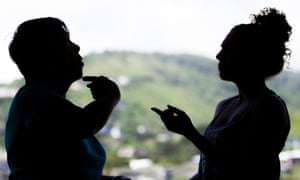
Linda Lambrecht and Emily Jo Noschese speaking in Hawaii Sign Language in Honolulu


Linda Lambrecht having a conversation in Hawaii Sign Language, Honolulu. Photograph: Eugene Tanner Photography, LLC

ASL may now be going global, but the language is at least partly rooted in local sign languages that have long since gone extinct. French Sign Language was the first modern, “methodical” sign language, codified in the 1760s and 70s for formal instruction from existing signs used in the Deaf community of Paris by the Abbé Charles-Michel de l’Épée. When America’s first school for the deaf opened in Hartford, Connecticut in 1817, French Sign Language was imported and likely fused with a handful of existing New England sign languages. The result was ASL. (British Sign Language, dominant in the UK but only granted official status in 2003, is not directly related to ASL.)


Today, there are at least 500,000 ASL signers in the US, while ASL and ASL-derived sign languages are also widespread across the Caribbean, the Pacific and much of Africa and south-east Asia. The language’s increasing dominance in countries on every continent reflects the strength of Deaf culture in America and the role that well-meaning American missionaries and educators have played in spreading Deaf education through ASL.


In the past, James Woodward told me, missionaries would often tell deaf people in other countries that they didn’t have a language. “It’s improving now,” he added, “but I saw that going on as late as 1999 in Thailand, when some Americans came over. I think there’s a growing awareness in the Deaf community in the US of how ASL has really endangered many other sign languages, and even destroyed some.”


As with English, prestige plays a major role in the growth of ASL. The linguist Victoria Nyst has written that “signers in West Africa tend to perceive ASL-based sign languages as being superior to sign languages of local origin.” Similarly, Misella Tomita, a young Gallaudet graduate from Hawaii, described visiting the Netherlands and seeing everyone using ASL rather than Dutch Sign Language: “I felt like ASL is taking over the world.” Closer to home, Woodward has studied Black ASL, which seems to have evolved in the second half of the 19th century at segregated deaf schools in the southern US. The dialect, which is an inspiration to Lambrecht, carries a heavy stigma and has become highly endangered. Almost all black signers now use standard ASL.


At the Hawaii School for the Deaf and Blind, ASL became the standard in 1960. Today, more than half the teachers are Deaf and students are expected to sign ASL while learning to read and write English. HSL is only used, occasionally, by one dedicated teacher, and Linda’s proposal to teach the language there was turned down.


“I think ASL is the reason for the decline of HSL,” Woodward told me matter-of-factly, but then added: “You can’t really separate the personal issues from the linguistic issues.”


The impending disappearance of a language puts enormous stress on a community. For years, the last two fluent speakers of Ayapaneco in Mexico were not on speaking terms, until outside pressures and incentives convinced them to reconcile. According to William O’Grady, one language with just 60 speakers has four competing writing systems. In any community that speaks an endangered language, there are often groups who think the language is not worth saving. “But usually when it’s too late, there’s a deep sense of regret,” O’Grady said.


In Hawaii, the remaining community of HSL signers is deeply divided. Lambrecht is the face of the language, but as a past president of the Aloha State Association of the Deaf (ASAD), she is on the opposite “side” from many of the older signers, who belong to a group known as the Diamond Head School Alumni (after the former name of the deaf school).


The impending disappearance of a language puts stress on a community. The remaining HSL speakers are deeply divided


The two organisations are the institutional expression of a seemingly intractable split in the Deaf community that dates back to at least the 1970s. Some explain it as generational, historical and linguistic, but it is also personal, visceral and mysteriously self-perpetuating. In 2014, when the deaf school marked its 100th anniversary, there were two separate celebrations: one for the Diamond Head group, one for the group Lambrecht is a part of. “I feel like it’s just natural now, this fighting,” Lopez told me.


Because HSL was in retreat by the 1950s, most younger Deaf people can hardly sign in the language – there was virtually nowhere for them to pick it up. Many take great pride in their identity as Deaf Hawaiians and emphatically support HSL as a symbol of that identity. But some of the most fluent of the older HSL signers, in the Diamond Head group, are deeply ambivalent about reviving the language. “Even though they use it in their conversations, they don’t feel that HSL is a real language,” said Darlene Ewan, a community activist who teaches at the deaf school.


Early on, Wanda Andrew, who is part of the Diamond Head group, warned off the researchers: “I said, ‘To tell you the truth, for HSL it’s too late, it’s dead,’” she told me. “The loss of HSL is sad, but it was just sort of a mixture of everything, like chop suey, just kind of like an accent.” For Andrew, who is in her 70s, ASL enabled a cosmopolitan life, from studies at Gallaudet to decades on the mainland and eventual marriage to a Deaf Australian man.


Explaining why some keep their distance from the project, Andrew added that “People will just say they don’t want to, because they don’t want to work with Linda.” She continued, “And if they don’t remember [signs], then they just don’t remember [them]. Or they might be afraid of what it’s for, or they don’t want to feel dumb… I don’t support Linda, I think she’s a little narcissistic.”


Others close to the Diamond Head group agreed that personal animosity and questions of authority – whose signs to record and revitalise? – are part of the problem. Lambrecht’s supporters counter that she has almost single-handedly led the revitalisation effort. Lambrecht herself points to the lingering power of the stigma: “HSL is in their hearts, but they’re resistant. They want to be modern.”


The divide, which has implications for how the language is documented, is now reflected in a similar rift between the researchers. Earth and Woodward now acknowledge that ASL must have had a deeper impact than was initially understood, obliterating HSL and leaving in its place a hybrid of ASL and HSL that Woodward calls CHSL (Creolised HSL).


Earth believes that when signers refer to HSL today, they may actually mean CHSL – a view Woodward does not share.After meeting more members of the Diamond Head group, Earth argues that CHSL is the only thing left: “I have never seen pure HSL. Fewer and fewer old folks retain strong HSL elements… They cannot recover pure HSL because they never knew it.” Woodward counters that “the past two years have shown that Lambrecht is using a different language from CHSL” – during recording sessions where Earth, increasingly estranged from the project, was not present.


The signs for “blue”, “green” and “yellow” have become a particular flashpoint in this dispute. Woodward argues that Lambrecht’s distinctive signs for these colour terms make semantic sense, because they are clearly related to the HSL signs for “water”, “bamboo” and “pineapple”. But other signers were incredulous, saying they had never seen the signs before and suggesting that they might be specific to Lambrecht or her family. Their own signs for those colours were basically ASL, and they couldn’t remember any others that might be original to HSL. Earth felt that the pressure to find such “original” non-ASL signs risked distorting the research.


“If no other person has a sign and Linda has a sign, I don’t know what else to do except use her sign,” said Woodward, who worked with the last known signer of Chiang Mai Sign Language in northern Thailand before he died of complications from diabetes in early 2015. Lambrecht’s signs for “blue”, “green”, and “yellow” are likely to be the standard for teaching HSL going forward. “If there’s only one person left,” Woodward said, “then that’s what you have to document.”


Now in its final month, the three-year project to document and revitalise HSL has made progress, but the hardest work remains ahead. “We haven’t been able to do everything we wanted,” Woodward told me recently. He is applying to the Endangered Languages Documentation Programme for a six-month grant extension. Even now, he said, the team is still finding new signs.


While she continues her work with Woodward, Lambrecht is looking beyond Hawaii, since ASL is spreading to other islands across the Pacific: “I want to tell people there: it’s not that you’re stuck with your local sign language, you can borrow signs from ASL, but please don’t throw out your local language.” Woodward believes that many of the Pacific’s innumerable islands had, or may still have, traditional, indigenous sign languages of their own – he has already identified one on Majuro, one of the Marshall Islands.


“Time is passing quickly,” Lambrecht said the last time I talked to her. The oldest signer who had joined the project, a Japanese-Hawaiian woman named Mildred, was dying. “I remember Mildred would always tell me, ‘I don’t like HSL, I like ASL, it’s for educated people like me,’ and I would say, ‘No, no, no, it’s our local language!’” Mildred was seen as one of HSL’s remaining masters, but she had been reluctant to sign for the camera when I visited last year.


Then in February, Linda told me, Mildred had a bad fall and went to the hospital. She couldn’t walk and was now under hospice care, living with her son. Linda visited her recently: “I saw her signing – and I noticed that she had reverted to HSL. We were just shocked. The others didn’t understand her, I said let me translate. Now when I visit her I try to catch every story I can, while she’s still here. Next time I go I really want to bring the camera and record her.”


• Follow the Long Read on Twitter at @gdnlongread, or sign up to the long read weekly email here.


The race to save a dying language | Ross Perlin

31 Mayıs 2014 Cumartesi

Ross Hutchins interview: "I knew it was cancer"

On court Hutchins wasn’t explosive like Andy Murray, his near friend since meeting in an under-10s match in Scotland in the early 1990s. Nor was he showy or swaggery he described himself as a lot more like Pat Rafter or Stefan Edberg, ‘quiet and focused’.


Hutchins’s life changed on December 27 2012. He had ultimately gone for exams after a physiotherapist flagged up the probability of kidney problems, and that morning he obtained the outcomes: Hodgkin lymphoma, cancer of the blood. It was stage 4, the most superior – the cancer had spread to his physique organs, including the lungs and spleen, and his back (therefore the pain).


About one,800 people a yr in the United kingdom are diagnosed with Hodgkin lymphoma, and it accounts for .2 per cent of all male deaths from cancer.


‘I knew it was cancer,’ Hutchins says. ‘I’d seen so a lot of experts, so a lot of physicians, had so several scans and biopsies. And the way they have been speaking, it was evident they didn’t want to tell me, but they had been preparing to say it was quite critical. So I was upset for literally two seconds and then, fine.’


Last January Hutchins exchanged the tennis court for the cancer ward. He invested every single other Thursday lying on a hospital bed in the Royal Marsden Hospital, Sutton, getting chemotherapy medicines pumped into a vein in his appropriate arm.


That month, Andy Murray focused his win in the Brisbane International to ‘one of my closest close friends, who is back property watching… you are going to get through it.’


And he did. Hutchins was offered the all-clear in August and is now rededicating himself to tennis. His recovery has been nothing at all short of miraculous.


Undergoing therapy for Hodgkin lymphoma in hospital Photo: Getty


‘Sometimes right after chemotherapy I couldn’t encounter eating. I’d have a plate like this’ – Hutchins points to his chicken and avocado salad – ‘and would only eat this considerably.’ He holds up a small forkful of chicken. We are possessing lunch in the members’ restaurant at the Queen’s Club in west London.


Founded in 1886, and named right after its very first patron, Queen Victoria, it is a single of the jewels in the crown of the British grass-court season as each and every June it hosts the Aegon Championships, which serve as a warm-up for Wimbledon.


We have met right here since Hutchins was recently appointed tournament director of the championships, a 1st for a existing tour player (even though he will not be permitted to compete at Queen’s). ‘A good deal of tennis players do not want other items on their plate, but that is the opposite of what I’m like. I like to hold busy,’ he says.


He has previously shown me all around – the 28 outside and eight indoor courts – and throughout the tour he has been greeted warmly by personnel and members alike. Hutchins himself seems as however he has stepped out from a observe ad – handsome, 6ft 3in tall, broad shoulders. His clothes – elegant jacket, verify shirt, teal tie – are by Ted Baker, for which he just lately grew to become a brand ambassador.


His encounter is tanned from taking part in in a tournament in California. When we sat down he ordered sparkling water and blackcurrant cordial, just about the only sugar he permits himself now.


He has a polite and charming air that belies his grit, and behaves so professionally each on and off the court that it is hard to realise that he is even now only 29. He sees himself as ‘a typical man, down to earth’. Ahead of his new position with Ted Baker, he says, ‘I would have possibly turned up to this in a tracksuit.’


He looks so wholesome it is difficult to envision how he was a 12 months in the past. ‘I misplaced most of my hair,’ he says. ‘The first time it happened I woke up in the morning and turned over and there was a stash of hair on the pillow. I believed I was going to go entirely bald.’


He dropped four kilos – he was 87kg (13st 10lb) before he grew to become unwell – but forced himself to consume so when he completed his therapy he was only one particular kilo shy of his original bodyweight. ‘I needed to be near to the same particular person I was when I commenced,’ he explains.


He knows the cancer could return, but for now he is consolidating his remarkable recovery with frantic activity. The day we met he was up at 6am to go for a thirty-minute run near his home in Wimbledon. He is taking part in with Fleming again – earlier this month they reached the ultimate of the BMW Open in Munich.


Hutchins was approached by the Aegon Championships’ managing director, Stephen Farrow, in January. ‘He asked if I’d think about the role and I mentioned it would be totally wonderful. I did not think about it for a second. I’ve been playing at tournaments for six or 7 years and know what it takes to run 1.’


His role includes seeking soon after the gamers, the media and on-web site pursuits, this kind of as a players’ lounge, plus overseeing transport, hotels, players’ foods and physiotherapy therapy. ‘He has a large task on his hands now with taking part in and also becoming a tournament director,’ Andy Murray tells me by way of e-mail, ‘but often gamers do make the best tournament directors due to the fact they know what operates.’


Amongst the comforts Hutchins ideas to provide is a grooming space, exactly where gamers can acquire complimentary manicures and pedicures. ‘We have the very best gamers in the planet coming to our tournament, let’s seem soon after them,’ he says.


His association with Queen’s runs deep. This was the club in which, in 2007, at the age of 22, he had his very first win in an Association of Tennis Professionals (ATP) World Tour match when he partnered Jamie Delgado on centre court in front of seven,500 spectators (they had been due to perform on a single of the back courts, but had been upgraded following yet another player pulled out). It was Hutchins’s 1st match with a pace gun. ‘I could see how quick I was serving!’


This is also the place the place he would come, despite feeling weak from chemotherapy, to organise Rally Towards Cancer, a charity match held soon after the last of the Aegon Championships last yr, which featured Boris Johnson, Jonathan Ross, Andy Murray and Ivan Lendl and raised more than £350,000 for the Royal Marsden Cancer Charity.


At the Rally Towards Cancer Charity Match, flanked by Boris Johnson, Jonathan Ross, Jimmy Carr, Andy Murray, Tim Henman, Sir Richard Branson, Eddie Redmayne and Michael McIntrye Photo: Getty


Rally Against Cancer was the thought of Chris Kermode, then the Aegon tournament director, and now the CEO and chairman of the ATP Planet Tour. ‘Chris referred to as me in January, most likely 10 days following my chemotherapy began and explained, how would you like to place on a charity event this year at Queen’s? And I mentioned, I’d love to. I do not know what state I’ll be in, how healthy I’ll be, but let’s go for it.’


‘It was inspirational,’ Kermode says. ‘He was so committed to producing sure that it was the ideal that it could be. He was plainly exhausted but never ever, ever complained, by no means really described it, unless of course asked. It was really extraordinary.’ Hutchins says the experience ‘gave me a great deal of belief that I could get in excess of the line and come back to court’.


He maintains that the chief issue in his recovery was his background as a tennis player. Not only was he physically fit – ‘that aided with dealing with the chemotherapy I was physically far more in a position to get on toxins’ – but he also had a psychological edge tempered by years on the aggressive circuit.


He decided to treat the cancer as an opponent. ‘If you have undesirable results in tennis, you have to do issues that are unpleasant to make your self comfortable yet again. So you train tougher, commit longer in the health club, spend much more hours studying opponents, and that is what I did with this. I did a great deal of investigation.’ His approach was to concentrate on diet plan, lifestyle and ‘keeping my thoughts busy’.


His fiancée, Lindsay Woods, a attorney, whom he met at a property celebration when he was sixteen, took a 12 months off perform to look right after him. She did a whole lot of study into what he should be consuming. The diet regime of elite athletes is abstemious, and just before he was sick Hutchins typically allowed himself two cups of coffee a week a glass of red wine once a fortnight Lindt milk chocolate as a treat.


But he liked sandwiches and pasta and ate a whole lot of red meat to build up muscle. Woods, a vegetarian, recommended he remove caffeine, red meat, dairy, shellfish and all bread, apart from that manufactured with spelt flour. She made spelt pizzas with tomato sauce and greens, and brown rice sushi with greens. He also had beetroot and orange juice every single morning and evening. ‘Even when I was feeling genuinely ill, I produced sure I nailed eight beetroots a day,’ he says.


His treatment program was a blood check at Sutton every single other Wednesday, then chemotherapy every other Thursday for five hours. Not that he would rest in among treatment options. ‘A lot of the time I’d be working on the personal computer, writing, carrying out projects,’ he says. 1 of these projects was doing work as a tactician for the British Davis Cup group.


‘Fridays were hard. But I created confident I acquired out of the home and did items with family and friends. And then Sunday I would typically start off to truly feel better. I’d arrange meetings on Monday morning no matter what whether or not I was ill or desired to lie in bed, I knew I had to get up on Monday morning.’


Hutchins incorporated factors of optimistic contemplating into his treatment method. ‘Psychology was vital for me,’ he explains. ‘The purpose was to get healthful again, back on court yet again and to have CT scans that showed no cancer. I constantly had that sight firmly in my mind.’ He goes on, ‘I’d talk to Colin about “when we’re taking part in once again following 12 months we want to do this”, often speaking in a positive way about when we’re back on court together. That mindset was quite massive for me.’


But positivity does not constantly help, I say. Elena Baltacha, the former British amount one particular, died of liver cancer at the age of 30 only a number of days ahead of we met. ‘Elena had the most positive mindset you could probably have,’ Hutchins says. ‘She would have hit cancer with every little thing she could have hit it with and never ever given up.


‘But at times cancer does get the much better of men and women and it is not a question of who has the stronger psychological powers or something.’ (On finals day at Queen’s, Hutchins and Murray will be taking element in Rally for Bally, a series of exhibition matches to increase money in Baltacha’s memory.)


Photograph: Getty


Ross Hutchins was born into a planet of tennis. His father, Paul, is a former British Davis Cup player and captain, and now runs national club league tournaments with Ross’s mom, Shali, who is Sri-Lankan born of Malaysian descent. Ross grew up in Wimbledon, the third of 4 children, and commenced playing aged five (his siblings – brother, Blake, and two sisters, Romy and Lauren – all played to national level).


From the age of 7 he went to King’s College College, Wimbledon, the place academically he was ‘middle of the road’, and he left with 7 GCSEs in 2001 to pursue a tennis profession. He turned professional in 2002 and played Junior Wimbledon in 2002 and 2003.


Ill overall health has dogged his profession. In 2004 he blacked out and collapsed right after a hefty practice session in Colombo, Sri Lanka. ‘I had cramping and kidney problems,’ he says. The lead to was dehydration. In sizzling situations he cannot replace quickly adequate the amount of fluid and sodium that he loses.


‘It occurred a lot. I was almost certainly hospitalised 20 instances and put on drips. It is not anything I’ve talked about a lot. It was one of the causes why I gave up singles.’


He turned to doubles in 2007 and started enjoying with Fleming in 2010. ‘There aren’t this kind of lengthy rallies in doubles, much less motion for every stage, so it’s significantly less taxing on the entire body.’


Hutchins says the cancer was one thing else fully, but now recognises the psychological benefit in possessing presently faced his body’s vulnerability. When he was diagnosed, ‘I did not really feel allow down by my body, just sensible that negative factors can happen.’


As soon as he was provided the all-clear last August he launched himself into getting back into form. ‘My oncologist told me the good information by phone one particular evening and the next morning I went to Wimbledon and hit some balls with my brother and my dad on the grass courts. It just felt correct to be in a location that indicates so much to me and to be ready to hit tennis balls cancer-free once again.’


He found an almost physical craving to compete again. ‘I wasn’t happy with just hitting. I was, “All correct, let’s play factors.” I was receiving destroyed by my brother and my dad and was hitting the ball atrociously, but loving the truth that I could perform aggressive factors.’


Prior to the illness, a common day’s education was 3 hrs of tennis, two hrs in the health club. Hutchins chose to adopt a far more fluid approach to acquiring match. ‘I stated to myself that each time I felt like hitting, I’d play. So if it was five hours a day, I’d perform five hrs and if it was half an hour, I’d play half an hour.’


He also committed himself to fat training. ‘I do not usually use machines, I do a whole lot of free of charge weights. But it was basically anything to get robust.’


He admits to overdoing it at initial. ‘I’d be falling asleep at five o’clock on some days. Literally mid-conversation falling asleep. But that was very good, that showed I was operating challenging, and then from September I began to be much more certain [with my ambitions]. I said, I’ve got to be ready to go to Miami with Andy in November.’


For the prior 5 years, Hutchins had joined Murray in Miami for pre-season instruction. ‘I knew that you can’t coast when you’re in the heat with such a match person, and because I wished to keep up with Andy that was my purpose.’ It worked. He was ready to fly out and stayed for two and a half weeks.


Hutchins’s comeback match with Fleming was towards Jérémy Chardy and Grigor Dimitrov in the Brisbane International in January. They took the initial set to love, but misplaced the 2nd six-4 and the deciding set to a tie-break. ‘We came out completely on fire, enjoying truly effectively and then my level dipped. We hadn’t played matches for 15 months. I wasn’t match-sharp.’


Photograph: Getty


Though now match, he says his physique has changed. ‘It does not recover as quickly. I can lift the very same weights but I tire quicker. I’d be silly to consider it is only because of the chemotherapy. It is currently being older.’


When not playing tennis he lives quietly with Woods, who now operates in the offices of the All England Club, and his labrador, Sammy. ‘We go to the cinema, go out for breakfast from time to time. We really do not go on numerous holidays but I like going away for the weekend, regardless of whether Kent or Bath or the New Forest.’ They are getting married at the finish of the 12 months.


He nevertheless forsakes alcohol, dairy, sugar and caffeine, though now enables himself a steak every three weeks and has relaxed the ‘spelt flour rule’. His idea of a deal with is afternoon tea at the Savoy. ‘I told you I like sandwiches,’ he says, grinning.


‘If the cancer returns, then so be it,’ he says, ‘I’ll tackle it head-on once again. But if it doesn’t, then I’ll preserve enjoying taking part in tennis and hold striving to be a better player and become the individual and athlete I want to be.’


The Aegon Championships begin on Monday (aegonchampionships.com). To donate to Rally for Bally go to justgiving.com/RallyForBally


Ross Hutchins interview: "I knew it was cancer"