Maybe you have decided that you want to open your own physical therapy clinic to help others. This is something that on one hand is relatively easy to do, but like any other business, there are downsides. You can’t just open a clinic and expect it to be filled with people and the money to just be rolling in. You really do have to work at it just like any other business if you truly want it to succeed. If you have decided that this is something you want to do, here are some tips to help get you on your way.
1. Start Out Slowly
If you have just completed your physical therapist training program, it is a good idea to work in the industry for a little while before opening your own clinic. Grow your experience at other clinics, and grow a following. Then, when you are ready to start your own clinic, you will have people lining up.
2. Learn how to be Confrontational
This probably goes against everything you learned during your training program. But, in order to be successful in business, you can’t be the type who lets others walk all over you. You need to learn how to be a leader, and how to say “no” when you have to. Learn how to deal with constructive criticism, but also know when you need to give it.
3. Treat Your Studio Like a Business
Your clinic will be a legitimate business, and you want it to make money for you. So, you need to treat it like a real business. Yes, you probably have a passion for physical therapy and want to share, but remember, if you offer too much for free aren’t going to make any money, and you are going to devalue your service.
4. Create Your Brand
Your brand, or your corporate identity, is important. It is the combination of what people see and the reputation that you earn as a business person. Your brand should combine your clinic name, the location of your clinic, logos and colors, and of course, the high quality of the service you are offering.
5. Don’t Expect Instant Riches
Most business do not make much money in the first year of operation, and this can particularly be said of physical therapy clinic. This is not a way to get rich quick. You will have to invest a lot of money to get started, for such things as space, equipment, instructors, etc. You won’t show an instant profit, but with hard work and dedication, you will succeed.
6. Learn how to be a People Person
You will need to learn more skills for dealing with people, because you are the face of your business, and people will want to talk to you about it.
7. Learn Financial Responsibility
It can be difficult to go overboard when starting a business, and you end up spending so much money that you can never dig the business out of a hole to show a profit. Don’t go out and hire a huge staff right away, or rent the largest clinic space. Do what you can afford to do now, and build from there. Over time, you will achieve the success you really desire.
When Bruce Springsteen’s memoir Born To Run was published last month, fans expecting the standard rock biography ticking off the milestones in the Boss’s life and analysing his albums got something of a shock. Threaded through the tale of how a blue-collar boy from New Jersey became a global rock star was a searing account of depression – both his father’s, which governed his childhood, and his own.
Admitting that he had struggled with depression for much of his adult life, Springsteen wrote hauntingly: “You don’t know the illness’s parameters. Can I get sick enough to where I become a lot more like my father than I thought I might?”
He is not the only public figure opening up about the effect depression can have on your life. Boxer Tyson Fury told Rolling Stone magazine that he self-medicated with cocaine and alcohol. “I can’t deal with it and the only thing that helps me is when I get drunk out of my mind,” he said.
Novelist Matt Haig detailed his longstanding relationship with anxiety and depression in last year’s Reasons to Stay Alive, noting that “to be calm becomes almost a revolutionary act”, while American comedian Paul Gilmartin has run a hugely successful podcast on the subject, The Mental Illness Happy Hour, since March 2011.
Musicians Kendrick Lamar and Frank Ocean have also tackled the illness, in interviews and in their work. Ocean told the Guardian in 2012: “My art [is] the one thing that I know will outlive me and outlive my feelings. It will outlive my depressive seasons.”
Meanwhile, Lamar tackles the illness on his latest album, To Pimp A Butterfly, singing: “I know your secrets … I know depression is restin’ on your heart for two reasons.” He later told MTV that he saw To Pimp A Butterfly as a form of therapy.
Martin Daubney, the former editor of Loaded, now campaigns on issues affecting men and boys. “We’re definitely turning a corner at the moment where talking about men and depression is concerned, and I really do think that’s been facilitated by celebrities leading the way,” he says.
“When Professor Green made the documentary about his father’s suicide there was a huge response. When Bruce Springsteen, someone so macho that his nickname is the Boss, talks about depression it’s another leap forward. It gives ordinary average Joes like me the permission we need to be vulnerable. The message sticks.”
This sense that the conversation about male depression is changing intensified last Wednesday when US rapper Kid Cudi released a bleak and emotional letter noting that he was checking himself into rehab for depression and suicidal thoughts. “It’s been difficult for me to find the words to what I’m about to share with you because I feel so ashamed,” he wrote. “Ashamed to be a leader and hero to so many while admitting I’ve been living a lie … My anxiety and depression have ruled my life for as long as I can remember.” An outpouring of support culminated in a new Twitter hashtag, #YouGoodMan.
“I’m shocked at the response to the hashtag, but it is a testament to how many black men are suffering in silence, isolated and feeling afraid,” says Dayna Lynn Nuckolls, a songwriter and artist from Chicago who started the hashtag with fellow Twitter user @TheCosby after reading Cudi’s letter. “It broke my heart that he was apologetic for being unwell … but I knew that his vulnerability and authenticity had the potential to open the door for other men.”
Alex Lewis, a 22-year-old digital marketing specialist and founder of the art project Car Window Poetry, was one of those to respond. “I felt it was a conversation that hasn’t happened much because black men aren’t open about their struggles with mental health,” he says. “As someone who wants to talk more about these things it was great to see.”
Yet what is striking about both these statements and the responses to them is the way in which they highlight how little previous conversation there has been around male depression.
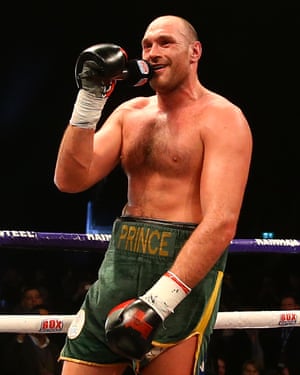
Tyson Fury says he self-medicates with cocaine and alcohol as the only way to cope with his illness. Photograph: Richard Heathcote/Getty Images
In 2016 the charity Men’s Health Forum reported that 12.5% of men in the UK are affected by mental health disorders and men are nearly three times more likely to self-medicate with alcohol or drugs. They are also less likely to seek therapy than women, Men’s Health said, with fewer than one in five being prepared to see a doctor.
That failure to seek help can have terrible consequences. “Suicide is the single biggest killer of men under 45 in the UK – 76% of all suicides are men,” says Jane Powell, CEO of suicide prevention charity Calm (Campaign against Living Miserably). “It’s taken a long time to get the issue of male suicide talked about properly because we have some very fixed opinions of men. There’s an unspoken discomfort around male suicide, a sense that he clearly wasn’t up to it.”
Former rugby league player Paul Highton agrees. “When my career ended in rugby league I set up a business and it was doing well but I still felt low and underfulfilled,” he says. “I masked it by drinking more than I’d ever done before and taking painkillers, which I’d been prescribed for an old injury. It got to the point where I was on my knees, which is when I knew something had to change.”
Highton, who now works for the RFL as a transition mentor for players about to retire and for the charity Sporting Chance, says that men find it particularly hard to open up because of an unstated sense of machismo. “Especially in sport there’s a sense that because you’re physically strong you should be mentally strong too,” he says. “You don’t want the coach thinking that your head’s not in it so it becomes this stigma you can’t talk about.”
There is an unspoken taboo surrounding male depression, a feeling that if you were to admit that you felt anxious or blue you would be judged and found wanting. This is particularly exacerbated in certain sections of the black community.
“Black men are stuck between the rock of toxic masculinity and the hard place of systematic racial bias that often prevents them from getting effective help even if they tried. It’s a vicious cycle,” says Nuckolls.
Last week BBC3 aired Being Black, Going Crazy, a documentary about black people’s experiences of mental health issues. Presenter Keith Dube has himself had depression and says the environment he grew up in exacerbated his illness. “If you showed weakness you’d get eaten alive,” he says. “I think men in general grow up being told that you have to be tough, that to show emotion is a sign of weakness.”
Dube adds that the feeling of shame is particularly pronounced in immigrant communities where people struggle with a sense of failure and of letting their families down. “Lots of us grow up with parents who just got on with things. They came over to the UK, worked crazy long hours and didn’t complain, so to say ‘I feel this way and I don’t know why’ just feels wrong.”
For Daubney, the key to breaking long-entrenched attitudes lies in acknowledging them. “There’s no point in trying to help by telling men to talk more like women,” he says. “You have to acknowledge that men will take longer to let their guard down. You have to challenge the generations of notions about having a stiff upper lip and promote the message that strong men talk, they don’t suffer in silence.”
In these circumstances the openness of those in the spotlight such as Springsteen and Cudi is a gift. “Absolutely,” says Lewis. “The more conversations that occur about this subject, both public and personal, the more it helps people to speak out.”
For help with male depression, go to: ■ Time To Change, www.time-to-change.org.uk ■ Calm, www.thecalmzone.net.gridhosted.co.uk ■ The Samaritans, telephone 116 123
The owner of an abortion clinic in Alabama’s capital city testified Monday that for the 36 years she’s been in business, she has always used out-of-town doctors who wouldn’t be able to admit patients to local hospitals as required under a new state law.
June Ayers, the owner of Montgomery’s Reproductive Health Services, was the first witness in the trial of a lawsuit that she and others filed over the law that requires clinics to use doctors who have approval to admit patients to nearby hospitals in case of complications. Her clinic and clinics in Mobile and Birmingham would have to close if the law is enforced, officials have said.
Mississippi, Wisconsin and Texas have laws similar to Alabama, but Texas is the only state where the law is being enforced.
Ayers said she has never been approached by any Montgomery physician wanting to perform abortions at the clinic. She said doctors can be harassed for performing the procedure that brings emotional debate from opponents and supporters.
She recounted one physician the clinic used from Baltimore, Maryland, who had his picture taken outside the clinic and then had posters about him being an abortion doctor show up in his neighborhood.
Proponents of the law say problems arise because traveling doctors remain in a city only a few hours and aren’t around to handle complications. Attorney General Luther Strange’s staff said in a court filing that the state will present witnesses, including physicians, who will testify that having a doctor on hand to manage complications and admit a patient to the hospital will improve the quality of care.
Ayers testified complications are rare, but her traveling physicians wouldn’t qualify for the privileges because they don’t live in the Montgomery area and would not have the required number of hospital admissions.
Three of Alabama’s five licensed abortion clinics, including Planned Parenthood Southeast clinics in Mobile and Birmingham, use traveling doctors and say they will have to close if the 2013 law is enforced.
The West Alabama Women’s Center in Tuscaloosa and the Alabama Women’s Center in Huntsville use local doctors who have admitting privileges at hospitals in those cities.
The owner of an abortion clinic in Alabama’s capital city testified Monday that for the 36 years she’s been in business, she has always used out-of-town doctors who wouldn’t be able to admit patients to local hospitals as required under a new state law.
June Ayers, the owner of Montgomery’s Reproductive Health Services, was the first witness in the trial of a lawsuit that she and others filed over the law that requires clinics to use doctors who have approval to admit patients to nearby hospitals in case of complications. Her clinic and clinics in Mobile and Birmingham would have to close if the law is enforced, officials have said.
Mississippi, Wisconsin and Texas have laws similar to Alabama, but Texas is the only state where the law is being enforced.
Ayers said she has never been approached by any Montgomery physician wanting to perform abortions at the clinic. She said doctors can be harassed for performing the procedure that brings emotional debate from opponents and supporters.
She recounted one physician the clinic used from Baltimore, Maryland, who had his picture taken outside the clinic and then had posters about him being an abortion doctor show up in his neighborhood.
Proponents of the law say problems arise because traveling doctors remain in a city only a few hours and aren’t around to handle complications. Attorney General Luther Strange’s staff said in a court filing that the state will present witnesses, including physicians, who will testify that having a doctor on hand to manage complications and admit a patient to the hospital will improve the quality of care.
Ayers testified complications are rare, but her traveling physicians wouldn’t qualify for the privileges because they don’t live in the Montgomery area and would not have the required number of hospital admissions.
Three of Alabama’s five licensed abortion clinics, including Planned Parenthood Southeast clinics in Mobile and Birmingham, use traveling doctors and say they will have to close if the 2013 law is enforced.
The West Alabama Women’s Center in Tuscaloosa and the Alabama Women’s Center in Huntsville use local doctors who have admitting privileges at hospitals in those cities.
Surgeons in France report that they have performed the very first complete endoscopic aortic valve replacement (TEAVR) in 2 human patients. Their paper has been published in the the Journal of Thoracic and Cardiovascular Surgery [subscription required].
In latest many years the development of TAVR (transcatheter aortic valve replacement) has attracted enormous focus. But TAVR, which is carried out by an interventional cardiologist, is generally restricted to patients who are either not appropriate for surgical procedure or at extremely higher risk for surgery. The new paper is the most recent indication that surgeons also are now doing work to restrict as much as feasible the trauma of aortic valve surgical procedure.
The new process could allow surgeons to change the aortic valve without having opening the chest, even though it will nonetheless require cardiopulmonary bypass and excision of the old valve. The essential to the new procedure is the latest availability of sutureless aortic valve bioprostheses, in this situation the Medtronic 3f Allow bioprosthesis. In current many years these gadgets have allowed surgeons to build “minimally invasive” surgical techniques. The new report is about the very first surgical method in which the chest is not opened and the method is carried out totally by way of endoscopes. The authors pointed out that 1 advantage of TEAVR is that it is really straightforward to convert to a much more traditional open surgical procedure if it gets needed.
The two patients have been 82 and 93 years of age and had aortic valve stenosis. The patients spent about 2 and 1/two hours under cardiopulmonary bypass, but the real implantation of the device took only 45 minutes. Both individuals have been discharged from the hospital in a week and have had no severe complications.
The authors said that the procedure occasions were “acceptable” and that they think the studying curve for TEAVR could be shorter than for completely endoscopic bypass surgical procedure. They further anticipate that advances in engineering will lead to a lot more productive procedures.
The lead author of the paper, Marco Vola, a cardiovascular surgeon in Saint-Etienne, France, mentioned the improvement of the procedure in a press release issued by the journal: “In our institution, we started by adopting the mini-sternotomy strategy, involving a tiny incision via the sternum, as regimen. We then transitioned to the correct mini-thoracotomy technique, involving a small incision by way of the thorax, very first beneath direct see, then with an endoscopic camera. Finally we adopted a entirely endoscopic method.”
“These 1st procedures show that totally endoscopic sutureless aortic valve replacement is technically feasible,” he stated. “Further clinical expertise and technical development are essential to shorten operation occasions and to assess further the prospective postoperative benefits of TEAVR.”