wall etiketine sahip kayıtlar gösteriliyor. Tüm kayıtları göster

31 Mart 2017 Cuma

Living with schizophrenia: "There is a wall of doubt, stigma and pain"

Anonymous, 40
I am a spider. I reach out and all I find is the cobweb I have woven. Woven out of experiences and childhood trauma. I reach out and find I can’t get out of this sticky mess. I can’t get out of bed. Something keeps me there and every time I try there is a wall. A wall of doubt, stigma and pain.


My name is Cobweb and I have schizoaffective disorder, which is a type of schizophrenia. As soon as you read “schizo”, parallels are made with “split personality” and perhaps craziness. Only the other day I heard someone say “schizo” in a casual way. They did not mean this in a kind way – it was referring to a kind of madness or craziness that is associated, perhaps, with crime or being possessed.


I recently explained to a friend that having schizophrenia did not mean a split personality. I believe I have suffered from this condition from the age of 17 or earlier. I was diagnosed only three years ago and got the help and support I needed. When I was 17, I was admitted to a psychiatric ward and suffered a psychotic episode and other complications. As a result, I suffer from chronic pain. I have this to cope with for the rest of my life, and I do not really know what the future holds for me.


Since this episode, I have been ill off and on, however, this did not stop me from studying for a degree, an MSc and a postgraduate course. It has not stopped me from raising awareness of mental health issues in Scotland and helping others with similar conditions. Whenever I have been out of work I have always done voluntary work and been an active member of my community. I may have schizoaffective disorder, but I’m a human. I’m slightly quirky and different, but no one is the same and the world is made up of many beings who deserve their right to be here.


I was born into a broken world, and experienced some things that others may never have. However, it has made me who I am. I have experienced trauma at an early age and am now living proof that with support and resilience it is possible to live with schizoaffective disorder. There is still much to be done. I want to tell Theresa May that more needs to be done to raise awareness of mental health generally, but most specifically among young people.


Ed, 45, from Liverpool
I have a diagnosis of schizophrenia, which means I am pretty much excluded from society. Doors that are open to most people are firmly closed to me. The reality of my life is isolation, poverty, fear and hopelessness. I sometimes like to express my thoughts and experiences in little cartoon strips.
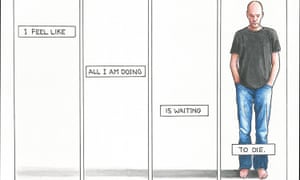


Ed’s depiction of living with schizophrenia.


Ed’s depiction of living with schizophrenia.

Lisa Heinlen, Arizona, US
My son was diagnosed with schizophrenia last March, and it was pretty sad the way it all went down. My mom has paranoid schizophrenia, so I knew the signs. I was trying to get help in a hurry and the crisis unit sent out an officer to assess the situation. The officer had no idea how to deal with someone having a breakdown, and put him in handcuffs. My son was hearing voices and this made him worse. He flipped out and kicked the officer in the groin area and tried to resist, so they took him to jail, and blamed me for his behaviour.


The only thing I can hope and pray for is that officers get more training and understanding. As long as people with mental health problems have a good support system, they’re less likely to end up back in the hospital. I spent months trying to get my son on the correct medicine. It has been a hard road for us. I encourage and love my son. It’s one day at a time for us.


In the UK, the Samaritans can be contacted on 116 123.
In the US, the National Suicide Prevention Hotline is 1-800-273-8255.
In Australia, the crisis support service Lifeline is on 13 11 14.


Living with schizophrenia: "There is a wall of doubt, stigma and pain"

30 Ocak 2017 Pazartesi

Dementia Diaries: "It"s like trying to go through a brick wall" – video

Dementia Diaries is an audio diary project that captures people’s diverse experiences of living with dementia, now the leading cause of death in the UK. While the origin of the disease is still unclear and symptoms can vary greatly, these recordings, here with accompanying film, aim to capture some of the complexity of each caller’s individual perspectives


Dementia Diaries: "It"s like trying to go through a brick wall" – video

8 Eylül 2016 Perşembe

There is an antidote to the failed humanity of the Calais wall

Build a wall … A great wall. But will it be high enough, big enough, thick enough? Will it be Trump-size, visible from space? Will it keep out the undesirables ? Will it protect the lorry drivers and nervous holidaymakers? Will it look nice if we put a few plants around it? Are the French going to raze the Jungle to the ground just as they did Sangatte?


I do not know whether Robert Goodwill, the immigration minister who announced the grand folly of a £1.9m wall in Calais – “We’ve done the fences, now we are doing a wall” – has a clue what he is talking about but this is part of a £17m security package that “we” are partaking in with the French to tackle the problem of the camp in Calais. This is the ultimate in closed thinking.


Walls, barriers, boundaries, borders, blockades: these are structures that make us feel in control, but in the end remind us only of chaos. This is part of the Brexit mentality, part but not all. There is another part that means opening up to a world beyond Europe and righteous Remainers should be wary of constructing even more walls around their own arguments, which seem to outdo each other in convincing us that everything will be terrible for ever.


The result of this on the left – except among those with a vivid enough imagination to actually envisage Jeremy Corbyn shambling down the G20 red carpet in China – is political paralysis. No more pessimism of the intellect, optimism of the will, but pessimism about everything. This a truly dangerous place to be. I understand the feeling: the world is going to hell in a handcart, so there is nothing to be done. It is a form of paralysis solved only by moving to places where nothing ever happens: New Zealand, Canada … Failing that, we make little walls around ourselves. Cosy up as the nights draw in and try not to think. About anything.


Strangely, though, the best cure for such a feeling is the opposite. It is getting involved with people who do work to change the lives of others, who make movement possible, whose very work is to pull down barriers not erect them.


This was made clear to me by Undocumented, an exhibition celebrating 10 years of a Bethnal Green clinic run by Doctors of the World which is used by migrants locked out of the healthcare system. In reality, everyone in the UK should be able to access healthcare. One of the myths is that this is what people come here for. The reality is that, if you are homeless and don’t have a national insurance number, you can’t access it.


Sarah (pictured above) explained this to me. She is from South Africa where she had been “correctionally” raped. Men, she said, had come to “fix” her because of her sexuality. She became pregnant and HIV positive. She could not get a GP but the clinic helped her. And there she was, beaming in front of photographs of herself despite her horrific story.


Ibrahim Doctors of the World


Ibrahim, a former Doctors of the World service user who is now training to practise as UK GP. Photograph: Toby Coulson

A man, Ibrahim Muyhayer, who was a doctor in the Sudanese army but had to leave because of the political volatility, told me how it had taken him five years to access the system. He was charged £2,000 for an ultrasound scan for his pregnant wife though he was earning £50 a week. Now he volunteers in the clinic and is retraining to practise as a doctor here.


This basic ethos of treating medical need, whatever the patient’s immigration status, is what this charity does. This is why it also runs clinics in Calais and works with refugees in Greece.


Users of the clinic often carry stories of awful suffering, torture, loss and rape, but this is the only service providing primary healthcare. Tearing down the barriers. It was the same in Calais. Unlike the immigration minister, I have been to the camps. It would take him an hour to get there. It’s incredible that he has not. Anyone who has actually talked to anyone in the Jungle, or worse, in Grande-Synthe, the camp in Dunkirk, would smell the desperation. Every night, these people risk getting their hands ripped up, breaking their limbs and getting teargassed trying to get over the fences because they feel that they have no life anyway. They will get around a wall.


So this wall is a symbolic gesture to be built with taxpayers’ money. That money could surely be used to fund centres for the processing of asylum claims. But something unforgivable is happening when we cannot even let in the unaccompanied children from the camps. Stella Creasy, MP for Walthamstow, went over with Alf Dubs to try and do something about this. Those kids, with their strange “protectors” lurking behind them, haunt me. These are traumatised children, left to rot and be exploited. The volunteers do the best they can, but the situation is at breaking point.


Nevertheless, to hear the stories of those who have been helped, is to be jolted out of political ennui. Lives can be rebuilt.


A wall is sign of a failure of humanity. In 1964, the artist Joseph Beuys satirised the Berlin wall, suggesting it be raised by 5cm to have better proportions. He made his point and we know what happened to that wall. It is good to be reminded that there are those who build walls but there are those who will build ladders over them. That is called hope.


There is an antidote to the failed humanity of the Calais wall

20 Şubat 2014 Perşembe

Wall Street Journal Op-Ed On Sham Surgical treatment Will get It Incorrect

In an op-ed piece in the Wall Street Journal Scott Gottlieb, a former FDA official under George W. Bush, argues that the FDA should cease requiring healthcare device companies to use sham procedures when they test particular new goods. To assistance his argument he utilizes the illustration of renal denervation, a once highly promising new engineering for reducing blood stress. Unfortunately, Gottlieb extracts exactly the wrong lesson from this story, because the renal denervation story is a perfect example of why sham procedures can be each required and far more ethical than any option.


At very first glance it is tough to disagree with Gottlieb. The idea that patients would acquire an invasive surgical process that could do no great appears abhorrent. “Research that introduces harm or danger with no chance for advantage would seem to be to conflict with the ideas governing investigation on humans,” writes Gottlieb.


But the exact same actual phrases could and must be utilized to describe medical gadgets with no established advantage. In such instances, even so, instead of the reasonably modest quantity of patients possibly exposed to harm in clinical scientific studies, the variety of patients exposed to harm in the real world could be larger by many orders of magnitude.


Let’s examine this issue utilizing the exact same instance utilised by Gottlieb: renal denervation. In situation you haven’t been following this story, for the final handful of years renal denervation– the zapping of the renal artery with electric power to reduced blood pressure– has been widely deemed to be a single of the most thrilling and promising new healthcare technologies around. Based mostly on preliminary– and uncontrolled– scientific studies renal denervation was believed to constantly lower blood pressure by an astounding 25-thirty mm Hg and was hailed by several hypertension experts as a potential breakthrough remedy for people who had persistently and dangerously higher blood strain even right after taking a number of blood strain drugs.


Then actuality intruded. Medtronic announced last month that its pivotal trial of renal denervation had not met its main endpoint. It grew to become clear that renal denervation was neither a remedy nor a breakthrough. Although the particulars of the trial have not been revealed, the underlying trigger of the trial’s failure is reasonably nicely understood. Final summer a few skeptical British researchers very carefully examined the underlying science and concluded– contrary to what market and the professionals had been saying– that the correct blood strain decreasing result of renal denervation wold be a lot smaller sized than predicted. And the cause was straightforward: since all the early research had been either uncontrolled or poorly controlled, the firms and the researchers had tremendously overestimated the real result of renal denervation. The Medtronic trial, by contrast, was a lot more rigorous, in element because it integrated the notorious sham procedures decried by Gottlieb.


As Gottlieb notes, renal denervation “is already obtainable in Europe, where regulators authorized it primarily based on classic research.” Gottlieb fails to recognize how this undercuts his stage. Following all, several 1000′s of men and women in Europe have acquired a gadget from which they may possibly have obtained no or minor advantage and may have seasoned harm. But this does not appear to concern Gottlieb. Right here, creating about the impact of effectively-managed trials, is what does concern Gottlieb:


All of this raises development costs—and it encourages firms to skip the U.S. industry and commercialize new items overseas. This can suppress innovation. When a sham trial doesn’t produce positive final results, the organization may possibly have exhausted its assets and have no capital left to refine a excellent idea into a beneficial product.


But, as the renal denervation story demonstrates, the trial did not “suppress innovation.” As an alternative it showed that the so-referred to as “innovation” was, effectively, a sham.


Even though he waves the flag for ethics, it is clear that what truly motivates Gottlieb to stand up and salute is organization revenue. He’s far far more interested in the overall health of businesses than he is in the well being of individuals. If he were in fact interested in the welfare of sufferers he would spend consideration to the medical particulars of his examples. But rather his genuine concern appears to be the overall health the’ bottom line.


This isn’t the first time Gottlieb has baffled ethics and economics. In 2012 he wrote about another new health-related technology, transcatheter aortic valve substitute (TAVR), and argued that the FDA and CMS had prevented the American public from benefiting from the process. As I wrote then, Gottlieb fully ignored the complicated issues of the story, spinning an untrue but compelling tale in which the forces of government were preventing desperately sick folks from getting a new daily life-conserving therapy.


It seems clear that Gottlieb has really small interest in a critical discussion of clinical trials or the best way to check and introduce new medical technological innovation. What he really desires is to offer a basis for campaign slogans that undermine the FDA and government involvement in medicine. It does not matter that sham surgical treatment is a complex issue or that TAVR had as considerably possible danger as advantage. It’s simple to score polemical factors by scaring people, telling them that they will be subject to damaging procedures or that their government is preventing them from acquiring existence-conserving remedies. It’s a lot harder, and less politically advantageous, to take into account the full complexity of these problems.


Update:


Sanjay Kaul sent the following comment:


“Those who can’t don’t forget the past are condemned to repeat it”.


There are several examples the place the “scam” of some gadget-primarily based therapies has been exposed by the “sham” process. How can any person forget the traditional examples of laser TMR (TransMyocardial Revascularization) or Pacemaker for hypertrophic cardiomyopathy, both touted as breakthrough interventions. It would not surprise me a single bit if RF ablation for atrial fibrillation ends up with a similar fate!


Wall Street Journal Op-Ed On Sham Surgical treatment Will get It Incorrect

7 Şubat 2014 Cuma

Clinical Trial Data At Heart Of Landmark Wall Street Insider Trading Scandal

Yesterday, Manhattan U.S. Lawyer Preet Bharara issued this statement shortly after the jury conviction of Mathew Martoma, a former portfolio manager at SAC Capital Advisors.


“As the jury unanimously identified, Mathew Martoma cultivated and bought the self confidence of medical professionals with secret information of an experimental Alzheimer’s drug, and utilized it to engage in unlawful insider trading. Martoma bought the response sheet prior to the examination – more than after – netting a quarter billion bucks in revenue and losses avoided for SAC, as properly as a $ 9 million bonus for him. In the brief run, cheating may possibly have been profitable for Martoma, but in the end, it made him a convicted felon, and probably will consequence in the forfeiture of his unlawful windfall and the reduction of his liberty. Mathew Martoma gets to be the 79th man or woman convicted of insider trading following trial or by guilty plea in this District in the last 4 years.” Statement of Manhattan U.S. Lawyer Preet Bharara (here)


A synopsis of the case was also supplied late yesterday by Over the Law (right here):


* The income produced and losses avoided by SAC Capital as a result of Martoma’s insider trading: $ 275 million.
* The win/loss record of U.S. Attorney Preet Bharara and the S.D.N.Y. in insider-trading circumstances: 79-.
* How prolonged the Mathew Martoma trial lasted: 4+ weeks.
* How extended the jury deliberated: 15 hrs.
* Gender breakdown of the jury: 7 women, five males.
* Counts of conviction: two counts of securities fraud, 1 count of conspiracy.
* Penalties paid by SAC Capital back in November 2013: $ 1.two billion.
* Recent or former workers of SAC Capital (such as Martoma) who have been convicted of criminal insider-trading fees (no matter whether by guilty plea or trial): eight.
* Number of “A” grades on Mathew Martoma’s fake Harvard Law School transcript: four (out of 7 grades).
* Number of D.C. Circuit judges that Martoma acquired clerkship interviews with: three.
* Age of Mathew Martoma: 39.
* How numerous youthful children Martoma has: three.
* The length of Martoma’s most likely prison sentence (pursuant to the non-binding federal sentencing recommendations): seven-ten many years.


Forbes has extensive coverage (here and here) on the Wall Street insider trading aspect – but the implications for the healthcare industry are equally crucial. Why? Because numerous believe the income to SAC Capital Adivsors – a substantial flying hedge fund with an equally substantial flying track record of achievement – were the result of the “most profitable within tip of all time” (PBS Frontline right here). That tip was within information offered by Dr. Sidney Gilman – a best Alzheimer investigation scientist who was earning $ 258,000 a 12 months as a professor at the University of Michigan (in which he was for decades).


The Frontline episode (“To Catch A Trader” right here) just aired last month. Central to Frontline’s claim of the “largest insider trading situation in history” was comprehensive clinical trial data provided by Dr. Gilman in a sequence that allowed SAC Capital to very first revenue from constructive trial data – and then keep away from large losses when subsequent trial data was adverse. The profit on each the excellent and undesirable clinical trial news was about $ 275 million.


In December of 2012, the New York Times profiled Dr. Gilman and his background of providing inside info to a selection of financial companies with the headline: Quiet Medical doctor, Lavish Insider: A Parallel Existence (right here).


What struck me wasn’t the normal Wall Street insider plot since there had been lots of publicly traded firms referenced in the Frontline section. A lot of were bellwether silicon valley chip producers with easily recognizable brand names. What struck me was how a single doctor – with within clinical trial details – could be at the very heart of one of the greatest – if not the largest – insider trading scandal in U.S. historical past. By assisting the Feds with their case towards Mathew Martoma it’s conceivable if not very likely that he will steer clear of criminal prosecution himself. It also highlights the enormous value of clinical trial information for one drug and 1 issue. The relative ease by which the details was provided (the inference was an early release of a presentation – likely by email) was noteworthy.


Mr. Martoma’s fate is now in the hands of sentencing – and then (really potentially) subsequent negotiations. He’s not the biggest fish the Feds are right after in their ongoing investigation. That would be Steven A. Cohen – the billionaire founder of SAC Capital Advisors. According to the Frontline section, Mr. Cohen’s fate might well escape any criminal prosecution. Even even though his insider trading record is an astonishing 79-, Mr. Preet Bharara ended the Frontline section with this sober legal assessment.


Narrator: As it stands, the criminal negligence laws that apply to some industries do not apply to finance. To alter that, Congress would require to pass a new statute. 


Preet Bharara: We have conspiracy statutes and we have aiding and abetting statutes and we have the criminal capability to carry a situation against an institution … but we really don’t carry criminal cases towards people for negligence.


Correspondent Martin Smith: Do you feel you’ll ever see a case in which negligence rises to the level of criminal liability? …. in the hedge fund planet?


Preet Bharara: I would doubt that.


Clinical Trial Data At Heart Of Landmark Wall Street Insider Trading Scandal

3 Şubat 2014 Pazartesi

Soapbox: SMEs should smash the wall of silence all around mental well being, says Patrick Watt

Watt pointed out that in accordance to the mental well being charity Mind, one in 6 employees are impacted by mental overall health issues. That signifies that in an organisation of ten individuals there might effectively be a single and perhaps two folks who are impacted by a mental overall health concern.


He mentioned: “Psychological wellness is a hidden problem that is impacting enterprise functionality. We want modest and medium sized companies to kick start the development of the economy, so if one in six people are not executing to their optimal level that has implications not just for the company but for the economic climate as a entire.”


Watt stated that at current a lot of personnel hide psychological health issues since they fear that speaking out could have an adverse impact on their careers.


He stated: “Staff are in search of assist for therapies of physical conditions because they are not ready to admit they have a mental problem. We are seeing much more individuals come to us with skin disorders or upset stomachs since they will not really feel comfortable putting their hands up and saying they need support for psychological overall health problems.”


Watt explained that contrary to what some men and women believed, it is feasible to effectively treat psychological sickness and pointed out that there are a lot of treatment options and therapies accessible to help individuals get much better.


Watt known as on SME leaders to introduce modifications in the workplace to help decrease the affect of stress on their workers, such offering entry to yoga classes, encouraging folks to consider suitable lunch breaks, and discouraging them from sending emails at the weekend.


He stated that even though most circumstances of tension tend to come from outside the function area, it can be small things at function like a computer not doing work or telephone calls not becoming answered that produce a tipping stage.


He stated: “There are a lot of things you can do to lessen pressure and stress and there are plenty of support and resources out there to support individuals.”


Watt also called on company leaders to develop a supportive work setting exactly where mental overall health troubles are viewed in the same way as physical health concerns are.


He additional: “No-a single would be concerned about putting their hand up and saying they require four weeks off to recover from a broken leg, but if a person has tension or nervousness or depression, no-one desires to say anything. Chief executives should lead by instance and tell their staff their business is supportive to these folks searching for support, and that there will no consequences to those coming forward.”


Soapbox: SMEs should smash the wall of silence all around mental well being, says Patrick Watt