Trading etiketine sahip kayıtlar gösteriliyor. Tüm kayıtları göster

28 Eylül 2016 Çarşamba

The Indonesian waste pickers trading trash for healthcare

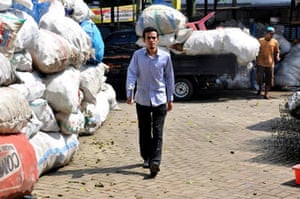
Aged 70, Tuna has pains in her leg, waist and chest, but her income as a garlic picker put even the most basic medical provision beyond reach. Until her neighbour told her about a “free” medical clinic in the neighbourhood. The cost: 10,000 Indonesian rupiah (£0.59) a month, paid for from cash raised from her recyclable rubbish.


Garbage Clinical Insurance is the brainchild of award-winning healthcare entrepreneur Gamal Albinsaid, CEO of health company Indonesia Medika. In a country where more than 10% live below the poverty line, the scheme encourages low-income households to recycle their rubbish and uses the revenues to finance a health micro-insurance system.


The scheme offers its members access to basic healthcare services in three clinics: two in Albinsaid’s hometown of Malang, East Java, and one near Jakarta. In total, the initiative counts about 600 rubbish-collecting members, who collect on average about 3kg of recyclable materials each per month, which nets them around 11,750IDR (£0.70) from commercial recyclers.


“We have 250 million people in Indonesia but more than 60% of them don’t have any medical insurance … At the same time, a city like mine [Malang] produces over 55,000 tonnes of rubbish every day, only about half of which gets collected,” says 27-year-old Albinsaid.


Gamal Albinsaid


Gamal Albinsaid. Photograph: Indonesia Medika

As well as covering basic medical care, Albinsaid’s initiative has recruited a network of more than 200 volunteers – most of them medical students or recent graduates – who pay members house-calls and advise on preventative care. The company also has a team that works in the neighbourhoods around its clinics to advise people on which recyclable items to collect and then brokers the sale process.


“Previously people tended to think that garbage is worthless and healthcare is expensive, but now they see that garbage can be valuable and healthcare isn’t necessarily so expensive after all,” says Albinsaid, who qualified as a doctor earlier this year.


The innovation has won plaudits, including the Unilever Sustainable Living Young Entrepreneurs Award two years’ ago. Yet it’s not all been plain sailing.


Achieving financial sustainability is a challenge. The business model rests on two key constants: the local price for recyclable materials remaining buoyant, and the number of members visiting the clinics staying at 20% of the total members or fewer. If a higher percentage of members need healthcare each month, the economics of the scheme start to break down.


Administrating the scheme can present problems too. Once a project has taken root in a poor neighbourhood, Indonesia Medika looks to members to manage the waste collection themselves. It’s during this transition stage that schemes often falter, Albinsaid says.


On other occasions, versions of the project have been backed by private companies as a philanthropic measure but then closed abruptly when the sponsor pulled out. Albinsaid wouldn’t be drawn on why these partnerships didn’t work out.


A shortcoming of the Garbage Clinical Insurance model is that it only offers access to the most basic healthcare. The poor access secondary or tertiary health services only if they join the government’s insurance scheme, which starts at around 25,000IDR (£1.49) per month. To make up the shortfall, Albinsaid’s team is now helping its members collect more rubbish and access government funding that they are possibly entitled to but don’t claim.


His final challenge is a more enviable one: satisfying the enormous demand from organisations to copy the model. Albinsaid says he has no desire to franchise his innovation and is happy for others to take it up. Indonesia Medika has put together a 70-page startup manual and the model has spread to more than 50 towns and villages in Indonesia. With limited resources, however, keeping tabs on how, and even where, the scheme is being implemented is proving tricky.


“I have people coming up to me in the airport and saying, ‘Hey Dr Gamal, I have replicated your model’. So you can see it’s hard to manage the replication process, but the benefit is that we inspire a lot of people,” says Albinsaid.


Nicola Dee, a fellow at the Cambridge Institute for Sustainability Leadership and a former mentor to Albinsaid, commends his open-sourced approach to scaling the model. “The upside is that this can create widespread adoption of an idea like this, but the downside is that you don’t really get to know how well the idea is implemented,” she says.


One way of regulating the process would be to introduce a compliance mechanism or certification scheme, but she recognises that this requires resources that most micro-entrepreneurs like Albinsaid lack.


Another hurdle is the need for a robust local recycling market to generate cash revenues from the collected waste. The absence of such a market needn’t be a deal-breaker, Dee says. She cites the example of Plastic Bank, which provides 3D printers to poor communities in developing countries to upcycle plastics collected from the ocean.


Back in Malang, Albinsaid is busy strengthening his management team so they can step into his shoes. “The system is well-established now,” he says, “which is great because it means I can start exploring other new ideas and innovations”.


The Indonesian waste pickers trading trash for healthcare

1 Temmuz 2014 Salı

Young father dies following trading punches in a new net craze

A 20-year-previous man was arrested by police investigating Mr Main’s death and launched on bail right up until September.


Mr Primary had been “messing around” with a pal during a party at his semi-detached residence in Erith, south east London, in the early hours of final Sunday when he collapsed, it was claimed.


Mr Main’s older brother Roy, 36, paid tribute to the young father and slammed the “friends” who had continued to movie the fight on their mobile phones and completed nothing to quit it.


He wrote on Facebook: “I enjoy you Tommy boy.


“I had to say excellent by to my minor brother these days for the final time.


“I’m hurting so undesirable I am so sad I adore you tommy major.


“I do not think I’ll ever be the very same again.


“For the individuals that was at the party that can see this contact by yourself close friends.


“I just hope that some thing genuinely … undesirable happens.


“You’d ought to have stopped it not try out and movie it. We live in hope.


“Hope your suffering actually negative hope you can’t rest.”


He later posted images of himself with his arm round his brother and a image of the two of them at a wedding ceremony.


Punch4Punch follows the NekNominate on the internet drinking craze which was linked to a quantity of deaths earlier this year including people of rugby player Bradley Eames, twenty, who died 4 days right after filming himself drinking two pints of gin and 20-yr-outdated, Isaac Richardson who drank a lethal cocktail of wine, whisky, vodka and lager.


Mr Main’s other brother Ben, 38, wrote on the web: “I’m so sorry I didn’t seem soon after you far better. I’m a broken man without you here with us. I will not know how to do this. I’m going to miss you so much child bro.”


He extra: “I’m in pain Tommy, I want it was me and not you.”


A third brother Jon uploaded a YouTube tribute titled Tommy Major Rest in Peace, featuring pictures of him as a kid, with buddies, family members and on his 21st birthday.


A tribute web page, set up by Mr Main’s greatest pal Matthew Davey, attracted more than 1000 ‘likes’ following just a few hours of going on the internet.


Mr Davey said: “He was my very best friend in the total planet.”


A Scotland Yard Spokesman said: “Police were named by London Ambulance Services at twelve.44am on Sunday to a residential tackle in The Nursery, Erith, to reviews of a guy collapsed.


“The 23-yr-old guy was taken by London Ambulance Services to a South London Hospital in a essential problem.


“He died in hospital a quick although later on. We await the outcomes of a publish mortem.


“It is currently being treated as an unexplained death rather than suspicious.”


A spokesman for the London Ambulance Support stated: “We had been called at 12.24am on Sunday to The Nursery in Erith to deal with a younger man in his 20s for a cardiac arrest.


“We sent two single responder cars and an ambulance crew to the scene.


“The patient was taken to Darent Valley Hospital as a priority, despite our efforts the patient sadly passed away. A doctor confirmed the death at one.28am.”


Young father dies following trading punches in a new net craze

7 Şubat 2014 Cuma

Clinical Trial Data At Heart Of Landmark Wall Street Insider Trading Scandal

Yesterday, Manhattan U.S. Lawyer Preet Bharara issued this statement shortly after the jury conviction of Mathew Martoma, a former portfolio manager at SAC Capital Advisors.


“As the jury unanimously identified, Mathew Martoma cultivated and bought the self confidence of medical professionals with secret information of an experimental Alzheimer’s drug, and utilized it to engage in unlawful insider trading. Martoma bought the response sheet prior to the examination – more than after – netting a quarter billion bucks in revenue and losses avoided for SAC, as properly as a $ 9 million bonus for him. In the brief run, cheating may possibly have been profitable for Martoma, but in the end, it made him a convicted felon, and probably will consequence in the forfeiture of his unlawful windfall and the reduction of his liberty. Mathew Martoma gets to be the 79th man or woman convicted of insider trading following trial or by guilty plea in this District in the last 4 years.” Statement of Manhattan U.S. Lawyer Preet Bharara (here)


A synopsis of the case was also supplied late yesterday by Over the Law (right here):


* The income produced and losses avoided by SAC Capital as a result of Martoma’s insider trading: $ 275 million.
* The win/loss record of U.S. Attorney Preet Bharara and the S.D.N.Y. in insider-trading circumstances: 79-.
* How prolonged the Mathew Martoma trial lasted: 4+ weeks.
* How extended the jury deliberated: 15 hrs.
* Gender breakdown of the jury: 7 women, five males.
* Counts of conviction: two counts of securities fraud, 1 count of conspiracy.
* Penalties paid by SAC Capital back in November 2013: $ 1.two billion.
* Recent or former workers of SAC Capital (such as Martoma) who have been convicted of criminal insider-trading fees (no matter whether by guilty plea or trial): eight.
* Number of “A” grades on Mathew Martoma’s fake Harvard Law School transcript: four (out of 7 grades).
* Number of D.C. Circuit judges that Martoma acquired clerkship interviews with: three.
* Age of Mathew Martoma: 39.
* How numerous youthful children Martoma has: three.
* The length of Martoma’s most likely prison sentence (pursuant to the non-binding federal sentencing recommendations): seven-ten many years.


Forbes has extensive coverage (here and here) on the Wall Street insider trading aspect – but the implications for the healthcare industry are equally crucial. Why? Because numerous believe the income to SAC Capital Adivsors – a substantial flying hedge fund with an equally substantial flying track record of achievement – were the result of the “most profitable within tip of all time” (PBS Frontline right here). That tip was within information offered by Dr. Sidney Gilman – a best Alzheimer investigation scientist who was earning $ 258,000 a 12 months as a professor at the University of Michigan (in which he was for decades).


The Frontline episode (“To Catch A Trader” right here) just aired last month. Central to Frontline’s claim of the “largest insider trading situation in history” was comprehensive clinical trial data provided by Dr. Gilman in a sequence that allowed SAC Capital to very first revenue from constructive trial data – and then keep away from large losses when subsequent trial data was adverse. The profit on each the excellent and undesirable clinical trial news was about $ 275 million.


In December of 2012, the New York Times profiled Dr. Gilman and his background of providing inside info to a selection of financial companies with the headline: Quiet Medical doctor, Lavish Insider: A Parallel Existence (right here).


What struck me wasn’t the normal Wall Street insider plot since there had been lots of publicly traded firms referenced in the Frontline section. A lot of were bellwether silicon valley chip producers with easily recognizable brand names. What struck me was how a single doctor – with within clinical trial details – could be at the very heart of one of the greatest – if not the largest – insider trading scandal in U.S. historical past. By assisting the Feds with their case towards Mathew Martoma it’s conceivable if not very likely that he will steer clear of criminal prosecution himself. It also highlights the enormous value of clinical trial information for one drug and 1 issue. The relative ease by which the details was provided (the inference was an early release of a presentation – likely by email) was noteworthy.


Mr. Martoma’s fate is now in the hands of sentencing – and then (really potentially) subsequent negotiations. He’s not the biggest fish the Feds are right after in their ongoing investigation. That would be Steven A. Cohen – the billionaire founder of SAC Capital Advisors. According to the Frontline section, Mr. Cohen’s fate might well escape any criminal prosecution. Even even though his insider trading record is an astonishing 79-, Mr. Preet Bharara ended the Frontline section with this sober legal assessment.


Narrator: As it stands, the criminal negligence laws that apply to some industries do not apply to finance. To alter that, Congress would require to pass a new statute. 


Preet Bharara: We have conspiracy statutes and we have aiding and abetting statutes and we have the criminal capability to carry a situation against an institution … but we really don’t carry criminal cases towards people for negligence.


Correspondent Martin Smith: Do you feel you’ll ever see a case in which negligence rises to the level of criminal liability? …. in the hedge fund planet?


Preet Bharara: I would doubt that.


Clinical Trial Data At Heart Of Landmark Wall Street Insider Trading Scandal