I think and write a lot about mental health. Since being diagnosed with anxiety and clinical perfectionism, writing has become an important way of coming to terms with my own psychiatric ailments, while trying also to raise public awareness. It’s not an easy task. Despite my eagerness and many importunate attempts to give a voice to mental illness, I am often left feeling like the world isn’t ready to listen.
But when mental health week ticked around this year, ears pricked up. My news feed was awash with articles about mental health, friends brandishing popular hashtags and events popping up all around my city.
Finally, a week where mental health was a hot topic, where my issues were on the frontline. If ever there was a time when my humble opinions on the human brain might count for something, this was sure to be it. I panicked.
Determined to seize the opportunity, I started bashing out stories and pitches with intensity, like I was trying to give my computer’s motherboard some kind of frantic deep tissue massage. My mind turned cartwheels. Within 20 minutes I had chewed all my fingernails back to the quick and yanked out a few generous handfuls of hair – telltale symptoms of my escalating anxiety.
I forgot to have lunch. I forgot to pick my little sister up from school. I missed two calls from my partner. But somehow I still managed to singlehandedly pluck all the tiny hairs on my leg, another delightful habit I tend to deploy with fervour whenever I need to curb my anxiety.
As time ticked by and the pressure mounted, I realised I was heading for a nervous breakdown. Maybe I was making too big a deal of mental health week, but that is the very nature of my mental illness – the tendency to inflate and catastrophise. It was a bitter irony: my anxiety was the very thing that stopped me from writing about it.
So I closed my laptop and resolved to stay silent for mental health week. I decided that protecting my own mental state was more important than writing about it. And I reassured myself there would be other opportunities.
See, that’s just it with mental illness. Often we cannot talk about it when the world wants us to – whether that be our families, therapists or the media. And when we are ready to speak up, we can’t find the ears.
Even with efforts to reduce stigma, mental health is an extremely sensitive topic. It takes a long time to develop the personal insight and vocabulary to be able to communicate about our mental states. In my experience, you can only really talk (or write) about it on your own terms and in your own time. This means we need a culture that is receptive to discussions the year round, not just at designated calendar points.
While initiatives like mental health week are exceedingly important, they are not always as beneficial to sufferers in the ways they intend to be. The sudden spike in publicity may feel like a fleeting injection of sympathy that leaves us even more isolated once the week is over and our issues fall into the background once again.
The ephemeral support for mental illness shines with a suspicious veneer, tarnished by the knowledge that talking about mental illness might earn you a hundred likes on Facebook on one day but compromise your job application the next.
On the other hand, the sudden spotlight on mental health can also cause people with mental illness to cringe and withdraw, unnerved (so to speak) by the unfamiliar pressure of public exposure. And then there is the risk of triggers that comes with a disordered flurry of news articles and tweets about mental health.
I am not disputing the merits of mental health week and the media’s reporting of it. I think these initiatives are noble and necessary. I think they are crucial to creating a society that makes it easier to live with a mental illness. But if listening to people with mental illness and understanding their experiences is the most important step in dissolving the silence and stigma, we need to be open on a more general, everyday basis.
We need a culture that is attuned to the nuances of mental illness and accepting of the silences as well as the disclosures. We need a world where mental health is an acceptable topic regardless of time and place, beyond the field days and short-lived social media campaigns.
Having had to swallow American jibes about “British teeth” for all these years, my little chest swelled with dental pride on Tuesday when I learned that the Americans don’t know absolutely everything about teeth – and dental patients in particular. For dental floss has now officially been declared dead in the US.
Well, I say dead. A great many American dentists still want it kept on a respirator just in case it shows a flicker of life – like when there’s a piece of Cajun chicken lodged between the most distant molars, or you need to make a video of your child’s tooth being pulled out by a homemade space rocket.
The fact is, the British dental profession gave floss a quiet burial years ago after sneaking it out the back and finishing it off humanely with a lump-hammer. Yes, in the UK we realised ages ago that – and if you still religiously floss daily, look away now – flossing simply doesn’t work as a health measure (or a fetish).
Related: Everyone recommends flossing – but there’s hardly any proof it works
Let me say that again. FLOSS DOES NOT WORK. Not at all. There’s not a shred of evidence that it does any good whatsoever. I mean, it seemed a good idea at the time – 1882 to be precise – but modern evidence would demonstrate that it doesn’t improve gum health one jot (to use the scientific term).
The British Society of Periodontology, the organisation that specialises in gum health, has known about the black heart of floss for years and currently recommends the use of single-tufted interdental brushes for effective cleaning between the teeth. The American Dental Association and the American Academy of Periodontology however, are largely ignoring the fact that their government’s latest Dietary Guidelines for Americans has quietly dropped its recommendations for flossing because under the law, the guidelines must be based on scientific evidence.
The enthusiasm with which American dental professionals promote flossing despite the evidence, has raised the notion of a conspiracy with floss manufacturers. I don’t believe for a second that American dentists are in cahoots with floss makers, but why do they cling to the notion that floss is a good idea and keep recommending it? Perhaps because, like flossing, it’s a habit and after over a century of promoting the use of floss, it must be extremely difficult to backtrack and say: “Houston, we may have a problem.”
The Brits never had that dilemma. As a nation we were never great flossers anyway and now we know that our patients had an uncanny and instinctively accurate inkling that the lacklustre recommendations of their dentists and hygienists were best ignored.
Related: The secret life of a dentist: some patients think superglue will fix their toothache | Anonymous
I can see why Americans like to promote floss. As a dentist I can appreciate that if flossing is done “properly”, the technique is precise, even elegant. If you have a regular flosser in the chair, you know the patient cares about their teeth, having dedicated a fair chunk of their day to a particularly tedious and often unpleasant task.
But even with the best technique, the evidence doesn’t support flossing as an adjunct to brushing. Most patients, even if they bother to get the minty-waxed out the box, are exceptionally heavy-handed and macerate their gums like they’ve been chewing on bare vacuum cleaner flex. Even in controlled studies, after instruction, the patients taking part couldn’t floss properly. I know of no dentist who flosses. Not one. And of the colleagues who don’t walk away bored witless when I have broached the subject of flossing, most admit that when they tried it, it was really difficult to do effectively, even with their assumed level of dexterity.
Nowadays in the UK, we (I hope, how I hope) all recommend single-tufted interdental brushes as an adjunct to regular brushing. The studies prove beyond doubt that they significantly reduce plaque deposits, decreasing gum inflammation and reducing the risk of gum disease and bone loss. They either have a conventional toothbrush handle or look a bit like a toilet brush on a stick, though it’s best not to think about lavatories while you are using them. The only time I reluctantly suggest floss is when a patient has an area so crowded, floss is the only way of getting between the teeth. And even then I cross my fingers.
Floss is dead. Long live the single-tufted interdental brush.
Beauty has seizures, and she worries about what she’ll be doing when the next one occurs. She was lucky with the first: she was in bed asleep next to her boyfriend, who woke to the bed shaking and was quick to pry his 24-year-old girlfriend’s jaw open to prevent her from biting her tongue. Since then she’s fallen down in the street and ended up alone in the hospital ICU, and so she lives in fear.
She thought she was doing the right thing by sticking with K2, her drug of choice.
In the South Bronx, a community known to struggle with addiction, Beauty chooses an active rebellion from the norm: she refuses to use crack, which removed her mother from her childhood, as well as heroin, which she’s seen turn functioning people into perpetually sick ones. Beauty’s drug, by contrast, is legally sold in corner stores. It couldn’t be so bad, she thought.
While she is neither dealt daily nausea from withdrawal (as with heroin users), nor risking arrest for drug paraphernalia (as with crack users), she is the only one in her peer group who seizes, and the only one whose drug produces a range of widely differing and often unknown effects. The drawbacks from crack and heroin – even a “speedball” mixture of the two – can be anticipated, but smoking K2 is a gamble.
The packages she favors seem child-sized, smaller than Ziploc sandwich bags. They’re adorned with swirls of pink, purple and green surrounding a cartoon Scooby-Doo, tongue out the side of his mouth. The words “Scooby Snax Potpourri” headline the bag containing what the media refers to as “synthetic marijuana”.
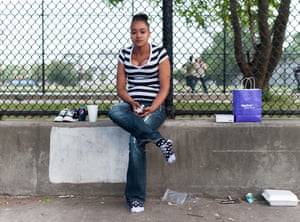
Beauty in the Bronx. Photograph: Chris Arnade
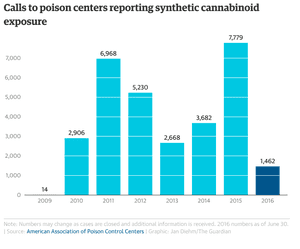
However familiar and innocuous the reference to marijuana makes the drug sound, the Centers for Disease Control and Prevention (CDC) reported a 229% increase in calls to US poison centers due to K2 or Spice (street names for synthetic cannabinoid mixes) between January and May 2015.
Major cities, too, have noticed a rise in use. In September 2015, New York City’s mayor, Bill de Blasio, announced a partnership with the Drug Enforcement Agency (DEA) to target both demand and supply-side factors as well as distribution in the area (earlier this month, 33 people reported extreme adverse reactions to the drug in Brooklyn). On an international level, in 2012 the DEA launched a project to combat the spread of K2 and other synthetic drugs like it.
Beauty buys a pack of her choice K2 brand for $ 10 from a corner store in the Bronx, as nonchalantly as she would buy a pack of cigarettes. She may get arrested for possessing marijuana and harder drugs, but not for this.
In her early days on the streets, pre-K2, she was lithe, with thick, winged eyeliner and electric tights. Her presence, cheerful, bounding, wild in gesture and loud in volume, was both innocent and magnetic, drawing her easy friendships. Her stance away from hard drugs made her alluring to those who had been in the neighborhood a while. Everyone presumed this stance was a show, but over time it became apparent that it was simply truth.
On this point, she was stubborn and relentless. She would be different; she would not get stuck out on the street for years. She would make a functional life, starting with her dream of finding real, lasting love with a decent man.
“I just wanna find somebody that will respect me and won’t play, then move somewhere nice … find a little house,” she said. Until then, “I’m gonna do what I have to do” to make a living: walk the streets.
Within a week or so of her arrival in the Bronx, Beauty found who she hoped would be a boyfriend fitting her ideal. Amid quick declarations of love, this man quickly gave her a place to stay, took charge of the money she made selling her body, some of which he portioned out for Beauty to spend on new clothes, shoes and a cellphone – a role insinuating “pimp” in everything but name. He also provided a guise of protection against ill-intentioned johns when Beauty climbed into unknown cars and spent his days tracking her movements.
At the same time, he introduced her to K2, buying her packs for encouragement and good behavior.
Perhaps this introduction was well-intended or benign, perhaps not; Beauty’s later boyfriends did little to discourage her drug habit. Under its influence, she was a bit less wild, less prone to yell obscenities in the street when frustrated, and more controllable.
Beauty believes she made a hard-learned, measured decision in her adoption of K2 as drug of choice, one she stands by even still. No one forced her: she tried it and liked how it made her feel.
Friends who use crack and heroin, however, are suspicious of her drug and refuse to partake in it.
“I tried that stuff once, and I could only turn left,” Prince, a 37-year-old heroin user said, miming a fast stride in a tight circle. “No way I’m doing that again. That’ll mess you up.”
The contents of K2 baggies, after tearing away the plastic seal, look something akin to marijuana: clumps of earthy green that are laid inside rolling papers to smoke.
The resemblance to marijuana stops with the nickname and appearance: though K2 and marijuana both interact with cannabinoid receptors in the central nervous system to produce psychoactive effects, they do so differently, with the lab-bred synthetics binding and activating receptors to potentially detrimental degrees for people who ingest them. Along with this, synthetics repeatedly change, with batches containing widely differing substances at differing concentrations.
Illustration: Jan Dihem
To manufacture K2, varying chemical combinations of unknown potency are often purchased from China, imported to the US, then dissolved in acetone to be poured or sprayed over plant material before packaging. The mixing process is notoriously inconsistent, known to involve implements as varied as industrial cement mixers to bathtubs. Alternatively, the entire mixture may be purchased wholesale from international sellers, both methods potentially cutting six-figure profits for distributors, according to Rusty Payne, public affairs officer for the DEA.
Packs of K2 are then sold with no hint at their chemical contents or the variation lying within, instead just simply emblazoned with directives such as “for aromatherapy use only”, “not for human consumption” or “incense”.
Known effects of ingesting the combinations within the packs range from irritability to tachycardia and vomiting, to psychosis, even death, or seizures, as in Beauty’s case.
Yet however dangerous the drugs may be, the seemingly rational efforts to control them are actually part of the problem.
Packages of K2 exist in a public health grey space, neither controlled nor completely illegal, and outlawing them outright is complex if not impossible with current methods. Because the cannabinoid class of drugs is so broad and diverse, encompassing everything from medically prescribed marijuana to varieties of K2, one law cannot realistically ban the group altogether, and so to effectively target the K2 variants that have proven to be dangerous, lawmakers must ban by specific drug name once the substances have been established to be toxic.
The Synthetic Drug Control Act of 2015 contains a 28-page laundry list of more than 300 Schedule 1 substances – substances that are illegal in all settings and have high potential for abuse – to be added to the list of federally controlled substances.
Of this list, a hundred or so are synthetic cannabinoids written in chemist’s hand – thus, one hundred or so are substances that once rendered illegal will force K2 manufacturers to change the chemical ingredients for products currently on the market, 100 existing variants of an ever-increasing number barred.
Once a substance is outlawed and components of K2 packages tweaked, scientists must restart their process of uncovering how the drugs people buy affect their health because on a biological level – an altered substance is a brand new one with a new set of potential interactions and effects on the body.
Such regulatory changes create a cycle of scientists ever-testing new combinations of substance profiles, never given enough time to study and identify how existing drugs affect people before drug creators change the game by inserting novel substance structures.
It brings to mind the Greek myth of Hydra: each time legislation is passed to ban a substance, new unknown substances arise to take its place, which yields more potential chemical combinations in K2 packages.
Eventually the heads, the substance combinations and their toxicological effects, become innumerable, lessening the likelihood of scientists getting a handle on understanding how the drugs work in real-world human systems due to the sheer volume of potential combinations residing in packages sold.
Beauty has probably tried several (at minimum) compound combinations in her relationship with the drug but she will never be informed of it, as the packages and labels do not change when their contents do.
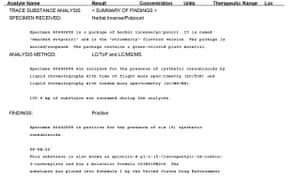
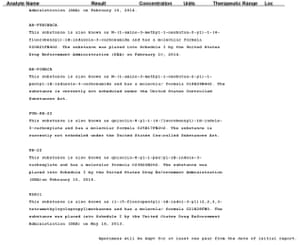
A sample of Beauty’s favored K2 purchased alongside her in Bronx, upon analysis by Kevin Shanks, a forensic toxicologist with AIT Laboratories in Indianapolis who specializes in the analytical detection and forensic toxicology of new psychoactive substances and other designer drugs, revealed six different synthetic cannabinoid compounds – some of which have been made illegal, some of which have not, each of which is likely interact with the body differently, made worse by dosages that vary between packages.
Photograph: AIT Laboratories
Payne, from a DEA perspective, likens the differentiation within and between packs to roulette.
“There are thousands and thousands of drug labs in China and elsewhere, and none of them – the labs, the distributors, the corner stores – care about the effects. All they want is your money,” Payne said. “This stuff is dangerous.”
Since some of the substances found in Beauty’s K2 sample (see analysis photos above) were added to the Schedule 1 Substance list in 2013 and 2014, the chemical composition in packs sold will probably be intentionally tweaked soon if it hasn’t been already. These are changes Beauty would fail to realize upon routine purchase of her favorite brand.
“What used to take years to synthesize now takes months or weeks,” said Payne.
Along with corner stores, the stuff can also be bought online, from websites proclaiming “legal herbal bud”. While the product description includes a “not for human consumption” disclaimer, it also boasts five-star customer reviews of people rolling up “100% Legal Herbal Spice”.
Beauty usually smokes along a cement foundation below a chain-link fence that buttresses a sports field. She smokes one joint after another, as much as she can in a day between turns in cars, as many as her boyfriend allows, which can be up to four packs. Four packs of compound cocktails, which she says she needs. Sometimes she has seizures; sometimes she doesn’t.
Lack of knowledge regarding the toxicological effects and biological interactions of K2 compound combinations make the mechanism for addiction and user dependency equally hard to uncover and explain.
Despite this, patient symptoms have arisen and persist since the drug’s advent in the early 2000s. Along with professed need akin to Beauty’s, clinicians have noted patient symptoms of increased heart rate and blood pressure, nausea, headaches and tremors indicative of withdrawal after K2 products have been ingested in large quantities.
This level of dependency, while presumably universally unappealing, was the last thing Beauty wanted – she had set out into her adult life in active defiance of such effects.
But the drug has a way to attract the young: whether it be through the lure of a more intense high than marijuana, the affordability and legal ease of obtaining it, or ancillary benefits – such as not appearing in typical employer-mandated drug testing. Combined, these spin an ill-fated illusion of a drug that isn’t so threatening.
Beauty sometimes smokes four packs of compound cocktails per day. Photograph: Chris Arnade for the Guardian
User profiles place male adolescents to be at increased risk (young females to a lesser extent), with 11% of high school seniors shown in survey data conducted by Johns Hopkins University researchers to have tried synthetic cannabinoids like K2.
According to a review in Progress in Neuro-Psychopharmacology and Biological Psychiatry journal, those who use synthetic cannabinoids can be grouped into three main categories: “1) marijuana smokers, 2) occasional drug users seeking to avoid legal complications, and 3) drug-naive, curious experimenters.”
Beauty came to K2 with youthful naivety, alongside an intimate knowledge of what legal trouble with drugs entails, and by moving to a new place, the Bronx, she believed she abandoned the cyclical drug-related tensions that collected in her past back in Oklahoma, where she was born in prison to a woman who has since been incarcerated for crack cocaine possession over and over again.
On K2, Beauty often appears sleepy and faded, eyes heavily lidded, her body and mind hunched, effects among others that led news reports to refer to “zombies”. Sometimes she cannot speak, react when her name is called or recognize familiar faces so slowed are her responses under its influence.
Beauty says she smokes to lessen “anger issues” and relies more on K2 when she’s stressed, when she worries that she and her boyfriend won’t be placed in the same homeless shelter, or that he may leave her for another girl.
“I need it to chill me out, to just be cool around all this,” she said, gesturing at people around her, at the others who spend their days loitering around the concrete fence, people from the shelter across the street and men she’s dated.
In jail, where she occasionally lands for prostitution and drug possession (illegal drugs that she’s bought for male clients), she doesn’t need K2. The anger and rage against her environment that she spoke of, which once escalated to her kicking out a police van window, is assuaged by medications given to her in jail, ones tailored to mental illness that make her feel better. On these, she is able to do a job working in the kitchen, a job she’s skilled at and enjoys.
Upon her last release from Rikers Island jail, a six-month stint, she tried to prioritize other things: seeing people for the first time since her arrest, getting something to eat aside from jail-mandated options, before buying K2, but the plan fell apart the nearer to her usual store she went. K2 was first, smoked outside the door, rolled beneath the awning with her paperwork and possessions from jail in her arms.
Living out of jail, and away from K2, she has withdrawals, urgent psychological or physical needs for the drug, for something to take her mind away from life, to make the world bearable. “I just need it, like without it I can’t handle all this. I’m gonna pop somebody,” she said.
Though Beauty uses K2, she actively dissuades those around her from dabbling in it. When a friend spoke of interest in trying the drug, she responded: “If you’re serious about doing that, I’m gonna be with you and make sure you’re safe. You’re gonna be inside and you’re not gonna do it by yourself, you hear me? But I don’t want you to do it.”
She says this, expression firm, as she smokes her joint, disregarding laughter of others milling the scene along the fence. It’s not a joke to her.
She knows she will probably have more seizures. When she does, she goes into the ICU, where she lies sedated on a narrow bed partitioned from ward chaos by a higher form of shower curtain; nurses pass otherwise, distracted, attending to others. There is little they can do for her: she is no longer seizing or in imminent danger that they know of. Here, she waits to be transferred to an inpatient floor to be put on an IV and monitored for a day before release.
In the hospital, doctors cannot tell her what is happening, only tell her to stay away from K2. They cannot convey a tidy explanation, because no one knows quite what to say about a drug that’s constantly mutating, one whose effects can’t be pinned down.
“I’m gonna calm it down. I’m gonna calm it down soon, for real,” Beauty said. She says it every few months, every time she’s hospitalized, when she’s forced to notice how bad her need has become.
Cassie Rodenberg is a writer exploring poverty and deviance. She has written about science for Scientific American, Popular Mechanics and Discovery Channel
On 21 May this year, Lynne Sandford contacted the Foreign Office and the police. She was worried about her 20-year-old son’s safety: Michael was a vulnerable adult, alone in America. He had been there for over a year, and his behaviour – in Skype calls home – had become increasingly erratic. Michael called every other day; after not hearing from him in a week, Lynne reported him as a missing person.
On 18 June, she was woken by a phone call at 11.30pm from the Foreign Office. She remembers every detail. They had found Michael. “I was like, ‘Brilliant – where did you find him?’ And that was the first shock. They said Las Vegas. I thought he was in New York. I said, ‘How did you find him?’ And they said he’d been arrested for trying to take a police officer’s gun in a casino. I said, ‘What was he doing in a casino?’ And they said he was at a Donald Trump rally. They said, when questioned, he had said he intended to assassinate Donald Trump. And my world just stopped.”
Michael Sandford arrested at Trump rally in Las Vegas
On 30 June, Michael Sandford was charged with disrupting an official function, and two firearm offences. He told police he had been planning to kill Trump for a year; the previous day he had been to a gun range to learn how to shoot. He was living out of his car and was in the US illegally, having outstayed his visa. A month on, he faces up to 30 years in jail and his mother is still in shock.
***
Michael was two when Lynne realised there was something different about him. His speech was delayed and his coordination was poor; he was referred to speech and physical therapists. He had a tremor in both hands – ironic, Lynne says, in light of the charges. She imitates his shaking hands. “Trying to grab a policeman’s gun? He wouldn’t have stood a chance.”
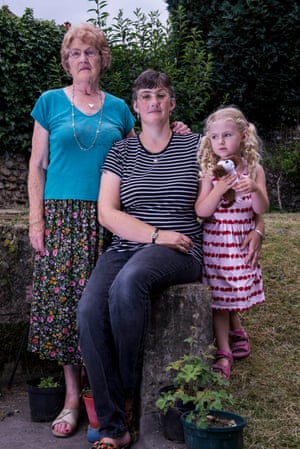
Lynne Sandford (mother of Michael), centre, with her mother, Christine, left and Lynne’s daughter, Jessica. Photograph: Mimi Mollica for the Guardian
We are in the sitting room of Lynne’s flat in Dorking, Surrey. Her mother, Christine, brings tea and biscuits. The room is small and stuffed with the paraphernalia of family life. Lynne also has a four-year-old daughter, Jessica, whose favourite colour is clearly pink: there’s a pink scooter, a pink doll’s house. Michael moved out four years ago, but his toy racing cars are still on the mantelpiece. In the family photos, he looks slight and sweet and a little otherworldly. Mother and son were always close. When he was five, Michael’s father left home; Lynne raised him largely as a single parent, with a huge amount of help from Christine. Michael, Mum and Nan: they were a team.
After his wobbly start, Michael made rapid progress at primary school, outperforming most of his classmates. He was unusually knowledgable: they used to say he was like an old man in a boy’s body. And yet in other ways he was very young: he had friends – Alex and Jack were the closest, Lynne says – but he didn’t like going to their houses. His gross motor skills (running, jumping, playing sport) were poor, but his fine motor skills were exceptional. He was great at Lego, for instance, and won a number of competitions. On the mantelpiece there is a cutting from the Dorking Advertiser with a picture of a young Michael holding a matchbox. “Creative Beaver Scout Michael Sandford is celebrating a winning strike after stuffing 210 items into a matchbox,” it reads.
He liked to make fellow pupils laugh, but there were other things Lynne struggled to explain. He took everything literally, and was punishingly honest. “He’d always say, ‘Well, I don’t mean to be rude – I’m just saying it as it is.’ He had a lack of empathy.” Lynne remembers a child in his class whose father died when he was nine. She had lost her own father at a young age, and explained to Michael how the boy might be feeling. “But he shrugged and said, ‘Well, he’ll get used to it.’”
Michael went on to a comprehensive with more than 1,000 pupils, where he was lost. There were detentions for not doing his tie tightly enough, and not having his shirt tucked in. It was only later, when Michael was diagnosed with hypersensitivity, that Lynne made any sense of it: the shirt and tie had been uncomfortable. “A lot of clothing made him itchy. Bedding, too. Sometimes he’d stay up all night. I remember one time going to Gatwick Tesco, a 40-minute drive away, just to buy him cotton bedding at 3am so he’d go to sleep.”
Michael refused to sign a home-school agreement promising to do his homework and wear uniform. “He was the only person in the history of the school who refused,” Lynne says. “I thought he was being a little bugger. But he just looked at me and said, ‘Well, quite honestly, Mum, I don’t know whether I can agree to these things. So I can’t put my name to it.”
Michael Sandford with his mother Lynne. Photograph: Mimi Mollica
He was still showing huge promise academically, particularly at maths. His teachers encouraged him to sit a mock GCSE at the age of 12, which he passed with an A. “This is the tragedy of it,” Lynne says. “He left school with no qualifications, and he has such potential.” Michael was bullied but didn’t like to talk about it. He started to truant. One day Lynne took him back to school three times. She would see him wandering around town on a winter’s day, his hands raw with the cold. She’d bring him home; if he was going to play truant, she’d rather he was somewhere safe and warm.
Michael became anorexic and developed paralysing OCD after starting secondary school. Every other weekend, his mother or grandmother would drive him to Portsmouth to stay with his father, but he became claustrophobic and unable to cope with the car, so that stopped. He became obsessed with hygiene – either not washing or brushing his teeth for weeks, or scrubbing himself until he bled.
At the age of 13, he was diagnosed with Asperger’s syndrome, a form of autism. The specialist said it was the most severe case she had seen in 30 years: his behaviour was so ingrained it would be almost impossible to change. The diagnosis explained a lot, but it didn’t help Lynne cope. Michael stopped going to school. “He said, ‘Why would I want to learn what everybody else is learning? Because everybody is going to know it. I want to learn what interests me.’ We fought tooth and nail about it. He was offered every opportunity: home school, online tuition, private tuition, a special school.” In the end, Lynne says, he sat at home watching documentaries. “I said you’re not going to have any qualifications, and he just said well, qualifications aren’t everything. I’d explain that if you want a job, they are crucial. But he couldn’t see that.”
At 14, Michael became anorexic and was sectioned. He hired a lawyer and brought a case that he should be allowed home
I ask Christine if she thinks her daughter was too soft on him. “I’m afraid I did, at times.” Michael would stay with his grandmother two nights a week, to give Lynne a break. But even she couldn’t get him to eat. “One evening he said, ‘Sorry, Nan, I can’t eat that. Don’t cook for me any more.’ He was bloody-minded.” The two women struggled to cope. “We were trying to learn about his condition, but no one was advising us.” Lynne tried the stick approach, taking away his teenage privileges; it made no difference.
At 14, Michael won a three-day scholarship to join a police training programme. “He had always said he wanted to be in the police force, and that was the last normal thing he was able to do. After that things went downhill. He did the three days, and I think that used up the last ounce of energy he had.” Michael was put on the child protection register – not because he was at risk from an adult, but because he was a risk to himself.
He became so weak from not eating that he could barely get out of bed. Later that year Lynne reluctantly agreed to have him sectioned at the Maudsley psychiatric hospital in London. How much weight had he lost? “He refused to let the doctor weigh him,” Lynne says. But she told them he wouldn’t live much longer without treatment.
“He was like a skeleton, wasn’t he?” Christine says. “Broke my heart, seeing him like that.”
A day after being sectioned, Michael escaped. Police discovered him trying to board a train home without a ticket and took him back. Lynne shows me a letter he wrote back at the Maudsley: “Dear Mum, I’m not bad or evil or naughty and I never intend to be. I try to be polite and non-rude. At the moment I have no death wishes or wanting to self-harm. My first escape attempt was meant to be peaceful and not to harm people or damage property or break the law. Any further attempts will be the same. I do not want or intend to be violent. Unless I feel I am in danger I will be peaceful and polite. I love you very very much and I am sorry that I upset you. Lots of love, Michael.”
The next day she called to see how he was. “They said, ‘Oh, he’s fine. He’s in bed reading legal papers and he’s acquired himself a lawyer!’” Even in his darkest moments, she says, he could make her laugh. Sure enough, Michael brought a legal case that he should be allowed to return home. He lost, but made progress at the Maudsley. While he did not attend the hospital school, Michael agreed to one-to-one sessions with a teacher. The report he received on leaving said: “Michael is a very polite and articulate young man who is confident and pleasant to talk with.” After four months, now 15, he was released.
That year, Lynne was surprised to find herself pregnant with Jessica. She says Michael was fantastically mature about it. “The pregnancy was the result of a brief relationship. I didn’t think I could keep her – I didn’t think it would be fair to Michael. Then he said, ‘Mum, you have to have that baby, and I’ll do everything I can to help you.’”
But life was not easy. Michael had become abusive. “He was never violent, but he would be very verbally aggressive. He’d shout and swear at me, and then he’d be so apologetic. He’d just unleash. I spent most of my time in my bedroom. It wasn’t sustainable.”
At 16, he found himself a one-bed flat to rent a few minutes away. “It was perfect. Clean, modern, a nice outlook over the hills.” How could he afford to live independently? “He was on disability living allowance, employment and support allowance and housing benefit. He didn’t do anything, go anywhere, so he had few other expenses.”
Michael was more content than he had been in a long time. He would visit his mother every day, have something to eat and play with his baby sister, whom he adored. “But after two or three hours, you could see his anxiety levels rise and he’d need to get back.” Lynne shows me a photo album: Michael holding Jessica when she was an hour old, reading to her, helping her on the trampoline, the two of them having a picnic.
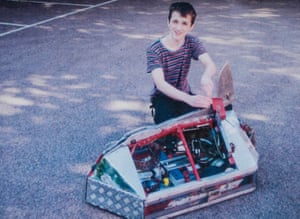
In the early days, he let Lynne and Christine come to the flat. It didn’t last; he continued his daily visits home, but barred them from visiting and withdrew into himself. Like many people with Asperger’s, Lynne says, he was a whiz with computers. She worried that he would befriend the wrong sort of people. Another passion was the TV series Robot Wars. Michael once paid £1,000 for a robot and his mother drove him, Jessica and the 16 stone robot to roadshows across the country so it could do battle.
Michael Sandford with Steel Avenger used for Robot Wars.
As Lynne talks, I notice a tattoo on her upper arm, with Michael’s name and date of birth attached. What is the design? She lifts her sleeve and laughs, embarrassed. It’s a playful devil with a pitchfork. “I had it done when he was born. It was just tongue in cheek, because all parents say ‘He’s a right little …’ She trails off. “In hindsight, perhaps I shouldn’t have.”
When he was 17, Michael decided he would learn to drive. His mother was delighted and offered to book him lessons. No need, he said: he had signed up for an intensive two-week course.
“We were terrified, weren’t we?” Christine says.
“Horrified,” Lynne says. Michael had a lesson every day for a fortnight, took his test and passed. He bought a car on eBay for £500, “which is every parent’s worst nightmare. I got the RAC to check it out and they said, ‘Well, it’s not bad,’ and he said, ‘OK, I’m off out.’” Thirty seconds later, he had over-accelerated into another car and written his off.
On New Year’s Eve 2014, Michael told his mother he had news – and she wasn’t going to like it. He was going to New York. “I just collapsed on to the sofa. I said, ‘This is insane – what the hell are you on about?’” Lynne asked her GP and local mental health services how she could stop him. “They said, ‘He’s 18; there’s no way short of having him declared mentally incompetent,’ which clearly he was not.” She tried to see it from his point of view. “His old school friends were at university or having gap years, and we thought he felt left behind. It was his way of being normal – do a bit of sightseeing.”
On 18 January 2015, he left. The next day, she received a call. “All I heard was, ‘Are you Michael Sandford’s mother? This is an American hospital emergency room,’ and again everything in me just stopped. I started yelling, ‘Oh my God! Is he dead? Is he dead?’”
Michael was not hurt, but he had been found by the road in a state of extreme distress. He was forcibly given a drugs test, because the police thought he was high. In fact, he was having a meltdown, and was sectioned overnight. But the hospital discharged him the next day, and he continued his two-week trip in a rental car.
By the time Michael returned home, he was a wreck. “He just broke down and came out with this…” Lynne shudders to a stop. “I can’t say ‘tale’ or ‘story’; I’ll say ‘version of events’.”
“He was terribly, terribly distressed,” Christine says. “He said that, unbeknownst to us, between the ages of 16 and 18, he’d had a girlfriend, and got her pregnant. He said they’d had a scan and it was a boy. And the day after Michael’s 18th birthday, this girl was killed in a car crash. He said that after this he’d attempted to commit suicide twice.”
Michael told them he had a new girlfriend, who had recently moved back to America; but when he got there, a friend had texted to say she was in prison on a drugs charge.
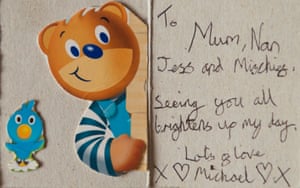
A card from Michael Sandford to his family (including the cat). Photograph: Mimi Mollica for the Guardian
Lynne didn’t know what to think. She still doesn’t know what to think: she has been unable to corroborate the story of the girlfriend and the fatal accident. She has no idea if any of it is true, but says Michael had no history of lying to her, and no history of psychosis. She pauses, and says there was one incident when he was eight and convinced aliens were coming to get him. “He was shaking and cowering, and we took him to hospital. It was like he was possessed.” But nothing since.
Michael told Lynne and Christine he wanted to be there for his girlfriend, Lauren, when she came out of jail. He said he would move in with Christine and save to get back to America. But he couldn’t save quickly enough; he asked his grandmother to mortgage her house.
“He plagued us for money.” Lynne’s voice is quivering. “He said, ‘I’m going to have to either commit suicide or turn to illegal measures.’ We said, ‘We love you, but we can’t do this. I’m a single mum on the minimum wage, and Nan can’t mortgage her house.’”
Lynne looks at her mother, just about holding her tears back. “If you’re OK with me saying this? Quite by chance my mum came into an inheritance. Her sister had left a reasonable sum of money, which Mum was going to split four ways: her, me, Michael and Jessica.” Christine and Lynne agreed to forfeit their shares and pay for a year’s rent for Michael in New York. It was a last resort.
They made Michael sign an unofficial document stating that the money was a one-off to help him turn his life around; that over the year he would come home regularly (he needed to sign on every 90 days for his benefits, for one thing); he would live in the flat; he would not break the law; and he would not attempt to kill himself. It was agreed that his first visit home would be in five weeks’ time, for Jessica’s third birthday.
But Michael never came. He told his mother there was a warrant out for his arrest in the UK (he had left a few utilities bills unpaid). Lynne contacted the police, who assured her there was not, but Michael said he believed his source rather than her. He lost his benefits. Lynne pleaded with him to come home for Christmas, but Michael said it wasn’t an option. He told them Lauren’s friends were now his friends. She began to worry that he had come under the influence of a cult; she also feared that he was simply ill and delusional.
Michael’s Skype calls were becoming less frequent. When he rang, his face was always blurry and against the same white background. Lynne asked him to show her around the flat, but he refused. Just before Christmas 2015, he rang home and said he’d moved into a cheaper flat. It didn’t make sense; the rent had already been paid. But he told them he’d got a refund on the outstanding time, and preferred the new flat.
On 17 April, he told them he’d been kicked out of the new flat, and needed money for a hostel. His father had been sending him £60 a month, and Lynne and Christine sent what they could. They begged him to come home. “He said, ‘I can’t – I’ve been very ill and run up lots of medical bills.’” A month later, Lynne reported him missing.
A letter Sandford’s mother sent to his old flat in New Jersey.
The night after Lynne was told of her son’s arrest, a friend rang. “She said, ‘I think you’d better turn the telly on.’ It was midnight and I saw pictures of him being arrested. Headlines going across the screen. I couldn’t believe it. My son, headline news for something so awful, and something just so not him. It broke my heart because it was the most I’d seen of him in a year. I just wanted to wrap my arms round him and never let him go .”
A few weeks ago, a tabloid newspaper offered to take Lynne and her ex-husband, Paul Davey, to Las Vegas, where Michael is in custody, in exchange for an interview. But Jessica did not have a passport and Lynne did not want to leave her, so Paul went alone. The newspaper promised to take Lynne as soon as Jessica’s passport came through, but then decided not to. Subsequent reports suggested Michael had a thing for guns. Lynne says this is misleading: there was a brief period when he was into airsofting (a game similar to paintball, in which participants shoot at each other with non-metallic pellets). Yes, at one point he had camouflaged his bedroom and hung replica guns on the wall, with help from his father; but three months later the room had returned to its motor-racing theme.
Paul tells me that the first time he talked to his son, via video link, at the detention centre he was unrecognisable. “Michael said, ‘Someone had to stand up for America,’ and was going on about how dangerous Trump’s policies were – building the wall, banning Muslims. He didn’t seem to know what the consequences were, what he had been charged with. He thought it would blow over and he’d be home soon. I saw him again a few days later and he was calmer, much more like his old self. We were talking about what we used to get up to. He never mentioned Trump once.” Paul has not been in touch with him since that second conversation.
Had Michael ever talked to Lynne about politics? “Not once,” she says. “Not to Mum, not to me, his father, his friends. He never had any interest.”
She and Christine talk about his despair in the weeks leading up to the Trump rally. I ask them if they think his attempt to grab the gun might have been a bid to die, while still keeping his promise that he would not commit suicide. “No,” Lynne says instantly. “I think this was his way of getting help. He was always a bit of baby on the physical side of things, so I wouldn’t think he’d choose to be shot. I also think he would have sent me a goodbye letter.”
Why Trump? Did Michael ever talk politics? ‘Not once. To Mum, me, his father, his friends. He never had any interest’
His grandmother seems less sure. “He did tell the police that he thought he’d be dead.” She mentions the most recent messages he had sent her. “One night, just before we got in touch with the police, I said, ‘Look after yourself,’ and he said, ‘I can’t.’ Then he sent me another message saying, ‘I can’t live like this much longer.’”
Did they ever suspect he might do something like this? No, she says. Apart from the verbal outbursts, he has never been violent. “I asked his friend Alex,” Lynne says, “‘You know him in a different way to me; did he ever give you any indication he could do something like he has done?’ And he said no, never. His other friend Jack went on Facebook and said, ‘I want to tell the world Michael isn’t like that.’”
For the past three weeks, Lynne has received calls every night from the detention centre in Las Vegas. All she hears is a crackling and beeping like a fax machine. She knows it is Michael. The detention centre has told her there is a technical issue with international calls.
“Then on Friday night, something incredible happened.” Her face lights up. “Eleven pm, an unknown number rang, and I just heard, ‘Hi, Mum.’ He’d been allowed to call from an office as a one-off. I spoke to him for five minutes. I asked him how he was and he said, ‘Well, not good, obviously. It’s prison.’” Did she ask him what happened? No, she says – she knew time was short. “I said, ‘Your nan loves you, your dad loves you, I love you.’”
She has been told he is on three medications: for anxiety; to help him sleep; and for hallucinations. “He’s hearing voices. He said in that call, ‘I just want to come home and get psychiatric help.’ Obviously I can’t condone what he attempted to do, but he was not in control of his mind. Yes, a sentence by all means, but a sentence over here where his family can visit him and where he can get the help he needs.” Lynne has been warned that US courts are not sympathetic to mental health problems; it is unlikely to affect his sentencing.
Lynne knows she is running on empty. Since she heard the news, she has been unable to sleep and eat properly. Fighting for her son is the only thing keeping her going; she has launched a CrowdJustice page to help with legal fees.
The trial is due to start on 22 August, though Lynne has heard that the case is more likely to be settled before that with a plea bargain. “I assume he will be asked to admit his guilt, and in return be offered a lesser sentence.” In a way, she says, she hopes it does go to trial – so a jury can see how helpless he is. But the danger is that they throw the book at him anyway.
Last week the Foreign Office told Lynne that Michael had been put on suicide watch. Does she think he is at risk of killing himself? “One hundred per cent. If he gets a lengthy sentence and he stays out there, he will commit suicide. He won’t see the point.”
On Friday, a day before this article was published, Michael managed to phone home successfully for the first time. “He was extremely distressed, and begged me to get him home,” Lynne says. “He said, ‘I can’t cope. I can’t last out much longer.’”
Mr Buscombe’s ordeal began when his leg started out swelling up and his doctor named for an ambulance to consider him to hospital.
He was sitting in the back seat of the motor vehicle as it travelled at speed in direction of Plymouth, but without the blue lights flashing.
“I was in terrible pain,” Mr Buscombe stated. “The leg was swollen and my toes had been starting to go black.
“We have been going at really a speed when the ambulance came to an abrupt quit. It was not fairly an emergency cease but ample to make my seatbelt lock.
“All of a sudden the door slid open and there was a girl standing there in the roadside.”
Mr Buscombe, who has 3 grown up sons with his wife Sandra, stated the woman looked “worse for wear” and was sporting a just skirt and a blouse regardless of the foggy and rainy weather.
He explained: “They looked like they’d had a couple of beers and missed their lift back residence.
“The female began asking me all sorts of queries – who I was, what was incorrect with me. I explained ‘how the hell do I know, I haven’t been to hospital yet’.
“I couldn’t think what was going on. The paramedic in the back with me looked as baffled as I was.”
The ambulance continued to Saltash on the Devon-Cornwall border and pulled in excess of yet again, in which the two hitchhikers jumped out at a garage, Mr Buscombe explained.
When it reached Derriford, Mr Buscombe was checked more than and put into another ambulance, which took him to the Royal Cornwall Hospital in Truro to see professionals the place medical professionals he was advised his leg could be treated with injections rather than getting to be amputated.
He was discharged the following day, but returned to have an angioplasty and stent inserted into his leg.
Mr Buscombe stated: “The blood clot was in the main artery above the knee. The pieces can break away, travel in direction of the heart and destroy you in a split second.
“It was a race against time to conserve me and my leg and however the driver was messing around offering individuals lifts – it truly is just not on.
“If he was concerned about these individuals he could have named the police.
“There are a whole lot of worthwhile medication in the back of an ambulance and for all he knew these two could have been armed with a knife or anything.
“I have the utmost respect for the work the ambulance men and women do and the care I acquired from the medical doctors and nurses at the Royal Cornwall Hospital was exemplary.
“I would not want anyone to get rid of their jobs above this but it cannot be allowed to come about yet again.”
It is believed the ambulance might have stopped since the crew considered the couple had been in a road traffic accident or at threat due to the fact of the negative weather.
An ambulance support spokesman mentioned details would not be disclosed until finally the investigation was finished.
He explained: “The Trust has received a complaint from Mr Buscombe relating to a schedule transfer from his residence deal with to Derriford Hospital, Plymouth, in the early hrs of Sunday, April 6th.
“The Believe in takes all complaints seriously and has began an investigation to establish exactly what occurred in the course of the transfer.
“After this investigation has completed we will be writing to Mr Buscombe again to inform him of our findings and the final result of the investigation.”
Earlier this year the only huge, properly-developed trial of renal denervation– the after highly-promising catheter-based mostly technological innovation that was broadly expected to “cure” tough instances of resistant hypertension– failed spectacularly. Numerous hypertension authorities think that ultimately the approach will demonstrate to be beneficial, but soon after the failure of Simplicity HTN-3 it is clear that there’s a fantastic deal of analysis that wants to be performed to find out just how– or if– this novel technology must be utilized.
In the US this does not existing a dilemma. The FDA has not approved renal denervation so it can only be utilized in a investigation setting. But that is not the case in Europe, in which the gadget is offered due to reduce requirements for gadget approval.
Correct now Europe’s largest interventional cardiology meeting, Euro PCR, is underway in Paris. Surprisingly– or probably not– renal denervation is still currently being heavily promoted in Europe. Right here is the evidence: a series of tweets by @Jeddacath, an interventional cardiologist at the Brigham & Women’s Hospital in Boston, who is attending the meeting.
The latest Nationwide Aids Trust figures also unveiled that 21,900 folks in the United kingdom are unaware they are infected with the virus. Every one of us, gay or straight, is aware when we have unsafe intercourse that we place ourselves at threat of a sexually transmitted illness, HIV integrated. Or are we? Does it cross our minds as much as it did a generation in the past? Is it a lack of understanding, an “it could by no means take place to me” mentality or a “no-1 dies from it these days” belief that’s trying to keep a percentage of the population from practicing secure intercourse?
Like numerous men, I spend income on ensuring I appear and really feel very good – good garments, excellent grooming merchandise, gym membership and a dose of monthly acupuncture. That is the external side of items taken care of, but I’m also really aware of the importance of the inner, and that consists of looking after my sexual wellness. Following some reckless behaviour in my 20s and those sweat-inducing waits for check final results, I came to realise just how important my sexual well being was. HIV could take place to me. Cancer could take place to me. Why would I be diverse to anyone else? Although cancer is somewhat out of my control, exposing myself to HIV is firmly in my energy.
Some individuals are much more cautious nevertheless. A gay friend of mine enquires about the HIV status of every guy he dates early on. He’s an anomaly, as most folks locate that a extremely intrusive and confrontational question, but why shouldn’t we all be so open? With men and women out there oblivious to the reality they are contaminated and other folks practicing unsafe intercourse, it would seem a honest query.
A guy I when dated responsibly informed me of his positive standing right after 3 dates. We hadn’t slept together and we never did. I truthfully couldn’t manage it.
But other folks are not so mindful. It is human nature to take dangers. We smoke, we drink, we get medication and we (not every person, granted) meet random strangers for intercourse through apps on our phones. Grindr, Scruff, Blendr, Tingle – consider your choose and you’re a couple of mobile phone taps away from no-strings sex. Arguably it’s never ever been simpler for a gay guy to locate a inclined sexual companion. That may well go some way to explaining why the number of new HIV circumstances between gay/bi males is at a record degree, but arguably it truly is also partly simply because the dangers of AIDS and HIV have to some extent disappeared from the broader public consciousness. The risk of contracting HIV is no longer so visible, in spite of the truth that 80 per cent of gay males know an individual residing with HIV (compared to sixteen per cent of the general population).
A couple of decades ago, public awareness campaigns on AIDS and HIV have been omnipresent, with figures like Elton John and Liz Taylor raising hundreds of thousands to spread the message. Go back even more, and there was the terrifying “AIDS: never die of ignorance” campaign, launched in 1987, with data leaflets being delivered to each home in Britain.
In the absence of these high-profile campaigns or compulsory intercourse education it is now up to us as people to educate ourselves and these about us about HIV.
Although creating this piece, I asked a 38 yr old (straight) good friend, who admits to getting taken many hazards with his sexual wellness in his 20s, how numerous HIV exams he had had. I was shocked at his response: “none”. Asked why, he explained he had stored meaning to do so but was truthfully as well afraid to discover out. He had put it to the back of his mind, until I asked.
Having an undiagnosed illness like HIV can have devastating consequences for a person’s well being as nicely as rising the danger of them passing HIV on to their partner or partners. Our sexual wellness is our obligation, to protect not only ourselves but also people we pick to have intercourse with.
My buddy is possessing a HIV check as quickly as feasible.


 Walking Dead Girl (Photograph credit: micadew)