sites etiketine sahip kayıtlar gösteriliyor. Tüm kayıtları göster

15 Şubat 2017 Çarşamba

Delhi"s deadly dust: how construction sites are choking the city

Far out on Delhi’s southern and eastern fringes the rows of high-rises suddenly turn skeletal. The population of the Indian capital, already the second largest in the world, is forecast to grow by 9 million in the next 15 years; and despite a recent lull in new projects, areas such as Noida are a universe of worksites, cranes and workers.


The empty towers stretch as far as can be seen – which is only about 300 metres. Like much of Delhi on most winter mornings, Noida is blanketed in thick smog and a heavy dust that cakes windows and clogs throats.


A comprehensive 2016 study of what is to blame for Delhi’s poor air identified some obvious sources,such as car emissions, the city’s coal-fired power stations and rubbish fires both small and literally mountainous. But it also highlighted more unlikely culprits.


Dust kicked up by cars along Delhi’s vast and growing road network contributes between a third and 56% of the most harmful pollutants in the city’s atmosphere.


The city’s construction sites, and the production of the raw materials that feed them – such as bricks and concrete – are also an outsized contributor to the foul air that some lung specialists warn is making Delhi hazardous, particularly for children and the elderly.


In a country largely under construction – by some rough projections, around 70% of the buildings that will exist in India’s cities by 2030 are yet to be built – controlling the dust produced by roads and worksites is an important, but largely neglected, part of clearing Delhi’s air, according to environmental groups.


Landlocked by treeless plains and deserts, Delhi is inherently dusty. “It’s one of the reasons we can’t have air quality standards as strict or high as the US,” says Sarath Guttikunda, the founder of UrbanEmissions, an air pollution research group. “Our annual standard for PM2.5 pollutants is 40 units, but the World Health Organization’s guideline is 10.”
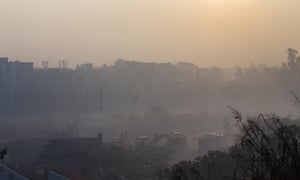


Construction equipment sits idle at a site shrouded in smog in New Delhi, India


Construction and demolition are the third-largest contributor of coarse pollutants. Photograph: Bloomberg/Getty Images

But poor building standards and antiquated practices, multiplied across thousands of worksites, make construction and demolition the third-largest contributor of coarse pollutants – strongly linked in a 2015 study to heart disease.


At one building site in Chittaranjan Park, an affluent south Delhi neighbourhood, half-covered piles of rubble spill out on to the pavement. No fences have been erected to keep the wind from whipping dust out into the street. Enormous mounds of dirt left in empty lots, or simply dumped at the roadside, are also a common sight.


“The Indian construction contractor is trying to maximise his margins,” says Polash Mukherjee, a researcher with the Delhi-based Centre for Science and Environment. “If he’s constructing his house, he’s not required to go to a facility by law and dispose of the waste. Unless he’s forced by government to cover his trucks when he transport raw materials, he won’t do it.”


Builders aren’t just cutting corners: Delhi simply lacks the capacity to safely process the amount of construction waste it produces. A senior environmental engineer at the Delhi Pollution Control Committee told the Guardian current facilities allow for about 1,000 tonnes of waste to be processed per day, but the city produces an estimated 3,600 tonnes.


Run-of-the-mill construction activities take a hefty toll. The process of mixing concrete alone, for example, is estimated to contribute 10% of the coarse pollutants in Delhi’s air, according to an Indian Institute of Technology Kanpur study. Less polluting methods of producing concrete exist, but cost money. “Here it’s often mixed in a pit by manual labour,” says Mukherjee. “It’s cheaper that way, because there’s such a surplus of labour.”
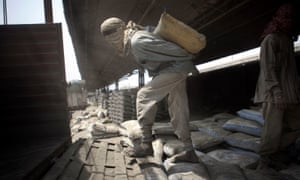


Laborers load cement bags manually onto transport carriers at the Shakur Basti station in New Delhi, India.


Concrete is ‘often mixed in a pit by manual labour. It’s cheaper that way.’ Photograph: Bloomberg/Getty Images

A 2015 study of 19 large Delhi construction sites found the air quality around all of them exceeded safe limits by at least three times, with workers on these sites, mostly daily wage labourers, bearing the brunt. Almost none wear pollution masks, while a handful tie handkerchiefs across their faces to guard against the dust.


Naresh Sharma, a cook on a site in Greater Noida, said workers were sometimes issued pieces of jaggery, a concoction of sugarcane and date palm believed to clear the throat and lungs. “It clears your throat from phlegm, but I don’t think it prevents damage,” says Sai Kiran Chaudhari, a leading pulmonologist at the Delhi Heart and Lung Hospital.


Two years ago, India’s environment court issued extensive regulations to clean up the city’s construction industry, mandating 50,000 rupee (£595) fines for builders who failed to cover their sites in tarpaulin, put up barriers, or sprinkle building materials with water before they were stored or transported. But Mukherjee says construction in Delhi is administered according to complex rules by numerous authorities, and in any case, “enforcement is very, very lax”.


Delhi itself has strong regulations, he adds, “but the biggest projects, the metros, hospitals or malls, are usually in suburbs outside the city, in Gurgaon or Noida, where those rules don’t apply”.


Even when clear orders are issued, they are routinely flouted. Brick production has been banned in Delhi for environmental reasons, but flourishes in nearby towns such as Dadri, in Uttar Pradesh state.
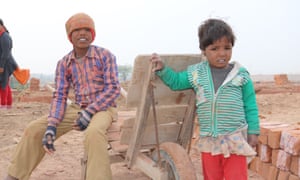


Children at brick factory Delhi


Children working at a brick production site on the outskirts of Delhi. Photograph: Michael Safi

At RR Brickfields, one of the 18 kilns that dot the dry fields around the town, workers including children were collecting finished bricks from a furnace cut deep into the earth. Thick smoke billows from a chimney stack for almost the entire six months each year that the kiln operates. Studies have suggested India’s brick industry could contribute nearly 10% of India’s emissions of black carbon, a major contributor to climate change.


Since early 2016, brick kiln owners have been required to gain environmental clearance before firing their ovens. “But in some areas, people bribe officials. Sometimes they produce bricks secretly,” said the owner of the kiln.


He said he was still in the process of applying for a clearance and, despite the apparent signs of industry, insisted his kiln was not one of those operating.


Then there is the largest year-round contributor to the city’s air crisis: the dust thrown up by the more than 9 million cars that grind along Delhi’s poorly maintained, sometimes unpaved 33,000km road network. Dust has always been factor of Delhi life, but the particles released by traffic are particularly toxic, Mukherjee says.


“It mixes up with the vehicular emissions, the industrial pollution,” he says. Harmful pollutants bind to the dust and settle in the air, when they might otherwise be dispersed by winds.


Building more pavements would make “a big difference”, he says. So would planting vegetation along dividers and road shoulders. “Those bushes would get covered in dust, but it would prevent the dust from blowing further down the road,” Mukherjee adds.


A significant proportion of Delhi’s pollution blows in from across the region, including from crop burning in Punjab and Haryana. There is growing awareness that Delhi’s air problem is really a regional one. Modelling produced for the Guardian by Greenpeace shows that air pollution increases the risk of heart disease for Delhi residents, and the risk of lung cancer by 62%. But the air in Amritsar, the Punjab capital, poses its residents a similar risk. The rates in Allahabad, in Uttar Pradesh, are even higher.


But lasting change will also involve tackling Delhi’s local pollution sources, Mukherjee says. “We know the solutions. We’ve known them for 30 years,” he says. “Implementation is the bane in India.”


Lung specialists such as Chaudhari are beginning to recommend to some older patients and those with chronic conditions to leave the city. “At one stage you have to think Delhi is not the place to live, you should look for a better option,” he says.


He says he aims to leave the city before the age of 50. “I’m serious,” he says. “Next time someone tries to trace me, I might be gone.”


Guardian Cities is dedicating a week to exploring one of the worst preventable causes of death around the world: air pollution. Explore our coverage here and follow Guardian Cities on Twitter and Facebook to join the discussion


Delhi"s deadly dust: how construction sites are choking the city

15 Haziran 2014 Pazar

Beyondblue survey finds construction internet sites are mentally wholesome workplaces

They may possibly look rough and ready but development internet sites are amid Australia’s most caring locations to function.


Which is according to a national survey carried out by the psychological health charity beyondblue.


It found building staff are the most very likely to say they work in a mentally wholesome environment.


The least probably are agriculture and public administration employees.


Geographically, workplaces in Western Australia are the most mentally healthy and individuals in Queensland the least.


The investigation was released on Monday to mark the launch of headsup.org.au, a cost-free on-line guide businesses can use to generate their personal psychological overall health plan.


It also also discovered that all around 50% of employees do not believe they perform in a mentally healthier environment and 1 in 5 had taken time off work in the past twelve months since they felt mentally unwell.


Supportive and caring managers and versatile operating hrs are crucial attributes of a mentally wholesome workplace, in accordance to beyondblue.


These organisations also motivate employees to get lunch breaks, prevent discrimination and have help programs.


Many employers do not realise they can reduce absenteeism and improve productivity by improving psychological well being, says beyondblue’s chairman, Jeff Kennett.


“Employers not only have a overall health and safety obligation to supply great psychological wellness in the workplace but also a moral obligation to support their employees who usually spend far more time at function than anyplace else.”


He mentioned the on-line manual could support organizations of all sizes with sensible advice on how to set up a psychological wellness strategy.


Beyondblue survey finds construction internet sites are mentally wholesome workplaces

13 Mayıs 2014 Salı

Tunisia"s poorest towns left to shoulder burden of hazardous toxic landfill web sites | Simon Speakman Cordall

MDG : Landfill in Tunisia : Dumping garbage in Le Kef

A refuse dump in Tunisia. The overall health implications of this kind of web sites, which frequently incorporate chemical waste, have raised issues. Photograph: Jeremy Graham/Alamy


Salah Darghouth’s aggravation is visible. “You see that man working on the ninth floor,” says the adviser to Tunisia’s sustainable growth ministry, pointing at a labourer on the half-constructed tower block opposite. “He harasses me. Every single day I observe him and all the other individuals throw their refuse on to the street below – concrete, litter, every little thing.”


Across Tunisia, with the dust of revolution beginning to settle, refuse looms large in the public conversation. Litter, especially plastic bags, has come to dominate the country’s famously dramatic landscape. The problem is felt by all citizens, but none encounter it more acutely than these living up coming to the straining landfill websites.


Ridha Trabelsi, 45, a shopkeeper who lives in the modest Tunis suburb of el-Attar, is a case in stage. “Would you like to reside here?” he asks, gesturing in direction of close by Jbel Borj Chakir, Tunisia’s biggest landfill web site and a source of expanding exasperation. “They explained they were going to shut it last year, but they haven’t. It’s nevertheless right here and it is only obtaining larger.”


The influence of landfills on this kind of areas is difficult to overstate. In 2011, right after the Jasmine revolution, it was the landfill websites at Djerba, Enkhila (near Nabeul), Oued Laya (close to Sousse), Agareb (near Sfax), and the country’s only hazardous waste-treatment plant, at Jradou, that bore the brunt of local residents’ fury.


All had been closed, most of them temporarily, as a end result of violence. Jradou stays shut, and it is unclear where its waste is being handled. Strategies to reopen the Djerba website have triggered far more violence.


In el-Attar, the stench of rubbish chokes the air it sticks in your throat and permeates your clothing. Trabelsi’s son, eight-year-previous Mohamed, is asthmatic. Respiratory sickness is rife.


“When you build a landfill, you create it for a specific time period,” says Morched Garbouj, an environmental engineer and president of the SOS BIAA environmental group. “Right here at Jbel Borj Chakir, that time period ended in 2013. At that level, it need to both have been closed or, at the least, working at about ten% to 20% capacity.”


According to Darghouth, no determination has been taken on the prolonged-phrase potential of Jbel Borj Chakir. “We’re taking delivery of all around two,000 tonnes of waste each and every day. That has to go someplace … We’re just dealing with almost everything on a day-to-day basis even though we perform to implement a bigger strategy.”


“1 of the issues here is that we don’t know what variety of waste we’re dealing with,” says Garbouj. “Elsewhere, waste is separated, here it all will get dumped collectively – chemical, industrial, family and health-related.” Residents and those who make their living scavenging the dump have reported locating blood bags and foetuses in the refuse at Jbel Borj Chakir, a claim denied by Agence Nationale de Gestion des Déchets, which manages waste on behalf of the environment ministry.


“I did not just see them [the diverse types of waste], I dealt with them,” says Kamel Marouani, a former refuse employee. “Chemical, health care, every thing.”


“One of the troubles with all the various types of waste is the leachate it generates [the liquid created at the base by the compressed refuse],” says Garbouj. “Leachate is extremely toxic, so there are stringent controls about how it should be treated and disposed of. Even so, simply because no 1 understands what’s in it, no one understands how it need to be handled.”


Marouani, who was diagnosed with lung cancer in August 2012, worked at Jbel Borj Chakir for 10 years, the previous 5 for a French company, Pizzorno, a single of 3 contractors that handle landfills for the Tunisian government. One particular of his tasks was to work in the 10 leachate basins that surround Jbel Borj Chakir. He was necessary to wade by way of the often chest-high, reeking, black leachate – constructing dams or clearing away the thick foam that forms on the surface of the basin.


SOS BIAA estimates that the value of transporting and disposing of waste at Jbel Borj Chakir was about $ 110-$ 125 (£65-£75) a ton, in contrast with the equivalent cost in New York of $ 86. This was in spite of drastically reduced overheads. Trucks dumping at Jbel Borj Chakir pay Pizzorno $ 15 for every single ton of waste deposited in return for the firm’s experience in managing the web site. Offered that, on an common day, about three,000 tons of waste is deposited, that equates to a day-to-day income stream of $ 45,000. The costs of trucks and labour are billed to the Tunisian government.


In 2011, Pizzorno was the subject of a complaint by the post-Arab spring government’s Commission of Investigation on Corruption and Embezzlement in excess of its dealings with President Zine al-Abidine Ben Ali’s regime. On 15 March, Pizzorno’s five-yr contract with the Tunisian government expired. No choice has been taken on a achievable successor. Pizzorno, which continues to handle the internet site on a caretaker basis, declined to comment on any of the factors raised in this report.


Desta Mebratu, deputy director of the UN Atmosphere Programme’s regional office for Africa, stated: “Disposal in sanitary landfills is the last alternative that need to be deemed … Tunisia is 1 of the 1st African nations that established a national programme on waste minimisation and cleaner production. This programme has led to reduction of a generation of industrial waste and reduction of pollution.”


In el-Attar, minor of this matters. Kids carry on to perform near the landfill website. According to SOS BIAA tests, the local water provide – like all the water inside a 5km radius – continues to be contaminated by fine particles, nitrates and even hefty metals from the dump. Trabelsi seems at the mountain of refuse that dominates the landscape for miles. “We have sick outdated folks. Our youngsters are sick. We can’t continue.”


Tunisia"s poorest towns left to shoulder burden of hazardous toxic landfill web sites | Simon Speakman Cordall

10 Mart 2014 Pazartesi

Self-harm internet sites and cyberbullying: the threat to young children from web"s dark side

“Some of the images do scare me, specially if it’s my pals. After my pal cut lines down the side of his face as a ‘Chelsea Smile’, he put it online and it was the worst thing I had ever noticed. He’s my buddy, I don’t want to see him that upset. He got so a lot hate for it and ended up going into hibernation, no person heard from him for in excess of a week and we truthfully believed he had killed himself.”


Frankie* is 15 and lives in the Midlands. For the previous 12 months or so she has updated her Tumblr website most days. On other social networks she employs her true identify, but on Tumblr – a blogging platform – she shares her darkest thoughts about depression, anxiety and self-harm anonymously. “The other day I place up a self-harm image,” she says. “I was alone and in a dark location. […] Of course, no person would aid, but posting it boosted my self-confidence a tiny discovering it buried in amongst all the other self-harm posts reminded me I’m not alone.”


Fears about self-harm sites have been expanding given that the suicides of two teens who, it emerged, have been obsessed with self-harm and depression blogs, with mental health campaigners and specialists warning that the UK’s teenagers are at risk of turning into a lost generation if dad and mom and grownups cannot attain out to them across the digital divide.


Tallulah Wilson, a 15-yr-outdated who killed herself in 2012, was caught up in a “toxic digital planet”, in accordance to her mom, whilst the mother and father of Sasha Steadman, a 16-12 months-previous who died from a suspected drug overdose in January following looking at self-harm web sites, stated her “impressionable thoughts” had been filled “with their damning gospel of darkness”.


For the uninitiated, self-harm blogs current a surreal globe of fantasy and ache. A great number of web sites dedicated to self-harm and depression are filled with images of bleeding wounds juxtaposed with pixelated gifs, flickering eerily with snippets of Hollywood angst. Helen, who is now 18, visited them frequently, before stopping to aid herself move on from self-harming. “You have men and women asking you how to minimize by yourself deep sufficient due to the fact their therapist explained it wasn’t poor enough,” she says. “I have had folks inform me to kill myself. I feel the most traumatic is when you uncover someone’s suicide note online and there is no way to truly get in make contact with with the man or woman.”


Isolated and lonely, she utilized the blogs due to the fact they gave her a sense of belonging. “You want to find men and women who are related to you. That is what humans do,” she says. “It commences off as trying to aid, but then it becomes competitive and unsafe. You get sucked into this world of who can lower the deepest/be the skinniest and avoid observe by the outside planet. You finish up spending hrs a day browsing these websites for reassurance, but it just makes it tougher.”


Retaining kids protected on the internet is the “child safety challenge of this generation”, in accordance to Peter Wanless, head of the NSPCC. ChildLine, part of the organisation, registered an 87% rise in calls about cyberbullying last 12 months, a 41% increase in calls about self-harm, and a 33% increase in calls about suicide, with the most significant enhance amongst 12- to 15-yr-olds.


Whilst the net gives unprecedented opportunities for young men and women to talk and discover, it can be a dangerous place for vulnerable teenagers, says Sue Minto, the head of ChildLine. “Kids are communicating in a way we have never ever witnessed before – all the time and quickly,” she says. “Personally, I believe this sort of relentless publicity is the biggest challenge we have ever faced.”


Minto notes that even though peer stress and bullying have been all around for a long time, the capacity to be contacted at all instances is new. The cloak of anonymity can lead kids to make remarks they would shy away from in “genuine” daily life, she says. “The pressure on young children is immense and very worrying – there is no break for these younger individuals, it is fairly relentless. Children who are currently being bullied inform us there is no point in turning off their mobile phone, simply because the messages will just be there waiting for them.”


A current survey carried out by youth charities ChildLine, Selfharm.co.united kingdom, YouthNet and YoungMinds revealed that 61% of the four,000 youthful folks who responded stated they self harmed because they felt alone, whilst 25% cited bullying. Practically forty% explained they had never ever spoken to any individual in the “true planet” about it.


Rachel Welch, director of Selfharm.co.uk, which supports younger people impacted by self-harm, says there is a enormous gap between what grownups see of the on the web globe and their children’s experience. “So numerous younger men and women are drifting into a world exactly where they are fully disconnected,” she says.


But how harmful are self-harm websites? Do they simply display teenage angst and inventive expression, or highlight a worrying deterioration of teenage mental wellness?


Mary Hassell, the coroner presiding over the inquest of Tallulah Wilson, was concerned enough to write to Jeremy Hunt, the well being secretary, to warn him of a risk of potential deaths without a higher understanding of children’s on-line worlds. Even though Tallulah was treated by healthcare experts, they did not have “a good sufficient understanding of the evolving way that the world wide web is used by younger men and women, most particularly in terms of the online existence that is really separate from the rest of daily life”, she wrote.


A examine into possible back links amongst suicide and the world wide web has just been commissioned by the Department of Wellness and will report in two and a half years: a division spokeswoman mentioned children’s psychological well being was a priority for the government and pointed to the introduction of “loved ones-pleasant filters” and net safety into the national curriculum.


But for Sarah Brennan, chief executive of the youth mental wellness charity Youthful Minds, the genuine issue is ignorance of the scale of the issue, or even denial that the problem exists. The present NHS commissioning of youth psychological well being solutions is primarily based on information collected in 2004 – the year Facebook launched.


“It is shocking that the government is enabling NHS commissioners to strategy providers based mostly on out of date and inaccurate data,” Brennan says, incorporating that a Younger Minds freedom of information request not too long ago unveiled that 34 out of 51 regional authorities in England have lowered the spending budget for their kids and adolescent psychological well being companies given that 2010, although a Neighborhood Care/BBC investigation this week showed that a developing quantity of critically sick youngsters are becoming admitted to adult psychiatric wards or sent hundreds of miles from residence for hospital care.


“We are sitting on a ticking time bomb right here,” says Brennan. “At the very same time that we are seeing an enhance in need to have, youth psychological well being companies are currently being lower. There is an explosion of bullying on-line and young individuals struggling to cope with psychological health troubles, anxiousness, eating problems. If we do not do some thing about it we could have a lost generation.”


What can be accomplished? Considering that Tallulah Wilson’s suicide, Tumblr has launched a warning that pops up when customers search for terms relevant to self-harm, directing them in the direction of internet sites providing support and calling on end users to report blogs with “inappropriate content material” so they can be taken down. A Tumblr spokeswoman mentioned the web site was “deeply committed to guarding our users’ freedom of expression”, but that it draws lines “all around a number of categories of material we contemplate damaging to our community, like blogs that encourage self-harm”.


And while there have been calls to shut down specific sites, this kind of as Inquire.fm – which makes it possible for users to request anonymous concerns and has been linked to teen suicides – teens and professionals spoken to by the Guardian agreed that simply banning sites or “harmful” search terms was futile. Regulation can also backfire – latest efforts to impose opt-out “objectionable material filters”, backed by the prime minister, have resulted in sites such as ChildLine and Refuge also becoming blocked.


“We can’t put our head in the sand, merely blame these sites or hope to regulate our way out of this,” says Minto. “We are enjoying catch-up, but we need to have to get duty. You wouldn’t allow your child cross the road without talking to them about street security and the exact same goes for the risks of the net – if we do not tackle this it is like opening the door and letting them stroll by means of this cyberworld completely unequipped.”


Welch at Selfharm.co.uk agrees: “Calling for any type of ban is just missing the stage. What we have to do is make confident our youthful folks are emotionally resilient, emotionally mindful and they know the place to go to get aid if they want it.”


Others say that whilst components of the web can be hazardous for vulnerable children, it can also give the signifies to preserve other folks risk-free and allow them talk about their issues. As a lot of young people get in touch with ChildLine on the internet as phone its helpline. Online friends can be a force for good.


Samantha, a 17-yr-previous who commenced self-harming when she was 14, says her Tumblr site helped her recover from depression. “I felt like I belonged someplace, they understood me in a way I felt I had never ever been understood ahead of,” she says. At a single stage, she was off college with depression and invested all day on the internet, answering ten-15 messages from other troubled youngsters each day. Now she “has a life” once more and is on the web much less usually. “I have been advised that I’ve saved lives and it made me truly feel very good about myself that I was assisting other people,” she says. “It truly is truly odd – but it works for me.”


Frankie, who is still functioning in the direction of recovery, has mixed emotions. Although she recognises that some blogs may possibly motivate self-harmers, or make them feel worse, she nevertheless believes they can support. “I believe for [people] like myself it can be reassuring just to know there are other folks out there that do it too [but] what scares me is pondering how several there are, how they are all posting it online, are they all cries for help? If that a lot of folks are crying for assist then one thing demands to be accomplished, and quickly.”


*Names of young individuals have been modified. If you face any of the issues in this piece, you can get in touch with ChildLine on 0800 1111


Self-harm internet sites and cyberbullying: the threat to young children from web"s dark side

24 Şubat 2014 Pazartesi

Targeting mosquito breeding sites in the fight towards malaria

An Indian worker sprays pesticide to kil

A wellness employee sprays pesticide on a pool of stagnant rain water – an ideal breeding website for mosquitoes, in New Delhi, India. Photograph: Manpreet Romana/AFP/Getty Pictures


As a youthful civil engineer in the 1950s, my grandfather was posted to Khartoum in Sudan, tasked with helping to construct a new water provide, drains and sewers for the city. Decades later on, this program started to leak and became 1 of the primary sources of standing water for malaria-transmitting mosquitoes to breed.


Nonetheless, right now, as part of a renewed hard work to manage malaria in Khartoum, these pipes are currently being mended. Other possible breeding web sites are destroyed on a standard basis. Those that can not be dried are treated with larvicide and this has contributed to a huge reduction (pdf) in malaria in the city.


This strategy – acknowledged as larval source management – aims to stop mosquitoes from breeding in swampy land and standing water, and research suggests it could perform an critical function in future malaria management.


Fantastic achievement has been accomplished in malaria control in the previous decade, with international malaria mortality minimize by a quarter. Nevertheless, our core vector management resources – long-lasting insecticide-treated bednets (LLINs) and indoor residual spraying of residences (IRS) – are being undermined by mosquito resistance to insecticides.


Larval source management, or LSM, could be an further technique. Historically it was the mainstay of early malaria handle operations, employed in Brazil, Egypt, Zambia, Indonesia, Europe, the US and a lot of other components of the planet. Famously, it was utilized to protect staff constructing the Panama Canal amongst 1904 and 1914. Even so, LSM fell out of trend in the mid-20th century, with the development of DDT for indoor house spraying.


These days there is renewed interest in LSM. Discipline trials in Eritrea, the Gambia, India, Kenya, Sri Lanka and Tanzania have demonstrated its possible impact. Many malaria-endemic nations in sub-Saharan Africa and elsewhere are also working or arranging LSM and last year the Globe Overall health Organisation published a guide to aid guide programmes.


Until finally lately, there has been small consensus on the effectiveness of LSM, stemming partly from the complexity of trialling this type of environmental intervention, meaning that reasonably few very good scientific studies exist. Some varieties of LSM also require an intense hard work and close management, related to IRS. Reflecting this, the newest Globe Wellness Organisation tips suggest larviciding as a supplementary malaria intervention, but advocate for more study to totally help its use in all settings.


Nonetheless last yr a Cochrane overview, the gold standard in synthesising proof on public overall health interventions, concluded that LSM may possibly reduce malaria incidence by up to 75%, and the prevalence of malaria infection by up to 90%. As such, LSM can be an efficient method towards malaria in parts of Asia and Africa.


LSM is not a panacea. We need to have to know much more ahead of we can assistance its use in specific contexts for instance, the place swamps or ricefields stretch for a lot of kilometres. As a programme it need to also be cautiously tailored to neighborhood mosquito species and ecology, requiring intensive effort and close management all through. Nevertheless, it could demonstrate a relatively low-cost addition to our core malaria interventions.


LSM also heralds a return to a broader strategy to controlling malaria by involving sectors outside health. In Khartoum, responsibility for malaria handle is shared among the ministries of health, public functions, agriculture and education. Collectively these ministries operate to restore broken water pipes, get rid of water basins, drain and flush significant mosquito breeding internet sites, and introduce new irrigation methods that minimize standing water. All at an annual value of $ 600,000 (£360,000) – or about ten cents per individual protected.


Of program, we need to proceed to advocate for high levels of funding for malaria handle. It is also critical to maintain higher coverage with current very first line interventions. Long-lasting insecticide taken care of nets, indoor residual spraying, preventive medication for substantial-threat groups and very good situation management remain integral to tackling this ancient illness.


Lucy Tusting is a research degree pupil at the London School of Hygiene &amp Tropical Medicine department of condition control. Stick to @LSHTMpress on Twitter


Join the local community of global advancement experts and experts. Turn into a GDPN member to get much more stories like this direct to your inbox


Targeting mosquito breeding sites in the fight towards malaria