town etiketine sahip kayıtlar gösteriliyor. Tüm kayıtları göster

2 Şubat 2017 Perşembe

Forget-me-nots in Purley: how the town became "dementia friendly"

You don’t need to spend long in Purley to realise the town is home to many elderly people. The otherwise unremarkable suburb of Croydon is surrounded by numerous residential care homes, and in Purley Library, staff are used to adapting to the needs of elderly visitors.


While the older generation adds much to the town’s community and economy, there are occasional issues: visitors from the local care homes often forget where they are or what they are looking for. “We’ve had two already this morning,” one librarian says on a Friday afternoon in January. Another local describes how she notices some people having trouble in shops, struggling to remember pin numbers or momentarily forgetting what they are buying.


In 2012, Croydon determined that 3,300 residents of the borough are living with dementia, above the London average, and set to rise to 4,500 by 2025. So when Purley Bid, the business improvement district, held a meeting to discuss measures to improve the town, much centred on finding new ways to support the elderly population.


“We realised there wasn’t much being done for them,” says Yuliana Topazly, marketing manager for Purley Bid. “Businesses knew they needed to do more to make them feel more welcome in the town centre.” After dementia awareness-raising events hosted by the Bid last year, and a number of workshops run by the Dementia Friends initiative, Purley was designated a dementia-friendly community in January this year.


The focus is now on providing free training so locals can better recognise, understand and assist those with dementia. Dementia-friendly businesses are provided with stickers displaying the Alzheimer’s Society forget-me-nots flower logo, which are date-stamped to encourage business owners to maintain standards.



The knotted handkerchief logo that shops in Bruges use to show they are dementia-friendly.


A sign in Bruges, Belgium denoting a ‘dementia-friendly’ shop. Photograph: Ross Davies

The Alzheimer’s Society has designated 220 communities in England and Wales as dementia-friendly, aiming to reduce stigma around the disorder and improve safety and quality of life for those who experience it. The charity is campaigning for London to be the world’s first “dementia-friendly capital city” by 2020, defining such a place as “a city where every person with dementia – no matter who they are or where they live – can live well and access the right support, at the right time, in the right way”.


The concept of dementia-friendly communities was born in Japan in the 1990s, where an ageing population forced radical thinking: rather than exclude people with dementia from society, Japanese cities developed a range of programmes that would allow those living with dementia to continue to engage with the world around them. It’s estimated that the condition will affect 7 million – or 20% of all people aged 65 or over – in Japan by 2025.


In the Belgian city of Bruges – a place where 2,000 of the 116,000 residents have dementia – 90 shops classify as dementia-friendly. They display a logo of a knotted red handkerchief – a symbol of the traditional memory aid – which signifies that staff can offer assistance to people with the condition. The initiative, set up by charity Foton, has also been distributing dementia guides and training sessions.


We want people with dementia to feel confident to go out


Sara Miles, the Alzheimer’s Society


Dementia is also a growing problem in the UK. The Alzheimer’s Society believes it will affect more than 1 million residents by 2025. Of the 850,000 people who currently have dementia in the country, 40% said they feel lonely and 34% don’t feel part of their community. To counter this, in February 2015, former prime minister David Cameron introduced the challenge on dementia 2020, which called for half the population of England and Wales to be living in a recognised dementia-friendly community by 2020 and for there to be 4 million “Dementia Friends”.


“Dementia Friends are those who have had awareness training in understanding and empathy,” explains Sara Miles of the Alzheimer’s Society. “That’s a crucial element in the community – you need those working in the infrastructure to understand the needs of people with dementia in your area.”


“We want people with dementia to feel confident to go out; we don’t want them sitting at home,” adds Miles. “We want them to stay active for as long as possible, to do their own banking or shopping, so that’s where retailers are so important. We want to keep those parts of the brains active as long as possible and to retain that quality of life, so they interact rather than sitting at home feeling isolated and alone.”


There’s no single set menu of measures to employ when creating a dementia-friendly community; instead areas are encouraged to choose what works best for them. These communities tend to be built from the ground up, often having been championed by people with direct experience.
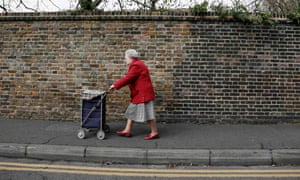


Elderly woman pushes trolley down street


Not everyone embraces the dementia-friendly idea. One Purley resident said: ‘My dad had dementia, and I wouldn’t have wanted him going out alone without a carer, even if there had been local improvements.’ Photograph: Stefan Wermuth/Reuters

It’s then down to community groups to contact a body like the Dementia Action Alliance, an umbrella organisation consisting of 150 groups working in the field, who can offer advice. This is an intensely localised concept, created so each community is able to adapt to specific needs.


“There are certain strands that come up regularly – arts, businesses and shops, transport, community associations, housing – but a community can decide what they want to focus on and what tools to use,” Miles says.


In the London borough of Lewisham, for instance, there has been a drive to persuade museums and arts venues to offer dementia-friendly activities, as well as working with shops, supermarkets and banks to provide slow lanes and special assistance. In York, a taxi firm has introduced a dementia-friendly service. In Bradford, particular effort has gone into working with a local primary school and also with gurdwaras to break down barriers in the Sikh community.


Raising awareness of the scheme is a challenge. Speaking to locals in shops and cafes in Purley, there seems to be little knowledge about its new status, although most like the idea. Anura Kalubowila, who runs the Purley View residential care home, understands the value of a supportive external community for those with dementia. “We would be happy for residents to get out more,” he says. “We do excursions with them already – stimulation is important.”


Lynda Pennington, a manager at the Purley Cross community centre, is pleased about the training on offer. “We want to upscale our volunteers to be dementia friendly,” she says.


“We often get people in here with dementia and it can be difficult, but as a community we are aware of the needs of old people because of all the local care homes. With training people can be even more responsive. Shopkeepers should come to get the training, it’s in their interests as it benefits the community.”



Elderly woman and shopkeeper


Training can help retailers interact better with people with dementia. Photograph: Rex Features

The only dissenting voice came in a nearby cafe. “My dad had dementia, and I wouldn’t have wanted him going out alone without a carer, even if there had been local improvements,” says a manager, who preferred to remain anonymous.


Purley Bid aims to challenge such fears and hopes that over time, people with dementia will feel more welcome and safe in the community when they leave their homes. Topazly hopes people may choose to move to Purley precisely because it has dementia-friendly status.


Issues around ageing are increasingly important to cities. While dementia-friendly communities share some characteristics with the broader concept of age-friendly cities, there are crucial differences. Natalie Turner, who works for the Centre for Ageing Better, has studied how the two approaches work in the US.


“Age-friendly is much broader and deeper, looking at how to tackle the challenge of demographic change,” she says. “It’s much more holistic, focusing less on decline and disability and more on change and opportunity.


“Dementia friendly is a much more specific lens, it’s grassroots and very localised, usually focused around a high street. It’s also more focused on training – getting people to understand needs. It’s not really going to be embedded into the city planning. As a result, the age-friendly conversation can inadvertently neglect the needs of the most vulnerable, and people with dementia and their carers can get left out of any big planning.”


One body working with this problem is the University of Stirling’s Dementia Services Development Centre. They use design to improve the private and public realm by encouraging dementia-friendly measures that promote familiarity, legibility, distinctiveness, accessibility, comfort and safety. “It’s about making sure surfaces between floors and walls are clearer, making exits and entrances much more obvious,” says Turner.


For such major changes to be introduced, the conversation about dementia friendliness has to go beyond communities and into local councils. This is partly why Purley Bid has begun talking to Croydon council about the plans.


“We need the council to put the resources out there so people have the information they need,” says Topazly. “Maybe any new business that opens on a high street should be encouraged to think about customers who have dementia. We want Croydon to be leading on this. The needs of the population are changing and there needs to be a close partnership between residents, business community and the local council. If everybody does their small bit from each corner it will have a much bigger impact.”


Follow Guardian Cities on Twitter and Facebook to join the discussion, and explore our archive here


Forget-me-nots in Purley: how the town became "dementia friendly"

15 Ağustos 2016 Pazartesi

Faeces linked to gastroenteritis outbreak that hit thousands in New Zealand town

Thousands of residents of a small New Zealand town in the North Island are seriously ill after the local water supply was contaminated – possibly by animal faeces.


On Thursday afternoon hundreds of residents of Havelock North in the Hawke’s Bay (population 3,000), began reporting severe symptoms of gastroenteritis such as vomiting and diarrhoea.


Related: ‘This is who I am’, says first female MP to wear Māori facial tattoo in NZ parliament


Many schools in the area were closed on Friday and over the weekend local medical centres, doctor’s surgeries and pharmacies were besieged with sick residents.


A spokesman for the Hawke’s Bay Distict Health Board (DHB) said thousands were affected by the outbreak, although most people were treating themselves at home.


However, more than 50 people presented to the emergency department at Hawke’s Bay Hospital, and 18 people were hospitalised.


Two elderly people were in intensive care, both as a result of the water contamination.


The death of a rest home resident in Havelock North from a gastro-like illness was also being investigated, Radio New Zealand reported.


Some schools in Havelock North remain closed on Monday, with many students and teachers too ill to attend.


The Hastings District Council was criticised for not informing residents of the contamination soon enough.


It said in a statement that the contamination and resulting sickness was “very serious”, and the water supply was found to be infected with Campylobacter – most likely a result of animal faeces finding its way into the bore.


Nick Jones, a Hawke’s Bay DHB medical officer, told Radio New Zealand the council had no idea how the faecal matter entered the water supply, but they were investigating.


The water supply has since been chlorinated but the council were advising residents to continue to boil their water until given the all-clear.


Medical centres in the area said they were prioritising caring for the young and elderly, as they were most severely affected by the bug.


The DHB and the local council were encouraging the community to check on their neighbours and any vulnerable people who may not be able to access medical help.


Andrew Lesperance, of the Hastings Health Centre, said they had tripled the number of staff working over the weekend, and set up an IV station at the clinic for rapid hydration.


Liz Dixon, co-owner of Gilmours Pharmacy in Havelock North said the community had pulled together over the weekend and organised groups of volunteers to visit elderly people living alone and bring them essential supplies – such as packets of electrolytes, water and toilet paper.


Related: Making meth: how New Zealand’s knack for ‘P’ turned into a homebaked disaster


The local supermarket – New World – sold 12,000l of bottled water and were selling bottled water at the discounted price of NZ$ 5.


The supermarket also noted a “significant increase” in the sales of toilet paper and hand sanitiser since the outbreak.


Faeces linked to gastroenteritis outbreak that hit thousands in New Zealand town

2 Ağustos 2016 Salı

Bilston"s revival: the pursuit of happiness in a Black Country town

Are you happy living in Bilston? “Why wouldn’t I be?” giggles a young mother pushing a stroller through a pub car park on the Stowlawn Estate.


My question is not as daft as it sounds. Seventy-one years ago, this corner of the Black Country town was part of a pioneering social experiment, devised by exiled Viennese philosopher Otto Neurath and a visionary town council, to “make Bilston happy”.


Today, the happiness industry is a lucrative business. In recent years we’ve had a government happiness tsar, and bookshelves groaning with bestsellers including Stumbling on Happiness, The Secrets of Happiness, and The Pursuit of Happiness.


But Bilston got the jump on them all in 1945 when it invited Neurath, then lecturing in Oxford, to become its consultant on human happiness. The hope was he could bring a visionary approach to housing to Bilston, as he had done to the rebuilding of post-war Vienna.


Heaven knows, Bilston needed something to cheer it up. “Surely no place could have grown up as ugly as this without some evil mind having deliberately planned to wipe out every trace of beauty,” wrote socialist politician Fenner Brockway about this town of more than 31,000 people in 1932, in his book Hungry England.


Brockway was visiting the Black Country town, scarred by years of coal mining and pollution from blast furnaces and factories, to see its notorious slums. “I find it difficult to describe the first house I visit. It would be more suitable for chickens than human beings … There are some streets which show efforts to maintain respectability and an appearance of comfort; but most folk seem to have given in. Poverty has got on top of them.”


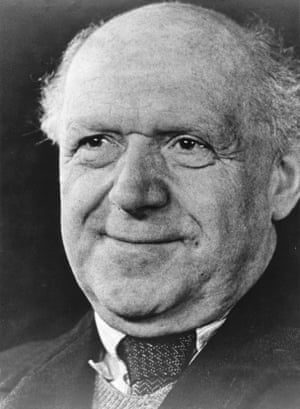
Otto Neurath-1945


Otto Neurath in 1945. Photograph: Otto and Marie Neurath Isotype Collection, University of Reading

Ten years later, despite building new council estates, Bilston still led the way in Britain for all the wrong reasons. A 1943 civic survey found that 1,400 tons of smoke particles per square mile were falling on Bilston each year, which local historian Frank Sharman colourfully suggests is “roughly the weight of 11 blue whales or 233 elephants per annum”.


According to Sharman, a national survey of housing conditions assessed the number of families in each local authority area who were living in “overcrowded conditions”. “The figure for England and Wales as whole was 3.8%. In Bilston it was 13.7%.” A later civic survey, just before the end of the war, found that of 7,771 houses in Bilston, 2,655 were unfit for human habitation.


Bilston, then, needed thousands more new houses for slum dwellers – and one of the prime sites for building those new council houses was land in the north-west of the borough. Today Stowlawn is green and pleasant, an estate of whitewashed houses, verdant verges and bucolic trees. But in the late 1940s, it was land which had been plundered for coal and road stone and then abandoned. “It was not exactly a greenfield site,” says Sharman. “Even calling it ‘brownfield’ would have been a bit optimistic.”


Neurath made us feel that the pursuit of beauty and happiness could be achieved by the common man


AV Williams


This plan to rebuild Bilston and rehouse its slum dwellers was fairly well advanced when in early 1945, Bilston’s town clerk, AV Williams, had an epiphany in Wolverhampton. He was there to attend a lecture given to the International Friendship League; the speaker was Otto Neurath, and his subject was “Housing in Vienna”.


Williams was impressed by the socialist philosopher’s humane vision: “He made one believe in the dignity of human beings.” Soon after, Neurath was invited to Bilston to see the nature of its housing problem and help eradicate it. “He made us feel that the pursuit of beauty and happiness could be achieved by the common man,” Williams explained.


Neurath believed that the common man – and woman – could and should have a role in designing their own homes. It was a perspective he had become committed to in the aftermath of the first world war in Austria, when he helped revolutionise working-class housing in the era of Red Vienna – the nickname of the capital between 1918 and 1934 when, following the collapse of the Habsburg Empire, its city government was ruled by social democrats.


It was a time and place when acute housing shortages had led to conditions of inhuman squalor – conditions, it’s not fanciful to argue, that applied to inter-war Bilston too.


During this time, Vienna became a crucible for communal living. Architecturally, the era is synonymous with vast apartment blocks such as the Karl Marx Hof and the Rabenhof, featuring communal facilities ranging from bathhouses, laundries, kindergartens, libraries and even kitchens.


Neurath was gaining fame at the time as a member of the Vienna Circle of “logical positivist” philosophers, and for developing the pictographic language isotype, one designed to help grasp by means of pictures complex information.


He was an unusual socialist, improbably influenced by Samuel Smiles, the Scottish Victorian reformer whose 1859 book Self-Help appealed to Neurath’s sensibility. Smiles had argued that poverty was caused largely by irresponsible habits and that human progress, perhaps even happiness, would come from the poor being given what Smiles called “the means of education, and of exerting freely all the powers of his godlike nature” .


The Stowlan estate


The Stowlawn estate is more green than black today, but are its people happy? Photograph: Neil Jeffries

This philosophy – the Christian sense of mission notwithstanding – inspired Neurath. He thought happiness could be achieved if workers could be educated on the principles of house design and communal living, and then be involved in the creation of their living spaces rather than having it inflicted on them from above – and he tried to put these ideas into practice in Vienna.


Shortly before this Jewish thinker was compelled to emigrate as Austrian fascists came to power in 1934, he saw the opening of the Werkbundsliedung, an estate of 70 houses in south-west Vienna that, as Dr Sabrina Rahman, co-curator of a recent exhibition called Bilston’s Happy Housing explains, “offered working-class families the opportunity to purchase or rent homes designed by a diverse group of 31 international architects”.


According to Rahman, “the Werkbundsiedlung remains one of the most important estates in modern architecture”. And the hope was Neurath could realise something similar in England’s Black Country.


Before Neurath came to Bilston, British architect Sir Charles Reilly was already sketching plans for Stowlawn estate, using ideas the Viennese would have found sympathetic, if a little more patrician. As Frank Sharman points out: “The chief feature of Reilly’s plans was that the houses should be built around greens, somewhat in the style of a village green, which Reilly seems to have seen as an archetype of a good community. And on each of these greens there would be a club, containing library, reading rooms, billiards room and catering facilities – to which families could go to eat or from which they could order meals to be delivered.”


These ideas chimed not only with Neurath’s but with the new Labour government’s housing minister Aneurin Bevan’s vision of a New Jerusalem in Britain – of mutually supportive, mixed communities. Bevan wrote in his introduction to the 1949 Housing Act: “We should try to introduce in our modern towns and villages what was always the lovely feature of English and Welsh villages, where the doctor, the grocer, the butcher and the farm labourer all lived in the same street.”


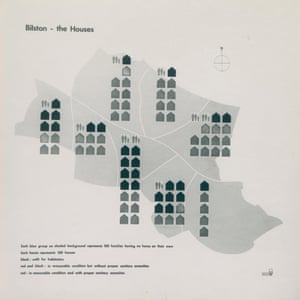
Bilston’s housing: each house represents 100 homes, the black colour are uninhabitable.


Bilston’s housing: each house represents 100 homes, the black houses are uninhabitable. Photograph: Otto and Marie Neurath Isotype Collection, University of Reading

Neurath went further in his philosophy of how Bilston’s new estates could create such communities and make the town happy. Some were noted down by AV Williams from meetings with Neurath at the time, and are cited by Frank Sharman. Even now they seem wonderfully sane and pertinent ideas for how we should – but often don’t – live:


“On estates,” advised Neurath, “mix up individuals: married and unmarried, old and young. Do not create ghettos of, for example, old people who, if they are stuck altogether in flats, will feel isolated, lonely and unwanted. If you put them in with young people, they can do things like babysitting and feel useful and wanted.


Care must be taken to avoid the accidental creation of a lunatic asylum


Otto Neurath


“Unmarried persons can be divided into those who will eventually marry and those who never will. If you put them all into one block of flats, the marrying kind will move out and you will be left with nothing but people who will never marry. Care must be taken to avoid the accidental creation of a lunatic asylum.


“You must study the existing community structure in the slums you are rehousing, and ensure these connections are not broken upon the new estate. Bear in mind that different people had different needs, and do not plan housing on a ‘one size fits all’ basis. You have to work out what sorts of houses and flats to build and who to put in them.”


One big idea Neurath was keen on was an exhibition of the plans for the benefit of those who would be living in these new houses. “You must consult the people who were to be re-housed and educate them on housing matters,” he told Bilston’s town clerk and his colleagues. “You should do this through an exhibition which made the issue understandable by anyone – through the use of isotypes – and that such an exhibition should be somewhere which was accessible to the people who were to be re-housed.” Nowadays, perhaps, this sounds like common sense; in 1945 it was a radical overturning of a patrician social order.


But before Otto Neurath could make Bilston happy, he died unexpectedly aged just 63 in his Oxford home in December 1945. His widow Marie recalled that he was reading a newspaper article about happiness before he passed away, and then commented on what he had read to her.


“What does happiness mean?” he reportedly said. “I can tell you what I mean by happiness. If godfather would come to me and say: ‘Dear Otto, I make you an offer as you are living now with your books and your work and your wife. You can live for ever and ever but you will never be more prosperous than you are now. Will you accept?’ ‘Yes, dear godfather. I gladly accept.’”


After his death, Marie went back to Bilston to fulfil her husband’s happy dream. She set up his planned exhibition in a disused store on Bilston’s Oxford Street, aimed at getting slum dwellers and other ordinary citizens to see what was being planned.


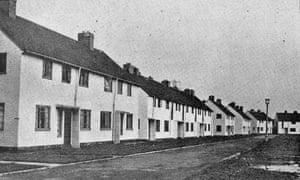
Oaklands Green on the Stowlawn estate, 1950.


Oaklands Green on the Stowlawn estate, 1950. Photograph: City of Wolverhampton archives

The year after Neurath’s death, Ella Briggs, who had worked with Otto in 1920s Vienna, became one of the main architects of the Stowlawn estate. She intended to build eight-house terrace blocks around common greens as her predecessor Reilly had envisaged, keeping designs simple to reduce building costs in the post-war austerity era. Bilston council gave the resultant streets rustic names such as Lawnside, Fairway, and Oaklands – evoking a bucolic mood in much the same way earlier and snootier developments such as Hampstead Garden Suburb did in north London.


‘It is a happy place’


What remains of the original vision for Stowlawn today? When I stroll around the estate, I notice many of the houses remain white-painted, which was unusual for 1940s British council estates and gave this corner of Bilston a continental, crypto-Bauhaus vibe. For a while, Stowlawn was known as the White City.


Stowlawn in 2016 is undeniably peaceful and green, and no doubt a nice place to live, but it’s also a traditional English bodge – a history of compromises, frustrations and muddling through inscribed on every brick, every blade of grass.


I look in vain for the community clubs Reilly envisaged – they were never built. Many of Stowlawn’s greens were replaced with new houses when land was in short supply in the 1960s. Nowadays only Lawnside Green remains, and even it is planted densely with shrubbery and bears a sign saying “No Ball Games” – which, I suspect, Neurath would have frowned at.


Much of the original vision for the estate got dismissed by central government or obliterated by later developments, argues Frank Sharman. He then points out a particularly poignant irony in Stowlawn’s evolution.


In 1979, Margaret Thatcher was elected prime minister, and soon after embarked on a sell-off of Britain’s council estates, as part of her policy of reducing the public sector and giving the market free reign. Sharman notes that she used to hand out copies of the Viennese economist Friedrich Hayek’s The Road to Serfdom which, she said, set out her economic vision – one of minimal state intervention and negligible public ownership.


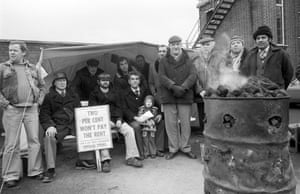
Bilston Steel workers striking for better wages in January 1980.


Bilston Steel workers striking for better wages in January 1980. Photograph: David Bagnall/REX

“Such ideas were, of course, anathema to Otto Neurath, who had spent much time advocating the necessity of government regulation of the free market and a degree of central planning,” writes Sharman in his superb history of the Stowlawn estate. “In fact, it seems that Hayek’s book had been written with the specific intention of refuting Neurath. And on Stowlawn the game played out – the planned community lost out to the forces of the unbridled free market.”


Did Bilston ever get happy? Well, one thing worth saying is that it was never quite as unremittingly miserable as Fenner Brockway portrayed it. My late mother went to Bilston Girls’ High School, on the southern edge of Stownlawn while the estate was being built in the late 1940s. It was a neo-Queen Anne-style building that had opened in 1929 and is now converted into luxury flats. That school, perhaps, was emblematic of the more genteel Bilston that existed alongside apocalyptic slums and industrial hell.


And my late father used to work at Quasi-Arc, the British Oxygen Corporation’s electrical welding division, in Bilston in the 1960s. That business, like many other of the Black Country’s heavy industries, is long gone. It wasn’t just the Thatcherite sell-off of council houses that changed Bilston; it was also her ideological commitment to destroying the industries that toxically thrived here.


In 1979, emblematically, the year Thatcher was elected was the year the final steel cast was made at the Elisabeth furnace at Bilston’s Spring Vale steelworks. The entrancing flames from that furnace, that I used to savour as they lit the Black Country at night from my nan’s back step in Wednesbury, were gone forever. Never such squalor, nor such grandeur, again.


Bilston, town of furnaces, flames and inhumane squalor, once looked like Mordor; now it’s more like Hobbiton.


Happy BilstonStowlan Estate, Bilston


No ball games allowed in the Stowlawn estate. Photograph: Neil Jeffries

These days, I reflect, as I walk from Stowlawn back to the tram stop to take me to Birmingham, I’ll bet the smoke particles falling on Bilston amount to rather fewer than 233 elephants per annum. This is, in many ways, not so much the Black Country as the Green Country. Bilston, town of furnaces, flames and inhumane squalor, once looked like Mordor; now it’s more like Hobbiton.


Otto Neurath may not have succeeded in making Bilston happy, and the ideas he set out may only have been realised in botched form – and even then diluted further. But perhaps it got there anyway. His vision of encouraging people to participate in the creation of a happier Bilston didn’t die with him.


Online, there’s a fascinating interview from 1975 with a Bilston town planner on local news programme ATV Today. With a superbly straight face, this nameless civic champion suggests putting tin foil over the gasometer so that it interestingly refracts the sunlight, pumping out coloured smoke rings from disused factory chimneys, covering an abandoned gantry with wire netting to make the Black Country’s biggest aviary, transforming the abandoned railway line into a green corridor complete with picnic areas, fishing holes and cycle paths. It’s not just Viennese philosophers who have visionary ideas for urban living.


Related: Story of cities #34: the struggle for the soul of Milton Keynes


Better yet, the interviewee invites town citizens to submit their own ideas to make Bilston beautiful. Otto Neurath would surely have liked that: anything to get locals involved in planning the circumstances of their own happiness.


True, Neurath’s vision of cities composed of mutually supportive, mixed communities, living together in harmony isn’t exactly voguish in our era of gated communities, sheltered accommodation, streets too dangerous for kids to play in. But it would be a fool or a snob who said Bilston isn’t a happy place.


“I’ve lived here all my life and I want my daughter to be as happy here as I’ve been,” says the young mother outside the pub which, I belatedly notice, is called The Happy Wanderer. “It is a happy place.”


Stuart Jeffries’s book Grand Hotel Abyss: The Lives of the Frankfurt School will be published by Verso in September


Follow Guardian Cities on Twitter and Facebook and join the discussion


Bilston"s revival: the pursuit of happiness in a Black Country town

25 Nisan 2014 Cuma

How one particular Ghanaian town sprayed away 74% of malaria situations in two years

Ghanaian fans

This Planet Malaria Day, management programmes across the planet are reflecting on how far they have come. Photograph: Joe Klamar/AFP/Getty Images


In the Obuasi area of Ghana, personal sector investment in tackling malaria has led to substantial enterprise and community positive aspects, with drastic reductions in malaria prevalence.


Obuasi is the website of a big gold mine owned by the firm AngloGold Ashanti. In 2004, the business noticed that its workforce had been suffering substantial amounts of malaria, which means that a lot of of them were off sick at any one particular time. This was clearly possessing an effect on its enterprise.


AngloGold Ashanti set out to tackle this with a complete programme that encompassed malaria prevention and remedy and featured indoor residual spraying as a major form of prevention. It is a comprehensive strategy of malaria handle that the company now refers to as the Obuasi model.


“We had a purpose of obtaining a 50% reduction [in malaria prevalence] inside of two many years,” says Sylvester Segbaya, programme director for AngloGold Ashanti malaria control. “Within two many years, we really had a 74% reduction.”


Although the Edwin Cade hospital in Obuasi noticed six,711 instances of malaria in 2005, the figure was down to 973 by 2009. In late 2013, it was just 238.


The Globe Wellness Organisation recommends indoor spraying with residual insecticide (IRS) as a important method of preventing malaria. It is “… a powerful way to quickly decrease malaria transmission. Its complete possible is realised when at least 80% of houses in targeted places are sprayed,” it says.


This was the situation in Obuasi, where the spraying of mines, surrounding buildings, houses and then complete districts have meant that there are just fewer mosquitoes that can spread malaria. This is benefiting all parts of the local community, not just miners. Individuals are paying significantly less on malaria treatment, children are much more most likely to be healthier and attending school and below-5s are much less likely to die of the condition.


This kind of a big programme could not be carried out by a personal firm alone. Partnerships with the public sector were key from the begin. The programme was set up in collaboration with Ghana’s ministry of health, which created typical reports to the Nationwide Malaria Management Programme.


This worked so effectively that in 2011 the Global Fund granted $ 130m (£77m) to the firm to carry out this work in partnership with government and public sector bodies. The thought was to spread this work to other elements of Ghana. As of April 2014, 22 districts of Ghana have been treated. This will increase to forty districts by the finish of 2015 and will focus on the north of Ghana, exactly where the malaria burden is greatest.


The work also involves training regional individuals to carry out the residual spraying and to get involvement from all locations of the local community. However IRS has been criticised by some for exposing men and women to insecticide, Segbaya says that wellness concerns are often taken into consideration. Rooms employed by people with asthma or allergies are not sprayed and there is the extra benefit that other pests, such as cockroaches and bed bugs, are destroyed.


So why regardless of this good results has indoor residual spraying been so little used in comparison to the mass distribution of bed nets? Since it has to be carried out comprehensively in a particular area in purchase to be powerful, and this can be both technically demanding and comparatively expensive.


“With bed nets, all you do is distribute them,” says Segbaya. “With indoor residual spraying you have to employ people, train them in managing the pump, mixing insecticide, managing people’s property, all of which need much more ability.”


Another element is the cost – a net to shield 1 or two people fees £2-3. “Presently it fees around $ 400,000 (£238,000) to spray one particular district, which is possibly $ 10-15 (£6-9) per person. This is nearly three occasions the cost of offering bed nets.”


These figures might not be right away eye-catching to donors, and cannot be borne by the public sector alone. Even so, the private sector may be better ready to assistance these charges, specifically when measuring them against enhanced productivity.


Trevor Keel is head of technological innovation at the Globe Gold Council, the industry improvement organisation for the gold mining sector. Many of its members – huge gold mines – operate some variety of local community well being programme to assistance their workforce and the surrounding communities.


“Our interest initially stemmed from the reality that gold is utilized in the rapid diagnostic tests that are now the most frequent way of diagnosing malaria,” says Keel. So safeguarding the miners and their communities from malaria appeared logical. “This is a fantastic instance of what the personal sector should be undertaking,” he adds.


AngloGold Ashanti – which also operates in Mali, Tanzania and Guinea – is now starting similar programmes in its other mines.


Join the neighborhood of global improvement experts and professionals. Become a GDPN member to get much more stories like this direct to your inbox


How one particular Ghanaian town sprayed away 74% of malaria situations in two years

30 Ocak 2014 Perşembe

Britain"s obesity epidemic linked to negative town planning, RIBA says

Leeds and Bristol have been the healthiest areas.


Seeking at diabetes all round, the least healthful locations in England’s cities had twice the housing density and a quarter significantly less green space than the most healthy areas.


Meanwhile for childhood obesity, green room was 44.7% in the worst cities although the percentage of land occupied by housing was 6.8%.


In comparison, the five local authorities outdoors London with the lowest prices of childhood obesity had been 71.4% green room and only three.1% housing.


Anna Scott-Marshall, head of external affairs at RIBA, warned: “The way we layout and program out cities can have an fast result on the weight problems crisis and how healthier we are.”


Investigation demonstrates one in eleven early deaths could be averted every single year if everybody exercised for the suggested 30 minutes five occasions a week.


Of the 59 per cent of people in Britain’s key cities not receiving this physical exercise 75 per cent explained that they could be encouraged to do much more in a far better environment, according to the YouGov poll carried out on behalf of RIBA.


Individuals have been most very likely to be encouraged by good quality above amount, with security and aesthetics deemed significantly crucial than a direct route or an enhance in the number of parks, the survey located.


Consequently, by designing areas people want to use developers could encourage workout and minimize weight problems and associated overall health troubles, like diabetes, the report concluded.


Division for Transport data present that walking has dropped 27% in the last 15 years.


Stephen Hodder, RIBA President, explained: “At a time of austerity and enhanced concern with bodily and mental effectively-becoming, it is surprising to find out that just by creating public wellness a priority when planning cities, we can conserve the country upwards of £1bn yearly though reduced weight problems-related health care charges.


He named for “planners and developers to get the lead and make certain more healthy cities.”


RIBA are calling on regional authorities, who took above obligation for public wellness last 12 months, to integrate policies with people for planning.


Britain"s obesity epidemic linked to negative town planning, RIBA says