scared etiketine sahip kayıtlar gösteriliyor. Tüm kayıtları göster

31 Mart 2017 Cuma

How mental health problems affect relationships: "They"re scared that this time you might die"

Anonymous
Last night I had a dream about my eldest son who’s just turned 11. Because of my mental illness, I have not been able to speak to or see my three boys for eight months now. In the dream I’m hangin’ with my eldest, shooting the breeze as we’ve done many a time, but this time I notice a difference; his voice has broken, and with this realisation my heart broke, too.


This dream is analogous of all those golden moments of childhood I have missed in their lives, that can never be relived, moments that seem even more precious when it comes to my eldest, as he rapidly approaches adolescence. The dream also feels analogous of everything I’ve lost as a result of mental illness; my marriage, career, liberty (sectioned twice), self-respect and societal approval.


What really frightens me about my mental illness is the way it suddenly grabs me and leads me to do things that I, when feeling stable, just would never want to do. Like right now I love my boys and mum so much I cannot believe I’d want to never see them again and devastate them through taking my own life. Yet out of the corner of my eye, I can see the omnipresent scar on my left wrist that is a constant reminder of how my mental health can construct a vast distance between me and my values.


Anonymous, 21
I have bipolar disorder, a highly stigmatised diagnosis. One of the hardest things to deal with is knowing you’re hurting people around you. After taking an overdose, lying in A&E with someone who loves you and feeling the guilt and horror of what you’ve done. They’re scared that this time you might die, but the urge was so strong you couldn’t stop yourself from doing it. Even when you know you are loved, you still wish to die. I have an illness. I wrote this poem in art therapy.


Today you are possible of great things,


Things of beauty, of purpose and of wonder.


Your voice is of importance, your body is of splendour.


Today you are tasked with only being fair to yourself and your soul, and to be fair to yourself and your soul is to be kind.


Kindness is all that you deserve.


Today you are you, and that is a magical thing, no one else will ever be you.


You are strong, you are mesmerising, you are intelligent, you are divine.


Today you are loved, as you should be, and as you always will be.


Anonymous
Go me: a poem about mental health, from a mother’s perspective


I am the world’s greatest mum


My teenage daughter is perfect


Good grades, no shouting, no drinking, no boys, no worries


I’m expert at giving lifts, coordinating activities, supporting vegetarianism, saying no to piercings, organising cultural excursions and understanding UCAS points


I’ve got this covered. Go me!


I am the world’s most understanding mum


I can support this exam stress


Distant, withdrawn, eating less, sleeping more, staying in


I am an expert at finding French tutors, arranging extra physics, breathing exercises, pep talks and staying positive


One of life’s challenges. Go me!


I am the world’s most bewildered mum


I don’t know why this is happening


School dropout, counselling, anger, a handful of pills, some minor cuts


I am expert at managing panic attacks, investigating colleges, negotiating the NHS and weird piercings


But I’m up for this. Go me!


I am the world’s most exhausted mum


I love her to death


Major overdose, psychiatrist, cardiac ward, cutting, minor overdose, more cutting


I am expert at bandaging cuts, hiding razor blades, 999 calls, police statements, social services, riding in ambulances, fighting for support, staying up all night, dispensing pills


But we’re still here and stronger. So go us


Helen, Manchester, 35
Fourteen years ago, I found my flatmate (and close friend) almost unconscious, with an empty bottle of pills next to her bed. I got her to the hospital. I stayed all night, until she was released in the morning. It was horrible. What came next was worse. At the hospital I asked the doctor what I should do the next day. He drew a blank. My other flatmate and I had no idea how to react. We were angry, we blamed her, we thought she was selfish. We treated her like a stranger. I went to my GP, who suggested we focus on ourselves because finals were coming up. Within a week, we just left her – went to our respective homes to study, claiming that we needed peace and quiet away from university.


I’ve never forgiven myself for that response, or forgotten how awful it was when she quietly confronted me about lying to her. In the end we both apologised, cried a lot, and made peace. It took me a few years, though, to fully accept that she wasn’t selfish or to blame. I hope that today’s 21-year-olds already know that, and that their doctors are giving better advice. By removing the stigma around mental health, and by educating people in how to support their friends and family, perhaps we can prevent other people being judged and abandoned.


Anonymous, early 40s
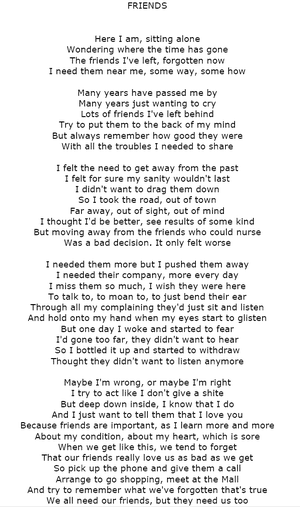


A poem dedicated to friends past, hopefully to return.


A poem dedicated to old friends, hopefully to return.

In the UK, the Samaritans can be contacted on 116 123.
In the US, the National Suicide Prevention Hotline is 1-800-273-8255.
In Australia, the crisis support service Lifeline is on 13 11 14.


How mental health problems affect relationships: "They"re scared that this time you might die"

11 Ağustos 2016 Perşembe

When I leave someone suicidal I"m scared they won"t be there the next day

Leaving a suicidal man in the hands of colleagues was hard


During my eight years in social care, I have struggled, like everyone in support roles, with the dreaded fear. It’s a fear that finds you not just at work but on your lunch break, during the commute, in the bath … everywhere. I recently supported a young man in his early twenties who has a long history of mental health problems and was alcohol dependent. It was the anniversary of a bereavement, and he was intoxicated, self-harming and suicidal so I spent hours with him calming him down and putting plans in place. I stayed late – you do in this role, it’s not 9 to 5 – but the time came when I needed to hand over to my colleague.


You have to trust your team when you leave someone like that. But then you leave after having been in an intense crisis situation and you close the door behind you and you’re in the street with people just walking their dogs, doing normal things. You go home thinking over everything you did and wondering what you’ll be told when you go back the next morning.


Senior support worker, Sussex


Related: Silence your phone and let go of guilt: 10 tips to improve your wellbeing at work


I worry when people with mental health problems are in crisis and have no support


Time constraints and a demanding caseload mean that at times I feel I’m just putting a sticking plaster on situations as we’re expected to work fast from assessment until discharge. I worry about the individuals that fall through the net. IAPT services appear to cherry pick those with low level support needs that will provide them with the best outcomes This leaves those with more substantial needs who have suicidal thoughts, or dual diagnosis unable to access counselling or cognitive behavioural therapy. I worry that genuine care for people seems to be missing from the service; my colleagues have judgmental attitudes and a lack of empathy. When I’m not there, I fear that people won’t be visited unless they hit a crisis. Even then, I worry about the lack of support from the crisis team. We’re meant to take people to A&E, which is a waste of NHS money. They often refuse to help so the police are called, who can’t help. All they need is some additional daily home treatment to get them through it.


Mental health social worker, Lancashire


Who looks after older people with advanced dementia?


In the past I’ve worried about the people we’ve looked after who were incapable of being alone because they had advanced dementia. One would walk around outside in the middle of the night, claiming they had been kidnapped and needed to get home. The police wanted to detain another under the Mental Health Act but the doctor refused. We have also reported numerous instances of service users being abused physically, emotionally, financially and sexually, only to be told by the relevant authorities they were private matters between husband and wife. Not enough is done to protect people. That is until it is the carers at fault and then people are up in arms about it.


Community team leader for a home care agency, North Devon


I was held at knife point by a five-year-old, but being taken off the case just made me worry about the family more


I worry about not having sufficient time to spend with families to really make a difference. My time is so thinly spread that I’m having a mediocre impact at best. I fear for families that are offered support but, due to caseloads and lack of funds, this doesn’t come to fruition.


One family sticks out in my memory. The dad was disabled, the mum was attending IT courses to help her get back to work and they had three children under seven, the oldest of whom had significant behavioural problems. The family felt like they had been passed from pillar to post and that the health team, school and social care were letting them down.


I have been held at knife point on two occasions while working and one of the incidents was in this family’s home. It was the normally well behaved middle child, aged five, who held the knife to my head while I was trying to help the older one. The parents were devastated and called the police themselves but no further intervention was offered. I was pulled out of working with them and it was stepped up to a social worker who didn’t know their history. The family had to retell the story, which must have been frustrating considering that the eldest child took a good year to put her trust in me.


Family support worker, east Midlands


Related: Social work is a high-stress job – support from peers is invaluable


We are humans, making human decisions. What if that decision is wrong?


You can’t always be there to make sure everyone is OK. Leaving work when someone is sick, substance affected or suicidal makes you fearful. I worked with a young woman who had experienced a lot of trauma and struggled with mental health issues. One afternoon she said she was having hallucinations and was concerned she may harm someone as a result. I took her to A&E and stayed three hours late with her. You try to make a difference in the social care sector, but there are always worries, especially given that we are humans, making human decisions. What if that decision is wrong? You often second guess yourself and wonder: “What if I had done that differently?”


Resident support worker, east Sussex


I hate not being able to make a difference when it really matters


I worry about children getting stuck in one part of the system and missing out on support that would make a difference. I was working with a 13-year-old girl last year at risk of child sexual exploitation who was recommended a different care plan to what she needed. Within a few months it was discovered that the girl had been groomed by an adult offender on the internet and he was arrested. Only then was she moved to the appropriate child protection plan.


Senior family support worker, Surrey


If you are experiencing suicidal thoughts, the Samaritans can be contacted on 116 123 in the UK. In the US, the National Suicide Prevention Hotline is 1-800-273-8255. In Australia, the crisis support service Lifeline is on 13 11 14. Hotlines in other countries can be found here.


Join the Social Care Network to read more pieces like this. Follow us on Twitter (@GdnSocialCare) and like us on Facebook to keep up with the latest social care news and views.


When I leave someone suicidal I"m scared they won"t be there the next day