poorest etiketine sahip kayıtlar gösteriliyor. Tüm kayıtları göster

11 Nisan 2017 Salı

Asylum seekers and the poorest parts of the UK are being let down | Letters

“Most refugees sent to the poorest parts of the UK” (Front page headline, 10 April). Here are suggested headlines for the remainder of the week: “Lowest life expectancy in the poorest parts of the UK”; “Proportionately highest levels of indirect taxation…”; “Worst maintained private and public housing…”; “Highest levels of prescription drugs…”; “Highest attendance at A&E departments…”; “Least investment in schools…”; “Highest number incarcerated…”; and more.


Condescending notions such as “responsibilisation” are used to deflect the political, economic, structural dynamics and suffering of poverty. Zero-hours contracts are recast as “flexible and adaptive working”; low-waged health support workers are declined travel time; part-time contracts without holiday pay or security underpin; essential services are cut to the bone. The list is endless.


On estates of poverty-induced resentment, the comparatively few refugees and asylum seekers entering Britain are warehoused and managed by private, profit-driven companies with, at best, questionable track records – G4S and Serco to name but two. The lack of coherent, integrated, humanitarian policies and interventions is the outworking of inadequately funded public authorities, reflecting a cynical and divisive betrayal by central government of those most in need, whether citizens, refugees or asylum seekers.
Professor Phil Scraton
School of Law, Queen’s University, Belfast


I was saddened but not surprised by your front page. An asylum seeker living with me has told me how he was initially sent to a hostel in Manchester after his arrival in Kent, but when he put in his asylum application, he was transferred to a house in a remote suburb of Liverpool. Unable to afford public transport, he had to walk for an hour or more to shops or to meet people: “it was like being in prison,” he says.


The charities I have been in contact with tell me there are enough potential hosts to house all the asylum seekers they are dealing with, but they lack the resources to assess their suitability. Why can’t the government work with these charities to enable more asylum seekers to be housed with people who are keen to help them learn English and find out more about life in the UK?
Cary Bazalgette
London


Yvette Cooper and the home affairs select committee are absolutely right to criticise the government’s policy on asylum seekers, and in particular its reliance on private sector providers of accommodation. In Newcastle some years ago, one such provider housed Iranian and Iraqi refugees in the same premises. More recently, the change from the provision of accommodation and support by Your Homes Newcastle (a public sector body leading management of the issue in the north-east) to G4S and its subcontractor Jomast, coupled with a reduction in funding, has effectively led to the disappearance of support services.


Treating the issue as a matter of housing alone is unsatisfactory, both for the asylum seekers and refugees and for the other residents of what tend to be the most disadvantaged areas of towns and cities in the least prosperous parts of the country.
Jeremy Beecham
Labour, House of Lords


Your front page says the home affairs select committee is calling for changes to the “appalling” system of sending these hapless people to the poorest parts of the country. Since government policy for their dispersal has been framed around the inability and unwillingness of local councils to provide education, health and other services for them, the outcome of location in impoverished ghettoes is inevitable. These same blanket policies mean that private hospitality, widely and generously offered, is effectively prevented from being taken up. Thus a Kindertransport scheme was made impossible.


Keith Vaz, as its previous chairman, presided over a select committee on the Shaw report, which highlighted many of the shortcomings in government policy but was kicked into the long grass.


The Home Office claims the UK has a proud history of granting asylum to those who need our protection. We now seem to be at the end of history.
Tommy Gee
Wingfield, Suffolk


Zoe Stewart (Passport checks for patients is an abandonment of NHS principles, theguardian.com, 7 April) is right to say that health tourism costs the NHS a relatively small amount (0.3% of a £130bn annual budget or some £330m). That is still the cost of a new hospital, so not insignificant, but she misses the bigger issue entirely.


The NHS, social housing and all of our public infrastructure were built by previous generations, out of their taxes, with an expectation that not only they but their descendants would benefit. The reason that “health tourism” sticks in the craw is that it breaks the implicit promise of “social goods” being passed on from generation to generation. People do have a sense of ownership over great public enterprises, and with that there is resentment of newcomers who are perceived as not having contributed to the development of the “common weal”, and who are then perceived as taking their jobs, houses and healthcare.


Proclaiming the “universality” of rights or benefits, while attractive as a principle, only really works in stable, homogenous societies. Immigration, of any variety, can dent that sense of communal solidarity, and hence “cracking down on health tourism”, an important though relatively minor financial amelioration, has a wider and justifiable significance.
Simon Diggins
Rickmansworth, Hertfordshire


Join the debate – email guardian.letters@theguardian.com


Read more Guardian letters – click here to visit gu.com/letters


Asylum seekers and the poorest parts of the UK are being let down | Letters

28 Mart 2017 Salı

The poorest will lose out from prescription cuts

The Conservative government is once again aiming to take more from the poor (GPs ordered to stop prescribing some drugs to save cash, 28 March). These treatments will effectively be removed from those currently entitled to free prescriptions (eg recipients of income support or pension guaranteed credit, those having a long-term disability, holding a valid medical exemption certificate or maternity exemption certificate). Doctors have long been advising those who pay for their prescription to buy these over-the-counter medicines at retail price, rather than pay the £8.40 prescription charge. Nothing changes here; it is those who cannot otherwise afford these medicines who will go without.
Aidan Shanks
Eastry, Kent


Join the debate – email guardian.letters@theguardian.com


Read more Guardian letters – click here to visit gu.com/letters


The poorest will lose out from prescription cuts

27 Şubat 2017 Pazartesi

Death-trap toilets: the hidden dangers of Mumbai"s poorest slums

On the morning of 4 February, Harish Tikedar, Ganesh Soni, and Mohammed Isafil Ansari waited in a queue to use the community toilet in the Indira Nagar slum in eastern Mumbai. All of a sudden the floor collapsed, plunging Tikedar, Soni and Ansari into the septic tank 15-feet below.


Two others who also fell – Sirajjudin Turat and Ramakant Kanojia – managed to hold on to the sides until they were rescued.


“I was submerged up to my shoulders in the slush,” says Turat. “I could feel it pulling me down but somehow held on to a slab. Then some people pulled me up and I passed out.”


The five men who were pulled out were unrecognisable, covered in faeces. They were all taken to a nearby hospital but Tikedar, Soni and Ansari did not survive.


In Mumbai’s slums, the simple act of relieving oneself is fraught with danger, especially in the slums of M-East ward where population density is high, and the few public amenities are crumbling.


M-East is the poorest and most deficient in civic services of Mumbai’s 24 administrative wards. It has expanded over the last 15 years but has remained on the periphery of the city’s consciousness and governance systems. The differences between the civic amenities available in the smattering of middle-class apartment blocks and the slums, which dominate M-East, are stark.


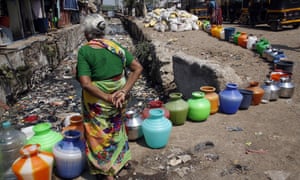
An elderly woman waits to fill pots for filling drinking water at a slum area in Mumbai.


The majority of slum residents are forced to depend on the thriving informal market for water, operated by a network of local strongmen. Photograph: Rajanish Kakade/AP

Most of the 100 square feet slum houses do not have sanitation and water facilities, either because applications for individual toilets and taps are pending approval or because the slum is on encroached land, which means that the civic body will not provide any services there.


For sanitation, people in Mumbai pay two to three rupees (£0.02-0.04) to use a community toilet, which generate revenues of 3.6bn rupees (£47m) a year, according to a recent report by the Observer Research Foundation. The poorest of the poor pay more than 10m rupees (£120,000) per day for the most basic necessity, yet the facilities are rarely maintained despite complaints.


If it wants, the Brihanmumbai Municipal Corporation can find a way to provide basic rights


Rais Shaikh


Some 78% of community toilets in Mumbai’s slums lack water supply, 58% have no electricity, and many don’t have proper doors or facilities for women to dispose of sanitary napkins. The statistics are worse in M-East.


“The chief minister [of Maharashtra] should order a structural audit of all community and public toilets. All those found deficient must be demolished and reconstructed,” says Dhaval Desai, author of the Observer Research Foundation report. “The long-term solution is to allow slum dwellers to construct individual toilets inside their houses. About 83% of the people we interviewed said they would spend the money, but the BMC [Brihanmumbai Municipal Corporation] denies permission on technical grounds.” Most of the slums appeared after 2005, which makes them illegal.


“That slums post-2005 are not given water is a sham,” says Rais Shaikh an elected representative to the BMC from M-East, and leader of the Samajwadi party. “All of them get water; by what means is an open secret. If it wants, the BMC can find a way to provide basic rights.”


The majority of slum residents are forced to depend on the thriving informal market, operated by a network of local strongmen that supplies water through tankers and via the unfinished pipe system laid by the civic body. The cost depends on demand and supply, from as high as 40 rupees (£0.48) to as low as five rupees (£0.06 ) for a 40-litre can. When the municipal corporation imposes water cuts in the summer, the cost rises considerably.


Where there is a gap in sanitation services, NGOs step in to construct community toilets, or local MLAs (member of legislative assembly) and MPs contribute money from area development funds. A coterie of contractors usually takes up the construction and management of these community toilets. But they have no accountability to either the BMC or residents, and repeated complaints about sinking floors and full septic tanks go unheeded.


After an incident, the MLA or MP comes visiting, often with a cheque. We know life is cheap in Mumbai, but so cheap?


Razzaq Shaikh


The community toilet that collapsed in the Indira Nagar slum was only 10 years old and was built using the local MLA’s area development fund. The contractor was arrested and booked under the Indian Penal Code on charges including culpable homicide not amounting to murder, but he was eventually set free. He was not available for comment.


The accident is not an isolated one. Across Mumbai, seven people have died and one was left disabled in similar incidents in the last three months.


“There must be guidelines that the BMC enforces for construction, otherwise this kind of death will become routine,” says Razzaq Shaikh, who helped rescue the two survivors. “After an incident, the MLA or MP comes visiting, often with a cheque. But what’s the point? We know life is cheap in Mumbai, but so cheap?”


The benchmark for toilets, adopted as part of India’s Swachh Bharat Abhiyaan [Clean India Mission], is one toilet for 25 women or 30 men. In M-East, however, the average is one toilet per 190 people, according to surveys by the Tata Institute of Social Sciences.


“The availability of toilets and tap water is so abysmal that the Swachh Bharat Abhiyaan is laughable,” says Amita Bhide, dean of the institute’s School of Habitat Studies and head of its M-East ward project. “The state and the BMC has to intervene and be innovative, not sit on applications for individual toilets because there aren’t sewer lines to link to.”


Regular water supply is also a perennial election promise, but despite politician’s campaigning, nothing seems to change in Mumbai’s poorest slums.


“All political parties come here using the water issue as their trump card,” says Syed Lateef. “All of them say that when they come to power, water issues will be resolved. Water pipes have been installed and reinstalled, but we don’t get water. We buy it.”


Additional reporting by Suryasarathi Bhattacharya and Jovita Aranha.


A version of this article first appeared on scroll.in and has been republished with permission. Follow the author @urjourno and @scroll_in on Twitter.


Join our community of development professionals and humanitarians. Follow @GuardianGDP on Twitter, and have your say on issues around water in development using #H2Oideas.


Death-trap toilets: the hidden dangers of Mumbai"s poorest slums

10 Şubat 2017 Cuma

Roving clinics tackle TB among Myanmar"s poorest people – in pictures

Tuberculosis is among the leading causes of death for people aged 15-49 in Myanmar, but the cost of reaching a hospital for a diagnostic X-ray is often prohibitive for those in isolated communities. A scheme that sends mobile teams out to test and give medication is helping people get much needed treatment


All photographs by John Rae/UN Office for Project Services


Roving clinics tackle TB among Myanmar"s poorest people – in pictures

13 Mayıs 2014 Salı

Tunisia"s poorest towns left to shoulder burden of hazardous toxic landfill web sites | Simon Speakman Cordall

MDG : Landfill in Tunisia : Dumping garbage in Le Kef

A refuse dump in Tunisia. The overall health implications of this kind of web sites, which frequently incorporate chemical waste, have raised issues. Photograph: Jeremy Graham/Alamy


Salah Darghouth’s aggravation is visible. “You see that man working on the ninth floor,” says the adviser to Tunisia’s sustainable growth ministry, pointing at a labourer on the half-constructed tower block opposite. “He harasses me. Every single day I observe him and all the other individuals throw their refuse on to the street below – concrete, litter, every little thing.”


Across Tunisia, with the dust of revolution beginning to settle, refuse looms large in the public conversation. Litter, especially plastic bags, has come to dominate the country’s famously dramatic landscape. The problem is felt by all citizens, but none encounter it more acutely than these living up coming to the straining landfill websites.


Ridha Trabelsi, 45, a shopkeeper who lives in the modest Tunis suburb of el-Attar, is a case in stage. “Would you like to reside here?” he asks, gesturing in direction of close by Jbel Borj Chakir, Tunisia’s biggest landfill web site and a source of expanding exasperation. “They explained they were going to shut it last year, but they haven’t. It’s nevertheless right here and it is only obtaining larger.”


The influence of landfills on this kind of areas is difficult to overstate. In 2011, right after the Jasmine revolution, it was the landfill websites at Djerba, Enkhila (near Nabeul), Oued Laya (close to Sousse), Agareb (near Sfax), and the country’s only hazardous waste-treatment plant, at Jradou, that bore the brunt of local residents’ fury.


All had been closed, most of them temporarily, as a end result of violence. Jradou stays shut, and it is unclear where its waste is being handled. Strategies to reopen the Djerba website have triggered far more violence.


In el-Attar, the stench of rubbish chokes the air it sticks in your throat and permeates your clothing. Trabelsi’s son, eight-year-previous Mohamed, is asthmatic. Respiratory sickness is rife.


“When you build a landfill, you create it for a specific time period,” says Morched Garbouj, an environmental engineer and president of the SOS BIAA environmental group. “Right here at Jbel Borj Chakir, that time period ended in 2013. At that level, it need to both have been closed or, at the least, working at about ten% to 20% capacity.”


According to Darghouth, no determination has been taken on the prolonged-phrase potential of Jbel Borj Chakir. “We’re taking delivery of all around two,000 tonnes of waste each and every day. That has to go someplace … We’re just dealing with almost everything on a day-to-day basis even though we perform to implement a bigger strategy.”


“1 of the issues here is that we don’t know what variety of waste we’re dealing with,” says Garbouj. “Elsewhere, waste is separated, here it all will get dumped collectively – chemical, industrial, family and health-related.” Residents and those who make their living scavenging the dump have reported locating blood bags and foetuses in the refuse at Jbel Borj Chakir, a claim denied by Agence Nationale de Gestion des Déchets, which manages waste on behalf of the environment ministry.


“I did not just see them [the diverse types of waste], I dealt with them,” says Kamel Marouani, a former refuse employee. “Chemical, health care, every thing.”


“One of the troubles with all the various types of waste is the leachate it generates [the liquid created at the base by the compressed refuse],” says Garbouj. “Leachate is extremely toxic, so there are stringent controls about how it should be treated and disposed of. Even so, simply because no 1 understands what’s in it, no one understands how it need to be handled.”


Marouani, who was diagnosed with lung cancer in August 2012, worked at Jbel Borj Chakir for 10 years, the previous 5 for a French company, Pizzorno, a single of 3 contractors that handle landfills for the Tunisian government. One particular of his tasks was to work in the 10 leachate basins that surround Jbel Borj Chakir. He was necessary to wade by way of the often chest-high, reeking, black leachate – constructing dams or clearing away the thick foam that forms on the surface of the basin.


SOS BIAA estimates that the value of transporting and disposing of waste at Jbel Borj Chakir was about $ 110-$ 125 (£65-£75) a ton, in contrast with the equivalent cost in New York of $ 86. This was in spite of drastically reduced overheads. Trucks dumping at Jbel Borj Chakir pay Pizzorno $ 15 for every single ton of waste deposited in return for the firm’s experience in managing the web site. Offered that, on an common day, about three,000 tons of waste is deposited, that equates to a day-to-day income stream of $ 45,000. The costs of trucks and labour are billed to the Tunisian government.


In 2011, Pizzorno was the subject of a complaint by the post-Arab spring government’s Commission of Investigation on Corruption and Embezzlement in excess of its dealings with President Zine al-Abidine Ben Ali’s regime. On 15 March, Pizzorno’s five-yr contract with the Tunisian government expired. No choice has been taken on a achievable successor. Pizzorno, which continues to handle the internet site on a caretaker basis, declined to comment on any of the factors raised in this report.


Desta Mebratu, deputy director of the UN Atmosphere Programme’s regional office for Africa, stated: “Disposal in sanitary landfills is the last alternative that need to be deemed … Tunisia is 1 of the 1st African nations that established a national programme on waste minimisation and cleaner production. This programme has led to reduction of a generation of industrial waste and reduction of pollution.”


In el-Attar, minor of this matters. Kids carry on to perform near the landfill website. According to SOS BIAA tests, the local water provide – like all the water inside a 5km radius – continues to be contaminated by fine particles, nitrates and even hefty metals from the dump. Trabelsi seems at the mountain of refuse that dominates the landscape for miles. “We have sick outdated folks. Our youngsters are sick. We can’t continue.”


Tunisia"s poorest towns left to shoulder burden of hazardous toxic landfill web sites | Simon Speakman Cordall