pushed etiketine sahip kayıtlar gösteriliyor. Tüm kayıtları göster

11 Aralık 2016 Pazar

"I felt pushed away": Beth Grant on having to move 380 miles for anorexia treatment

Beth Grant, 25, has been receiving treatment for anorexia on and off since she was 13, including five months in a hospital in Glasgow earlier this year, 380 miles from her home in Hertfordshire.


I was 13 when I was first diagnosed with anorexia. I didn’t have my first stay in hospital until I was in my 20s. Before that I received outpatient treatment, first through children’s and late adults mental health services. I was discharged when I went to university aged 21.


I got support while at university from the university’s counselling services, though I gradually declined while on my course. During the last month of my third year in 2015, I was admitted to the Priory hospital in Chelmsford, Essex, about 45 minutes from my family home near St Albans in Hertfordshire. It was a great place. As you progressed you got more freedoms, for example unsupervised snacks and home visits if you managed to get your Body Mass Index up to 15. That gave many of us something to aim for.


I left having regained a suitable amount of weight but was still not completely healthy. Then in February this year I relapsed after a family bereavement. I was told I couldn’t go back to Chelmsford. It’s my understanding that there are just over 300 beds in the country and there are thousands of people who need help. Chelmsford only has 12-14 beds, was small, intimate and a nice group of people.


I was told that the only place available was in Glasgow, 380 miles and a six-hour drive from my home. I resisted the move at first because I really didn’t want to be that far from home. My family were similarly concerned. The problem was that I needed more help than my parents could offer. I was worried that if I lost any more weight I would end up on a medical ward. I didn’t want to leave, but I felt I had no choice.


My parents were so incensed that I had to go so far away that they refused to drive me up. So the NHS decided to transport me by taxi, which must have cost them over £1,000. After that I didn’t see my family for five weeks. My mum was going through treatment for breast cancer at the time so found it hard to come up. I stayed in Glasgow for the next five months but saw my mum a total of four times.


I felt let down. I felt I had been sent away originally just so people could get rid of me, like I was being pushed aside. During my time in Glasgow, no friends came up to visit. I know it sounds silly, but I felt ashamed about being in an inpatient unit and I didn’t want to tell too many people. The nurses were for the most part OK. Some clearly cared more than others, though they could be dismissive at times and sometimes they would simply ignore you. Staff weren’t as hands-on as they should have been and some of my friends were left for five hours during the day without being checked on. But the daily group programmes were very helpful, such as ‘nutritional education’ and ‘understanding your eating disorder’.


In June this year, I was eventually transferred because I was so homesick and depressed. Knowing I was so ill didn’t help as I blamed myself and believed that I deserved to continue to feel that bad. It felt even worse not to be near my mum and unable to physically support her while she was going through radiotherapy as well. I wasn’t putting on weight and it was decided that it would be better for me to be treated closer to home.


Having an eating disorder is extremely isolating; as a normally sociable person it feels like torture. Being so far from home just made it worse. I absolutely love food so for me anorexia is more of a self-punishment. I was bullied from a young age and withholding food became a way of controlling something in my life. I didn’t deserve food. I am also extremely driven, which is maybe linked to it somehow, although it holds me back.


I’ve been an inpatient at one other place since then, in Ealing in west London, which is not too far from my home. The very strict regime there meant I put on weight, but my mental health was no better. I left two weeks ago. I didn’t want to have to stay there over Christmas and I didn’t like the unbelievably strict, inflexible guidelines. I’m now in treatment through my old outpatient team and see a counsellor twice a week, a dietician and a social worker. Constant support is really important and having someone to talk to, or simply to sit with and be near when you don’t want to be alone, is what you need most when you are this unwell.”


"I felt pushed away": Beth Grant on having to move 380 miles for anorexia treatment

26 Kasım 2016 Cumartesi

I feared my life lacked meaning. Cancer pushed me to find some | Bradford Frost

It was late. I was drunk, nearing my 35th birthday this past May, alone in a dank college dorm room, attending my five-year grad school reunion.


The journal entry I wrote that night was just one line: “I’m not the man I want to be.”


As reunion charades go, nothing about my life actually suggested I was off track. I had ambitious public service aspirations; worked tenaciously; loved fiercely; wrote confidently about equal opportunity and the American dream; bought into and unabashedly endorsed my adopted hometown of Detroit as the best place in the country to work with meaning and purpose. I’d published a book. I’d supported my wife through cancer, relapse, and now four years of remission. I even ran a marathon.


But my journal admission reflected two longstanding personal challenges. First, despite all my accomplishments, I carried a deeply held internal anxiety about being “good enough” to meet my ambitions. Second, I believed my alcohol abuse posed a serious threat to it all. Combined, they exposed my biggest fear: was my life of meaning and purpose as I envisioned it slipping through my fingers? I decided to make a change.


After nearly 20 years of various cycles of alcohol abuse, moderation and abstinence, I concluded I would take one last shot at forging a balanced approach to drinking before turning to sobriety. I’d read about a drug called naltrexone, which is a pill that helps mitigate and manage alcohol cravings and abuse. After sporadically trying it over the prior year, I decided to use it every day for the next three months.


Change came quickly. Two months in, my weekly consumption had cut in half; it would cut in half again by early October. I lost 20 pounds and felt great. In tears, I confided to my wife, “I’ve finally broken through.”


“I’m so proud of you,” my wife replied. “I’m so grateful you found a path that works. Let’s stick with it.”


That was Monday, 10 October. Two days later, I was diagnosed with stage IV kidney cancer. Less than 15% of people with my diagnosis survive five years.


This prompted a swift resolution of my other core challenge: I would no longer allow my anxiety about “living the right way” interfere with being my true self in all dimensions of this life. There would no longer be any distinction between the “representative version” of me online versus living every day with full authenticity. Any other way would be a total waste of time.


I’ve embraced the news as an invitation to be my most honest, vulnerable and wholehearted self. I live every day as fully integrated and courageously as possible. I don’t waver.


One key outlet has been a podcast I started with my wife and best friend called Defending Your Life, where we process in real time the unfiltered experience, fears and reality of dealing with stage IV cancer. I write now more directly, less esoterically, about my experience on my blog.


Although my opportunities to achieve my public service or other professional goals down the road may now be limited by time or strength, I now know they won’t be hobbled by inauthenticity.


Most importantly, I’ve come to recognize that I have lived a life of meaning and purpose. A life rich with love and connection. Some have even generously shared that I’ve lived a life that has inspired others. And, having worked through my demons, I’m able to forgive and be proud of myself too.


Of course, what’s scary now is while there is so much to live for, this disease, despite all the science, love and everything else needed to take it on, could very well ultimately beat me. I had surgery in October and am facing upcoming systemic treatments over the next 6-12 months, and it remains to be seen whether that will make me one of the 3-6% who achieve a “complete response”, or the 94% who end up somewhere else along the kidney cancer progression line.


The truth is, we’re all terminal. I could also get hit by a bus tomorrow. Or I could beat the odds and live till I’m 90. But whatever my time left on this earth, I’ll now endeavor forward with some earned resolve.


I am the person I want to be. I’m not afraid.


I feared my life lacked meaning. Cancer pushed me to find some | Bradford Frost

25 Kasım 2016 Cuma

Thatcher pushed for breakup of welfare state despite NHS pledge

Margaret Thatcher secretly tried to press ahead with a politically toxic plan to dismantle the welfare state even after a “cabinet riot” and her famous declaration that the “NHS is safe with us”, newly released Treasury documents show.


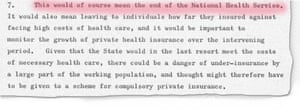
The plan commissioned by Thatcher and her chancellor Sir Geoffrey Howe included proposals to charge for state schooling, introduce compulsory private health insurance and a system of private medical facilities that “would, of course, mean the end of the National Health Service”.


Some of her cabinet ministers believed they had buried the plan, drawn up by a seconded Treasury official, Alan Bailey, from the Central Policy Review Staff (CPRS), at a special cabinet meeting on 9 September 1982.


Nigel Lawson in his memoirs said the paper of “long-term public spending options” had been buried after what he described as “the nearest thing to a cabinet riot in the history of the Thatcher administration”. In her own memoirs, Thatcher claimed to have been “horrified” by the CPRS paper and insisted that she and her ministers had never seriously considered it.


The CPRS paper had been partially leaked and she was only able to quell the subsequent furore by famously pledging the “NHS is safe with us” at the October 1982 Tory party conference. Downing Street briefed that the toxic plan had been “shelved”.


Thatcher documents ragout


Photograph: Handout

But Howe’s Treasury private office papers released by the National Archives on Friday confirm that not only had that special cabinet meeting taken place to discuss the plan but that two months later, far from being buried, Thatcher was still secretly trying to press ahead with it.


The Treasury papers show that once a clutch of tricky byelections were out of the way she was keen to keep pushing the plan and held a series of meetings in December to “to soften up the big three spenders” under her chairmanship “to resolve any immediate political anxieties”.


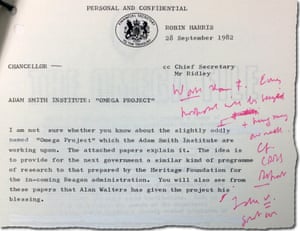
The papers also show after the 9 September cabinet showdown Howe rejected an approach from the Adam Smith Institute, the rightwing libertarian thinktank, to back their “slightly oddly-named Omega Project” despite it being personally endorsed by Thatcher’s own economic adviser, Sir Alan Walters.


The Omega Project papers said the plans were modelled on research by a rightwing US thinktank for the incoming Ronald Reagan administration. It also argued for many state services to be replaced by “more efficient alternatives from the private sector”.


Chancellor - Adam Smith Institue - Ragout from 1982


Photograph: HM Treasury

Howe rejected the approach in a note on 29 September not because he objected to their proposals to dismantle the welfare state but because he feared its “ill-researched proposals, which will be portrayed as strongly resembling our own, might prove an embarrassment”. The then chancellor added: “Every proposal will be seized on and hung (round) our necks. Cf CPRS Report. I see v. (underlined twice) great harm.”


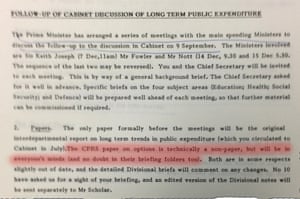
The Treasury papers show that “no real action” was taken on the CPRS “radical right manifesto” until November 1982. “The prime minister (we understand privately) did not want to stir this up before the cabinet discussions on the 1982 survey, nor risk any adverse publicity while the last two byelections were pending. The leaks of the CPRS report did not help,” a senior Treasury official, Peter Mountfield, told Howe in a confidential note entitled “Follow-up of cabinet discussion on long-term public expenditure”.


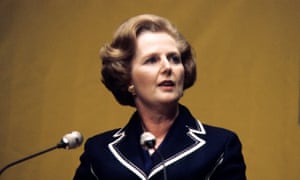
Margaret Thatcher


Margaret Thatcher secretly continued to pursue the politically explosive plans even after ministers thought they had been killed off by a cabinet revolt. Photograph: PA

“The prime minister has arranged a series of meetings with the main spending ministers to discuss the follow-up to the discussion in cabinet on 9 September. The ministers involved are Sir Keith Joseph (7 Dec, 11 am), Mr Fowler and Mr Nott (14 Dec, 9.30 and 15 Dec 5.30.). You and the chief secretary will be invited to each meeting.”


Joseph was education secretary, Norman Fowler was health secretary and John Nott was defence secretary. The CPRS paper proposed to cancel Trident and halt the growth in defence spending.


“The only paper formally before the meetings will be the original interdepartmental report on long-term trends in public expenditure … The CPRS paper on options is technically a non-paper, but will be in everyone’s minds (and no doubt in their briefing folders too),” Mountfield told Howe.


The chancellor was told the objective of the meetings was “designed to soften up the three big spenders. Without their support the operation will not work. Your main aim, I suggest, should be to ensure that no sacred cows are prematurely identified. Given the prime minister’s concern about the NHS, this may be difficult. But we want to make sure that the ministers concerned do not close off any options at this stage, and, if possible, put their personal weight behind the exercise.’’


Follow up of Cabinet Discussion of Long Term Public Expenditure - Ragout


Photograph: HM Treasury

These papers flatly contradict Thatcher’s claim that the CPRS proposals were never seriously considered by ministers. The Treasury files released on Friday do not record what happened at the meetings with the big three spenders.


But a Treasury official’s note on 28 October 1982 to the then chief secretary to the Treasury, Leon Brittan, gave an indication of the depth of internal opposition Howe and Thatcher faced. “DHSS (health and social security) officials say there is no chance that Mr Fowler would agree to a further study of this idea. I imagine in the circumstances, and especially given the prime minister’s speech at Brighton it is difficult to press them.”


In his memoirs, Howe reflects that although the row had postponed the “fundamental debate” he had hoped to start, until after the 1983 general election, “nothing from the Treasury’s point of view is ever as quite as bad as it seems”.


He reported that the impact of what he called the “CPRS furore” had ensured ministers made no new spending pledges and had “set the pace for our forthcoming 1983 manifesto”.


Thatcher pushed for breakup of welfare state despite NHS pledge