welfare etiketine sahip kayıtlar gösteriliyor. Tüm kayıtları göster

25 Kasım 2016 Cuma

Thatcher pushed for breakup of welfare state despite NHS pledge

Margaret Thatcher secretly tried to press ahead with a politically toxic plan to dismantle the welfare state even after a “cabinet riot” and her famous declaration that the “NHS is safe with us”, newly released Treasury documents show.


The plan commissioned by Thatcher and her chancellor Sir Geoffrey Howe included proposals to charge for state schooling, introduce compulsory private health insurance and a system of private medical facilities that “would, of course, mean the end of the National Health Service”.


Some of her cabinet ministers believed they had buried the plan, drawn up by a seconded Treasury official, Alan Bailey, from the Central Policy Review Staff (CPRS), at a special cabinet meeting on 9 September 1982.


Nigel Lawson in his memoirs said the paper of “long-term public spending options” had been buried after what he described as “the nearest thing to a cabinet riot in the history of the Thatcher administration”. In her own memoirs, Thatcher claimed to have been “horrified” by the CPRS paper and insisted that she and her ministers had never seriously considered it.


The CPRS paper had been partially leaked and she was only able to quell the subsequent furore by famously pledging the “NHS is safe with us” at the October 1982 Tory party conference. Downing Street briefed that the toxic plan had been “shelved”.
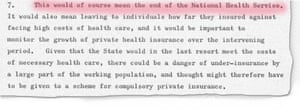


Thatcher documents ragout


Photograph: Handout

But Howe’s Treasury private office papers released by the National Archives on Friday confirm that not only had that special cabinet meeting taken place to discuss the plan but that two months later, far from being buried, Thatcher was still secretly trying to press ahead with it.


The Treasury papers show that once a clutch of tricky byelections were out of the way she was keen to keep pushing the plan and held a series of meetings in December to “to soften up the big three spenders” under her chairmanship “to resolve any immediate political anxieties”.


The papers also show after the 9 September cabinet showdown Howe rejected an approach from the Adam Smith Institute, the rightwing libertarian thinktank, to back their “slightly oddly-named Omega Project” despite it being personally endorsed by Thatcher’s own economic adviser, Sir Alan Walters.


The Omega Project papers said the plans were modelled on research by a rightwing US thinktank for the incoming Ronald Reagan administration. It also argued for many state services to be replaced by “more efficient alternatives from the private sector”.
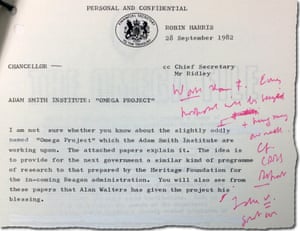


Chancellor - Adam Smith Institue - Ragout from 1982


Photograph: HM Treasury

Howe rejected the approach in a note on 29 September not because he objected to their proposals to dismantle the welfare state but because he feared its “ill-researched proposals, which will be portrayed as strongly resembling our own, might prove an embarrassment”. The then chancellor added: “Every proposal will be seized on and hung (round) our necks. Cf CPRS Report. I see v. (underlined twice) great harm.”


The Treasury papers show that “no real action” was taken on the CPRS “radical right manifesto” until November 1982. “The prime minister (we understand privately) did not want to stir this up before the cabinet discussions on the 1982 survey, nor risk any adverse publicity while the last two byelections were pending. The leaks of the CPRS report did not help,” a senior Treasury official, Peter Mountfield, told Howe in a confidential note entitled “Follow-up of cabinet discussion on long-term public expenditure”.
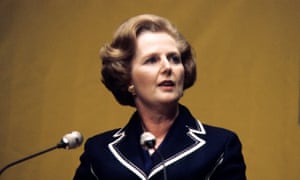


Margaret Thatcher


Margaret Thatcher secretly continued to pursue the politically explosive plans even after ministers thought they had been killed off by a cabinet revolt. Photograph: PA

“The prime minister has arranged a series of meetings with the main spending ministers to discuss the follow-up to the discussion in cabinet on 9 September. The ministers involved are Sir Keith Joseph (7 Dec, 11 am), Mr Fowler and Mr Nott (14 Dec, 9.30 and 15 Dec 5.30.). You and the chief secretary will be invited to each meeting.”


Joseph was education secretary, Norman Fowler was health secretary and John Nott was defence secretary. The CPRS paper proposed to cancel Trident and halt the growth in defence spending.


“The only paper formally before the meetings will be the original interdepartmental report on long-term trends in public expenditure … The CPRS paper on options is technically a non-paper, but will be in everyone’s minds (and no doubt in their briefing folders too),” Mountfield told Howe.


The chancellor was told the objective of the meetings was “designed to soften up the three big spenders. Without their support the operation will not work. Your main aim, I suggest, should be to ensure that no sacred cows are prematurely identified. Given the prime minister’s concern about the NHS, this may be difficult. But we want to make sure that the ministers concerned do not close off any options at this stage, and, if possible, put their personal weight behind the exercise.’’
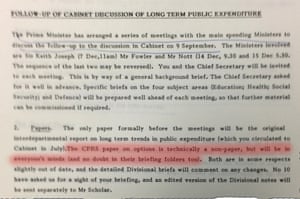


Follow up of Cabinet Discussion of Long Term Public Expenditure - Ragout


Photograph: HM Treasury

These papers flatly contradict Thatcher’s claim that the CPRS proposals were never seriously considered by ministers. The Treasury files released on Friday do not record what happened at the meetings with the big three spenders.


But a Treasury official’s note on 28 October 1982 to the then chief secretary to the Treasury, Leon Brittan, gave an indication of the depth of internal opposition Howe and Thatcher faced. “DHSS (health and social security) officials say there is no chance that Mr Fowler would agree to a further study of this idea. I imagine in the circumstances, and especially given the prime minister’s speech at Brighton it is difficult to press them.”


In his memoirs, Howe reflects that although the row had postponed the “fundamental debate” he had hoped to start, until after the 1983 general election, “nothing from the Treasury’s point of view is ever as quite as bad as it seems”.


He reported that the impact of what he called the “CPRS furore” had ensured ministers made no new spending pledges and had “set the pace for our forthcoming 1983 manifesto”.


Thatcher pushed for breakup of welfare state despite NHS pledge

20 Eylül 2016 Salı

I remember the welfare state being built. A divided Labour cannot save it | Harry Leslie Smith

As the date for the Labour conference grows closer, like dark clouds gathering on the horizon, my thoughts are focused on the social and economic injustices from our nation’s history that helped form this party’s progressive political ideology.


Come this October it will be 90 years since my eldest sister Marion was buried in a pauper’s pit on the outskirts of Barnsley. Not a day has gone by in the intervening decades when I have not thought of her miserable death from TB in a workhouse infirmary, or her ignoble burial in a mass grave for indigents because my parents, being from the working class, were too poor to afford my sister a doctor’s care.


My sister’s tragic end came at a time when Britain was ruled by a Tory government that had unleashed austerity on the citizens of Britain. Her death, and the misery I endured from poverty in the 1930s, were caused by government indifference to the plight of working-class Britain – and that politicised me to become a pragmatic socialist. I learned during the Great Depression that there can be no middle road to social or economic justice when my family, along with millions of other British citizens, were forced to live in substandard housing or slums because the government didn’t adequately tax its most affluent citizens and corporations.


Labour must end its eternal battle between its heart and its head. Both are necessary for electoral victory


It’s why since 1945 my political ideology has been fixed in orbit around the Labour party’s commitment to social democracy. So, when I was invited to speak at the Labour conference in 2014 about what life was like in Britain before the NHS, I was honoured. I was also gratified that I was finally able to give the speech I had waited a lifetime to give about the iniquities ordinary people endure if there is no social safety network to protect them.


Since then, I have spoken all across Britain to small and large crowds about how my generation struggled to build a welfare state, and how that became a tide which raised all boats from the miseries of unharnessed capitalism. But my talks were not so much about my past as about everyone else’s future, and how the younger generations must now shoulder the responsibility to maintain and preserve my generation’s legacy, the welfare state.


But for the young to make a difference and reverse years of neoliberalism that have fragmented this society and ossified their ability to prosper, the left must unite for one purpose: to defeat conservative politics that benefits the few at the expense of the many. Those of social conscience who want a nation based upon egalitarian ideals can only accomplish this if the Labour party ends its eternal battle between its heart and its head. Both are necessary for electoral victory. The warring factions in Labour must unite in a grand alliance that includes the PLP and its 500,000 enthusiastic members, as well as the millions of voters all across these islands who want a new deal.


Make no mistake: I am a fervent supporter of Jeremy Corbyn but I will not forget or ignore how I came to speak at that Labour conference in 2014. I will always be grateful to Andy Burnham, along with Ed Miliband and his office of dedicated staffers, who asked me to speak about healthcare because they believed in an NHS that is for the people and not for the benefit of hedge funds. It’s why, having met many of the members of the PLP over the past two years in every nook and cranny of this country, I can attest to their professionalism and their dedication to social justice. But in their anguish after Brexit, I believe the PLP members erred when they tried to oust a leader who had been elected less than a year earlier. I understand their frustrations just as well as those party members who are now angry at the PLP. I can see the merits to both sides in this acrimonious battle.


That’s why this year’s conference in Liverpool will be more important than even one held right before a general election. The speeches will be a window for the British electorate to see whether Labour can tell the human stories that win elections, rather than just settling old scores.


So, for those members given the great honour of addressing conference delegates – whether they support Corbyn or Owen Smith – they must remember that history is watching them and measure their words accordingly. This is not the time nor the place for the politics of revenge, but instead a time for amity. This is the time for Labour to reaffirm its commitment to forming the next government and building a compassionate Britain, where all are welcomed. The only way to do that is to get our own house in order.


I remember the welfare state being built. A divided Labour cannot save it | Harry Leslie Smith

18 Ağustos 2015 Salı

Disabled youngsters are very easily misplaced in a welfare state cut to the bone | Frances Ryan

Against the backdrop of this month’s jubilant A-level and GCSE final results, 17-year-previous Sanjeev Singh gives a various image of what it is to be younger in Conservative Britain.


In several methods, Sanjeev is a younger individual “doing the right thing”. He lives at house with his mum and 3 siblings and, because leaving school a year in the past, he has persisted in seeking for function. But Sanjeev, 17, is deaf and as soon as prospective employers know he has a disability, they really don’t get in touch with him once more. He keeps making an attempt to get interviews but, unable to travel securely alone on public transport, he has no way of receiving to them.


This is where the welfare state’s security net is meant to kick in. Disability living allowance (DLA), for instance – a benefit Sanjeev has obtained since he was 6 years previous – could pay for a taxi on the days he demands get to an interview and has no one to support him communicate with the crowds on a bus. But the government chose to change DLA with personal independence payment (PIP) and following currently being tested for the new, tougher evaluation in December, Sanjeev had his advantages stopped, soon after much more than a decade


Related: We must assist the disabled men and women dealing with imprisonment at property | Frances Ryan


Even unemployment advantage is out of his attain. There is no specific entitlement for jobseeker’s allowance for anybody below 18, in accordance to the Division for Operate and Pensions (DWP). As an alternative, it is left to regional jobcentres to arbitrarily judge if an individual is in “hardship”. Neither is Sanjeev eligible for the disability “unfit for work” benefit, employment and help allowance (ESA). As a DWP spokesperson confirmed to me this week, that advantage is only available to beneath-18s if they have not only left school but also are residing “independently”. So a teenager coping with chronic sickness or disability is expected to move out of their loved ones residence ahead of the government will take into account them for unemployment help.


Perversely, as a younger disabled jobseeker, Sanjeev has no way of knowing if he is even classed as “fit for work”. He can’t be assessed for ESA right up until he is 18 but in the meantime, have to commit yet another 12 months attempting to uncover a job no employer so far desires to give him.


This is unwinnable Britain. Where you can be outdated enough to have left college but be classed as too youthful for out-of-operate rewards. Where you can have a disability that stops you acquiring to a task interview but are not disabled sufficient to get living allowance.


What is occurring to Sanjeev sits within a wider landscape of the state’s abandonment of youthful individuals: housing benefit cuts for beneath-21s, unemployed 18- to 21-12 months-olds to be sent on instruction “bootcamps”, and the servicing grants for students from bad backgrounds abolished. Each and every policy is based mostly on the exact same assumption that each mother or father can afford to feed, clothe and residence their children into adulthood.


Latest government ideas to eliminate 18- to 22-12 months-olds’ in-perform rewards – that is tax credits to youngster advantage – will only hit disabled younger individuals and youthful dad and mom (any other below 25-12 months-outdated is not eligible). As Sam Royston, policy director at the Children’s Society, put it to me: remove assist this kind of as tax credits, and youthful disabled men and women who are moving into adulthood and needing added help will locate it significantly more difficult to get into function and to reside independently. It factors to how far fears of so-referred to as “welfare dependency” are detached from actuality. The advantage technique is not a crutch of dependency but – for any person born outside of the protection of income – often the launchpad to independence. To stamp out younger people’s housing, wages, training, unemployment, and disability assistance is to lock a entire generation – bar the wealthy – into stagnated opportunity, low incomes, and insecure work.


Sanjeev tells me he’s going to maintain hunting for function even though beginning the appeal approach to try out and get his disability advantage back. He asks if I know how to fill out the types. “I’m not receiving any assist,” he explains. “I’ll need to have to tell my mum to ring them.”


Disabled teenagers are easily lost in a welfare state lower to the bone. To be younger whilst bad or disabled is more and more to view your existence chances be pulled away.


Disabled youngsters are very easily misplaced in a welfare state cut to the bone | Frances Ryan

30 Haziran 2014 Pazartesi

Pennsylvania Governor"s Healthy PA is an ObamaCare Welfare Medicaid Growth by One more Identify

By Josh Archambault and Jonathan Ingram, Mr. Archambault is a Senior Fellow and Mr. Ingram Research Director, at the Foundation for Government Accountability.


In 2014 only a single state (NH) has expanded Medicaid, contrary to the media narrative. But a handful of red-state governors are nevertheless toying with the notion, largely calling them Healthful [insert state abbreviated name]. Contrary to the rhetoric, the ideas are not state certain as they borrow heavily from Arkansas’ Personal Selection and the Medicaid growth in Iowa. Pennsylvania Governor Tom Corbett is guilty of this.  He need to walk away from “Healthy PA” Medicaid growth in order to focus on patient-centered reform.


Governor Corbett has previously spoken persuasively about the unsustainability of the existing Medicaid plan in his state. It is clear he understands the failings of the broken status quo, and that the plan is set to expand to $ 41 billion a yr by 2022 with no Medicaid expansion. That is why it is so head scratching that he is championing his personal version of Medicaid expansion.


Image and video hosting by TinyPic

Governor Tom Corbett (R-PA) has been trying to promote his Healthful PA program, while being annoyed with how negotiations have gone with federal officials. (Photo credit: Christine Baker, The Patriot-News)


His employees need to examine the last terms and situations for Medicaid expansions in the two Arkansas and Iowa, as they would discover how weak people waivers really are. They would inform the Governor that refocusing on reform rather than expansion would not only advantage the most vulnerable citizens in his state, but assist his electoral prospective customers as effectively.


Just last month, the Washington Times editorial page slammed the Arkansas experiment, which has run in excess of budget in every single month of its operation, leading state bureaucrats to pursue a federal bailout. Pennsylvania can not afford this identical fate. It has also resulted in the architect of the strategy getting defeated in a primary by a political novice.


Expanding an unsustainable entitlement program to operating-age, in a position-bodied, largely childless adults is not how you reform Medicaid. The Governor has previously publically expressed his disappointment with federal negotiations above his waiver request, which serves to highlight how inflexible federal officials are and reveals their true priority of expansion more than reform.


Image and video hosting by TinyPic


Wholesome PA is Medicaid Growth


In February, the Pennsylvania Department of Public Welfare submitted Governor Corbett’s Medicaid growth strategy, dubbed Wholesome PA, to the federal Centers for Medicare &amp Medicaid Services (CMS) for review.


If negotiations from other states are any indication, the Obama Administration will strip Healthful PA of most of the provisions that have been utilised to sell the program to the public. But even if it moves forward as proposed, Healthful PA is little much more than ObamaCare Medicaid expansion by an additional name. Healthy PA has been sold as “common sense” Medicaid reform. Even so, it misses the mark for meaningful reform and rather creates a new Medicaid welfare entitlement for primarily capable-bodied, doing work-age childless grownups.


There has been a lot of rhetoric about Healthier PA—but here’s the actuality:


Wholesome PA won’t save cash.


Rhetoric: Wholesome PA will save Pennsylvania taxpayers $ 125 million per year.


Actuality: The bulk of the “savings” are likely to come from expense-shifting capable-bodied adults presently covered in the Common Assistance plan into the Healthy PA system. No funds is in fact saved, given that Pennsylvania taxpayers spend the two state and federal taxes.  It just signifies taxpayer bucks will run via Washington D.C. first then into Harrisburg to fund the Medicaid growth.


In addition, below Healthy PA, taxpayers will pay billions in additional taxes and lower reimbursement prices for seniors in Medicare resulting in 568, 221 Pennsylvania seniors shedding their Medicare Benefit plans in purchase to fund free of charge taxpayer-paid Medicaid for in a position-bodied adults. The state is also projected to hire an additional 700 government employees to implement Healthy PA.


Pennsylvania Governor"s Healthy PA is an ObamaCare Welfare Medicaid Growth by One more Identify

19 Ocak 2014 Pazar

The welfare culture: I see "Benefits Street" each day

A couple of weeks in the past, a person initial spat at me and then threw a chair at me, simply because I had the audacity to suggest that if he continued to inject himself with heroin every day, despite becoming in remedy for more than two many years, he should be discharged from the services and that this might have an effect on his advantages. ”They cannot stop my funds,’’ he shouted. ”I’ll just go thieving.’’


As regular readers will know, I have spent much of my profession as a doctor working with disadvantaged and disfranchised patient groups. I have worked with the mentally ill, in paediatric palliative care, geriatrics, outreach programmes, drug clinics and with the homeless. Several of these folks are desperately in want.


And this is why I become so enraged when I listen to those critics who persist in the belief that some of the individuals featured on Advantages Street are a fantasy.


Welfare paying in Britain has increased more rapidly than in practically any other nation in Europe given that 2000. It has risen from 18.6 per cent of GDP to 23.7 per cent – an improve of 27 per cent. By contrast, the regular increase in welfare paying in the OECD nations was 16 per cent.


I believe it is just and noble for a country to support its weakest members. I want pensions and welfare payments to enhance, as at the minute they barely lift individuals over the poverty line. But if we are going to do this, we have to acknowledge that there is a proportion of rewards claimants that do not deserve them a proportion for whom advantages have turn into a way of existence.


How have we got to the state whereby for some, the welfare state is no longer a safety net, but a feather-filled mattress on which to recline even though enjoying your Xbox? I am tired of seeing match and wholesome people who choose not to perform, even though there are poor, needy and desperate men and women operating tough but struggling to pay out simple payments. I’m tired of seeing young children who go to college hungry and pensioners dying of cold while there are able-bodied men and women who have by no means had a work in their daily life. I’m tired of seeing the chronically unwell consumed by poverty even though others use spurious medical complaints to play the system and continue to be on prolonged-term sickness benefit.


There is no effortless response to this issue. Jobcentres are powerless to force folks to work. Attempts to assess suitability for Disability Residing Allowance have been a disaster as the approach relies on crude and poorly validated exams.


But while there may possibly be a issue with the procedure, that doesn’t mean the sentiment is incorrect. Our opprobrium should be directed at the men and women featured on Advantages Street – not at a programme that proves that they exist.


The Very good Samaritan who made a decision not to stroll on by


Six many years ago, Jonny Benjamin, then a pupil, climbed over the railings of Waterloo Bridge and ready to leap into the swirling, icy Thames. He had not too long ago been diagnosed with schizoaffective disorder, a type of schizophrenia characterised by episodes of psychosis mixed with serious depression.


Life, he considered, was no longer really worth living. However a passer-by stopped and, somehow, persuaded him to climb back to security. The youthful man, a stranger, was on his way to operate but his determination not to stroll on by saved Jonny’s existence.


Jonny, who has gone on to have a effective career in television manufacturing and now campaigns for far better understanding of mental wellness issues, has launched a search for the man who aided him in purchase to thank him and raise awareness of mental illness. He knows practically nothing about the Very good Samaritan and so has nicknamed him ”Mike’’.


What an uplifting tale of the kindness of strangers. It reminds me of the lovely Hebrew saying: ”He who saves a lifestyle, saves the planet entire’’.


Even if Jonny in no way finds Mike, their quick encounter a single January morning is an instance of how every of us can make a distinction if we take the time to cease and speak to somebody.


Thank you, Prof Hawking


In a heartfelt tribute, Prof Stephen Hawking has, when once more, stood up for the beleagured NHS. The renowned physicist, who was diagnosed with motor neurone ailment at the age of 21, mentioned in a recording for a new documentary that he would not have survived without the care he has acquired from the well being service, which he described as ”Britain’s best public service’’.


His remarks come at a time when the NHS is below escalating strain to embrace the personal sector. Solutions are currently being cut or decreased and there is great uncertainty about the long term. It is straightforward to feel overwhelmed and undervalued, so Prof Hawking’s words are specifically welcome. Thank you!


Max Pemberton’s newest guide, ‘The Medical professional Will See You Now’, is published by Hodder. To order a copy, call Telegraph Books on 0844 871 1515


The welfare culture: I see "Benefits Street" each day