biggest etiketine sahip kayıtlar gösteriliyor. Tüm kayıtları göster

5 Mart 2017 Pazar

Friends’ pictures on social media have biggest impact on body image

Seeing friends’ carefully curated selfies on Facebook is more likely to induce feelings of guilt or shame among young women, and lead to unnecessary dieting, than images of models or celebrities they see in magazines.


Academics found that young women are more likely to compare their appearance with that of their peers’ images on social media than they were with celebrities on TV, adverts or other forms of traditional media. When they then make an unfavourable comparison with the other woman they are looking at, the impact is more pronounced when the image is on social media.


Women are also more likely to diet and do exercise when negative comparisons take place on sites such as Facebook or Instagram, the research found. The vast majority of study participants were not overweight and did not need to diet.


Researchers said the study, which will appear in March in the journal Body Image, has implications for how schools should teach young people about the influences that might affect their self-esteem.


Jasmine Fardouly, lead researcher at the centre for emotional health at Macquarie University, Sydney, said there are several reasons why social media may be more damaging than traditional media. “Celebrities may seem more distanced and their appearance may seem less attainable than people you work with or see regularly.”


The study, which questioned about 150 young women who completed five daily surveys over a five-day period, found that participants overwhelmingly considered themselves less attractive than the people they saw both online and in traditional media.


The negative impact that thin models and airbrushed adverts have on young women has been a source of concern for decades, but increasing attention is being paid to the role of social media. Around 70% of women aged 18 to 35 regularly edit their images before posting them – as do 50% of men in the same age group, according to research by the Renfrew Center Foundation, a US organisation that specialises in tackling eating disorders. Airbrushing on social media has become commonplace: Samsung users have reported that their phones default to a “beauty” mode that alters their faces and smooths out imperfections.


Last month Be Real, a national campaign, was launched to improve body confidence by providing resources to schools, as well as calling on the diet industry, media and businesses to promote different body shapes and sizes. The campaign was launched in response to a report by the all-party parliamentary group on body image which found that girls as young as five were worrying about their appearance.


Natasha Devon, the former children’s mental health champion, and co-founder of the Self-Esteem Team, said that PSHE (personal, social and health education classes in schools) – which cover topics such as body image – should be made compulsory, if these issues are to be taught properly.


Friends’ pictures on social media have biggest impact on body image

31 Ocak 2017 Salı

Biggest headache for the NHS boss is his own plan | Denis Campbell

Who would be Simon Stevens? The job he takes such pride and purpose in has recently got a lot harder. Colleagues of NHS England’s chief executive say Downing Street’s preoccupation with Brexit means officials are letting him get on with his self-declared mission of transforming the health service in England. But that is the only good news about his relationship with Theresa May and her advisers.


Until July, Stevens worked and got on well with a prime minister who did at least protect NHS funding while cutting almost everything else – David Cameron. But he now has the misfortune of dealing with May, whose curious lack of interest in the true state of the health service is almost as worrying as her capacity for self-delusion over it.


Unprecedented poor waiting times for A&E care, planned operations, ambulance responses to 999 calls and delayed transfers of care from hospital? Just normal winter pressures. Record numbers of A&E units having to divert patients elsewhere and NHS trusts being forced to declare an alert because they can’t cope? There’s only the odd problem here and there – and it’s all lazy GPs’ fault anyway. Too little money to do the job properly? The £10bn is more than the NHS asked for – an outright lie. Rarely have a prime minister and NHS boss spoken from such different scripts.


Stevens is operating in the chilliest political climate any boss of the NHS has faced since the tailend of John Major’s time in office. Will May seek to oust him? Maybe, though a vengeful Stevens publicly telling it like it is could do her incalculable damage. The sheer brio of his evidence to the public accounts committee last month – a masterclass in speaking uncomfortable truth to power – does not suggest a man who would go quietly.


But Stevens’s biggest headache is not the “winter crisis”, cancelled cancer operations or financial failure. Rather, it’s his NHS Five Year Forward View, and the lack of realisation of its ambitious goals since its launch in October 2014.


Stevens may have made bold speeches promising a brave new NHS world by 2020 through new models of care, accountable care organisations and innovative sustainability and transformation plans (STPs). But reality has failed to match rhetoric by a wide margin. Yet next month sees a “national Five Year Forward View delivery plan for the rest of the parliament” – a progress report, albeit of only limited progress.


Stevens will formally green light the metamorphoses of a small number of the 44 regional STPs into “integrated organisations”, which ultimately dissolves the split between commissioners and providers of healthcare. They will probably include those covering Birmingham and Frimley in Surrey. The cadre of belated pioneers will get extra money and staunch support to “reshape what they’re doing” in a dramatic way. He will bat away questions about what became of all the other areas’ plans – still mere “proposals”.


Stevens hopes that even the modest progress made so far in transforming the NHS will persuade May & Co that – given money and political backing – more integrated services between GPs, acute hospitals and social care will deliver an NHS that is able to cope with the pressures. But will May, bereft of her own alternative vision of the health service, see the wisdom of backing the man who dared to challenge her over it so publicly?


Biggest headache for the NHS boss is his own plan | Denis Campbell

21 Eylül 2016 Çarşamba

UN agrees to fight "the biggest threat to modern medicine": antibiotic resistance

All 193 United Nations member states are set to sign a declaration agreeing to combat “the biggest threat to modern medicine” in Wednesday’s high-level meeting on antibiotic resistance.


The agreement was reached just before the general assembly convened to discuss the threat of antibiotic resistance, which is only the fourth health issue to trigger a general assembly meeting.


“It’s ironic that such a small thing is causing such an enormous public threat,” said Jeffrey LeJeune, a professor and head of the food animal research program at Ohio State University. “But it is a global health threat that needs a global response.”


The declaration routes the global response to superbugs along a similar path as the one used to combat climate change. In two years, groups including UN agencies will provide an update on the superbug fight to the UN secretary general.


It is estimated that more than 700,000 people die each year due to drug-resistant infections, though it could be much higher because there is no global system to monitor these deaths. And there has been trouble tracking those deaths in places where they are monitored, like in the US, where tens of thousands of deaths have not been attributed to superbugs, according to a Reuters investigation.


Scientists warned about the threat of antibiotic resistance decades ago, when pharmaceutical companies began the industrial production of medicine. The inventor of penicillin, Alexander Fleming, cautioned of the impending crisis while accepting his Nobel prize in 1945: “There is the danger that the ignorant man may easily underdose himself and by exposing his microbes to non-lethal quantities of the drug make them resistant”.


But in the last few years, studies have dramatically increased awareness about antibiotic resistance. There has also been considerable advocacy by health officials, like Sally Davies, chief medical officer of the UK.


“Drug-resistant infections are firmly on the global agenda but now the real work begins,” Davies said in a statement. “We need governments, the pharmaceutical industry, health professionals and the agricultural sector to follow through on their commitments to save modern medicine.”


Signatories to the UN declaration committed to encouraging innovation in antibiotic development, increasing public awareness of the threat and developing surveillance and regulatory systems on the use and sales of antimicrobial medicine for humans and animals.


Only three other health issues have been the subject of general assembly high-level meetings: HIV/Aids, non-communicable diseases and Ebola.


Mark Woolhouse, professor of infectious disease epidemiology at the University of Edinburgh, said he was encouraged that unlike with HIV/Aids and Ebola, the UN is addressing this health crisis before it has spun out of control.


“It’s very serious indeed – it’s killing people around the world at the rate of hundreds of thousands of year and we all expect it to get worse if something isn’t done now,” Woolhouse said. “But the UN is coming in at just the right time, in a sense.”


UN agrees to fight "the biggest threat to modern medicine": antibiotic resistance

11 Ağustos 2016 Perşembe

How the World Bank’s biggest critic became its president | Andrew Rice

In a shanty town perched in the hilly outskirts of Lima, Peru, people were dying. It was 1994, and thousands of squatters – many of them rural migrants who had fled their country’s Maoist guerrilla insurgency – were crammed into unventilated hovels, living without basic sanitation. They faced outbreaks of cholera and other infectious diseases, but a government austerity program, which had slashed subsidised health care, forced many to forgo medical treatment they couldn’t afford. When food ran short, they formed ad hoc collectives to stave off starvation. A Catholic priest ministering to a parish in the slum went looking for help, and he found it in Jim Yong Kim, an idealistic Korean-American physician and anthropologist.


In his mid-30s and a recent graduate of Harvard Medical School, Kim had helped found Partners in Health, a non-profit organisation whose mission was to bring modern medicine to the world’s poor. The priest had been involved with the group in Boston, its home base, before serving in Peru, and he asked Kim to help him set up a clinic to aid his flock. No sooner had Kim arrived in Lima, however, than the priest contracted a drug-resistant form of tuberculosis and died.


Kim was devastated, and he thought he knew what to blame: the World Bank. Like many debt-ridden nations, Peru was going through “structural adjustment”, a period of lender-mandated inflation controls, privatisations and government cutbacks. President Alberto Fujimori had enacted strict policies, known collectively as “Fujishock”, that made him a darling of neoliberal economists. But Kim saw calamitous trickledown effects, including the tuberculosis epidemic that had claimed his friend and threatened to spread through the parish.


So Kim helped organise a conference in Lima that was staged like a teach-in. Hundreds of shanty town residents met development experts and vented their anger with the World Bank. “We talked about the privatisation of everything: profits and also suffering,” Kim recalls. “The argument we were trying to make is that investment in human beings should not be cast aside in the name of GDP growth.” Over the next half-decade, he would become a vociferous critic of the World Bank, even calling for its abolition. In a 2000 book, Dying for Growth, he was lead author of an essay attacking the “capriciousness” of international development policies. “The penalties for failure,” he concluded, “have been borne by the poor, the infirm and the vulnerable in poor countries that accepted the experts’ designs.”


Kim often tells this story today, with an air of playful irony, when he introduces himself – as the president of the World Bank. “I was actually out protesting and trying to shut down the World Bank,” Kim said one March afternoon, addressing a conference in Maryland’s National Harbor complex. “I’m very glad we lost that argument.”


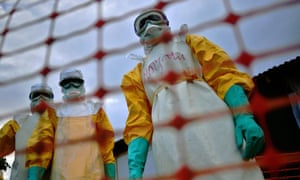
Medical staff treat people with Ebola in Kailahun, Sierra Leone, 2014.


Medical staff treat people with Ebola in Kailahun, Sierra Leone, 2014. Photograph: Carl de Souza/AFP/Getty Images

The line always gets a laugh, but Kim uses it to illustrate a broader story of evolution. As he dispenses billions of development dollars and tees off at golf outings with Barack Obama – the US president has confessed jealousy of his impressive five handicap – Kim is a long way from Peru. The institution he leads has changed too. Structural adjustment, for one, has been phased out, and Kim says the bank can be a force for good. Yet he believes it is only just awakening to its potential – and at a precarious moment.


Last year, the percentage of people living in extreme poverty dropped below 10% for the first time. That’s great news for the world, but it leaves the World Bank somewhat adrift. Many former dependents, such as India, have outgrown their reliance on financing. Others, namely China, have become lenders in their own right. “What is the relevance of the World Bank?” Kim asked me in a recent interview. “I think that is an entirely legitimate question.”


Kim believes he has the existential answers. During his four years at the bank’s monumental headquarters on H Street in Washington, he has reorganised the 15,000-strong workforce to reflect a shift from managing country portfolios to tackling regional and global crises. He has redirected large portions of the bank’s resources (it issued more than $ 61bn in loans and other forms of funding last year) toward goals that fall outside its traditional mandate of encouraging growth by financing infrastructure projects – stemming climate change, stopping Ebola, addressing the conditions driving the Syrian exodus.


Yet many bank employees see Kim’s ambitions as presumptuous, even reckless, and changes undertaken to revitalise a sluggish bureaucracy have shaken it. There have been protests and purges, and critics say Kim’s habit of enunciating grandiose aspirations comes with a tendency toward autocracy. The former bank foe now stands accused of being an invasive agent, inflicting his own form of shock therapy on his staff. “The wrong changes have been done badly,” says Lant Pritchett, a former World Bank economist.


Pritchett argues that, beyond issues of personality and style, Kim’s presidency has exposed a deep ideological rift between national development, which emphasises institution-building and growth, and what Pritchett terms “humane” development, or alleviating immediate suffering. Kim, however, sees no sharp distinction: he contends that humane development is national development – and if the bank persists in believing otherwise, it could be doomed to obsolescence.


The hardest thing to learn is mud-between-your-toes, on-the-ground development work


Jim Yong Kim


Kim likes to say that as a doctor with experience of treating the poor, his humanitarian outlook is his strongest qualification for his job – an opinion that probably vexes critics who point out that he knew little about lending before arriving at the bank. “Finance and macroeconomics are complicated, but you can actually learn them,” he says. “The hardest thing to learn is mud-between-your-toes, on-the-ground development work. You can’t learn that quickly. You can’t learn that through trips where you’re treated like a head of state. You have to have kind of done that before.”


Kim talks fast and he walks fast. Following him – a lithe, balding 56-year-old surrounded by a deferential, suited entourage – you can easily imagine him in a white coat as a physician making his rounds. He has a doctor’s diagnostic mindset too; he talks about ascertaining “the problem”, or what public-health experts call the “cause of the causes”. He thinks of poverty as an ailment and is trying to devise a “science of delivery”. It’s a philosophy built on a life-long interest in the intersection of science and humanities. Born in Seoul in 1959 to parents displaced by the Korean war, Kim emigrated to the US with his family when he was a child, eventually ending up in Muscatine, Iowa. His was one of two Asian families in the small town. His mother was an expert in Confucian philosophy, his father a dentist. Kim excelled at his studies while playing quarterback in high school. He attended Brown University in Providence, Rhode Island, where he studied human biology. His father wanted him to be a doctor, but he gravitated toward anthropology. Because Harvard let him pursue a medical degree and a PhD simultaneously, he landed there. Kim struck up a friendship with Paul Farmer, a fellow student, over shared interests in health and justice. In 1987, they formed Partners in Health.


The two came of age when the World Bank’s influence was arguably at its most powerful and controversial. Conceived along with the International Monetary Fund at the 1944 Bretton Woods conference, the bank was meant to rebuild Europe. However, it found its central mission as a source of startup capital for states emerging from the demise of colonial empires. The bank could borrow money cheaply in the global markets, thanks to the creditworthiness of its shareholders (the largest being the US government), then use that money to finance the prerequisites for economic growth – things such as roads, schools, hospitals and power plants. Structural adjustment came about in response to a series of debt crises that culminated in the 1980s. The Bretton Woods institutions agreed to bail out indebted developing states if they tightened their belts and submitted to painful fiscal reforms.


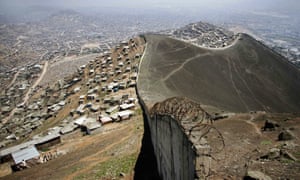
A wall dividing shanty towns and rich neighbourhoods in Lima, Peru, where Kim’s journey to the World Bank began.


A wall dividing shanty towns and rich neighbourhoods in Lima, Peru, where Kim’s journey to the World Bank began. Photograph: Oxfam/EPA

To Kim and Farmer, the moral flaw in the bank’s approach was that it imposed mandates with little concern for how cutting budgets might affect people’s health. They thought that “the problem” in global health was economic inequality, and in Haiti Partners in Health pioneered a grassroots methodology to tackle it: improve the lives of communities by training locals to provide medical care (thus creating jobs) and by expanding access to food, sanitation and other basic necessities. Though hardly insurgents – they were based at Harvard, after all – the friends passionately argued that policy discussions in Geneva and Washington needed to be informed by ground truths, delivered by the people living them.


Farmer’s impressive work ethic and pious demeanour made him famous – and the subject of Tracy Kidder’s acclaimed book Mountains Beyond Mountains – but Kim was the partner with systemic ambitions. “For Paul, the question is, ‘What does it take to solve the problem of giving the best care in the world to my patients?’” Kim says. “But he doesn’t spend all his time thinking about, ‘So how do you take that to scale in 188 countries?’” (Both men, who remain close friends, have won MacArthur Foundation “genius grants” for their work.)


Kim’s desire to shape policy landed him at the World Health Organisation (WHO) in 2003, overseeing its HIV/Aids work. The job required him to relocate to Geneva with his wife – a paediatrician he had met at Harvard – and a son who was just a toddler. (They now have two children, aged 16 and seven.) In the vigorously assertive style that would become his hallmark – going where he wants to go even if he’s not sure how to get there – Kim pledged to meet an audacious goal: treating three million people in the developing world with antiretroviral drugs by 2005, a more than sixfold increase over just two years. The strategy, in Kim’s own words, was, “Push, push, push.” The “three-by-five pledge,” as it was known, ended up being impossible to reach, and Kim publicly apologised for the failure on the BBC. But the world got there in 2007 – a direct result, Kim says, of the pledge’s impact on global-health policymaking: “You have to set a really difficult target and then have that really difficult target change the way you do your work.”


Kim left the WHO in 2006. After a stopover at Harvard, where he headed a centre for health and human rights, he was hired to be president of Dartmouth College in New Hampshire. He arrived in 2009, with little university management experience but characteristically high hopes. With the global recession at its zenith, however, Kim was forced to spend much of his time focused on saving Dartmouth’s endowment.


He hardly knew the difference between hedge funds and private equity, so a venture capitalist on the college’s board would drive up from Boston periodically to give him lessons, scribbling out basic financial concepts on a whiteboard or scratch paper. His tenure soon turned stormy as he proposed slashing $ 100m from the school’s budget and clashed with faculty members who complained about a lack of transparency. Joe Asch, a Dartmouth alumnus who writes for a widely read blog about the university, was highly critical of Kim. “He is a man who is very concerned about optics and not so concerned about follow-through,” Asch says now. “Everyone’s sense was that he was just there to punch his ticket.” Soon enough, a surprising opportunity arose.


The way Kim tells it, the call came out of the blue one Monday in March 2012. Timothy Geithner, another Dartmouth alumnus who was then the US treasury secretary, was on the line asking about Kim’s old nemesis. “Jim,” Geithner asked, “would you consider being president of the World Bank?”


When the government contacted him, Kim confesses, he had only the foggiest notion of how development finance worked. He had seen enough in his career, however, to know that running the bank would give him resources he scarcely could have imagined during his years of aid work. Instead of agonising over every drop of water in the budgetary bathtub, he could operate a global tap. “When I really saw what it meant to be a bank with a balance sheet, with a mission to end extreme poverty,” Kim says, “it’s like, wow.” His interest was bolstered by the bank’s adoption, partly in response to 1990s-era activists, of stringent “safeguards”, or lending rules intended to protect human rights and the environment in client states.


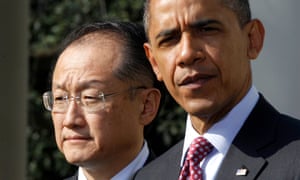
Barack Obama and Jim Yong Kim


Barack Obama nominates Kim for the presidency of the World Bank, Washington DC, 2012. Photograph: Charles Dharapak/AP

By custom, the World Bank had always been run by an American, nominated by the US president for a five-year term. But in 2012 there was a real international race for the post. Some emerging-market nations questioned deference to the United States, and finance experts from Nigeria and Colombia announced their candidacies. After considering political heavyweights such as Susan Rice, John Kerry and Hillary Clinton – who were all more interested in other jobs – Obama decided he needed an American he could present as an outsider to replace the outgoing president, Robert Zoellick, a colourless former Goldman Sachs banker and Republican trade negotiator. Clinton suggested Kim and “championed Jim as a candidate”, says Farmer. (Partners in Health works with the Clinton Foundation.)


Embedded within the dispute over superpower prerogatives was a larger anxiety about what role the World Bank should play in the 21st century. Extreme poverty had dropped from 37% in 1990 to just under 13% in 2012, so fewer countries needed the bank’s help. With interest rates at record lows, the states that needed aid had more options for borrowing cheap capital, often without paternalistic ethical dictates. New competitors, such as investment banks, were concerned mainly with profits, not safeguards. As a result, whereas the World Bank had once enjoyed a virtual monopoly on the development-finance market, by 2012 its lending represented only about 5% of aggregate private-capital flows to the developing world, according to Martin Ravallion, a Georgetown University economist. And while the bank possessed a wealth of data, technical expertise and analytical capabilities, it was hampered by red tape. One top executive kept a chart in her office illustrating the loan process, which looked like a tangle of spaghetti.


At Kim’s White House interview, Obama still needed some convincing that the global-health expert could take on the task of reinvigorating the bank. When asked what qualified him over candidates with backgrounds in finance, Kim cited Obama’s mother’s anthropology dissertation, about Indonesian artisans threatened by globalisation, to argue that there was no substitute for on-the-ground knowledge of economic policies’ impact. Two days later, Obama unveiled his pick, declaring that it was “time for a development professional to lead the world’s largest development agency”.


Kim campaigned for the job with the zeal of a convert. In an interview with the New York Times, he praised the fact that, unlike in the 1990s, “now the notion of pro-poor development is at the core of the World Bank”. He also embarked on an international “listening tour” to meet heads of state and finance ministers, gathering ideas to shape his priorities in office. Because votes on the bank’s board are apportioned according to shareholding, the US holds the greatest sway, and Obama’s candidate was easily elected. Kim took office in July 2012, with plans to eradicate extreme poverty. Farmer cites a motto carved at the entry to the World Bank headquarters – “Our dream is a world free of poverty” – that activists such as Kim once sniggered at. “Jim said, ‘Let’s change it from a dream to a plan, and then we don’t have to mock it.’”


Kim still had to win over another powerful constituency: his staff. Bank experts consider themselves an elite fraternity. Presidents and their mission statements may come and go, but the institutional culture remains largely impervious. “The bank staff,” says Jim Adams, a former senior manager, “has never fully accepted the governance.” When Robert McNamara expanded the bank’s mission in the late 1960s, doing things such as sending helicopters to spray the African black fly larvae that spread river blindness, many staffers were “deeply distressed to see the institution ‘running off in all directions’”, according to a history published in 1973. When James Wolfensohn arrived in the mid-1990s with plans to move away from structural adjustment and remake the bank like a consulting firm, employees aired their gripes in the press. “Shake-up or cock-up?” asked an Economist headline. Paul Wolfowitz, whose presidency was marred by leaks, was pushed out in 2007 after accusations of cronyism resulted in a damning internal investigation.


Recognising this fraught history, Kim went on a second listening tour: he met representatives of every bank department and obtained what he describes, in anthropologist-speak, as “almost a formal ethnography” of the place. What he lacked in economic knowledge, he made up for in charm. “Dr Kim is personable, Dr Kim is articulate, Dr Kim looks very moved by what he has to say,” says Paul Cadario, a former bank executive who is now a professor at the University of Toronto.


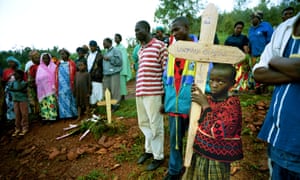
The funeral of a woman who died of Aids on the outskirts of Kigali, Rwanda.


The funeral of a woman who died of Aids on the outskirts of Kigali, Rwanda. Photograph: Sean Smith for the Guardian

The initial goodwill, however, vanished when Kim announced his own structural adjustment: a top-to-bottom reorganisation of the bank. It wasn’t so much the idea of change that riled up the staff. Even before Kim took office, respected voices were calling for a shakeup. In 2012, a group of bank alumni published a report criticising an “archaic management structure”; low morale was causing staff turnover, and there was an overreliance on consultants, promotion on the basis of nationality, and a “Balkanisation of expertise”. Where Kim went awry, opponents say, was in imposing his will without first garnering political support. “One famous statement is that the World Bank is a big village,” says Cadario, now a Kim critic. “And if you live in a village, it is a really bad idea to have enemies.”


The bank had been designed around the idea that local needs, assessed by staff assigned to particular countries and regions, should dictate funding; cooperation across geographical lines required internal wrangling over resources. So Kim decided to dismantle existing networks. He brought in the management consulting firm McKinsey & Co, which recommended regrouping the staff into 14 “global practices”, each of which would focus on a policy area, such as trade, agriculture or water. Kim hired outsiders to lead some departments and pushed out several formerly powerful officials with little explanation. To symbolise that he was knocking down old walls, he had a palatial, wood-panelled space on the World Bank’s executive floor retrofitted as a Silicon Valley-style open-plan office, where he could work alongside his top staff.


Kim also announced that he would cut $ 400m in administrative expenses, and eliminate about 500 jobs – a necessary measure, he said, because low interest rates were cutting into the bank’s profits. Kim says he “made a very conscious decision to let anyone who wanted… air their grievances.” His opponents detected no such tolerance, however, and their criticisms turned ad hominem. Around Halloween in 2014, a satirical newsletter circulated among the staff, depicting Kim as Dr Frankenstein: “Taking random pieces from dead change management theories,” it read, “he and his band of external consultants cobble together an unholy creature resembling no development bank ever seen before.” Anonymous fliers attacking Kim also began to appear around bank headquarters.


Kim portrayed internal dissent as a petty reaction to perks such as travel per diems being cut. “There’s grumbling about parking and there’s grumbling about breakfast,” he told the Economist. Meanwhile, bank staffers whispered about imperial indulgences on Kim’s part, such as chartering a private jet. (Kim claims this is a longstanding practice among bank presidents, which he only uses when there are no other options.)


A French country officer named Fabrice Houdart emerged as a lead dissenter, broadcasting his frustrations with Kim in a blog on the World Bank’s intranet. In one post, he questioned whether “a frantic race to show savings… might lead to irreversible long-term damages to the institution.” (This being the World Bank, his sedition was often illustrated with charts and statistics.) The staff went into open rebellion after Houdart revealed that Bertrand Badré, the chief financial officer, whom Kim had hired and who was in charge of cutting budgets, had received a nearly $ 100,000 bonus on top of his $ 379,000 salary. Kim addressed a raucous town hall meeting in October 2014, where he told furious staffers, “I am just as tired of the change process as all of you are.”


A few months later, Houdart was demoted after being investigated for leaking a privileged document. The alleged disclosure was unrelated to Kim’s reorganisation – it had to do with Houdart’s human rights advocacy, for which he was well known at the bank – and Kim says the investigation began before Houdart’s denunciations of his presidency. Critics, however, portray it as retaliatory. “Fabrice has become a folk hero,” Cadario says, “because he was brave enough to say what many of the people within the bank are thinking.” (Houdart is currently disputing his demotion before an internal administrative tribunal.)


In the heat of the staff revolt, Kim was devoting attention to a very different crisis: Ebola


“It’s never fun when large parts of the organisation are criticising you personally,” Kim admits. Yet he maintains that his tough decisions were necessary. “In order to do a real change, you have to put jobs at risk,” he says. “And completely understandably, people hate that.”


In the heat of the staff revolt, Kim was devoting attention to a very different crisis: Ebola. In contrast with the bank’s historically cautious, analytical approach, Kim was pushing it to become more involved in emergency response. He committed $ 400m to confront the epidemic immediately, a quarter of which he pushed out in just nine days. He dispatched bank employees to afflicted west African countries and reproached the head of the WHO for the organisation’s lack of urgency. “Rather than being tied up in bureaucracy, or saying, ‘We don’t do those things,’ Jim is saying that if poor people’s lives are at risk… then it is our business,” says Tim Evans, whom Kim hired to run the bank’s new global practice for health.


Some bank veterans disagreed, vehemently. Nearly two years on, they still worry that in trying to save the day, Kim runs the risk of diverting the bank from its distinct mission. “Pandemic response is important – but it’s not the WHO, it’s the World Bank,” says Jean-Louis Sarbib, a former senior vice-president who now runs a nonprofit development consultancy. “I don’t think he understands the World Bank is not a very large NGO.” Referencing Kim’s work with Partners in Health, Sarbib adds, “The work of the World Bank is to create a system so that he doesn’t need to come and create a clinic in Haiti.”


In reply to this critique, Kim likes to cite a study co-written by a former World Bank economist, Larry Summers, that found that 24% of full-income growth in developing countries between 2000 and 2011 was attributable to improved public health. Put simply, Kim says, pandemics and other health deficits represent enormous threats to economic development, so they should be the World Bank’s business. The same goes for climate change, which the bank is fighting by funding a UN initiative to expand sustainable energy. As for violent conflicts, rather than waiting until the shooting has stopped and painstakingly preparing a post-conflict assessment – as the bank has done in the past – Kim wants to risk more capital in insecure zones.


“We… bought into this notion that development is something that happens after the humanitarian crisis is over,” Kim said at a recent event called the Fragility Forum, where he sat next to representatives of various aid groups and the president of the Central African Republic in the World Bank’s sun-soaked atrium. “We are no longer thinking that way.”


After the forum, amid a whirlwind day of meetings and speeches, Kim stopped at a hotel cafe with me to unwind for a few minutes. As a counterweight to his life’s demands, he practices Korean Zen-style meditation, but he also seems to blow off steam by brainstorming aloud. Goals and promises came pouring out of him like a gusher. Besides eliminating extreme poverty, which he has now promised will be done by 2030, Kim wants to raise incomes among the bottom 40% of the population in every country. He also wants to achieve universal access to banking services by 2020.


Long past our allotted interview time, Kim told me he had just one more idea: “Another huge issue that I want to bring to the table is childhood stunting.” At the Davos World Economic Forum this year, he explained, everyone was chattering about a “fourth industrial revolution”, which will centre on artificial intelligence, robotics and other technological leaps. But Kim thinks whole countries are starting out with a brainpower deficit because of childhood malnutrition. “These kids have fewer – literally fewer – neuronal connections than their non-stunted classmates,” he said. “For every inch that you’re below the average height, you lose 2% of your income.”


“This is fundamentally an economic issue,” he continued. “We need to invest in grey-matter infrastructure. Neuronal infrastructure is quite possibly going to be the most important infrastructure.”


To World Bank traditionalists, addressing nutrition is an example of the sort of mission creep that makes Kim so maddening. Despite its name and capital, the bank can’t be expected to solve all the world’s humanitarian problems. (“We are not the UN,” is an informal mantra among some staffers.) Poor countries may well prefer the bank to stick to gritty infrastructural necessities, even if Kim and his supporters have splashier goals. “The interests of its rich-country constituencies and its poor-country borrowers are diverging,” Pritchett says. “It’s like the bank has a foot on two boats. Sooner or later, it’s going to have to jump on one boat or the other, or fall in the water. So far, Jim Kim is just doing the splits.”


The World Bank headquarters in Washington.


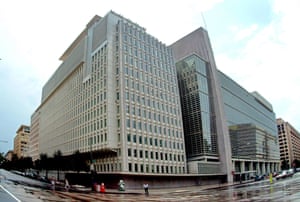
The World Bank headquarters in Washington. Photograph: Lauren Burke/AP

Kim’s defenders insist the bank hasn’t abandoned its core business. In fact, as private investment in emerging markets has contracted recently, due to instability in once-booming economies such as Brazil, countries have found more reasons to turn to the World Bank. Its primary lending unit committed $ 29.7bn in loans this fiscal year, nearly doubling the amount from four years earlier. “There is so much need in the world that I’m not worried we’re going to run out of projects to finance,” Kim says. He also hopes the worst of the tumult within the bank is over. A few elements of his reorganisation have been scaled back; after the new administrative structure proved unwieldy, the 14 global practices were regrouped into three divisions. Some of his more polarising hires have also left.


A five-year term, Kim says, is hardly sufficient to implement his entire agenda, and he has conveyed his desire to be reappointed in 2017. Though internal controversies have been damaging, and America’s domination of the bank remains a source of tension, the next US president (quite possibly Kim’s friend Hillary Clinton) will have a strong say in the matter. If he keeps his job, Kim wants to show that the World Bank can serve as a link between great powers and small ones, between economics and aid work – retaining its influence as old rules and boundaries are erased and new ones are scribbled into place.


Kim thinks he can succeed, so long as he keeps one foot rooted in his experiences as a doctor with mud between his toes. But he also wants to share his revelations about capital with his old comrades. “I really feel a responsibility to have this conversation with development actors who, like me 10 years ago, didn’t really understand the power of leverage,” Kim says with a guileless air.


“God,” he adds, “it is just such a powerful tool.”


• This article first appeared in Foreign Policy magazine.


• Follow the Long Read on Twitter at @gdnlongread, or sign up to the long read weekly email here.


How the World Bank’s biggest critic became its president | Andrew Rice

9 Ağustos 2016 Salı

Young men and body image: what are your biggest fears and insecurities?

Body image issues are typically seen to mainly affect young women, but a survey by an advertising think-tank has found young men can have just as many insecurities.


The survey by Credos of more than 1,000 secondary-school aged students, found 56% saw eating disorders as an issue for both genders and 55% would consider changing their diet to look better. What’s more, 23% said they believed there was a “perfect male body”.


Despite this, over half of those surveyed found it hard to talk about their concerns with teachers – and 29% struggled telling parents. The biggest influences on young men to look good come from friends, social media, advertising and celebrities, according to the survey.


We want to hear from young men about this, sharing with us your biggest worries and concerns. Do male teens focus on this issue just as much as girls? What is the “perfect male body” in your eyes? How much time do you spend exercising and dieting?


Share your experiences and views with us in the form below – and we will use responses for an article that will appear online.


As this is a sensitive topic, please be reassured that we will not share or publish any personal details without obtaining contributors’ permission first. You have to be over 16 to take part.


Young men and body image: what are your biggest fears and insecurities?

Social care professionals: what is your biggest fear?

It’s no secret that the social care sector is under huge pressure and staff are expected to juggle never-ending caseloads.


When the most vulnerable make the news, from people living with severe mental health problems or children who suffer at the hands of violent parents, they will probably be known to the social care system.


Social care professionals, social workers and carers can’t be with service users all the time, so what measures do you put in place for when you’re not there? What do you worry might happen in your absence?


Perhaps it’s the woman with dementia who you worry will accidentally start a fire at home, or maybe it’s the mother who can’t leave her violent partner, or that child with mental health problems who can’t access the care they need to keep them safe?


We want to hear from foster parents, carers, social workers, occupational therapists and peer support workers about your biggest fears.


Share your worries by filling in the form below. We’ll use a selection in our reporting.


Social care professionals: what is your biggest fear?

1 Temmuz 2014 Salı

John Ashton: "Inequality is our biggest challenge" | Denis Campbell

When the British Healthcare Journal recently asked John Ashton to describe himself in three phrases, the president of the Uk Faculty of Public Overall health, chose “visionary, outspoken, impatient”. An hour in his organization confirms all 3 traits, and “loquacious” and “political” have to have been close contenders for inclusion also. If garrulousness was an Olympic sport, he would have a gold medal. His solutions routinely but engagingly veer way off-subject, and grow to be element historical past tutorial, element individual story and portion refreshingly authentic diagnosis of the nation’s most pressing overall health ills – many of which, in his view, are not healthcare in origin.


Asked to determine the country’s most significant public well being difficulties Ashton does not cite obesity, smoking or alcohol. “One is the increasing inequalities in people’s position, income and manage in excess of their lives more than the last twenty or thirty many years. Tons of individuals are becoming left behind. Outside the wealthy parts of the country people are living miserable, quick lives, with a good deal more sick-wellness than men and women in the far more advantaged components of the country.


“Becoming a northerner, I am aware that a lot of individuals in the more advantaged components of the south-east have no awareness at all of what individuals are up against in some other components of the country. I’m speaking about men and women on the west coast of Cumbria or in parts of north Liverpool or east Manchester where nobody’s worked for two or 3 generations, they can’t put meals on the table and the youngsters can not take element in school trips, so individuals young children are expanding up as 2nd-class citizens relative to other young folks”, he stresses. All this matters, he adds, because of the massive distinctions in daily life expectancy among rich and bad up to a decade among Glasgow and Surrey, for example.


Ashton’s instruction in psychiatry before he turned to public overall health emerges when he talks, with the two passion and disappointment, about what he says is the expanding burden of mental sick-well being. He blames that on a disparate list including the “intransigent” epidemic of obesity that can be each a result in of and impact of depression, addictive behaviours, the changing roles in male-female relationships and the escalating sexualisation of young people, particularly girls.


“The condition of grownup males is of increasing concern due to the fact suicide has been going up in working-age men, specially the below-40s. There is something in the dramatically changed place of males in society vis-a-vis females and vis-a-vis the labour marketplace that is affecting men’s self-esteem and self-self-confidence as a consequence of this dislocation, with the reduction in their traditional role as breadwinners”, he says.


His main worry, although, is young individuals. Rising divorce costs, residing away from your loved ones, a lack of help for parents, widespread youth unemployment, and fact that “bringing up young children is a really lonely business” are all creating young children and younger men and women who, uncertain of their location in the globe, are increasingly troubled, he says.


“We’ve acquired youthful men and women who are self-harming, whose lifestyles will consequence in troubles later on in life – the alcohol, the drugs, the lack of self-esteem – but our kid and adolescent mental well being solutions are a disgrace. They are in crisis. We’re not stopping difficulties in young individuals and we’re not responding to them when they get them. Folks can not get witnessed, even when they are genuinely sick”.


The FPH’s annual conference, which commences nowadays in Manchester, involves a debate on what public wellness experts can do to tackle the objectification of youthful men and females, notably the latter, by means of clothes, music, specially promotional video clips, the pornography industry and the media.


“The fact that a third of ladies have now had sex by the time they are 13 is element of a sexualised culture that can often be adverse in final result, such as pregnancy and disease, but can also be measured in its impact on psychological health”, says Ashton.


He bemoans that National Institute for Overall health and Clinical Excellence tips on sex schooling for youthful men and women have gathered dust on schooling secretary Michael Gove’s desk given that 2010.


“Classroom teachers will tell you that boys are hunting at pornography on their iPhones at the age of eleven,twelve and 13. This is where they are receiving their intercourse data from, because we’re not offering them correct intercourse and relationships education.”


If only credit card companies this kind of as Visa would, on ethical grounds, cease allowing clients to shell out for porn with their cards, the multibillion pound business would no longer be so capable to do its damage, Ashton suggests.


He is effortlessly the most colourful of the senior physicians at the helm of the health care royal colleges and their constituent groups. (The FPH represents 3,300 public wellness specialists across the Uk operating in the NHS, academia, NGOs and English neighborhood government). That’s partly because no other health care large cheese would ever dress in a pink shirt, pink stripy tie and cream jacket, but also because he speaks his thoughts to a degree his peers may take into account reckless.


The Liverpool-born Labour party stalwart is an virtually identikit leftwing public wellness physician, describing his politics as “pragmatically radical”, although he surprisingly names Denis Healey alongside Tony Benn and Ken Livingstone as politicians he admires.


The Sunday Occasions was wrong to report last 12 months that he supports reducing the age of consent from 16 to 15, he insists. What he actually stated, he maintains, is that if Britain does not tackle the roots of “early sexualisation”, then legalising intercourse at 15 might be needed.


Ashton is not shy about detailing unconventional suggestions. “When you search at the way we lead our lives, the anxiety folks are underneath, the strain on time and sickness absence, mental health is plainly a significant situation. We ought to be moving in the direction of a four-day week simply because you have acquired a proportion of men and women who are functioning too challenging and a proportion that haven’t acquired jobs. The lunch-hour has gone individuals just have a sandwich at their desk and carry on functioning”, he explains.


“So we want a four-day week so that folks can take pleasure in their lives, have more time with their families, and maybe minimize high blood stress simply because folks might commence doing exercises on that further day. It would suggest that men and women may well smile a lot more and be happier and increase general overall health.”


Age 67.


Lives Cumbria.


Household Married 4 sons, two stepsons.


Education Quarry Financial institution large college, Liverpool Newcastle-upon-Tyne healthcare college London College of Hygiene and Tropical Medication (LSHTM).


Job 2013-current: president, Faculty of Public Health 2006 -13: director, public health (PH)/county healthcare officer (MO), Cumbria 1993-2006: North West regional director, PH/MO 1993-94: regional director, PH/MO, Mersey Regional Health Authority 1990-93: director, Liverpool Public Overall health Observatory 1983-93: senior lecturer/professor, public overall health, University of Liverpool 1980-82: senior lecturer, LSHTM 1975-79: senior registrar, lecturer, University of Southampton 1971-75: principal/registrar/SHO, Newcastle on Tyne &amp Northumberland 1970-71: property surgeon, Newcastle hospitals.


Public life Chairs in various health-related colleges and universities. CBE for outstanding services to the NHS.


Interests Smallholding, walking, cycling, Liverpool FC.


John Ashton: "Inequality is our biggest challenge" | Denis Campbell

23 Haziran 2014 Pazartesi

Coalition faces huge strike as biggest unions ballot council workers

Unions strike Dave Prentis

Unison leader Dave Prentis said the action could be greater than the 1926 common strike if employees voted for it. Photograph: Paul Faith/PA Wire/Press Association Pictures


The government is this week dealing with up to the prospect of the greatest strike because the coalition came to workplace amid developing anger over spend restraint in the public sector.


The UK’s most significant trade unions are balloting hundreds of 1000′s of council employees in England and Wales in protest at an provide worth one% for most staff.


Unison will announce the outcome of its ballot on Monday, followed by GMB and Unite above the subsequent week.


The Public and Business Companies union is also balloting its members for a strike in a lengthy-running dispute above cuts in the civil support, with the result due by the end of the month.


If workers vote yes, there will be a 1-day strike on ten July, which the Unison leader, Dave Prentis, has predicted could be greater than the 1926 basic strike.


Members of the National Union of Teachers will also take industrial action on 10 July, while firefighters in England and Wales have staged a series of walkouts in excess of pensions in the previous yr and have not ruled out even more stoppages.


Midwives in England could also quickly be balloted for industrial action in protest at the government’s choice not to accept a advisable 1% across-the-board pay rise for NHS employees.


Thousands of midwives and maternity support staff are getting consulted on whether they want a formal ballot for action.


Jon Skewes of the Royal School of Midwives explained: “Midwives are really angry that the government said to them they’d get a 1% pay out rise but now only employees at the top of their pay out scales will get that rise, and it truly is not consolidated into their pay out.


“Jeremy Hunt has picked out wellness workers for harsher treatment method on spend than anybody else in the public sector.


“This is the time for midwives to get a stand since the government is intent on assaulting their shell out and conditions.”


Other well being unions are warning of ballots for industrial action, which could lead to a second wave of public-sector strikes in the autumn.


At the opening of the annual conference of the transport union RMT in Bristol, the acting standard secretary, Mick Income, reinforced calls for co-ordinated action towards cuts and the threat to jobs and operating problems.


He said: “This is the very first RMT AGM given that the death of our standard secretary, Bob Crow, but the fighting, militant organisation that was constructed underneath Bob’s leadership remains in area, as we have proven in a wave of latest disputes from London Underground to Heathrow Express and in ongoing campaigns to defend our members’ jobs, spend and functioning circumstances.


“RMT has lengthy argued for a policy of co-ordinated and generalised strike action that unites every single group of staff threatened with the cosh of austerity and it is encouraging to see that that position is gaining traction the length and breadth of the trade union motion.”


Coalition faces huge strike as biggest unions ballot council workers

20 Mayıs 2014 Salı

Uk launches biggest research of mobile mobile phone effects on children"s brains

The Department of Well being has commissioned the world’s biggest study into the effects of mobile phones’ radio waves on childrens’ brains, nine many years following a government study said children must only use mobile phones when “totally essential”.


The Review of Cognition, Adolescents and Mobile Phones (Scamp) will examine about 2,500 schoolchildren at the ages of 11 and 12, acquire data about how they use the phones and how a lot time they invest on them, and assess them two many years later on on psychological functions such as memory and consideration, which carry on to produce into the teenage years.


Even though no review has ever shown damaging effects from the minimal-power radio waves, known as “non-ionizing radiation”, produced by mobile phones, almost all have targeted on grownups.


The final suggestions on childrens’ use of mobile phones came in the Stewart report in January 2005, in which Sir William Stewart suggested that as a precaution kids under eight ought to not use mobile phones at all, and that older youngsters must use it for texting rather than voice calls.


Since then ownership of mobile phones has continued to rise: an estimated 70% of eleven- to 12-12 months-olds in the Uk now own a mobile phone, increasing to 90% by age 14.


The Scamp examine will be led by Dr Mireille Toledano, of the faculty of medication at Imperial College, who has written papers on investigations into claims of cancer back links among minimal-energy emissions from mobile phones and from power lines.


The Scamp review was commissioned by the Department of Overall health through the Analysis Initiative on Well being and Mobile Telecommunications, which is funded jointly by the government and mobile mobile phone operators.


Toledano stated: “This guidance to mother and father is based mostly on the precautionary principle, provided in the absence of obtainable evidence, and not simply because we have proof of any damaging results.


“As mobile phones are a new and widespread technological innovation central to our lives, carrying out the Scamp examine is important in order to offer the evidence base with which to inform policy and by way of which parents and their kids can make informed lifestyle options.


“By assessing the youngsters in yr 7 and yet again in 12 months 9 we will be in a position to see how their cognitive abilities create in relation to changing use of mobile phones and other wireless technologies.”


The study will by its nature include some examination of the impact of Wi-Fi capability, offered that several young children now use smartphones – which have a tendency to have larger SAR (specific absorption charge) values, a measure of how a lot electromagnetic radiation is absorbed by the body during use, than older mobile phones.


But even that picture is challenging since older phones have a tendency only to use GSM technologies, which emits a lot more radiation than the 3G engineering of newer phones.


Recent Uk health tips, based on the 2005 Stewart report, say kids beneath 16 ought to be encouraged only to use mobile phones for vital calls, and the place attainable to use a hands-free of charge kit or to send text messages. When they do have to make calls, they are suggested to maintain them brief.


Regardless of there becoming no convincing proof that mobile phones impact grownup well being, authorities have hypothesized that young children could be far more vulnerable to any results due to their developing nervous techniques and thinner skulls, which soak up larger ranges of radio power.


Professor Patrick Haggard, deputy director of the Institute of Cognitive Neuroscience at University University London and chairman of the Scamp steering committee, explained it was crucial to have a properly-funded, large-scale review. “It has taken a extended time to get to this. A longitudinal research, which seems to be at a whole lot men and women, is far better but a lot more high-priced and difficult to set up.”


A great deal of earlier scientific studies were also modest to rule out likelihood effects, he mentioned. “It truly is great that the Uk is leading in this. I hope that the public, parents and kids are ready to give generously of their time.”


The Globe Well being Organisation (WHO) has ranked forward-hunting studies of the effects of mobile phones on children and adolescents as a “highest priority analysis want”, but to date there are only two research, each in Europe, focusing on childhood cancers and mobile mobile phone use. 1 has reported no association and the other is ongoing.


Co-investigator Professor Paul Elliott, director of the MRC-PHE Centre for Atmosphere and Health at Imperial School, explained: “Scientific proof offered to date is reassuring and shows no association amongst publicity to radio frequency waves from mobile phone use and brain cancer in grownups in the quick term (significantly less than 10 years of use). But the evidence obtainable concerning lengthy term heavy use and children’s use is constrained and less clear.”


Another examine, called Cosmos, which has a United kingdom arm funded by the Department of Health, is at present investigating the attainable extended-phrase health results of mobile phones on 290,000 adult users in excess of a period of twenty to 30 years. The most current research on this topic was carried out in Australia from 2006-7 with 250 participants, and published in 2010. It found no statistical result.


Toledano said: “Scamp will complement this other investigation by focusing on the ongoing growth of cognitive functions in the brain for the duration of adolescence.


“Cognition is essentially how we believe how we make selections and how we method and recall data. It is linked to intelligence and educational achievement and kinds the constructing blocks of the progressive and imaginative likely of each and every personal and for that reason society as a whole.”


Youngsters volunteering for the review will undertake classroom-primarily based computerised tasks made to measure cognitive skills that underpin functions this kind of as memory and consideration. Collectively with their parents, they will also reply concerns about their use of mobile phones and other devices, wellbeing and way of life.


Toledano additional: “Taking part in Scamp is a amazing possibility for schools to deliver ‘live’ science into their classrooms, demonstrate youngsters how we perform overall health research and, over all, for colleges, pupils and mothers and fathers to make a real contribution to the wellness of recent and future generations.”


Uk launches biggest research of mobile mobile phone effects on children"s brains

1 Mayıs 2014 Perşembe

MyFitnessPal Starts Tracking Methods To Expand The World"s Biggest Nutrition Database


Latest hype about healthcare tech has been more than wearable fitness trackers, but an arguably much more impactful way to be healthful and shed fat is to track eating habits, something you can already do with a smartphone alone. MyFitnessPal, one of the initial mobile apps to track foods intake, is set to broaden its support to track activity too, marking a direct challenge to the software supplied by wearable products like Fitbit and Jawbone and an attempt to produce 1 of the first, complete windows into a person’s health.


MyFitnessPal says it will track fitness action via a feature referred to as Actions, and while the attribute will sync with information that comes in from wearable products like the Fitbit and Jawbone UP, it will also track steps directly by means of the iPhone 5S. The app is taking advantage of the phone’s M7 chip, which is powerful and effective adequate to continuously track action without having draining the phone’s battery.


MyFitnessPal’s founder and CEO Mike Lee, who wears a black Fitbit Flex on his wrist, hopes to make activity monitoring on his app operate with other smartphones too. He notes the obvious overlap of his app with Fitbit’s, which also tracks nutrition intake, but adds that “a good deal of people favor ours. Our consumers want to be capable to see all that information inside of our app.”


Lee has spent the final final 9 years creating up an huge sum of data based on what his much more-than 50 million registered customers contribute to the app. “We have the largest database that is ever existed of what men and women eat,” says Lee. “There’s never ever been one thing like this.”


Well being care companies and researchers have naturally come knocking at his door in a bid to gain accessibility to that data, but Lee claims to be “very protective” of it and is holding back for now. Whilst other fitness apps have open APIs for information sharing, MyFitnessPal’s is private and demands a formal partnership for that data to be unlocked.


There is an argument that as smartphones develop far more sophisticated sensors like the Samsung Galaxy S5’s finger-print sensor and heart price check, they’ll send wearable fitness trackers like the Fitbit towards obsolescence. Smartphones did the identical for in-auto navigation, following all, following the short-lived reputation of TomToms and Garmins.


Lee says it’s as well early to make a bet on form factors both way, since men and women really do not often have their phones on their bodies, and wearables have the advantage of sensors that could, more and more, measure issues like heartbeat and sweat articles at all occasions.


“The sum of information you have available to you is going to grow exponentially,” he adds. “What’s fascinating is what you can do with that data in the long term.”


Over time, Lee hopes to find a spot for his support in the healthcare area. Fitness apps and wearable units usually fit into the so-called consumerization of well being care trend, exactly where providers hope to consider a bite out of the $ two.3 trillion overall health care industry and shell out a position in that prolonged span of time amongst doctor’s visits.


Lee sees his support as an “incredibly powerful” way to bridge the data gap among consumers and their overall health care companies. A future services that ties in with healthcare “would have to be permission primarily based,” he adds, but such functions are already being mapped out and MyFitnessPal has an API that allows users to connect to specific healthcare suppliers. “We’d be interested in including a health-related companion,” he says.


That could be 1 likely route to creating money. For now, MyFitnessPal derives revenue totally from marketing ad room on its app with the help of mobile ad networks. The startup, which was bootstrapped for most of its existence till an $ 18 million funding round led by Kleiner Perkins last year, was actually profitable for a even though, Lee says. Nonetheless investments in hiring for roles like data science to boost its analytics offerings, have pushed it into the red more not too long ago.


Lee began MyFitnessPal nine years ago as a desktop app when he and his then-fiancee were striving to shed a few pounds ahead of their beach wedding ceremony. When his trainer told him to start counting his calories on paper, Lee created a world wide web application that permitted him to do it on a personal computer alternatively. The services grew to become an iPhone app in early 2009.


These days it’s 1 of many cost-free, excess weight-reduction apps that have challenged paid-for dieting stalwarts like Jenny Craig and Fat Watchers, the two of whom have suffered share drops in excess of the last year or so as a result.


A lot of of these cost-free apps, like MyFitnessPal, RunKeeper and Runtastic, cross reference information with 1 an additional via open APIs to support them scale up. More than time however, some might select to quit sharing data in a bid to create single platforms that end users go to for a holistic see of their overall health and activity. This looks to be the street MyFitnessPal is going down with its private API and now, the inclusion of steps tracking.


The app’s announcement is also interestingly timed, coming a day right after Facebook unveiled the new behind-the-scenes network that connects mobile apps by means of a user’s Facebook ID. With it, users will soon be in a position to log into apps “anonymously.”


The thought is that this will motivate more people to use Facebook as an identifier amongst third-celebration providers.


For an app like MyFitnessPal which may at some point partner up with healthcare providers, a ubiquitous ID program like Facebook’s could make that simpler. But Facebook and MyFitnessPal will want to obtain scale, and far more importantly the believe in, of users to consider that following stage.


MyFitnessPal Starts Tracking Methods To Expand The World"s Biggest Nutrition Database